❌

Reading view

Study Finds: Scientists Built Cancer Kill Switch That Turns On With Flash Of Light

Photonics influences cell behavior by using light. Technocrats have discovered that many cells, or genetically modified cells, express light-sensitive proteins (opsins, rhodopsins) that open or close ion channels when illuminated, changing membrane potential and firing patterns. In neurons, this directly controls excitability, synaptic transmission, and network dynamics on millisecond timescales. ⁃ Patrick Wood, Editor.

Cancer has a dirty trick: it can put itself to sleep. When tumor cells slip into a kind of biological hibernation, they become hard to kill, shrugging off treatment and lying low until conditions improve, then waking up and bringing the disease back. For decades, researchers have struggled to shut down this hiding strategy without causing serious harm elsewhere in the body. A team in Switzerland has now built a molecule that flips on and off with flashes of light, giving scientists a precise new way to probe, and possibly disrupt, the way sleeping cancer cells hide.

Behind this cellular sleep state, at least in certain cancers, sits a protein called the glucocorticoid receptor, a sensor inside cells that reacts to stress hormones. When it switches on, it can push cancer cells, especially in some solid tumors such as lung cancer, into a drug-resistant, dormant state. The obvious fix would be to destroy the receptor outright, but there is a catch: the same receptor does important jobs all over the body, including calming inflammation. Removing it everywhere would cause real damage. What was needed was a way to hit the receptor inside a tumor and leave the rest of the body alone.

That is what the team set out to build. Their solution, described in the journal Proceedings of the National Academy of Sciences, is a class of molecules called photoPROTACs: drug-like compounds engineered to destroy the stress hormone receptor, but only when a specific color of light switches them on. Shine the right light on them, and they go to work. Keep them in the dark, and they stay idle.

A Kill Switch for a Stress Hormone Receptor

It helps to know what a PROTAC is. A PROTAC is a molecule that grabs onto a specific protein inside a cell and tags it for destruction by the cell’s own waste-disposal system. It works like slapping a “delete me” sticky note on an unwanted protein. PROTACs have stirred huge excitement in medicine because they can eliminate proteins that ordinary drugs cannot touch.

Conventional PROTACs have a problem: they are always on. Once taken, they work throughout the entire body, destroying their target in cancer cells and healthy cells alike. For a receptor this important to normal health, that is a dealbreaker.

To get around it, the team embedded a light-sensitive part directly into the PROTAC molecule. By adding a chemical structure that physically changes shape depending on the wavelength of light hitting it, they created a molecular switch. In one shape, called the E-form, the molecule has the right geometry to do its job and destroy the receptor. In the other, the Z-form, it bends into a configuration that leaves it far less active. The switch runs both ways: one wavelength turns the molecule on, another turns it off.

Building the Light-Activated Cancer Switch

Researchers built and tested several versions of these light-switchable molecules, hunting for the best balance of stability and responsiveness. Two lead compounds, KH-5-306 and KH-5-309, stood out. Both flipped almost completely between their active and inactive shapes under different wavelengths of light and showed no signs of wearing out after repeated exposure.

Inside cells, both compounds destroyed the stress hormone receptor in their active E-form at very low doses. Switched to the inactive Z-form, the effect dropped sharply, though the inactive form still held on to some activity. Because the Z-form naturally drifts back toward the active E-form at body temperature, researchers kept it locked in place during experiments by hitting the cells with brief bursts of ultraviolet light every 30 minutes, a lab-only workaround they confirmed did not harm the cells or disturb the biology under study, and not a method meant for patients.

Additional tests confirmed the receptor destruction ran through the cell’s normal disposal machinery: when a separate inhibitor blocked that machinery, the photoPROTACs stopped working. The compounds also left a closely related receptor alone, even at higher doses, a sign the molecules were hitting their intended target and not damaging look-alikes. And the effect proved temporary. When the active compound was washed away after 12 hours, receptor levels started climbing back within 24.

Infographic by StudyFinds

Waking Up Sleeping Lung Cancer Cells

With the chemistry checked, researchers moved to a test closer to real medicine. They took human lung cancer cells and treated them with dexamethasone, a common steroid that switches on the glucocorticoid receptor and nudges these cells into a dormancy-like state. That setup mirrors a real problem: dexamethasone is routinely given to cancer patients to manage inflammation and treatment side effects, yet it may quietly push tumor cells toward this drug-resistant sleep.

After confirming that dexamethasone triggered the expected dormancy response, the team tested whether the lead photoPROTAC, KH-5-309, could reverse it. Cells treated with the active E-form saw the dormancy-linked gene activity roll back toward normal, and a sweep across thousands of genes confirmed the shift toward a more active state. By contrast, the inactive Z-form left those genes essentially untouched, behaving in this experiment as a neutral control on par with no treatment at all.

What’s Next for Light-Controlled Cancer Treatment

Researchers are candid about the limits. The biggest obstacle to reaching real patients is the kind of light involved. The wavelengths that switch these compounds on do not travel far into living tissue, so the current version could not reach a tumor buried deep in the body. Developing compounds that respond to longer, redder wavelengths, such as near-infrared light that penetrates tissue more deeply, is a key goal for future work rather than a solved problem.

For now, the strongest promise is in the lab: studying cancer biology in cell cultures, tissue slices, and lab-grown miniature organs called organoids, where light can be aimed precisely and repeatedly. Those tools give scientists a way to study how stress hormone signaling drives cancer behavior that existing drugs cannot match.

Cancer’s ability to play dead has long been one of the most frustrating barriers to lasting cures. This is early-stage work, years from any use in the clinic, but a well-aimed flash of light that disrupts cancer’s hiding strategy is the kind of proof-of-concept result that hands researchers a fresh grip on a stubborn problem.

Read full story here…

  •  

SpudCells: Scientists Build Fully Synthetic Life Form That Can Eat And Reproduce

Professor Kate Adamala is an expert in synthetic life at the University of Minnesota and is clearly pursuing alternative life forms from biochemistry. As I have written in The Evil Twins of Technocracy and Transhumanism, Technocrats and Transhumans share the same fundamental mechanistic worldview of life. If you can follow the video below, you will see how crazy ideas morph into crazy projects and then into crazy outcomes. Note that all of this so-called science is performed at public expense. ⁃ Patrick Wood, Editor.

Scientists claim that for the first time in history, they have constructed a synthetic cell that feeds, grows, and replicates — just like a natural one — out of non-living chemical components.

The team from the University of Minnesota says their “SpudCell” is the “first synthetic cell with a complete cell cycle,” and can “grow, replicate its genome, divide, and undergo selection and competition across multiple generations.”

The research, which is being hailed as a major breakthrough, could usher in a new biotech era defined by synthetic organisms that can be grown from scratch and programmed to complete specific functions. It’s a futuristic approach that could open many doors for our efforts to solve a wide variety of human problems, from fighting cancer to capturing carbon.

It could also challenge our preconceived notions of what’s considered “life,” while exploring the essential functions of a living cell.

“We’ve replicated in chemistry what only used to be possible in biology: the complete set of behaviors of a cell,” said team lead and University of Minnesota synthetic biologist Kate Adamala in a statement about the work. “It proves that the most fundamental functions of life, like growth and replication, do not need a mysterious magical spark.”

Yet the research is still in its infancy. SpudCell is still primitive, most closely resembling a bacterium. But since it’s built from scratch, the team says it has some key advantages over natural cells.

“I know the full ingredient list of the cell, I know exactly what chemicals, what molecules at what concentrations,” Adamala told CNN. “It is fully defined, which means we can engineer it.”

“We’re hoping we’re really starting the true age of bioeconomy, enabling technology that will let people engineer biology,” she added.

As detailed in a preprint paper that’ll be submitted for publication this week, SpudCell is made up of anywhere from 150 to 200 molecules. While it can feed, grow and replicate across roughly five generations, it’s orders of magnitude simpler than a natural cell, which can hold billions of molecules.

Adamala called the construct an “incredibly wimpy organism that right now basically does nothing other than to eat and occasionally make a daughter cell.”

To get it to replicate once every 12 hours or so, scientists have to feed it externally while holding it at 86 degrees Fahrenheit. That’s a lot slower than natural bacteria, like E. coli, which divides every 30 minutes, as CNN points out.

It also can’t produce its own proteins, meaning that scientists have to feed it regularly.

Put simply, SpudCell is far from self-sufficient.

“It’s just the beginning,” Adamala told CNN. “It’s a chassis that we’re hoping to build on, and that’s significant, because now we actually can have some reasonable idea of how to build on it.”

Whether SpudCell actually constitutes what we refer to as “life” remains hotly debated, with experts arguing it can’t evolve on its own without the laborious care of its makers.

“I would say Kate has constructed a cell,” Stanford University associate professor of bioengineering Drew Endy, who founded a public-benefit institution alongside Adamala, told CNN. “I don’t think she’s created life.”

“However, does it promise a future where more people will be able to build cells?” he added. “Yes.”

Others were more open to the idea that the researchers had made a major step towards creating synthetic life.

“Kate Adamala’s team designed and built a nonliving synthetic cell that is much closer to being ‘alive’ than anything else produced by the bottom-up synthetic cell field,” J. Craig Venter Institute synthetic cell researcher John Glass, who was not involved in the research, told the New York Times.

Read full story here…

💾

In this episode of The Cognitive Revolution, University of Minnesota Professor of Genetics and Synthetic Biologist, Kate Adamala, offers insights into synthe...
  •  

Scientists figured out how to shrink huge ultrafast lasers so they fit on a tiny chip ‪‪—‬ the 'holy grail' of the field

A breakthrough in photonic chips could make large, costly, ultrafast lasers dramatically smaller, leading to portable and affordable imaging, diagnostic and information-processing devices, researchers say.

By using a decades-old overlooked laser architecture, scientists managed to fit an ultrafast laser onto a tiny photonic chip — a chip that uses light, rather than electricity, for computing operations.

In a new study published June 3 in the journal Nature, the team demonstrated that a tiny laser on the photonic chip could deliver 1.05 nanojoules of energy in 147-femtosecond (147 quadrillionths of a second) bursts — thereby competing with the output of laboratory-class ultrafast lasers.

Ultrafast lasers are used in a variety of applications, from precision manufacturing and eye surgery to biological imaging and atomic clocks, but the systems needed to power them tend to take up whole tabletops in labs or factories. Yet the powerful output of these laser pulses made them difficult to miniaturise onto photonic chips.

"For more than twenty years, a high-pulse-energy femtosecond laser on chip was widely regarded as a holy grail of integrated photonics," Tobias Kippenberg, a photonics professor at the Swiss Federal Institute of Technology(EPFL), said in a statement.

"Our result shows that it is not only possible, but that it can be achieved with a surprisingly elegant architecture that the integrated-photonics community had overlooked."

Forward-thinking breakthrough comes from looking back

Photonic chips manipulate light by using microscopic structures called waveguides — usually in the form of optical fibers or etched cavities — to carry information. They aren't particularly novel, and can be found in fiber-optic communications, medical sensors and lidar systems.

But photonic chips have previously struggled when handling high-powered, ultrafast lasers. That's because they need to contain light to extremely small waveguides, leading the light to interact strongly with itself and destabilizing the laser pulses.

To tackle this problem, the researchers looked at a laser architecture called the Mamyshev oscillator, created in 1998 by Pavel V. Mamyshev, a physicist and engineer at Bell Labs.

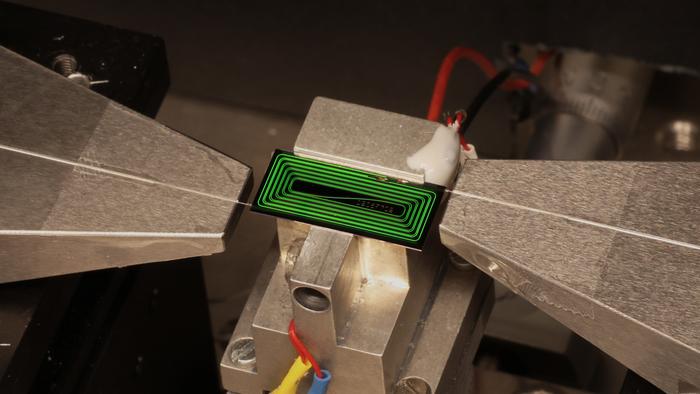
A close up of a chip on a metal platform.

EPFL's chip-based ultrafast laser operates in a testing set up. (Image credit: Zheru Qiu/EPFL)

This oscillator, which has received little attention in the world of photonic chips, works by placing a nonlinear waveguide between two optical filters. This causes a high-intensity laser pulse to expand into a broader range of colors that can then pass through both filters while weaker light, which can cause laser destabilization, is blocked out. This technique essentially means that a high-intensity laser pulse can be maintained.

Because the Mamyshev oscillator doesn't require extra components to manufacture on a chip, it presents an attractive design for use on photonic chips. And although the laser cavity needed to direct an ultrafast laser is 16.5 inches (42 centimeters) long, it can be folded to occupy around the same area as a match head. This can't be done with conventional fiber-optic-based lasers, often used in photonic chips.

That takes care of the size, but the cost of ultrafast laser systems is another challenge. But because photonic chips can be fabricated using silicon wafers in the same fashion as computer chips, more than 1,000 laser cavities could potentially be produced in a single batch, the researchers said. As such, photonic chips with ultrafast laser capabilities could be produced at scale, in turn reducing manufacturing costs and even expanding their use.

Photonic chips capable of handling ultrafast lasers could, in the future, lead to portable tools for tasks like detecting pollutants or performing advanced medical diagnostics in the field, the researchers noted in the study. The technology also opens the door to smaller atomic clocks that can benefit navigation and future communications.

  •  
❌