❌

Reading view

What do the IPOs for SpaceX, OpenAI and Anthropic mean for Microsoft?

The AI IPO tsunami on the stock market has only recently gotten under way, with SpaceX’s more-than-$2 trillion IPO likely to be followed in several months by OpenAI’s and Anthropic’s IPOs — each of which is likely to hit $1 trillion.

That will mint three new trillion-dollar AI companies in a matter of months, all of which compete with Microsoft. 

Wall Street has never seen anything like it. Previously, the most money raised by all IPOs in a single year was $671 billion in 2021. It took 38,644 deals to get to that figure. Compare that to three deals this year that by themselves will likely total $4 trillion.

The numbers are eye-popping. 

For Microsoft though, it’s not the numbers themselves that are important. It’s what will happen to the company once it as three newly minted trillion-dollar AI competitors. Until recently, when it came to AI, Microsoft was king of the hill. But can it keep that place?

Microsoft’s weakened position

The IPOs come at a particularly fraught time for Microsoft. At one point, it was the most valuable AI company in the world, with a big head start on the tech industry.

No longer. Microsoft’s stock price has tanked in the past 12 months, even as the S&P index has soared. In the last year, Microsoft’s stock price has dropped 24%, while the S&P has jumped 24%. The two were pretty much in sync until last fall..

Microsoft has fared even worse against its most powerful AI competitor, Google. In June 2025, Google’s total value was $2.1 trillion, well behind Microsoft’s  $3.57 trillion. By  mid-June this year Google was worth $4.5 trillion, Microsoft, $2.8 trillion. That’s entirely due to Google’s AI push and Microsoft’s failure to improve Copilot significantly.

Matt Vellosso, who worked for Microsoft for 14 years — including four as technical advisor to CEO Satya Nadella and then as Partner Director for fostering AI innovation in Windows before leaving in 2023 — is scathing about what he views as Microsoft’s AI failures. 

He warned: “Microsoft missed the internet wave, the mobile wave and now it missed the AI wave.”

Show me the money

The most immediate likely impact on Microsoft after the three massive IPOs take place will be on the company’s stock price, which could well take another hit. Investors don’t want to miss out on the AI boom, and until now, there’s been a relatively small number of companies in which they could. When Anthropic and OpenAI join SpaceX as publicly traded companies, investors will have three more choices than they did only a few months ago. That could make it tougher for Microsoft to attract AI-focused investors. And that, in turn, could knock down its stock price. 

A lower stock price means the company will have a harder time raising money when it needs it. In addition, Microsoft won’t be able to as easily buy other companies in stock-only deals, because the value of its stock will be less.

Still, the IPOs are not all bad news for Microsoft’s stock position. It does, after all, own 27% of OpenAI. So if OpenAI is valued at $1 trillion after its IPO, Microsoft has a $270 billion stake in it.

Thumbs up for increased Azure revenue

One area where these mega IPOs should be unalloyed good news for Microsoft is in Azure revenue, which should significantly. Microsoft’s final divorce settlement with OpenAI requires the latter to buy $250 billion in Azure services through 2030. And its  estimated trillion-dollar valuation ensures the company will be around for the long term, meaning Microsoft can count on that revenue — and possibly more on an ongoing basis.

Microsoft will likely also get tens of billions of dollars from Anthropic for Azure cloud services. Anthropic might spend $43 billion annually on Azure cloud services by 2030, according to estimates by HSBC, one of the world’s largest banking and financial services companies.

Thumbs down for the effect on Copilot

Although Azure use will boom thanks to the IPOs, Microsoft’s own Copilot could face significant competition at a time when it’s having serious problems gaining traction. In its April 2026 earnings call, the company said Microsoft 365 Copilot had 20 million paid seats. That’s up from 15 million paid seats as of January, but still a minuscule number, considering Microsoft has 450 million Microsoft 365 commercial subscribers. That means only about 4% of the company’s business customers have been willing to pay for it since its launch in late 2023.

Beyond that, developers have been leaving GitHub Copilot and turning to Anthropic’s Claude Code and SpaceX’s recently purchased Cursor. A survey by the software development company JetBrains of more than 10,000 developers found that 29% used GitHub Copilot, 18% used Cursor and 18% used Claude Code. 

Early in 2025, GitHub Copilot had a commanding 67% market share.

More downside than up from the IPOs

Although the IPOs do have some upside for Microsoft — dramatically increased Azure revenue and several hundred billion dollars in OpenAI stock holdings — mostly, they’re bad news thanks to increased competition. 

Unless Microsoft significantly improves Copilot for businesses, developers and consumers, the company’s one-time AI dominance will erode even further.

  •  

Entry-level AI workers now need ‘senior-level’ skills, PwC says

AI has created a tough job environment for entry-level workers and things aren’t getting better anytime soon — even those with AI capabilities now need “senior-level” skills to land a job.

“AI-exposed entry-level roles are seven times more likely to require traditionally senior-level skills such as judgement and leadership,” consulting firm PwC said in a study released this month.

That’s because AI is changing the traditional career ladder. Companies are increasingly looking for candidates that use the cutting-edge tools and services to amplify their performance and grow faster. “Organizations must rethink how they mentor and train junior staff, helping them step up to complex decision-making much earlier in their careers,” PwC said.

Entry-level job seekers with or without AI skills are already dealing with stagnant wages,  layoffs, and stalled hiring. 

(The PwC findings echo similar concerns raised late last year in McKinsey’s State of AI report. Many companies are reducing headcount by deploying AI agents to take over entry-level jobs.)

Early-career AI job postings “have flatlined in highly AI exposed sectors,” and listings for junior roles with mid-career or senior-level skills have grown 35% since 2019, PwC said.  The consulting firm largely discounted the notion that AI is taking jobs away, though other studies point in the opposite direction. 

By the end of May, AI-driven job cuts had reached 87,174 for 2026, already outpacing the total of around 54,836 in 2025, according to figures released by Challenger, Gray and Christmas earlier this month.

The AI-driven layoffs haven’t reached the “jobpocalypse” stage yet, and workers are more productive with it, said Andy Challenger, chief revenue officer at Challenger, Gray and Christmas. But companies are rethinking hiring and long-term operational strategies as AI becomes a routine component in daily workflows and processes, he said.

Businesses are “restructuring aggressively as they reposition for an AI-driven economy,” he said.

That’s putting downward pressure on entry-level hiring as AI tools absorb more routine work, said Kye Mitchell, head of Experis US, a part of ManpowerGroup. “That doesn’t remove opportunity, but it changes the expectations. Employers now expect candidates to come in with hands-on experience, AI familiarity, and the ability to contribute faster,” Mitchell said.

Compensation remains strong for specialized, in-demand skills, while more commoditized roles such as customer service, helpdesk, and some entry-level positions  are flattening. “The shift overall is toward skills-based hiring, where demonstrable capability matters more than credentials alone,” Mitchell said.

Graduates who combine technical fundamentals with practical experience, AI fluency and strong communication skills stand out quickly. Job candidates can’t rely solely on academic credentials. 

“Employers are moving away from ‘train-from-scratch’ hiring and looking for talent that can contribute earlier and continue to adapt,” Mitchell said.

The PwC study also focused on the productivity gap between companies that have invested heavily in AI and companies lagging in adoption.

Since ChatGPT showed up in 2022, AI-exposed companies have seen productivity gains of 40% versus other companies. “The companies achieving the biggest productivity gains from AI are not using it only to cut costs,” PwC said.

AI-forward firms are also raising headcounts and wages. “Far from being a job killer, AI may actually be a job expander when used to unlock growth and enter new markets,” PwC said. 

Workers who use their domain expertise to supplement AI tools can advance, with AI-exposed roles “2.5 times more likely to rely on skills like empathy, judgement, and creativity that become even more valuable as AI absorbs some routine work,” PwC said.

  •  

Using Visual Studio Code’s ‘air-gapped’ AI model mode

Microsoft has been pushing hard to make Visual Studio Code a major way to consume its AI services, mostly in the form of GitHub Copilot. GitHub Copilot’s deep integration with VS Code brings many conveniences — inline autocomplete, for instance — but it’s frustrating for those, like me, who would rather use another model provider, or even a locally hosted LLM, for those functions.

Visual Studio Code 1.122 introduced a new feature, “Use BYOK [Bring Your Own Key] without a GitHub sign-in,” that allows you to “use chat, tools, and MCP servers in air-gapped or restricted environments where GitHub sign-in isn’t possible.” More importantly, it “enables fully offline workflows with local models like Ollama.”

In other words, you can now use locally hosted LLMs for chat, tools, and Model Context Protocol servers inside Visual Studio Code. The one thing you still can’t do is use a local LLM for inline and next-edit suggestions — at least, not without additional tooling.

Choosing a model for BYOK mode

If you want to use a local LLM with VS Code’s bring-your-own-model system, the first thing you need is a way to host the model. VS Code lacks a model-hosting mechanism of its own, although it’s conceivable that a VS Code extension may offer something like that in the future. That said, hosting models is complicated enough that a dedicated app is really needed for the job.

One easy way to host models is via a product like LM Studio, a convenient GUI for standing up, serving, and managing LLMs on one’s own hardware. The model host does not have to be the same system you run VS Code on, either. It can be on a server box you control, or on a cloud instance.

The choice of model is also important. Many models are powerful but won’t run well on commodity hardware because they’re simply too big. A good rule of thumb is to choose a model that fits into existing VRAM, along with the memory needed for a sizable token context (the more, the better). Also, the model should be suited to coding and development work. Some models in this vein that fit comfortably into 8GB VRAM include:

Setting up BYOK mode in VS Code

Once you have a model up and running, you can integrate it with Visual Studio Code. If you’ve disabled VS Code’s AI features, you will need to turn them on. Make sure the setting chat.disableAIFeatures is turned off. You can find it in Settings | Chat | Miscellaneous.

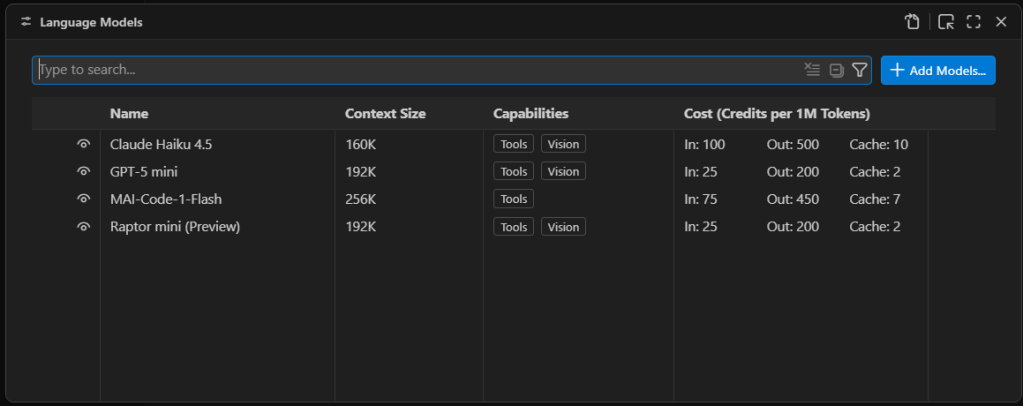
Third-party language models are managed through Visual Studio Code’s language model list. Press Ctrl-Shift-P and type Manage Language Models to open the list of existing language models.

Managing VS Code's AI language model list

Managing VS Code’s AI language model list. The models available by default are only models available as external APIs, not models that run locally.

Foundry

First you will see a list of the built-in models, which are all externally hosted. To add a new model, select Add Models at the top right and select Custom Endpoint.

You’ll then get a series of prompts:

  • Group Name: This is “Custom Endpoint” by default, but you can choose any name you want. The name is strictly for organizing the model list and doesn’t affect things like model recognition or connectivity.
  • API Key: If you’ve configured LM Studio to use an API key for serving models, provide it here. If you’re hosting the model locally and you haven’t explicitly set up API keys, you can leave this blank.
  • API Type: The options here are Chat Completions, Responses, and Messages. Most of the time you’ll want to use Responses, as it’s the most general-purpose option of the three.

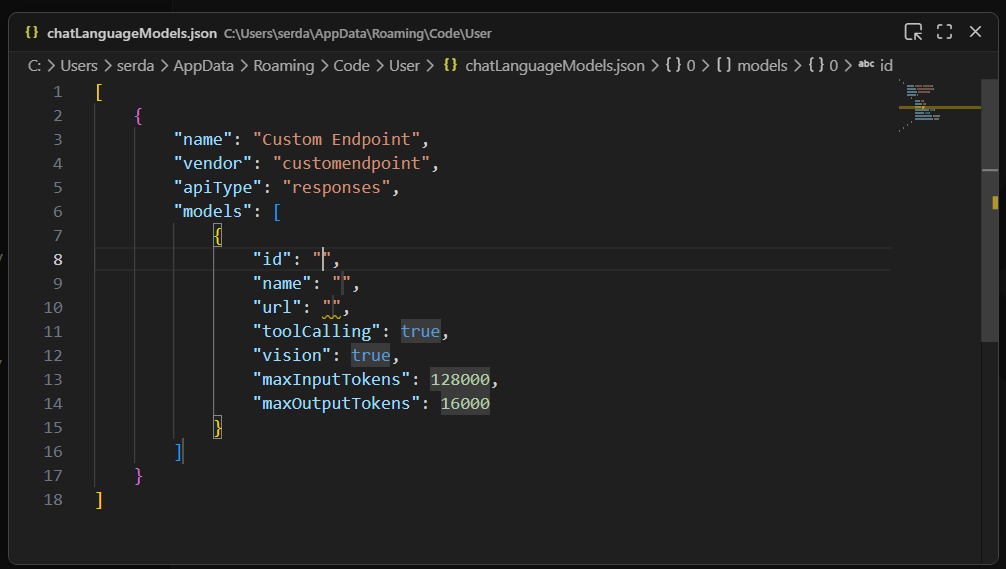
Once you finish providing those answers, you’ll be dropped into a modal editor for a JSON file that holds the details about the endpoint you’re configuring.

A newly created custom endpoint for a locally hosted model

A newly created custom endpoint for a locally hosted model. The ID, name, and URL still need to be defined for this model to be useful.

Foundry

You’ll need to provide a few more details by typing them into the labeled fields:

  • id: A text field that uniquely identifies this particular entry. The choice of ID is pretty much arbitrary; if you’re using only a single model, the ID could be the model name.
  • name: The name of the model that is used to identify it on the model server. In LM Studio, you can get this name by clicking on My Models in the main interface, then selecting the three-dot icon for the model in question and clicking Copy Default Identifier. For Qwen 2.5, for instance, name might be something like qwen2.5-coder-7b-instruct.
  • url: The URL to the server’s endpoint. On LM Studio, this defaults to something like http://127.0.0.1:1234/v1. The /v1 at the end is important because that endpoint is used for autodiscovery of models and their capabilities.

The other fields generally don’t need editing. Most models have tool calling functionality. If you know for a fact that the model you’re using doesn’t have vision support, then set vision to false.

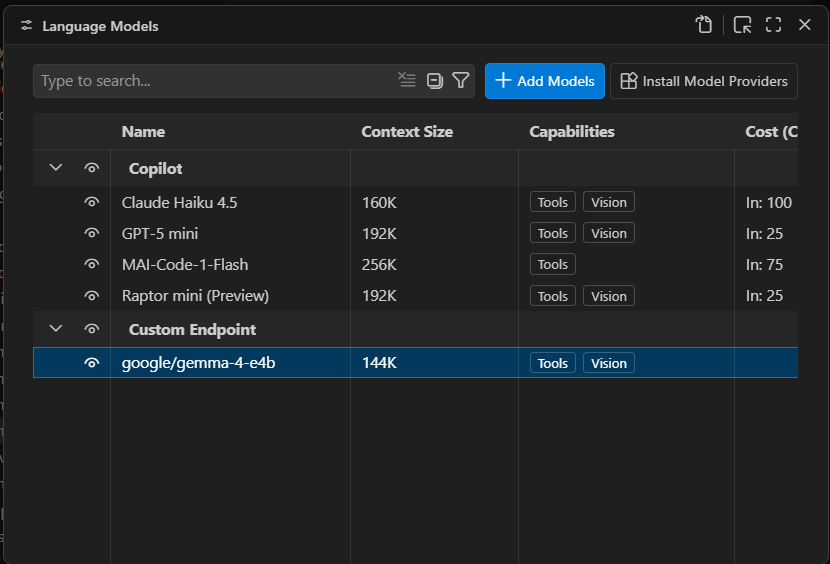
Once you have these fields filled in, you can close the modal editor to save the changes. If you reload the Manage Language Models page, you’ll now see your new endpoint:

A newly created local endpoint

A newly created local endpoint. The choice of name and group is arbitrary. “Custom Endpoint” is the default name for a newly created group of endpoints.

Foundry

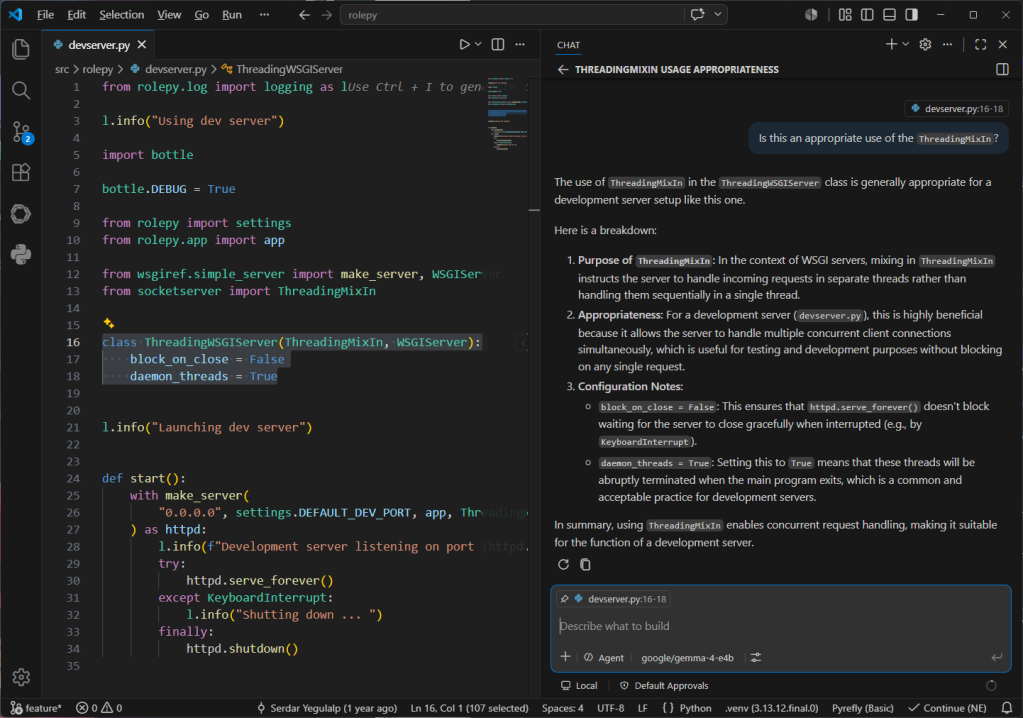
You should now be able to launch the chat window and use the defined model for conversation and utilities:

Conversing with the local model using VS Code's chat window

Conversing with the local model using VS Code’s chat window. Note the selected code block in the left pane that is being used as the context for the conversation.

Foundry

One current, and major, limitation of Visual Studio Code’s BYOK functionality is that it only works for chat and utility tasks. It doesn’t allow you to use a local model for inline suggestions or code completions. The only way to take advantage of local models for expanded functionality with VS Code is to use a third-party tool like Continue.

It isn’t clear if Microsoft will eventually lift this restriction. GitHub Copilot integration in VS Code is a large part of how Copilot as a service reaches its target audience. For the time being, you can certainly use third-party and local models for a significant part of your AI-assisted development work in VS Code, and you can close the functionality gap with additional tooling.

  •  

Open source grapples with agentic coding

Unless you’ve been living under an old woodpile in your backyard, you have certainly seen how agentic coding is rocking the software development world. Things are happening fast and furious, and keeping up is practically a full-time job. 

The latest area that is catching the attention of developers is how agentic coding is affecting the open source community. The open source movement has been defending the rights of folks to use, change, and contribute to software for many years. And of course, agentic coding is starting to become part of that process.

On the one hand, maintainers of open source projects rightfully are frustrated as they become overwhelmed with pull requests of dubious quality and usefulness being submitted by coding agents. On the other hand, as David Heinemeier Hansson notes, maintainers are starting to get a little snooty about accepting AI-written code, viewing it as somehow not worthy of being included. Some organizations have explicitly banned AI-generated submissions.

I get that they don’t want AI slop overwhelming their input queues. But I think it is a huge mistake to ban AI-written code outright.

Whose code?

Before I dig deeper into that notion, it’s important to look at another issue that arises from all of this: Who actually owns the code that AI writes? 

Copyright requires that a human produce the thing being copyrighted. If you prompt Claude Code with “Write me a CMS system” and then Claude writes you a CMS system that you check into a public GitHub repository unchanged, it’s not quite clear if that code is protected by copyright. However, if you prompt Claude Code with a specification and guidelines and then you work with Claude to refine the initial result, reviewing the code and making changes as part of an iterative process, then it could be argued that a human did produce that code. But it is not at all clear-cut legally. (Please note that I am not a lawyer.)

The current thinking is that the result of accepting verbatim the output of a simple prompt is not copyrightable, and that no one actually owns the code — an interesting notion in and of itself. 

But then the ethical question comes into play. If I find a bug in an open source project, I ask GitHub Copilot to fix it, and Copilot writes a clever and effective fix, then who cares who owns the code? Should a maintainer of the project reject such a pull request just because it was AI-generated? That seems silly to me, yet it is happening today. 

Our code

There is, too, the issue of license compliance for AI-generated code. As a general rule, LLMs generate code rather than copying it. They don’t copy and paste code directly from repositories. However, there have been cases where AI-produced code has resembled open source code so closely that the claim could be made that it is a copy. If this happens with GPL code, it could be a violation of the license to use it without the receiving code base being “infected.” Open source maintainers naturally should be concerned about this happening.

In the end, an open source maintainer should care about the quality and license compliance of submissions, not how those submissions were derived. Gatekeeping based on the source of code doesn’t seem like a good path towards project success. Good code is good code, no matter where it comes from.

Agentic coding is here, and the open source community needs to realize — and embrace — that inevitability.

  •  

Trump vs. Anthropic: The AI wars are heating up

The US government decision to force Anthropic to close down its latest and greatest AI models, Fable 5 and Mythos 5, was only the next step in a burgeoning battle between AI providers and ignorant politicians. 

Anthropic was on top of the world. Its Mythos 5 LLM had everyone excited. (If you believe the hype, it was kind of scary, too.) Even Anthropic CEO Dario Amodei admitted — or boasted? — that Mythos would bring an “enormous increase in the amount of vulnerabilities, in the amount of breaches” to us all. But with that fear came the promise of more AI power than ever. 

Then, the roof caved in.

On June 12, the US Commerce Department used its export-control powers to demand that Anthropic cut off access to its Fable 5 and Mythos 5 models for all foreign nationals, citing national security concerns and fears of jailbreaks. After figuring out it had no way to do that, Anthropic pulled both of its newest frontier AI models offline worldwide.

Just what an AI company needs! All other Claude models, like the Opus and Sonnet series, remain online. But, come on, AI sales are all about the newest and most powerful models.  

Adding insult to injury — and this is true at many high-tech companies — Anthropic has many employees who aren’t US citizens. This means Anthropic’s own programmers can’t work on their latest models.

Of course, this isn’t the first time US President Donald J. Trump and company have tried to put a spoke in Anthropic’s wheels. Back in February, Anthropic refused to give Defense Secretary Pete Hegseth the power to use its models to spy on American citizens and to power autonomous weapons.

This go-around, it wasn’t because Anthropic refused to kowtow to Trump’s officials. It was, they say, out of fear that these new models could be used to attack American interests. 

Mind you, no one in Trump’s regime has the tech chops to know just how dangerous, or not, any AI model is. As I recently noted, Trump’s AI executive order has no teeth. Nor, more to the point, is there anyone in the administration with a clue about AI.

Specifically, at the Department of Commerce, neither Commerce Secretary Howard Lutnick nor William Kimmitt, undersecretary of commerce for international trade, knows a thing about AI. Just what we need, more political hacks deciding tech policy. 

So, how did they discover that Fable and Mythos were theoretically a danger to the US? Good question. According to The Wall Street Journal, it was Amazon CEO Andy Jassy who told the Trump administration that Fable was untrustworthy. Guess what? AWS offers its own full cloud AI stack, starting with Amazon Bedrock for foundation models, Amazon SageMaker for training and deployment, and a growing set of agentic AI tools and services. 

In other words, Amazon is not a neutral party; it’s a competitor. Funny, that.

Sure, Amazon also has partnerships with Anthropic. But, in case you haven’t noticed, all the big AI companies are in bed with each other. That doesn’t stop them from fighting. What’s heating this up is that the AI companies are no longer offering flat-rate subscriptions and are replacing them with far more expensive, token-based pricing schemes. 

Armed with this information, Commerce gave Anthropic 90 minutes to fix its “problem.” Right. AI development is fast, but it’s not that fast. In addition, according to Anthropic, officials haven’t spelled out exactly what’s wrong. They only know that Commerce claims there was a “narrow, non‑universal jailbreak” in Fable.   

That’s it. That’s all. 

Anthropic has also observed, with reason, that similar jailbreaks are possible on other leading models, like OpenAI’s GPT‑5.5. Those others, however, haven’t been hammered with comparable export controls.

The AI and security experts who do have an AI clue believe Commerce is behaving stupidly. (You won’t get any argument there from me.) For example, in an open letter, “On Transparent AI Cyber Protections,” they said Commerce’s directive “has taken the best models away from defenders, created market uncertainty, and risked America’s AI leadership without any real risk to justify it,” warning that pulling capabilities “away from defenders without a good reason when our adversaries are rapidly advancing is dangerous.”

Exactly so. 

Besides, as Alex Zenla, co-founder and CTO of security company Edera, observed, Fable’s capability to identify insecure code sections is the baseline for any model you’d trust to write secure code. The same capability exists in GPT-5.5, Opus, Sonnet, and Kimi 2.7 — it’s not unique to Fable. Pulling Fable from defenders doesn’t remove the capability from the threat landscape. It just removes it from the people trying to build safer systems.”

This is not about AI safety or security. 

What this is really about is opening a new front in Trump’s war against the liberal-leaning Anthropic. Mind you, Anthropic isn’t really liberal. This has more to do with Anthropic not following in other tech firms’ groveling to Trump. 

However, Trump doesn’t seem to realize that by essentially shutting down Anthropic’s biggest move to date, he’s also telling the world that they can’t rely on American AI companies down the road. Sure, in the short run, this hurts Anthropic. In the long run, it’s going to be another reason for Europe and other countries — taking digital sovereignty seriously — to avoid doing business with any American tech company. 

In the meantime, Anthropic and Trump administration officials are in tense talks over whether, and under what safeguards, the models could return to the marketplace. Commerce indicates it might allow a narrower relaunch if jailbreak issues are resolved and additional controls are in place — whatever those might be. 

Since it’s really all about massaging Trump’s ego, I’m not feeling terribly optimistic. Just ask Israeli Prime Minister Benjamin Netanyahu how well letting Trump set the terms of engagement goes. It’s not pretty. 

  •  

‘Agentic AI’ PCs? Not much new here, say analysts

Nvidia and Microsoft this month touted the reinvention of computers with a new class of “agentic AI PCs” that will “reinvent the way PCs work.” 

That’s how Nvidia CEO Jensen Huang described the computers at the recent Computex trade show. At the event, Nvidia introduced its first AI-focused PC chip called N1X, which has an integrated CPU and GPU and will be used in agentic AI PCs.

Nvidia’s new RTX Spark PCs are the first in a major “PC reinvention for 40 years,” Huang said, likening them to AI phones. “You could talk to it, it could look at you. You could ask it to read files… [or] go help you do research.”

Not so fast, say analysts, who argue the computers are mostly repackaged AI PCs that shouldn’t necessarily drive enterprise upgrades.

“Agentic AI PCs is a strange term that should probably be deemphasized,” said Leonard Lee, principal analyst at neXt Curve. “Depending on use case, PCs of the last two generations are ‘agentic AI’-capable.”

Skeptical of the hype, analysts said many current PCs are already capable of running agents, such as those spun up on device by OpenClaw. Those agents don’t need to communicate with AI models in the cloud.

In fact, Lee said, Apple has already shown that Windows isn’t needed to run agentic workloads, with the Mac Mini among the most talked-about device for hosting personal AI agents and OpenClaw.

Analysts said the definition of agentic AI PCs really comes down to the hardware inside, which largely defines their capabilities. Most are really just an evolution of earlier AI PCs, which arrived a few years ago amid similar hype.

AI PCs, specifically CoPilot+ PCs, were originally designed with neural processing units (NPUs) to support the requirements of Windows Recall. “Some argue agentic AI PCs need more GPU compute, but…Qualcomm and Microsoft would counter that agentic AI PCs have been around for a while,” Lee said.

To highlight the capabilities of the RTX Spark PC, a demonstration at Computex showed how an architectural design workflow could be split between the PC and the cloud. (An MCP server managed data exchange to facilitate the cloud-PC workflow.)

Adobe has reengineered Photoshop and Premiere for RTX Spark PCs, allowing the software to communicate with AI agents on PCs and tools to run twice as fast, Huang said.

And at the company’s recent Build conference, Microsoft CEO Satya Nadella demonstrated the new Surface Laptop Ultra AI PC based on the RTX Spark design. He positioned agentic AI PCs as running a new execution layer that can act across files and devices, including generating and executing code. 

While AI PCs with agents will be capable, they still lack applications, said Jim McGregor, principal analyst at Tirias Research. “However, PCs — especially the small form factor PCs and workstations — are likely to be the home AI appliance,” he said.

For enterprises, upgrading to RTX Spark PCs at this point could pose problems. That’s because Nvidia’s N1X CPU is based on the Arm processor architecture and could run into compatibility issues with x86 applications designed for Intel and AMD chips.

“Despite Arm processors being available for a while, enterprise penetration stays small, since compatibility with all apps, drivers, and corporate systems is critical and requires extensive testing…, even though Microsoft has done a reasonably good job with Windows 11 on Arm,” said Jack Gold, principal analyst at J. Gold Associates.

Because Microsoft is moving to natively incorporate AI into Windows, those PCs will land in enterprises ultimately, Gold said.

Regardless of hype, it might be a good time for enterprises chasing an agentic AI agenda to upgrade laggard Windows 10 devices, Lee said. “Considering the considerable hype about agentic AI, early adopters will need to upgrade their fleets if they pursue a broad agentic AI agenda for their organizations,” he said.

  •  

The missing layer in enterprise agentic AI

In the past year, the enterprise AI ecosystem has gained enormous capability and zero consensus.

Developers now have a remarkable set of tools for building AI agents: OpenAI’s frameworks, Anthropic’s Claude tooling, LangChain, LangGraph, CrewAI, Microsoft AutoGen, and a growing list of alternatives. Each promises to coordinate reasoning loops, manage multi-step task execution, and connect agents to tools and APIs. For experimentation, the progress has been substantial. Teams can now assemble sophisticated agent workflows in days that would have taken months two years ago.

But I’ve watched this pattern before. In over two decades of building and selling distributed systems platforms, I’ve seen the same dynamic play out across nearly every major infrastructure shift: the tools for consuming a new capability arrive before the infrastructure for governing it does. The gap that emerges isn’t immediately obvious in development environments. It becomes obvious in production.

That’s exactly where enterprise AI stands today.

What agent frameworks don’t handle

Modern agent frameworks are fundamentally coordination systems. They determine what a system should do: which tools to call, how to sequence tasks, how to delegate work across agents. That’s hard work, and they’ve gotten quite good at it.

What they rarely address is where those tasks are allowed to run, and under what conditions.

Take a seemingly simple workflow: summarize customer support transcripts using an LLM. In a development environment, the implementation is clean. The agent calls a model API, passes the transcript, and returns a summary. In production at an enterprise, the same request may involve a dataset that can’t cross a specific geographic boundary, a model that isn’t approved for regulated data, and an audit requirement that demands a traceable record of what happened.

Those aren’t planning problems the agent framework was designed to solve. They’re execution governance problems. Most frameworks quietly assume they’re handled somewhere else in the stack. In many enterprise environments, they’re not handled at all. Gartner predicts more than 40% of agentic AI projects will be canceled by the end of 2027, citing inadequate risk controls as a primary driver of failure—a number that reflects exactly this gap.

What the missing layer actually does

Addressing these governance problems requires an additional layer between agent logic and execution: one that evaluates every agent action against policies governing where data can reside, which models may process it, who authorized the request, and how the action fits within the organizational context. The agent framework determines what the system should do. The orchestration layer determines whether and where it’s allowed to happen. Keeping those responsibilities separate allows both layers to evolve independently. It also means you can adopt new agent frameworks without rebuilding your governance model from scratch.

This separation will feel familiar to anyone who has worked through the Kubernetes era. Kubernetes doesn’t care what’s inside your container. It finds capacity, allocates resources, and ensures things run. The orchestration layer for agentic AI plays an analogous role: it doesn’t care which agent framework generated the request. It enforces the conditions under which that request can execute.

Richer authorization models

Traditional enterprise access control is built around a simple question: can user X access resource Y? That’s insufficient for autonomous agents.

A realistic authorization decision for an agent request might look more like this:

request = {
    "agent": "support-summary-agent",
    "task": "summarize",
    "dataset": "customer_support_logs",
    "model": "external_llm_api",
    "delegated_by": "user_4821"
}

policy = evaluate_policy(request)

if policy.allowed:
    route_to_execution(policy.execution_environment)
else:
    raise AuthorizationError(policy.reason)

The policy engine here evaluates dataset classification, model approval status, geographic processing rules, and the delegation chain that initiated the request. That might mean redirecting the task to an internal inference cluster instead of a public API endpoint, or blocking the request if no compliant execution environment exists. From the agent’s perspective, the task still executes. The orchestration layer ensures it runs in an environment that satisfies enterprise policy.

Why ontologies are load-bearing infrastructure

For the orchestration layer to make good decisions, it needs to do more than label data. It needs to understand how the entities involved in a request relate to each other, and reason over those relationships to determine what’s allowed.

Consider the customer support transcript example again. Metadata tells you the dataset contains PII (personally identifiable information). An ontology lets the system reason across a connected chain: the task operates on a dataset containing personal data; that data is governed by GDPR; the organization’s policy requires processing within an approved EU environment; the selected model runs outside that boundary. From those four connected facts, the orchestration layer can infer the request must be rerouted or blocked. The system reasoned over the relationships rather than matching against a hardcoded rule tied to a specific dataset.

This is what makes policy enforcement, execution routing, data locality, and audit decisions computable at runtime. An ontology can be built around virtually any entity-relationship set the enterprise needs to govern: datasets, models, agents, users, regulations, tasks, environments. The relationships that matter are the ones that drive the decisions the governance layer needs to make. Access control lists can restrict who touches a resource, but they can’t reason across a connected set of entities. That reasoning is what the orchestration layer depends on.

Decision provenance as a first-class requirement

Enterprise systems also require auditability. When automated agents trigger actions across multiple systems, organizations must be able to reconstruct the decision path that produced the outcome. Compliance depends on it. So does incident response and basic operational trust.

An orchestration layer generates records describing the initiating identity, the agent, the model, the data sources, the policies evaluated during authorization, and virtually anything else the organization chooses to capture in its ontology. That chain of custody allows teams to investigate incidents and validate compliance without treating production AI systems as operational black boxes.

Regulators and auditors are no longer satisfied with knowing what an AI system was designed to do. They want a factual record of what it did in a specific instance, under what authorization, and with what effect—something dashboards can’t provide, but a well-designed orchestration layer can. The EU AI Act makes this explicit: under Article 12 and Article 17, high-risk AI systems must maintain documentation that makes decisions traceable and auditable, with records sufficient to support investigation after the fact.

Where this leaves enterprise teams

Agent frameworks will keep improving. The coordination problems they solve are real, and the ecosystem will continue to mature. But the architectural challenge for enterprises has shifted. It’s no longer primarily about coordinating agents. It’s about governing how those agents interact with real infrastructure, real data, and real compliance obligations.

The patterns for doing that exist today: contextual authorization, data locality enforcement, ontology-aware policy evaluation, decision provenance. What most organizations are missing is the recognition that these capabilities belong in a distinct layer that operates independently of whichever agent framework sits above it. Build that layer, and the rest becomes manageable.

—

New Tech Forum provides a venue for technology leaders—including vendors and other outside contributors—to explore and discuss emerging enterprise technology in unprecedented depth and breadth. The selection is subjective, based on our pick of the technologies we believe to be important and of greatest interest to InfoWorld readers. InfoWorld does not accept marketing collateral for publication and reserves the right to edit all contributed content. Send all inquiries to doug_dineley@foundryco.com.

  •  

Too good to be true? Avoid free AI token offers — or risk vendor lock-in

Tech industry experts are urging IT decision-makers to be wary of AI vendor gimmicks such as free tokens, and to adopt a multi-vendor and multi-model strategy to avoid vendor lock-in.

“Don’t be afraid to adopt a multi-vendor approach to get value from different AI tools rather than risk lock-in with a single one,” said Max Goss, senior director analyst at Gartner.

It is unlikely one AI vendor or model will meet an organization’s requirements, Goss said.

The advice comes as more AI vendors are offering cheap tokens subsidized by venture capital in a land grab for customers. The companies are also hiring forward-deployed engineers (FDEs) to push their models to enterprises.

Once companies start developing business processes around specific AI models, they get locked into their ecosystem. “People are adopting hybrid strategies…to cut token costs, and adopting more token-efficient models,” said Jack Gold, principal analyst at J. Gold Associates.

Free and low-cost tokens from AI vendors could incentivize companies to build processes and workflows around proprietary LLMs and agents, said Max Leaming, head of data science and AI solutions at ManpowerGroup.

But as the AI landscape evolves, it’s difficult to predict whether a multi-model or multi-vendor landscape will emerge, said Logan Wolfe, partner of global AI strategy and sovereign transformation at IT consulting firm Kyndryl. “I think it could be multi-model, yes. It really comes down to the use case and the type of implementation that you’re having,” Wolfe said.

Enterprises are still in the midst of moving blue-sky experimentation to a mindset where they see AI as a powerful tool that needs to make sense from a business perspective. With that in mind, IT leaders should ground their AI strategies on use cases as opposed to vendors, Wolfe said.

“If it’s a highly regulated space, if it’s a financial sector, a healthcare sector, then you will be placing a lot more emphasis on safety, privacy, maintaining certain regulations, and so that could prevent you from rapid model switching based on cost,” Wolfe said.

For low-stakes use cases, it would be prudent to have a model-switching approach that doesn’t break the bank. “For a low-hanging fruit use case with varying volume, like a customer support data center, during heavy load times you could switch to the more capable model, then optimize that on evenings and weekends,” Wolfe said.

ServiceNow Chief Digital Information Officer Kellie Romack, who’s worked in IT for 25 years, said companies need to understand how their AI is built. “You can’t have AI built in such a way that you don’t have human beings understanding how it was built…, how to debug, back up, and retrace,” she said.

Romack has also long resisted ripping out one vendor’s platform to replace it with another. “I say, ‘Let’s talk about the technology you already have…, now let’s see the best of breed,’” she said.

After studying what customers already own and where their contracts and plans are headed, Romack looks at options based on architectural principles and the problem being solved, then runs multiple models in-house, such as Anthropic’s Claude and Microsoft’s Copilot, through one LLM gateway.

“We have a lot of different things in-house that people can put their fingers on,” Romack said.

For example, Claude might be better for reading a long Word document, while Copilot might be better for a quick summary.

She is sensitive about internal AI spending. “Every day we look at token spend. I’ll look at an engineer that’s got the same job as another engineer, and I’m like, ‘OK, you spent $10, you spent $10,000. Why?’”

Avoiding vendor lock-in is important for continuity of service. Outages hit AI services from OpenAI and Claude in recent months, and a multi-model approach provides fallback options, Gartner’s Goss said.

“If you are relying on a single provider with a single model, there’s risk there. You can mitigate that risk with a multi-model approach,” he said.

  •  

The AI revolution comes with a hidden tax

It was the best of trends, it was the worst of trends. It was the epoch of artificial intelligence,  it was the epoch of artificial inflation. 

I’m truly excited to be alive at a time when AI, formerly the stuff of science fiction, is now an everyday reality and promising so many benefits to humankind. 

AI is accelerating drug discovery, slashing the cost of protein folding research, diagnosing cancers earlier than human radiologists can, automating the drudgery out of nearly every white-collar job, translating speech across hundreds of languages in real time, and giving the blind a way to see the world through a camera. 

AI is giving us all this and so much more. But no amount of techno-optimism can hide the fact that AI is making just about everything more expensive. 

While the AI trend is making a tiny number of rich people even richer, the public at large is paying the price through rapidly rising prices; it represents a transfer of wealth from the have-nots to the haves. 

AI is a machine that eats resources. It eats chips. It eats electricity. It eats water, land, labor, and building materials. AI’s gluttony creates scarcity, and scarcity creates inflation. 

Here are all the ways AI is driving up costs for you and me. 

Your gadgets cost more

AI runs on memory chips and other computing hardware. AI companies buy so many of them that they’ve created a shortage. NAND prices shot up around 246% from the start of 2025 through last December, according to Kingston. Hard disk drive prices in Europe rose 46% in just four months. 

The chip shortage pushed smartphone prices to all-time highs — one analyst called it a “tsunami-like shock” to the industry. Beyond that, computer and device prices will climb by 20% by the end of 2026, according to one estimate.

Apple CEO Tim Cook told the Wall Street Journal this week that price increases on Apple products are “unavoidable,” citing the surging costs of memory and storage chips driven by AI data-center demand. He described the supply shock as a “hundred-year flood.”

Software costs more

Greedflation has hit the software industry. Salesforce, ServiceNow, and others have increased subscription prices, blaming AI for the hikes. IT spending globally is forecast to grow 13.5% in 2026 over the previous year, reaching $6.31 trillion, according to Gartner, with the bulk of the increase driven by AI infrastructure investments.

The pricing models themselves are getting more complex and more expensive: seat licenses plus API usage plus GPU compute plus data storage plus compliance layers. What used to be one subscription is now five line items.

Enterprise software spending is growing 13.3%, with much of it being price increases on existing contracts rather than new purchases.

Services cost more

The services you buy cost more because companies are burning money on AI and passing on the costs to you. While tokens are getting cheaper, the new reasoning models can use anywhere from several times to tens of times more tokens than traditional models for comparable tasks.

SaaS inflation now runs at 13.2%, which is nearly five times the consumer inflation rate, and a majority of that increase is due to AI costs. 

Goldman Sachs forecasts that agentic AI could drive a 24-fold increase in token consumption by 2030, and that applies to the companies that provide enterprise services. 

Electricity costs more

AI data centers draw power the way a city does, pushing US residential electricity prices up roughly 5% on an annual average basis in 2025. That’s nearly double the general inflation rate of 2.7%.

Wholesale electricity prices near data center clusters have more than doubled since 2020. Goldman Sachs says electricity inflation will hover around 6% through 2027. 

The utilities build new power plants and transmission lines to serve these data centers, then hand the bill to everyone on the grid. You pay for AI’s appetite, whether you use AI or not. 

Your heating bill goes up, too, because the same natural gas that warms your home is being burned to generate power for data centers.

Your car costs more

Modern cars are computers on wheels. And a new automotive chip shortage is now underway. Prices for the memory chips that go into cars are expected to rise 70% to 100% in 2026 adding as much as $400 to the price of a car. 

Your house costs more

Data centers need land near power lines and water. They buy it at record prices, and they outbid the people who would have built homes on it. In Texas, data centers compete directly with homebuilders for utility-ready lots. In Northern Virginia, the data center buildout is squeezing the housing supply in a market that is already short. In Columbus, Reno, and Salt Lake City, data center land deals are pushing up land values beyond anything those markets have ever seen for industrial property. And the houses that do get built cost more, because data center construction has driven up wages for workers by 25% to 30%. 

Data centers even compete with public infrastructure projects for the same crews and the same concrete, copper, and steel — driving up the cost of roads and public works.

Everything costs more

AI is helping all kinds of companies fleece customers. Research from Carnegie Mellon in 2025 found that AI-driven ranking and pricing systems raise prices. 

AI-powered pricing algorithms now set the price of your rideshare, your flight, your hotel room, even your concert ticket. They use AI to estimate the maximum amount you’re willing to pay, then charge you that amount. Called surge pricing or dynamic pricing, the bottom line is that it affects your bottom line. 

A 2020 study in the American Economic Review showed that AI algorithms create a poverty premium: They learn that people with fewer alternatives are less sensitive to price, so they charge poor people more. 

Here’s another weird phenomenon hardly anyone talks about: When competing companies all use similar AI pricing systems, they can arrive at higher prices together without ever talking to each other. It adds up to a kind of accidental price-fixing. 

Food costs more

Higher electricity prices flow through the entire economy. Farms, food processors, trucking companies, and stores all pay more for power because of AI consumption, and they pass those costs down the chain until they’re ultimately paid by food consumers. 

Data centers are also consuming land that was once used for farming, forcing some farms to locate further away from population centers. 

Taxes cost more

Data centers receive enormous tax incentives and subsidies from state and local governments. At least 38 states now offer such incentives to data centers, which means funding shortfalls have to be made up by families paying their taxes. 

Texas is projected to lose $3.3 billion by 2029. Meta’s got a 20-year sales tax exemption from the state of Louisiana on data center equipment worth an estimated $3.3 billion. Pennsylvania will probably give around $2 billion in data center tax breaks. 

AI may one day change the world. But for now, it’s mainly just changing the cost of living. 

AI disclosures: I don’t use AI for writing. The words you see here are mine. I used a few AI tools via Kagi Assistant (disclosure: my son works at Kagi) as well as both Kagi Search and Google Search as one part of my fact-checking for this column. I used a word processing product called Lex, which has AI tools, and after writing the column, I used Lex’s grammar checking tools to hunt for typos and errors and suggest word changes. Why I disclose my AI use and encourage you to do the same. 

  •  

Why open infrastructure will define the AI era

A new form of vendor lock-in is here. And it’s not proprietary languages or rigid enterprise software suites — it’s something more fundamental. It’s the very thing that writes the code.

JetBrains Research found that 74% of developers worldwide use AI tools. Claude Code, available only since May 2025, is now the most popular AI coding tool, followed by Gemini Code Assist and GitHub Copilot, according to Jellyfish’s 2026 State of Engineering Management Report.

The latter study also found that 91% of developers say their productivity has increased in the past 12 months. As coding output expectations are rewritten daily, the engineering world is becoming heavily reliant on paid external AI services.

Gartner predicts that by 2028 spending on AI coding tokens could exceed developer salaries. Yet, tokenmaxxing while vibe coding through a vendor’s cloud-based API feels like a far cry from the open foundations of free programming languages and open models, which many of today’s AI platforms now abstract.

“Open infrastructure will be the backbone of the AI era,” says Peter Farkas, CEO of Percona, a provider of open-source database solutions. “Right now, too many companies are building their entire AI strategy on top of proprietary platforms because the convenience is seductive.”

“It’s ‘three clicks’ to stand up a database or an AI service in a hyperscaler, and that convenience blinds people to the lock-in they’re signing up for,” he adds. “As AI workloads mature, organizations will realize that depending on one vendor for their data, models, runtime, and pricing is not a strategy.”

AI-assisted coding is democratizing software engineering for non-engineers and accelerating top performers. But if teams are always working within the confines of how one platform thinks the world should work, it could create locked-in toolsets at scale. And as AI platform costs rise, a fundamental question arises: will software developers consume AI on their own terms, or on someone else’s?

There’s a strong case that the long-term winners in tech will be built on open-source standards and foundations, similar to the history of cloud-native computing and the internet itself.

“Open always wins,” says Brian Alvey, CTO at WordPress VIP, a managed WordPress hosting platform. “Not because it’s a fancy ideology, but because it gives you total freedom to adapt, evolve, and stay in control.”

Open infrastructure avoids a future where developers perpetually rent. “For AI to be useful to people at large, it can’t be something you’re paying rent for the rest of your life,” says Manik Surtani, CTO and co-founder of the Agentic AI Foundation (AAIF), a vendor-neutral home for open-source agentic AI technologies. “And it can’t be concentrated in one particular corporation or a small handful of corporations, because we know how that goes.”

Pricey, closed, proprietary AI

AI development today is traveling two parallel paths. On one path, open-source AI is thriving and fueling tremendous growth in the number and variety of AI models and tools. Just take the thousands of open-weight models on HuggingFace, the community around the OpenClaw AI agent, or the many academic institutions publishing new breakthroughs.

“Open-source models and tooling are hot on the heels of state-of-the-art, with interesting and boundary-pushing work being shared by labs and researchers across the world,” says Austin Parker, director of AI strategy at Honeycomb, an observability platform provider, citing frontier open-source models like Mistral, DeepSeek, and Ai2’s OLMo as examples.

Others agree. “There’s unprecedented openness at the model and tooling layer, with open-source models, frameworks, and orchestration advancing at remarkable speed,” says Mark Collier, general manager of AI and infrastructure at the Linux Foundation.

On the other path, we’re seeing heavy reliance on proprietary AI systems controlled by Anthropic, Cursor, Google, Microsoft, OpenAI, and others. As Collier says, “Many platforms are wrapping those open components in closed, opinionated interfaces that trade short-term speed for long-term constraints.”

Open source and the AI tooling market don’t always mix well. LangChain’s Open Agent Platform, for instance, was open-sourced to much fanfare in 2025, but by 2026 had been deprecated, with the repository now recommending fully managed alternatives.

For Roman Shaposhnik, co-founder and CTO of Ainekko, provider of an open-source, composable AI stack, the current AI platform landscape is reminiscent of low-code and no-code platforms, which promised democratization of software development but often failed to deliver, becoming synonymous with platform lock-in and inflexibility.

“Honestly, it feels familiar,” Shaposhnik says. “We have incredibly powerful AI tools right now, but most of them come bundled as tightly controlled platforms.” This is a risk for AI, he says, because the infrastructure, models, and hardware are tightly coupled. “If those layers are closed, you lose flexibility fast.”

Some abstractions that sit on top of models, like routing and agent frameworks, tend to be tightly coupled and optimized for certain models. Other platforms take the walled garden concept quite literally. Anthropic, for instance, has repeatedly made headlines for blocking access to its Claude models over vague policy violations. The company recently shut off competitor xAI’s use and stonewalled OpenCode, drawing community backlash.

Moves toward increasingly closed systems don’t bode well for an AI economy already built on shaky economics. As Vikram Srivats, head of product experience at WaveMaker, provider of an agentic application development platform, adds, “Given the unit economics of AI tooling and pace of accelerated change to keep up, it seems obvious that some will evolve to more of a closed system to be able to monetize and gain ROI.”

Why openness matters in the AI era

Reliance on proprietary AI platforms can create long-term operational dependencies. As systems become less interoperable, organizations may be forced to standardize on a single stack across data pipelines, models, and decision logic, says the Linux Foundation’s Collier.

“As infrastructure consolidates, enterprises become more exposed when platforms change direction, raise prices, or fall behind technically,” he says. “If you can’t change platforms without re-architecting your AI systems, you’ve already given up too much control.”

“When you build on someone else’s platform, you have to live by their rules and those rules always change,” adds WordPress VIP’s Alvey. “We’ve all seen this before, businesses wasting time and money building to serve Google, Facebook, YouTube, and the App Store, instead of building to serve their customers.”

Platform lock-in can also create direct business risk. As Ainekko’s Shaposhnik says, “It usually shows up as higher costs, fragile systems, and growing risk when it’s time to change direction.”

At Ainekko, an internal group called the AI Plumbers focuses on back-end AI infrastructure like inference, scheduling, memory, and hardware integration. “Their view is simple,” says Shaposhnik. “If those layers are closed, everything above them becomes fragile.”

Open standards, interfaces, and infrastructure provide a necessary hedge against closed systems to prevent this sort of fragility. “In the AI era, open infrastructure gives enterprises control, portability, and choice at exactly the time they need it most,” says Percona’s Farkas.

It can cost upwards of $100,000 to migrate enterprise software, according to Cloudaware, making portability a major enterprise concern. From this perspective, procuring closed systems can become a costly architectural dependency.

Others argue that openness is a critical hedge against vendor concentration risks at large, especially if AI replaces human labor en masse. “If all of that economic value is now being concentrated in the hands of one or two companies,” says the AAIF’s Surtani, “that’s an order of magnitude bigger problem than we’ve seen in any other wave of computing.”

Instead, open foundations allow adaptability to evolving conditions so enterprises can swap out models, agents, data, hardware, and orchestration, as needed. “Open standards let those components change independently without breaking the system,” says Collier. 

Openness can also help future-proof businesses against economic upheaval. “Open everything will help build a cushion for businesses and users to survive and thrive after the almost-certain correction in the current hype cycle,” says WaveMaker’s Srivats.

Momentum toward open AI infrastructure

At the industry level, momentum toward open AI infrastructure is growing. The establishment of the Agentic AI Foundation, Anthropic’s donation of Model Context Protocol (MCP), and Block’s donation of its Goose agent are significant ecosystem-wide moves toward openness. Other advances include the donation of llm-d, a Kubernetes framework for LLM inference, to the Cloud Native Computing Foundation (CNCF).

For Parker, donations like this help ensure long-term support and care. “Open standards aren’t just the foundation of the internet, they’re the foundation of the AI space,” he says. “I predict that we’ll see these practices continue, especially as enterprise adoption increases in earnest,” he adds.

Still, some question whether this level of stewardship is enough for a rapidly evolving ecosystem. “The internet benefited early on from groups that helped keep vendors aligned,” says Shaposhnik. “In AI infrastructure, we don’t really have that yet.”

“All of us open source veterans are hopeful,” he says, “but we also need to adapt to this new reality in what we do regarding AI infrastructure.”

Beyond industry governing bodies, companies themselves are also spearheading open AI initiatives. Warp, an agentic development environment, recently went open source amid closed-source rivals. Arcade.dev, meanwhile, is pushing an open-source Agent Library for agentic memory.

Where openness matters most in the AI stack

While AI infrastructure can be open in many ways, a few layers stand out as especially important. First is the openness of the model itself. “Open-source models must be the foundation of future trust and value,” says WaveMaker’s Srivats.

“The forms of open infrastructure that reduce integration friction and accelerate adoption stand out,” adds Neeraj Abhyankar, VP of data and AI at R Systems, a global digital solutions provider. For him, open model representation formats, open orchestration and execution layers, open agentic protocols, and open governance and metadata standards are all essential for enterprise flexibility.

Others place more value on the connective tissue between AI components. “The most important forms of open infrastructure are the ones that connect systems together,” says Collier. “That includes open APIs, metadata standards, identity and policy frameworks, and protocols for how models and agents communicate.” 

Arguably, MCP has become the connective tissue between AI agents and the broader API ecosystem. “If we get MCP right we unlock the same level of interoperability between entities on the web and models driving them as we came to enjoy during the Web 2.0 era and the API-first boom,” says Shaposhnik. “If we don’t we risk massive proprietary lock-ins.”

Parker agrees that open protocols will underlie future AI progress. “We’ll see continued development and progress on AI agents which will rely on protocols like MCP and ACP [Agent Client Protocol] to interoperate with various clients and each other,” he says. Yet a gap remains around API conventions for models. “It would be nice if we could get a commitment from model providers to use a standard here.”

For the AAIF’s Surtani, opening up the protocol layer is the most important aspect. “I think it’s really important for interoperability, for choice,” he says. “It means you can bring your own agent, you can bring your own framework, you can bring your own harness, and pick what model you want.”

Open standards may also play a significant role within inference architecture. “As AI expands to the edge, developers need visibility into how models run, how memory is used, and how performance scales,” says Shaposhnik. Open systems could make it easier to optimize, debug, and adapt while helping enterprises avoid observability fragmentation.

Lastly, cloud-native architectural standards are a key ingredient for open AI infrastructure. “We’re seeing Kubernetes become the missing link for people who want the hyperscaler-style convenience without hyperscaler lock-in,” says Percona’s Farkas. For him, Kubernetes has become the de facto hybrid enterprise deployment option for data, workloads, and AI components.

History repeats itself

The 2026 State of Open Source Report found avoiding vendor lock-in to be the primary driver of open source adoption. But beyond being a strategic decision for a single company, open infrastructure provides a layer for entire industries to be built upon.

Arguably, the internet itself is evidence of this, where groups like the IETF and the IEEE were instrumental in defining the fundamental protocols. “Without open protocols we would’ve been in telco hell and without phenomenons like Google or Facebook,” says Shaposhnik.

Or, take the history of Linux as a parallel. “Linux became the default operating system because it offered a common, vendor-neutral foundation that everyone could build on,” says Collier. “In the AI era, open infrastructure will define the layers that organizations rely on for long-term continuity.”

At the infrastructure level, open standards have repeatedly underpinned major platform shifts, from Docker to Kubernetes. The question now is whether AI will develop a similarly durable standards layer.

For Parker, it’s too early to say, but the current growth of AI mirrors the early cloud. “Remember that it took many years before we saw the development and popularization of the open source cloud-native ecosystem,” he says. “I think it would be a mistake to extrapolate from the current trajectory towards a closed, proprietary future.”

Others agree the future must be rooted in openness. “I see open infrastructure becoming the foundation of enterprise AI,” says R Systems’s Abhyankar. “As systems become more distributed and agent‑driven, closed ecosystems simply won’t scale.”

The groundwork is being laid through open agentic protocols, open frameworks, and industry support intended to reduce fragmentation around proprietary standards.

“Ironically, the AI movement has mostly seemed to learn from the mistakes of the past and is starting off on a more open foot,” says Parker. “Over time, I believe we’ll see innovation and openness thrive.”

  •  
❌