❌

Reading view

AAS 248: Day 4

Andromeda Galaxy

Editor’s Note: This week we’re at the 248th AAS meeting in Pasadena, CA. Along with a team of authors from Astrobites, we will be writing updates on selected events at the meeting and posting each day. Follow along here or at astrobites.com for daily summaries, or follow @astrobites.bsky.social on Bluesky for more coverage. The usual posting schedule for AAS Nova will resume on 22 June

Table of Contents:


Plenary Lecture: Ian Roederer, The Ultraviolet Path to the Origin of the Elements (by Susanna Kohler)

When the universe first formed, the only elements present were the three lightest — hydrogen, helium, and lithium. Today, there are 118 confirmed chemical elements that make up the periodic table. So where did the heavier elements come from, when were they first created, and what can they tell us about the first stars that formed in the universe? In the final plenary of AAS 248, Ian Roederer (North Carolina State University) walked us through how ultraviolet observations are the key to understanding the origin of the elements.

We know that hydrogen, helium, and lithium were cycled through the earliest stars in the universe, where fusion and other processes produced the first heavy elements that were spit back out into the cosmos when these stars ended their lives as supernovae. According to Roederer, within just the first two or three generations of stars, every element with stable or long-lived isotopes had already been created. For the heaviest of these elements, the dominant source is likely a process called r-process nucleosynthesis, in which a rapid burst of neutrons bombards atomic nuclei, resulting in the quick capture of the neutrons to form very massive nuclei that subsequently decay to stable isotopes.

illustration of a neutron star merger

Illustration of two neutron stars approaching a merger, emitting gravitational waves as they draw closer together. [ESO/L. Calçada/M. Kornmesser; CC BY 4.0]

The conditions needed for r-process nucleosynthesis are too extreme to reproduce in a laboratory on Earth, so we rely on models and observations of the cosmos to better understand it. We know that to get a rapid burst of neutrons, you need some sort of explosive event — and, in fact, the first example of an r-process event caught in the act was GW170817, the first detected neutron star–neutron star merger.

But remember all those news headlines about how binary neutron star mergers produce gold and platinum? Roederer points out that these were all inferred results — we didn’t actually observe direct evidence of gold and platinum in the aftermath of this explosion. That’s because it’s very difficult to detect the spectroscopic emission lines of heavy elements. To do so effectively, Roederer argues, requires high-resolution ultraviolet (UV) spectroscopy. He showed that in a cool star, high-resolution UV spectra provide a 50% increase in the number of elements you can detect. The heaviest of elements are only detectable with spectra in the UV range.
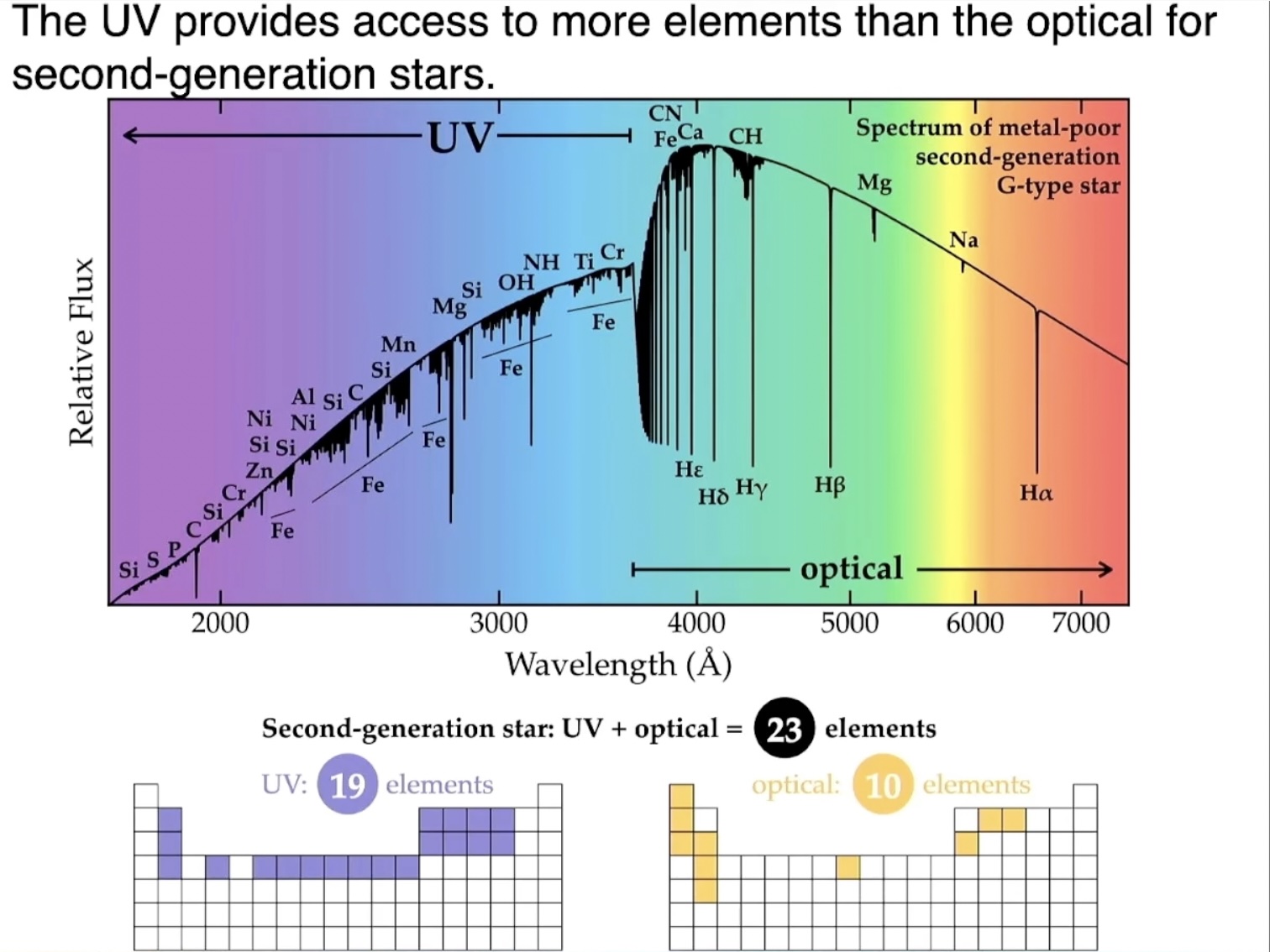
A stellar spectrum shows a large number of metal lines identified in the UV, as compared to fewer lines in other wavelengths. Text at the top of the slide reads "the UV provides access to more elements than the optical for second-generation stars."

An example spectrum for a second-generation star shows how the UV is critical for identifying a broad range of elements. [Roederer 2026]

Roederer walked us through some of the insights we can gain into the production of the heaviest nuclei found in nature when we use a combination of UV and optical spectroscopy. He also gave examples of what we can learn about even some of the lighter elements like phosphorus or boron when we have high-resolution UV spectroscopy to reveal the presence of these elements in low-metallicity stars.

Roederer ended his talk with a look ahead at the future of UV spectroscopy and the path to the universe’s first stars. Right now, the only mission we have that produces high-resolution UV spectroscopy is Hubble. NASA’s next big flagship mission with a high-resolution spectrograph, the Habitable Worlds Observatory (HWO), will be transformational in the ability to detect — or verify the absence of — heavy elements in stellar atmospheres. An observatory like HWO will provide our best shot at identifying low-mass, metal-free stars that survive from the first generation of stars in our universe. As Roederer concluded, “The future of studying the origin of the elements is bright in the UV.”

You can read Astrobites’s interview with Ian Roederer here.

The post AAS 248: Day 4 appeared first on AAS Nova.

  •  

Un experimento cuántico acaba de superar uno de los grandes obstáculos para buscar materia oscura y nuevas ondas gravitacionales. Dos nubes de átomos ultrafríos lograron cancelar el ruido que normalmente oculta las señales más débiles del universo

Un prototipo desarrollado por la colaboración AION, liderada por el Imperial College de Londres, ha demostrado que dos interferómetros atómicos pueden cancelar el ruido láser que normalmente enmascara señales extremadamente débiles. El avance, publicado en Nature, es un paso clave hacia futuros detectores cuánticos capaces de buscar materia oscura ultraligera y ondas gravitacionales en rangos todavía poco explorados.

  •  

Over ten workdays, researchers sent employees on 15-minute lunchtime walks through a park, and afternoons changed — sharper concentration, less fatigue, with much of the lift carried by how genuinely people enjoyed the walk.

Most lunch breaks are not really breaks. A sandwich at the desk, the screen never quite off, an eye on the next message. The afternoon arrives already flat, and you spend it pushing a boulder that did not feel this heavy at ten in the morning. I suspect a lot of us know that particular afternoon flatness without ever connecting it to how we spent the forty minutes before it.

A small Finnish study made me think about that connection more carefully.

I am not a psychologist or any kind of clinician, so take this as one curious reader’s reading of one piece of research, not advice about what your body or your workday should do. What follows is a single intervention study with a modest number of people, and the findings are from a particular group, not settled laws about everyone.

What the study actually did

Organizational psychologist Marjaana Sianoja and colleagues asked Finnish knowledge workers to do something simple during their lunch breaks. One group took a slow 15-minute park walk; a comparison group did 15 minutes of relaxation exercises. They kept it up for 10 consecutive working days, and reported on their afternoon concentration, strain, and fatigue along the way. The park walk group had 51 people, the relaxation group 46.

The headline finding is the kind you might expect. The authors reported that “park walks at lunchtime were related to better concentration and less fatigue in the afternoon through enjoyment.” Fifteen minutes among trees, and the afternoon went a little better.

The part that surprised me

The interesting word in that finding is the last one. Through enjoyment.

That reorders things in my head. We tend to treat the activity as the active ingredient, as if a walk is a pill you swallow whether or not you taste it. The study suggests the enjoyment is doing a lot of the quiet work, and the walk is mostly a reliable way to produce some.

A separate line of research points the same direction. In an experience-sampling study, John Trougakos and colleagues found that the restorative value of a lunch break depends heavily on how freely it was chosen.

Why the distinction matters to me

This is where it stops being abstract. My weekday afternoons run from two different cafés, with a walk between blocks. When a sub-task is done, I pack up and move to the second café, and the walk in between is the seam. I did not start doing this for any measured productivity reason. I do it because moving lets the last task drain out of my head before the next one starts, and switching the room seems to switch something in me too.

What I notice is that I look forward to that walk. It is not a chore I have inserted to be virtuous. If someone scheduled it for me, made it mandatory, told me to log it, I think it would quietly stop working. The mechanism in the study and the reason my own version holds up seem to be the same one: the walk is the vehicle, the wanting-to-do-it is the engine.

The honest limits, and what I take from it

It is worth keeping the size of all this in proportion. Research from the same program found that lunch break activities did increase restoration and reduce fatigue, but the authors were candid that the effects seem weak, short-lived, and dependent on the season. Fifteen minutes in a park is probably not going to fix a job that grinds you down, and it was never going to.

What I take from it is smaller and more usable than a fix. Protect the break, and make it one you genuinely want. For me the strongest version of this has nothing to do with work at all: when I am home in Ireland, I walk alone with no music or podcast, and it is the closest thing I have to a practice. I tried meditation and it never stuck. The quiet walk, and solo golf, are my equivalent, and I think the reason they last is the same reason the study points at. I am not enduring them. I like them.

A break taken and a break enjoyed are not the same break. You can do all fifteen minutes, hit every step, and come back no lighter than you left. The walk gets the credit, but perhaps the enjoyment is what is actually carrying the load.

If  flat afternoons are part of something heavier than a dull lunch break, the kind of fatigue that does not lift, a good counsellor or therapist is worth more than any walk or any artic

The post Over ten workdays, researchers sent employees on 15-minute lunchtime walks through a park, and afternoons changed — sharper concentration, less fatigue, with much of the lift carried by how genuinely people enjoyed the walk. appeared first on Space Daily.

  •  

Marvel aposta no terror para tentar frear sucesso avassalador da DC

Que a DC Comics está na dianteira em vendas e críticas, não é mistério para ninguém. Com o Batman e o Universo Absolute na frente dos seus negócios — além das suas adaptações cinematográficas, que receberam um grande carinho do público —-, seus super-heróis volta e meia aparecem entre os “bestsellers”.

Por outro lado, a Marvel não está tão atrás, mas possui razões demais para se preocupar. Com o fim do Universo Ultimate, eles precisam de um grande “boom” para não comerem poeira. Se eventos como o Armageddon podem chamar a atenção do público, eles agora precisam de algo que se sobressaia. 

A tempo do Halloween, a aposta da Casa das Ideias é seguir um caminho mais sombrio e de terror. Se uma de suas maiores obras recentes chegará ao fim, basta criar outra: assim, temos a chegada do Universo Midnight para assombrar os fãs com versões sinistras dos personagens que você conhece.

-
Entre no Canal do WhatsApp do Canaltech e fique por dentro das últimas notícias sobre tecnologia, lançamentos, dicas e tutoriais incríveis.
-

De olho na escuridão

A Marvel Comics anunciou o selo de terror Midnight como uma forma de apresentar seus super-heróis e vilões, mas sob uma nova perspectiva. A estratégia é ousada, mas pode render um grande sucesso se eles souberem o ponto certo que vai misturar o que sabemos com o “desconhecido” desta realidade.

Universo Midnight
Revista de Midnight Fantastic Four #1 (Divulgação/Marvel Comics)
Universo Midnight
Revista de Midnight Spider-Man #1 (Divulgação/Marvel Comics)
Universo Midnight
Revista de Midnight X-Men #1 (Divulgação/Marvel Comics)

Com lançamento previsto para o dia 7 de outubro de 2026, inicialmente serão publicadas apenas três revistas com a temática: Midnight Fantastic Four #1 (Quarteto Fantástico), Midnight X-Men #1 e Midnight Spider-Man #1 (Homem-Aranha). 

As capas já dão um “gostinho” do que vem por aí. Na revista dos mutantes, por exemplo, temos Noturno com um traje medieval e uma espada em suas mãos. Atrás dele, a figura de Tempestade com a boca cheia de sangue (além dos dentes caninos). 

Já o Quarteto parece muito com uma trama de horror cósmico, com uma silhueta adicional do Doutor Destino na sua arte. Por fim, o Homem-Aranha literalmente possui uma aranha preta que é formada em seu peito — o que pode significar uma transformação que modifica ainda mais o corpo de Peter Parker. 

A promessa é clara: dar a tudo o que conhecemos um aspecto de terror. Provavelmente inspirados em livros e filmes, é possível que seja um passo longo em direção a histórias que vão conversar com o público de um modo único, tal qual o Universo Ultimate.

As histórias tradicionais vão permanecer. Com o Armageddon, por exemplo, veremos os Sobreviventes mais Fortes da Terra formarem os novos Vingadores. O mais poderoso Mago Supremo também tem muito a mostrar. Contudo, essas revistas extras podem trazer o frescor muito pedido pela comunidade de fãs.

Flerte da Marvel com o horror

Ainda que se misture com o gênero aqui e ali, a Marvel Comics sempre tentou incluir terror nas suas páginas. Venom, por exemplo, nunca foi introduzido como uma simples ameaça para o Homem-Aranha. A presença do Motoqueiro Fantasma, Blade, Hellstorm e outras já traziam muitos elementos disso.

Imagem do Motoqueiro Fantasma
A Marvel sempre flertou com o terror em seus maiores personagens (Imagem: Reprodução/Marvel Comics)

Os próprios Zumbis Marvel (2005), que recentemente foram adaptados também em What If… (2021) e em uma série animada própria na Disney+, são outro exemplo de como este tipo de coisa sempre esteve ao redor das revistas. Contudo, parece que chegou a hora de mergulharem fundo nisso com o Universo Midnight.

Pode não representar um grande risco para o trabalho que a DC Comics tem feito, porém é o suficiente para mantê-los dentro do jogo. A estratégia foi ousada o bastante para atrair a atenção dos fãs, se combinada com boas histórias, isso tem potencial para ganharem mais espaço nas bancas e livrarias.

Apesar desta realidade despontar em outubro nos Estados Unidos, não há previsão para a sua chegada no território nacional. No Brasil, as HQs da Marvel Comics são publicadas pela Panini Comics. 

Além da chegada do terror, se prepare: Deadpool e Justiceiro terão um novo encontro explosivo nas HQs.

Leia a matéria no Canaltech.

  •  

'This is not like life that we’ve experienced' 'Star City' cast on struggling to relate to the brutality of Soviet existence in Apple TV's For All Mankind' spin-off

Apple TV’s "For All Mankind" spinoff series, "Star City," places viewers directly behind the scenes of the hush-hush Soviet space program community in the late ‘60s and early ‘70s to witness all the harrowing missions, love triangles, espionage, sabotage, interrogation, and torture of those turbulent times. And believe us, there’s more than a little truth behind this alternative-history re-enactment.

Priya Kansara (who also voiced Ryan Gosling's AI spaceship in "Project Hail Mary") portrays Lakshmi Chadha in the absorbing new series. A gifted Indian aerospace scientist, Chadma, is recruited to Star City for a special, under-the-radar project by Rhys Ifans’ Chief Designer for the risky Venera-7 mission to Venus.

Josef Davies plays a younger version of Sergei Nikulov, a rocket engineer working at Soviet Ground Control, a character previously portrayed by Piotr Adamczyk in "For All Mankind." In that series, Nikulov becomes the director of Roscosmos and develops a relationship with Margo Madison (Wrenn Schmidt) during the Apollo-Soyuz program that leads to costly secrets shared and a very bad outcome.

Both Kansara and Davies both play pivotal roles in the show’s experimental Venera-7 deep space expedition and we spoke to them about crafting their roles. "I was very excited to play a much-loved character which people already know," Davies tells Space.

"But also to dive into it because this show has its own completely different identity. To be able to play that character that feels familiar but tells a lot more of the story to people who are interested in him and the world he came from.

"The whole experience has been incredible and something I hope continues for a very long time. I loved it deeply. Finding every moment of that character and really being able to have the reins to take control of it and play with it is my favorite part of the whole thing."

a spaceflight engineer in a control room

Josef Davies as a younger version of Sergei Nikulov in" Star City" (Image credit: Apple TV)

Kansara considered it a supreme privilege to play Lakshmi and to conjure up the character’s confident demeanor and innate determinism.

"She never questions her own ability even if the situation is not what was expected or somebody else doesn't believe in her," she reveals. "She really believes in herself. And when presented with a challenge she takes it head on even if it's terrifying."

"I really respect that strength that she has," continues Kansara. "It was so much fun to play and to explore that journey with her. The circumstances are so intense. Just some of the scenarios that are thrown at you, you’re like, 'I don’t have a relatable thing. This is not like life that we’ve experienced.' But it was fun to play with that as well."

Both Davies and Kansara had specific costumes touches that allowed them to create layered performances in their "Star City" episodes.

"The watch was a big one for me because it felt like it was mechanical," Davies mentions. "Everything was about precision and timing and all that. So that helped and it felt like an anchoring. Also my tie. I always liked for it to be a little bit too tight so I could feel it. That helped me get into that space. Honestly the whole thing was an amazing six months."

a young woman in a patterned dress on a lawn

Priya Kansara portrays engineer Lakshmi Chadha in "Star City" (Image credit: Apple TV)

To stand out amid the drab colorless environment of Star City, costumers thankfully brightened things up for Lakshmi’s wardrobe.

"Lakshmi naturally had a little bit more color in her clothing because we wanted her to feel and look like an outsider," Kansara adds. "That was really important in terms of me walking into these bleak spaces. That physical reminder of me being someone who’s from the outside. The other thing was the Sindoor that I wear on my head, which is the red powder that symbolizes a married woman for Hindu and South Asian women. I wanted a piece of her that she can’t let go of. That’s hugely important. To put that on every day was a real grounding for me.

"We laughed a lot on set, we had so much fun filming together. It was amazing."

"Star City" season 1 is streaming now exclusively on Apple TV.

Watch XXXXXXXXX on Apple TV+:
Apple TV+: $12.99/month (7-day free trial)
Apple TV & Peacock Premium: $14.99/month

  •  

Una IA ha encontrado una forma inesperada de buscar mejores catalizadores para producir hidrógeno verde. En vez de mirar una sola familia de materiales, cruzó conocimientos entre átomos individuales y perovskitas

Un equipo del Instituto de Ciencias Básicas de Corea del Sur desarrolló una red neuronal capaz de aprender de dos familias de catalizadores distintas: los catalizadores monoatómicos sobre carbono y los óxidos de tipo perovskita. El sistema predijo una nueva clase de materiales híbridos para mejorar la reacción de evolución de oxígeno, uno de los grandes obstáculos de la electrólisis del agua.

  •  

Solving an ARD problem in AI: Agentic Resource Discovery

Enterprises implementing agentic AI face a challenge: Which tools should they allow their agents to use, where can they be found, and how can they be used safely? A new protocol, Agentic Resource Discovery, or ARD, aims to let agents answer those questions for themselves. Behind it are Google, Microsoft, Cisco, Nvidia, Salesforce and others.

ARD aims to standardize the way that tools and services are shared across systems within a corporate domain. For example, when investigating a production problem, an agent may want to query engineering documentation and open support tickets, deployment history and observability systems, all of which could be managed by different registries and across different silos. There is no common layer that pulls them together. ARD has been designed to be that layer.

It operates across two levels. Catalogs and Registries. In the first, an organization publishes a catalog setting out its available capabilities. The Registries layer act as a form of search engine, crawling those published catalogs.

The ARD specification is available now. Organizations are invited to publish their own catalogs using the quickstart guide. After this, they are able to join the community and participate in the evolution of ARD.

This article first appeared on InfoWorld.

  •  

Solving an ARD problem in AI: Agentic Resource Discovery

Enterprises implementing agentic AI face a challenge: Which tools should they allow their agents to use, where can they be found, and how can they be used safely? A new protocol, Agentic Resource Discovery, or ARD, aims to let agents answer those questions for themselves. Behind it are Google, Microsoft, Cisco, Nvidia, Salesforce and others.

ARD aims to standardize the way that tools and services are shared across systems within a corporate domain. For example, when investigating a production problem, an agent may want to query engineering documentation and open support tickets, deployment history and observability systems, all of which could be managed by different registries and across different silos. There is no common layer that pulls them together. ARD has been designed to be that layer.

It operates across two levels. Catalogs and Registries. In the first, an organization publishes a catalog setting out its available capabilities. The Registries layer act as a form of search engine, crawling those published catalogs.

The ARD specification is available now. Organizations are invited to publish their own catalogs using the quickstart guide. After this, they are able to join the community and participate in the evolution of ARD.

  •  

OpenAI gets the attention it needs from AI researcher Noam Shazeer

An IT executive changing jobs usually attracts little attention outside a narrow group of people, but Noam Shazeer’s move from Google to OpenAI is as momentous as any high-value soccer transfer.

He announced the news in a post on X: “I’m excited to share that I’ll be joining OpenAI and look forward to working with the exceptional team there.”

Shazeer initially achieved fame as one of the eight co-authors of the influential AI paper Attention Is All You Need, published when he was working at Google Brain. He is also one of the creators of the transformer technology that lies at the heart of modern AI models.

He left Google when the company failed to back his chatbot Meena and was tempted back when Google subsequently bought the company he founded, Character.AI, for $2.7 billion. That company achieved notoriety when it was sued by a grieving mother, who alleged that a Character.AI chatbot had contributed to her son’s death by suicide. The company subsequently settling out of court.

Shazeer has since been working as the co-lead on Google’s Gemini project. It’s not clear what role he will play at OpenAI, but hiring someone with his background shortly before the company’s IPO could be an attractive move for investors.

This article first appeared on Computerworld.

  •  

OpenAI gets the attention it needs from AI researcher Noam Shazeer

An IT executive changing jobs usually attracts little attention outside a narrow group of people, but Noam Shazeer’s move from Google to OpenAI is as momentous as any high-value soccer transfer.

He announced the news in a post on X: “I’m excited to share that I’ll be joining OpenAI and look forward to working with the exceptional team there.”

Shazeer initially achieved fame as one of the eight co-authors of the influential AI paper Attention Is All You Need, published when he was working at Google Brain. He is also one of the creators of the transformer technology that lies at the heart of modern AI models.

He left Google when the company failed to back his chatbot Meena and was tempted back when Google subsequently bought the company he founded, Character.AI, for $2.7 billion. That company achieved notoriety when it was sued by a grieving mother, who alleged that a Character.AI chatbot had contributed to her son’s death by suicide. The company subsequently settling out of court.

Shazeer has since been working as the co-lead on Google’s Gemini project. It’s not clear what role he will play at OpenAI, but hiring someone with his background shortly before the company’s IPO could be an attractive move for investors.

  •  

Flamingos are not born pink: chicks hatch a dull grey and only slowly take on their famous colour as they feed on algae and tiny brine shrimp loaded with pigments called carotenoids — which means a flamingo’s brilliant flush is essentially a visible read-out of how well, and how richly, it has been eating

The bird most people would name first if asked to picture something pink is not pink when it hatches. A flamingo chick comes out of the egg in dull grey or white down, and it stays that way for a long time.

The famous rosy colour is not part of the bird when it arrives. It is built, slowly, out of what the bird eats.

The grey beginning

According to most accounts of flamingo development, a young bird needs roughly two to three years of the right diet before it carries the full adult flush.

That grey phase is not a flaw waiting to be corrected. As the British Ornithologists’ Union notes, the melanin behind that early colour strengthens the feathers and provides photoprotection and thermoregulation. The dull plumage is doing a job of its own before the pink ever arrives.

Where the colour comes from

The pink is borrowed. Flamingos, like many other birds, cannot manufacture the pigments that make them rosy, so they have to eat them. Their food, algae and small crustaceans, carries pigments called carotenoids. The bird’s liver metabolises the raw pigment, converts much of the beta-carotene into canthaxanthin, and deposits the result into newly growing feathers, skin, bill and legs.

This is why all six flamingo species end up rosy despite living in very different places. Because carotenoids cannot be synthesised by animals and must come entirely from the diet, the shade on the outside is essentially a record of what went in.

Some species go further and apply colour directly. Greater flamingos studied in Spain were found to spread pigmented secretions from the uropygial gland near the tail onto their neck, breast and back feathers, a cosmetic touch-up before breeding. As reported in Smithsonian, the more often a bird does this the pinker it gets, and the colour fades within days if it stops reapplying.

Colour as a signal worth reading

If the colour comes entirely from food, then the colour says something about the eating. Paul Rose, a behavioural ecologist at the University of Exeter, argues the pink is likely an honest signal rather than mere decoration. Rose told National Geographic, “It’s an honest signal. That pink color tells other birds that it’s healthy and fit.”

The logic is straightforward. A bird that feeds well takes in more carotenoids and shows more colour, so a brighter flush generally points to an efficient feeder. Rose put it plainly: “A healthy flamingo — which is demonstrated by its colorful feathers — is an efficient feeder.” This is a reliable proxy, not an infallible one.

That signal appears to matter in the daily scrum of flamingo life. In an observational study of captive lesser flamingos at WWT Slimbridge, Rose and colleagues scored birds on a colour scale. The brightest birds were more aggressive. The authors are careful to note only correlation, not causation, so the link between hue and behaviour is a pattern worth taking seriously rather than a settled mechanism. On colour’s social role, Rose observed that “Color plays an important role” in their social relationships.

What captivity reveals

The clearest evidence that the colour is diet rather than identity comes from birds that lose access to the right food. In captivity, where the natural carotenoid-rich prey of a salt lake is absent, flamingos fade toward pale pink or white unless their keepers intervene. Zoos now supplement the diet with formulated pellets to maintain the colour, a workaround that only exists because the colour was never built into the bird.

The pink is not a costume the flamingo was born wearing. It is information, laid down feather by feather over years, a running record of how well the bird has fed and where. Look closely at a flamingo’s colour and you are reading its meals.

The post Flamingos are not born pink: chicks hatch a dull grey and only slowly take on their famous colour as they feed on algae and tiny brine shrimp loaded with pigments called carotenoids — which means a flamingo’s brilliant flush is essentially a visible read-out of how well, and how richly, it has been eating appeared first on Space Daily.

  •  

Afghanistan verso il ban degli smartphone, le autorità distruggono quelli confiscati

A quanto pare i talebani hanno proibito gli smartphone: per ora il provvedimento riguarda solo funzionari pubblici, membri delle forze di sicurezza e più in generale il personale governativo di tutti i livelli, dai dirigenti ai dipendenti ordinari, passando per i combattenti e il personale di servizio. Come si vede dai video che sono circolati in queste ore, tutti i dispositivi trovati devono essere fisicamente distrutti; i trasgressori saranno soggetti a sanzioni sia legali sia religiose. È possibile ottenere delle eccezioni, ma devono essere autorizzate per iscritto dal leader supremo dei talebani, Hibatullah Akhundzada.

Molti temono che questo divieto circoscritto sia solo un primo passo verso un ban più generalizzato per tutta la popolazione, ed effettivamente ci sembrano già essere alcune conferme in questo senso. In alcune regioni, infatti, è stato esteso anche a donne, insegnanti, studenti, operatori sanitari e cittadini comuni.


La perfetta esperienza Android ad un piccolo prezzo? Google Pixel 9a, compralo al miglior prezzo da Smarterstore.it a 339 euro.

CLICCA QUI PER CONTINUARE A LEGGERE

  •  

Rispunta la Ferrari di Michael Jordan, mistero risolto dopo 24 anni

Quando una leggenda dello sport sceglie una icona del mondo dei motori si crea una legame difficile da spezzare. Tra la Casa modenese e il cestista americano più famoso della storia della NBA c’è sempre stata una connessione unica. Una storia cominciata il 29 maggio 1997, quando tra le mani fatate di<strong> Michael Jordan</strong> arrivò una 550 Maranello dalla storica concessionaria Ferrari del North Carolina, Foreign Cars Italia.Jordan si innamorò subito dell’auto e guidò la Barchetta di Maranello durante le partite più importanti della sua carriera. Due settimane dopo averla ricevuta in dote il nativo di New York celebrò il suo quinto titolo NBA con i <strong>Chicago Bulls.</strong> In quella indimenticabile notte il numero 23 fu immortalato in una celebre foto mentre lasciava lo United Center al volante di questo iconico esemplare con un sigaro in mano e il trofeo al seguito.<h2>Un’auto generazionale</h2>Commercializzata dal 1996, la 550 Maranello è nota per essere una delle vetture del Cavallino più belle di tutto i tempi. Rappresentò anche una svolta per la Casa modenese nel segmento delle berlinette sportive a motore anteriore, dal quale mancava dagli anni ‘60/’70. La 2+2 presentava una meccanica raffinata con un tradizionale 12 cilindri per una potenza di 485 CV. La vettura raggiungeva una velocità massima di 320 km/h, e un'accelerazione <strong>da 0 a 100 km/h in 4,4 secondi.</strong>Il modello che avrebbe ispirato la creazione delle Air Jordan XIV, ha affrontato circa <strong>10.300 km</strong>, per lo più con il più grande giocatore di basket di tutti i tempi. Nei suoi ultimi anni con i Chicago Bulls, Michael era solito girare per le vie della città a bordo della vettura italiana. Il 4 dicembre 2002 Jordan decise di cedere la 550 Maranello alla <strong>Lake Forest Sports Cars</strong>. Da quel giorno la vettura sparì dai radar.<blockquote class="instagram-media" style="background: #FFF; border: 0; border-radius: 3px; box-shadow: 0 0 1px 0 rgba(0,0,0,0.5),0 1px 10px 0 rgba(0,0,0,0.15); margin: 1px; max-width: 540px; min-width: 326px; padding: 0; width: calc(100% - 2px);" data-instgrm-captioned="" data-instgrm-permalink="https://www.instagram.com/p/DZnnJianVC6/?utm_source=ig_embed&amp;utm_campaign=loading" data-instgrm-version="14"><div style="padding: 16px;">&nbsp;<div style="display: flex; flex-direction: row; align-items: center;"><div style="background-color: #f4f4f4; border-radius: 50%; flex-grow: 0; height: 40px; margin-right: 14px; width: 40px;"></div><div style="display: flex; flex-direction: column; flex-grow: 1; justify-content: center;"><div style="background-color: #f4f4f4; border-radius: 4px; flex-grow: 0; height: 14px; margin-bottom: 6px; width: 100px;"></div><div style="background-color: #f4f4f4; border-radius: 4px; flex-grow: 0; height: 14px; width: 60px;"></div></div></div><div style="padding: 19% 0;"></div><div style="display: block; height: 50px; margin: 0 auto 12px; width: 50px;"></div><div style="padding-top: 8px;"><div style="color: #3897f0; font-family: Arial,sans-serif; font-size: 14px; font-style: normal; font-weight: 550; line-height: 18px;">Visualizza questo post su Instagram</div></div><div style="padding: 12.5% 0;"></div><div style="display: flex; flex-direction: row; margin-bottom: 14px; align-items: center;"><div><div style="background-color: #f4f4f4; border-radius: 50%; height: 12.5px; width: 12.5px; transform: translateX(0px) translateY(7px);"></div><div style="background-color: #f4f4f4; height: 12.5px; transform: rotate(-45deg) translateX(3px) translateY(1px); width: 12.5px; flex-grow: 0; margin-right: 14px; margin-left: 2px;"></div><div style="background-color: #f4f4f4; border-radius: 50%; height: 12.5px; width: 12.5px; transform: translateX(9px) translateY(-18px);"></div></div><div style="margin-left: 8px;"><div style="background-color: #f4f4f4; border-radius: 50%; flex-grow: 0; height: 20px; width: 20px;"></div><div style="width: 0; height: 0; border-top: 2px solid transparent; border-left: 6px solid #f4f4f4; border-bottom: 2px solid transparent; transform: translateX(16px) translateY(-4px) rotate(30deg);"></div></div><div style="margin-left: auto;"><div style="width: 0px; border-top: 8px solid #F4F4F4; border-right: 8px solid transparent; transform: translateY(16px);"></div><div style="background-color: #f4f4f4; flex-grow: 0; height: 12px; width: 16px; transform: translateY(-4px);"></div><div style="width: 0; height: 0; border-top: 8px solid #F4F4F4; border-left: 8px solid transparent; transform: translateY(-4px) translateX(8px);"></div></div></div><div style="display: flex; flex-direction: column; flex-grow: 1; justify-content: center; margin-bottom: 24px;"><div style="background-color: #f4f4f4; border-radius: 4px; flex-grow: 0; height: 14px; margin-bottom: 6px; width: 224px;"></div><div style="background-color: #f4f4f4; border-radius: 4px; flex-grow: 0; height: 14px; width: 144px;"></div></div>&nbsp;<p style="color: #c9c8cd; font-family: Arial,sans-serif; font-size: 14px; line-height: 17px; margin-bottom: 0; margin-top: 8px; overflow: hidden; padding: 8px 0 7px; text-align: center; text-overflow: ellipsis; white-space: nowrap;"><a style="color: #c9c8cd; font-family: Arial,sans-serif; font-size: 14px; font-style: normal; font-weight: normal; line-height: 17px; text-decoration: none;" href="https://www.instagram.com/p/DZnnJianVC6/?utm_source=ig_embed&amp;utm_campaign=loading" target="_blank" rel="noopener">Un post condiviso da CURATED (@wearecurated)</a></p></div></blockquote><script async src="//www.instagram.com/embed.js"></script><h2>Torna sul mercato</h2>Per quasi un quarto di secolo nessuno era consapevole di dove potesse trovarsi la Rossa. Dopo tante illazioni, la 550 Maranello è stata rinvenuta e potrebbe esaudire il desiderio di qualche facoltoso collezionista, cresciuto con la maglia <strong>numero 23 di Jordan</strong>. Le buone condizioni generali e il basso chilometraggio del telaio 108712 la trasformeranno in uno degli esemplari più desiderati del panorama collezionistico globale.CURATED ha annunciato che tutte le informazioni verranno rilasciate nei prossimi tempi, creando ulteriore suspence. Ciò che conta è che la <strong>Ferrari 550 Maranello</strong>, appartenuta a <a href="https://www.hdmotori.it/auto-articoli-n594278-michael-jordan-pininfarina-battista-basket/" target="_blank" rel="noopener">Jordan</a>, cambierà proprietario nell’autunno del 2026. Dopo 24 anni avvolti dal mistero l’auto emiliana è pronta a rubare la scena ed è lecito attendersi una cifra di vendita da capogiro.

La perfetta esperienza Android ad un piccolo prezzo? Google Pixel 9a, compralo al miglior prezzo da Smarterstore.it a 339 euro.

CLICCA QUI PER CONTINUARE A LEGGERE

  •  

Amazon hides its Prime Day sex toy deals — so I found the best alternatives

Woman holding white vibrator
Best early Prime Day sex toy deals so far:

Best licking toy deal
Tracy's Dog OG Lick
$29.99 (save $10)
Tracy's Dog OG Lick

Best suction toy deal
Hello Nancy Lem
$89 (save $70)
Nancy Lem vibrator

Best rabbit vibrator deal
G-Stroking Rabbit

Prime Day is just a few days away (yes, Amazon bumped the official sale up to June this year), and it's my pleasure, and journalistic duty, to give you the deets on where to find the best sex toy deals.

As I've noted in years past, buying sex toys on Amazon is a gamble. If you don't know what to look for, you could end up with something that does more harm than good (think porous jelly materials or chemical-laden vibrators). On top of that, Amazon isn't allowed to promote sex toys on Prime Day the way it does for TVs and air fryers, which means you have to dig to find the discounts.

Luckily, you have me to do the research for you. To be transparent, there aren't a ton of early sex toy deals live on Amazon just yet, but I expect a lot more to drop when the official sale kicks off next week. Below, I've rounded up the best early discounts — including a few Amazon finds that are already marked down, the toys I'm betting will go on sale next week, and deals from outside brands running their own sales. Happy shopping!

Best Amazon Prime Day sex toy deal so far

$29.99 at Amazon
$39.99 Save $10.00
 

Why we like it

A lot of the toys I usually hype up on Prime Day aren't on sale yet (I've listed those below), but Tracy's Dog is almost always marked down. It is one of my favorite sex toy brands for people who crave intense clitoral stimulation but aren't willing to pay more than $50. This is one of the only times I feel confident saying you'll get more bang for your buck.

Right now, you can get Tracy's Dog OG Lick for $29.99 at Amazon (it's basically just a newer version of the OG Sucking Vibrator, which I have and love). It's only 13% off on the Tracy's Dog website, so this is a good deal.

The OG Lick includes a remote and has seven licking modes and 10 vibration patterns. It's also waterproof and super easy to use hands-free (I actually love using mine while I'm giving my partner head; it's fun for everyone involved). Note: This is a "licking" vibrator; if you want suction, I recommend buying the OG Sucking Vibrator (which isn't available on Amazon for some reason).

More early Prime Day deals hiding on Amazon

The toys I'm betting will go on sale next week

All the sex toy deals you can shop right now

  •  

L&#039;UE prepara la stangata alle plug-in cinesi: perché Bruxelles pensa ai dazi

Siamo al cospetto di un nuovo capitolo nella guerra commerciale tra l'<strong>Unione Europea</strong> e la <strong>Cina</strong> nel settore automobilistico. Secondo le indiscrezioni raccolte dalle principali testate di settore e dal quotidiano economico tedesco <em>Handelsblatt</em>, la Commissione Europea è pronta a introdurre <strong>dazi compensativi </strong>sulle auto<strong> ibride plug-in </strong>(PHEV)<strong> prodotte in Cina</strong>. Questa misura, che segue quella già attiva dal 2024 per i veicoli 100% elettrici, rappresenta una mossa strategica per tutelare l'industria automobilistica continentale da quella che viene definita una concorrenza sleale sostenuta dai sussidi statali orientali.<h2>Le ragioni economiche</h2>La motivazione principale dietro questa imminente "stangata" risiede nell'esigenza di riequilibrare il mercato. Bruxelles sostiene che i costruttori della Repubblica Popolare abbiano beneficiato per anni di massicci <strong>sussidi pubblici</strong>. Questi aiuti di Stato avrebbero permesso alle aziende cinesi di mantenere prezzi di listino estremamente bassi, rendendo i loro prodotti artificialmente più competitivi rispetto a quelli dei produttori europei, che devono invece affrontare costi di produzione e standard normativi più onerosi.Oltre alla questione dei sussidi, l'Unione Europea mira a contrastare il <strong>pesante deficit commerciale</strong> nei confronti della Cina. La dipendenza del blocco europeo dalle forniture critiche cinesi, come le terre rare, unita a un disavanzo commerciale crescente, ha spinto i leader dell'<a href="https://www.hdmotori.it/auto-articoli-n611043-mercato-batterie-auto-elettriche-cina-europa/">UE</a> a discutere misure più incisive per proteggere la sovranità industriale del continente. I dazi compensativi servono quindi a neutralizzare il vantaggio competitivo ottenuto illegalmente tramite il sostegno governativo nel paese d'origine.<h2>La mossa tattica dei colossi cinesi</h2>Perché Bruxelles ha deciso di colpire proprio ora le ibride ricaricabili? La risposta risiede nel repentino cambio di rotta commerciale dei colossi asiatici. Quando nel 2024 l'Europa ha introdotto <a href="https://www.hdmotori.it/dazi-auto-elettriche-trattative-cina-ue-prezzo-minimo/">dazi</a> sulle auto a zero emissioni, i produttori cinesi hanno rapidamente modificato la loro strategia: hanno iniziato a puntare massicciamente sulle <strong>plug-in hybrid</strong>, che fino ad oggi erano soggette solo alla normale tassa di importazione del 10%.I risultati di questa strategia sono stati immediati e dirompenti. In soli diciotto mesi, la presenza di modelli cinesi nella classifica delle 10 auto plug-in più economiche sul mercato è passata da tre a nove unità. In Italia e in Europa, le immatricolazioni di questo segmento hanno registrato un balzo straordinario, con una <strong>crescita del 71% </strong>solo nel mese di maggio 2026. Di fronte a questa "nuova ondata", la Commissione ha capito che i dazi sulle elettriche non erano più sufficienti a proteggere il mercato interno e ha deciso di estendere le tariffe anche alle ibride.<h2>Le Case automobilistiche coinvolte</h2>I nuovi dazi colpiranno i principali attori della mobilità elettrificata cinese che hanno investito pesantemente in Europa. Tra i nomi più citati figurano <strong>BYD, Chery, SAIC (proprietaria del marchio MG) e Geely</strong>. BYD, per esempio, ha recentemente lanciato modelli come la <a href="https://www.hdmotori.it/prove/byd-dolphin-g-dm-i-eu-lutilitaria-ibrida-plug-in-da-1-000-km/">Dolphin G DM-i</a>, sviluppati specificamente per il gusto e le esigenze degli automobilisti europei.Tuttavia, i produttori cinesi non stanno a guardare e hanno già pronti dei contropiani. La soluzione per evitare i dazi è semplice: <strong>produrre direttamente in Europa</strong>. BYD ha già annunciato l'apertura di un impianto a Szeged, in Ungheria, mentre Chery è in procinto di avviare la produzione in Spagna. Poiché i dazi vengono applicati in base al luogo di produzione e non alla nazionalità del marchio, le auto assemblate entro i confini dell'Unione Europea ne rimarrebbero escluse.Resta ora da capire quale sarà l'entità precisa di queste tariffe e come esse influenzeranno i prezzi finali per i consumatori. Se i dazi dovessero essere molto elevati, i prezzi delle plug-in cinesi potrebbero salire sensibilmente, frenando una crescita che finora sembrava inarrestabile. La decisione finale spetta ora agli Stati membri, che dovranno dare il via libera definitivo alla proposta della Commissione.

Miglior smartphone rapporto qualità prezzo fascia media? Motorola Edge 60 Pro, compralo al miglior prezzo da Amazon Marketplace a 329 euro.

CLICCA QUI PER CONTINUARE A LEGGERE

  •  

Microsoft broke some OLE automations with latest Windows update

Microsoft Office users may find that some of their applications are failing to open when called on by third-party applications. It’s an issue that has emerged after the latest round of Microsoft updates.

The problem affects Word, Excel, and other Office applications opened from third-party offerings including CCH Engagement, Workpaper Manager, Zotero, or dental office software such as Dentrix or Softdent.

The update issued on June 9 appears to have triggered problems with the OLE automation that these third-party applications use to interact with Office. Users have reported that files are failing to open, with no error message indicating what has gone wrong,

According to one Windows user forum, the issue is particularly frustrating because of this lack of error message. As one user put it, “‘Word won’t open from our workpaper system’ is functionally the same as ‘Word is broken.’ To an administrator, the difference determines whether the next hour is spent repairing Office, rolling back Windows, calling a line-of-business vendor, or opening a Microsoft support case.”

Microsoft has said that it is aware of the issue and is working towards a resolution.

Deleting mystery file

The company is also looking to fix a minor issue that has emerged from this latest round of updates: Users are finding that when items are deleted, the confirmation dialog box displays the internal Recycle Bin file name (for example, $Rxxxxx.ext) instead of the original file name. However, Microsoft stressed that in the Recycle Bin, the item still appears with its original name.

  •  

Rocket Report: Rebuild begins at Blue Origin launch pad; Relativity targets Mars

Welcome to Edition 8.46 of the Rocket Report! We don't mention Starship in the body of this week's report, so I'll give a brief update here. The next test flight of SpaceX's mega-rocket—Flight 13—could happen as soon as next month, according to Gwynne Shotwell, the company's president and chief operating officer, in a recent interview with CNBC. There's still a fair bit of work to do before Flight 13, so don't count on a launch next month just yet. What we do know, based on Shotwell's comments to CNBC, is the next Starship test flight will look a lot like the previous one last month, with a suborbital flight path and a splashdown of the ship in the Indian Ocean. SpaceX is holding off on an orbital flight until at least the following launch, Flight 14, after the ship was unable to complete a critical engine restart in space on the last flight.

As always, we welcome reader submissions. If you don't want to miss an issue, please subscribe using the box below (the form will not appear on AMP-enabled versions of the site). Each report will include information on small-, medium-, and heavy-lift rockets, as well as a quick look ahead at the next three launches on the calendar.

Isar test flight scrubbed again. Isar Aerospace still commands top position among a new generation of European rocket startups, but the company’s efforts to launch a critical test flight of its Spectrum rocket continue to encounter roadblocks, Ars reports. The latest delay came Monday, when Isar scrubbed a launch attempt after "detecting off nominal behavior in the vehicle’s fluid systems," according to a social media post. "The teams are analyzing the new data to isolate the root cause." Isar is flush with cash, having raised nearly $1 billion to date, but is still lacking in the critical currency of flight experience. The Spectrum rocket has flown just once to date, on a failed launch last year that lasted less than 30 seconds.

Read full article

Comments

© Relativity Space

  •  

Rocket Report: Rebuild begins at Blue Origin launch pad; Relativity targets Mars

Welcome to Edition 8.46 of the Rocket Report! We don't mention Starship in the body of this week's report, so I'll give a brief update here. The next test flight of SpaceX's mega-rocket—Flight 13—could happen as soon as next month, according to Gwynne Shotwell, the company's president and chief operating officer, in a recent interview with CNBC. There's still a fair bit of work to go before Flight 13, so don't count on a launch next month just yet. What we do know, based on Shotwell's comments to CNBC, is the next Starship test flight will look a like like the previous one last month, with a suborbital flight path and a splashdown of the ship in the Indian Ocean. SpaceX is holding off on an orbital flight until at least the following launch, Flight 14, after the ship was unable to complete a critical engine restart in space on the last flight.

As always, we welcome reader submissions. If you don't want to miss an issue, please subscribe using the box below (the form will not appear on AMP-enabled versions of the site). Each report will include information on small-, medium-, and heavy-lift rockets, as well as a quick look ahead at the next three launches on the calendar.

Isar test flight scrubbed again. Isar Aerospace still commands top position among a new generation of European rocket startups, but the company’s efforts to launch a critical test flight of its Spectrum rocket continue to encounter roadblocks, Ars reports. The latest delay came Monday, when Isar scrubbed a launch attempt after "detecting off nominal behavior in the vehicle’s fluid systems," according to a social media post. "The teams are analyzing the new data to isolate the root cause." Isar is flush with cash, having raised nearly $1 billion to date, but is still lacking in the critical currently of flight experience. The Spectrum rocket has flown just once to date, on a failed launch last year that lasted less than 30 seconds.

Read full article

Comments

© Relativity Space

  •  

It’s 50 years since the 1976 drought: how would the UK cope with its next major one?

It’s 50 years since the intense heat of the 1976 drought hit the UK.

The country’s worst drought for 200 years, and one of the most severe ever, left reservoirs dry, cracked land, and melted tarmac on roads. For 15 consecutive days, temperatures hit 32°C in parts of the country. The record temperature for a June day was equalled, and still stands (for now).

What became known as the “drought of the century” resulted in the UK’s driest 16-month period for more than 200 years.

In that summer of 1976, people struggled to go to work on public transport in searing heat, wildfires sprang up in paper-dry woods and forests, farmers battled to save their harvests , and it was reported that 400 spectators were treated for heat exhaustion at Wimbledon in one day.

Weeks and weeks without rain led to national appeals to save water. An emergency powers bill, announced on July 3 1976, gave the government extra power to ration water use.


Read more: Think before you flush: expert advice on how and when to save water at home


In south-east Wales, Yorkshire and north Devon, people queued for water at standpipes in the street, while other areas experienced interruptions to their water supply. Meanwhile, food prices went up as farmers’ crops and garden vegetables died in the hot weather.

But the public of 1976 learned to cope with these unusual weather conditions, and per-person use of water dropped from an estimated 190 litres per day in 1972 to 95 litres in 1976. This was a generation with direct or family experience of the hardships of the second world war – including following government restrictions on food, clothing and fuel rationing, which finally ended in 1954.

Some of them had also experienced extreme weather in preceding decades, such as the significant droughts of 1949, 1955 and 1959 – as well as the “great freeze” of 1962-3, which caused an estimated 90,000 excess deaths.

What happened in 1976?

These experiences, plus a public that was generally more trusting of government policy, meant compliance with restrictions was high.

What would happen today?

The environment, the economy and society have all changed since 1976. But drought risk is increasing.

The UK’s population has grown from 56.2 million in 1971 to 69.5 million in 2025. By 2021, one in six residents of England and Wales were born outside the UK, an increase of 2.5 million since 2011.

In 1976, 78% of the UK population lived in urban areas, increasing to 83% by 2024 – or from 43.7 million in 1976 to 57.6 million in 2024. This is also a population that experiences less time spent in nature than previous generations.

But compared with 1976, the UK is now more likely to experience higher summer temperatures, protracted heatwaves and drier soils.


Read more: England’s sewage spills: why citizen scientists want to test for pollution themselves


Our array of washing machines, dishwashers, power showers, pressure washers and paddling pools means we have come to expect water to be in our taps, regardless of what is happening to the weather and environment or our rivers.

When taps do not run, there is considerable frustration and anger, as has been experienced in the South East Water region during 2025 and ’26. Importantly for any government struggling to deal with a drought, trust in privatised water companies is low. This follows legal cases over sewage spills, worries about declining water quality, and perceptions of failing regulation.

During the UK’s 2018 heatwave, trust and willingness to act was seen to be dependent on the belief that water companies were also doing their part to reduce water consumption. But a 2023 survey by Ofwat on customer trust in these companies found 47% of respondents felt their water provider put the interests of its shareholders and owners first. Trust fell to the lowest level in a decade.

Around 60% of households now have a water meter, compared with none in 1976. But while smart meters are good at identifying leaks and tracking water use, reports suggest many consumers do not yet check them regularly to reduce use.

Another challenge is how to reach the public with updates and requests to reduce water use. Communicating about a drought is very different to 1976, when news channels were limited to BBC TV and radio, ITV and independent radio and print newspapers.

News is now widely consumed through social media as well as other media channels. But misinformation also spreads quickly through social media.

How can the UK prepare?

In preparing for the next major drought, the first and fundamental change required is to stop thinking of the UK as a wet country. London, with 690mm of annual rainfall, is drier than Rome’s 878mm and Paris’s 720 mm.

We, as consumers, should also start to think about how we do or don’t value water in our everyday actions. It’s important that households understand, and reduce, how much water each uses. If nothing changes, by 2055, the nation will need up to an additional 5 billion litres of water per day.

A 2020 survey found that 46% of respondents believed their household used less than 20 litres a day, while 17% said they consumed between 20 and 39 litres a day, and 15% thought they used 40 to 59 litres. The reality is between 135 and 150 litres per person, per day.

Archive news footage from the 1976 drought.

The biggest challenge for any current government and the water sector generally is likely to be gaining public trust in heeding national requests to save water.

New policy proposals for infrastructure investment, improved regulation, greater fairness and enhanced environmental resilience aim to reset confidence in the water sector as a whole. But as water bills rise to pay for this investment, and if issues around water quality and sewage pollution continue, it may not reset the balance of public trust.

Nonetheless, we should all also start to value water more, and use less, in order to adapt to a climate where intense droughts are an increasing risk in the UK.

The Conversation

Kevin Collins receives funding from the Environment Agency, Affinity Water, and UKRI.

  •  

We tend to blame burnout on simply doing too much, but some researchers argue it grows from six quieter mismatches — workload, control, reward, community, fairness and values — between a person and the job

For years I believed burnout was a simple equation. Too many hours in, not enough rest out, and eventually you hit the wall. It is a tidy theory, and in my experience mostly wrong.

The worst stretch I have ever had was not in finance. It came later, when I was running my own businesses, an online school. I felt hollowed out and a bit hopeless. I want to be honest about that: I was never formally diagnosed with anything, so I am not claiming a clinical label. But the feeling was real, and it did not track neatly with how busy I was. Some of my busiest weeks felt fine, while some of my lighter ones were unbearable.

Quick note before we go further. I am not a psychologist or a doctor, and nothing here is treatment advice. This is one writer reading the research and reflecting on it. The work I am leaning on is from a particular research team and describes patterns across groups of people, not a rule that fits every reader or every job.

Research helped me make sense of my own experience. Psychologists Christina Maslach and Michael Leiter argue that burnout has as much to do with job conditions as with personal factors, and that when there is a mismatch between a person and their job, the risk of burnout goes up. Their framework, sometimes called the areas of worklife model, points to six areas where fit can break down: workload, control, reward, community, fairness and values.

Here is what each one looks like up close.

1. Workload

This is the one we all reach for first, and it does matter. But the problem is rarely volume on its own. It is overload without recovery, or the wrong kind of demand arriving with too few resources to meet it.

Maslach and Leiter describe work overload as when “the job demands are too many, the hours are too long, and the resources to handle them are too few.”

Notice the third part. Two hard weeks with a good team and a clear finish line can feel energising, while two easy weeks with no support and no end in sight can flatten you.

2. Control

Having work to do is one thing; having no real say over how it gets done is another, and it may be the heavier load. Maslach and Leiter suggest a lack of control “is often a more serious issue for workers than workload per se.”

Their case for why is simple. “With the capacity to participate in decisions or to make choices, people can adjust” — without that capacity, even a reasonable workload starts to grind.

3. Reward

Reward is money, yes, but it is also recognition, the sense that the effort registered with someone. When you pour yourself into work and it disappears into a void, something quietly corrodes.

When I managed an adult language school, I learned you cannot manufacture engagement with perks or pep talks. The pizza Fridays and the motivational emails landed flat when the underlying work and the person did not fit.

Engagement showed up when people felt their effort actually counted for something, and no amount of catering could fake that.

4. Community

Work is a social place, and when the social fabric frays, it shows. Chronic conflict, isolation, a manager who plays favorites, a team that has stopped trusting each other.

Maslach and Leiter are blunt about one corrosive ingredient, writing that “Disrespectful behavior has no benefits at work.” A good community carries you through a brutal stretch; a poisoned one makes an easy job feel heavy.

5. Fairness

Fairness is the area people often cannot name but feel acutely. Decisions get made behind closed doors, or promotions follow politics rather than work, or two people end up held to different standards on the same behaviour.

The sting is not so much the unfair outcome itself as what it signals about whether you are seen and valued at all. Once you start reading the workplace as rigged, almost everything else gets harder to swallow.

6. Values

This is the gap between what you believe matters and what the job actually asks of you, day after day. It is the quietest of the six and, for me, the decisive one.

I left finance because the shape of the job was the problem, not the hours. No amount of yoga, kale or ten thousand daily steps was going to change that shape.

That was right for me and might well be a bad call for someone else. Plenty of people thrive in exactly the work I walked away from. The values mismatch is personal by definition, about the fit between this person and this job, not a verdict on the job itself.

Burnout as a fit problem

What changed for me was the reframe. Maslach and Leiter describe burnout not as a personal failing or a stamina deficit, but as a mismatch between the job and the person. And the mismatches stack. As Maslach put it in a 2018 talk, “The more the mismatches you have, the more likely we are to see a risk of burnout down the road, a year later, or two years later.”

Keep in mind that this is one influential model rather than the final word on burnout, but it is a useful lens.

The practical value of the six areas is that they give you something more precise to ask than “am I doing too much?” You can ask which one is actually off. Is it the workload, or is it that nobody noticed the workload? Is it the hours, or is it that the hours go toward something you no longer believe in? Naming the specific mismatch is more useful than the blanket prescription to do less, because doing less solves nothing for a values gap or a fairness problem.

If any of this is landing closer to home than it is interesting, talking to a qualified therapist or counsellor is worth far more than any article. There is no prize for white-knuckling through it alone.

The post We tend to blame burnout on simply doing too much, but some researchers argue it grows from six quieter mismatches — workload, control, reward, community, fairness and values — between a person and the job appeared first on Space Daily.

  •  
❌