NASA’s Fermi Mission Uncovers Possible Sibling Supernova Remnants
A new study of two supernova remnants, the debris left behind after stars explode, suggests the explosions came from stellar siblings that once orbited each other. The first star’s detonation sent its binary companion hurtling through space, and then, after traveling for thousands of years, the surviving star blew up too.
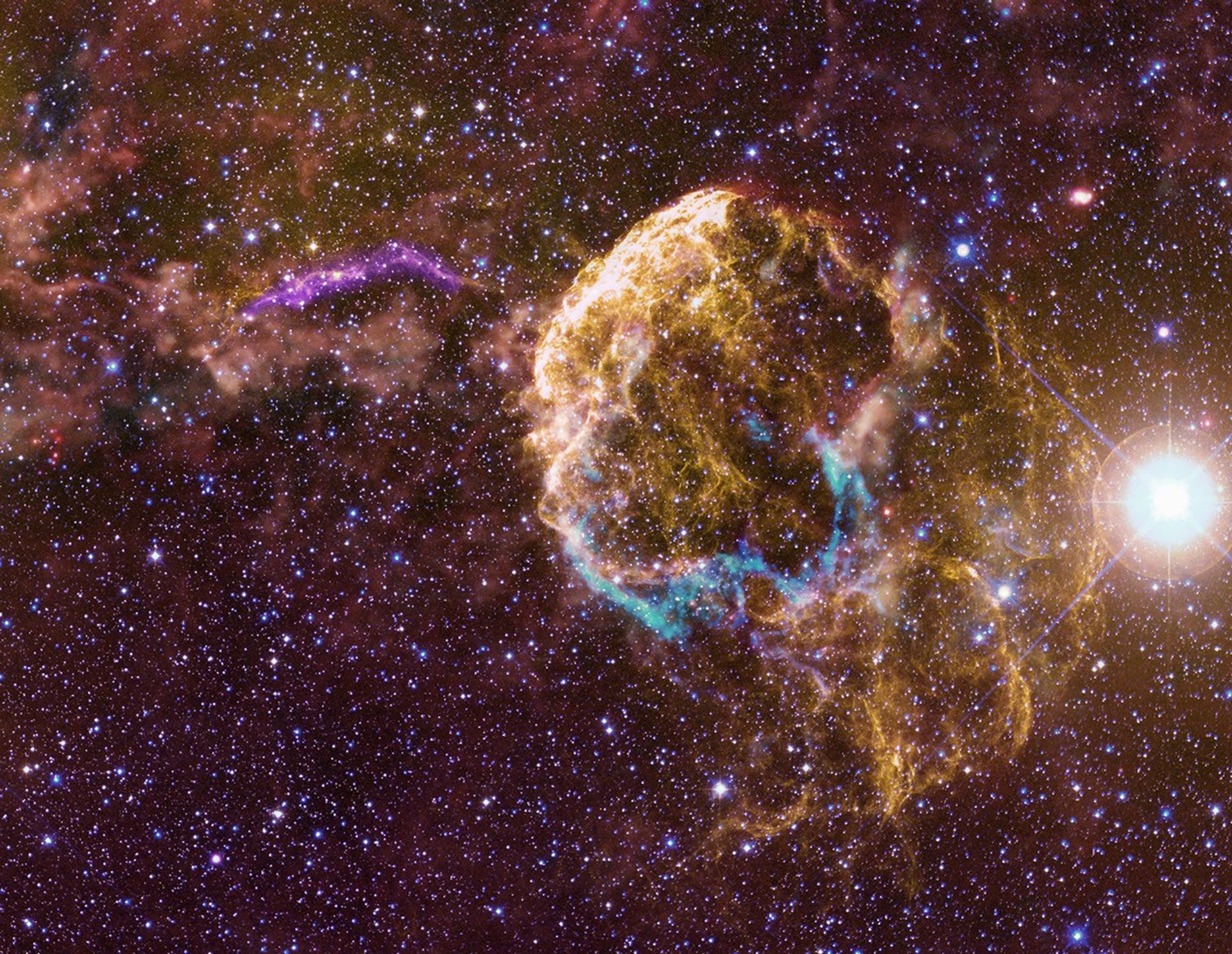
This multiwavelength scene shows the Jellyfish Nebula supernova remnant (right), the interstellar cloud it’s interacting with, and a distinctive curving filament to its upper left. The filament, which is shown here both in optical and ultraviolet (UV) light, is the visible part of an overlapping supernova remnant, G189.6+3.3, that is more prominent in radio and X-rays. Visible light is shown in yellow, UV from NASA’s Neil Gehrels Swift Observatory is shown in violet, and infrared light from NASA’s retired WISE (Wide-field Infrared Survey Explorer) mission appears in cyan, red, and orange. Both remnants are located about 6,000 light-years away in the constellation Gemini. The brilliant star at far right is Propus, also known as Eta Geminorum.
NASA Goddard Space Flight Center and M. Michailidis et al. 2026; optical: DSS; infrared: NASA/WISE/JPL-Caltech/UCLA; ultraviolet: NASA/Swift
“Using 16 years of data from NASA’s Fermi Gamma-ray Space Telescope, our analysis uncovered gamma rays associated with a supernova remnant that was hidden in the glare of its neighbor, the Jellyfish Nebula, one of the brightest gamma-ray-emitting supernova remnants known,” said Miltiadis Michailidis, a postdoctoral fellow in the physics department at Stanford University in California. “There are so many striking connections between the two remnants that we conclude they’re likely related, giving us the first known example of a binary system where both stars have undergone supernova explosions.”
Michailidis presented the findings Wednesday at the 248th meeting of the American Astronomical Society in Pasadena, California. A paper describing the results will appear in a future edition of Nature Communications.
The study focused on a faint supernova remnant called G189.6+3.3, which is mainly visible in X-rays. It is upstaged by its brighter and better-known neighbor, the Jellyfish Nebula (IC 443). The two star wrecks, both located in the constellation Gemini, appear to partially overlap as seen in X-rays. Recent X-ray evidence suggests that hot plasma likely associated with G189.6+3.3 may extend across the entire region, a hint that the overlap may be nearly total.
A massive star explodes when its energy-producing core runs out of fuel and collapses under its own weight, triggering an explosion that blows the star apart. The explosion’s shock wave encloses a hot cloud of debris that rapidly expands into space. So far, astronomers have cataloged about 300 supernova remnants in our galaxy.
The Fermi mission is part of NASA’s fleet of observatories monitoring the changing cosmos to help humanity better understand how the universe works. More than a decade ago, observations from Fermi’s LAT (Large Area Telescope) showed that the shock waves of supernova remnants accelerated particles to within a fraction of the speed of light, a process first proposed by physicist Enrico Fermi — the mission’s namesake — in 1949.
These high-speed particles, called cosmic rays, interact with interstellar gas to produce gamma rays, the highest-energy form of light. Protons make up 99% of cosmic ray particles. To prove that accelerated protons are responsible for the glow, astronomers search for a specific gamma-ray feature. When cosmic-ray protons smash into interstellar gas, they produce a short-lived particle called a neutral pion, which almost immediately decays into a pair of gamma rays. This emission occurs within a specific band of energies associated with the neutral pion’s mass and lies within the range detected by Fermi’s LAT instrument.
In 2013, Fermi observations proved that the Jellyfish Nebula, which is interacting with part of a glowing cloud of hydrogen gas known as Sharpless 249, produced gamma rays through this mechanism. Its neighbor, G189.6+3.3, was discovered in 1994 as part of an X-ray survey by the German-led ROSAT (Roentgen Satellite) mission.
A bright filament of gas lies between the overlapping remnants. New observations of this feature reveal that the shock wave from G189.6+3.3 slammed into dense interstellar gas there and dramatically slowed, key evidence that both remnants are interacting with the same cloud system.
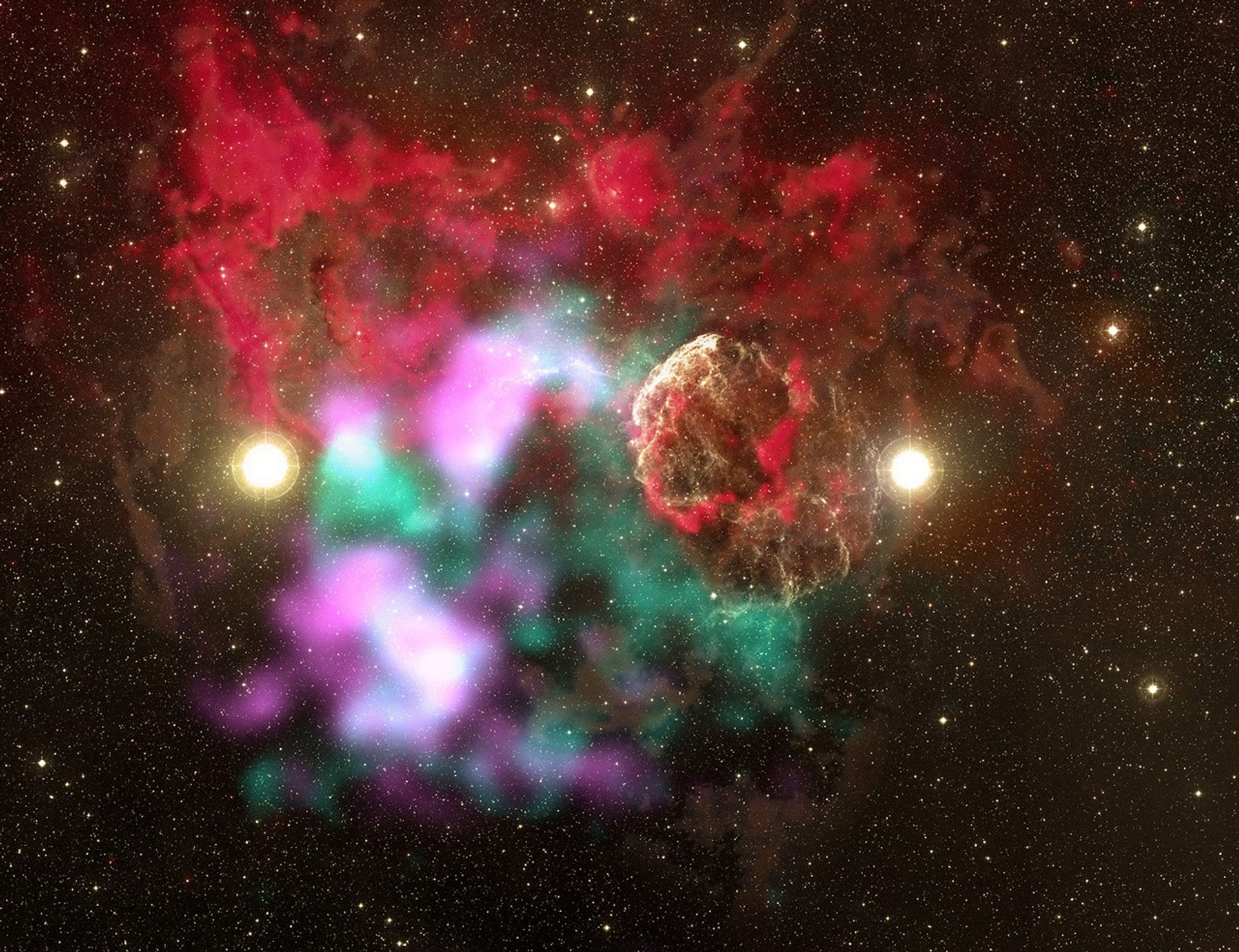
The well-known supernova remnant IC 443 (right) has an older, fainter neighbor (shown here in blue-green and magenta) called G189.6+3.3. A filament of gas between them, glowing in visible and ultraviolet light (violet arc at center), traces the neighbor’s shock wave and shows that both remnants are interacting with the same molecular cloud, shown in red, orange, brown for infrared and radio data and yellow for visible light. Blue-green shows X-rays from the fainter remnant, while magenta shows gamma rays with energies greater than 10 billion electron volts; for comparison, visible light has energies between about 2 and 3 electron volts. In this view, high-energy light from the much brighter IC 443 has been removed for clarity. Gamma-ray emission near the filament stems from protons accelerated in the supernova’s shock wave as it expands into the cloud.
NASA Goddard Space Flight Center and M. Michailidis et al. 2026; radio, MWISP and ESA/Planck; infrared: NASA/WISE/JPL-Caltech/UCLA; optical: DSS; ultraviolet: NASA/Swift; X-ray: SRG/eROSITA; gamma ray: NASA/DOE/Fermi LAT Collaboration
Astronomers think the Jellyfish Nebula is also a candidate PeVatron, a cosmic particle accelerator capable of boosting protons to energies so high they could nearly escape our galaxy. Such particles can produce gamma rays with trillions of times more energy than visible light. Finding a second particle accelerator near the Jellyfish Nebula could offer scientists new clues for how supernova remnants develop into PeVatrons.
“The overlapping remnants, a connecting gas filament, and the availability of data from Fermi and other facilities motivated us to delve into this complex but little-studied region,” said co-author Marianne Lemoine-Goumard, an astrophysicist at the French National Centre for Scientific Research (CNRS) based at the University of Bordeaux. “With Fermi’s LAT instrument, we found gamma-ray emission associated with accelerated protons in the northern part of the fainter remnant. If both remnants are interacting with the same structure, then they must share a common distance from us.”
The team concludes the remnants lie about 6,000 light-years away, their explosion centers are separated by roughly 40 light-years projected onto the plane of the sky, and the original stars may have been 20 or more times the Sun’s mass.
Estimates of the remnants’ ages vary widely, but the team concludes that the age of the Jellyfish Nebula is 8,000 to 9,000 years, while G189.6+3.3 is between 20,000 to 110,000 years old. This means the delay between the explosions could have extended for up to 100,000 years.
In addition, the team conducted computer simulations of a million massive binary systems. They show that systems where the stars orbit close enough to exchange matter and interact during their lives can readily produce dual supernova explosions with similar separations and time delays as those found for the remnants. The team also estimated that the chance of randomly encountering this combination of observed spatial alignment and compatible distances to be less than 1%, strongly supporting a physical association.
“The evidence we’ve compiled — including observations across the spectrum, the chemical and physical properties of the remnants, simulations, and more — paints a compelling picture of a dual supernova event,” said Michailidis.
This study identifies a unique possible example of a binary system where both stars exploded as supernovae and left behind separate, detectable supernova remnants. Astronomers think that most massive stars form in binary or multiple-star systems. The Jellyfish Nebula/G189.6+3.3 complex offers astronomers a rare opportunity to study how massive binary stars evolve, exchange matter, explode, and experience velocity changes — called kicks — induced by the supernova blast. It also provides a powerful new laboratory for understanding how coupled supernova remnants behave, including how they accelerate particles, generate gamma rays, and shape their surrounding environments.
“Fermi’s gamma-ray observations of supernova remnants continue to reveal the dynamic lives of stars,” said Elizabeth Hays, the Fermi project scientist at NASA’s Goddard Space Flight Center in Greenbelt, Maryland. “We can now connect the glowing remains of two massive stars to a powerful pair that evolved together over thousands of years.”
Employees increasingly use AI tools secretly at work despite restrictions, often sharing sensitive data while believing policies are inconsistently enforced.
A groundbreaking analysis of 173,303 exomes and genomes from the Pakistan Genome Resource (PGR) has unveiled compelling insights into the genetic architecture of human diseases and the therapeutic potential of loss-of-function (LoF) variants. This expansive dataset offers unprecedented resolution into homozygous loss-of-function (homLoF) mutations across diverse genes, providing critical human biological data that challenge and refine preclinical models. The ramifications for drug discovery are profound, underscoring the value of population-based genomic studies in elucidating gene function and safety profiles of potential therapeutics.
The PGR study corroborated previously established phenotypic associations for numerous homLoF variants. For instance, homozygous LoF mutations in LDLR were linked to hypercholesterolemia, while variants in LPL were associated with elevated triglyceride levels. Similarly, ANGPTL3 and APOB homLoF carriers exhibited notably reduced cholesterol and triglyceride profiles, whereas variants in ADCY3, POMC, MC4R, and MRAP2 were implicated in obesity phenotypes. These observations not only validate the penetrance of key metabolic genes but also affirm the rigorous phenotyping framework employed by the PGR.
Delving into therapeutically relevant homLoF variants, the study sheds light on the nuanced interplay between genotype and phenotype in neurodegeneration. LRRK2, a well-known protein kinase whose gain-of-function variants increase Parkinson’s disease risk, was examined in the context of loss-of-function. Notably, two PGR participants harboring homozygous LRRK2 pLoF variants exhibited early-stage kidney disease, a phenotype absent in heterozygous carriers. This human evidence mirrors renal dysfunction observed in LRRK2 knockout rodent models and preclinical trials with LRRK2 inhibitors in primates, suggesting a need for vigilant renal monitoring in therapeutic contexts targeting LRRK2.
In the realm of metabolic disease, a participant with a homLoF variant in SLC2A4—the gene encoding GLUT4—demonstrated type 2 diabetes, aligning with experimental models where GLUT4 deficiency impairs glucose homeostasis. Contrastingly, homLoF variants in DENND1B, previously linked to obesity and implicated in MC4R signaling pathways, did not confer obesity phenotypes in the cohort. This could indicate a lack of functional penetrance of DENND1B in human energy balance, differing substantially from prior murine models. Moreover, carriers of homLoF mutations in POMC, MC4R, and MRAP2 exhibited elevated BMI, reinforcing their contributory role to obesity.
Cardiovascular research insights emerged with RXFP1, a gene encoding a receptor extensively studied for its role in fertility, fibrosis, and cardiac function. Despite the gene’s pivotal role in murine reproductive and cardiovascular models—where its absence causes pronounced phenotypes—16 PGR individuals with RXFP1 homLoF variants spanned ages 30 to 73 years with no consistent deficits. Subtle associations with reduced waist-to-hip ratio and myocardial infarction risk were noted, and echocardiographic evaluations revealed mild variations in cardiac function among some homozygotes. Such findings suggest that the translational relevance of RXFP1 as a therapeutic target may be overestimated from rodent data, urging a recalibration of expectations for RXFP1 agonist therapies.
The hepatoprotective potential of CIDEB inhibition also gained support from PGR findings. Fourteen individuals homozygous for CIDEB loss-of-function variants displayed no liver disease, and burden analyses correlated CIDEB deficiency with decreased levels of liver enzymes ALT and AST and a reduced risk of non-alcoholic fatty liver disease. This human genetic evidence bolsters the rationale for targeting CIDEB therapeutically with siRNA or other modalities, highlighting an encouraging safety profile for chronic intervention.
Surprising evolutionary biology insights were uncovered in the reproductive gene PRDM9, a histone methyltransferase essential for meiotic recombination hotspot determination. While Prdm9 knockout mice exhibit infertility, PGR identified multiple human homLoF variant carriers of PRDM9 with proven fertility and successful reproduction. This stark species divergence reveals that PRDM9’s indispensability in meiosis is not conserved in humans, emphasizing the complexity of translating mouse genetic models to human biology.
Sensory gene analyses revealed functionally impactful homLoF mutations in TRPM8, an ion channel activated by cold stimuli. RBG cohort phenotyping demonstrated that carriers exhibited delayed cold-induced pain sensitivity and increased tolerance to cold-related discomfort, aligning with murine knockout models. Intriguingly, genome-wide association studies link TRPM8 variants to migraine susceptibility, positing TRPM8 inhibition as a promising therapeutic avenue. The PGR data indicate that complete loss of TRPM8 is generally well-tolerated, mitigating safety concerns for pharmacological antagonism targeting migraine prevention.
Collectively, these results highlight the critical importance of integrating large-scale human genomic data with functional assays to delineate gene-disease relationships and therapeutic potential. The PGR exemplifies how comprehensive population-based sequencing can validate, refine, or refute biological assumptions derived from animal models, fostering a more precise paradigm for drug target validation. By profiling rare homLoF variants and linking them with detailed phenotypic data, the study provides invaluable resources for developing safer, more effective genetic-driven therapies.
This study also accentuates the value of consanguineous populations, such as the Pakistani cohort, which enrich for homozygous rare variants and enable the detection of recessive phenotypes difficult to observe in outbred populations. Such datasets maximize the discovery power for identifying natural human knockouts, thereby informing on both the efficacy and potential deleterious effects of gene inactivation.
Beyond specific gene findings, the broader implication is a caution against uncritical extrapolation from model organisms to human physiology. While murine models remain indispensable, discrepancies evidenced in PRDM9 and RXFP1 underscore that human genetic data are indispensable for accurate target validation and safety assessment. This alignment between genotype, phenotype, and therapeutic action forms the cornerstone of precision medicine.
As the PGR and similar initiatives continue to expand, the integration of genomics with phenotypic and clinical data will catalyze a new era of therapeutic development truly grounded in human biology. The promise of harnessing human loss-of-function variants lies not only in uncovering disease mechanisms but also in guiding drug discovery toward targets with validated human safety and efficacy profiles, ultimately accelerating the path from bench to bedside.
This landmark study published in Nature offers a crucial template for leveraging population genomics in drug development, emphasizing the necessity of human genetic evidence to underpin the next generation of therapies. The insights gleaned provide a roadmap for more rational, genetics-informed clinical decision-making, heralding a future where personalized medicine and pharmacogenomics converge to transform healthcare.
Subject of Research: Genomic analysis of homozygous loss-of-function variants in the Pakistan Genome Resource and their implications for human disease and drug target validation.
Article Title: Analysis of 173,303 exomes and genomes in the Pakistan Genome Resource.
Article References:
Koch, C., Khalid, S., Khan, M.Z. et al. Analysis of 173,303 exomes and genomes in the Pakistan Genome Resource. Nature (2026). https://doi.org/10.1038/s41586-026-10667-5
 Login