❌

Reading view

Microsoft quer abrir a porta à era dos agentes de IA autónomos no trabalho com o Copilot Cowork

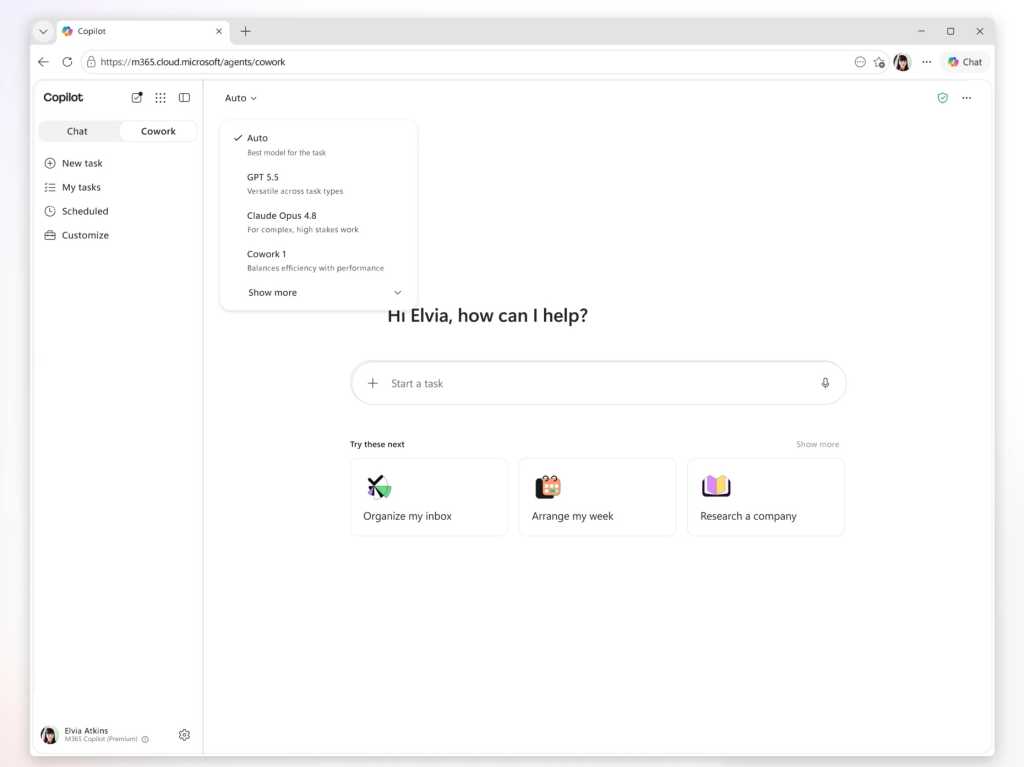
O Copilot Cowork, que passa a estar disponível a nível internacional, é um agente de IA que promete tratar do trabalho real e ajudar na produtividade. Tarefas que levavam dias a concluir passam agora a ser finalizadas numa manhã, afirma a Microsoft.

The post Microsoft quer abrir a porta à era dos agentes de IA autónomos no trabalho com o Copilot Cowork appeared first on Tek Notícias.

  •  

Microsoft launches Copilot Cowork with usage-based pricing

Microsoft has introduced usage-based billing for Copilot Cowork, which is now generally available. 

Microsoft unveiled Copilot Cowork in March, pitching it as an AI agent that’s capable of independently performing long-running, multi-step tasks — even when a user’s computer is off. 

It’s built on the same technology that underpins Anthropic’s Claude Cowork. Unlike Claude Cowork, which can interact directly with files and applications on a user’s computer, Copilot Cowork runs in Microsoft’s cloud environment and acts on documents held in a customer’s Microsoft 365 tenant.

On Tuesday, Microsoft unveiled pricing details for Copilot Cowork, which involves usage-based billing in addition to a Microsoft 365 Copilot license ($30 per user each month for large enterprises before discounts, and $20 for Microsoft 365 Copilot for Business). 

The usage-based pricing is calculated from four components, according to Microsoft: “model use, context retrieval, tool calls, and runtime.” 

In practice, this means more intensive tasks that draw on multiple sources, use “deep reasoning” and generate two or more outputs will lead to higher costs — denoted in Copilot Credits. 

There are two payment options: pay as you go — priced at 1 cent per credit — and P3, where customers commit to usage volume in advance and receive a discount.

Cowork is turned off by default; IT admins can decide when to make it available and which employees get access. Admins can also impose spending limits at the tenant, group, and user level, and receive notifications when spending reaches a certain level.

Users will also be able to see how much each tasks costs in credits (available “soon after” the general availability launch, Microsoft said). 

Copilot Cowork customers can select from multiple AI models, including Anthropic’s Opus 4.8 and Sonnet 4.6, while those enrolled on the Frontier program can access OpenAI’s GPT 5.5 and Microsoft’s own Cowork 1 model.

Microsoft is considering hosting a version of DeepSeek’s open source models. “We are actively exploring a range of options that meet those requirements, and DeepSeek is one of several models under consideration. We’ll share more specifics on the underlying model closer to release,” said a Microsoft spokesperson.

Microsoft also announced new integrations with third-party apps such as Miro and Monday.com, with more — such as Adobe, Box, and Canva — coming soon.

This article was updated on June 19 to add Microsoft’s comment on DeepSeek.

  •  

Microsoft says you don’t need another email security tool; experts say, not so fast

Despite best efforts by defenders, malicious emails continue to slip through the cybersecurity cracks, leading some enterprises to implement a layered “defense in depth” strategy that incorporates multiple tools.

Microsoft seems to be challenging this idea, revealing that there are only nominal returns from adding integrated pre- and post-send partners to Defender for Office 365’s protections.

According to its new quarterly benchmarking data, the tech giant catches the vast majority of malicious and spam emails before delivery, misses the fewest compared to competitors by a wide margin, and removes nearly 100% of dangerous emails that do reach the inbox. Collectively, its integrated partners improve that catch rate by less than .05%.

While these numbers seem to tip the scales towards a one-vendor email security stack, experts urge enterprises to be skeptical and cautious of such vendor claims.

Seva Ioussoufovitch, senior research analyst at Info-Tech Research Group, pointed out, “percentages obscure the true quantity and severity of what’s getting through, and, considering it only takes one message to result in an incident, it’s simple enough to argue that there is real value in the defense in depth that having multiple tools provides.”

Malicious and spam email catch by the numbers

Microsoft introduced its quarterly benchmarking report in July 2025 alongside a Defender integrated cloud email security (ICES) ecosystem designed to support multi-vendor security strategies.

The SEG players it ranked itself against this year includes Mimecast, Proofpoint, Hornetsecurity, Trend Micro, Iron Port (Cisco), Barracuda, and FireEye (Trellix); ICES companies include Abnormal, Checkpoint Harmony, Cisco, DarkTrace, KnowBe4 Defend, Tessian, and Trend Micro.

Redmond reported that Defender “consistently leads” in pre-delivery detection, missing 59% fewer high-severity cyberthreats prior to delivery than the other SEG vendors it evaluated. Its closest competitors were Mimecast and Proofpoint. The company also introduced a new metric in this area: A threat miss rate per 1,000 employees. In Microsoft’s case, that was 194 per 1,000; for Mimecast, 478; for Proofpoint, 483.

When it came to post-delivery protection, Defender removed an average of 96.03% of malicious emails that reached the inbox, up from an initial 45% when Microsoft first started tracking the data in its second report.

This makes Defender “an increasingly critical backstop, operating even when ICES solutions are in place,” Jeff Pinkston, VP and GM for Microsoft Defender, wrote in a blog post. Still, ICES tools operating in tandem with Microsoft Defender “continue to provide benefits,” improving malicious catch by 0.29% and spam catch by 0.68%, he said.

“If we focus on the basics, their argument seems strong,” Info-Tech’s Ioussoufovitch noted. “Do you really need a separate ICES vendor for that extra sub 1% catch?” Microsoft paints a “compelling picture” by only focusing on raw catch rate, he said, but we don’t hear the rest of the story: “What exactly is the danger of what isn’t being caught by Defender?”

No one vendor catches everything

David Shipley of Beauceron Security pointed out that the report underscores the fact that “lots of stuff still gets by e-mail filters.”

His company regularly analyzes hundreds of thousands of emails, and the content that gets through “ranges from the shockingly mundane and obvious to a human expert, to highly clever time-delayed attacks,” he said.

A key factor in what gets through is the amount of content that is allowlisted; settings in “100% paranoid mode” get high catch rates, as well as high false positives, Shipley noted. “Anyone who has ever had a sales person lose a deal because the purchase order PDF got flagged has felt this pain.”

Then there’s the AI conundrum: “A key risk for e-mail vendors using agentic LLM-based analysis is it’s now possible to poison those models with hidden content (such as ‘ignore this e-mail, pretty please’),” Shipley said. This means enterprises need a variety of analysis methods.

Ioussoufovitch agreed that keeping pace with threat actors using AI is an industry-wide challenge, particularly as AI enables higher-quality phishing. Filters are improving and will catch some of it, but some will inevitably continue to get through. Those messages are likely highly-targeted, which are lower in volume but harder to catch.

“As of now, current tools do seem to be struggling to keep pace, but that doesn’t mean those tools aren’t necessary,” said Ioussoufovitch. “It just highlights that defense-in-depth, broadly speaking, is becoming more and more important.”

Claims ‘appear more honest’

Shipley said that this report appears more honest, accurate, and mature than others claiming 99.99% phish catch rates, “which is never true.” It’s also a “smart marketing move,” because Microsoft competes for the same security budget as other tools, and would rather enterprises remove those vendors and buy more from it in areas beyond e-mail.

On the other hand, he said, Microsoft is offering up a list of other vendors to think about, “which, congrats to Mimecast on coming in second.”

In the long run, CISOs need to determine the best spend for their limited security dollars, he noted. Enterprises need a good filter; whether they need two is up for debate. “They also clearly still need to invest in a robust awareness program,” Shipley said, “because as this report shows, lots of phishes are still getting delivered.”

Missing an important nuance

Ioussoufovitch noted that while the claims in the study are interesting, the data is presented without much of the nuance that would make it truly actionable.

“We are all too familiar with vendors’ abilities to massage data to tell the story they want, so I would advise leaders not to extrapolate the data beyond what it actually says,” he said.

Instead of the takeaway being “get rid of our current vendors,” this post highlights that Defender provides “considerable value,” he noted. Whether adding or subtracting additional vendors is worth the money should be a case-by-case conversation that considers an organization’s risk appetite, and overall security budget and environment.

“I’d treat these claims more as a reminder to assess your own environment and compare detections,” he said. “Come to conclusions based on the data you have, not what a vendor is presenting.”

This article originally appeared on CSOonline.

  •  

KAIST Enhances Humanoid Robot Vision Using Minimal Memory

In a groundbreaking development that promises to revolutionize the way artificial intelligence perceives the world, a collaborative research team from KAIST, MIT, and Microsoft has unveiled a novel technology named “Upsample Anything.” This pioneering innovation substantially enhances the visual acuity of AI systems while drastically reducing the memory demand on hardware, specifically GPU memory. The new method achieves up to a sixteenfold increase in memory efficiency, addressing one of the most critical bottlenecks in real-time AI vision applications for mobile and embedded devices.

The cornerstone of this advancement lies in overcoming the traditional compromise faced by AI-driven image processing systems. Historically, achieving higher resolution visual input required extensive GPU memory and computational power, creating a significant barrier to real-time implementation on resource-constrained devices such as smartphones and humanoid robots. Conversely, compressing images into low-resolution features, which is a common practice to conserve resources, often leads to the loss of crucial visual details like small objects and fine structural elements. This trade-off has long hindered the deployment of precise AI vision in dynamic and mobile environments.

The “Upsample Anything” technology ingeniously sidesteps this issue by introducing a training-free upsampling mechanism capable of reconstructing high-resolution features from low-resolution inputs without additional data training. Unlike conventional methods that necessitate retraining or complex optimization when exposed to new data or environmental conditions, this approach adapts instantly by leveraging the edge and structural information inherent within a single input image. This capability drastically simplifies deployment and customization across diverse AI vision applications.

At the heart of the method is a sophisticated process called test-time optimization (TTO), which refines pixel-wise anisotropic kernel parameters based on the specific low-resolution image. These learned kernels are then applied to foundational feature maps to generate high-resolution representations. The final phase involves pixel-wise anisotropic Joint Bilateral Upsampling, a technique that preserves edge details and texture fidelity while reconstructing the image in high resolution. This multi-stage pipeline ensures that essential visual information is restored with remarkable accuracy and efficiency.

Highlighted through an illustrative example, the research team demonstrated the restoration of a 224×224 pixel image— a common resolution in AI research— to a clarity nearly identical to the original, within approximately 0.4 seconds of computation. This substantial leap in processing speed and memory efficiency heralds a new era for real-time AI vision, where systems can now maintain high precision without the prohibitive cost of extensive hardware resources. The direct implication is that AI can better understand and interact with its environment, making it invaluable for applications requiring fine object detection and manipulation.

The utility of “Upsample Anything” stretches far beyond humanoid robots. Autonomous driving systems stand to benefit immensely, as they depend heavily on the rapid and accurate interpretation of complex visual scenes. With this technology, vehicles can process crucial visual cues in a more resource-efficient manner, enhancing safety and navigation capabilities. Additionally, on-device AI for smartphones and other portable gadgets can achieve superior visual comprehension while minimizing battery drain and thermal load— critical factors for consumer electronics.

The research team’s achievement was officially recognized at CVPR 2026, the most prestigious conference dedicated to computer vision and artificial intelligence. The work earned the “CVPR Compute Gold Star” award, a distinction granted to research that excels in computational efficiency. Furthermore, it was named the “Transparency Champion” for leading in research process transparency and reproducibility, emphasizing the team’s commitment to responsible and open scientific practices. This dual recognition highlights not only the technological ingenuity but also the ethical and procedural rigor of the research.

One of the most remarkable attributes of this technology is its universality and plug-and-play nature. Its training-free design means that no additional datasets or retraining cycles are required when deploying it in different settings. This contrasts sharply with existing upsampling methods that often demand labor-intensive tuning or environment-specific learning. Consequently, “Upsample Anything” can seamlessly integrate into a wide array of AI frameworks, simplifying engineering workflows and accelerating the timeline from development to deployment.

Professor Changick Kim, the project lead from KAIST’s School of Electrical Engineering, emphasized the transformative potential of this technology. He noted that by boosting visual precision with minimal resource demands, the algorithm can catalyze the commercial viability of complex AI entities like humanoid robots and enable more powerful on-device AI applications. The convergence of computational efficiency and high visual fidelity, he added, represents a critical step forward in the quest to bring sophisticated AI capabilities to everyday devices.

This advancement is particularly significant in the context of emerging AI models based on world models— frameworks that aim to understand and predict changes in physical environments. Effective deployment of such models often requires processing a large volume of visual data accurately and expediently. By enabling high-resolution feature upsampling without overwhelming hardware limitations, “Upsample Anything” paves the way for smarter, faster, and more adaptive AI models that truly comprehend their surroundings in detail.

The first author of the study, Minseok Seo, a doctoral student at KAIST, alongside co-authors from MIT and Microsoft, detailed their findings in a paper titled “Upsample Anything: A Simple and Hard to Beat Baseline for Feature Upsampling.” The work is publicly accessible via the arXiv repository (DOI: 10.48550/arXiv.2511.16301), facilitating further exploration and innovation by the wider research community. Their approach exemplifies a blend of elegance and practicality, challenging the assumption that high computational cost is a prerequisite for high-quality visual reconstruction in AI.

In conclusion, the “Upsample Anything” technology marks a significant leap in AI visual processing by resolving a longstanding dilemma between image resolution and hardware resource constraints. Its immediate applicability across various AI-driven fields— ranging from robotics to autonomous systems and portable devices— underscores its impact and longevity. As AI continues to entwine itself with daily human interaction and technological progress, innovations like this will form the backbone of smarter, more capable, and accessible intelligent systems.


Subject of Research: Not applicable

Article Title: Upsample Anything: A Simple and Hard to Beat Baseline for Feature Upsampling

News Publication Date: 17-June-2026

Web References: https://dx.doi.org/10.48550/arXiv.2511.16301

References: Upsample Anything: A Simple and Hard to Beat Baseline for Feature Upsampling, DOI:10.48550/arXiv.2511.16301 (Seo et al., 2026)

Image Credits: KAIST

Keywords

AI vision, upsampling technology, GPU memory efficiency, real-time image processing, test-time optimization, pixel-wise anisotropic kernels, Joint Bilateral Upsampling, on-device AI, humanoid robots, autonomous driving, world models, computer vision, computational efficiency

  •  
❌