❌

Reading view

OpenAI buys Ona to help rein in AI agents

CIOs and CISOs have many strategic and operational fears when it comes to unleashing fully-autonomous agents on tasks and hoping that everything works out. Will the agent start to delete critical files? Will the agent go off on a mission tangent and generate a massive token bill for the team when they return the next morning? Will it be tricked by a state actor and engage in malicious actions?

To help alleviate those concerns, OpenAI announced on Thursday that it has agreed to acquire Ona, a 79 person cloud development environment (CDE) provider formerly known as Gitpod, to accelerate its efforts to make agentic AI enterprise-friendly. 

An OpenAI statement said Ona’s technology “provides secure, persistent environments where agents can access the tools, systems, and context they need to make progress over time. By bringing Ona to OpenAI, we will expand Codex beyond work tied to a single device or active session and help more organizations deploy agents securely in production.”

An Ona statement attributed to CEO Johannes Landgraf shared similar sentiments.

“Ona brings the building blocks agents need for enterprise work: trusted, customer-controlled cloud environments where work continues across devices, inside the systems where software actually lives,” Landgraf said. “OpenAI brings frontier intelligence, product polish, and a scale of research and distribution we could never reach alone.”

Landgraf’s statement did not provide any annual revenue numbers, but did hint, without naming, at some large customers. “Since the beginning of the year, weekly Ona agent sessions have grown 13x in production across some of the world’s most demanding institutions: the oldest bank in the US, one of Europe’s largest pharma companies, one of Asia’s largest sovereign wealth funds and many others,” he wrote. “The largest enterprises out there love the platform and are expanding more rapidly than ever before.”

Arnal Dayaratna, research VP for software development at IDC, said IDC’s figures for Ona put its annual revenue for 2025 at “roughly $7 million.” He speculated that Ona’s revenue for 2026 would be higher: “Let’s say it’s $15 million. I am being generous. Maybe it’s really $10 million or $12 million.”

Dayaratna said if he uses a standard acquisition price of roughly a multiple of 30 times revenue, then depending on the actual 2026 figure, “that comes to $450 million or $500 million or so.”

But IDC sees this being a potentially good move for OpenAI, regardless of the specific acquisition price, given that OpenAI had the classic “buy or build” challenge. 

OpenAI has a substantial Codex effort, Dayaratna said, but what they lack is a safe area to protect enterprise autonomous agent efforts. “This is outside of what OpenAI has now. These are secure environments where agents can have memory and operate securely,” he said. “This is the kind of technology that one would expect to be needed, but I don’t know how good it is, to be honest.”

Gartner’s First Take, published today, noted that the acquisition will bring Codex “the essential scaling capability it lacked,” but also pointed out it forces some difficult decisions on enterprises: “Software engineering leaders must weigh the benefits of a vendor-specific integrated stack against the flexibility of staying vendor-agnostic.”

In addition, Gartner wrote, “This acquisition appears to be OpenAI’s response to Anthropic supporting self-hosted sandboxes in Claude Managed Agents, starting May 2026.”

Tom Findling, CEO of Conifers.ai, said he also sees OpenAI’s fear of Anthropic playing a meaningful role in this deal. 

“It feels like a move to keep pressure on Anthropic, especially as Claude Code gains traction with developers and enterprise buyers,” he said. “So I’d read this less as OpenAI taking out a small competitor and more as OpenAI trying to make sure Codex is enterprise-ready before Anthropic gets too far ahead. In the enterprise market, the battle is not just who has the smartest coding model, but who can make AI agents safe and useful enough for big companies to actually deploy.”

He added, “I don’t think this means OpenAI suddenly needs help making Codex better at writing code. The bigger issue is making Codex work inside real enterprise environments, where security, access controls, persistent cloud workspaces, audit trails, and integration with existing developer workflows matter just as much as the model itself. Ona gives OpenAI some of that missing plumbing.”

Jason Andersen, principal analyst for Moor Insights & Strategy, echoed the concerns about Anthropic.

“To be honest, I think it reinforces what I think, which is that OpenAI and Codex have given a lot of ground to Anthropic and Claude Code, who are winning right now,” he said. “But again, this is not about the market today, I think it’s about how OpenAI will need to position itself as more than just a model as we see the incumbent players, particularly Microsoft, bolster their enterprise coding infrastructure story.”

Andersen said that Moor doesn’t have any strong basis for a guess on the financials, but added, “I am going to assume it was a fairly high multiple, but on a small base. I would not speculate on an amount, but given the enterprise customers that Ona did have, it may be more than we think.”

He also reinforced the idea that OpenAI is going to need help to achieve its own objectives.

“We continue to see that AI adoption is strongest in coding, and other use cases are not as far along,” he said. “So, if you are a general-purpose AI company like OpenAI, you need to double down on development use cases. The meaningful investment and spending on development is happening at the enterprise level, and those customers have more demands for governance, security, etc. than Codex or Claude code can handle.”

That said, he noted, “what you’re seeing is traditional software and cloud plays building out the coding and ops infrastructure around the popular models. That increased competition, while good for selling tokens, is still keeping OpenAI and Anthropic on the outside looking in. So, OpenAI and Anthropic need a stronger enterprise dev story, or they are just another model that could be easily replaced.”

Jeremy Roberts, senior director at Info-Tech Research Group, said that he also sees this as likely a good move for OpenAI.

“OpenAI is growing up a little bit,” and they may be falling behind Anthropic, Roberts said. “I see Ona as a boring company, but not in a bad way. They are not flashy, but absolutely necessary.”

Ona is delivering a workspace for Codex that an enterprise can run in its own virtual private cloud, with governance and persistence and an environment where the company can apply their own controls including log management, credential management and resource access, he said. “It is a bucket for the agents to operate in” where IT can “make sure that access is properly credentialed and is controlled effectively to prevent the model doing what it shouldn’t be doing,” which includes managing read/write protections.

  •  

Software engineer reportedly wins religious exemption from AI use

When Pope Leo XIV wrote about the effect that AI is having on our world in his encyclical, Magnifica Humanitas, he may not have imagined the document being referenced in an HR environment.

But, according to a report by Business Insider, Erin Maus, a software developer in North Carolina, used the Pope’s message about the need for vigilance in how AI would be deployed to gain a special exemption from her employer about using the technology for coding.

Maus is not even a Catholic but a Unitarian Universalist, according to the report. However, it said, she maintained that the use of AI didn’t align with her religious beliefs.

Business Insider said that to make her case, she consulted an employment lawyer — a move to be expected — and her local chapter’s minister — which probably wasn’t. Her wishes were reportedly granted last month. “I’m writing my code and reviewing my code by hand, which seems crazy to say,” she told the publication.

She’s certainly not alone in wondering whether AI is always the way forward for techies: a journalist at PC World has also been rethinking its use after reading the encyclical.

It remains to be seen whether this will be the spur for a torrent of claims from Catholic workers, asking to be freed from the demands of using AI or whether Business Insider’s report is an outlier.

  •  

World Cup Fever in Guadalajara

April 13, 1986
April 27, 2026
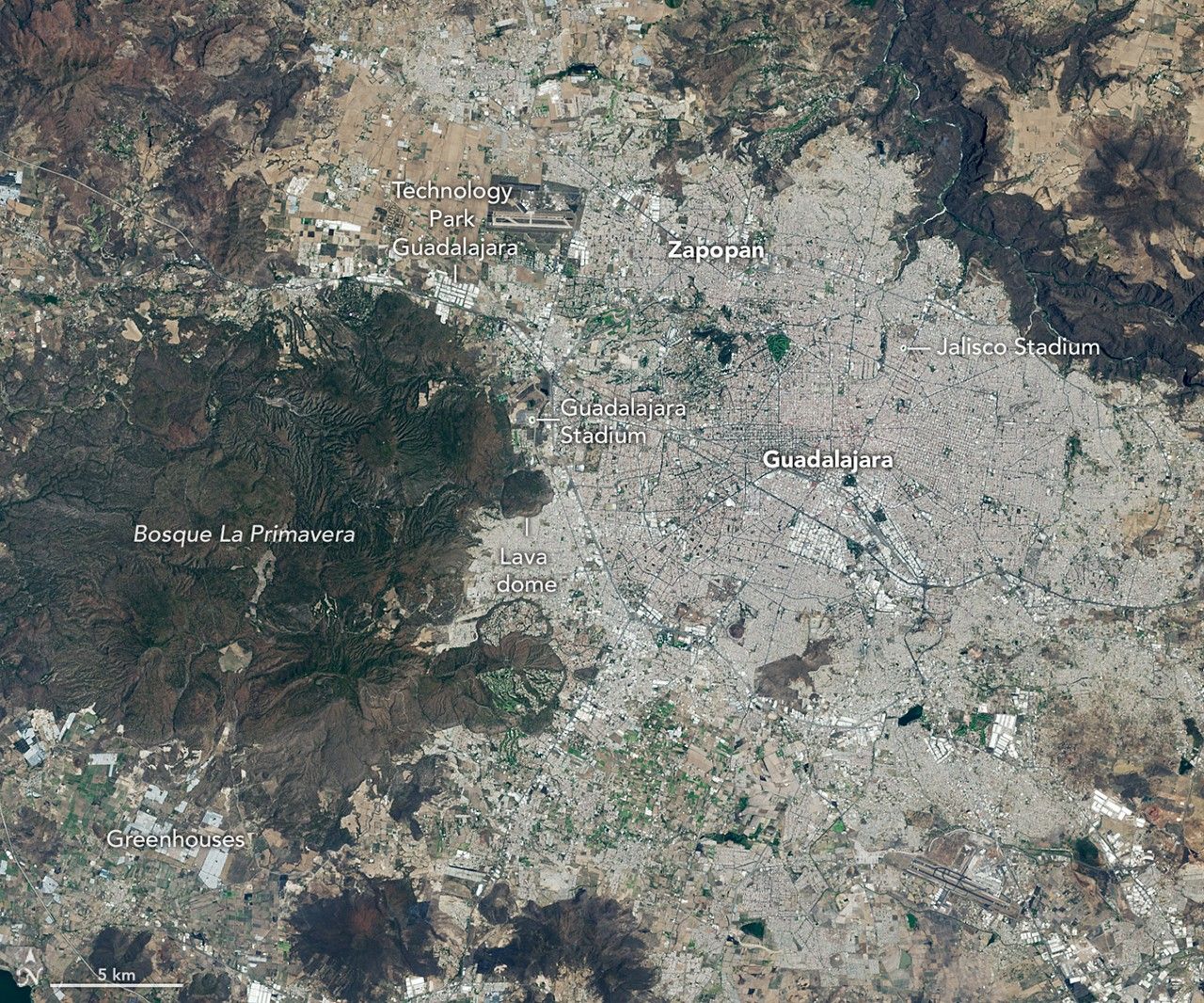
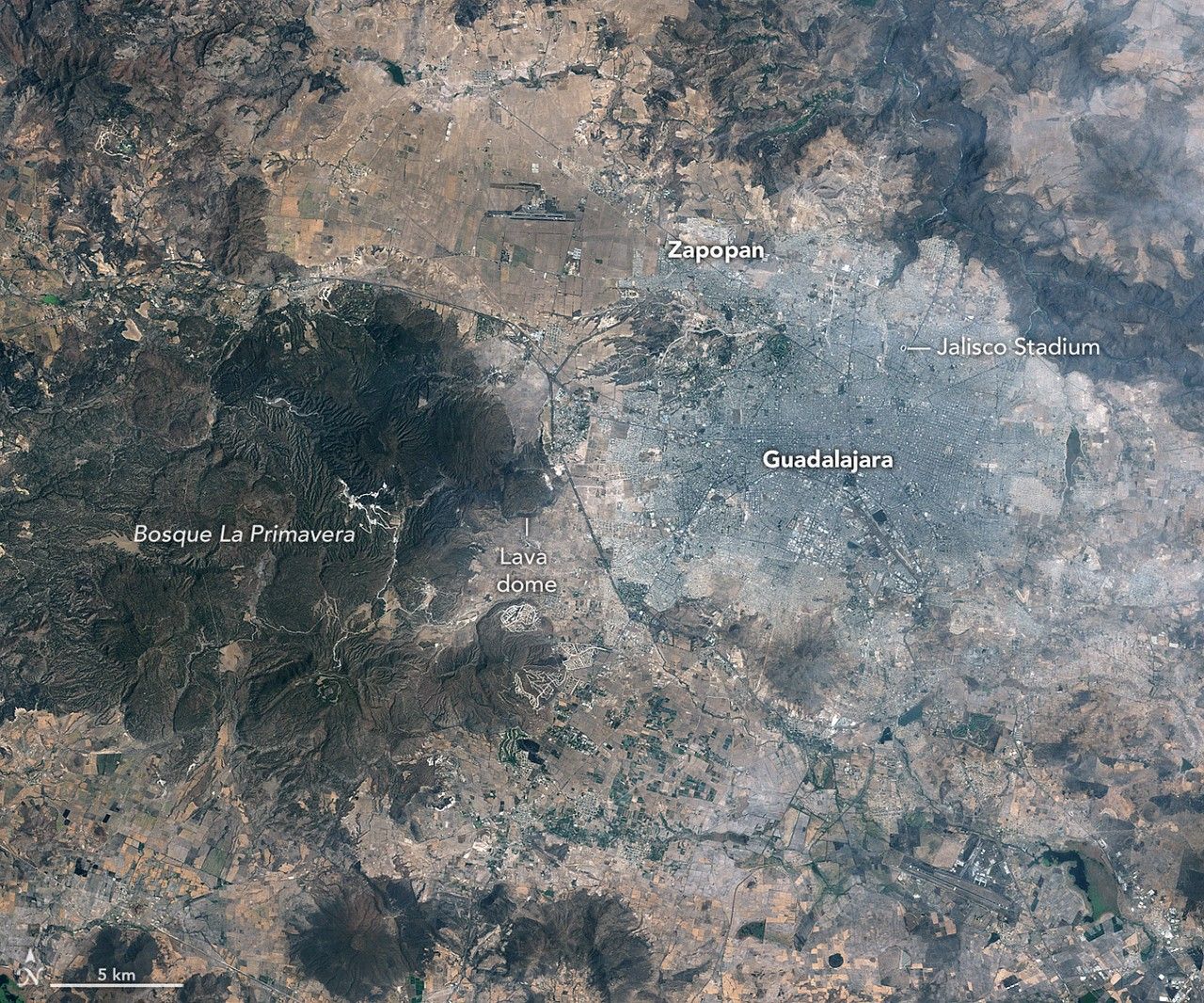
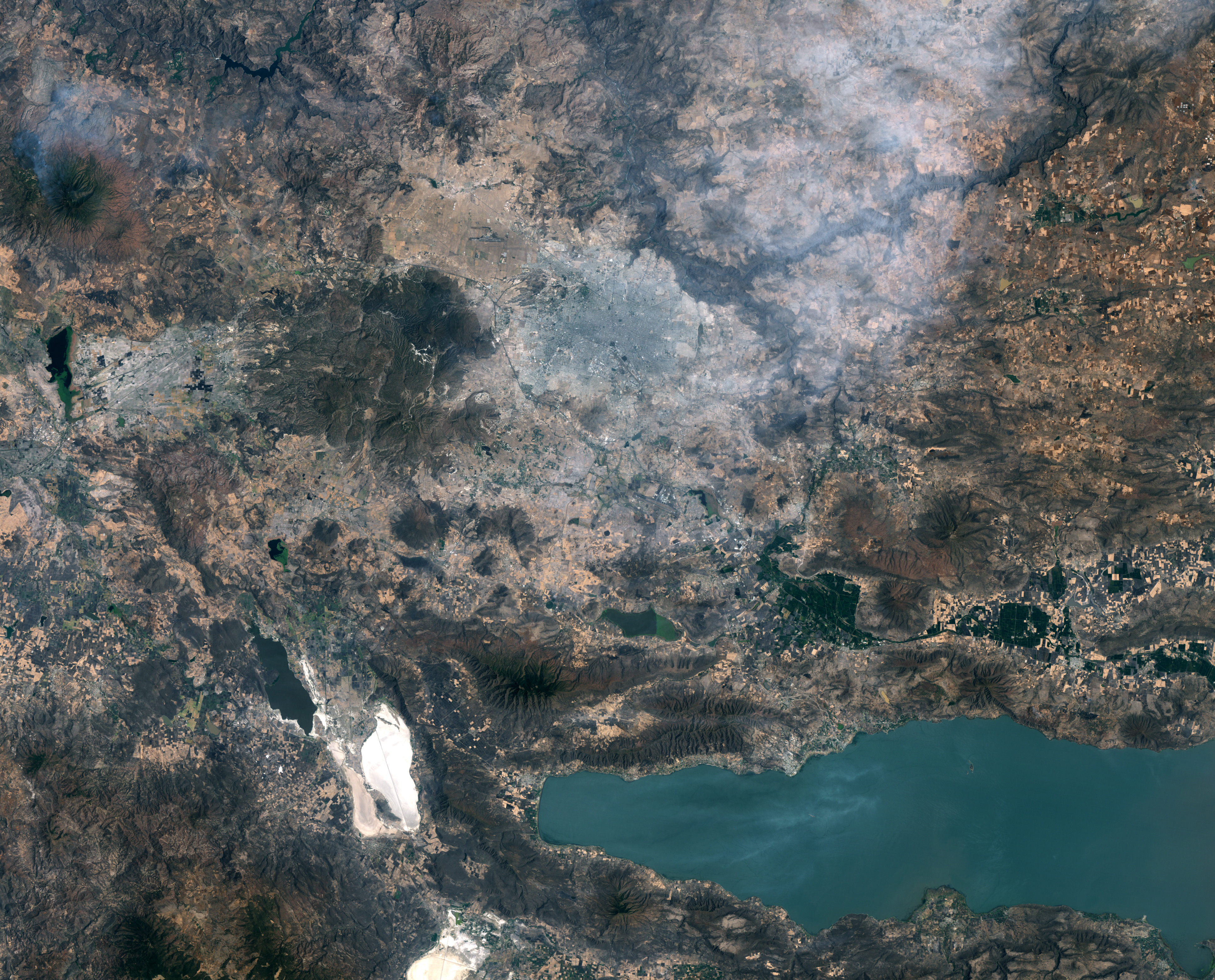
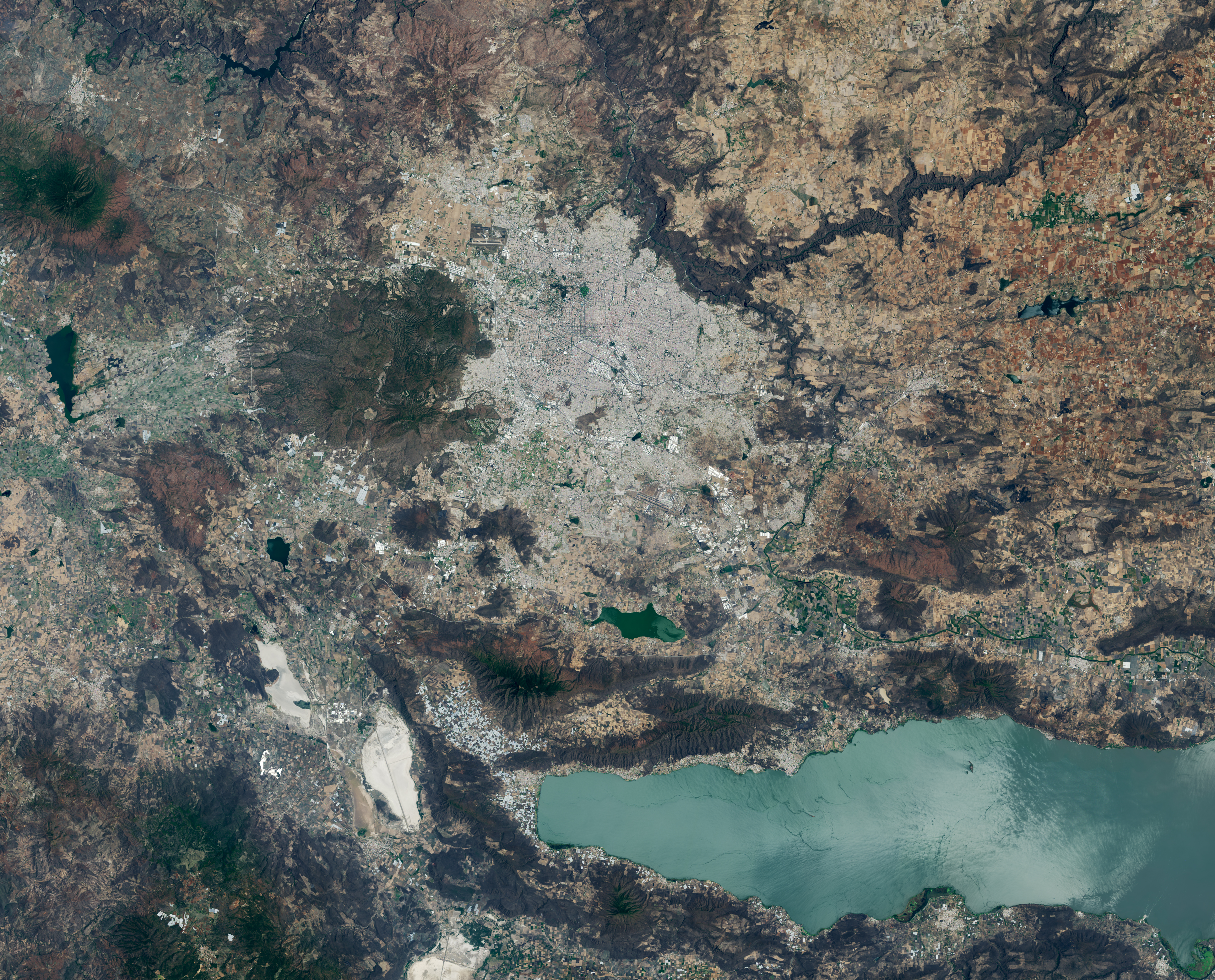
: Images of Guadalajara in 1986 (left) and 2026 (right) shows the city expanding westward into an area that had been mostly farmland. Guadalajara Stadium appears as a small circular feature on the left side of the 2026 image.
A pair of Landsat images shows 40 years of westward urban expansion from Guadalajara, Mexico. The Thematic Mapper on Landsat 5 captured the left image in 1986; the Operational Land Imager on Landsat 8 captured the right image in 2026.
Images of Guadalajara in 1986 (left) and 2026 (right) shows the city expanding westward into an area that had been mostly farmland. Guadalajara Stadium appears as a small circular feature on the left side of the 2026 image.
A pair of Landsat images shows 40 years of westward urban expansion from Guadalajara, Mexico. The Thematic Mapper on Landsat 5 captured the left image in 1986; the Operational Land Imager on Landsat 8 captured the right image in 2026.
NASA Earth Observatory / Lauren Dauphin
April 13, 1986
April 27, 2026

April 13, 1986 – April 27, 2026

A pair of Landsat images shows 40 years of westward urban expansion from Guadalajara, Mexico. The TM (Thematic Mapper) on Landsat 5 captured the left image in 1986; the OLI (Operational Land Imager) on Landsat 8 captured the right image in 2026.

Guadalajara, Mexico, was quite a different place when it last hosted World Cup games 40 years ago. The city welcomed matches in June 1986 and did so again in 2026, when South Korea faced Czechia at Guadalajara Stadium in the opening round of the 2026 FIFA World Cup.

In 1986, Guadalajara Stadium had not yet been built in Zapopan, the fast-growing municipality just northwest of Guadalajara. Many of that year’s World Cup matches were held instead at Jalisco Stadium in northeastern Guadalajara. It was in that stadium that France defeated Brazil in a penalty shootout in the 1986 quarterfinals, in what is widely regarded as one of the most memorable World Cup games of all time.

As seen in the Landsat images above, the land where Guadalajara Stadium (also called Estadio Akron) now sits was farmland in 1986. The new stadium, built in 2010 to host Mexico’s Club Deportivo Guadalajara, or Chivas, lies near the Sierra la Primavera volcanic complex, a rugged landscape full of lava flows, volcanic domes, steam vents, and hot springs. The architects who designed the stadium took inspiration from the nearby volcanic terrain, creating a structure that rises from a grassy earthen berm meant to resemble the flanks of a volcano, topped with a white roof reminiscent of a volcanic cloud.   

About 95,000 years ago, the volcanic system underneath Sierra la Primavera produced a massive eruption that caused a caldera 11 kilometers (7 miles) in diameter to slump downward. Water filled the depression for tens of thousands of years, but tectonic uplift and the accumulation of sediment eventually led to the demise of the lake. Erosion wore away the softer surrounding rock over time, leaving harder, erosion-resistant volcanic rocks within the circular feature that now stand high above the surrounding terrain.

Starting about 60,000 years ago, several lava domes erupted along the southern edge of the caldera. The youngest of them, Cerro del Colli, formed about 30,000 years ago, leaving the dome-shaped feature just south of the stadium and contributing to a broader landscape dotted with other volcanic domes and cinder cones.

Today, much of the original caldera has been preserved as a forested area known as La Primavera Biosphere Reserve, even as development has partially encircled it during the past 40 years. The population of the Guadalajara metro area has grown from about 2.7 million in 1986 to more than 5.5 million now, with particularly rapid growth in Zapopan, a burgeoning tech hub sometimes billed as “Mexico’s Silicon Valley.” A prominent development visible in Landsat images is Guadalajara Technology Park, one of several new industrial parks in Zapopan. New greenhouses have also come to the area en masse, including south of the reserve, where they are mostly used to grow fruits and vegetables.

World Cup fever runs particularly high in Guadalajara, which is hosting World Cup matches for the third time. During Brazil’s legendary title run in 1970, when Pelé led the team, Jalisco Stadium was the venue for Brazil’s first-round, quarterfinal, and semifinal matches. To commemorate him, the city in May 2026 erected a 9.5-meter (31-foot) bronze statue of the iconic football (soccer) player.

Even the animals at Guadalajara Zoo are taking part in the festivities, with elephants, gorillas, giraffes, capybaras, pumas, and macaws “predicting” match winners by choosing between food, shirts, boxes, soccer balls, and other items. A puma named Muluk predicted South Korea would beat Czechia by sniffing and moving a ball, one newspaper reported.

Guadalajara will host four first-round matches: South Korea vs. Czechia on June 12, Mexico vs. South Korea on June 18, Colombia vs. Democratic Republic of the Congo on June 23, and Uruguay vs. Spain on June 26.

NASA Earth Observatory images by Lauren Dauphin, using Landsat data from the U.S. Geological Survey. Story by Adam Voiland.

Downloads

Images of Guadalajara in 1986 (left) and 2026 (right) shows the city expanding westward into an area that had been mostly farmland. Guadalajara Stadium appears as a small circular feature on the left side of the 2026 image.

April 13, 1986

JPEG (13.09 MB)

Images of Guadalajara in 1986 (left) and 2026 (right) shows the city expanding westward into an area that had been mostly farmland. Guadalajara Stadium appears as a small circular feature on the left side of the 2026 image.

April 27, 2026

JPEG (13.71 MB)

References & Resources

You may also be interested in:

Stay up-to-date with the latest content from NASA as we explore the universe and discover more about our home planet.

A Volcanic Medley Near Mammoth Lakes 
4 min read

A massive, old caldera and more recently formed craters shape the landscape in the eastern Sierra Nevada.

Article
Scoria Cones on Earth and Mars
7 min read

The hill-shaped features are a sign of explosive volcanic activity—a rarity on the Red Planet.

Article
Restless Kīlauea Launches Lava and Ash
3 min read

Episode 43 of the Hawaiian volcano’s current eruption was marked by high lava fountains and widespread ash dispersal.

Article

The post World Cup Fever in Guadalajara appeared first on NASA Science.

  •  
❌