❌

Reading view

Satellite Surplus Around Dwarf Galaxy DDO 161

LMC

Small galaxies are expected to have even smaller companion galaxies, according to current cosmological models. A recent study takes a look at one dwarf galaxy and finds more tiny companions than anticipated. 

Cosmology Predicts Satellite Galaxies

Critical to our understanding of dark matter and galaxy formation, satellite galaxies are small, faint galaxies surrounding a larger host galaxy. The leading cosmological model, known as lambda cold dark matter (ΛCDM), predicts dark matter halos of all masses to host smaller dark matter subhalos whose luminous counterparts make up satellite galaxies. 

While the satellite systems of Milky Way-like galaxies are well characterized, the companions of dwarf galaxies are less well studied. Despite being significantly smaller, dwarf galaxies should also host even smaller satellites galaxies around them. These satellites push the limits of observations — extremely faint and hard to distinguish from background sources, dwarf galaxy satellites require innovative imaging techniques to discover. 

In recent years, new surveys have identified a number of satellites around dwarf galaxies that appear broadly consistent with ΛCDM predictions, though the sample size is still small. Continuing the search for little galaxies’ little galaxies is critical to testing the ΛCDM framework and will further our understanding of galaxy formation on the smallest scales. 
DDO 161 satellite map

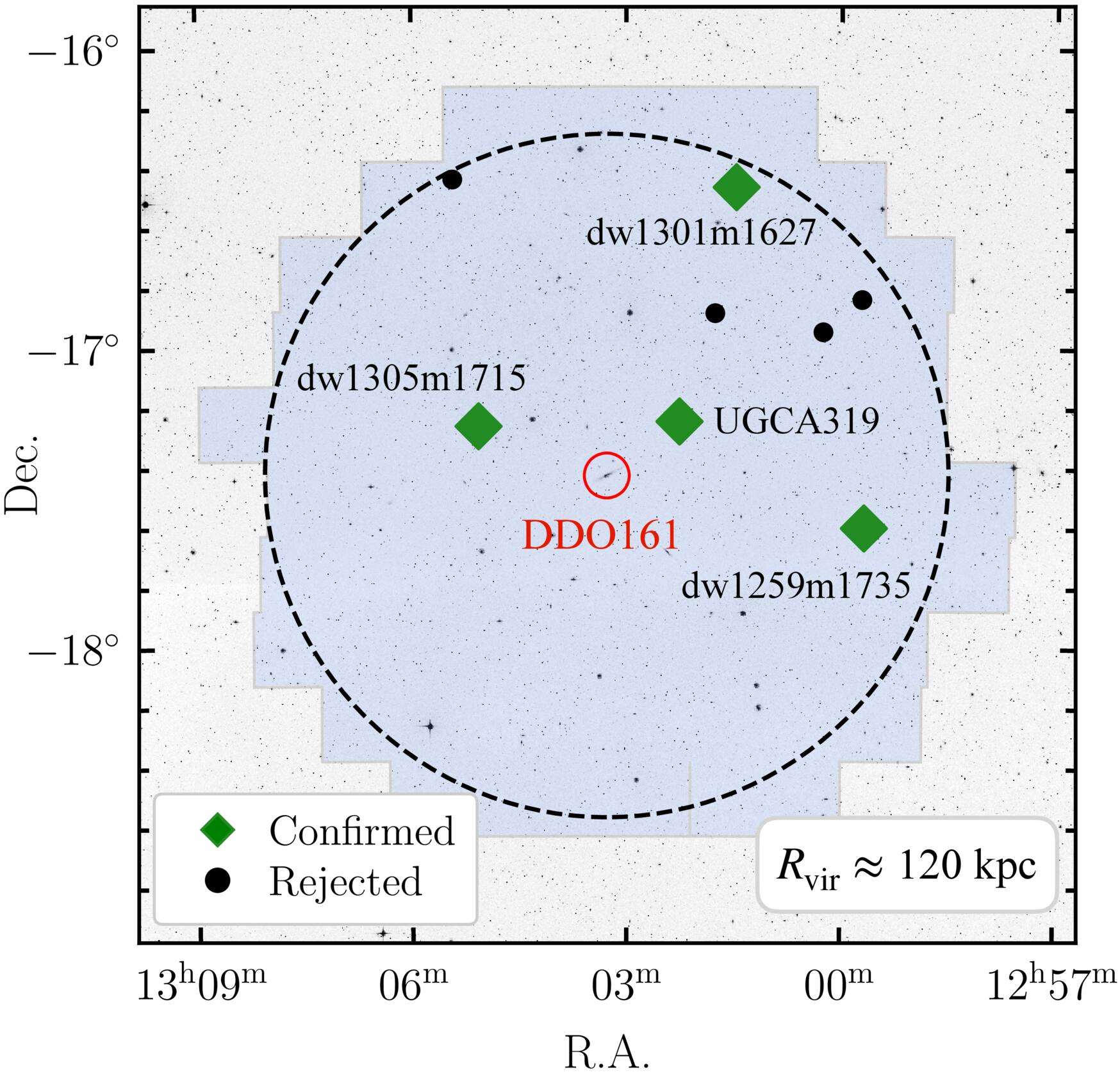
Satellite candidates around DDO 161 as they appear on the sky. Click to enlarge. [Li et al 2026]

Searching for Satellites Around DDO 161

Diving into a specific system, a team led by Jiaxuan Li (李嘉轩) from Princeton University began an in-depth search for satellites around the dwarf galaxy DDO 161. Prior to this study, DDO 161 was known to have one companion, UGCA 319, that is about 10 times smaller than its host. 

The authors used data from the Legacy Surveys to search for satellites within about 400,000 light-years of DDO 161 — the expected reach of DDO 161’s gravitational influence. After removing bright sources and smoothing the image to bring out very faint objects, they found eight satellite galaxy candidates including UGCA 319.
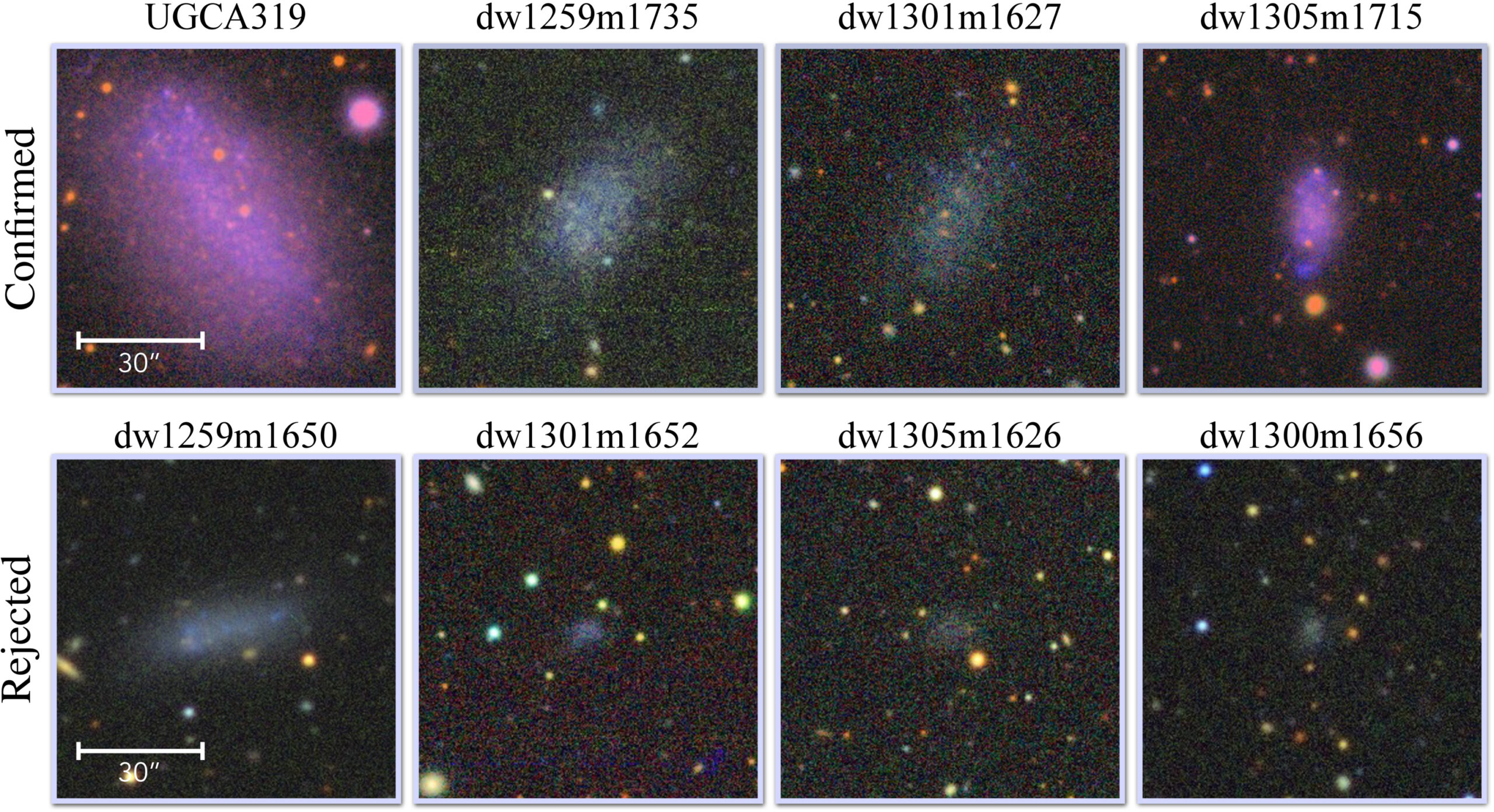
Images of the satellite candidates of DDO 161 from the Legacy Surveys. The top row shows the confirmed satellites, and the bottom row shows the rejected satellites. Click to enlarge. [Li et al 2026]

To confirm if these candidates were actual satellites of DDO 161, the team performed follow-up observations of the seven unconfirmed sources with the Magellan 6.2-meter telescope. Using the surface brightness fluctuation technique — measuring how a galaxy’s light fluctuates from pixel to pixel to determine its distance — the authors confirmed that three of the candidates are located at a similar distance to DDO 161 and are likely satellites. With the previously confirmed companion UGCA 319, DDO 161 has four satellite galaxies with stellar masses above 250,000 solar masses, making it the most satellite-rich dwarf galaxy known to date. 

Too Many Satellites

How does DDO 161 compare to theoretical predictions for galaxies of its size? The authors ran cosmological simulations to quantify the expected satellite populations around galaxies of similar size to DDO 161. Just as it is an outlier observationally, DDO 161 is also an outlier when compared to the simulation results that predicted fewer satellite galaxies in similarly massive host systems. 
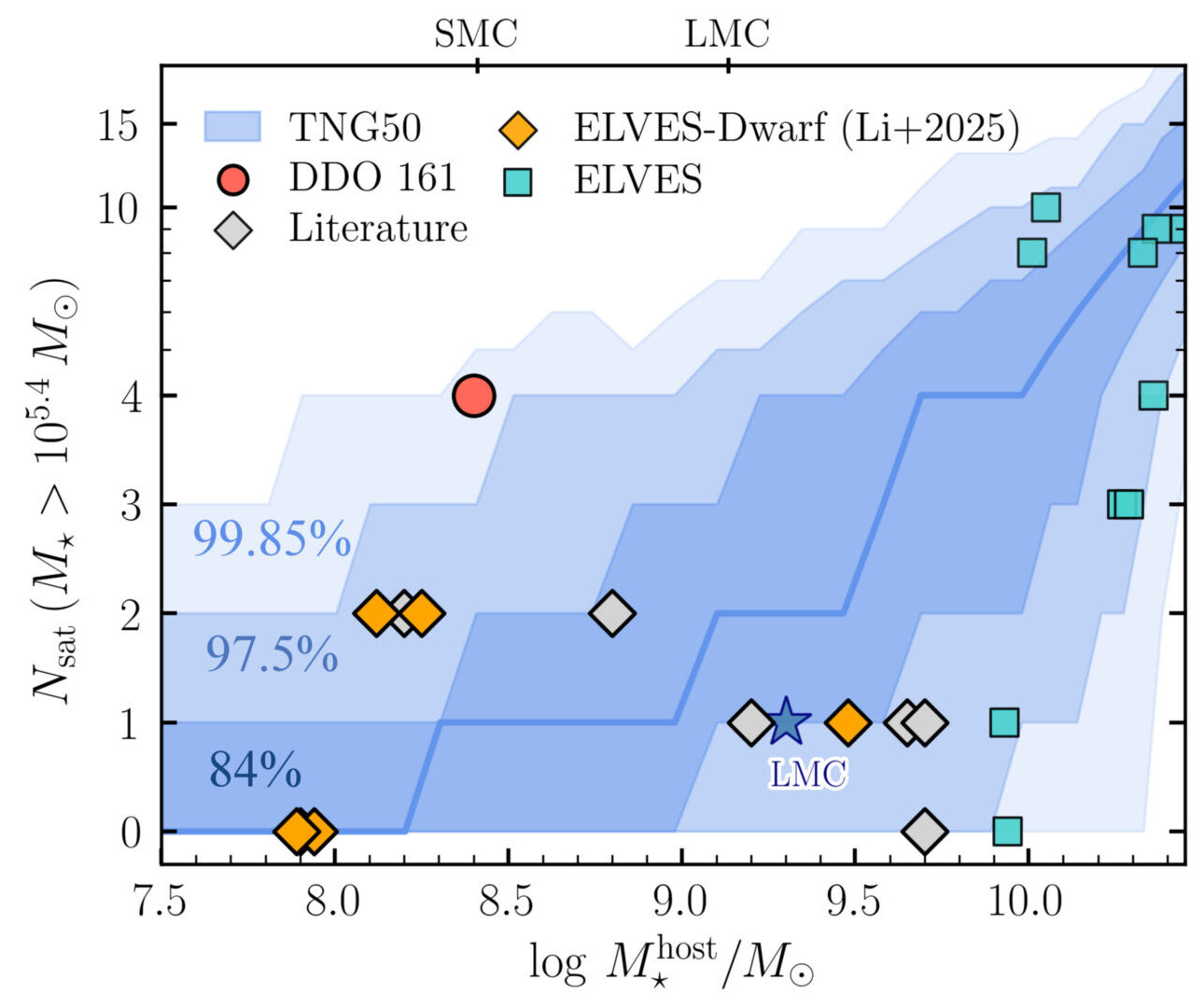
DDO 161 Satellite Population Comparison

Number of satellites versus host galaxy stellar mass for DDO 161 (red circle) compared to other observed low-mass galaxy satellite systems (data points) and predicted ranges from simulations (blue regions). DDO 161 is a clear outlier, having a high number of satellites for the host galaxy’s stellar mass. Click to enlarge. [Modified from Li et al 2026]

Making sure to cover all bases, the authors considered their observational uncertainties, limitations of the simulations, different relationships between stellar and dark matter halo mass, and possible environmental effects. None of these checks could, at this point, sufficiently explain the satellite overabundance in DDO 161, introducing a possible “too-many-satellites” problem for this galaxy. A larger sample of satellites around dwarf galaxies is necessary to better understand this discrepancy, test our current cosmological framework, and give new insight into galaxy formation on small scales. 

Citation

“A Possible ‘Too-many-satellites’ Problem in the Isolated Dwarf Galaxy DDO 161,” Jiaxuan Li et al 2026 ApJL 998 L24. doi:10.3847/2041-8213/ae3ddd

The post Satellite Surplus Around Dwarf Galaxy DDO 161 appeared first on AAS Nova.

  •  

A Long, Hard Look at (Potentially) Nothing to See

cloud-9 neutral hydrogen contour map

Editor’s Note: Astrobites is a graduate-student-run organization that digests astrophysical literature for undergraduate students. As part of the partnership between the AAS and astrobites, we occasionally repost astrobites content here at AAS Nova. We hope you enjoy this post from astrobites; the original can be viewed at astrobites.org.

Title: Examining the Nature of the Starless Dark Matter Halo Candidate Cloud-9 with Very Large Array Observations
Authors: Alejandro Benítez-Llambay et al.
First Author’s Institution: University of Milano-Bicocca
Status: Published in ApJ

Astronomy, in many ways, is the study of light — in every wavelength that exists — coming at us from light-years away. But most of the mass in our universe is made of dark matter, a material that neither emits nor reflects any light. So, how exactly are we supposed to find this dark matter? Well, the dominant theory of what our universe is made of, Lambda cold dark matter (ΛCDM), predicts that this dark matter can form small halos — regions of gravitationally bound matter — that host reservoirs of cold gas but no stars. While we cannot directly observe dark matter, this cold gas can reflect light at radio wavelengths. Finding these dark halos, referred to as reionization-limited neutral atomic hydrogen clouds (RELHICs), is therefore rather important to confirm ΛCDM. The authors of this article are attempting to do just that by taking a close look at Cloud-9, a potential RELHIC.

How to “See” in the Dark

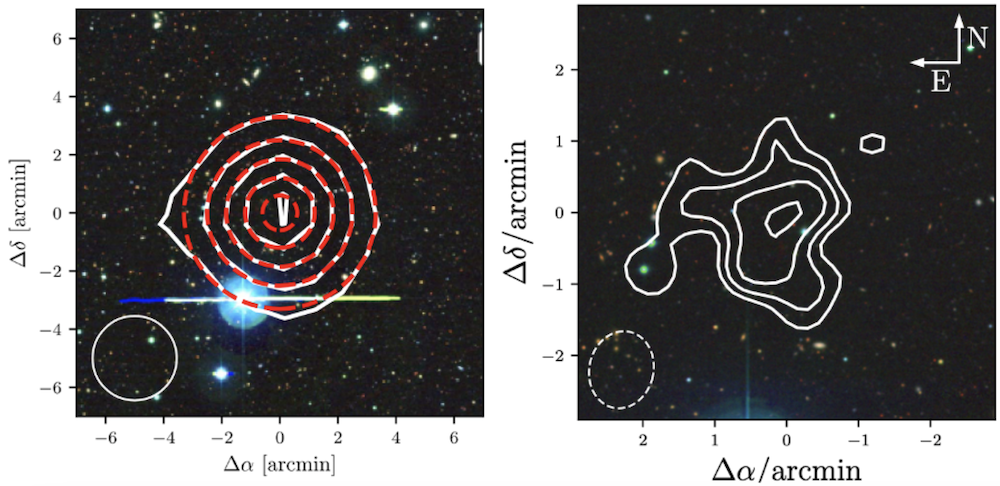
Cloud-9 was first discovered in 2023 when a team of astronomers noticed an excess of neutral hydrogen (HI) gas with no bright stars around it, near the spiral galaxy Messier 94 (M94). This discovery was made with the Five-hundred-meter Aperture Spherical radio Telescope (FAST), which doesn’t have the best resolution. For reference, this article found Cloud-9’s diameter to be roughly 3 arcminutes in the sky, while FAST’s resolution is 2.9 arcminutes. So, the authors of this article decided to look at Cloud-9 again, this time with the Very Large Array (VLA), an array of radio telescopes that can pick out more of the structure of this system.

With this upgraded resolution, the authors were able to get a clearer picture of the shape of Cloud-9 and compare it to the previous study (see Figure 1). They found that Cloud-9 was slightly smaller and much more lopsided than previously thought. This funky shape is likely due to gravitational interactions with the larger nearby galaxy M94, causing the gas in Cloud-9 to squish and stretch.

neutral hydrogen density contours for Cloud-9

Figure 1: Left: The HI gas column density from the previous FAST observations. [Benítez-Llambay & Navarro 2023] Right: The HI gas column density from the VLA observation in this article. [Benítez-Llambay et al. 2024] Corner circles represent the resolution of each telescope and the x and y axes are the position on the sky. Note the scale of the axes in each plot; the right plot is a zoomed-in version of the left.

RELHIC or Just RELHIC-tively Dim?

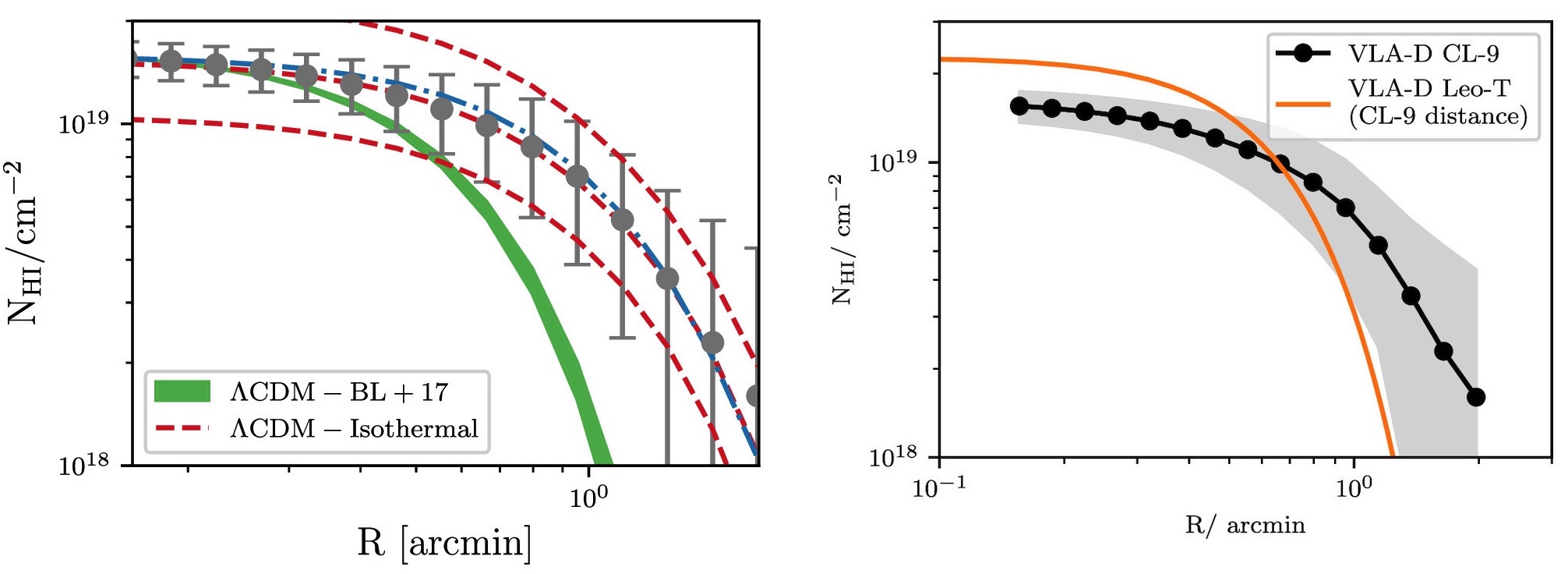
To determine if Cloud-9 really is a RELHIC, the authors needed to compare its HI radial density profile to the profiles of simulated RELHICs. Density profiles are a good tool to use here since although we don’t fully understand what dark matter is, we do know how it will affect things around it gravitationally. If the only matter hosted by Cloud-9 is HI gas and dark matter, then that gas will have a specific distribution that we can observe. If other baryonic matter is hosted by Cloud-9 that we just aren’t picking up right now, it will affect that density profile.

The authors found that for a detailed, general simulation the profiles did not match well, specifically in the outer regions. But when they compared it to a sphere of gas with a constant, specific temperature, they were able to get the fits to line up (see Figure 2). However, the authors point out that these simulations are isolated, meaning there is no big galaxy next to them affecting their shape, unlike Cloud-9.

observed and modeled neutral hydrogen density

Figure 2: Left: Comparison of Cloud-9’s HI profile (grey dots) to a general simulated RELHIC’s profile (green line) and a simulated RELHIC at a specific temperature (red line). Right: Comparison of Cloud-9’s profile (black dots) to Leo T’s profile (orange line). Although the positions are shifted, the slopes of the profiles match. [Benítez-Llambay et al. 2024]

The authors also tried to test another explanation for Cloud-9’s apparent lack of stars: the stars are there but just too dim for us to see right now. The Milky Way sits near many ultra-faint dwarf galaxies, which are small and have quite dim stellar populations. We’ve only just developed telescopes in the last few years that can take in enough light to see these galaxies, and we might not be able to detect stars in an ultra-faint dwarf galaxy as far away from us as Cloud-9. The authors compare the HI density profile of Cloud-9 to that of Leo T, a nearby ultra-faint dwarf galaxy. They find that these profiles match up better than for the general RELHIC simulations, particularly in the innermost regions of Cloud-9 and Leo T.

What Are the Next Steps?

The authors conclude that, as of right now, they can’t definitively say whether Cloud-9 is or is not a RELHIC, but there are a few things astronomers can do to clear things up. First, theorists can re-run the RELHIC simulations with halos that have been affected by gravity like Cloud-9. This will allow them to better compare their observations to the simulations.

Second, observers can image Cloud-9 with an optical telescope that is powerful enough to detect any stars that could be there. They suggest the Hubble Space Telescope since it would be able to detect the brightest handful of stars in the potential dim population. JWST would be an even better choice, with its even deeper imaging capabilities, but it is very difficult to get observing time on it. (JWST recently received the most proposals in one year for any telescope ever!)

We will likely have to wait a bit for a definitive answer on the nature of Cloud-9, but either way the authors are excited by this gas cloud. Either it is the first starless dark matter halo, a confirmation of one of the predictions of ΛCDM, or it is the most distant ultra-faint dwarf galaxy ever detected! Although Cloud-9 is not much to look at right now, you should still definitely keep your eye on it.

Original astrobite edited by Maggie Verrico and Cole Meldorf.

About the author, Veronika Dornan:

Veronika is a final-year PhD candidate at McMaster University. Her research is in observations of extragalactic globular star clusters and what they can tell us about galaxy evolution and dark matter distribution in the universe.

The post A Long, Hard Look at (Potentially) Nothing to See appeared first on AAS Nova.

  •  
❌