Paleontologists have described a previously unknown species of mosasaur -- a group of extinct marine reptiles that patrolled Cretaceous seas alongside dinosaurs on land -- based on fossils unearthed in Egypt’s Dakhla Oasis.
Credit: Museum of Mediterranean and Near Eastern Antiquities, Stockholm
The precise composition of ancient Egyptian paints, binders, adhesives, and similar materials used to make artifacts is largely unknown, in part because a full analysis would require taking samples that would damage those valuable artifacts. The development of cutting-edge, non-destructive techniques has been helping to unlock those secrets, aiding conservation efforts.
Most recently, researchers have used mass spectrometry-based proteomics to analyze the glues and adhesives in a broad set of Egyptian artifacts, according to a new paper published in the journal Science Advances. They found plenty of expected sources, such as animal collagens and egg proteins, but also plant proteins, specifically from sesame and drumstick tree (moringa) cereals.
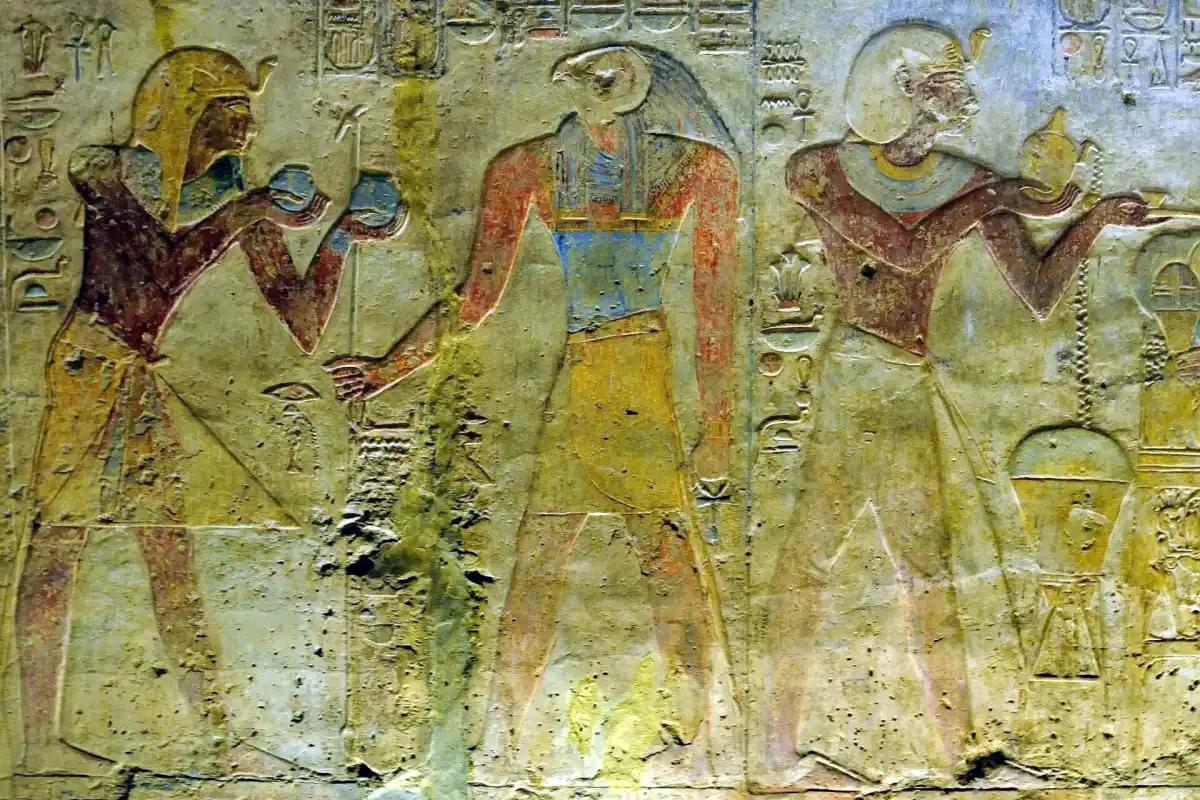
As previously reported, the ancient Egyptians had a highly formalized (and easily recognizable) painting style, and there has been considerable interest in gaining insights into the specific pigments and painting techniques employed. Common pigments included hematite and realgar for red; goethite and orpiment for yellow; Egyptian blue; Egyptian green; carbon-based black; and calcite, gypsum, anhydrite, and huntite for white. (Just last year, Washington State University researchers were able to re-create Egyptian blue by mixing together silicon dioxide, copper, calcium, and sodium carbonate in varying proportions and heating them at very high temperatures akin to those of ancient kilns.)
The name that keeps pulling archaeologists back to the eastern frontier What if a city that appears in the records of ancient Egypt has been sitting in plain sight, hidden beneath later roads, barracks and stonework? That is the possibility raised by a new discovery at Tell Abu Seifi in northern Sinai. Archaeologists have found […]
An important Egyptiantomb from the Fifth Dynasty of the Old Kingdom has been discovered in the Saqqara necropolis by a Spanish-Egyptian archaeological mission.
Josep Cervelló, an Egyptology professor at the Autonomous University of Barcelona, led the work, which was coordinated with the Egyptian Supreme Council of Antiquities to investigate the unique tomb in the Saqqara region southwest of Cairo.
The tomb did not belong to a Pharaoh, but was commissioned by a high-ranking official named Yunmen, who served during the reign of Djedkare Isesi. Strangely, the structure features two funerary chapels: one of which is dedicated to the Iti, Yunmen’s father, who held a lower rank than his son.
The discovery may offer a new context for the intersection of spirituality and social mobility in ancient Egypt.
Egyptian Tombs
We now see the Saqqara necropolis primarily as the remains of a dead culture, filled with long-forgotten tombs. While often portrayed as settings for horror stories, the Spanish-Egyptian archeological team viewed them differently, seeing them as places used by a vibrant community, where the living constantly came to leave offerings and work on funerary monuments.
The recent work is part of the continuing exploration of Egyptian sites discovered by archaeologists in the 19th century. To this day, archaeologists continue to seize on hints in the works of their forebears over a century ago to explore ancient Egypt’s impressive remains. Auguste Mariette, a French archaeologist, first discovered the site, identified as containing a large tomb complex, but no detailed exploration or documentation had been done.
Instead of just a place for corpses to lie, an Egyptian necropolis was a major urban feature. Credit: EFE/Egyptian Ministry of Antiquities
Life In the Necropolis
Egyptian mastabas were a unique style of tomb, and in some ways were like modern cemeteries: they were frequently visited places where the lost were mourned and remembered. For this reason, the team was also very interested in the tomb complex’s topography, rather than just its beautiful decoration. They studied the tomb as an urban location, investigating how ancient people moved through it and whether they worshipped outdoors or inside.
Exploring the bustle of urban life in the necropolis netted the team their first indication of Yunmen’s tomb, alongside hints at two more located nearby. In follow-up excavations, the archaeologists are planning to explore the remaining pair.
The tomb’s interior details were extremely well preserved, revealing intricate designs. Credit: EFE/Egyptian Ministry of Antiquities
Moving in Ancient Egyptian Society
The tomb’s physical structure intrigues archaeologists, as it is a rare example of a building with two funerary chapels. Fortunately, the 4,400-year-old tomb is remarkably well preserved, with vibrant color and fine details observable in the wall reliefs. Archaeologists can still clearly make out tiny donkeys and other animals in the wall art. Elsewhere, some elements of the texts adorning the walls follow common formulas—yet even these are customized to the official role and personality of the owners.
Archaeologists interpreting the mastaba believe it reflects social advancement. Yunmen achieved a higher social status than his father, Iti. Yet on the journey to the afterlife, Iti was not forgotten; Yunmen ensured his father received a tomb of similar opulence, so the son’s prestige would apply retroactively to the father in death.
“We still need to fully examine it, but one possibility is that the official originally came from that outlying province, arrived at the court, and settled in Memphis—Egypt’s capital at the time—while his son became an official in the central state administration and was the one who built the tomb,” Cervelló said in a press release.
It remains to be seen what the other two mastabas identified by the team will reveal, whether they will provide more evidence for our traditional understanding of Egyptian culture or add more nuance to our view of these ancient people.
Ryan Whalen covers science and technology for The Debrief. He holds an MA in History and a Master of Library and Information Science with a certificate in Data Science. He can be contacted at ryan@thedebrief.org, and follow him on Twitter @mdntwvlf.
When the French Egyptologist Auguste Mariette surveyed the necropolis at Saqqara in the mid-19th century, he catalogued hundreds of mastaba tombs and marked one more on his map that he never got around to excavating. It stayed there, noted but untouched, for more than 160 years. A joint Spanish-Egyptian mission has now finished what Mariette […]
More than 4,000 years ago, an Egyptian official named Sekhentiu-Ptah held a collection of titles that placed him remarkably close to royal power. He oversaw the king’s works and documents, supervised scribes, and even served as the “Keeper of the Secrets of Royal Commands.”
Now, archaeologists have found his tomb. An Egyptian archaeological mission excavating the Saqqara necropolis inGizahas uncovered the Old Kingdom tomb of Sekhentiu-Ptah, including its funerary chapel, an intact false door, and a complete collection ofalabaster ritual objectsstill positioned where they were left thousands of years ago.
Nearby, researchers discovered an interconnected network of burial shafts containing human remains, more than 100 funerary figurines,and three stone sarcophagithat were still sealed when archaeologists found them.
Speaking with The Jerusalem Post, Mohamed Abdel-Badie, head of Egypt’s Antiquities Sector, said finding a complete set of funerary objects still in their original position was “an important discovery, offering valuable information about funerary rituals and practices during the Old Kingdom.”
The discovery was made during the Egyptian mission’s first excavation season in Sector A, west of the Bubasteion at Saqqara, roughly 20 miles south of Cairo. Saqqara served as a major burial ground for ancient Memphisand contains monuments and tombs spanning thousands of years of Egyptian history.
Sekhentiu-Ptah’s tomb dates to the Old Kingdom, the era roughly spanning the third millennium BCE that witnessed the construction of Egypt’s great pyramids.
Inside the remains of his funerary chapel, archaeologists encountered a false door still standing in its original location. Such doors were symbolic thresholds associated with the deceased and the offerings made to sustain them in the afterlife.
Directly in front of the false door was a complete group of alabaster ritual objects that had apparently remained together in their archaeological context. The assemblage includes an offering table and offering disk, purification basin, jug, and another basin.
Hieroglyphic inscriptions on the false door and funerary objects revealed not only Sekhentiu-Ptah’s name but an extraordinary résumé.
He was identified as Royal Chamberlain, Overseer of All the King’s Works, Overseer of Royal Documents, Keeper of the Secrets of Royal Commands, Priest of the goddess Maat, and Overseer of the Scribes. Together, the titles indicate that Sekhentiu-Ptah occupied a prominent position within Egypt’s royal administration.
Archaeologists also uncovered a system of interconnected burial shafts filled with human burials and large quantities of painted funerary cartonnage, a material commonly made from layers of linen orpapyrusand plaster and used in funerary coverings.
Archaeologists recovered more than 100 faience ushabti figurines. These small figures were placed in Egyptian tombs to perform work for the deceased in the afterlife symbolically. Archaeologists also found a wooden falcon statue, pottery, and three stone sarcophagi that were kept sealed in their original condition.
The collection is particularly interesting because it captures different chapters in Saqqara’s history. While Sekhentiu-Ptah’s tomb belongs to the Old Kingdom, material from the surrounding shafts provides evidence for funerary practices during the much later Late Period. In essence, the site became a cemetery layered on top of a cemetery, repeatedly returned to and repurposed across Egyptian history.
Not everything survived undisturbed. Archaeologists found openings cut between some burial chambers, evidence that ancient tomb robbers had already penetrated portions of the complex. Even so, enough remained intact to allow researchers to reconstruct how the necropolis changed over time.
The surviving artifacts retain “great archaeological and scientific value, contributing to understanding the site’s internal layout and the development of its architecture through its successive historical phases,” excavation director Dr. Amr El-Tayebi explained.
For now, the discovery is a work in progress. The Egyptian team is continuing to document and compare the artifacts with material recovered elsewhere in Egypt, with plans to publish the results in peer-reviewed scientific journals. Archaeologists also believe Sector A could contain additional structures and artifacts still waiting beneath the sands of Saqqara.
Tim McMillan is a retired law enforcement executive, investigative reporter and co-founder of The Debrief. His writing typically focuses on defense, national security, the Intelligence Community and topics related to psychology. You can follow Tim on Twitter:@LtTimMcMillan. Tim can be reached by email: tim@thedebrief.org or through encrypted email:LtTimMcMillan@protonmail.com
iPhone prices are drawing attention ahead of Wednesday’s launch, with U.S. estimates placing the iPhone 18 Pro around $1,250 to $1,300, the Pro Max around $1,350 to $1,400, and the foldable Ultra above $2,000. Those expectations build on reports of a new premium price tier for the foldable iPhone, but the figures circulating under Vodafone’s name need closer examination.
Vodafone Egypt has denied that the alleged pricing leak came from its operation. In a September 4 correction, PhoneArena reported the carrier’s response and acknowledged that it could not verify the material.
The American price estimates and the overseas carrier claims come from different sources. Apple has not announced U.S. retail prices for any of these devices.
U.S. iPhone Prices Could Rise Across the Pro Lineup
For American buyers, the most useful figures are the estimates expressed directly in U.S. dollars. Current reporting on the projected Pro prices places the iPhone 18 Pro between $1,249 and $1,299 and the iPhone 18 Pro Max between $1,349 and $1,399.
Those ranges reflect expectations built around TrendForce’s pricing outlook. They are possible starting prices before applicable sales tax, rather than authenticated carrier listings or amounts Apple has approved publicly.
The foldable has a wider potential spread. In its September 3 forecast, TrendForce estimated a starting price between $2,099 and $2,299, with the highest configurations potentially exceeding $3,000.
The firm expects price increases of roughly 10% to 20% for the new models as rising memory costs put pressure on production expenses. It also expects Apple to absorb some of those costs to protect demand.
An increase in component spending does not translate directly into the same increase at checkout. Apple can accept a smaller margin, negotiate elsewhere in the supply chain, or distribute the increase differently across models and storage configurations.
The exact starting capacities will therefore deserve attention alongside the prices. A more expensive entry model that includes additional storage presents a different comparison from an unchanged configuration carrying a higher charge.
Image Credit: AppleMagazine
Australian Ultra Claim Converts to About $2,700
The separate Australian claim would put the entry iPhone Ultra at approximately $2,700 when converted into U.S. dollars. The original amount is AU$3,699 for a purported 256GB model.
The same claim lists a 512GB version at roughly $3,000 in converted value, with an original price of AU$4,199. The alleged 1TB model approaches $3,400, corresponding to AU$4,699. These rounded equivalents provide context for the overseas figures; they are not predicted American retail prices.
The post also names September 12 as the preorder date. Neither that date nor the claimed Australian pricing has been authenticated through a public carrier announcement.
The proposed storage structure adds about $360 in converted value at each step, or AU$500 locally. If accurate, that would make storage selection a substantial part of the purchase rather than a minor addition to the headline price.
A buyer planning to record large amounts of video or carry a substantial offline library could quickly move into a more expensive configuration. Comparing an entry Pro with a fully equipped Ultra would then combine two separate premiums: the folding hardware and the extra capacity.
The Egyptian Figures Are Disputed
The alleged Egyptian listing translates to approximately $1,930 for the iPhone 18 Pro, $2,070 for the Pro Max, and a little over $3,000 for the Ultra, using the conversions reported when the claim circulated.
The original figures were EGP 98,000, EGP 105,000, and EGP 155,750, respectively. Vodafone Egypt’s denial means these amounts cannot be presented as prices confirmed or leaked by the carrier.
A recognizable logo and local currency can make a screenshot appear convincing. They do not establish that a company published it, that its contents are authentic, or that the amounts represent final retail pricing.
For U.S. buyers, this material offers no dependable basis for changing an upgrade budget. Its main relevance is explaining where some of the unusually high numbers appearing online originated.
Image Credit: AppleMagazine
Currency Conversions Can Exaggerate U.S. Expectations
An overseas price converted into dollars answers what that amount of foreign currency is worth. It does not reveal what the same product will cost in an American store.
Tax treatment contributes to the difference. Australian consumer prices generally include GST, while U.S. advertised prices typically exclude sales tax. Regional pricing also reflects currency planning, distribution expenses, and commercial decisions.
Removing tax and applying an exchange rate still would not produce an official American price. Companies set regional prices for a selling period, rather than adjusting them continuously to match daily currency movements.
The same limitation applies when comparing percentage differences with an older phone. Assuming that the Ultra will carry an identical premium over the Pro in Australia, Egypt, and the United States introduces another unverified step.
That is why the direct U.S. estimates deserve priority when considering a purchase here. The international claims can provide additional context, but they should not replace an American price forecast or be mixed into it as supporting confirmation.
The Ultra Premium Creates a Different Buying Decision
If the projected U.S. ranges hold, the foldable could cost roughly $700 to $950 more than the Pro Max at entry level. That is a substantial amount to spend on a different form factor.
The larger internal display would need to earn its place in everyday use. Reading documents, comparing information, reviewing photographs, and working with more content on screen could make the extra space valuable. Someone primarily interested in photography, messaging, and navigation may find fewer reasons to make the jump.
The most expensive device also will not automatically be the best choice in every category. Camera versatility, battery endurance, weight, and comfort can favor different designs. Those comparisons will become more useful once Apple publishes complete specifications.
For a first-generation foldable, repair pricing deserves particular attention. An attractive monthly device payment can look different once accidental-damage protection and display service costs enter the ownership budget.
Carrier Offers Will Need Their Own Comparison
Apple’s September 9 event announcement confirms a presentation at 10 a.m. Pacific Time. Product pricing, availability, and ordering details remain separate from that confirmed schedule.
When American carrier offers appear, the monthly figure should be read together with the requirements attached to it. A promotion may depend on an eligible trade-in, a particular service plan, or credits distributed across an extended agreement.
A household already using the required plan might receive substantial value. Someone moving to a more expensive plan solely to obtain a phone discount could spend more over the full term.
The final comparison should use the same storage capacity and include the upfront payment, service cost, financing charges, and any credits lost by leaving early. A smaller payment on the device line of the bill does not necessarily produce a smaller total bill.
Long before the age of the Pharaohs and the monumental construction that defined the ancient Egyptian world, the famed Gift of the Nile was once a sea filled with hungry monsters.
Today, evidence of these ancient aquatic beasts can still be found in Egypt’s sands, as revealed in a new study appearing in Cretaceous Research, which sheds new light on the diversity of ancient shark communities that swam modern-day Egypt’s ancient oceans in the Late Cretaceous.
Adding to the known species of sharks from this era, the new research has revealed five additional species of ancient marine predators that once thrived there, fossils of which were among those unearthed in a fossil tomb very unlike those excavated by Egyptologists over the last two centuries.
An Ancient “Shark Graveyard” Resurfaces
During the Cretaceous period, Earth saw much higher temperatures, which also meant less ice accumulation around the poles. That abundance of liquid water caused by the greenhouse effect during this period in Earth’s history, therefore, led to much higher ocean levels than those seen today.
In Egypt’s Western Desert today, a vast tropical sea once existed 150 million years ago along what is recognized as the Abu-Tartur Plateau, which is home to the fossil-rich Duwi Formation. There, organic sediments collected over vast periods, which helped to create the phosphorite deposits that were conducive to fossil formation, thereby preserving a record of the ancient species that once thrived there.
Past studies had already documented several ancient shark species from the region’s Cretaceous oceans, prompting the additional research detailed in the new study. According to the team’s findings, more than a dozen new fossil shark teeth were recovered from the area around the Abu-Tartur mine, displaying a remarkable diversity.
Based on their individual characteristics, paleontologists have identified the new specimens based on existing records kept in museum collections and other record sources.
New Discovery of Lamniform Shark Species
Of fourteen teeth the researchers uncovered from phosphorite beds during their field work, at least five extinct varieties of lamniform sharks—a variety known as mackerel sharks—were uncovered, which brings the number known to have once inhabited the region up to seven.
Examples of recent fossil shark tooth discoveries from Egypt (Image Credit: Cretaceous Research (2026). DOI: 10.1016/j.cretres.2026.106476)
Of the five newly identified varieties, two species—Squalicorax bassanii and Serratolamna serrata—were previously unknown to Egypt, while one other variety, Scapanorhynchus raphiodon, appears to have been an ancient ancestor of the odd-looking goblin shark. Modern varieties of this species are known to thrive around continental shelves and seamounts throughout the Atlantic, Pacific, and Indian oceans, although the ancient relative identified in the new research had never previously been found anywhere on the African continent.
If confirmed, the recent Egyptian discovery could also indicate the earliest known presence of this species in Earth’s ancient oceans.
A Tropical Sea Unlike Any Other
The new findings reveal new insights into the nature of Earth’s ancient seas, revealing that the prevalent nutrients in the tropical waters of the Cretaceous helped to foment a thriving ancient shark community.
“Collectively, this assemblage highlights a nutrient-enriched, high-productivity marine ecosystem along a phosphogenic shelf margin, most likely developed during a transgressive systems tract in the Late Cretaceous,” the study authors say.
The recent paper, “Egyptian shark graveyard: New Late Cretaceous Lamniform shark Assemblage from Duwi Formation of Abu-Tartur Area, Southwestern desert, Egypt,” appeared in Cretaceous Research.
Micah Hanks is the Editor-in-Chief and Co-Founder of The Debrief. A longtime reporter on science, defense, and technology with a focus on space and astronomy, he can be reached atmicah@thedebrief.org. Follow him on X @MicahHanks, and at micahhanks.com.
Researchers from the multi-organizational Egyptianarchaeological mission working at Tell Abu Saifi in Qantara East, Ismailia, have unearthed numerous architectural elements and artifacts, including a previously undiscovered inscription, that the country’s Ministry of Tourism and Antiquities suggests may link the site to the lost ancient Egyptian city of “Msen.”
“A new archaeological discovery in Tel Abu Saify in Qantara East redefines the map of the ancient Hors Wara road… and strengthens the hypothesis of locating the lost ancient Egyptian city of ‘Msen’,” explained a Facebook post from the country’s Ministry of Tourism and Antiquities.
The team behind the discoveries from the current excavation season said their findings also shed new light on the ancient Horus Military Road and may offer previously unavailable insights into the site’s architectural, religious, and military development throughout history.
Inscription Links Site to Lost Ancient Egyptian City of Msen
According to the Ministry’s post, new excavations revealed a massive mudbrick enclosure wall that had not yet been fully excavated. The full excavation included the enclosure’s gateways, interior rooms, and construction layers from different time periods.
A further analysis determined that the structure was an outer enclosure surrounding an ancient temple. The researchers said this new interpretation contradicts previous interpretations of portions of the ancient site.
Hisham El-Leithy, Secretary-General of the Supreme Council of Antiquities, said the research team also found intriguing evidence connecting the ancient site with the city of Msen. The most striking connection came from a huge sandstone lintel found broken into two pieces. Along with several references to Pharaoh Ramses II, the stone lintel contained a section of text recording ancient repairs to a statue of Horus, Lord of the City of Msen.
The huge broken lintel bears an inscription connecting the site to the lost ancient Egyptian city of Msen. Credit: Egypt Ministry of Tourism and Antiquities.
“Dr. Hisham Hussein, head of the Central Administration for the Coast and Sinai and head of the mission, confirmed that the most important findings were a huge upper crust of sandstone broken into two parts, and three-sided carvings of the titles of King Ramses II on three sides, as well as a literary text indicating the restoration work carried out on the statue of the deity “Horus, the lord of the city of Masna,” which is of great importance in studying the identity of the site,” the Facebook post explained.
Other ancient Egyptian texts name an ancient eastern border settlement during the New Kingdom with that name. However, archaeologists have yet to discover its precise location. The researchers said mention of the god Horus supports earlier evidence from the same site linking Tell Abu Saifi to the lost Egyptian city. Still, they caution, research still underway is expected to shed more light on the potential connection.
Additional Findings Include Ancient Roads and Military Items
Along with the main structures, Mohamed Abdel Badie, Head of the Egyptian Antiquities Sector at the Supreme Council of Antiquities, said the excavations revealed a pair of successive stone roads leading from the fortified structure’s exterior into the central temple. The first road was dated to the Ptolemaic period. The newer, narrower road built on top of the older road was attributed to the Roman era.
Hisham Hussein, Head of the Central Administration for Lower Egypt and Sinai and head of the archaeological mission, said the work identified the remains of a second temple with several storage rooms on one side and larger “service” rooms on the other, leading toward the central sanctuary.
Mahmoud Galal, Director General of Sinai Antiquities and Director of the mission, said the team found items of military and administrative significance at the ancient Egyptian site. One noteworthy discovery was described as a 26th Dynasty “schist” statue depicting an army scribe carrying a broken naos. The researchers said this discovery highlights the site’s strategic and military character.
Other items of interest included a Late Period statue missing its head and feet, a royal basalt statue torso, and small fragments of basalt and limestone falcon statues.
The research team said their excavation revealed the site had experienced several phases of development and transformation. For example, the ancient Egyptian site appeared to peak during the Ptolemaic period before being converted in the third century into a military barracks. Roman-era circular kilns containing limestone remains revealed during the latest excavations suggest the site had finished its life as an ancient lime quarry.
Findings “Support the Hypothesis” Connecting Site to Msen
When discussing the significance of the discoveries, including an inscription potentially connecting it to the ancient lost Egyptian city of Menes, Minister of Tourism and Antiquities Sherif Fathy said the ongoing efforts help document valuable ancient sites in North Sinai and the Qantara region. The minister said this effort also highlights the site’s role in protecting ancient Egypt across several generations.
“The current results confirm that Tel Abu Saif represents one of the main sites along the Horus War Road, revealing the sequence of military, religious, and economic functions at the site, reflecting its strategic importance and its role in protecting Egypt’s eastern borders, as well as its religious status during the Pharaonic, Babylonian, and Roman eras,” the post explained.
Secretary-General El-Leithy echoed the sentiments, highlighting decades of work at the site before the new discoveries. He also said the new data has improved the understanding of previous discoveries of architectural elements made at the same site, including the site’s layout, development, and potential connection to the ancient lost Egyptian city of Msen.
“The head of the mission confirmed that the results obtained by the mission during the current season, in addition to what was previously revealed in previous seasons, support the hypothesis of the connection of Tel Abu Saif to the Pharaonic city of ‘Msen’ mentioned in ancient Egyptian texts and sources during the modern era,” the post concluded.
Christopher Plain is a Science Fiction and Fantasy novelist and has spent the last six years as Associate News Editor and Head Science Writer at The Debrief. Follow and connect with him on X, learn about his books at plainfiction.com, or email him at christopher@thedebrief.org.
Spanish archaeologists excavating an ancient Egyptian tomb in the Theban Necropolis opposite Luxor have discovered an unexpected order to how the 16 mummified human remains were placed within it over several centuries.
The team studying chamber three of tomb TT 209 also found the completely unexpected remains of a mummified dog placed carefully among the ancient burials, suggesting a deep connection between humans and animals or a previously unidentified ritualistic practice.
Researchers Document Ancient Egyptian Tomb in Detail
The Theban Necropolis contains over 400 tombs. Previous studies have determined that the burial space was used and reused from its construction during Egypt’s Twenty-fifth Dynasty (754-656 BCE) until its abandonment during the Ptolemaic period (305-30 BCE).
However, archaeologists are still searching for new clues to the people who built them and those buried inside. Dr Miguel Ángel Molinero Polo, a professor of Egyptology at the University of La Laguna and the senior author of the study detailing the team’s discoveries, said researchers have “few details” about how people who entered the tombs behaved. Dr. Polo also noted a lack of knowledge about these people’s motivation “in each historical period” the site was in use, and how they “conceptually reconfigured the pre-existing space” as time passed.
The research team ultimately determined that the best way to explain the methodology for placing the human remains and individual dog remains found in the ancient Egyptian tomb was to excavate the chamber and photograph the mummies. They also decided to create sketches and descriptions of the mummy’s position, orientation, and any possible relationship with the overall structure.
Archaeologists Unearth 16 Mummified Bodies and Related Funerary Items
As the team began cataloging their findings, they realized the chamber contained nine funerary deposits, which they described as “individual and multiple burials.” The site also contained several “associated funerary objects.”
“We found a total of 16 mummified human individuals, a mummified dog, and a disturbed deposit containing the remains of at least four individuals,” explained Dr. Jared Carballo-Pérez, a researcher at the University of La Laguna and the study’s first author.
After further examination, a pattern began to emerge. For example, the earliest burials were relatively separated. These earliest bodies were also placed in coffins, with funerary nets and amulets. These burials also contained what Dr. Molinero Polo termed “an assemblage containing costly items, such as the contents held in Phoenician amphorae,” placed with or near them. The research said these discoveries suggest that these individuals were likely “of high social standing.”
When the researchers examined the second layer, they noted that bodies were less carefully placed and instead “inserted into any space available.” Critically, this shift occurred towards the end of the 25th dynasty and into the Persian period (around 680-404 BCE).
Examples of the new interment method include limb positioning. In one case, an arm was found folded in, and in others, two arms were folded.
Above: Mummified individuals from Side Chamber 3 of Theban Tomb 209, showing variation in body orientation and arm position. Image Credit: Proyecto dos cero nueve, Universidad de La Laguna / Jared Carballo-Pérez.
This positioning differed from earlier burials, where the arms were stretched out. The team also cataloged a change in body position in the ancient Egyptian tomb, with later mummies deposited vertically. The team said the resulting “superposition of bodies” was found in two-thirds of the burial chamber.
Still, Dr. Molinero Polo explained, although the vertically positioned bodies were not placed in coffins, the remains were “carefully mummified.” The researcher said the later internments “can be associated with upright jars that point to a specific ritual not found in the earlier phases of the tomb’s use.”
Mummified Dog Buried with Humans Suggests Intimate Relationship
Perhaps the most unexpected find inside the ancient Egyptian tomb was the remains of a mummified dog. Even more unexpected, the animal’s remains were buried with human remains “one on top of another.”
“One detail I find quite beautiful is the presence of a mummified dog placed directly on top of the mummies of a man and a woman,” said Carballo-Pérez.
Above: A detail of superposition and spatial relationships between individuals in SC3 (TT 209). The figure shows the relative position of several individuals, highlighting direct vertical contacts and partial overlaps between bodies. M6 and M7 are closely superimposed. The dog’s remains (M9) are placed over its lower limbs. Image Credit: J. Carballo-Pérez.
The researcher said this preferred, intimate placement could suggest a close relationship between the animal and its humans, “an idea that I think is quite easy to empathize with.” Carballo-Pérez said the unexpected placement could also reflect a change in funerary or ritualistic practices, “with an animal taking on the role of a psychopomp, a symbolic helper in the journey to the afterlife.”
Although an initial examination gave the team the impression the site’s internment became less organized over the centuries, they said that impression was likely false. For example, the team notes that bodies buried in the Osirian position, meaning both arms folded, suggest that the ancient Egyptian tomb “did not become disordered or without structure, or that cultural rites were lost.”
“The detailed study of the bodies indicates neither chaotic accumulation nor a loss of the original ritual over time,” Dr. Carballo-Pérez explained. “Rather, there was a spatial logic in which each new deposition was adapted to the presence of previous bodies – a kind of funerary memory in the processes of reuse.”
Above: Evidence of disturbance and displacement affecting two mummified individuals inside Chamber 3. Image Credit: Proyecto dos cero nueve, Universidad de La Laguna / Jared Carballo-Pérez.
The team conceded that it was sometimes difficult to identify the sequence of some of the funerary deposits, including what they described as the “disturbed” remains of four individuals. They also suggest that the chamber was likely flooded several times over the centuries, experienced periodic fires, and human re-entry, which “transported debris within the tomb.”
Still, Carballo-Pérez concluded that their findings suggest deposits previously considered ‘disordered’ can now be reinterpreted.
“This helps us develop a better understanding of the social behaviors behind funerary practices,” the researcher explained.
Christopher Plain is a Science Fiction and Fantasy novelist and has spent the last six years as Associate News Editor and Head Science Writer at The Debrief. Follow and connect with him on X, learn about his books at plainfiction.com, or email him at christopher@thedebrief.org
Deep within ancient chamber tombs where elite members of society in ancient Greece and Crete were once laid to rest, new evidence has emerged that these high-status individuals wore some out-of-this-world iron jewelry.
Among the most coveted jewelry worn in the Bronze Age Mediterranean world were rings that were likely made from extraterrestrial iron, according to a new study published in the Journal of Archaeological Science.
Researchers Matthieu Gounelle and Eleni Mantzourani used chemical analysis to examine more than 90 iron objects from the Bronze Age and Early Iron Age, uncovered from 33 archaeological sites, revealing that about one-third of the artifacts were likely crafted using iron that fell from space.
Although iron harvested from ancient meteorites accounted for at least 10 of the rings the researchers examined, another three “might deserve further examination,” the study’s authors say, in new observations that indicate these ancient extraterrestrial adornments “may have been popular power symbols among prominent individuals” that included the Mycenaean and Minoan palatial elite.
Yet despite their apparent significance, the otherworldly fashion trend involving these otherworldly rings seems to have mysteriously vanished by the 12th century BCE, for reasons that remain unclear to researchers.
Meteoritic Iron as a Status Symbol
Using portable X-ray fluorescence, or XRF, to assess these rare artifacts in various museums where they are kept, most of the objects were found to contain very little nickel, if any at all. This is consistent with iron produced using smelting processes from the periods in question, which relied on terrestrial ores.
However, 13 of the objects possessed elevated levels of nickel, which hinted at the likelihood that some of these ancient rings had been crafted with metal originating in meteorites, which contain far more nickel than smelted varieties of iron do.
Another intriguing discovery the researchers made was that each artifact suspected of being made from meteoritic iron was either a whole or fragmentary signet or bezel ring, combining the suspected meteoritic iron with gold, silver, or bronze. Most were also found in various chamber tombs alongside other luxury goods, adding to the likelihood that these unique artifacts may have been considered symbols of status or authority.
Where Did Ancient Greeks Obtain Extraterrestrial Iron?
However, another mystery involves the source of the meteoritic material, which remains uncertain since extraterrestrial iron was uncommon in ancient Greece. Because of this, the team suspects that one reason for this material’s role as a status symbol may have been not just its otherworldly nature, but also the fact that it was likely imported.
“Given the rarity of meteorites in Greece and the established trade networks during the Bronze Age, we propose that the source of the raw meteoritic material was Egypt,” the team writes, “where meteorites are numerous due to the abundance of deserts.”
Several famous examples of meteoritic iron have been recovered from Egypt, which include a dagger found among the items entombed with the Pharaoh Tutankhamun.
The abundance of rings made from this extraterrestrial metal contrasts with the more common iron objects that appear to have been made from smelted material. This suggests that ancient metalworkers recognized the distinction between the materials, and ascribed higher value to the far rarer meteoritic forms of iron.
An Otherworldly Fashion Trend Goes Missing
Curiously, the researchers also found that by around the 12th century BCE, this otherworldly fashion trend appears to have almost completely vanished, and for reasons that remain unclear.
Possible reasons for this may include interruptions to trade networks, political upheaval, or simply changes in trends from the period. However, one potential clue is that the ancient Greeks’ production of meteoritic iron rings seems to have ended coinciding with the collapse of the Mycenaean palace system.
“Such a development could be related to economic, social or political changes,” the team speculates, although they also acknowledge more mundane possibilities.
“It is also possible that the meteoritic finger ring fashion, almost exclusive to Minoan and Mycenaean Late Bronze Age, has ‘naturally’ faded away as does any fashion,” the researchers write.
Micah Hanks is the Editor-in-Chief and Co-Founder of The Debrief. A longtime reporter on science, defense, and technology with a focus on space and astronomy, he can be reached atmicah@thedebrief.org. Follow him on X @MicahHanks, and at micahhanks.com.
The Egyptian archaeological mission under the authority of the Supreme Council of Antiquities has brought to light, during excavation work carried out in the archaeological area of Kom el-Khilgan, in the Dakahlia Governorate, a necropolis whose origins date back to the Predynastic Period and whose use continued through the Greek and Roman eras, together with […]
The silvery fur of the hamadryas baboon is, under a spectrometer, nearly the exact color of moonlight, which may explain why ancient Egyptians made a monkey the face of their moon god, according to a new study in Time and Mind.
The work, from biological anthropologist Nathaniel Dominy of Dartmouth College and primatologist Catherine Hobaiter of the University of St Andrews, takes an old Egyptological question and points an instrument at it. Thoth, god of the moon, writing, and magic, had two sacred animals: the ibis and the baboon. The ibis makes sense. A curved beak echoing a crescent, white plumage the same color as the moon’s glow.
The baboon, however, has long “defied explanation,” as one Egyptologist put it; the key problem being that baboons didn’t live in Egypt. Egypt’s pantheon features many local creatures, from the jackals that haunted its cemeteries to the cow that stood in for the mother goddess Hathor. But no wild baboon has ever been found in Holocene Egypt. The hundreds recovered from tombs and temples were all imports, carried in by ship from somewhere down the Red Sea coast. Of all the animal gods, the baboon is the only foreigner. “Why would two such different animals be used to represent one deity? Most other Egyptian deities are represented by just one type of animal. Ancient Egyptians were familiar with at least three species of ibis, but they chose the white one for embodying Thoth. They were also familiar with two species of baboon, along with vervet monkeys and patas monkeys, but again they chose the silver-white species,” explained lead author Professor Catherine Hobaiter in a press statement. According to the study, the Egyptians were picky. They knew two species of baboon and three of ibis, and each time they deified only one of each.
“Sacred ibises and hamadryas baboons are different in many ways, but one thing that unites them is their moon-like colour,” Hobaiter said.
To test whether color was the thread, the team recorded reflectance spectra from the hair of 12 baboon specimens at the American Museum of Natural History and lined them up against the measured spectrum of moonlight. The olive baboon came back green, peaking around 525 to 650 nanometers (which is precisely why it is called the olive baboon). The hamadryas came back silver-gray, roughly 65 percent brighter, with a curve the authors call “indistinguishable from moonlight.”
Spectroscopy results of baboon hair. Image: Catherine Hobaiter
According to the study and historical records, the living emblem of Thoth is not just the hamadryas but the mature male, with his heavy silver shoulder mantle and white cheek ruffs. This head of hair is so reflective the authors clock it as brighter than a golden lion tamarin, a monkey practically famous for glowing. The Germans noticed too. Their name for the animal is Silberpavian, the silver baboon.
There is a stranger layer beneath the color. Egyptians kept baboons in their temples partly to watch them, because the animals seemed to answer to the moon. There are historical records which indicate that male baboons in Egypt, during a fifth-century solar eclipse, fell into a state of “grief” and, according to the ancient writer, entered a sort of trance of reverence.
Modern ethologists watching zoo baboons during the2017 total eclipse logged something uncomfortably close: activity falling away, the animals going quiet and huddling together. The Egyptians, in effect, may have kept a small colony of living eclipse detectors and read their unease as devotion.
History being what it is, and not an exact science, the authors are careful not to pretend that their findings are direct evidence as to why Ancient Egyptians made gods of baboons. A spectrometer can confirm that a baboon is the color of moonlight. It cannot confirm that the color is why anyone bowed to it. The argument rests on a2024 etymology tracing Thoth’s name to a word meaning roughly “bright-thing.”
There is also an irony the study mostly steps around. The male’s silver mantle did not evolve to look like the moon; it evolved as a sexual signal, a way for dominant males to advertise themselves to other baboons. The Egyptians took a mating ornament and read it as a message from the sky.
That may be the most human thing in the whole account. The Egyptians were meticulous observers who noticed that one animal, in one sex, at one particular brightness, resembled the thing they worshiped, and decided the resemblance meant something.
One of those baboons even has a name. Harnufi was brought to Egypt in the sixth year of Ptolemy V and entombed 31 years later, on September 6, 168 BC. Someone counted out his life in years, mummified him, and laid him down as a small gray piece of the moon.
MJ Banias is a co-founder of The Debrief, covering science and technology news. You can email him at mj@thedebrief.org or follow him on LinkedIn.
The archaeological mission under the Supreme Council of Antiquities has uncovered, during its first excavation campaign at the Tell Nasser archaeological area, a comprehensive complex of bathing facilities dating back to the Ptolemaic and Roman periods. The site is located approximately 40 kilometers south of the city of Port Said, 35 kilometers north of the […]
Thousands of years ago, a striking blue pigment began appearing in the art that adorned the walls of ancient Egyptian tombs, and eventually on the crown of the famous bust of Nefertiti, wife of the 18th dynasty pharaoh Akhenaten and half-sister to one of Ancient Egypt’s most famous kings: Tutankhamun.
However, the ancient artists who first used this remarkable pigment, known today as “Egyptian blue,” had likely never guessed that thousands of years into the future, this unique substance would have applications in modern biomedical research.
That is precisely what one team of researchers discovered several years ago, in a study that revealed how this striking pigment is more than just a modern medical marvel with origins in the ancient world—it also provides evidence of ancient nanotechnology in early Egypt.
The Enigma of Egyptian Blue
“Egyptian blue” is the common term for a pigment first developed in ancient Egypt around 2500 B.C., made from calcium copper silicate. Originally, it was created to provide an artificial alternative to a more costly form of blue pigment from the era, which was produced using lapis lazuli.
However, ancient Egyptian scientists discovered that by heating limestone, sand, and copper, they could produce a far less expensive form of blue pigment, and soon its use spread throughout the ancient Mediterranean world, making its way into the craftsmanship in parts of the ancient world that ranged from Mesopotamia to Greece and Rome.
An Ancient Technology Finds Modern Biomedical Applications
Although Egyptian blue’s obvious practical uses in art were derived from its unique and stunning appearance, time would eventually reveal that it had other uses. Specifically, in a 2020 study published in Nature Communications, a team of researchers reported on their discovery that Egyptian blue in its powdered form can be separated into nanoscale sheets roughly 100,000 times thinner than a human hair.
This is significant because these tiny particles of the substance exhibit significant fluorescence under near-infrared light, which can be used by researchers to track them within biological samples.
Chemist Sebastian Kruss of Georg-August University Göttingen, the lead author of the 2020 study, remarked at the time that he was certain such capabilities “will be of growing interest for material scientists as well as biomedical research” in the years ahead.
Ancient Nanotech’s Survival Through the Centuries
One reason the pigment is so useful is also the likely reason behind its discovery, and that is Egyptian blue’s durability. For many millennia, samples of this unique material have managed to survive, and the material’s nanoscale form remains stable even over such long periods.
In the past, earlier studies had demonstrated that the material fluoresces in near-infrared wavelengths. Additionally, it was known to scientists that the pigment could be broken down into flakes after being stirred in hot water for periods of several days.
Building on this knowledge, the research detailed in the 2020 paper sought to go even further by examining whether those particles could function as fluorescent markers in living systems.
Near-Infrared Applications
One thing that scientists find useful about near-infrared imaging is that it provides an effective way to examine biological material by leveraging wavelengths that fall just beyond the ranges of the visible spectrum.
Although some molecules can already be used as fluorescent markers, Egyptian blue nanoparticles generate significantly brighter signals than several common alternatives. Additionally, unlike other fluorescent compounds, the pigment can resist photobleaching, which is important because this allows its glow to persist even during prolonged observation.
A pair of experiments was used by the team to demonstrate the material’s potential. The first involved using Egyptian blue particles injected within a fruit fly embryo, which were tracked as it developed. In another, the particles were added to plant leaves, allowing comparisons with the performance of a conventional near-infrared imaging molecule.
In this experiment, the team found that the Egyptian blue produced a bright signal that remained visible even against the leaves’ natural fluorescence—the comparison molecule, by contrast, was heavily obscured.
According to Kruss, the tiny Egyptian Blue particles prove to be “very useful glowing labels in biomedical research,” calling the pigment a “very powerful fluorophore.”
An Ancient Discovery Breaking New Ground in the 21st Century
According to Kruss and his colleagues, such particles could eventually help scientists observe processes including embryonic development and cell division, while potentially supporting applications such as image-guided surgery and the labeling of cancerous tissue.
Altogether, this enigmatic form of ancient nanotechnology is still playing a role in helping develop the cutting-edge biomedical technologies of tomorrow, even more than 5,000 years after its initial discovery.
Micah Hanks is the Editor-in-Chief and Co-Founder of The Debrief. A longtime reporter on science, defense, and technology with a focus on space and astronomy, he can be reached atmicah@thedebrief.org. Follow him on X @MicahHanks, and at micahhanks.com.
The pyramids at Giza remain one of ancient Egypt’s most enduring historical legacies, and questions have long persisted about the exact methods used in their construction, as well as the origins of those architectural practices.
However, new evidence suggests that more than 5,000 years ago, ancient Egyptian builders had already begun experimenting with architectural techniques that foreshadowed those seen in the monumental constructions at Giza, which would eventually become the country’s most lasting and recognizable features.
According to archaeologists working at Jabal al-Tayr in Egypt’s Minya Governorate, a pair of Early Dynastic tombs display several “sophisticated” construction features at a site where burials span several periods of ancient Egyptian history.
An Ancient Burial Site is Revealed
Excavations undertaken by an Egyptian mission from the Supreme Council of Antiquities have revealed that the site, located on the Nile’s eastern bank, once served as a burial ground for several thousand years, from Egypt’s Predynastic period through the Late Period.
Some of the most significant discoveries at the site include the two tombs, whose architecture resembles the tomb of King Den at Abydos, who ruled during the country’s First Dynasty.
Within the first tomb, archaeologists uncovered intriguing evidence of early engineering, including walls that were built thicker at their bases and gradually became thinner near the top. Such designs appear to have offered enhanced structural stability, and similar principles would go on to be featured on a far greater scale in Egypt’s step pyramids and later in the larger “true” pyramids that followed.
An aerial view of the excavations at Jabal al-Tayr in Minya, Egypt (Image Credit: Egyptian Ministry of Tourism and Antiquities)
Surviving Stone Theft for Millennia
Unfortunately, some parts of the tomb sustained significant damage after its stone was quarried for reuse—a common practice throughout Egypt’s history—although the researchers say several important construction details managed to survive.
Among these, the team identified oxide lines on stone surfaces, which they linked to ancient cutting and extraction techniques, along with large wooden supports incorporated into the structure. Some of these supports extended the full length of the tomb’s walls, while in other cases, they reinforced only certain localized sections.
Within the second tomb, which was found immediately to the south, a very similar architectural plan was followed. Unlike the first tomb, there was little evidence of stone robbing here, leaving behind a structure in a very good state of preservation that allows archaeologists to examine its original construction in greater detail.
Although much of what archaeologists have located at the site is relevant to the Early Dynastic period, excavators also uncovered part of a Predynastic cemetery, where the remains of individuals were found under unusual conditions. These bodies appeared to have been buried in crouched positions and were originally wrapped in mats made from plant material.
Alongside the human remains, pottery vessels featuring blackened tops were dated to the Naqada II and Naqada III periods, which predated Egypt’s political unification.
Still other graves found nearby dated to the Late Period and included individual and collective burials, some containing the surviving remains of ancient wooden coffins.
The Changing Faces of Egypt’s Ancient Funerary Landscape
The discoveries offer archaeologists a vivid look at ancient Egyptian funerary practices and how they changed over time across the various phases of Egyptian civilization represented at the site, as well as the architectural techniques employed during these periods.
Arguably, among the most intriguing discoveries associated with the site are the structures themselves, whose similarities to royal architecture seen at locations like Abydos imply that sophisticated construction ideas had already begun to circulate between various regions of Egypt during some of the Egyptian state’s most formative centuries.
As excavations at Jabal al-Tayr continue, archaeologists may be able to glean further clues about the architectural experimentation that occurred there and how it might have helped shape the changing appearance of Egypt during the age of the pyramids. Ultimately, such discoveries may bring new light to longstanding questions about the origins of the monumental architecture at Giza—designs which have shown their resilience by enduring now for several millennia.
Micah Hanks is the Editor-in-Chief and Co-Founder of The Debrief. A longtime reporter on science, defense, and technology with a focus on space and astronomy, he can be reached at micah@thedebrief.org. Follow him on X @MicahHanks, and at micahhanks.com.
The Supreme Council of Antiquities of Egypt has announced the discovery of around twenty funerary tombstones, several sarcophagi, and a collection of amulets in Tell el-Deir, the necropolis located south of the city of New Damietta, in the Nile Delta. The discovery took place during the excavation season that the Egyptian archaeological mission is currently […]
For more than a century, two enormous structures cutting across the desert southwest of Egypt’s famous Red Pyramid have been assumed to be ancient transport features—perhaps roads or ramps used to haul limestone blocks duringpyramidconstruction. However, a new study argues that archaeologists may have been looking at the wrong answer all along.
Instead of transportation infrastructure, researchers now suggest the mysterious earthworks could represent a nearly 4,600-year-old sophisticated hydraulic engineering system, with two giant dams built to capture, regulate, and redirect water through the desert landscape.
If confirmed, the discovery would dramatically revise our understanding of how thebuilders of Egypt’s pyramidsengineered not only stone, but water itself.
The new research, published in Nature Heritage Science, combines satellite imagery, historical maps, digital elevation modeling, watershed analysis, and paleoclimate data to reexamine the little-studied features at Dahshur, the royal necropolis where Pharaoh Snefru built both the Bent Pyramid and the Red Pyramid.
While no excavation has yet confirmed the interpretation, researchers argue that the structures display multiple characteristics far more consistent with dams than with construction ramps.
“This study presents, for the first time, evidence of two ancient, giant dams built across Wadi Dahshur, Egypt, along with a water diversion channel west of the Red Pyramid,” researchers write. “Satellite imagery and watershed mapping show that the two long structures, previously interpreted as stone transport ramps, exhibit the technical signature of dams, each extending 600–700 m and anchored to the valley flanks.”
Egypt’s Red Pyramid of Dahshur. (Image Source: Olaf Tausch/Wikicommons)
The findings add a fascinating new chapter to one of archaeology’s enduring mysteries. How did ancient Egyptians organize the enormous logistical operation required to construct the pyramids during the Fourth Dynasty?
The Red Pyramid, completed around 2600 BCE during Snefru’s reign, is widely recognized as Egypt’s first successful “true” pyramid. Scientists have spent decades studying the monument itself. However, much less attention has been devoted to the surrounding landscape and the engineering systems that may have supported its construction.
According to researchers, the wider landscape may have been far more technologically sophisticated than previously appreciated.
The two massive structures stretch approximately 2,000 to 2,300 feet (600 to 700 meters) across Wadi Dahshur. Earlier researchers interpreted one as a transport route leading from nearby quarries while considering the other a natural rise in the terrain. However, the new analysis points to several features that appear difficult to reconcile with those interpretations.
Rather than following the valley, both structures run directly across it, anchoring into the surrounding hillsides much like embankment dams. One also contains a distinctive zigzag geometry that the researchers argue resembles a duckbill spillway—a specialized overflow design still used in modern hydraulic engineering because it can safely release significantly larger volumes of water than a straight spillway of the same width.
No securely identified duckbill-style spillway has previously been documented from ancient Egypt. So if that interpretation is correct, it would mean that the Dahshur structure is one of the earliest known examples of this type of hydraulic design anywhere in the world.
Researchers believe the two structures may have functioned together as a multi-stage flood-control system.
In their proposed scenario, one dam traps sediment carried by flash floodswhile allowing cleaner water to pass into a second reservoir. From there, water could have been diverted through an artificial channel running remarkably close to the western side of the Red Pyramid before reconnecting with the surrounding drainage network.
That canal is especially intriguing because it raises the possibility that water may have played a more direct role inpyramid construction than traditionally assumed.
Historic Royal Air Force aerial photograph of Egypt’s Red Pyramid showing the two enigmatic linear structures southwest of the pyramid that a new study suggests may be ancient dams rather than long-assumed transport ramps. (Image Source: Royal Air Force/UCL Institute of Archaeology/Landreau, et al.)
Researchers have long known that the ancient Egyptiansexploited waterways for transporting heavy stone. Previous discoveries at Giza revealed harbor basins and canals associated with pyramid construction, while papyrus records from Wadi el-Jarf describe crews transporting limestone by boat during Khufu’s reign.
The newly proposed Dahshur canal could represent another piece of that larger hydraulic network.
If maintained at a stable water level, it could have assisted in transporting heavy materials on barges or water-assisted sleds over relatively flat ground. Even beyond transportation, the water could have supported workers, supplied construction areas, mixed mortar, reduced dust, and later been adapted for irrigation or ceremonial uses.
The hypothesis also depends on a very different view of Egypt’s climate nearly 4,600 years ago.
Today, the Dahshur plateau lies within an extremely arid landscape, making the idea of dams initially seem ridiculous. However, paleoclimate evidence reviewed by the researchers suggests northern Egypt during the Old Kingdom was considerably wetter than it is today.
Although the Sahara was already drying following the end of the African Humid Period, seasonal rainfall appears to have remained substantially higher than modern levels. Even infrequent storms could have produced powerful flash floods racing through normally dry wadis.
The study estimates that while average annual rainfall may have ranged between roughly 2 to 6 inches (50 to 150 millimeters), individual storm events could generate enough runoff to create destructive floodwaters requiring engineered control systems. Rather than depending solely on the annual Nile inundation, Egyptian engineers may also have exploited seasonal runoff flowing through desert valleys.
That broader perspective fits with growing evidence that water management extended well beyond the Nile floodplain itself.
Other nearby examples showing evidence of water management well beyond the Nile floodplain include the famous Sadd el-Kafara dam, located less than 12 miles (20 kilometers) east of Dahshur, which is generally regarded as one of the world’s oldest large dams.
Additional archaeological sites around Saqqara and Giza likewise show increasing evidence of canals, flood-control structures, and carefully engineered landscapes associated with pyramid construction.
Even so, the researchers stress that their interpretation is still a hypothesis awaiting archaeological confirmation.
The structures themselves have never been excavated. Much of the area lies within a military zone, limiting direct access, while centuries of windblown sand have buried much of the earliest construction. Modern roads, pipelines, and other infrastructure have also altered parts of the site, making efforts to reconstruct its original appearance more difficult.
Future excavations will therefore be critical. Researchers hope sediment studies could determine whether deposits behind the structures resulted from flowing water rather than drifting desert sand.
Excavations may also reveal construction techniques, protective stonework, spillway features, and datable material capable of establishing whether the structures truly belong to Snefru’s era.
If those investigations support the new interpretation, they would suggest that Old Kingdom engineers possessed a much wider understanding of landscape-scale hydraulic engineering than previously identified.
More intriguing, the study hints that similar forgotten infrastructure could still lie covered beneath Egypt’s deserts, disguised as ordinary landscape features or misidentified for generations.
“Nevertheless, the convergence of geomorphological evidence, watershed connectivity, hydraulic plausibility, and regional cultural context supports the interpretation of the Dahshur structures as intentional large-scale hydraulic installations rather than incidental landscape features,” researchers write. “Other hydraulic structures are most probably lost in the desert, waiting to be identified as such.”
Tim McMillan is a retired law enforcement executive, investigative reporter and co-founder of The Debrief. His writing typically focuses on defense, national security, the Intelligence Community and topics related to psychology. You can follow Tim on Twitter:@LtTimMcMillan. Tim can be reached by email: tim@thedebrief.org or through encrypted email:LtTimMcMillan@protonmail.com
Saudi Arabia has diverted huge amounts of oil to the Red Sea since the Iran war began, but now the Iranian-backed Houthi militants say that they intend to block that route.

 Login