❌

Reading view

New Geometric Toolkit Reveals Hidden CP-Violating Patterns in Meson Decays

Neutral mesons, the fleeting particles that endlessly oscillate between matter and antimatter forms, have just acquired a strikingly new mathematical lens. In a theoretical study published in The European Physical Journal C, physicist Swarup Sangiri of the Indian Institute of Technology Kharagpur has constructed a fresh class of geometric objects, called connected sequential Bargmann invariants, that encode how two different decay channels of an entangled meson pair relate to one another inside the projective geometry of quantum states. The work extends an earlier framework and shows that when decay-projected states are wired directly into a cyclic chain of quantum overlaps, the resulting quantities behave in a fundamentally different way near the boundary where CP violation switches off.

To appreciate why this matters, it helps to recall what makes neutral meson systems so special. Particles such as the neutral kaon, the D meson, and the two neutral B mesons are produced as flavor eigenstates but propagate as mixtures of heavy and light eigenstates, conventionally written as combinations of the meson and its antiparticle with coefficients p and q. When the magnitudes of p and q differ, the two propagation eigenstates are no longer orthogonal, and this nonorthogonality is the hallmark of indirect CP violation, the subtle asymmetry between matter and antimatter that was famously discovered in kaons in 1964. Because any physical observable must be independent of arbitrary phase conventions attached to quantum states, the natural language for describing interference in these systems is one of rephasing-invariant quantities.

Bargmann invariants provide exactly that language. For a closed sequence of quantum states, the nth-order Bargmann invariant is the product of overlaps taken around the cycle, and it remains unchanged under independent phase redefinitions of each state. Its phase is a geometric phase, the kind of holonomy familiar from the Berry phase, accumulated along a closed loop in the space of rays. Earlier work had applied this machinery to correlated neutral meson decays, constructing third-order invariants that probe single-channel interference and fourth-order invariants that correlate two decay channels through the heavy and light propagation eigenstates. Those constructions linked the geometric picture to conventional flavor observables, including Jarlskog-type structures, without introducing any new phenomenological parameters.

The new study asks a deceptively simple question: what happens if the two decay-projected states themselves are connected directly inside the cyclic overlap chain? When one meson of an entangled pair, produced for example in the decay of a phi or Upsilon resonance, decays into a channel f, its partner is projected into a conditional state determined by the decay amplitudes. A second channel g prepares a different conditional state. The connected sequential fourth-order Bargmann invariant follows the loop from the heavy eigenstate to the f-conditioned state, then directly to the g-conditioned state through their mutual overlap, then to the light eigenstate, and finally back to the heavy one. The crucial new ingredient is the overlap between the two conditional states, a quantity built purely from the decay amplitudes that measures how similar the two post-selected meson states are in projective Hilbert space.

This change in connectivity has dramatic consequences for how the geometric quantities scale as CP violation becomes small. The previously studied disconnected fourth-order invariant, when normalized by the product of two third-order invariants, produced a ratio that blows up quadratically, scaling as the inverse square of the mixing asymmetry, the difference between the squared magnitudes of p and q. The connected sequential ratio, by contrast, carries only a single factor of that asymmetry in its denominator, so its enhancement near the CP-conserving limit is merely linear. Physically, replacing one propagation-mediated link with a direct overlap between the projected states removes one power of the heavy-light suppression, placing the two classes of geometric correlation in distinct scaling classes.

A second new ratio compares the sequential invariant directly with the disconnected one. This comparison ratio behaves in the opposite manner: it is proportional to the mixing asymmetry itself, vanishing in the exact CP-symmetric limit. Its behavior is governed by a competition between two effects, the shrinking of the heavy-light overlap on one side and the possible alignment of interference phases between the two decay channels on the other. When the conditional states prepared by the two channels become geometrically aligned, the suppression can be weakened, revealing that the connected structure is sensitive not only to mixing asymmetry but also to the relative coherence of the decay projections.

To make these statements precise, the analysis is carried out in terms of the standard rephasing-invariant interference parameters lambda, the products of the mixing ratio q over p and the ratios of decay amplitudes to their CP-conjugates. A systematic small-asymmetry expansion, with the squared magnitudes of p and q written as one half plus or minus a small parameter, shows that the sequential ratio depends explicitly on the phase difference between the two channels through the numerator structure. This dependence has no analogue in the disconnected construction, where the channels communicate only through the propagation eigenstates. It means the connected sequential geometry probes the relative orientation of the decay-conditioned rays themselves, a piece of interference information that conventional observables do not isolate on their own.

The geometric interpretation is perhaps the most elegant part of the story. Both the disconnected and the sequential fourth-order invariants involve the same four rays, the heavy and light propagation eigenstates and the two decay-projected states, yet they define different closed paths through projective Hilbert space. A Bargmann invariant depends not just on which states participate but on how they are stitched together, so rewiring the cycle produces a genuinely different geometric correlation. In the CP-conserving limit the heavy and light eigenstates become orthogonal, one link of every cycle collapses, and the entire cyclic structure degenerates, which is why the invariants vanish there. The formalism thus ties the very existence of these CP-sensitive geometric objects to the nonorthogonality of the propagation eigenstates.

Crucially for experiment, none of this requires new physics inputs. The sequential invariant and both ratios can be written entirely in terms of the mixing parameters and decay amplitudes already extracted from time-dependent flavor analyses at flavor factories such as the KLOE experiment with entangled kaons and the BABAR and Belle measurements with entangled B mesons. The framework simply reorganizes the same accessible information into cyclic geometric quantities. The neutral kaon system, with its small indirect CP violation and long-lived interference phenomena, is flagged as a particularly natural arena where the linear enhancement of the sequential ratio could be pronounced, with candidate channels including two-pion, semileptonic, and multi-pion final states. The B meson systems, including channels like B decays to J/psi kaons and to pion pairs, offer rich phase-dependent interference structures, while the D system, where both mixing and CP violation remain tiny in the Standard Model, could serve as a sensitive testing ground for small deviations from exact symmetry.

The study stops short of claiming a new dynamical observable. The author is careful to note that the sequential construction does not add an extra propagation stage in the manner of conventional cascade CP analyses; it is a reorganization of overlap geometry within a single meson system. Even so, the result establishes a hierarchy of Bargmann invariant structures, from single-channel triangles through disconnected quadrilaterals to directly connected sequential cycles, each capturing a different layer of CP-sensitive interference. As precision flavor physics continues to squeeze ever tighter constraints on the origins of matter-antimatter asymmetry, geometric tools of this kind may reveal correlation patterns hiding in plain sight within data that experiments already collect.

Subject of Research: Geometric Bargmann invariant structures and CP-sensitive interference in correlated neutral meson systems

Article Title: Connected sequential Bargmann invariants and (\mathcal CP~)-sensitive geometric correlation structures in neutral meson systems

Article References: Sangiri, S. (2026). Connected sequential Bargmann invariants and $$\mathcal CP~$$-sensitive geometric correlation structures in neutral meson systems. The European Physical Journal C, 86(9), Article 1056. https://doi.org/10.1140/epjc/s10052-026-16308-5

Image Credits: AI Generated

DOI: 10.1140/epjc/s10052-026-16308-5

Keywords: Bargmann invariants, neutral mesons, CP violation, geometric phase, quantum interference, meson mixing, projective Hilbert space, kaons, B mesons, rephasing invariance, entangled meson pairs, flavor physics

  •  

Scientists recreate the universe's first moments and find something they didn't expect

Physicists smashed gold nuclei together at nearly the speed of light and found an unexpected pattern in the particles these collisions sprayed out. If confirmed, that pattern could help reveal how the hot soup of quarks and gluons that filled the universe in the first few microseconds after the Big Bang cooled and condensed into the protons and neutrons that make up ordinary matter today.

In every collision, particles are flung out sideways; how hard they are flung, on average, varies slightly from one collision to the next. Physicists expected the size of these variations to change smoothly as they adjusted the collision energy. Instead, the variations dipped, shrinking and then growing again. This dip could be a sign of a long-sought "critical point," a special set of conditions at which nuclear matter changes the way it transforms from one form to another.

The signal, detected by the STAR experiment at the Relativistic Heavy Ion Collider (RHIC) at Brookhaven National Laboratory in New York, is strong enough that it is very unlikely to be a statistical accident. However, the researchers cautioned that the dip is a tantalizing hint, not proof of the long-sought transition. They published their findings Sept. 22 in the journal Physical Review Letters.

A rulebook for extreme matter

Protons and neutrons are made of smaller particles called quarks, which are held together by the "strong force" carried by particles called gluons. When heated or squeezed enough, protons and neutrons melt into a hot soup of free quarks and gluons known as a quark-gluon plasma. It's thought that this primordial soup of particles filled the universe in the first milliseconds after the Big Bang.

Physicists want to pin down how this soup-ification happened, by measuring the so-called equation of state of nuclear matter. "For water, it tells you how pressure, temperature and density are linked, and therefore when it freezes, boils or expands," study co-author Rutik Manikandhan, a postdoctoral physics scholar at The Ohio State University, told Live Science in an email. For nuclear matter, "it is the basic rulebook for matter under the most extreme conditions in nature, such as the cores of neutron stars," Manikandhan added.

The "critical point" is a key landmark in that rulebook "For water, it is the point where the boundary between liquid and steam disappears," Manikandhan said, and theorists have long suspected that nuclear matter has a similar point. At extremely high temperatures, matter melts smoothly and gradually into quark-gluon plasma, but at higher densities, the change may become abrupt.

The critical point would mark where one kind of transition turns into the other. Some recent calculations place this point within reach of RHIC's lower-energy collisions. "But all of this is still conjectured and there is nothing concrete yet, either from the experimentalists or theorists," Manikandhan said.

The work also matters for cosmology. "Because the matter we create in these collisions resembles the matter that filled the universe a few microseconds after the Big Bang, mapping how it behaves helps us understand how the universe evolved from a hot soup of quarks and gluons into the protons and neutrons that make up everything today," Manikandhan said.

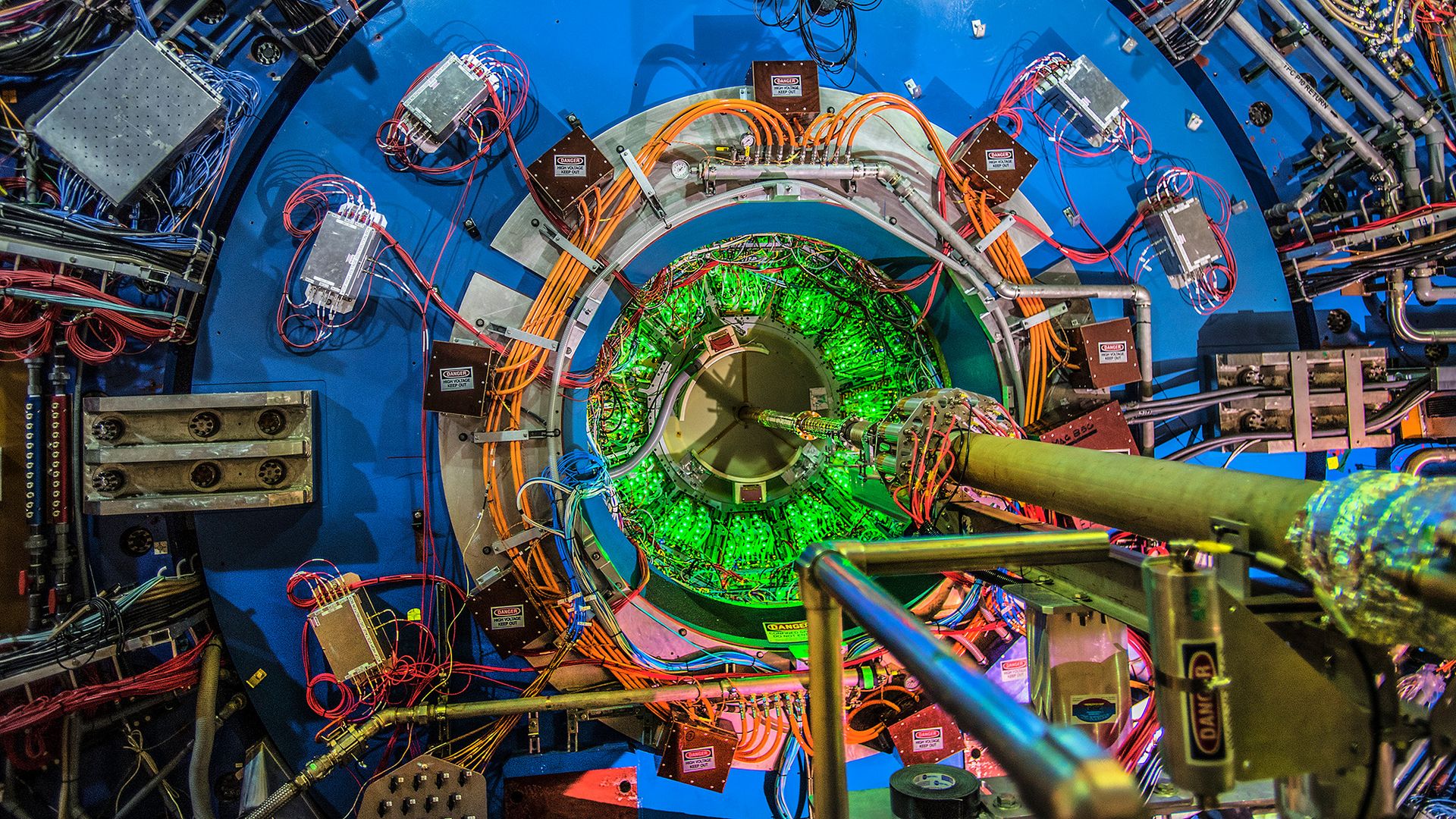
A close up of a circular collider with wires and pipes leading into it.

The central part of the three-story STAR detector at the Relativistic Heavy Ion Collider (RHIC). Scientists recently used the detector to study the conditions of the early universe, just milliseconds after the Big Bang. (Image credit: Brookhaven National Laboratory)

A dip where a smooth trend was expected

To explore this territory, the researchers ran RHIC at a range of collision energies. The lower the energy, the more tightly the colliding matter was squeezed. For its lowest-energy runs, STAR used a "fixed-target" setup, in which a beam of gold nuclei strikes "a thin gold foil placed inside the detector," Manikandhan said, instead of a second, oncoming beam. This produces the densest matter RHIC can make.

Collision energies are measured in electron volts (the energy an electron gains when accelerated across 1 volt). That is a minuscule amount, so particle physicists usually work in billions of electron volts, or giga electron volts (GeV). One GeV is roughly the energy locked up in the mass of a single proton, according to Einstein's famous equation E = mc2. The team analyzed roughly 1 billion collisions at energies between 3 and 7.7 GeV per pair of colliding protons or neutrons. That is the bottom of RHIC's range, which reaches 200 GeV.

In each collision, the team measured how hard charged particles were flung sideways out of the fireball ‪—‬ a quantity known as transverse momentum. The researchers then looked for correlations between the particles. A correlation measures whether two things tend to change together. Here, the team checked whether pairs of particles from the same collision tended to both be flung harder than average, or both more gently. That reveals something about the fireball as a whole. If a fireball is slightly hotter, or expands more forcefully, all of its particles get an extra sideways kick together.

"Those correlations reflect how much the temperature and the flow of the fireball fluctuate," Manikandhan said.

Close to a critical point, the matter's heat capacity — the amount of energy needed to raise its temperature — is expected to shoot up. That makes the fireball's temperature harder to budge, so the correlations should weaken. "If the matter approaches a critical point or a phase change, we would expect to see those correlations change in an unusual, non-smooth way as we vary the collision energy," Manikandhan said.

That is what the team saw in the most head-on collisions. "Instead of changing smoothly with energy, the correlations show a dip," Manikandhan said. The researchers compared the data with a smooth trend anchored by earlier STAR measurements at higher energies. The dip departs from that trend with a statistical significance of 5 sigma, the standard physicists usually demand before treating a signal as real. It means that if the true trend were smooth, random scatter in the data would produce such a pronounced dip only about once in 3.5 million tries.

"A smooth trend is what you'd expect from ordinary nuclear matter, so a dip suggests something more interesting is happening at those conditions," Manikandhan said.

By contrast, a widely used computer simulation of the collisions, which contains no critical point, reproduced the overall trend but not the dip. Off-center collisions showed only a faint hint of the same feature, which is too weak to count as evidence on its own.

Not the final word yet

"The result is suggestive, not proof of a critical point," Manikandhan said. Effects unrelated to a critical point can also shape these fluctuations, and how much of the dip they could explain remains unclear, the researchers noted.

Still, the dip "does point to a set of conditions where the behavior of nuclear matter changes, and it gives theorists a new, precise measurement to test their calculations against," Manikandhan said.

Next, the team plans to use the correlations to "extract the specific heat of the hot matter," Manikandhan said. They will then compare it with supercomputer simulations that calculate the behavior of quarks and gluons from first principles.

The researchers also plan to test the dip against more theoretical models and combine it with other measurements, such as fluctuations in the number of protons produced in the collisions. "Only when different measurements agree can we say confidently whether a critical point exists," Manikandhan said.

  •  

Scientists Say: Antimatter

Antimatter (noun, “AN-tee-MAT-ter”)

Antimatter is made of antiparticles. Think of antiparticles like partners of ordinary particles, but with the opposite properties.

You’ve likely heard of protons, neutrons and electrons. These are the tiny particles that make up atoms. But you may not have heard of their anti-twins. These are antiprotons, antineutrons and positrons.

Particles and antiparticles have the same mass. But they generally have opposite electric charges. An electron is negative. So the positron is positive. A proton is positive. So the antiproton is negative. But exceptions to law of opposites exist. Take the neutron, which has no electric charge. It’s neutral. So the antineutron is also neutral.

When matter and antimatter meet, they destroy each other. If an electron meets a positron, for instance, they self-destruct. As physicists say, they “annihilate” each other. This releases energy in the form of gamma rays. That’s a high-energy type of light.

Antiparticles can bind together to form atoms, just as ordinary particles do. Scientists have built antihydrogen in the lab. They do that by pairing a positron and an antiproton. This isn’t an easy feat, though. If either of those antiparticles touch ordinary matter — poof! They cease to exist. That means scientists must “handle” the particles without touching them. They do this through magnetic or electrical fields.

Very, very little antimatter exists today. A tiny amount occurs naturally. For example, cosmic rays constantly smash into Earth’s atmosphere. When they do, they produce tiny bits of antimatter. Some radioactive decay gives off antiparticles, too. But antimatter never lasts very long. Normal matter quickly destroys it.

Scientists believe that the Big Bang produced equal amounts of matter and antimatter. Why does ordinary matter reign supreme today? That’s one of the universe’s biggest mysteries.

In a sentence

Scientists search for mysterious forms of matter such as dark matter and antimatter hoping to reveal secrets of the Big Bang.

Check out the full list of Scientists Say.

  •  

Biology Might Not Be Quantum, but Its Math Is Quantumlike

Two decades ago, scientists seemed on the verge of understanding biology in a new, quantum way. Life unfolds over an incomprehensible span of scales, from our planet-enveloping biosphere at one end, to individual cell-building biomolecules at the other. Even at its most microscopic, though, biology doesn’t really reach down to the quantum realm, in which particles act like waves…

Source

  •  

Where Does the Quantum World End and Ours Begin?

Quantum mechanics may be one of the most precisely tested paradigms in science, but there’s still no universally accepted interpretation of what it tells us about reality. How do we get from the wave-like behavior of quantum systems to the solid, macroscopic world of objects and the universe at large? Jonathan Halliwell, a professor of theoretical physics at Imperial College London…

Source

  •  

Metasurface optical device boosts nonlinear frequency conversion

By combining a band-structure engineered multi-quantum-well heterostructure with a nanostructure known as a metasurface, physicists in Austria and the US have created a device that can efficiently transform light into different frequencies – including those at technologically important near-infrared wavelengths. Their technique, which boosts nonlinear frequency conversion, could help in the development of smaller and more efficient components for telecommunications, quantum information transfer and other photonics technologies.

Nonlinear frequency conversion is an optical process in which a material is used to generate light of a different frequency to that incident on the material. It is now routinely employed in a wide range of photonics devices that rely on frequency mixing, ultrafast signal processing, broadband and pulsed light sources, and high-speed light modulation. It is also used to generate entangled photon pairs for quantum communication. One common type of frequency conversion, and the one used in this new study, is second-harmonic generation. Here, two input photons are combined to produce one photon with twice the energy.

Efficient nonlinear devices require light with high electric field strengths and materials that respond to these intense electromagnetic fields by producing a light polarization that is not directly proportional to the applied field. “Only a handful of such nonlinear crystals exist and these have complicated structures with weak nonlinearities, which means they require high optical powers to make photons interact with each other,” says Marcus Ossiander from the Institute of Experimental Physics at TU Graz in Austria, one of the authors of the new study published in Nature Nanotechnology. “While, new such crystals emerge from time to time, their structure is fixed, which dictates which light wavelengths they work at and how efficiently.”

Asymmetrically coupled multi-quantum wells

Recently, a group of researchers at the University of Texas at Austin in the US, led by Seth Bank, also an author of this latest study, succeeded in creating an optical nonlinearity not via a new crystal structure but by growing a semiconductor metamaterial made from nanoscale layers of gallium arsenide and aluminium gallium arsenide. These layers contain multiple quantum wells that are asymmetrically coupled to each other.

The quantum wells confine electrons in one dimension while allowing them to move freely in the other two dimensions, something that has the effect of restricting their energy levels into discrete, quantum states. Since they are asymmetrically coupled, the electrons end up mainly moving in one direction when exposed to light. This so-called “one-way street leads to increased nonlinear electron oscillations, allowing light waves to interact with each other extremely efficiently and exceed naturally occurring nonlinearities.

Ossiander and his colleagues, including Federico Capasso at the Harvard John A. Paulson School of Engineering and Applied Sciences (SEAS), have now added a second, two-dimensional metamaterial atop the first one. This metasurface, which consists of titanium dioxide pillars, each several hundred nanometres in size, precisely creates the particular light polarization required to deflect incoming light so that it scatters along the one-way street. This enhances the interactions between light waves even further and so increases the intensity of light in the structure.

An extra lap

Researchers have known for a while now that metasurfaces are extremely good at resonantly trapping light and increasing the interaction of light with matter. Usually, the process is straightforward, explains first author Pernille Undrum Fathi, who works in Capasso’s group: you implement a resonant metasurface, and it enhances, for example, the nonlinear effects that you are aiming for.

“The new material sent us for an extra lap, however, because, during our experiments, we discovered that the designable second-order nonlinear susceptibility tensor element (the required incident polarization) is different to that of conventional materials,” she says. “Therefore, when we shone light at exactly normal incidence, the metasurface–material combination generated light waves whose polarizations cancelled each other out completely, so annihilating any enhanced optical nonlinearity.”

However, the researchers found that tilting the sample by just 0.3° broke this symmetry and solved this challenge. Indeed, they were able to increase the effective nonlinear conversion of the light to three orders of magnitude higher than that for a non-patterned heterostructure. The effect is also higher than previously reported values for comparable devices at near‑infrared wavelengths.

“Nonlinear optics are ubiquitous in modern science and technology, with examples including the generation of light at new frequencies (where lasers might be unavailable), all-optical signal processing and the generation of entangled photon pairs for quantum communication,” Ossiander tells Physics World. “Enhancing the fundamental processes enabling this technology will allow for much more efficient, compact devices and enable new measurements that would previously be impossible.”

Metasurfaces offer an excellent route to control and enhance the interaction of light with matter, and the team was intrigued to find out what could be made possible when combining these materials with nanostructures, adds Fathi.

“Working with new materials of course comes with additional uncertainty, and we spent a lot of time learning about and understanding the mechanisms of these new structures and how the particular nonlinear tensor elements of this material interact with the resonant modes introduced by the metasurface,” she says.

“The material we studied is very interesting but also complex,” adds Ossiander, noting that the reseachers believe they can learn how to make even better use of the designer nonlinearity in it by further investigating its fundamental properties. “Indeed, there is a new publication in Optica by Bank’s group on how to improve the multi-quantum-well material even more.”

The post Metasurface optical device boosts nonlinear frequency conversion appeared first on Physics World.

  •  

Mobile trap transports 92 antiprotons by road and stores them for over a month in world first

In March 2026, scientists succeeded in transporting antiprotons by road for the first time in a purpose-built trap loaded on a truck. The BASE collaboration, which realized this experiment at the European Organization for Nuclear Research (CERN) in Geneva under the lead of Professor Dr Stefan Ulmer and Dr Christian Smorra from Heinrich Heine University Düsseldorf (HHU), now presents its findings and experiences from this pioneering experiment in the journal Nature. Among other things, they report that it was possible to store antiprotons in a mobile transport vessel for more than a month for the first time ever.

  •  

Roll waves emerge as uniform water flow destabilizes on steep slopes, equations show

When it rains, traveling waves appear on steep asphalt pavement, slowly making their way down the slope. Because these so-called "roll waves" propagate without deforming and are typically characterized by abrupt discontinuities, they play an important role in hydraulic engineering. Understanding unsteady flows like roll waves is crucial for the design, management and safety of hydraulic structures such as dam spillway chutes.

  •  

Light lets microswimmers switch between bacteria-like and algae-like propulsion

Physicists at Leipzig University and Charles University in Prague have developed a method for changing the swimming style of tiny artificial microswimmers in real time. They can make a single microscopic particle switch at will between modes of swimming inspired by bacteria and algae. The researchers have thus turned a property that was previously fixed during production into a programmable parameter. They believe their findings pave the way for an evolutionary approach to the development of synthetic active matter. Their study has now been published in Nature Communications.

  •  

Circular Rydberg atoms set three records, staying stable for 11 milliseconds

Rydberg atoms are considered promising building blocks for quantum computers and their precursors, quantum simulators. Researchers at the 5th Institute of Physics of the University of Stuttgart have achieved record values for the lifetime, size, and storage time of circular Rydberg atoms, a special form of Rydberg atom in which electrons move in a stable circular orbit around the nucleus. The findings were published in Nature Communications.

  •  

CERN Physicists Find Evidence of One of Higgs Boson’s Rarest Decays

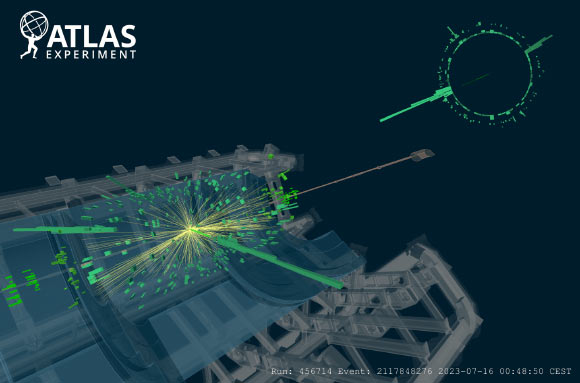
Event display of a candidate Higgs boson decay to a photon and a lepton pair, from proton-proton collisions recorded with the ATLAS detector in 2022. Image credit: ATLAS Collaboration / CERN.

Physicists from the ATLAS Collaboration at CERN’s Large Hadron Collider (LHC) have found evidence of the Higgs boson decaying into a ‘virtual’ photon and a real photon, which in turn produces a pair of leptons.

The post CERN Physicists Find Evidence of One of Higgs Boson’s Rarest Decays appeared first on Sci.News: Breaking Science News.

  •  

What happens when neutrinos swap identities inside a supernova?

Our basic understanding of core-collapse supernovae hasn't changed in decades. Large stars burn through all the fuel at their cores and start creating heavier elements in reactions that consume energy. The lack of energy from these reactions allows gravity to pull the interior of the star in on itself, collapsing it into a neutron star or black hole. The energy released by this process then blows the remainder of the star apart.

And, generally, that's right. But there's an entire busload of devils in the details. The statistics of supernovae that we've observed indicate that the model may be seriously incomplete. And on the theoretical side, there are still plenty of uncertainties, including over some of the basics, such as whether all core collapses actually result in a supernova.

A paper being released by Physical Review D provides what might be a potential explanation for the discrepancy: flavor-changing neutrinos. Neutrinos play a key role in our current models of supernovae, and right now, those models don't take into account one of neutrinos' most striking features: their ability to change identity.

Read full article

Comments

© Ken Chen, Academia Sinica Institute of Astronomy and Astrophysics

  •  

Heating mica to 200°C reveals friction independent of sliding speed

Through joint research with the U.S. Geological Survey and the University of Tokyo, NIMS for the first time experimentally demonstrated friction completely independent of sliding velocity—an ideal that had never been realized—by heating mica, a layered oxide also used as a lubricant material, to 200°C (392°F). NIMS also clarified that this is caused by the disappearance of defects within crystals at high temperatures.

  •  

Scientists Discover Jupiter-Like Weather Just 20 Light-Years Away

Scientists have discovered that the weather on a distant world may be far more organized than it first appears. The object, known as SIMP 0136, is a brown dwarf located about 20 light-years from Earth. It is larger and hotter than a gas giant planet such as Jupiter, but it is not massive enough to […]

The post Scientists Discover Jupiter-Like Weather Just 20 Light-Years Away appeared first on Knowridge Science Report.

  •  
❌