When it comes to power, the pair think it should be possible to generate sufficient energy even for a large city and without the need for nuclear power.
They estimate it would be possible to generate 3 GW of electricity using kilometre-tall towers covered with photovoltaic arrays. Not only that but it would be possible to manufacture solar panels on the Moon given the amount of silicon on the surface.
Yet it is not good news when it comes to water consumption. We have known for well over a decade that the Moon’s poles contain water ice, possibly as much as a billion tonnes, with Moon-orbiting craft mapping out likely locations in great detail.
Even assuming one billion tonnes of water on the Moon, if nothing was recycled then a city of a million would last only a few years, while a population of 100,000 would run for 20 years before running dry.
Even when recycling the water with an efficiency of 98% – as performed on the International Space Station – a city of a million would only have enough water for around a century.
The authors say that to sustain a lunar city of that size would require improving water-recycling efficiencies beyond 99.5%, reducing water usage through vertical farming or simply finding more water on the Moon.
So for now it sounds like a Moon village may be the only possibility. The authors state that a town of around 10,000 people, for example, may be sustainable for several centuries.
While Earth’s atmosphere is constantly changing, many spectacular storms and atmospheric waves on Saturn remain stable for decades or even centuries.
Images from NASA’s Voyager craft as it flew-by the planet in the early 1980s revealed a large and long-lived hexagonal atmospheric wave around Saturn’s north pole.
Yet despite decades of observations from other craft such as the Cassini mission, no similar wave has been reported in the southern hemisphere or elsewhere.
The researchers discover the phenomenon thanks to images from NASA’s Hubble Space Telescope as well as ground-based telescopes as the planet’s south pole came back into view from Earth due to Saturn’s axial tilt.
It seems that the 10-sided wave developed between 2023 and 2025 and may still be evolving, in contrast to the 40-plus years of steadiness shown by the hexagon.
The longitudes of the decagon’s vertices oscillate over a period of 32 days, and its movements suggest it may be trapped by the curvature of an atmospheric jet.
The researchers suggest the wave could have been created by a spatially periodic disturbance in the jet peak or driven by an “anticyclonic vortex” to its north.
However, further study is required to better understand how it formed and how it compares to the hexagon structure in the north.
“The most intriguing part to me is that this seems to have just formed recently,” notes study co-author Amy Simon from NASA’s Goddard Space Flight Center in Maryland. “The question is, why did it suddenly form now when we haven’t seen one before?”
As wildfires and extreme heat events rage across the world, “apocalyptic” has become an increasingly common descriptor. These climate disasters are not unprecedented, however. New research suggests they may have been the main mechanisms behind the mass extinction event that killed the dinosaurs – and much other life on Earth – 66 million years ago.
Our modern understanding of this extinction dates back to 1980, when the father-and-son, physicist-and-geologist team of Luis and Walter Alvarez presented evidence that it was triggered by an asteroid strike. Subsequent work identified the Chicxulub crater in Mexico’s Yucatán Peninsula as the likely impact site, but debate has persisted – including over how a single asteroid could cause worldwide destruction.
In the latest work, Brandon and Alexandria Johnson, a husband-and-wife duo at Purdue University in the US, fit another piece into this puzzle. By combining Brandon’s research on impact cratering with Alexandria’s expertise on the behaviour of atmospheric particulates, they found that the asteroid impact sent up a near-impermeable layer of dust that smothered the entire planet. Their research, published in Journal of Geophysical Research: Biogeosciences, breathes new life into a theory that had fallen out of favour: that extreme heat and wildfires were the main killers on the day the asteroid hit.
The key to ignition
At some level, this dust layer likely produced a cooling effect, much as large volcanic eruptions do today. Indeed, a previous study showed that condensed droplets of rock known as spherules would have blocked the Sun’s radiation from entering the atmosphere.
At the Earth’s surface, however, the Johnsons think the dinosaurs had the opposite problem. The impact also sent a massive plume containing over 1000 km3 of vaporized material high into the atmosphere. When this material rained down as spherules, the dust cloud’s potential cooling effect was reversed.
“[The spherules] are essentially adding energy back to the atmosphere by travelling through it to the surface. That energy has to go somewhere,” Alexandria Johnson explains. “What we found is that this dust layer over the planet is essentially acting like a lid, and it’s keeping almost all the radiation that should try to find its way back out to space and reradiating it back down to the surface. So it’s enough to not only kill the dinosaurs but actually start widespread wildfires.”
Both researchers were surprised at just how opaque this dust layer was. By their reckoning, it trapped almost all radiation within the atmosphere, allowing a staggeringly tiny upwards transmittance of just 10-286.
“I asked [Brandon] to redo my calculation, I was like ‘make sure these numbers are right’, because this is absolutely nothing,” says Alexandria. “I expected more than what we got to be reradiated out, but the fact that it doesn’t just enhances the whole idea of the heat pulse killing things off in a very quick manner.”
Based on the Johnsons’ estimated heat fluxes, any creatures that couldn’t shelter or burrow – dinosaurs included – would have suffered temperature-induced deaths within an hour or two of the impact. The radiation was also more than enough to ignite lichens, grasses and pine needles, destroying vast amounts of plant life through wildfires.
Never-ending night
Anything that survived the heat then had to face the darkness. “You would have had darkness lasting for a long time which then can cause collapse of the food chain in the oceans and cause oceanic extinctions,” says Brandon Johnson. The dust particles were about as small as those in wildfire smoke, and they may have blocked out the Sun for as long as decades before settling into what we now see as the K-Pg boundary: a rock layer a few millimetres thick that contains high levels of iridium, identified by the Alvarezes as coming from an asteroid.
Although some previousworks suggested that the impact couldn’t have ejected enough material to trigger such large-scale effects, Brandon says his analysis of rock vaporization thresholds indicates that the plume’s mass was big enough to facilitate the transport of material across the planet’s atmosphere. Without this transport, he adds, the wreckage would have been more localized to the Chicxulub impact site.
Given the interdisciplinary nature of the field, Brandon thinks there are many ways this line of research could continue. Possibilities include investigating the geological record in more detail and combustion experiments to better understand the wildfires’ impacts. He himself is hoping to carry out 3D impact simulations which can more accurately incorporate the vaporization of rock. “Essentially, [we want] to see what happens to that vapour and see if it is going to expand and be deposited globally as we expect,” he says.
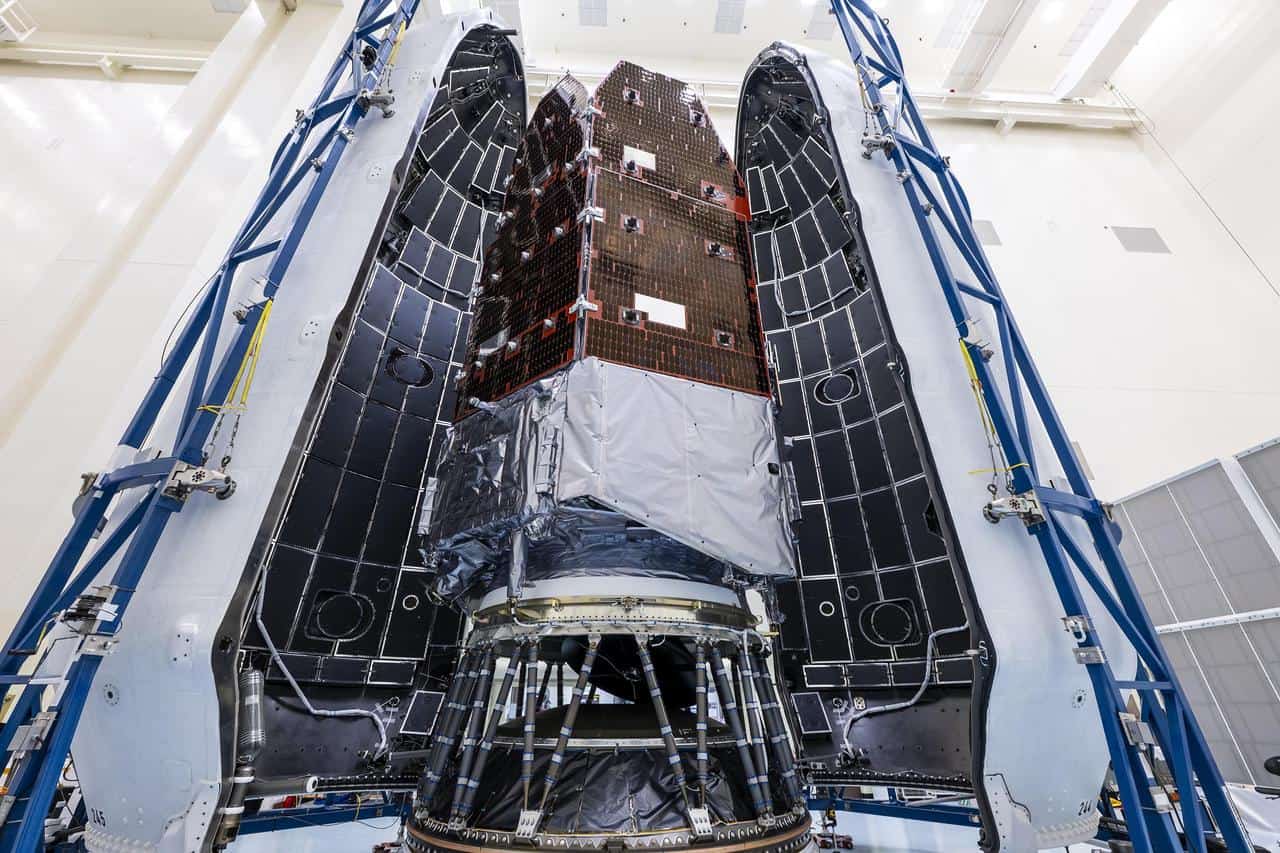
NASA has successfully launched the $4.3bn Nancy Grace Roman Space Telescope. The observatory took off atop a SpaceX Falcon Heavy rocket from Florida’s Kennedy Space Center at 7.26 a.m. local time on 30 August. The craft will now spend three months travelling to a point in space known as the second Sun–Earth Lagrange point (L2) where it will survey space with a field of view at least 100 times greater than the Hubble Space Telescope.
From L2, which lies about 1.6 million kilometres from Earth, the Nancy Grace Roman Space Telescope will yield insights into dark energy and dark matter, discover and characterize exoplanets, map billions of galaxies, and gain fresh understanding of black holes.
It will do so via a 2.4 m primary mirror that is accompanied by two instruments: a wide-field instrument will obtain images in visible and near-infrared light, while an experimental coronagraph will use masks, prisms and mirrors to cancel out the light from stars to help detect exoplanets.
“Roman will be a discovery machine that will bring us closer than ever before to answering humanity’s most profound questions about our cosmic history,” notes Nicola Fox, associate director for NASA’s Science Mission Directorate.
NASA intends the observatory to operate for at least a decade, with three specific surveys planned for its initial five years. The first will identify tens of thousands of distant supernovae, many more than the 2000 currently known, while a second survey will observe more than a billion galaxies.
Both these sets of measurements, combined with data from other survey telescopes, will be used to improve our understanding of dark energy and its potential role in the speed at which the universe expands. Their observations of gravitational lensing will also allow astronomers to map dark matter.
A third survey, meanwhile, will search the centre of the Milky Way for signs of gravitational microlensing that will reveal more than 2000 otherwise invisible exoplanets.
Space surveyor: the observatory will yield insights into dark energy and dark matter, study exoplanets, map billions of galaxies and to gain fresh understanding of black holes. (Courtesy: SpaceX)
Mother Hubble
The observatory was initially known as the Wide-Field Infrared Survey Telescope before it underwent several design changes due to cost pressures. In 2020 it was then renamed after Nancy Grace Roman (1925–2018), who in the early 1960s became NASA’s first chief astronomer and is known as “the mother of the Hubble Space Telescope”.
Yet the Roman observatory won’t replace Hubble or the James Webb Space Telescope, rather it will complement them, providing data from wide areas of the universe that those two instruments will then be able to observe in greater detail.
Indeed, Roman will survey the universe a thousand times faster than the Hubble, creating 1.4 billion terabytes (1.4 zettabytes) of information daily – the highest data rate of any NASA astrophysics mission.
NASA says that machine learning, artificial intelligence and “citizen science” will be used to help sift through the data and flag findings that astronomers will then study.
NASA administrator Jared Isaacman praised the mission as “exactly the kind of success story we want to see”. He noted that it was completed “ahead of schedule and on budget”, adding that it “will demonstrate what is possible when America’s space programme pairs bold ambition with disciplined execution”.
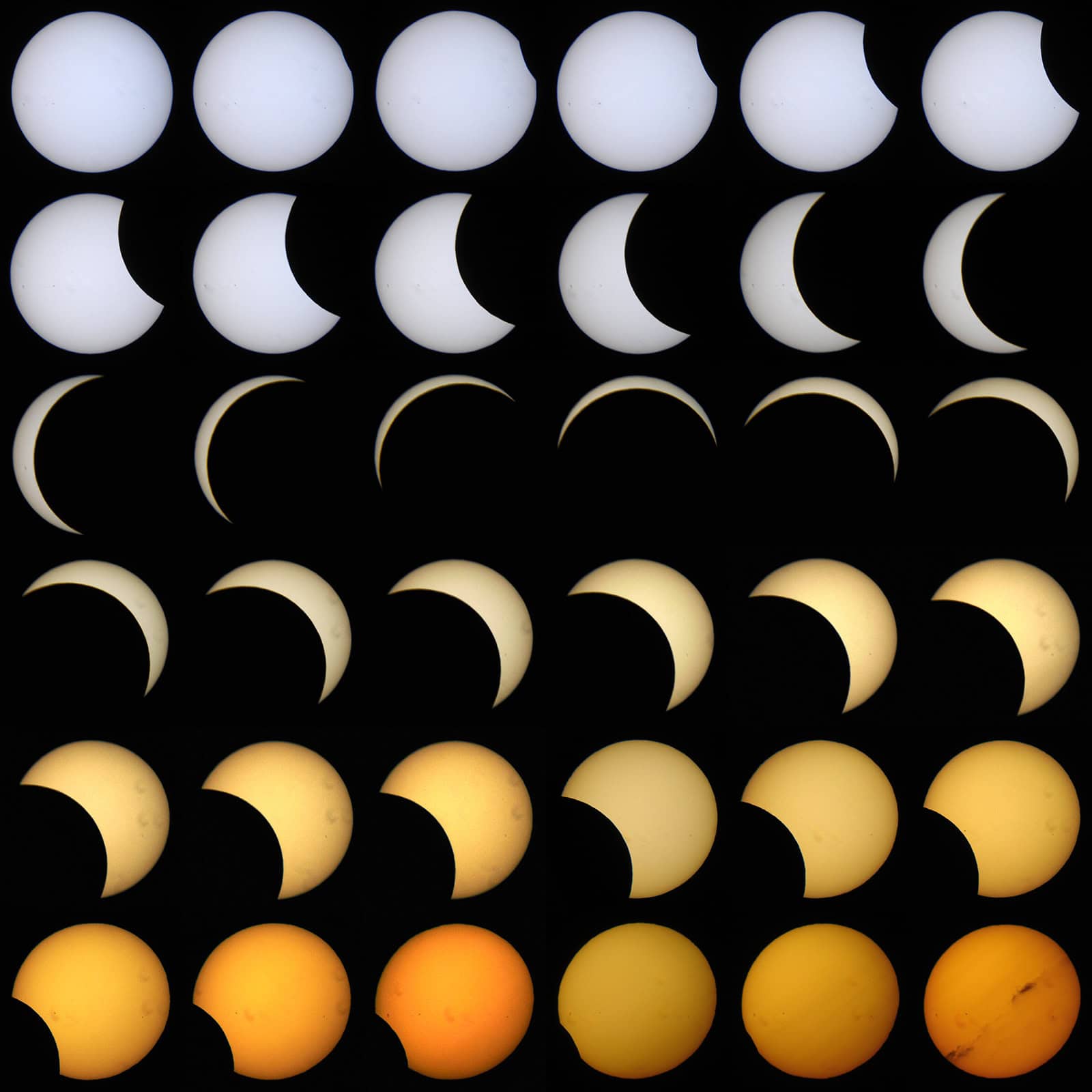
Packed with physics This photo montage of the 12 August 2026 solar eclipse as seen from the Isle of Wight, UK, holds a surprising amount of science. (Courtesy: Sean Ryan)
The UK’s hot, dry summer provided widespread clear skies for the solar eclipse that took place on Wednesday 12 August 2026. It was not a total eclipse – you had to be in northern Spain for that – but Britain still enjoyed a partial eclipse between around 6 p.m. and 8 p.m. BST, depending on location.
With typically more than 90% of the Sun’s disc covered – and with the event occurring after many people had finished work – the circumstances were ideal for a rare, immersive mass-engagement with physics.
Many people had got hold of eclipse glasses in advance or searched through kitchen cupboards for a colander to produce shadow patterns
Widespread public-awareness raising by professional and amateur astronomical societies had led to a strong build-up to the event in mainstream and social media. As a result, much of the public was aware the eclipse was coming, and many people had got hold of eclipse glasses in advance or, failing that, searched through kitchen cupboards for a colander to produce shadow patterns.
Here in the UK, friends and families gathered on west-facing hills, parks and village greens that evening with folding chairs, smartphones, cameras, telescopes and colanders, to enjoy the spectacle over a picnic tea. In built-up areas of towns and cities, many sought out west-facing windows of homes and offices.
I’m an old-school visual observer and recorded the eclipse sequence using 20-year-old equipment
While the eclipse on the UK mainland was deepest in Cornwall, I took my chances on the Isle of Wight, just off the coast of southern England.
Amateur astrophotography has been revolutionized over the last few years thanks to specialized high-sensitivity astronomical CMOS cameras, but I’m an old-school visual observer and recorded the eclipse sequence using 20-year-old equipment.
The montage presented here contains 36 frames spanning the entire eclipse sequence and packs in a wealth of physics. Besides the obvious relative motion of the Earth, Moon and Sun, three sunspot groups are visible, approximately delineating the solar equator; the camera was aligned with the sunspot groups and the equatorial mount maintained this orientation.
The Moon’s sharp-edged silhouette is a reminder that it has no atmosphere, whereas the Sun is brighter in the centre than the edge. Known as “limb-darkening”, it arises because of the temperature gradient of the tenuous solar photosphere – and is a reminder that the perceived edge of the Sun is merely a wavelength-dependent opacity transition.
While we often describe the Sun as yellow, the transmission profile with the OD5 solar filter that I used here gives it a slightly silvery-blue tinge. But as the Sun sank lower in the sky during the evening, wavelength-dependent extinction and scattering reddened the light, so the silvery disc progressively turns distinctly yellow and then orange.
Along with the colour change, the solar disc takes on an oblate form in the final row of frames due to differential atmospheric refraction close to the horizon. Terrestrial clouds close to the local horizon are seen in the final frame.
For many people viewing an eclipse for the first time, talk of intersecting orbital planes is perhaps already too much physics for one evening, but for those who wish to look a little deeper, more questions – and more physics – pop up the closer you look. What have you spotted in the montage that I haven’t?
The technical stuff
I took these images using a portable 90 mm diameter Maksutov-Cassegrain telescope (a Meade ETX-90) on an equatorial mount with a battery-powered drive, a full-aperture glass OD5 solar filter, and a 25 mm focal-length eyepiece paired in eyepiece-projection mode with a 5 megapixel Sony Cyber-shot CCD digital camera.
The camera was set for manual operation: minimum ISO (100), minimum aperture (f/5.6), fixed focus (achieved at f/2.8), and manually adjusted exposure time (1/400 – 1/13 s). Image processing was minimal, conducted using ImageJ software, which is widely used in biomedical imaging.
Shadowing of the sensor by dust on the lens surfaces was partially corrected by dividing through by a normalized clear-sky exposure. Frames were cropped manually and re-scaled in intensity to compensate for increasing atmospheric absorption as the Sun sank towards the horizon, and for changes of exposure duration.
Newborn and rapidly growing supermassive black holes could be powering the mysterious “little red dots” that litter the early universe. That is the conclusion of an international team of astronomers who have found the best evidence yet for a new kind of object called a “black-hole star”, which appears to be driving a little red dot that existed just 660 million years after the Big Bang.
“A little red dot is an extraordinary object,” says team leader Rohan Naidu, of the University of Hawaii and MIT. “Somewhere within it lies a black-hole star, surrounded by a good old fashioned galaxy.”
When the James Webb Space Telescope (JWST) began observing the distant universe in the summer of 2022, astronomers were astonished to find lots of little red dots. They are highly luminous as one would expect an active black hole to be, but their spectra are odd, looking more like stars with no X-ray emission.
Some astronomers believe little red dots are dense cocoons of gas incubating a growing black hole at their cores. As the black hole accretes gas from the interior of the cocoon, it radiates energy that is absorbed by the cocoon – making it glow brightly. This is similar to how stars shine, the radiation from their core heating their outer layers. Hence these hypothesized objects are dubbed black-hole stars.
Until now, however there had only been circumstantial evidence for this hypothesis. Part of the problem is that in most cases the light from the little red dots mingles with the light from the unresolved host galaxy, clouding the observations.
Miracle or mirage?
Naidu is co-lead of the Mirage or Miracle (MoM) survey. When pushing to high redshifts (further distances) with the JWST, it can be difficult to discern whether a faint red splotch is really a high-redshift galaxy or a cool star in the foreground masquerading as something from the early universe.
Now, MoM has found a black-hole star shining 100 billion times brighter than any known star, and drastically outshining its host galaxy.
Called MoM-BH*-1, the object is incredibly luminous at longer wavelengths, but below the wavelength corresponding to the Balmer series of hydrogen emission there is no light at all. This sudden drop in luminosity is called the Balmer break and is often seen in young stars.
“In MoM-BH*-1 the Balmer break is three to four times stronger than any we’ve seen ever before,” says Naidu. “This feature alone tells us there is something truly singular afoot, and that this is a new kind of astrophysical object.”
Extremely dense cocoon
Simulations modelling the Balmer break and the object’s luminosity strongly suggest that there is a 100,000 solar mass black hole at the centre of MoM-BH*-1, surrounded by an extremely dense cocoon of gas.
“The physics of how its light is being produced by this dense gas cocoon around this black hole is radically different from what we see around us in the local universe,” says Naidu.
If the object is indeed a black-hole star, a salient question is how did the black hole form? Numerous possibilities have been raised, from the direct gravitational collapse of a gas cloud to the merger of a cluster of massive stars.
Naidu favours an explanation involving a supermassive star – an object that could have formed about 150 million years after the Big Bang when the universe was dense with hydrogen and helium. According to many popular models, these conditions spawned stars thousands of times the mass of the Sun.
Recent outburst
Naidu points to the life cycles of the massive stars in the Milky Way, which top out at a few hundred solar masses. Eta Carinae, for example, had an outburst in the 1840s that made it the second brightest star in the sky for several days. The outburst from this 100-solar-mass star left a cocoon of gas called the Homunculus Nebula. A much larger supermassive star could have had a similar outburst and then collapse to a black hole, thereby creating a black hole star.
“In the past few months I’ve seen so much evidence for this, that at this point, it is the main hypothesis that needs to be proved or disproved because the similarities to supermassive stars are uncanny,” says Naidu.
Indeed, it is possible that every supermassive black hole in the universe could be a relic of the very first giant stars created just after the Big Bang. Over time these objects would steadily erode their gaseous cocoon, eating it away from the inside-out while radiation from accretion onto the black hole would blow away the remainder of the cocoon. This is supported by a recent discovery by NASA’s Chandra X-ray Observatory of a little red dot that existed 11.8 billion years ago and from which X-rays are starting to peak through holes in its shredded cocoon.
Naidu is suitably awe-struck by the possibilities, describing how “it’s inspiring to be witnessing the birth of supermassive black holes.”
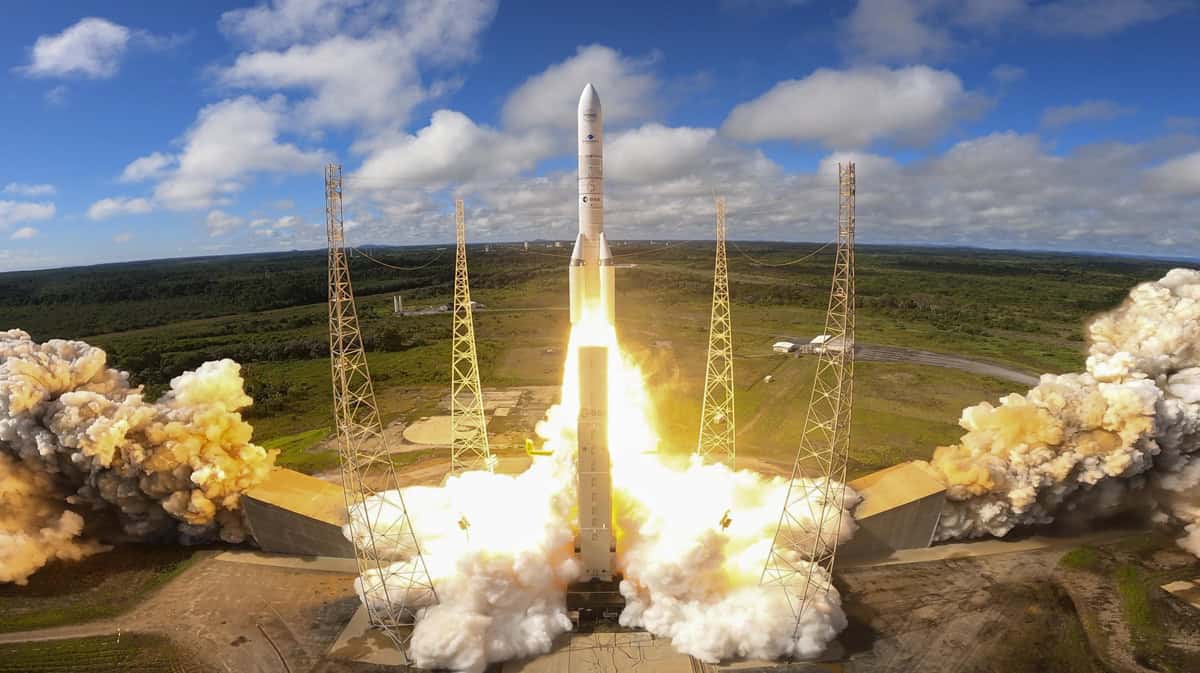
Multinational missions Ariane 6 is the latest rocket in a long history of launchers – demonstrating the power of multinational co-operation for more than five decades. More than 3000 staff are working at ESA to implement space missions for exploring the universe, protecting our planet or serving our daily life. (Courtesy: ESA)
The European Space Agency (ESA) is globally recognized for its iconic space missions that push the boundaries of science and technology, whether it’s a rendezvous with a comet, landing a probe on Saturn’s giant moon Titan or mapping the stars of the Milky Way in unprecedented detail. But ESA does so much more than these headline-grabbing scientific and exploratory endeavours.
“Space is no longer solely a playground for curious minds,” says Eric Wille, ESA Head of the Opto-Electronics Section. “It’s really important for our everyday life too.” In fact, modern society relies on space technologies.
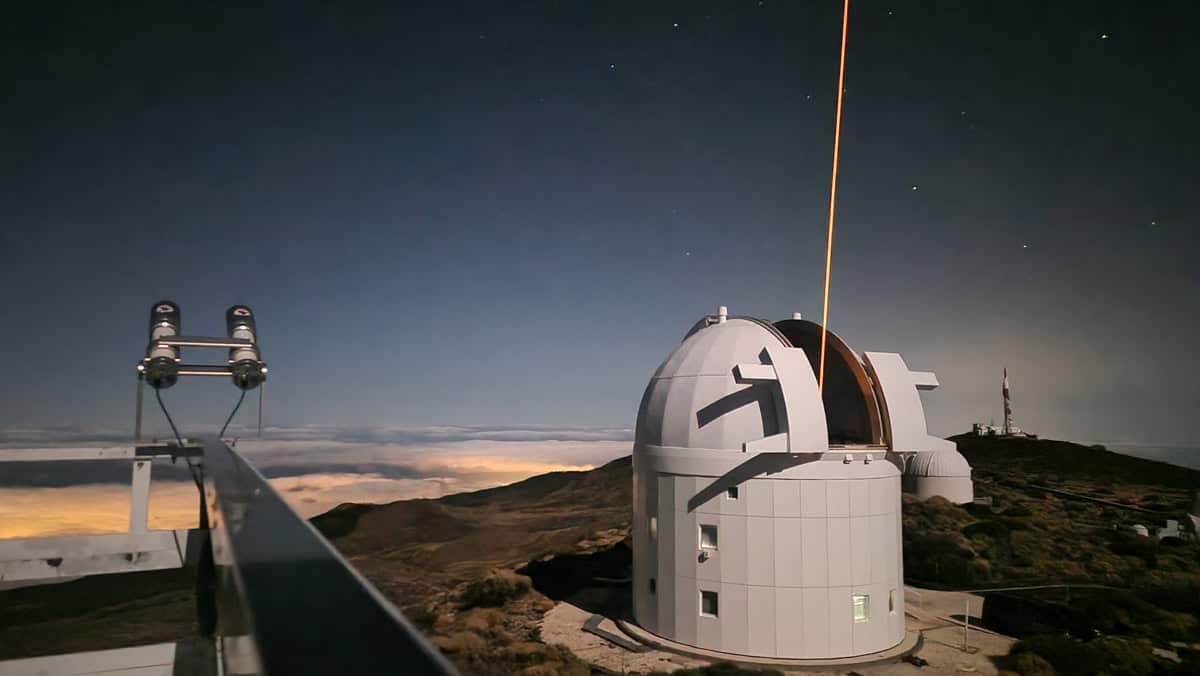
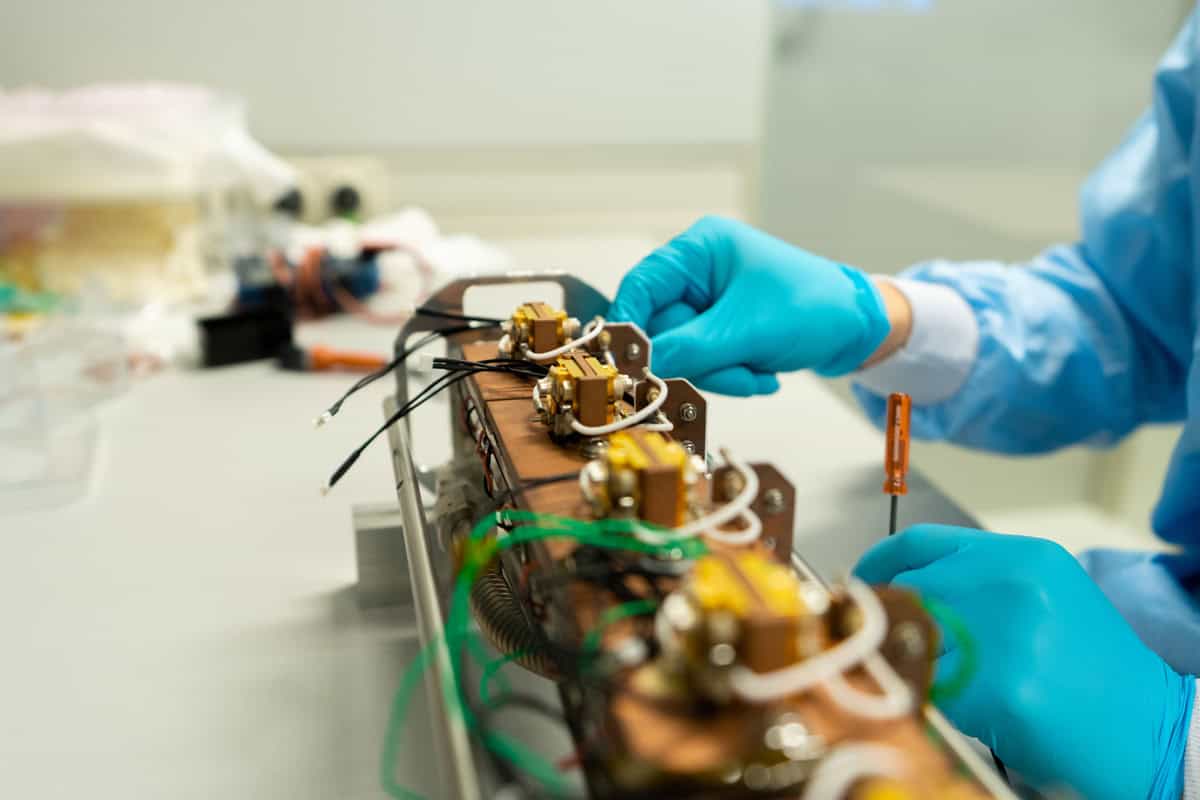
Project management The ESA Optical Ground Station in Tenerife is used to develop laser technologies for high-speed data links or quantum communication. The laser beam projects a guide star to control an adaptive optics system that improves the beam quality of the optical communication link. It is one of several ESA laboratories managed by Eric Wille and the opto-electronics section for testing optical systems for space. (Courtesy: ESA)
Satellite-based environmental monitoring, weather forecasting and global navigation are obvious examples, but there are many other important applications. For instance, the global financial system could not function without atomic clocks aboard satellites time-stamping millions of stock trades and digital payments every second. Similarly, when natural disasters strike, satellite networks become essential lifelines: mapping floods, tracking wildfires and helping with the co-ordination of emergency response efforts on the ground.
Fulfilling all of these roles and ESA’s bold space ambitions – from seeking answers to big questions about the universe to watching over our precious planet – requires a highly dedicated, technically proficient and multi-skilled workforce made up of scientists, engineers and various other professionals.
Diverse and challenging work
When Wille joined ESA as an optical systems engineer in 2009 after completing his PhD in experimental quantum optics, it was the sheer diversity of challenging work that attracted him. “Working in an international space agency, you’re partly a researcher, partly a project manager, partly also someone with ambassadorial skills,” he says. “That mixture is really something which I found at that time very attractive and I still like today, very much.”
Charlotte Pachot also craved a technically challenging role after her master in optics. She found it at Thales Alenia Space in France as a space engineer working on optical instruments. But after a few years, her interactions with ESA staff through joint projects convinced her to join the Agency as an optical engineer. She is now Lead Payload Engineer for the Laser Interferometer Space Antenna (LISA) mission, intended for launch in 2035, which will be the first gravitational wave detector in space.
Both Wille and Pachot have found that the technically challenging work at ESA is particularly satisfying because it has real-world impact. The first 10 years of Wille’s ESA career were largely spent on Athena (Advanced Telescope for High ENergy Astrophysics; now renamed NewAthena), a powerful X-ray observatory set to launch in the late 2030s that will provide fresh eyes on a wide range of hot and energetic processes in the universe.
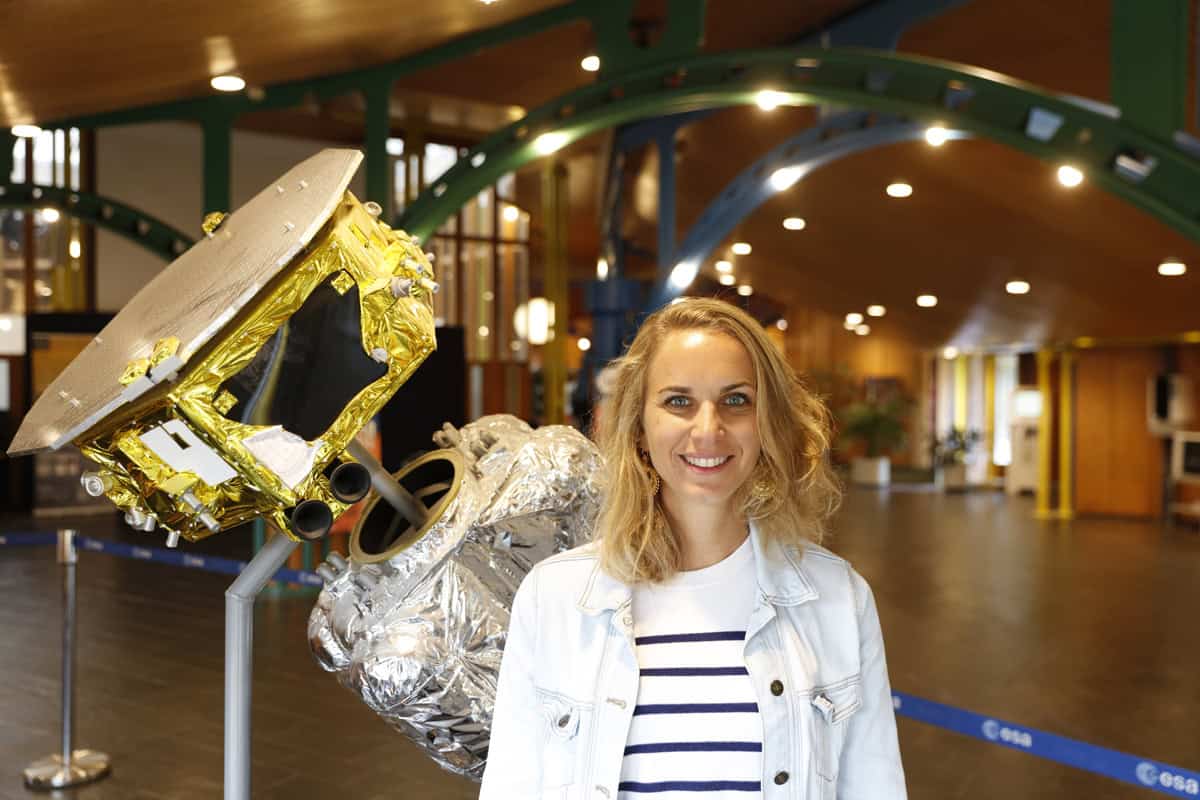
Charlotte Pachot is overseeing the LISA optical bench assembly. Next to her is a model of LISA Pathfinder that tested critical technologies in space in 2016. (Courtesy: ESA)
In this role, Wille and the ESA team collaborated with an industrial consortium led by Dutch measuring instrument supplier cosine to develop a completely new type of optics, called silicon pore optics. Using techniques perfected by the semiconductor industry, cosine bonded and stacked many silicon plates on top of each other. By shaping the plates, a lightweight mirror to focus X-rays was created; in fact, 10 times lighter than the ones flying on current X-ray missions XMM-Newton and the Chandra X-ray Observatory.
Like Athena, LISA will also provide fresh eyes on cosmic events, but through the unique prism of gravitational waves. This will be achieved through a completely new approach involving a triangle of three satellites spaced 2.5 million kilometres apart.
Understandably, LISA calls for a unique optical bench, which Pachot is managing from design to manufacturing and testing. She sees her role as being like that of a conductor of an orchestra: a lot of her time is spent co-ordinating team members and partners, while also helping to solve technical, budget and schedule problems. For Pachot, tackling these daily friction points is part and parcel of working on real-world big science. “The instruments are very complex technically, very challenging, but they are also real pieces of hardware as part of a real project,” she says.
International community
As Wille and Pachot’s stories show, ESA selects talent from different career stages. The Agency offers several programmes that support students, graduates and experienced professionals in finding the right role for their profile and interests.
Device testing Lasers are used in many different space applications. Igniting launchers, high-speed optical communication, LIDARs for atmospheric measurements or for measuring gravity waves with LISA. The opto-electronics laboratory at ESTEC is frequently used to characterize the lifetime and performance of high-power diode lasers.(Courtesy: ESA)
For example, university students can benefit from ESA Academy sponsorship, such as participating in hands-on projects or training sessions. They can also join ESA as interns. Graduates can apply to ESA’s Graduate Trainee Programmes where they can gain experience on actual ESA projects and develop technical and professional skills. And for those currently in industry with less than three years’ experience, the Junior Professional Programme allows them to join ESA as staff members for four years and benefit from tailored learning and development opportunities to prepare them for a long-term position.
Whichever pathway they take, once new recruits get started in their first role, an excellent employment package – including competitive salary and pension scheme, hybrid working and flexible hours, and professional development training opportunities – comes as standard.
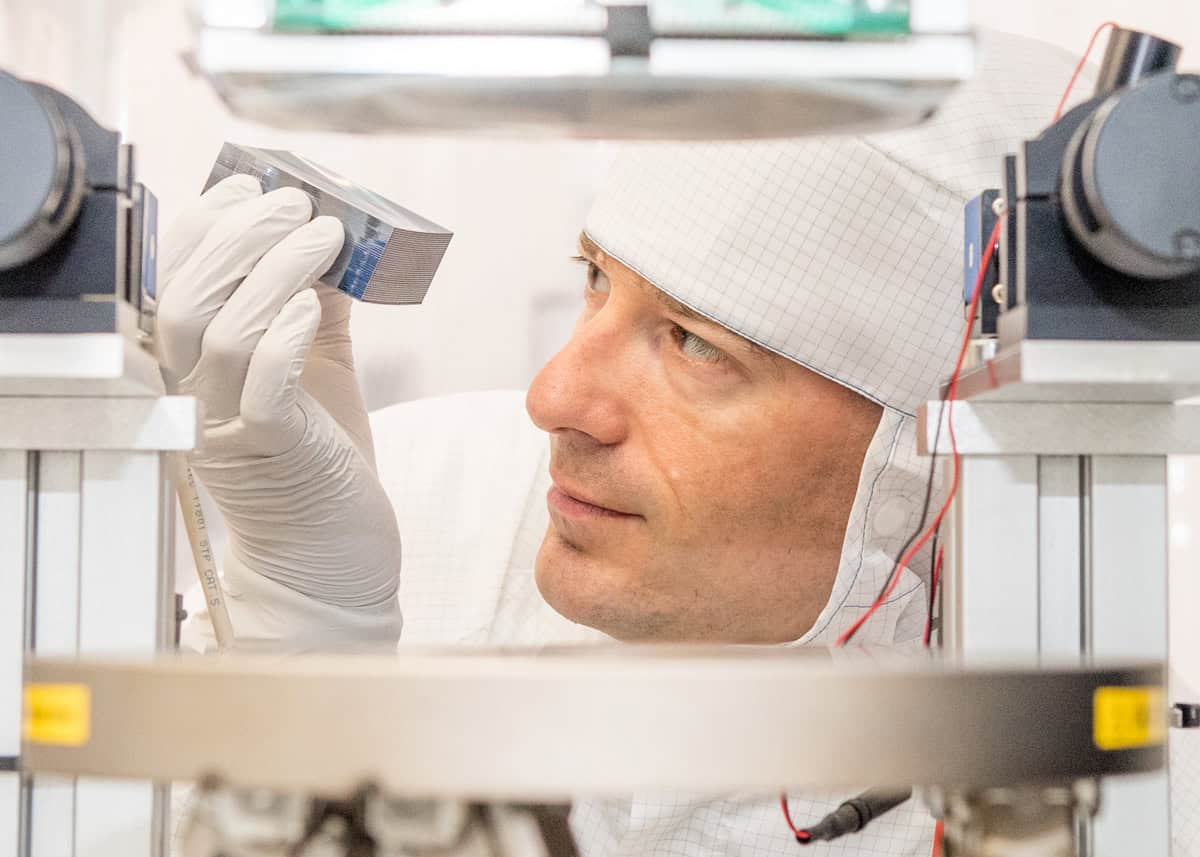
Eric Wille inspecting a new X-ray mirror using stacked silicon plates. The mirror was assembled using an automated stacking robot partially visible in the foreground. (Courtesy: ESA)
What sets ESA apart is the multicultural work environment. Team members might come from any of ESA’s 23 Member States and nine further Cooperating States and Associate Members. And recruits can be based in more than nine locations in seven countries (France, Germany, the Netherlands, Italy, Belgium, Spain and the UK). This makes for a melting pot of cultures.
“There’s a very lively expat community,” says Wille. “At the European Space Research and Technology Centre (ESTEC) and other big sites, it’s like a small Europe.” This cultural diversity is of course intentional. “The problems we have to solve require teamwork,” says Pachot. “And this is made easier at ESA because we all see problems in a different way depending on our culture.”
Working life at ESA
Want to learn more about working at ESA? Take a look at life at ESA and what ESA offers. Quickly find out which programme could be the best fit for you by following the pathways to ESA on this flowchart.
The first direct glimpse of vacuum birefringence has been claimed by astronomers who have studied X-ray and radio emissions of a neutron star that is both a magnetar and a pulsar. A central, but unconfirmed prediction of quantum electrodynamics (QED), vacuum birefringence involves the polarization of the quantum vacuum by powerful magnetic fields.
Made by a US-led international team, the observation could lead to the use of magnetars as natural laboratories to study other extreme-field phenomena of the quantum vacuum. However, another group headed by researchers in Italy remains unconvinced that the data constitute a “smoking gun” for vacuum birefringence. They believe that alternative explanations remain viable.
Birefringence occurs when the refractive index of a medium depends on the polarization of the radiation passing through it. When refraction occurs at such a medium, there is an angular separation of the two differently-polarized waves. This occurs with certain crystals such as calcite and lithium niobate, where the anisotropic lattice structure interacts differently with oppositely polarized photons. Birefringence can also arise from the interaction of photons with magnetic fields in plasma.
Virtual pairs
A key prediction of QED – first made in 1935 by Werner Heisenberg and Hans Euler – is that sufficiently strong magnetic fields can make a vacuum birefringent by polarizing the virtual electron–positron pairs that fluctuate in and out of existence. Ninety years on, however, vacuum birefringence had not been observed because the huge fields required cannot be generated in the laboratory.
“Having a natural lab already existing that could look into some of these effects is something that would be very beneficial,” says astronomer Rachel Stewart of George Washington University in the US. “That’s something people have probably been looking into for decades.”
Stewart and colleagues’ natural lab is a magnetar. These objects comprise a rare subtype of neutron star that have extreme magnetic fields of up to 1011 T. This makes magnetars the most magnetic objects observed in the universe and bright sources of X-rays. Data from NASA’s Imaging X-ray Polarimetry Explorer (IXPE) telescope have shown that this radiation is often polarized.
This is not surprising because the surface of a magnetar is likely to be surrounded by magnetized, birefringent plasma. The plasma’s field, however, should be tangled and variable, so the net polarization imprinted on light emitted into the far field should be relatively small.
Magnetic axis
If the magnetar’s intense magnetic field polarizes the vacuum of empty space, then the birefringence polarization imprinted onto the X-rays should follow the orientation of the magnetic poles into the far field as the magnetar rotates. Disentangling the two effects is difficult, however, because it is not generally possible to ascertain the orientation of the magnetic poles with respect to the direction of our observation.
A very few magnetars, however, are also pulsars that emit narrow beams of radio waves from their magnetic poles. The magnetic and rotational poles of a pulsar are misaligned, which causes the radio beam to sweep around like a lighthouse beam. If Earth happens to be in the path of the beam, we observe radio pulses.
In the new research, Stewart and colleagues observed the magnetar 1E 1547.0−5408, which is unique among observed objects for having persistent, bright radio emission alongside its X-ray emission. They combined observations from two space-based X-ray telescopes – IXPE and the Neutron Star Interior Composition Explorer (NICER) – with radio observations from Australia’s Murriyang telescope.
The radio observations allowed the team to the work out the angle between the magnetar’s magnetic and rotational poles and the angle between the rotational pole and the direction of our observation. This gave them the information needed to disentangle the two birefringence effects.
Large polarization
The researchers found a high degree of polarization in the detected X-rays – up to 80% at photon energies 2–3 keV in energy. They point out that this high degree of polarization is consistent with vacuum birefringence being driven by the magnetar’s powerful field.
The X-ray emission is closely aligned with the radio emission, which the researchers believe is naturally explained by the magnetic poles of the star being closely aligned with the rotational poles – and difficult to reconcile with alternative explanations.
However, another recent paper challenges this interpretation. Roberto Taverna of the University of Padova in Italy, who led the work, says that pairing the radio emission data with the X-ray observations was “very smart”, but he says that “it is not obvious to me whether the two observations – the radio and the X-rays – are compatible or not.” He says that, if the X-ray emission all emerged from one small region such as a hotspot slightly away from the radio polarization axis, the X-ray radiation would be polarized in the absence of vacuum birefringence. As a result he does not believe the observation is a “smoking gun”.
George Younes of NASA’s Goddard Space Flight Center in Maryland – part of the US group – argues that Taverna and colleagues are “ignoring about 60 years of radio pulsar science…They are hiding behind the fact that magnetars are different from pulsars, so we don’t know exactly where the radio emission comes from and all results are on the table,” he says, “but there are fundamentals that we should not ignore.”
The US-led team is now investigating further to see whether they can find more evidence for vacuum birefringence. Nuclear astrophysicist Hoa Dinh Thi of Rice University in Texas, who led the theoretical effort, is now modelling QED effects of magnetism on radiation in the plasma. “In the far future we also plan to use machine learning in the model so we can explore the different sources together and understand better the properties of neutron stars and magnetars.”
The image shows the Helix Nebula, a bright ring of gas that is located 650 light-years from Earth in the constellation Aquarius.
Resembling a giant human eye, its familiar ring formed from material expelled by a star near the end of its life. The remnant of that star, a white dwarf, lies at the nebula’s centre.
Astronomers trained the Modular Optical Telephoto Hyperspectral Robotic Array (MOTHRA) on the nebula while it was still being constructed at the El Sauce Observatory in Chile’s Coquimbo Region.
When complete later this year, MOTHRA will use 1,140 high-end telephoto lenses and filters that function as a giant 4.8-m aperture refractor telescope to detect the extremely faint glow of gas across large swaths of the sky.
In the image above, the MOTHRA data are shown in black and were collected in November 2025 using 190 or so lenses. These have been combined with previous observations made by the Hubble Space Telescope and the Kitt Peak 4 m telescope, which are shown in colour.
The MOTHRA data reveal a collection of 22 complete or partial arc-shaped glowing shock waves on the eastern side of the nebula.
Dubbed bow shocks, the waves resemble those that form in front of a boat moving through water. In the Helix Nebula, mostly invisible clumps of stellar debris dart rapidly through the thin gas among stars. The glowing bow shocks mark where those clumps collided with the surrounding gas.
By studying the image, astronomers traced the star’s debris as it is stripped, broken apart and gradually mixed into interstellar space.
“We are seeing material shed near the end of a star’s life being broken apart and returned to the galaxy,” notes Yale University astronomer Pieter van Dokkum, who led the study. “That handoff – from recognizable stellar debris to the diffuse gas between the stars – has been very difficult to observe.”
All scientific inquiry involves some kind of uncertainty, but the uncertainties in cosmology are particularly daunting. As well as being complex and difficult to describe, the systems cosmologists investigate are almost by definition out of reach. In these conditions of uncertainty, how confident can we be in the models we’ve built? How can we come to know how galaxies form, how the universe began or how much dark matter it contains?
In The Random Universe: How Models and Probability Help us Make Sense of the Cosmos, cosmologist and astrophysicist Andrew Jaffe offers a masterful and refreshing take on these questions. As the director of the Centre for Inference and Cosmology at Imperial College London, UK, and a past co-investigator on ESA’s Planck satellite that provided us with so much new information about the cosmos, Jaffe is well-equipped to walk readers through the tools that allow us to learn about the world despite its uncertainties. Anchoring his insights in beautifully narrated episodes from the history of physics, astrophysics and cosmology, he sheds light on how our theories of the universe evolved into our current best cosmological model – which nonetheless still has limitations.
Jaffe is particularly good at recounting how we refined, revised and even replaced some of our assumptions in light of incoming evidence such as the first measurements of stellar distance; the discovery of galaxies beyond our own; and precise measurements of cosmological parameters. Throughout this journey, he engages thoughtfully with a rich philosophical tradition that runs from David Hume in the 18th century through Willard Van Orman Quine, Imre Lakatos and Paul Feyerabend in the 20th.
Bayes’ theorem is important because it tells us how to update our degree of belief in light of new evidence
The book’s main protagonist, though, is the mathematician Thomas Bayes. For Jaffe, Bayesian probability is key to dealing with uncertainty, and even to solving Hume’s notorious problem of induction: how do we justify inferences from a finite set of observations to generalizations that go beyond them? Bayes’ theorem is important, Jaffe argues, because it tells us how to update our degree of belief in light of new evidence. It shows us why and how, even in an uncertain world, “the more observations we make, the surer we become”.
Of course, before we can use probability to deal with uncertainty, we first need a model. As Jaffe puts it, “Absent a model, I can’t assign a probability, and absent a probability, I can’t quantify my uncertainty about the world.” So, what exactly is a model? I found Jaffe’s answer to be one of the most captivating elements of the book. As the title of a subsection of chapter five puts it, “a model is a story about the world”. Without models, Jaffe tells us, our world would be an unexplained series of unrelated events. Models are also what allow us to take a finite set of data and use it to create something new. Without this leap, Jaffe suggests, we cannot learn anything about the world, because “you can’t make sense of an experimental result unless you have some model to interpret it”.
Of course, if the way we interpret data depends on our model, then different people may well obtain different interpretations depending on which model and which prior probability they choose. This charge of subjectivity is a longstanding accusation against Bayesians, but Jaffe offers at least a partial solution: “If you and I agree on the model, we should assign the same probability.” This, Jaffe argues, is where objectivity emerges, writing that “we come to the same conclusions if we start from the same premises”.
Models allow us to understand the world by bridging subjectivity with objectivity, and the personal with the collective
Many contemporary philosophers are at odds with the idealized view of science as an objective and linear enterprise that produces theories from a God’s-eye view. Instead, they strive to portray it as something that is social and human, but reliable nonetheless. Jaffe’s own views seem to align with this endeavour; as he puts it, “the scientific coupling of models and observations is a living, breathing, subjective endeavour, simultaneously collective and personal”. Through their interplay with data, he argues, models allow us to understand the world by bridging subjectivity with objectivity, and the personal with the collective.
Not everyone will agree with Jaffe that Bayesian probability offers a solution to Hume’s problem of induction. Personally, I (or perhaps the hardcore rationalist in me) was not convinced. Nevertheless, I found the book’s thesis – that uncertainty is not a hindrance to knowledge, but an opportunity to learn (and learn more) about the world – simultaneously liberating, humbling and empowering. I recommend The Random Universe to scientists, philosophers and anyone interested in better understanding the role of probability in science; the philosophical problems with how we handle uncertainty; and how our standard cosmological model came to be. I also hope it will encourage more collaborations between philosophers and scientists. There are many questions we can explore further if we work together.
The Sun’s visible surface – the photosphere – is a thin layer of its atmosphere where the fluid plasma becomes transparent. This region is known to be dynamic and complex, with factors such as magnetic field and convection currents shaping the atmosphere.
The studied region by the astronomers is a magnetically active area close to a sunspot. In the image, the solar surface appears dominated by band-like and vortex-like structures.
The authors associate these features with Kelvin-Helmholtz instabilities, a well-known effect in fluid dynamics in which rippled structures form when two fluids slide past each other at different speeds.
This generates shear forces at the interface, causing minute disturbances to grow into wave- or vortex-like flows.
The vortices occur at the edges of so-called granules, which densely cover the Sun’s visible surface and measure between 500 and 2000 km in diameter.
Some of these “fringes” are little more than 20 km wide and resolving these structures is comparable to discerning a €1 coin from a distance of 180 km.
The findings provide the first known confirmation of Kelvin-Helmholtz instabilities on the Sun and researchers suggest that the instability might explain why the Sun’s outer atmosphere gets so hot, and why magnetic energy builds up and moves around the surface.
“The newly discovered plasma vortices impressively demonstrate how minute processes – at the limit of what we can resolve using all available techniques – significantly determine the nature of our star,” notes Sami Solanki, director of the Max Planck Institute for Solar System Research in Göttingen, Germany.
Science is often easier to learn and understand when its abstract ideas are presented through the lens of our everyday world. Indeed, a key challenge for science teachers is to make the subject as interesting as possible to students, usually by showing its applications to real-world problems. As a former college lecturer turned science journalist, Trisha Muro is very well suited to this task.
To introduce her new book It’s (Just) Rocket Science: Exploring Physics Through Spaceflight Missions, Muro recalls how, while teaching high-school physics, she had a student drop out of her course because they “thought it would be more like ‘story’ physics”. Muro wasn’t exactly sure what the student meant, but the phrase stuck with her over the years, eventually leading her to write this book. Within its pages, Muro presents quintessential physics concepts in the context of spaceflight. She touches upon everything from the Apollo space programme to the Mars rovers, to provide the narrative aspect that makes abstract science relatable.
I’d argue that rather than story, the examples she uses in the book are more like case studies, as there is not much of a continuing narrative. Indeed, I couldn’t help but wonder if by “story”, Muro’s student meant science-fiction physics rather than real-life examples, but that’s semantics. What Muro has written is a very effective guide to all manner of basic physics that draws upon all her experience as a physics teacher and all her skills as a science writer.
In It’s (Just) Rocket Science, each chapter features an interview with one or two scientists (refreshingly, mostly women) providing insights into how the missions that they work on employ physics. There are some clear and concise explanations and neat analogies throughout. Muro provides a treatise on general relativity by highlighting the Hubble Space Telescope’s observations of gravitational lensing. She also includes a fascinating explanation of momentum via the physics of NASA’s DART mission, which impacted and deflected the little asteroid Dimorphos. Muro’s description of the electromagnetic spectrum is aided by discussions about interplanetary radio communications, the spectroscopic measurements of Venus that the forthcoming DAVINCI mission will make, and the X-ray vision of the Chandra Observatory.
The chapters I enjoyed best were in part two of the book where, as a self-confessed Space Cadet, Muro talks about how she attended a NASA Space Camp in the 1980s. (She is donating 100% of the proceeds from this book towards funding scholarships for children to attend the camp too.) In this section, Muro takes us through the science of rocket launches and landing on other worlds. She explains how the balance of forces as described by Newton’s laws of motion will enable NASA’s Dragonfly helicopter mission to fly on Saturn’s moon Titan. I especially liked the ice-skating analogy that Muro used to describe gravitational slingshots. Imagine two ice skaters, one being yourself and the other a champion speed skater, writes Muro. You get a head start, then the speed skater races up alongside you, takes your hand just for a moment and then lets you go, giving you an energy boost.
Muro gets through an impressive amount of science in a short space – the first 50 pages alone are full of heavy topics such as Kepler’s laws of orbital motion, planetary transits, exoplanet science, Lagrange points, gravitation, the three-body problem, general and special relativity, the concept of space–time, the speed of light, the Doppler effect, and even an equation or two. Phew! That’s a lot of science, and while at times it might feel dense to the uninitiated, at no point is it too confusing or impenetrable for the science or space enthusiast.
Muro’s willingness to include equations (there are even two interludes featuring derivations) reminds us of her teaching background. I found it refreshing to see maths presented front and centre when most popular-science books shy away from it, in an attempt not to lose readers. In this book, the maths isn’t complex and it is crucial in showing us why various physical laws work the way that they do.
One small issue for me was Muro’s decision to incorporate both imperial and metric units, which made for some confusing reading. In some instances, she mixes the systems in the same sentence – for example, giving a distance in kilometres followed by a weight in pounds, or a speed in miles per hour followed by energy in joules. Muro comments in the chapter about momentum and the DART mission that she has been using both systems to help readers become more comfortable with them. However, if the conversions between imperial and metric are not going to be given, then I’m not sure she really succeeds at making people more comfortable using metric.
If I were to nitpick further, I’d point out that when Muro strays from straight physics and engineering to astrophysics, some mistakes do crop up. These include stating that objects in the early universe are “red” because they have been cooling for billions of years. What is really happening is we are seeing them as they were long ago and their colour is the product of cosmological redshift, not temperature. Another is implying that gravitational waves are what cause the orbits of asteroids and comets to be perturbed. This ignores the fact that gravitational interaction from the planets, particularly Jupiter, is the dominant influence. However, these errors do not detract from the otherwise clear and correct explanations of the physics, which are easy to read and pitched perfectly for students below university level.
Overall, It’s (Just) Rocket Science is an excellent book that turns abstract physics into something more relevant. With the popularity of the recent Artemis II mission, the book’s focus on space missions will hopefully help it find an audience who will really take all that Muro has to teach on board.
2026 Johns Hopkins University Press £25.50 hb 384pp
Researchers in China have cross-calibrated radiation detectors on 25 navigation satellites. Data from two decades of measurements have been combined to create a record of the flux of relativistic electrons that impinges on Earth’s atmosphere. The technique can be applied to other satellite data, and could boost our understanding of the threat that this radiation poses to satellites and shed light on the solar processes that generate the electron flux.
The Global Positioning System (GPS) uses signals from a constellation of satellites to locate the position of receivers on the Earth’s surface to within several metres. There are currently 32 GPS satellites orbiting about 20,000 km above the Earth and each of them carries a radiation detector. These detectors allow scientists to observe changes in radiation levels in space. Much of this radiation comes in the form of high-energy electrons from the Sun, which can disrupt the operation of satellites and even damage them.
The electron flux rises and falls with the solar cycle. This has a period of about 11 years and involves the waxing and waning of sunspots, solar flares and coronal mass ejections.
For those who design and operate satellites, it is crucial to understand this electron flux. However, it has proven difficult to make full use of the data generated by these detectors because the instruments had not been cross calibrated. Indeed, measurement values of high-energy electrons can vary between satellites by several orders of magnitude when the flux is low. One important issue is that not all satellites use the same detectors – with two different instruments having been deployed.
Cross calibration
Now, researchers in China have done a cross-calibration of the particle detectors on 25 GPS satellites. The result is a calibrated dataset of relativistic-electron flux that spans two complete solar cycles (2000–2020).
To do this, the team looked at two different measurements made by the detectors. One is the differential electron flux at 2 MeV arriving from one specific direction. The other is the integral electron flux electrons arriving from all directions at energies greater than 2 MeV.
Because electron flux is affected by Earth’s magnetic field, the team had to consider its effect on measurements. This was done using a concept called magnetic local time, which accounts for the fact that Earth’s magnetic poles are offset from our planet’s axis of rotation.
The team used a satellite called NS59 as the reference for their study because its detector has produced a consistent set of data from 2004 – overlapping in time all other satellites in the study. By doing several statistical analyses, the team was able incorporate data from 24 of the 25 satellites. One detector, however, remained problematic and the researchers recommend that data from this satellite not be used.
The team says that their technique can now be used to cross-calibrate the detectors at other energies – there are 14 differential and 29 integral channels that can be also be analysed. They have already used the same techniques to cross-calibrate the GPS data with measurements made by satellites in China’s BeiDou positioning system and observations made by NASA’s two Van Allen Probes.
Astronomers have raised concerns over a decision by the Federal Communications Commission (FCC) to permit the launch of a private satellite that can reflect sunlight onto the Earth’s surface after dark. Astronomers, however, fear that the mirror, and the several thousand that could follow it, will negatively impact both optical and radio astronomy.
The proposal by the Californian company Reflect Orbital involves putting a mirror-carrying-satellite – Eärendil-1 – into low-Earth orbit. Reflect Orbital aims to use the craft to test technology intended to deliver sunlight to solar farms after sunset, thus expanding the production of solar power at a time of peak demand for electricity.
In orbit, the satellite will unfold an 18 × 18 m aluminiumized Mylar reflector that can deliver a roughly 5 km circular spot of light to the ground with about the brightness of a full Moon.
In addition to providing solar power after dark, the company sees its technology as potentially effective for response to disasters, construction work and outdoor events at night.
Assuming Eärendil-1’s flight proves successful, the company plans to launch 1000 larger satellites in 2028, which would be able to reflect as much light as 100 full Moons with 5000 more satellites two years later.
The FCC has approved only the radio operations of “a single demonstration satellite [that is] an example of a potentially groundbreaking technology”. Other aspects of Eärendil-1, however, do not require official authorization.
Ben Nowak, chief executive and co-founder of Reflect Orbital, sees the licence as “the first step toward rigorously testing our technology’s efficacy and the safeguards we have developed”.
Flash points
Orbiting satellites’ impact on astronomy is hardly a new phenomenon. Their burgeoning number has already reduced observing times for optical astronomers, particularly after sunset.
Following the approval, the American Astronomical Society (AAS) has expressed “dismay” at the FCC’s decision. [Eärendil-1] carries the potential for significant harm to our members and the broader community of those who depend on a dark night sky,” the association says in a statement. “[This] could include damage to sensitive research equipment, potential flash-blinding of pilots and drivers, and potential permanent eye damage to anyone looking through a mid-sized telescope.”
While some satellite owners have been open to working with astronomers to reduce the impact on astronomy, astronomer Marcel Agüeros from Columbia University, who is also president of the AAS, told Physics World that Reflect Orbital “has been far less open” to discussing its plans. “We know nothing about the satellite’s orbit, for example,” adds Agüeros.
DarkSky International, a nonprofit organization that aims to preserve and protect the nighttime environment, has now called on the company to commission a “comprehensive, independent environmental impact assessment conducted by qualified experts”.
“The burden of proof rests with the operator to demonstrate that their system will not cause environmental or public harm, and a full, independent assessment is the necessary first step,” notes DarkSky International.
That move is backed by Agüeros, who adds that there doesn’t seem to have been much thought about the consequences of the FCC’s decision. “When you start to mess with the nighttime, there should be a very high bar you have to clear,” he adds. “We’re losing our ability to experience a dark sky – an experience that gives you a sense of your place in the universe that is pretty much unmatched.”
Reflect Orbital spokesperson Christopher Buscombe told Physics World that the company “care deeply” about the night sky and that they “want to preserve astronomical observation”.
“We’re also working with the National Science Foundation to develop a coordination agreement on these questions and look forward to their input,” adds Buscombe.
For decades, the Outer Space Treaty (OST) has prevented any nation from placing nuclear weapons in space. To date, however, no mechanisms have been put in place to determine whether a signing member’s satellite may be violating this treaty, or even developing other nuclear capabilities that the original treaty never considered.
Through new analysis of the problem, Areg Danagoulian at MIT suggests a safe and feasible approach to monitoring suspicious satellites, using neutrons emitted as radioactive material is impacted by naturally occurring protons in the Van Allen radiation belt.
At the height of the Cold War in the 1960s, there seemed a growing possibility that space could be used as a platform for developing nuclear weapons. With the prospect of nuclear strikes being launched from orbit with practically no warning, both the US and Soviet governments recognised the possibility of miscalculations by either side leading to a catastrophic nuclear conflict.
In 1967, this led to the signing of the OST: which in part, demands that no signing member should ever deploy nuclear weapons in orbit, on celestial bodies or in outer space. Today, it has been signed by 117 countries, including the US, Russia and China. However, in the decades since the treaty’s origins, both political and technological landscapes have profoundly transformed, creating entirely new concerns that nobody could have conceived in the 1960s.
“In 2022, Russia launched the Kosmos 2553 satellite, which the US has determined is a platform for testing components for a future nuclear anti-satellite weapon,” Danagoulian says. With the ability to target orbiting satellites, such a programme could ultimately destroy vital communication and navigation systems – bringing society to a standstill without any direct strike on the ground.
Despite this threat, no robust mechanism has ever been developed for verifying whether a country is violating the OST, and to date, very little research has even considered the problem.
To Danagoulian’s knowledge, the only related study was an undergraduate thesis by Stanford University student Isobel Portenous – who proposed that suspicious satellites could be probed for nuclear material by measuring radioactivity in the vicinity. However, not only is space already highly radioactive, likely drowning out the signal from a single satellite; it would also require spacecraft to closely approach the satellite, which could be interpreted as a hostile act.
To address this challenge, Danagoulian considered how satellites could instead by probed by naturally occurring, highly energetic protons in the Van Allen radiation belt: which mostly originate from the solar wind, and become trapped by Earth’s magnetosphere.
When interacting with nuclear material in a suspect satellite, “these protons would trigger a process known as spallation in the uranium radiation case of the thermonuclear weapon,” Danagoulian explains. “This would produce a large flux of neutrons that can be detected and used as a fairly specific signature of a nuclear weapon.”
Crucially, the kind of device needed to detect these neutrons wouldn’t need to be too close to the satellite. From a distance of 4 km, Danagoulian calculated that a standard CubeSat detection platform could accurately determine the composition of the nuclear payload of a satellite like Kosmos 2553, within just a week of measurement time.
For now, much more work will be needed before this kind of mechanism can be realistically applied. “Uncertainty remains regarding whether this approach will be practical, so much work is still needed,” Danagoulian says. “Can one build a reliable detector array to perform this measurement? That’s to be determined.”
Yet if these hurdles can be overcome, they could provide a valuable new layer of security in a fast-changing world, and could potentially guide new international policy decisions. “The required physics and basic technology are available to solve this problem,” Danagoulian continues. “If an inspector satellite can be built, it will finally create a mechanism for verifying the OST.”
A major astronomy facility in the Andes has begun a 10-year survey of the Southern sky with the aim of creating the most comprehensive, cinematic record of the universe ever made.
Based in Cerro Pachón in the Andes, the Vera C Rubin Observatory is named in honour of the US astronomer and dark-matter pioneer Vera Rubin.
The observatory is funded by the US National Science Foundation and the Department of Energy along with international partners including France and the UK.
Last year the observatory released its first images, featuring millions of galaxies and Milky Way stars and thousands of asteroids in exquisite detail. This was then followed by further commissioning work as well as an “operational readiness” review.
Now that is complete, the LSST has today begun its 10-year mission. It will now take a ultrawide, ultrahigh-definition picture of the southern night sky every 3–4 nights, replicating the process over a decade to produce almost 1000 full images of sky.
This will be used to plot the positions and measure the brightness of objects in the sky to help improve our understanding of dark matter and dark energy.
The survey will examine 20 billion galaxies as well as produce the most detailed star map of the Milky Way, imaging 17 billion stars and cataloguing some six million small objects within our solar system including asteroids.
When the LSST survey is complete, the final dataset will contain billions of objects with trillions of measurements, all accessible through regular data releases.
“It is amazing and humbling as we start the Legacy Survey of Space and Time, after more than two decades of incredible work by our dedicated team,” says Vera C Rubin Observatory director Bob Blum. “Rubin Observatory is for everyone; the LSST will change how we do astronomy and astrophysics, allowing researchers anywhere to participate in cutting-edge science.”
“Human beings have a remarkable ability to accept the abnormal and make it normal,” observes Ryland Grace, the main protagonist of Project Hail Mary, as he floats alone in interstellar space, millions of miles from Earth. And yet there is nothing ordinary about the spectacular film released earlier this year, based on Andy Weir’s bestselling 2021 novel of the same name.
With its sweeping plot that spans civilizations and light-years, at its heart, Project Hail Mary is a humorous and uplifting story routed in friendship, survival and what it means to be “human”. It also shines a bright light on international co-operation and scientific problem-solving under great pressure, as the human race is forced to come together in a time of dire need.
Starring Ryan Gosling (who also produced the film), the tale follows Grace, a middle-school science teacher turned extremely unwilling astronaut – “I put the ‘not’ in astronaut! I’ve never done a space walk, I can’t even moonwalk!” Strongarmed into becoming our interstellar saviour, Grace has the self-deprecating charm coupled with enough scientific acumen to make him a lead character that audiences can happily root for.
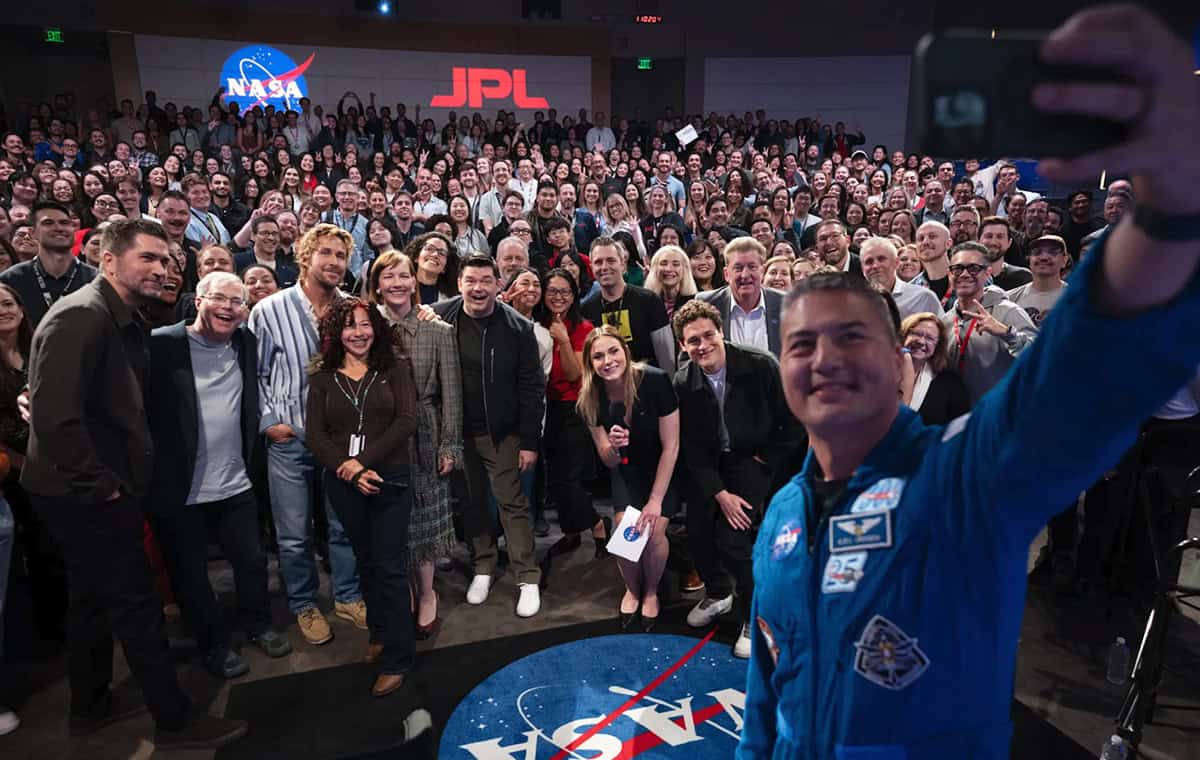
Art meets reality NASA astronaut Kjell Lindgren takes a selfie with the people behind Project Hail Mary, including Ryan Gosling and Andy Weir, and the audience during a panel about the movie at NASA’s Jet Propulsion Laboratory. (Courtesy: NASA)
The film is a visual masterpiece, with sequences that visualize the beauty and terror of space, often viewed from Grace’s disorienting and lonely perspective; alongside scenes on an increasingly more frantic Earth in a bid for survival and sunshine. It is directed and produced by Phil Lord and Christopher Miller (The Lego Movie and Spider-Man: Into the Spider-Verse), who are both well known for their funny and fast-paced movie style. If you expected a certain level of inventive energy in their adaption of this story you will not be disappointed, as Project Hail Mary is expansive in every aspect. New cinematic techniques were combined with the centuries old artform of puppetry to simulate the disorienting reality of long-term zero gravity and the unique physiology of alien life for gigantic IMAX screens.
A dual timeline narrative
Project Hail Mary opens with a familiar Weir set-up – a lone scientist in crisis, who must use all his ingenuity and scientific know-how to save the day. Indeed, Grace wakes up aboard a spacecraft, light-years from Earth with no memory of his identity or how he got there. He soon realizes that he is the sole surviving member of the crew on the ship, and as he slowly recovers his memories, he recalls their desperate, one-way mission to save humanity.
Interspersed in flashbacks, we learn that scientists have discovered a so-called “Petrova line” of infrared light between the Sun and Venus. They have worked out that this line is made up of a mysterious micro-organism, which seems to be consuming the Sun’s energy and threatens to plunge our planet into icy doom. Dubbed “astrophage” (Latin for “star eater”), the algae-like microbe has already noticeably dimmed the light that Earth receives from the Sun, and extrapolating, it will cause catastrophic global cooling within 30 years.
A “Petrova Taskforce” is created, made up of scientists and military personnel from across the globe. It is led by the formidable Eva Stratt – perfectly played by German actor Sandra Hüller – who brings a reticent Grace into the fold, who uses his skills as a one-time top molecular biologist to study the unicellular organism. It is Grace who, after some comedic and somewhat DIY experimentation, figures out that the astrophage are capable of absorbing and storing solar radiation; and later expelling it, which serves as a source of propulsion, allowing them to travel at near-light speeds.
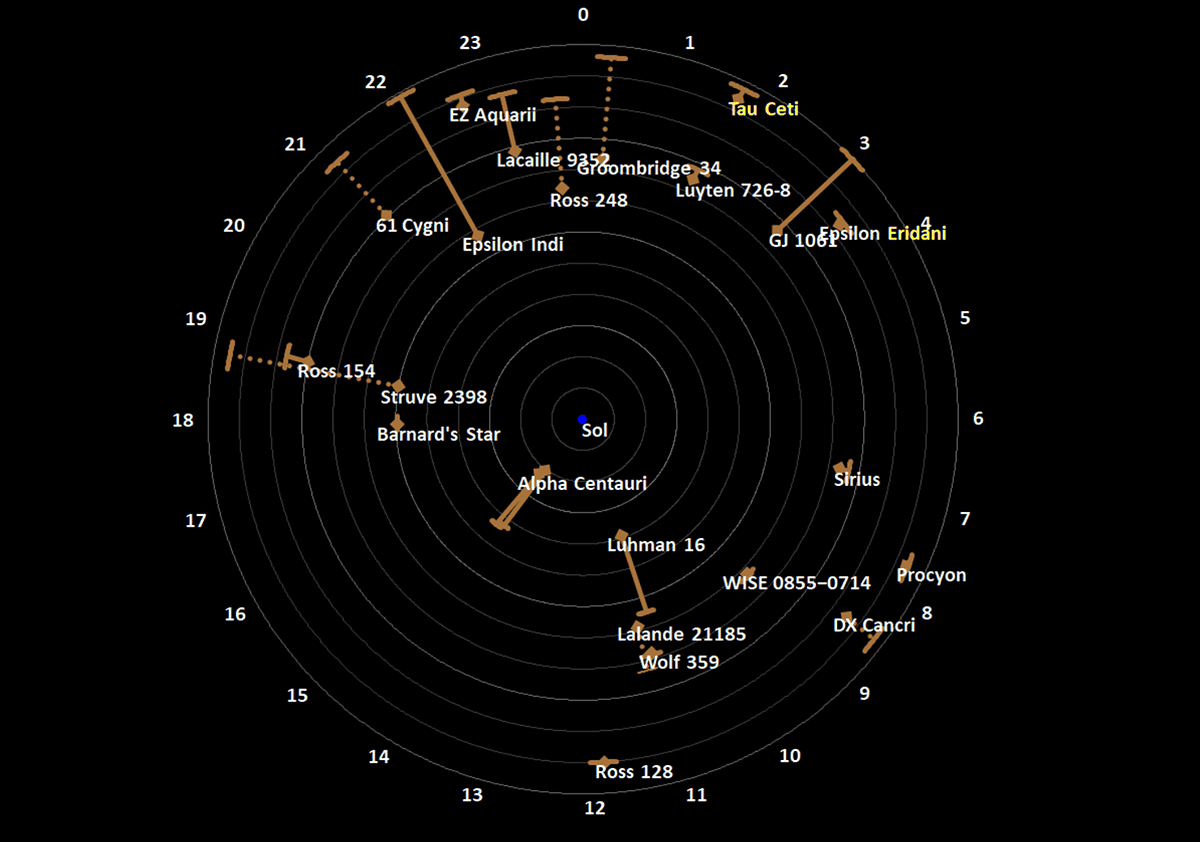
Further research shows that all but one of the stars in our galactic neighbourhood are similarly infected by the astrophage. The exception is Tau Ceti, which is 11.9 light-years away from Earth (see box “Around the Sun”) and hosts a few planets of its own. The taskforce decides to send a one-way crewed mission to this special star, to determine what makes it immune to these interstellar interlopers.
Around the Sun
(Courtesy: Nsae Comp by CC-BY-SA-4.0)
This stellar map is a graphical representation of nearby stars to our own star – Sol – all within 12 light-years of Earth. Each stellar object is jointly marked by two points, a diamond marked point (which shows the location of the stellar objects according to its declination) and a line marked point (which represents the distance in light-years from the centre). The circular lines indicate the distance from the centre by being set apart in one light-year steps.
The map accurately depicts these stars’ distance from Sol and their location in 3D space; to help visualize the distances to nearby stars in our galactic neighbourhood. Both Taue Ceti (2) and Eridani (4) can be seen on the map in the top right-hand quadrant.
In an interesting twist, it is the astrophage themselves that ultimately fuel the Hail Mary ship, after Grace discovers how to breed them on Earth. With only enough time to breed the required amount of astrophage for a one-way trip – they decide that any findings will be sent back to Earth via a series of much smaller and lighter probes. Despite Tau Ceti being almost 12 light-years away from Earth, it takes the spacecraft only about four years to get there, thanks to the fact that the ship travels at 92% the speed of light. This allows relativistic effects such as time dilation and length contraction come into play.
With this complex set-up, the real story picks up once Grace arrives at Tau Ceti, only to find that he is second in line, with another spaceship already there. Grace soon meets its sole occupant – the alien creature that he refers to as Rocky thanks to its stone-like morphology. Grace learns that Rocky is on the exact same mission as him, and that the alien hails from another nearby astrophage-infested star system called 40 Eridani. The pair soon realize that the only way to save both their planets is to work together.
Alongside Grace and Rocky’s adventures in space, the film does well in bringing in the more sober aspects of the story back on Earth – highlighting the trials and triumphs of the taskforce. These range from the global mobilization of scientists and engineers, working together to build and fuel a light-speed ship in record time; to Stratt’s character bypassing international law to ensure humanity’s survival. Lord and Miller use a distinct visual language to illustrate the two timelines. The Earth sequences look more bleak; while the scenes aboard the Hail Mary use visualizations of waveforms and light-absorption to show how Grace perceives the microscopic threat that is astrophage.
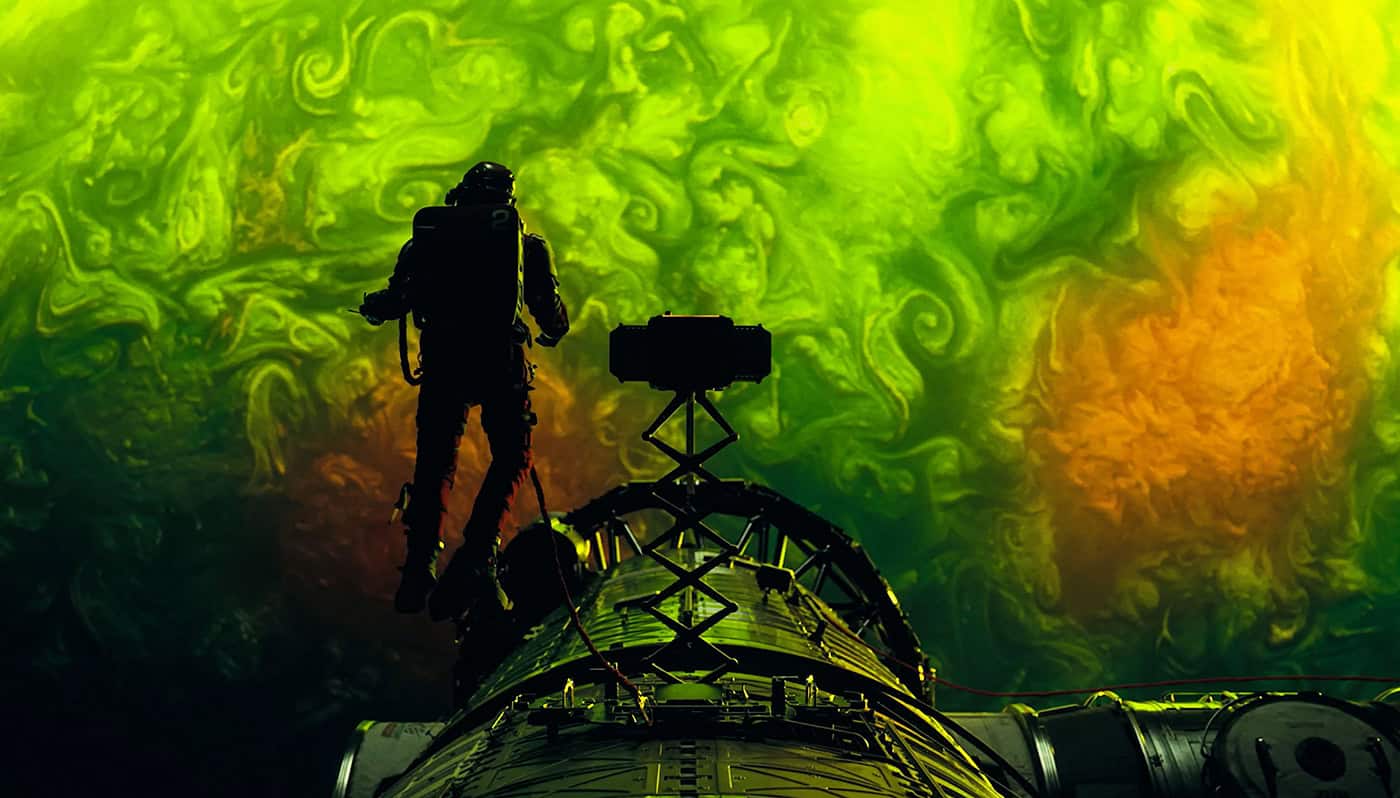
Natural predators Grace floats in space above the planet Adrian in the Tau Ceti system, to observe the native home of “Taumoeba”. (Courtesy: Landmark Media Studios / Amazon MGM / Alamy)
Rocky is one of the most lovable alien creatures to have graced our cinema screens in recent years, brought to life by the clever use of puppetry. The astrophage, by contrast, are meant to evoke fear and intrigue. We are treated to visualizations of how these “black matter” organisms absorb radiation, giving the audience a sense of how matter and energy can be manipulated on a grand scale. Visually, this metaphor continues throughout the film and, ultimately, to the survival of the planet.
Science and fiction, on screen and the page
It is clear that both Weir and the film’s producers and director were keen to highlight science and scientists throughout the book and film. For example, 40 Eridani is a real star system and Weir used astronomical data to build Rocky’s world.
In fact, when the book Project Hail Mary was written, the planet 40 Eridani-B was believed to be real. More recent data has revealed the dimming of the star that inferred the planet’s existence is in fact more likely a result of the composition of the star itself, and the planet most likely does not exist (see box “Exoplanetary exploits”).
In Project Hail Mary, Weir used the real-world observations of stars sometimes dimming for unknown reasons to come up with the idea of the astrophage and its effects on stars. The book also has much more detailed (if scientifically dubious) explanations, using neutrinos and quantum physics, for how astrophage devours starlight and manages to survive on the surface of stars.
Exoplanetary exploits: the science and speculation behind Rocky’s home world
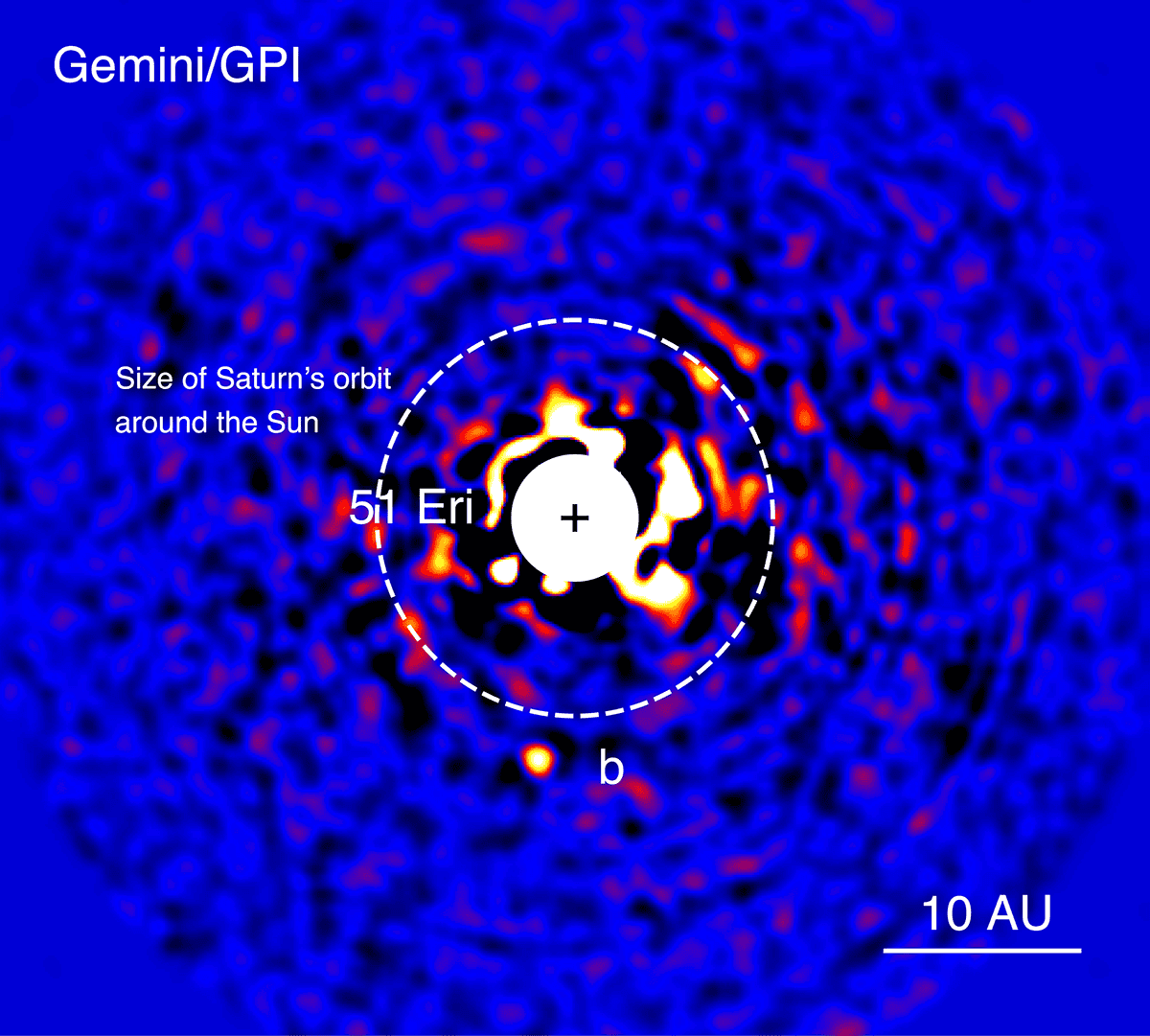
(Courtesy: Gemini Observatory, NSF’s NOIRLab, NSF, AURA, Julien Rameau (University of Montreal), Christian Marois (NRC Herzberg))
Andy Weir based Rocky’s home planet in a star system that is beloved in science fiction, while existing in reality. 40 Eridani is a triple star system that is about 16.3 light-years from the Sun. Fans of Star Trek might also recognize 40 Eridani as the solar system that is home to planet Vulcan. The system comprises the larger star 40 Eridani A and a binary pair of stars, consisting of a red dwarf (40 Eridani C), and a white dwarf star (40 Eridani B).
The system has been well known and observed for a number of years, so much so that as of 1991, Star Trek creator Gene Roddenberry described how the binary stars would “gleam brilliantly in the Vulcan sky” in a letter to Sky & Telescope magazine.
In Project Hail Mary, Erid (or “40 Eridani A b”) is the closest planet to the main star in the system, with some extreme conditions compared with those found on Earth. For example, the planet’s gravity is more than twice Earth’s, and it has a very dense (28 Earth atmospheres) ammonia-based atmosphere at extremely high pressure. The planet has an average surface temperature of 210 °C – despite this, it is able to have liquid water on its surface, as the high surface pressure raises water’s boiling point above that temperature.
According to Weir, Erid’s dense atmosphere blocks almost all incoming light, meaning that Eridians are “blind” to visible light and use echolocation to “see” and communicate. Erid also has a strong magnetic field that blocks the large amount of radiation a planet so close to a star would be bathed in. The high-pressure environment, meanwhile, meant that Weir had to base Eridian biology on a high-mineral content, stone-like exoskeleton, with a circulatory system using liquid mercury, making it an especially unique alien life form.
In reality, astronomers at one point believed that 40 Eridani A was host to a planet or two, thanks to periodic variations in its radial velocity – a common signature of exoplanets. However, the observed variation was on the scale of 42 days, which is similar to the star’s rotation period, meaning that it was next to impossible to confirm the existence of a planet. After a series of observations over a number of years, as of 2024 astronomers sadly concluded that the radial velocity signal very likely does originate from stellar activity, and not from a planet.
But all is not lost in the Eridian stellar neighbourhood – the not too far away system of 51 Eridani b (roughly 96 light-years from Earth) has a confirmed and directly imaged exoplanet (see image above). Dubbed 51 Eridani b, the Jupiter-sized planet orbits 11 billion miles from its star, a little farther out than Saturn’s orbit in our solar system. As of 2021, NASA announced that its James Webb telescope plans to probe the planet’s atmosphere at infrared wavelengths to learn more about this distant world – and the secrets it currently keeps.
Weir wrote the book before the global COVID-19 pandemic, but it was released in the very midst of it. Indeed, there are many parallels in the way humanity deals with global problems. As we see in Project Hail Mary, the fictional version of our world has this immediate burning issue and while not everybody quite agrees on a plan, there is a global realization and agreement that something must be done, no matter what it takes. Weir is not so convinced that it always works like this though, as he told us that “I do think that the world works together when there’s a common problem, but only if it’s a direct and immediate problem like COVID. We’re not so great at it when it’s a slow burn, like environmental damage.”
Filmmaker and scriptwriter Drew Goddard – who wrote the screenplay for Project Hail Mary as well as Weir’s previous bestselling-book-turned-movie The Martian – reportedly drew up a list of 10 things that he would like to bring from the pages to the film. He achieved nine of them – the missing one was the nuking of the polar ice-caps by Stratt to purposefully trigger global warming. It is a shocking and thought-provoking moment in the book, stripped from the film due to the necessary time it would take to explore and depict such a drastic decision (though one can imagine an entire story based on just that one issue). The film also could have included some more details from the book of the political machinations on Earth, though there are already a lot of ideas to take in, especially for those viewers who have not read the book.
Building a common language
When it comes to depicting an alien, the filmmakers did a great job, not only of realizing Rocky on screen, but also showing the growing friendship between two creatures from distant worlds. Despite their many differences, both Grace and Rocky have been displaced from their homes and tasked with the burden of saving them. To do so, they must overcome their fear of the unknown, and find ways to converse and connect.
On Earth, we are able to communicate in a number of ways – even sometimes between species. In science fiction, science and maths often become a common language. Rocky’s language is decidedly otherworldly. The script, which includes not just the spoken lines but also the complex “musical” language of the Eridian, was developed with linguists and xenobiologists. Via Grace, the audience is able to experience the genuine difficulty of two distinct life-forms learning to communicate for the first time (see box “Words of great encouragement”).
Despite the challenges the pair face in dealing with a culture alien to their own, the two of them go from being fearful and intrigued to amused and friendly; eventually making great sacrifices to help one another.
“Words of great encouragement”
Hannah Little, a linguist and lecturer in communication and media at the University of Liverpool, on the language and communication between Grace and Rocky:
I love Rocky and Grace’s first contact scene – they initially don’t know how the other communicates, but Rocky must find a way to tell Grace to leave the airlock. To do this, he creates a 3D model of Grace and the Hail Mary, to act out that he wants Grace to return to his ship. Grace understands this communication attempt immediately. Without a shared language at the start, the pair must use other strategies to converse, such as using something called “iconicity”. Iconicity is when we use sounds or gestures that depict what we are trying to communicate in some way. Humans often do this using gesture (imagine playing charades) or with drawings (like in Pictionary), but we don’t usually have a 3D printer to hand like Rocky does. This is an excellent opening concept as a 3D model can be a more accurate representation of a human or a ship than a 2D drawing, and it also tells us something about how Rocky perceives the world – he doesn’t have vision that uses light as we do, but instead something more similar to echolocation that can only detect 3D objects.
As they continue to interact, we see Rocky mimicking Grace in raising his index finger: a gesture Grace uses to communicate “can you wait a minute”. Through imitating him, Rocky is able to see what Grace does in response to this gesture and gather data about what the gesture means and the effect it has. This is exactly how humans learn language. When we speak to babies, we are constantly trying to get them to imitate us.
After these initial exchanges, Grace starts to build a translation programme where he logs different sounds Rocky makes and his best guess for what they mean in English. This is where the realism of the movie gets lost: to build reliable translation systems between different human languages, we need an enormous amount of data, even with everything we know about how human languages are produced and structured. It would be a mammoth task to work out what aspects of Rocky’s sounds are meaningful and how those meanings map to human concepts and grammar, but the film depicts this as relatively straightforward. We then suddenly jump forward in time to a point where they have a working translation model without much clue of how long this took. Of course, this has to happen for the sake of the story, and I prefer this as an explanation than some magical universal translator or a fish you put in your ear.
I also love how Rocky’s biology is such that he looks like a strange rocky spider with no discernible face. This makes Project Hail Mary a more exciting exploration of potential alien biology than other films and TV shows where the aliens all look and speak a lot like humans do. But Rocky still communicates with sound, as humans do, and presumably using structures that are very easy to translate. I’m always after depictions of alien communication that get away from a human-centric view of what language can be. It would have been entertaining if Rocky communicated via smell or vibrations or electricity.
“I’m going to have to science the **** out of this.”
Alongside the intriguing linguistics, a side-effect of the interwoven timelines is that viewers are confronted with the reality of scientific progress: it is often messy, desperate and driven by people who are deeply flawed. For the most part, the characters are shown as tenacious individuals, who refuse to give up in the face of a dying sun.
Grace is the embodiment of a reluctant hero. He is also painted as something of a lone voice in academia, having presented a paper at a conference about non-carbon-based life, and being ridiculed for the idea. He is then ostracized by the scientific community, and so turns to being a school-teacher instead, making him a rather unlikely candidate for a space mission.
Despite Grace’s reticence, it turns out he is perfect for the role of saviour of the planet, mainly thanks to his relentless resolve to find the answer, even when armed with minimal resources. Gosling’s face, initially confused, then increasingly determined, fills the screen as we see him try to come to terms with his mission.
It is, however, impossible to know for sure how a person in such total isolation may truly feel or react. This uncertainty is core to the script. The big questions of the film about the value of sacrifice and the necessity of co-operation are left for the audience to decide. The directors are not didactic storytellers, and Weir himself is adamant that his main aim is to entertain. It will be a great bonus if readers and viewers come away with a new understanding of science and the scientific process.
Indeed, this story features many physics concepts, from exoplanetary science to the special theory of relativity; as well as space travel, artificial gravity and a healthy dose of quantum and materials science. Weir contends that the science of Project Hail Mary is sound until you get deep into the quantum level. It is there where he used a literary plot device often referred to as a “MacGuffin” that enabled interstellar travel, using a biological organism.
Becky Smethurst, an astrophysicist at the University of Oxford, recently joined the Physics World Stories podcast, and was delighted that Weir went to such lengths for the science in his narratives. “I think it really surprised me in terms of energy storage,” says Smethurst. “It’s mass-energy equivalence at the crux of the story, if the astrophage can take in the Sun’s energy and store it and then release it later. It’s just e = mc2.”
She goes on to explain that this fundamental physics concept is what allowed for interstellar travel, by harnessing huge amounts of energy to accelerate the spacecraft up to nearly the speed of light. In reality, the issue lies in terms of what kind of single-cell can store that much energy and with that much energy efficiency, which she estimates to be “a billion times more efficient” than any we know on Earth.
But Smethurst goes on to highlight that this is what makes Weir a creative writer, especially when it came to developing the biological and physical mechanisms that allow astrophage to interact with neutrinos. “He invented this whole term in the book called ‘super cross-sectionality’,” she says, “which is fun because it’s sort of a borrowed word from particle physics, when you talk about cross sections of particles and whether they’re likely to intersect. So I like that the idea is obviously sci-fi, but the fact that it’s rooted in some elements of physics and he made that effort to do that, I think was incredible.”
At the heart
Project Hail Mary succeeds as an entertaining space adventure because it trusts its audience to be as smart as its protagonist. It treats astrophysics and molecular biology not as hurdles to the plot, but as the plot itself. Without giving it all away, the story does not end with a straightforward “victory” and much of the lessons learned come from the realization that science is a universal language. In 2026, where global challenges often feel intractable, the film offers a fundamentally sunny outlook. It suggests that when people – or even different species from distant planets – come together to overcome impossible odds, survival is possible.
Using the immense format of IMAX, Project Hail Mary leads us into a total immersion of Grace’s lonely, pressurized world; only to show us that we are never truly alone – as long as we have the tools of discovery, and the ability to overcome our fear of the unknown.
In this episode of the Physics World Weekly podcast, Woosley and Nomoto talk about the astrophysics of supernovae – exploding stars – and what these spectacular events tell us about the elemental composition of the universe and how it has expanded since the Big Bang.
Nomoto is emeritus professor and visiting senior scientist at the Kavli Institute for the Physics and Mathematics of the Universe, at Japan’s University of Tokyo. Woosley is professor of astronomy and astrophysics at the University of California, Santa Cruz in the US.
This podcast is sponsored by the Shaw Prize Foundation.
The Shaw Prize is an international prize based in Hong Kong. Currently, it consists of three annual awards. The Shaw Prize in Astronomy; The Shaw Prize in Life Science & Medicine; and The Shaw Prize in Mathematical Sciences. In 2027 a fourth prize will be awarded for work in computer science. Each prize carries a monetary award of $1.2m. The prize was established by Runrun Shaw, a media mogul and philanthropist. It was first awarded in 2004 and since then 121 prizes have been given individuals from across the world.
Photos of research facilities in the former Soviet Union and its satellite nations might not seem the most promising subject matter for a coffee-table book. But French photographer Eric Lusito has done just that with Soviet Scientific Institutes, which contains more than 150 pictures from his travels across the former Soviet bloc. Unable to travel to Russia, Azerbaijan and Belarus, images from what Lusito calls the “authoritarian remnants” of the Soviet Union are absent. However, his photos across eight other countries depict the downfall of many once vibrant labs, from a rusty cosmic-ray telescope in Armenia to a defunct nuclear reactor in Georgia. The grim reality stands in contrast to the colourful 1970s mosaics in a Ukrainian cybernetics institute that seemed to herald a utopian future. Matin Durrani
Meet the Neighbours: Life on Mars and How to Find It By Steven A Benner
In 1976 Viking 1 achieved two remarkable things: it performed the first successful landing on Mars and it sent home evidence for life on the red planet. Yet shortly after, Mars was again declared dead and for decades any scientist who suggested otherwise was ostracized. What happened? This is the story that astrobiochemist Steven Benner traces in his book Meet the Neighbours. He clearly explains the science and history, but most of all the machinations and philosophy of how science works. The work is a little polemical and very US-focused, but also extremely enlightening. Kate Gardner
2026 Allen Lane
Amazing Worlds of Science Fiction and Science Fact By Keith Cooper
Fans of the British TV show Doctor Who might recall the 10th Doctor visiting the stunning and terrifying planet “Midnight” – a diamond-encrusted place, bathed in extreme radiation, replete with a “sapphire waterfall”. While some aspects of this fictional world will remain in the realms of fantasy, as of 2011 astronomers believe that the supermassive exoplanet 55 Cancri Ae orbits so close to its parent star that it is indeed bathed in extreme radiation. And it is mainly made up of carbon, in the form of diamond and graphite. This is a perfect example of the symbiotic relationship that science fiction and fact can have with one another, as Keith Cooper outlines in his fascinating book Amazing Worlds of Science Fiction and Science Fact. From the many “strange new worlds” of Star Trek to the Dyson spheres of Ringworld and beyond, this book is a must for “hard sci-fi” aficionados and astronomers alike. Tushna Commissariat
An Anthology of Stargazing: a Collection of Constellations and Other Wonders in the Sky By Abigail Beall, illustrated by Angela Rizza and Dilbag Singh
While the target audience of children will likely be immediately attracted to its beautiful cover and gold-edged pages, what makes An Anthology of Stargazing special is journalist Abigail Beall’s clear explanations alongside the artistic talents of Angela Rizza and Dilbag Singh. Despite covering everything from the history of stargazing and careers in the field, to the life of a star and the celestial sphere, Beall manages to tread that fine line of being informative while not losing the attention of young readers. There is a page devoted to each of the 88 recognized constellations, providing details on when and where you can see them, and a diagram of their configurations. These are accompanied by illustrations of the animals, people and objects astronomers saw in the patterns, and snippets of their myths and legends, helping the next generation of stargazers see the stories in the sky. Sarah Tesh
2025 DK Children
Hum
By Helen Phillips
A mother loses her job to AI, so to make some cash she agrees to have her appearance altered to fool face-recognition technology. With this money she takes her family on a trip of a lifetime to the Botanical Garden – the only place to glimpse nature in their arid, dirty city. A treat only for the well-off, the children are amazed to see trees, swim in waterfalls and encounter wildlife. Hum by Helen Phillips has just won the Climate Fiction Prize 2026 for its view of a harsh world where nature is something you have to pay to see – but perhaps its real power is in Phillips’ portrayal of the future of day-to-day technology. This fabulous book will leave you with a lot to think about. It will likely make you put down your phone, too. Kyla Rushman
Belokurov is at the UK’s University of Cambridge; Helmi is at the Kapteyn Astronomical Institute at the Netherlands’ University of Groningen; and Ibata is at France’s University of Strasbourg.
Fossil hunters Left to right are Rodrigo Ibata, Amina Helmi and Vasily Belokurov. (Courtesy: The Kavli Prize)
This episode of the Physics World Weekly podcast features an interview with Helmi and Per Barth Lilje, who is chair of the Kavli Astrophysics Prize committee and is based at Norway’s University of Oslo.
In a wide-ranging conversation, we explore the history of the Milky Way and why the work of the Kavli laureates provides crucial evidence that our galaxy was formed by the merger of smaller dwarf galaxies. We talk about what hierarchical accretion tells us about dark matter and the Standard Model of cosmology – and we look forward to the future of the Milky Way.
Belokurov, Helmi and Ibata share the $1m prize money equally. The prize will be awarded in Oslo in September

 Login