❌

Reading view

One of Earth’s Driest Deserts Just Turned White

Atacama Desert SnowIn August 2026, a series of powerful winter storms transformed parts of northern Chile’s Atacama Desert, covering the famously dry landscape in an unusual layer of snow. Snow is not unheard of in the Atacama. Significant falls occurred in 2025 and, before that, in 2011. But one of the August 2026 storms stood out because [...]
  •  

A Discovery Hidden in Antarctica’s Soil is Unlike Anything Found Elsewhere on Earth, Challenging Past Assumptions

Scientists at the University of Colorado at Boulder’s Cooperative Institute for Research in Environmental Sciences (CIRES) have discovered that some microbes in Antarctica’s soil don’t exist anywhere else on Earth, upending the long-held belief that microbes move freely around the planet and inhabit many regions.

The researchers behind the discovery said understanding that some microbes are endemic to Antarctica’s soil challenges previous assumptions and offers valuable insights for future research and present-day conservation efforts.

Microbes in Antarctica’s Soil Live in an Extreme Environment

Announcing the findings, study leader and postdoctoral researcher Nick Dragone and co-author Noah Fierer, a CIRES Fellow and Director of the Center for Microbial Exploration, noted that scientists have always assumed that microbial species were widespread.

“There is a long-standing assumption in microbiology that ‘everything is everywhere,’” Dragone explained.

That’s because, unlike plants and animals, which are generally restricted to certain global zones or latitudes, microbes are highly mobile. For example, a simple updraft could propel microbes into an atmospheric jet stream, then deposit them hundreds or even thousands of miles away.

Still, Dragone and Fierer propose that, given Antarctica’s remote location, if there were a spot on Earth containing species unlike the rest of the globe, it would be on the planet’s southernmost continent.

“If we do find we’re looking for endemic microorganisms, a good place to start is Antarctica, because it’s an entire continent that is geographically isolated, ” Fierer said.

The study coauthor also noted that the unique conditions found in Antarctica’s soil aren’t usually found in other soil environments. “[Being] cold is the obvious one,” Fierer said, “but also super dry; Antarctica is a desert.”

Comparing 100 Antarctic Strains with 500 Worldwide Strains

Instead of starting with any microbial species, the CIRES team focused on bacterial strains within the Arthrobacter group. First, these strains grow well in lab conditions, which was critical to the team’s experiments. Second, Arthrobacter group bacterial strains are found in diverse environments ranging from the tropics to Colorado, and most critically, to Antarctica’s soil.

Byron Adams, professor of biology at Brigham Young University and a co-author of the study, said the species is widespread, but also diverse.

“Arthrobacter as a group may be found all over the planet, but when we look closely at individual strains, just like penguins, Antarctica clearly has its own distinctive biological history,” the professor explained.

To start, the team collected soil samples from Antarctica. They also collected comparison samples from similarly cold, arid regions like the Tibetan Plateau, Svalbard in the Arctic, and Chile’s Atacama Desert.

When examining the sampled soils, the team tested over 100 Antarctic bacterial strains and 500 worldwide strains.

Dragone and Fierer both noted that the research was made possible by “long-term collaborations among international research teams who have spent decades collecting samples across the continent for various projects.”

Genetic Sequencing Finds 90% of Antarctic Microbes are Endemic

After sequencing the genomes of the Arthrobacter strains found in samples from Antarctica’s soils, the team compared them with worldwide strains. For the worldwide species, the team obtained genomes from international research databases.

As hoped, the genetic comparison found species in Antarctica’s soil that were not found anywhere else in the world. Perhaps even more shocking, 90 percent of the Antarctic strains they’d sequenced were completely endemic, with no matches anywhere in the world.

Fierer said previous studies had identified “a few endemic microbes found in very specific environments.” However, the researcher also noted that finding such a large and unexpected number of endemic microbial species “does suggest there could be some in other locations.”

“[Determining] whether other microbial groups show these patterns is a good direction to go,” Fierer added.

Next, the team ran a follow-up experiment to see whether the endemic Antarctic strains showed signs of adaptation to the local, extreme environment. This included growing strains of the collected Antarctic Arthrobacter strains in the laboratory. Critically, the team mimicked the continent’s harsh environmental conditions.

First, the experiments showed that the strains collected from Antarctica’s soil were extremely resilient. They also grew more slowly than non-endemic strains. The team suspects these results show that Arthrobacter strains “are uniquely adapted to Antarctica.”

“We already knew that a broad diversity of microbes can survive the inhospitable conditions of Antarctica,” Fierer said. “Now we know that some of those microbes are also unique to Antarctica and are uniquely adapted to life on the southern continent.”

“Some of Antarctica’s Most Distinctive Species are Microscopic”

When discussing the implications of their findings, Adams pointed to a potential shift in public perception of what species diversity means.

“We tend to think of biodiversity in terms of penguins, seals, and whales, the researcher explained, “but this shows that some of Antarctica’s most distinctive species are microscopic.”

Along with the study’s scientific and public relations value, the team said it “sets the stage for future research on microbial life in Antarctica.” They also noted that the findings will aid efforts to preserve Antarctica’s biological diversity, including its microbial species.

“Protecting Antarctic biodiversity also means protecting the biological history contained in a handful of soil,” Adams concluded.

The study, “Evidence for endemism and local adaptation in Antarctic soil bacteria,” was published in the Proceedings of the National Academy of Sciences. 

Christopher Plain is a Science Fiction and Fantasy novelist and has spent the last six years as Associate News Editor and Head Science Writer at The Debrief. Follow and connect with him on X, learn about his books at plainfiction.com, or email him at christopher@thedebrief.org.

  •  

How Climate Change and Tariffs Help China Raise More Cattle

As increased rain makes grasslands and cornfields possible in areas that once were deserts, the world’s largest beef importer is becoming more self-reliant by expanding domestic herds.

© Gilles Sabrié for The New York Times

A herder taking her cows to graze in mountain pastures in northern China’s Hebei Province.
  •  

Surprising Evidence of a ‘Lost’ Ancient City is Emerging from Beneath the Sands of Egypt’s Western Desert

A remarkable discovery has been made in Egypt’s western desert, according to archaeologists with the country’s Ministry of Tourism and Antiquity.

The surprisingly well-preserved remains, which represent a Byzantine-era city, are located approximately 350 kilometers from the Nile in the New Valley Governorate within the Dakhla Oasis, one of the country’s several oases.

Features unearthed during excavations include residential and religious structures, one comprising an ancient Byzantine church which has been characterized as a basilica-style structure, as well as numerous artifacts, including pottery and coins featuring the likeness of Byzantine emperors and Christian symbols accompanied by Latin.

The church is believed to date to the middle of the fourth century and is situated near the entrance to the city. Nearby, a pair of towers once stood, which were used as lookout posts for defending the location.

An Ancient Egyptian City Resurfaces

The newly uncovered structures offer a unique glimpse at the lives of Egyptians during an era when the country was a part of the Byzantine Empire.

Hisham el-Leithy, Egypt’s Secretary General with the Supreme Council of Antiquities, said that several thoroughfares were evident in the areas uncovered during excavations, which point to large public squares and open spaces where inhabitants of the ancient city would have once gathered.

Egypt lost city
A view of one of the many passages within the newly excavated ruins (Image Credit: Ministry of Tourism and Antiquities

One of the structures at the site is believed to have been the domicile of a church deacon dating to the late fourth century, which might have served as a temporary place of worship before construction of the city’s basilica.

Among the other artifacts uncovered at the site were hundreds of pottery fragments, known as ostraca, which are potsherds that were used for writing material.

Inscriptions on the fragments describe elements of daily life that include financial information, lists, and message exchanges between neighbors, according Diaa Zahran, who heads Egypt’s Islamic, Coptic, and Jewish antiquities department.

Additional Discoveries at Nearby Marina el-Alamein

In addition to the ancient Byzantine city, Egypt’s Ministry of Tourism and Antiquity has also revealed discoveries at the nearby site of Marina el-Alamein, located to the west of Alexandria.

There, The Guardian reports that archaeologists have uncovered 18 newly identified tombs, adding to the dozens that were already known at the site.

Archaeologists also found a 2.5-meter granite sarcophagus containing human remains, in addition to a plaster sphinx, and several burials featuring gold pieces placed in the mouths of the deceased—a funerary practice known as the “golden tongue” that reflected ancient beliefs about the afterlife.

Other artifacts uncovered at Marina el-Alamein include pottery, amphorae, lamps, altars, and other funerary artifacts, according to Ministry of Tourism and Antiquity officials.

Presently, skeletal remains that were uncovered within the granite sarcophagus are being studied, according to Eman Abdel-Khaliq, the site’s mission chief.

Micah Hanks is the Editor-in-Chief and Co-Founder of The Debrief. A longtime reporter on science, defense, and technology with a focus on space and astronomy, he can be reached at micah@thedebrief.org. Follow him on X @MicahHanks, and at micahhanks.com.

  •  

Discovery of Fungi Living Within Desert Moss is Challenging Past Thinking on How Organisms Thrive in Arid Environments

Moss has long been regarded as unusual among land plants for its resilience and apparent independence from fungal partnerships, which are common in other species. However, new research from UC Riverside indicates that this view may not apply in desert environments.

An Unexpected Partnership

More than 85% of land plants form relationships with fungi that exchange soil nutrients for sugars, and approximately 75% of these plants specifically associate with arbuscular mycorrhizal fungi, or AMF, which require a host to survive. Moss was considered the exception. All 10,000 known species were believed to exist without such fungal partnerships.

“That’s been the model,” said Jason Stajich, a UCR professor of microbiology and plant pathology and co-author of the study, published in New Phytologist. Mosses, he explained, simply didn’t need fungi. Recent findings now challenge that assumption.

Chasing Moss Through 100-Degree Heat

To investigate this, UCR doctoral researcher Kian Kelly collected samples from the Mojave and Sonoran deserts, focusing on biological soil crusts. These crusts contain complex communities of fungi, bacteria, algae, moss, and microscopic animals that stabilize desert soils. The team wanted to know whether desert mosses host different fungal communities than mosses in milder environments. “Sometimes I couldn’t find the same species of moss,” Kelly said of the search.

The team then processed moss samples and sequenced their DNA in the laboratory. They identified fungal genetic material, including AMF, which are typically unable to survive without a host plant. Furthermore, the fungal species present in desert moss differed from those found in moss from less extreme climates and from fungi in the surrounding soil. “We suspect that certain fungi are more helpful for surviving hotter, drier climates,” Kelly noted.

This mismatch made simpler explanations, such as contamination or fungi decomposing dead tissue, less likely. The evidence suggested a more specific association.

Unexpected Structures Inside Moss

Since DNA evidence alone could not confirm that fungi were living within moss tissue, Kelly stained samples with a dye that binds specifically to fungal cells and examined them under a microscope. He observed branching structures located inside the moss. “As soon as I saw that, I knew we had something really interesting,” Kelly said.

The structures resembled arbuscules, small, tree-shaped structures that fungi typically form within plant roots to facilitate nutrient exchange. Since moss lacks traditional roots, these structures were observed in the moss leaves. The researchers therefore refer to them as “arbuscule-like” rather than identifying them as true arbuscules. Whether nutrient exchange actually occurs between fungus and moss remains unconfirmed and will be the subject of future investigation.

Potential Implications

If this relationship is confirmed, its significance extends beyond desert ecology. Mosses belong to one of the oldest surviving lineages of land plants, which first colonized terrestrial environments approximately 470 million years ago. A fungal partnership present in moss tissue today could represent a remnant of the original alliance that enabled plants to adapt to life on land.

There are also more immediate implications. Biological soil crusts are fragile, and even small disturbances can take decades to heal. These ecosystems are increasingly threatened by rising temperatures and human activity. If fungi help desert moss survive heat and drought, understanding this relationship could guide future efforts to restore degraded soil crusts rather than merely documenting their decline. For now, the main conclusion is that moss, once thought to be independent of fungal associations, may have been getting help the entire time.

“The desert is full of things people overlook. Sometimes, the biggest surprises are the ones growing quietly beneath our feet,” Kelly concludes.

Austin Burgess is a writer and researcher with a background in sales, marketing, and data analytics. He holds an MBA, a Bachelor of Science in Business Administration, and a data analytics certification. His work focuses on breaking scientific developments, with an emphasis on emerging biology, cognitive neuroscience, and archaeological discoveries.

  •  

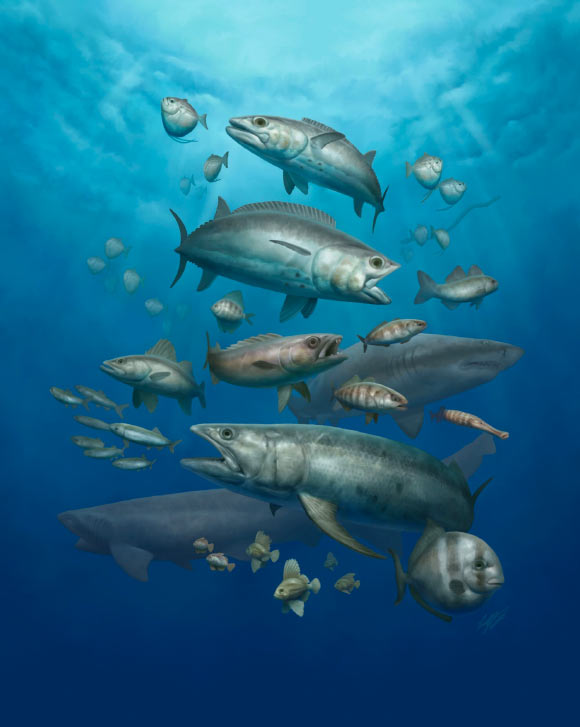
Fish Fossils from Early Paleocene Fill 10-Million-Year Gap after Dinosaur Extinction

Marine fishes from the Early Paleocene site of Qreiya 3 in the Eastern Desert of Egypt. Image credit: Ian Baylatry.

Paleontologists have described an assemblage of marine fish fossils from the 62.2-million-year-old site of Qreiya 3 in the Eastern Desert of Egypt, providing a window into this transition.

The post Fish Fossils from Early Paleocene Fill 10-Million-Year Gap after Dinosaur Extinction appeared first on Sci.News: Breaking Science News.

  •  
❌