
❌

Reading view

Beyond the data: art meets climate at the edge of the world

“The most beautiful thing we can experience is the mysterious,” wrote Albert Einstein. “It is the source of all true art and science.” It is a reminder that wonder – particularly in the natural world – lies at the heart of both disciplines. When it comes to an issue as multifaceted and emotive as climate change, it feels only natural to turn to art as well as science to make sense of what is happening around us.

The latest episode of Physics World Stories brings together two artists doing exactly that. Host Andrew Glester speaks first with Tom Bailey, a performance and environmental artist from Bristol-based creative company Mechanimal. Bailey has recently returned from an extraordinary 600 kilometre journey through the Arctic borderlands — spanning Norway, Finland and Sweden — travelling by ski, sledge, foot and boat, and occasionally dressed as a reindeer.
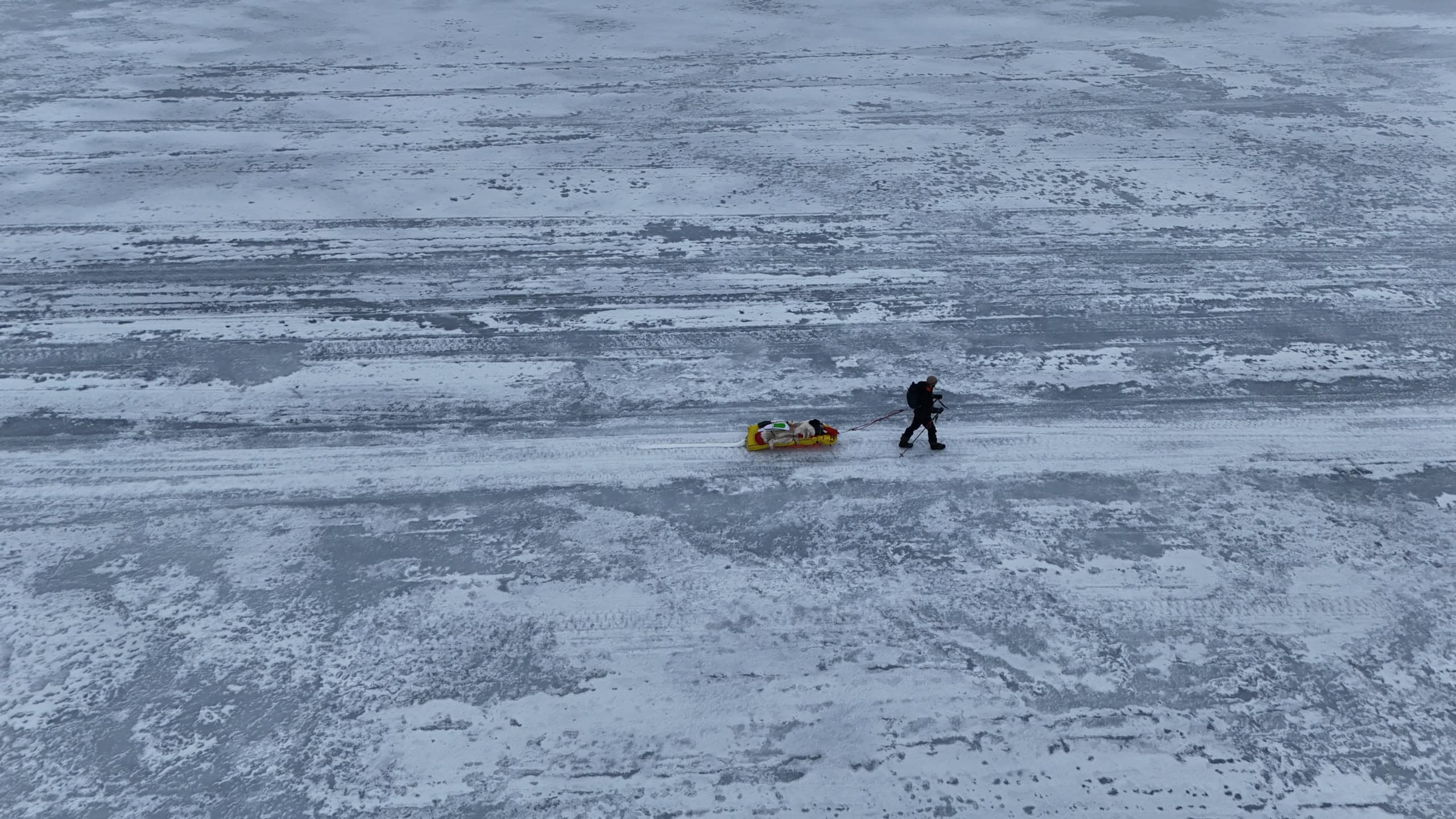
Drone shot of artist Tom Bailey pulling a sled along an ice sheet in the Arctic
Arctic art Tom Bailey on his 600 km climate journey and performance tour in the Arctic borderlands. (Courtesy: Tom Bailey and Natasha Soonchild)

Travelling between festival performances, Bailey immersed himself in a region undergoing dramatic change: shifting weather patterns, transforming landscapes, and growing international interest in its mineral resources, raising urgent questions about governance and access. Central to his vision is a “more-than-human” perspective, advocating for nature to have formal representation in international decision-making, not merely as a resource to be managed, but as a presence with its own legitimate interests.

A climate video game with beautiful music

Composer Naomi Hart approaches the crisis from a different angle. After a conversation with her daughter about fears for the future left her saddened but resolute, she channelled that emotion into Save Progress – a short video game exploring how human connection can help us to think about the world and the choices ahead. In the podcast, Hart talks about her creative choices; the game combines an intentionally old-school design with specially composed synthesizer music. Save Progress takes around 10 minutes to play: give it a try.

  • To keep track of how physicists are investigating climate change and developing solutions, visit the Environment and Energy section of the Physics World website.

The post Beyond the data: art meets climate at the edge of the world appeared first on Physics World.
💾

  •  

Stunning Moon sculpture unveiled at Royal Observatory Greenwich

A spectacular new lunar art installation has been installed at the Royal Observatory Greenwich.

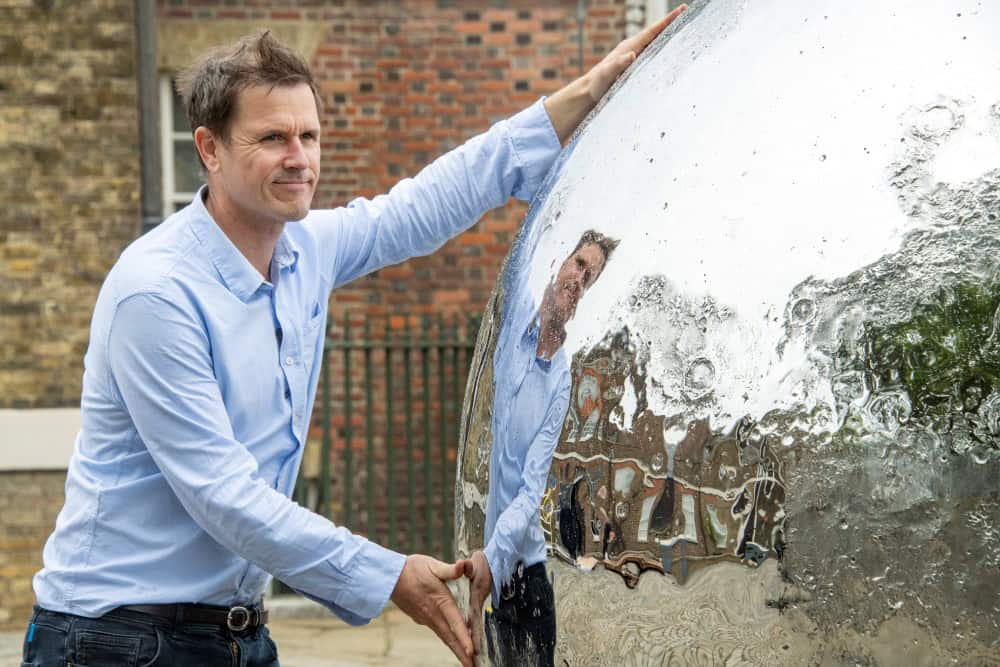
Dubbed Mirror Moon it has been created by British artist Luke Jerram and is open for public display today at the observatory.

The artwork is 2 m in diameter and is made of stainless steel. It uses accurate topographic data collected from NASA missions to map the features of the Moon onto the mirrored steel surface.

This includes craters, valleys, mountains and smooth lava fields as well as details from the heavily cratered far side of the Moon.

The installation opens as the NASA Artemis crewed missions foster a renewed interest in the Moon. A crewed lunar landing – Artemis IV – is currently set for 2028.

The Royal Observatory Greenwich is the home of Greenwich Mean Time and the Prime Meridian, and since its founding in 1675 astronomers have used the observatory to study the Moon.

Luke Jerram with Mirror Moon
Moonstruck: British artist Luke Jerram with Mirror Moon. (Courtesy: National Maritime Museum)

Jerram is best known for his large-scale public engagement artworks including Museum of the Moon and the Earth artwork Gaia, both of which have been displayed internationally.

Jerram says that the observatory has been an “inspiration” for his work as an artist.

“I hope Mirror Moon will inspire generations of visitors to have an interest in contemporary science, art and the wonder of the night’s sky,” he adds.

To mark the installation, Royal Museums Greenwich are selling 20 limited-edition mini versions of the artwork for £2000 each.

Each one is hand signed and numbered by Jerram and includes a presentation box, bespoke display stand and certificate of authenticity.

The post Stunning Moon sculpture unveiled at Royal Observatory Greenwich appeared first on Physics World.

  •  

Fractal maths helps distinguish genuine artworks from forgeries

Researchers at the Polytechnic University of Hauts-de-France have used fractal mathematics to create a new non-invasive method that can distinguish genuine artworks from forgeries (Surf. Topogr.: Metrol. Prop. 14 025016).

Art forgery is a growing problem worldwide and traditional authentication of an artwork relies on expert opinion, historical research, pigment analysis and digital techniques.

While these approaches can be effective, they are also resource‑intensive and can sometimes still be inconclusive.

The new technique works by capturing the subtle patterns created by an artist’s brushwork – patterns so consistent that they act like a morphological signature unique to that particular artist.

By converting high-resolution images of the artwork into 3D‑like topological maps the researchers created a microscopic “texture” of a painting, measuring how rough or detailed the surface is using fractal dimensions – a mathematical ratio that measures how densely a fractal shape occupies space as it scales.

The fractal dimensions are calculated for the whole artwork as well as for selected homogeneous areas that are representative of brushwork.

“Fractal analysis gives us a measurable fingerprint of an artist’s brushwork without needing to sample or disturb the painting,” notes lead researcher Francois Berkmans.

The researchers tested the fractal method on works attributed to the Dutch painter Vincent van Gogh finding that the well‑documented fake The Plowmen was a strong outlier compared to other works while the recently authenticated Sunset at Montmajour aligned closely with Van Gogh’s known painting.

Using eight works for each artist, the approach also successfully separated the stylistic signatures of Van Gogh with that of the 17th‑century painter David Klöcker Ehrenstrah.

The researchers say that the technology can improve authentication, especially when combined with other techniques such as chemical analysis.

“This approach won’t replace traditional expertise, but it significantly strengthens it,” adds Berkmans. “Our results show that our technique can clearly point out genuine artists and reliable detect known forgeries.”

The post Fractal maths helps distinguish genuine artworks from forgeries appeared first on Physics World.

  •  
❌