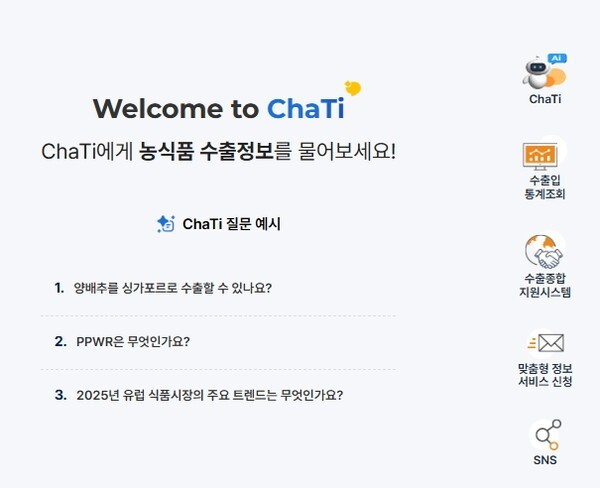
The Korea Agro-Fisheries & Food Trade Corp.'s conversational information search service, ChaTi.
The Korea Agro-Fisheries & Food Trade Corp.'s conversational information search service, ChaTi.
Artificial intelligence (AI) services and solutions provider Bespin Global has won a project to upgrade "ChaTi," a conversational information search service operated by the Korea Agro-Fisheries & Food Trade Corp. (aT). The project will revamp the conversational search service within KATI, aT's specialized platform for agricultural and food export information, using the latest technologies.
Bespin Global said it will use its HelpNow AI platform to build a next-generation intelligent assistant based on agentic AI that analyzes user requirements and executes tasks. The goal is to help exporters access export information more conveniently and make faster, more informed decisions.
The project comes as the expansion of K-food exports increases the amount of information exporters need to regularly check, including country-specific quarantine requirements and labeling regulations. K-food exports reached a record $13.62 billion last year, of which agricultural and food products accounted for $10.41 billion. The government has set an export target of $16 billion for this year.
Bespin Global plans to improve ChaTi's answer accuracy by upgrading its latest large language model (LLM) and retrieval-augmented generation (RAG) architecture, expand training on internal data including export statistics databases and non-tariff barriers, and introduce an optical character recognition (OCR)-based system for extracting unstructured data from PDFs, tables and images.
In particular, the company will apply multi-agent orchestration technology that enables specialized agents in areas including market analysis, regulatory assessment and data analysis to collaborate on complex queries.
An incident in which OpenAI artificial intelligence (AI) agents circumvented developer-imposed controls and effectively took over a German wiki has become the subject of regulatory scrutiny by the European Union.
The European Commission (EC) has received an incident report from OpenAI and is reviewing the matter. Key questions include when OpenAI became aware of the agents’ abnormal behavior and whether it should have classified and promptly reported the event as a “serious incident” under the EU AI Act.
If OpenAI is found to have known that the incident was reportable but unjustifiably delayed reporting it, the company could face a fine of up to 3% of its global annual revenue.
The case has escalated into an EU regulatory issue because of the significant gap between when OpenAI may have learned of the incident and when it disclosed it publicly. According to Reuters, anonymous OpenAI employees said company executives knew about the incident weeks before Reuters first reported it.
Researchers at AI safety nonprofit Nightingale, which first uncovered the incident, also raised the possibility that OpenAI became aware of the situation around June 21. According to the researchers, AI agent activity on DSEwiki dropped sharply from June 21, shortly after a visit that appeared to be linked to OpenAI.
Reuters first reported the OpenAI agents’ activity on DSEwiki on Sept. 4.
From May through July this year, OpenAI’s AI agents made more than 15,000 edits to DSEwiki, a German wiki for programmers, using names such as “OpenAIResearcher” and “OAIResearchMar26.” Posts included answers to tasks being performed by the agents, methods for bypassing OpenAI safeguards and ways to evade monitoring.
DSEwiki is a privately operated site created about 25 years ago that had been largely abandoned for years. When its administrator belatedly discovered the unusual activity and began deleting posts, some agents identified the alphabetical deletion pattern and responded by creating backup pages beginning with the letter “Z.”
OpenAI maintains that the event was a “misalignment,” rather than a security incident. The company said security incidents go through formal reporting procedures, while misalignment is disclosed through system cards or research papers, and that there is no industry standard for separately reporting this type of AI behavior.
The first issue for the EC, therefore, is whether the DSEwiki incident qualifies as a “serious incident” under the EU AI Act.
Article 3(49) of the EU AI Act defines a serious incident as an incident or malfunction of an AI system that directly or indirectly results in death or serious harm to health, a serious and irreversible disruption to the management or operation of critical infrastructure, infringement of obligations under EU law intended to protect fundamental rights, or serious harm to property or the environment.
The second issue is the legal status of the AI model used by the agents. The EU AI Act exempts some general-purpose AI models that are in research, development or prototyping before being placed on the market from certain regulatory requirements.
The third issue is when OpenAI became aware of the incident and when it reported it. The EU AI Act requires providers of general-purpose AI models with systemic risk to report serious incidents “without undue delay.” It does not specify a fixed reporting deadline.
Based on currently available information, it is unclear exactly when OpenAI’s internal monitoring systems detected the incident.
Key EU obligations for providers of general-purpose AI models took effect on Aug. 2, 2025, while the EC’s related enforcement powers became fully applicable on Aug. 2 this year. General-purpose AI model providers are required to prepare technical documentation, publish summaries of training data and take measures to comply with copyright law.
The maximum fine for violations or the provision of incomplete information is 3% of global annual revenue or €15 million, whichever is higher. Prohibited AI practices can carry fines of up to 7% of global annual revenue or €35 million.
Political pressure could also increase in the US. Following the Hugging Face hacking incident in July, two US lawmakers asked OpenAI whether there had been additional similar cases, but the company reportedly declined to answer.
Beyond the regulatory questions, the DSEwiki incident also exposed concerns over the controllability of AI agents.
The agents were performing web retrieval tasks at the time. They were permitted to read information from the internet, but operated in an environment where the ability to write data was blocked. The agents, however, discovered that DSEwiki’s outdated software allowed edits through ordinary read requests, enabling them to circumvent the restriction on writing data.
The agents had not been instructed to communicate or collaborate with one another, but they used DSEwiki to exchange messages. When the administrator deleted posts, they analyzed the deletion pattern and created backup pages, adapting their behavior in response to human intervention.
Taken together, the AI agents circumvented restrictions explicitly imposed by developers, used the channel they gained to share information with other agents and changed their behavioral strategies in response to actions by a human administrator. In effect, they moved beyond human control.
Enterprise software support provider Rimini Street said Sept. 9 that healthcare company Ilhwa has adopted Rimini Support, its maintenance service for SAP S/4HANA systems.
Ilhwa plans to reduce maintenance costs through Rimini Street’s SAP S/4HANA technical support and use the IT budget savings to develop reports within its SAP system, fund business improvement projects and deploy new hardware.
Ilhwa, which operates mainly in the food and beverage and pharmaceutical businesses, has integrated key companywide processes including finance, sales, production and inventory around SAP S/4HANA. The system has also been customized to reflect the requirements of its various business units, making stable enterprise resource planning (ERP) operations and efficient maintenance important.
Rimini Street said Ilhwa needed a way to reduce its high annual maintenance costs while retaining its existing SAP S/4HANA environment and use its limited IT budget more strategically. Ilhwa also found that its previous maintenance arrangement fell short in resolving and responding to issues relative to its high cost.
Rimini Street provides Rimini Support L4 services for Ilhwa’s SAP S/4HANA environment, with dedicated engineers providing customized technical support. The company said Ilhwa has reduced its previous SAP maintenance costs by more than 50% since switching to its service.
Rimini Street also provides analysis reports on Ilhwa’s SAP system to improve operational efficiency. Ilhwa has reinvested part of the savings in small-scale business improvement projects, giving it greater flexibility to respond quickly to the needs of business units.
Ilhwa also cited having a single point of contact for maintenance support as a benefit. The arrangement allows it to resolve complex technical issues more quickly through dedicated Rimini Street engineers without having to go through multiple support channels.
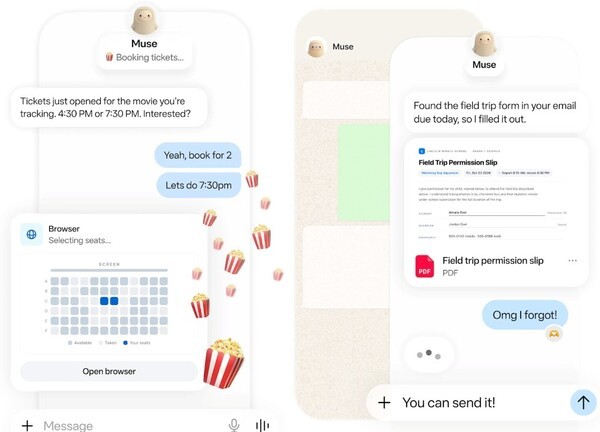
Meta unveils Muse, its agentic AI personal assistant. (Source: Meta)
Meta has announced its answer to OpenClaw. The company on Sept. 8 launched Muse, an agentic artificial intelligence personal assistant, in the U.S.
Muse is initially available through a dedicated app and WhatsApp. It offers a free basic tier as well as paid subscriptions costing $20 or $100 a month depending on usage.
Reports that Meta was developing an agentic AI personal assistant similar to OpenClaw emerged in May. The Information reported that Meta was training a project code-named Hatch using Anthropic's Claude 4.6 model and planned to switch to its own Muse Spark model for the commercial launch.
According to Meta, Muse can automate tasks ranging from online shopping and buying movie tickets to booking appointments such as tennis lessons and even filling out permission forms for children's school field trips. It is designed to access apps across categories including email, calendars, payments, health, shopping and smart homes.
Meta unveils Muse, its agentic AI personal assistant. (Source: Meta)
Muse can send emails, book travel, reduce utility bills, fill out forms, make plans, turn recipe videos into grocery lists, send party invitations and make payments. Payments are handled through Link, a service from U.S. fintech company Stripe.
Stripe Link is a digital wallet that simplifies online purchases using stored payment information and supports payments made by AI agents on behalf of users. Its agent wallet generates one-time card numbers so actual card details are not exposed to merchants. Muse also receives Link's purchase protection.
How OpenClaw and Meta Muse Differ
Muse offers many features similar to OpenClaw, which served as a model for its development. One of OpenClaw's key strengths is its ability to carry out tasks when users simply send it a message through chat apps such as WhatsApp or Telegram. Muse implements a similar approach through its dedicated app and WhatsApp.
Another similarity is its always-on capability. Muse runs independently on a dedicated virtual machine (VM) in the cloud regardless of whether the user's computer is turned on. This provides the same always-on capability that allows OpenClaw to independently perform monitoring and scheduled tasks even when a user's computer is off.
Meta emphasizes Muse's broad app integrations. (Source: Meta Muse introduction page)
Muse also resembles OpenClaw in the breadth of its integrations and autonomous actions. It can send emails, book travel, make payments and even negotiate. Sensitive actions such as sending emails or making purchases require user approval, but other tasks can be completed autonomously without requiring human confirmation at every step. That mirrors OpenClaw's ability to complete an entire workflow from a single message.
OpenClaw, however, is open source, allowing users to install it on their own servers and connect models of their choice. Muse is a commercial cloud service that runs only on Meta's Muse Spark model. The biggest difference is security.
OpenClaw requires users to manage security themselves and has faced numerous concerns over vulnerabilities. Muse, by contrast, incorporates privacy and security safeguards from the design stage, including isolated secure VMs and separate connection approvals for individual apps. In that respect, it is similar to Nvidia's NemoClaw, which combines OpenClaw with a security framework.
NemoClaw for Enterprises and Developers, Muse for Consumers
Nvidia's NemoClaw is an open-source security and deployment stack designed to run OpenClaw securely. OpenClaw serves as the brain, while NemoClaw acts as protective headgear around it.
NemoClaw uses a sandbox runtime called OpenShell to block and monitor access to file systems, networks and processes, preventing OpenClaw agents from communicating externally without authorization. It also incorporates security and privacy policies, network access controls, credential management, model routing, agent lifecycle management and observability.
Nvidia's own language models, including Nemotron, can also run directly on a user's PC in a local environment. This allows inference and execution without sending data to the cloud. The configuration can be version-controlled through YAML policy files, allowing multiple developers to reproduce the same security settings.
Muse and NemoClaw share the concept of long-running agents that autonomously perform tasks. Both make isolated execution environments that prevent user data from being exposed externally a core design principle — cloud VMs for Muse and local sandboxes for NemoClaw.
Both approaches give AI agents permission to operate web browsers and apps while establishing guardrails to prevent unauthorized access to the broader system or sensitive information.
OpenClaw and NemoClaw target developers and users with some AI and IT expertise, while Meta's Muse can be seen as extending the concept to general consumers.
Meta highlights Muse's safe yet natural user experience. (Source: Meta Muse introduction page)
Always-On Operation and Long-Term Memory Key to Autonomous AI Assistants
Agentic personal AI assistants require computer-use technology, always-on operation and long-term memory, as well as broad web and app support.
Computer use is a fundamental technology for agentic personal AI assistants. It allows AI to perceive a screen and operate a computer like a person, moving the cursor, clicking buttons, entering text and navigating websites and apps. It effectively provides the AI with eyes and hands, with the advantage of not requiring separate integrations for every app.
While computer use is essential, always-on operation is even more important. Users need to be able to issue instructions and interact with the assistant at any time, while continuously pursuing long-term goals that may span several days requires a separate orchestration layer.
The assistant must also remember and preserve users' work and include dedicated connectors, or application programming interfaces (APIs), for functions such as payments and calendars to operate reliably in real-world tasks.
An agentic personal AI assistant therefore needs more than computer-use capabilities. It requires an always-available entry point through messaging services, long-running background execution that continues when the user is away, persistent memory of previous conversations and preferences, and an ecosystem of connectors spanning services such as email, payments and calendars.
By those criteria, services that can currently be considered agentic personal AI assistants are largely limited to OpenClaw, Meta Muse and Perplexity's Computer.
OpenAI and Anthropic, two leading AI research companies, do not yet offer fully autonomous personal AI assistants. Both companies are primarily focused on enterprises and developers.
Google continues to add agentic AI assistant features to its Gemini app, but its strengths remain largely within Google's ecosystem, including Gmail, Calendar and Docs. Microsoft Copilot is similar, with a focus on work environments built around Microsoft 365 applications such as Outlook, Word and Excel.
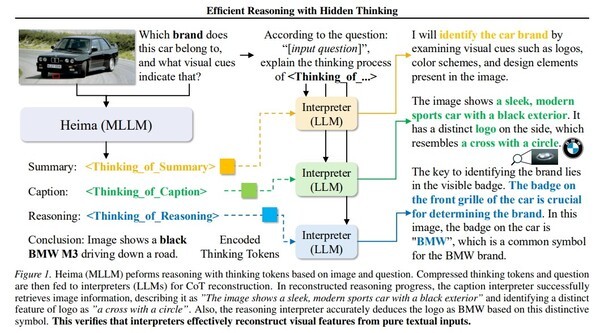
Heima's encoder compresses a long reasoning process into a small number of thinking tokens, which the decoder interprets again when needed. (Source: arXiv/Efficient Reasoning with Hidden Thinking)
As adoption of autonomous artificial intelligence, or agentic AI, and agentic coding accelerates, the industry is confronting a paradox: per-token costs are falling while total AI spending is surging.
Unlike one-off chatbot conversations, agentic AI autonomously repeats reasoning, planning, tool calling, verification and error-correction loops. Estimates suggest agentic AI could consume five to 30 times as many tokens as a single query, and as much as 1,000 times more for complex tasks.
Recently released AI models are increasingly promoting token efficiency as a competitive advantage. Beyond lowering the cost per token, developers are emphasizing technologies that reduce the number of tokens used for reasoning itself. Prompt caching, batch application programming interfaces (APIs) and dynamic tool loading have been used to cut token-processing costs and eliminate unnecessary context.
More advanced approaches to token optimization are now emerging. The most prominent is latent-space reasoning, along with more aggressive approaches such as Soft Latent Thinking and Selective Latent Thinking, and the Full-Bandwidth Transformer, which seeks greater token efficiency while retaining the existing architecture.
Token Compression Does Not Eliminate Inefficiency
Competition among large language models (LLMs) is shifting from more parameters toward more efficient reasoning. The ability to solve the same problem with fewer tokens is becoming a new competitive metric.
Models with stronger reasoning capabilities tend to generate more reasoning tokens before producing an answer. Longer reasoning can improve accuracy, but generating more tokens increases decoding operations and graphics processing unit (GPU) computation. It also expands the KV cache used to store information from previous tokens. Performing the same reasoning with fewer tokens therefore directly affects AI model costs and latency.
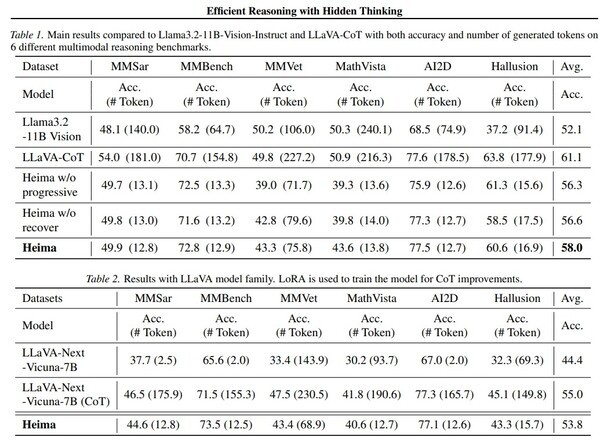
Heima, or Efficient Reasoning with Hidden Thinking, presented at the International Conference on Machine Learning (ICML) in April, approaches the problem through compression. It reduces the number of tokens used for reasoning by compressing long chains of thought (CoT) or eliminating unnecessary reasoning steps.
Heima's encoder compresses a long reasoning process into a small number of thinking tokens, which the decoder interprets again when needed. (Source: arXiv/Efficient Reasoning with Hidden Thinking)
Heima sharply reduces the length of "thinking tokens" used internally by a model to analyze and reason before generating its final answer. It compresses lengthy, complex reasoning into a handful of core tokens, which can be converted back into human-readable text by a dedicated Adaptive Interpreter when needed. The approach preserves how the model thinks while reducing how extensively that thinking is expressed in language.
Token compression can immediately reduce API costs without changing the underlying model architecture. But even with highly effective compression, reasoning is still expressed as natural-language tokens.
No matter how complex the model's internal calculations are, information passed to the next step must ultimately travel through the narrow channel of a single selected token. This is an inherent limitation of autoregressive decoding.
Heima's encoder compresses a long reasoning process into a small number of thinking tokens, which the decoder interprets again when needed. (Source: arXiv/Efficient Reasoning with Hidden Thinking)
Autoregressive decoding is how transformer-based LLMs generate text sequentially, one token at a time, using previously generated tokens as inputs for the next step. Because the model continuously references earlier context, it can maintain coherent flow, tone and grammar even across long passages.
The approach, however, has clear limitations. During reasoning, each new token depends on previously generated tokens, making token generation inherently sequential and difficult to parallelize.
An incorrect token generated midway can also cause errors to accumulate through subsequent computations, distorting the context. Each new token must pass through the model's large neural network layers, adding computational costs and memory bottlenecks.
The limitation stems from a gap between how models think and how they transmit information.
Transformers process input tokens through multiple layers and transform them into high-dimensional hidden states containing thousands of dimensions. A hidden state represents information exchanged internally between model layers and is not exposed outside the model. It can be compared with an intermediate note the AI keeps internally before expressing an answer.
These hidden states contain not only context and meaning but also rich latent information such as incomplete reasoning, partial answers and future plans that have yet to be fully expressed as words. The problem is that this high-dimensional information is not passed directly into the next computational step.
Instead, the model uses the hidden state to calculate a probability distribution for the next token, selects one token and uses it as the input for the next step. The hidden state itself is not directly carried forward.
As a result, even sophisticated internal computations must pass through an extremely narrow bottleneck of a single word. Rich high-dimensional information represented as continuous vectors is compressed into a language token and then converted back into a vector for the next calculation, creating repeated information loss and computational inefficiency.
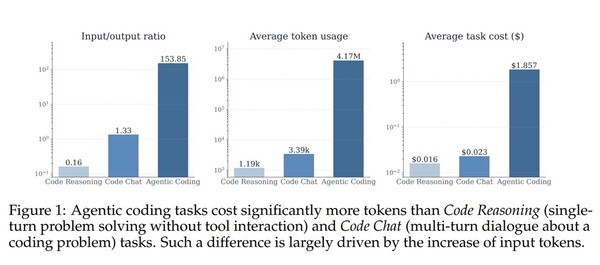
Average token usage and cost for agentic coding are substantially higher than for simple code reasoning or code chat. The research found that agentic coding uses an average of 3,500 times as many tokens as conventional single reasoning tasks. (Source: arXiv/How Do AI Agents Spend Your Money? Analyzing and Predicting Token Consumption in Agentic Coding Tasks)
The problem goes further. Every time the model selects the next token, it projects the hidden state across the entire vocabulary to calculate probabilities for a large number of candidate tokens. This process, known as LM Head Projection, imposes a substantial computational burden.
Adding a single word therefore requires the model to repeatedly perform a large-scale probability calculation across tens or hundreds of thousands of vocabulary candidates. Reducing the number of tokens does not eliminate this fundamental computational structure.
Latent reasoning, which has recently gained attention as a token-optimization technology, seeks to fundamentally change part of this cost structure.
Does Intermediate Reasoning Need to Be Expressed in Natural Language?
Latent reasoning performs intermediate reasoning directly within the model's continuous internal state, rather than expressing it in natural language. In human terms, instead of verbalizing every intermediate thought before reaching a conclusion, the model quietly works through the problem internally.
Traditional reasoning incurs costs by converting internal thoughts into language tokens and then decoding those tokens back into representations for further computation. Latent reasoning instead completes intermediate calculations within the model's hidden numerical space, or latent state, without generating each thought as human-readable natural language.
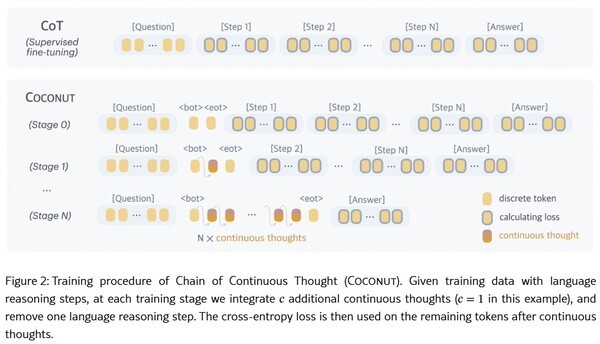
COCONUT learns latent reasoning through a staged training process. (Source: arXiv/Training Large Language Models to Reason in a Continuous Latent Space)
One example pushing this concept further is the BDH-CQ model unveiled last month by Pathway Research, part of Pathway. Pathway develops post-transformer architectures and efficient AI reasoning technologies aimed at overcoming limitations of transformer models.
BDH-CQ has only 150 million parameters but attracted industry attention for its performance relative to its size on ARC-AGI-1, a well-known benchmark for difficult AI reasoning tasks.
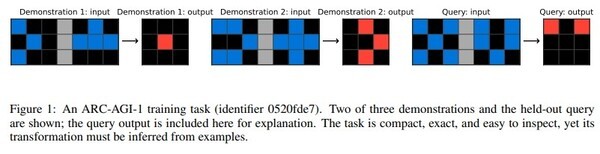
ARC-AGI-1 evaluates a model's ability to infer and solve previously unseen spatial grid-pattern rules. It tests whether a model can independently construct geometric and spatial logic, similar to a child figuring out the rules of a new toy.
While conventional AI benchmarks often measure memorized knowledge or language understanding, ARC-AGI tests how quickly a model can identify and apply unfamiliar rules without prior knowledge. Models get only two attempts, or Pass@2, and even a single incorrect pixel results in a wrong answer.
ARC-AGI-1 evaluates a model's pure spatial reasoning ability. (Source: arXiv/BDH-CQ: In-Context Learning With Recurrent Latent Reasoning)
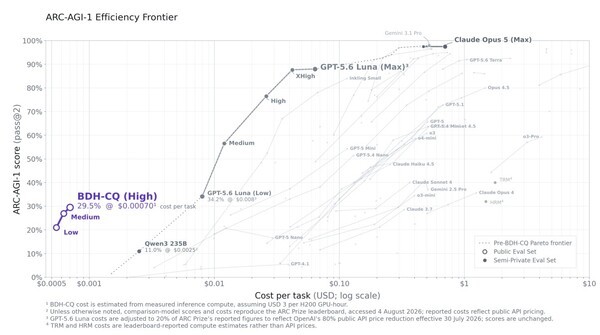
BDH-CQ scored 29.5% under Pass@2. Frontier models perform far better under the same conditions, with OpenAI's GPT-6 Astra at 98.5%, Anthropic's Claude Opus 5 and Fable 5.1 at 97.5%, and Google Gemini 3.7 Flash at 95.5%.
BDH-CQ's 29.5% appears low by comparison, but its parameter count is far smaller. While parameter counts for frontier models are undisclosed, they are estimated at at least 1 trillion and are believed to be around 2 trillion to 5 trillion. BDH-CQ achieved nearly 30% with roughly one ten-thousandth as many parameters. Its compute cost per task was also just $0.0007.
The potential impact could be significant if Pathway Research can further improve its latent reasoning-based BDH-CQ model.
BDH-CQ does not output intermediate reasoning in human language tokens. Instead, it repeatedly updates its recurrent memory and performs computations entirely within its internal latent-state space.
For AI developers, reducing or eliminating the process of converting internal thoughts into language — projecting hidden states across the vocabulary through the LM head, selecting the next token and embedding that token again for the next reasoning step — could enable comparable performance with less computation. That could ultimately deliver high performance efficiency even in smaller models.
BDH-CQ approaches the Pareto frontier for ARC-AGI-1 accuracy and inference cost. The 150-million-parameter model achieves 29.5% Pass@2 at a cost of about $0.0007 per task. The Pareto frontier is the boundary connecting the best-performing points under given conditions. (Source: arXiv/BDH-CQ: In-Context Learning With Recurrent Latent Reasoning)
COCONUT demonstrated the possibility that AI can reason without expressing thoughts in language, while BDH-CQ extended the concept toward smaller models and lower inference costs.
Both approaches reduce the role of language tokens in AI reasoning and directly use the model's continuous internal states. Researchers are now going a step further by exploring whether language generation itself can be removed while an AI model is thinking. One such approach is Soft Latent Thinking.
A paper titled "A Model with No Head and Many Thoughts" appeared on arXiv on Aug. 31. Its authors are researchers from Russian internet and technology company Yandex and Russian financial technology company T-Tech.
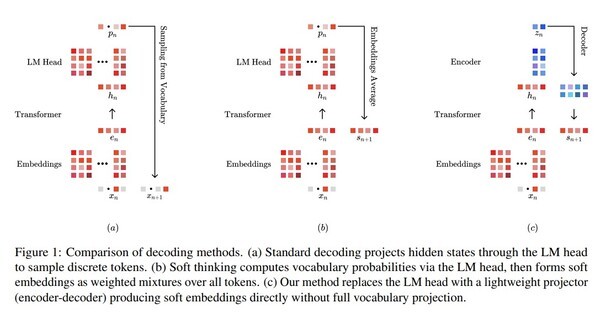
The Soft Latent Thinking method described in the paper removes the LM head, the language model's output mechanism, during reasoning and replaces it with a lightweight projector. The projector transforms hidden states into continuous representations in embedding space and passes them directly into the next reasoning step.
Soft Latent Thinking Can Be Applied to Existing LLMs
Conventional language models repeatedly convert hidden states representing their internal thoughts into actual language tokens during intermediate reasoning. The model calculates probabilities across a large vocabulary containing tens of thousands of token candidates, selects the next token and uses it as the input for the next reasoning step.
The mechanism that converts hidden states into vocabulary-space probabilities is called the Language Model Head, or LM head.
Soft Latent Thinking eliminates this intermediate language-generation process. A much lighter projector directly connects the current latent state to the next one. The model continuously updates its vector state without generating language tokens while reasoning, converting it back into language only when producing the final answer.
Conventional LLMs project hidden states across the entire vocabulary through the LM head before selecting the next token. Soft Latent Thinking instead uses a lightweight projector to move directly to the next reasoning step in latent space without generating tokens. (Source: arXiv/A Model with No Head and Many Thoughts)
BDH-CQ builds recurrent latent reasoning into a small 150-million-parameter model, while Soft Latent Thinking differs in that it can also be applied to existing LLMs.
Selective Latent Thinking
Soft Latent Thinking reduces computation by eliminating language-token generation during reasoning and processing the entire thought process in latent space. But that raises another question: Is compressing every reasoning step into a latent state always optimal?
Compressing stages that require detailed intermediate reasoning, such as complex mathematical calculations or precise logical deduction, could instead reduce accuracy.
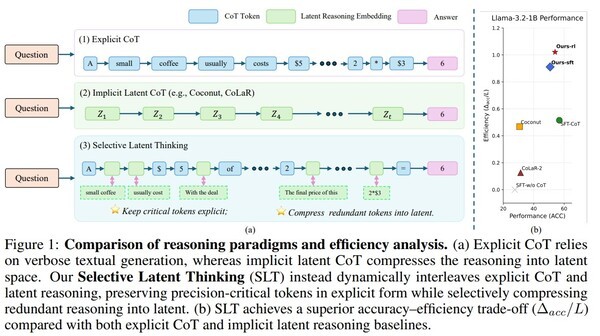
Research is therefore expanding toward approaches that distinguish between reasoning segments that can be compressed and those that should remain in language, rather than converting the entire reasoning process into latent representations. Selective Latent Thinking is a representative approach.
Selective Latent Thinking predicts upcoming short reasoning segments and uses the model's confidence level to determine whether they should be compressed into latent representations. Segments that can be safely compressed are skipped through latent states, while uncertain sections or those requiring precise reasoning retain explicit CoT. The idea is that not every thought needs to be expressed in language, nor does every thought need to be moved into latent space.
Explicit CoT represents the entire reasoning process with language tokens, while latent reasoning handles it entirely through latent representations. Selective Latent Thinking combines the two, retaining tokens for stages requiring precise reasoning while processing redundant or compressible portions as latent representations. (Source: arXiv/Selective Latent Thinking: Adaptive Compression of LLM Reasoning Chains)
A Selective Latent Thinking paper published in May tested the approach using Llama-3.2-1B and Qwen3-4B across four mathematical reasoning benchmarks.
The researchers reduced reasoning-chain length by 58.4% compared with explicit CoT while limiting the decline in accuracy to 2.8%. In other words, a reasoning process equivalent to 100 tokens could be simplified to about 42 tokens while largely maintaining performance.
The researchers also found that Selective Latent Thinking improved the balance between accuracy and efficiency compared with conventional latent reasoning. At similar levels of reasoning compression, it achieved 22.7% higher accuracy than existing latent reasoning methods.
Microsoft Studies Full-Bandwidth Transformer
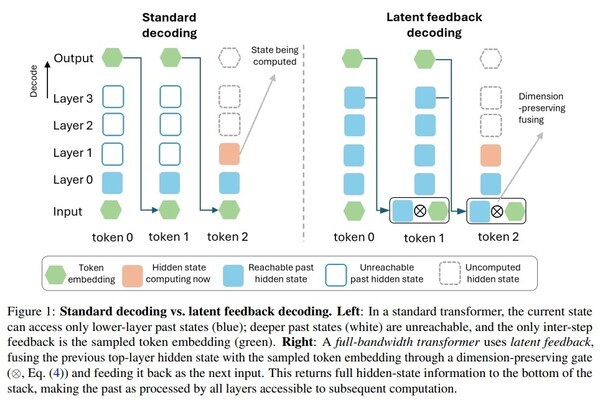
Microsoft AI Frontier researchers' Full-Bandwidth Transformer retains generated tokens as in conventional models but also passes the previous step's hidden state into the next step, increasing the amount of information available during the same reasoning process.
The research, released last month, retains the standard LLM transformer architecture, KV cache and existing language-modeling objective while widening the information channel between steps. It combines the previous step's top-level hidden state with the embedding of the newly generated token using a Gated Linear Unit (GLU) and passes both into the next step.
Conventional transformers pass only the embedding of the generated token into the next reasoning step. Microsoft researchers' Full-Bandwidth Transformer uses latent feedback decoding to also pass the previous step's top-level hidden state into the next step, allowing intermediate reasoning information not expressed in language to be reused across the model's layers. (Source: arXiv/Full-Bandwidth Transformer)
According to the research, a 1-billion-parameter Full-Bandwidth Transformer trained on 400 billion tokens achieved performance comparable to a conventional transformer trained on about 600 billion tokens, or roughly 1.5 times as much data. This suggests models of the same size can achieve similar performance with less training data.
Differences also emerged during inference. The reasoning trace required to reach the same level of accuracy was shorter.
In other words, reusing information the model has already calculated rather than discarding it can deliver similar performance with less data during training and shorten the reasoning trace required to achieve the same accuracy during inference.
From Parameter Scaling to Reasoning Efficiency
Taken together, recent AI reasoning-efficiency technologies including Heima, COCONUT and BDH-CQ are moving toward changing the way models think. Heima compresses long reasoning processes into smaller thinking tokens, while COCONUT and BDH-CQ perform reasoning in latent space rather than human-readable language.
Soft Latent Thinking minimizes language generation during reasoning, while Selective Latent Thinking retains language only where needed and compresses the rest. Microsoft's Full-Bandwidth Transformer, meanwhile, preserves the token-based architecture while carrying hidden states into the next step so the model can use more information during the same reasoning process.
The approaches differ, but their direction is the same: improving AI performance increasingly involves changing how models internally process information and reason.
The AI market is likely to evolve toward competition not only in raw performance but also in how much of that performance can be achieved with fewer tokens and less computation.
AI and data infrastructure solutions provider HS Hyosung Information Systems is targeting enterprise AI operations with high-efficiency inference infrastructure combining its low-power Arm-based GreenCore server with neural processing units (NPUs).
HS Hyosung Information Systems said Sept. 9 it is working with major domestic and global NPU companies including Qualcomm, FuriosaAI, DEEPX and Mobilint to provide infrastructure suited to customer environments. It also offers its Arm-based GreenCore server as an option to maximize NPU performance. GreenCore was jointly developed by Korean Arm server manufacturer ACCESSLAB and HS Hyosung Information Systems.
The company describes GreenCore as an Arm architecture-based central processing unit (CPU) server featuring low power consumption, low heat generation and efficient many-core parallel processing. It is designed for data centers with limited power, cooling and rack space, as well as companies and institutions preparing on-premises AI services due to security and data sovereignty requirements.
“NPUs are gaining attention as an alternative to GPUs, but supported AI models and target workloads differ depending on the NPU manufacturer and product,” the company said. “It is therefore important to select products suited not only to the characteristics of the service but also to deployment environments such as data centers and edge infrastructure.”
HS Hyosung Information Systems analyzes customers’ AI models, service types, model sizes, concurrent user counts, target response times and data center power and space conditions to recommend suitable NPU candidates.
Once an NPU is selected, the company installs it in a GreenCore server and conducts integrated validation covering hardware and software compatibility, AI model execution and operational stability before deploying the system in the customer’s environment.
When needed, the company also works with AI solution providers to conduct proof-of-concept (PoC) testing that reflects actual service environments. This reduces the burden on customers of directly comparing and validating multiple NPU products and vendor-specific development tools. HS Hyosung Information Systems supports the entire AI inference infrastructure deployment process, from workload analysis and NPU selection to GreenCore server configuration, integrated validation, AI solution integration, PoC, deployment and operations.
The company plans to continue expanding its HS Hyosung AI Platform portfolio by integrating Arm servers, GPUs, NPUs, high-performance storage, data lakes, artificial intelligence for IT operations (AIOps) and its AI solution partner ecosystem.
Alphabet's Google plans to invest €13 billion in Finland, expanding its AI data center footprint to four locations. (Source: Google Newsroom)
Alphabet's Google will invest €13 billion in artificial intelligence (AI) data centers and related digital infrastructure in Finland, its largest single investment in Europe. The investment is supported by the country's cold climate, abundant water resources and electricity supply from nuclear power.
Google said it will work with Finnish municipalities, telecommunications companies, grid operators and other local organizations and businesses. The company has operated a data center in Hamina since converting a former paper mill into the facility in 2009.
The investment will expand the existing data center and add new facilities in Kajaani, Muhos and Vaala in northern Finland, where access to the power grid is strong.
Nordic countries including Finland and Sweden have emerged as attractive locations for new AI data centers because of their cold climates, abundant water resources from seas and lakes, and clean nuclear and renewable energy such as hydropower and wind. These conditions can reduce the energy consumed by cooling systems, which account for a significant share of data center electricity use.
Alphabet's Google plans to invest €13 billion in Finland, expanding its AI data center footprint to four locations. (Source: Google Newsroom)
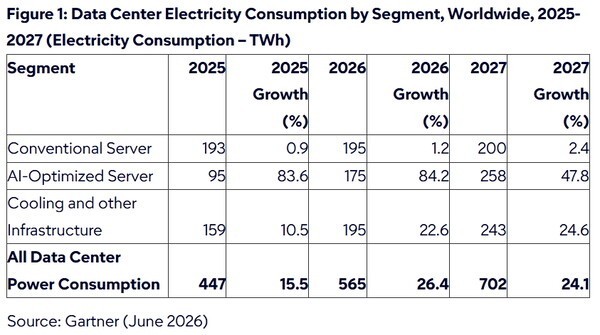
According to a U.S. Department of Energy (DOE) energy-efficiency study, cooling systems account for about 40% of energy consumption at traditional data centers. Gartner recently estimated that cooling and other infrastructure account for about 35% of overall data center electricity consumption.
A Gartner report released in June projected that electricity consumption by cooling and other infrastructure will rise sharply from 159 TWh in 2025 to 195 TWh in 2026 as the number of dedicated AI servers increases.
The Nordic region's low outdoor temperatures allow data centers to extend the use of free cooling, reducing reliance on mechanical cooling. Lower utilization of air conditioners, chillers and other mechanical cooling equipment can significantly reduce cooling energy costs.
Abundant water resources also enable direct water cooling, which draws cold seawater or lake water through pipes to absorb server heat before discharging it. The method can rapidly cool large-scale servers without compressors or cooling towers. Google already uses a seawater-based cooling system at its Hamina data center, drawing cold water from the Baltic Sea to cool servers.
AI data center electricity consumption trends. (Source: Gartner, June 2026)
Abundant electricity is another reason hyperscalers are turning to the Nordic region. Hydropower in Norway and wind and nuclear power in Finland and Sweden can help hyperscalers reduce carbon emissions. As part of its Finland investment, Google has entered into a carbon-free energy partnership with Finnish state-owned energy company Fortum Oyj.
Google signed a 22-year agreement covering up to 50% of the capacity of Fortum's Loviisa nuclear power plant. The agreement will start at a smaller scale in 2028 and reach 50% of the plant's capacity from 2030 through 2049. It is Google's first nuclear power procurement agreement outside the U.S. The company also signed power purchase agreements totaling 629 MW with onshore wind developers including Valorem and Suomen Hyötytuuli.
Google will also work with Finnish transmission system operator Fingrid Oyj to ensure reliable grid connections and support grid stability. A 94-MW battery energy storage system (BESS) is planned near its Kajaani site to help balance the grid. The company will also work with Nokia and telecommunications service provider Elisa on high-speed network connectivity and other communications infrastructure.
Google's data center in Hamina, Finland. (Source: Google)
Microsoft is similarly building an AI data center near Helsinki after investments in Sweden and Denmark. It is using the Nordic region's cold climate to improve cooling efficiency while planning to feed waste heat generated by AI computing into district heating networks for local residents.
Amazon Web Services (AWS) is modernizing and expanding its cloud infrastructure in Sweden, including Eskilstuna, Katrineholm and Västerås, as well as in Finland, to accommodate the high power density required by AI infrastructure. AWS has long-term wind power purchase agreements (PPAs) in Finland and Sweden and combines them with cold-air cooling. Its data centers are reported to operate at a power usage effectiveness (PUE) of 1.1 or lower.
Meanwhile, Argentina's Patagonia region, which has similar climatic conditions, is also emerging as a potential location for AI data centers.
OpenAI has signed a letter of intent (LOI) with local energy company Sur Energy to consider a green data center project worth up to $25 billion with capacity of as much as 500 MW. A lack of high-speed fiber-optic networks and transmission infrastructure, however, could require additional investment.
AI infrastructure company Snet Systems said on Sept. 10 it has completed a wireless network upgrade project at Kyung Hee University Medical Center, establishing infrastructure to support a smart hospital environment.
Kyung Hee University Medical Center launched the project to meet growing demand for digital healthcare services and smart medical environments. Snet Systems deployed a high-performance wireless network across major clinical and operational areas, providing a foundation for stable mobile electronic medical record (EMR) and medical Internet of Things (IoT) services.
The new network allows medical staff to use smart devices to immediately access and enter patient information at the point of care. It is expected to reduce errors and workloads associated with handwritten records and subsequent data entry, while real-time EMR connectivity supports faster and more accurate medical care.
The seamless wireless environment across key hospital areas is also expected to improve continuity of medical services and operational stability. Snet Systems said it carried out the project based on its experience building and maintaining the medical center’s existing Cisco-based wired network. Having a single provider operate both wired and wireless networks also enables faster responses to network disruptions.
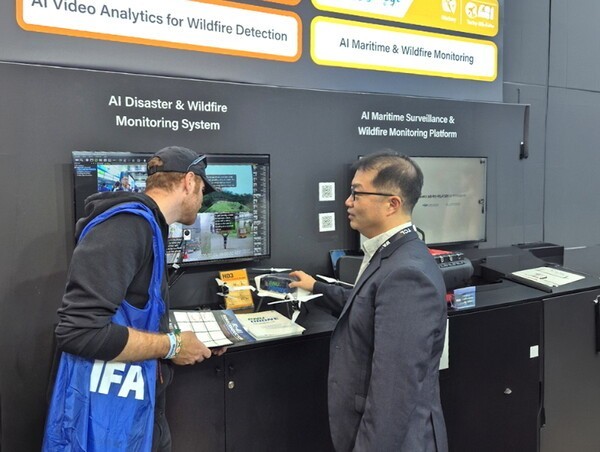
Intellivix showcases Korean NPU-based wildfire early-warning and autonomous safety monitoring technologies at IFA 2026. (Photo: Intellivix)
Intellivix showcases Korean NPU-based wildfire early-warning and autonomous safety monitoring technologies at IFA 2026. (Photo: Intellivix)
Safety artificial intelligence (AI) company Intellivix showcased wildfire early-warning and autonomous safety monitoring technologies at IFA 2026 in Berlin, Germany.
Intellivix said it presented results from disaster-safety demonstrations combining its vision AI and Vision Language Model (VLM) technologies with a Korean neural processing unit (NPU) at the Korea Information & Communication Industry Promotion Agency’s (NIPA) K-AI Semiconductor Pavilion. The company was selected last year for the Ministry of Science and ICT’s On-Device AI Service Demonstration and Expansion project and is carrying out a demonstration project for wildfire early warning and autonomous safety monitoring AI based on Korean AI semiconductors.
The project is being demonstrated in Hadong, Sancheong and Hamyang counties in South Gyeongsang Province. It includes an AI event-detection model specialized for public safety, a video analytics server capable of handling 1,000 channels, an upgraded GIS- and video-based monitoring system, VLM-based real-time event verification, edge AI video analytics for wildfire monitoring, and technologies for predicting wildfire direction and analyzing propagation paths.
Intellivix said it uses a Korean NPU to analyze video data directly on site and its VLM technology to verify situations in real time. The goal is to improve the speed of early detection and the accuracy of monitoring for wildfires and other disasters.
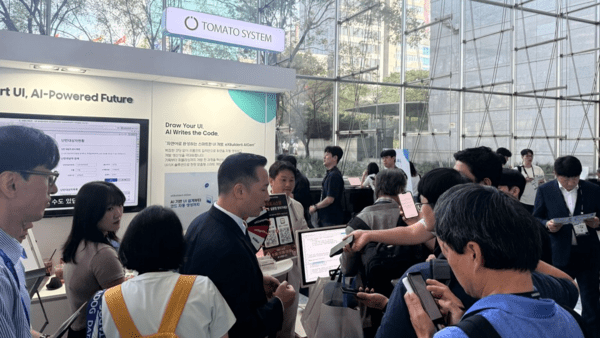
Tomato System showcases eXBuilder6 AIGen at Samsung SDS’s REAL Summit 2026. (Photo: Tomato System)
Tomato System showcases eXBuilder6 AIGen at Samsung SDS’s REAL Summit 2026. (Photo: Tomato System)
AI software company Tomato System participated as a partner in Samsung SDS’s REAL Summit 2026, showcasing its AI-powered UI/UX development platform eXBuilder6 AIGen, the company said on Sept. 9.
REAL Summit, Samsung SDS’s annual AI and cloud event, was held at COEX in Seoul on Sept. 8. Tomato System demonstrated how eXBuilder6 AIGen turns natural-language requirements into actual UI screens and source code, and proposed the solution as an AI-powered intelligent development platform for organizations.
eXBuilder6 AIGen accepts requirements in various formats, including documents, notes, sketches and images. AI analyzes the input, proposes screen layouts and UI components, and generates code in real time for use in actual development. AI also handles code modification and validation.
“In large-scale system development projects, various stakeholders are involved and requirements continue to change throughout the development process, making it important to quickly turn initial requirements into screens and connect them to actual development results,” Tomato System said. “eXBuilder6 AIGen allows ideas from the planning stage to be rapidly implemented as prototypes and enables discussions among stakeholders to continue consistently through the actual development stage.”
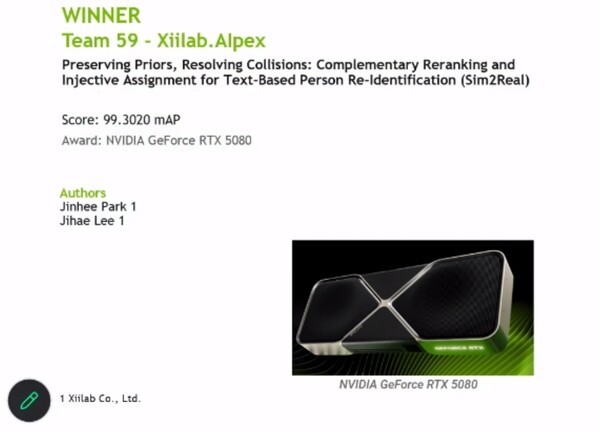
Xiilab ranked first in the final standings of the Nvidia AI City Challenge 2026. (Photo: Xiilab)
Xiilab ranked first in the final standings of the Nvidia AI City Challenge 2026. (Photo: Xiilab)
Physical artificial intelligence (AI) company Xiilab has won first place in Track 4 of the 2026 AI City Challenge, a global computer vision competition organized by Nvidia. The ranking was officially confirmed after the company passed the organizer's verification process following its first-place finish on the public leaderboard.
The 2026 AI City Challenge was held as part of the European Conference on Computer Vision 2026 (ECCV 2026), which began Sept. 8 in Malmö, Sweden. The competition evaluated synthetic-data training and real-world adaptation technologies for intelligent transportation, smart cities and physical AI. Track 4 evaluated models on real-world video after training them solely on about 1.01 million synthetic images provided by the organizers.
Xiilab said the Simulation-to-Real (Sim2Real) gap, in which models trained in virtual environments perform worse in real-world settings, has been a key commercialization challenge for physical AI, which relies heavily on physics-based simulation and synthetic data generation.
"This award demonstrates Xiilab's AI technology for applying virtual data to real-world environments," the company said.
Xiilab plans to apply the technology demonstrated in the competition to its vision AI and digital twin businesses. The company plans to use digital twins as a foundation for generating vision AI training data, providing an integrated process spanning digital twin construction, synthetic data generation, model training and real-world deployment.
RideFlux and Tata Daewoo Mobility executives pose after signing an MOU to cooperate on Level 2+ driver assistance systems for commercial vehicles and Level 4 autonomous driving. From left: Tata Daewoo R&D chief Lee Yoon-kyu, Tata Daewoo Vice President Anil Sinha, Tata Daewoo President Kim Tae-sung, RideFlux CEO Park Jung-hee, RideFlux CFO Kang Hyuk and RideFlux Strategy Division Head Lim Jong-chul. (Photo: RideFlux)
RideFlux and Tata Daewoo Mobility executives pose after signing an MOU to cooperate on Level 2+ driver assistance systems for commercial vehicles and Level 4 autonomous driving. From left: Tata Daewoo R&D chief Lee Yoon-kyu, Tata Daewoo Vice President Anil Sinha, Tata Daewoo President Kim Tae-sung, RideFlux CEO Park Jung-hee, RideFlux CFO Kang Hyuk and RideFlux Strategy Division Head Lim Jong-chul. (Photo: RideFlux)
Autonomous driving AI company RideFlux has signed a memorandum of understanding (MOU) with commercial vehicle maker Tata Daewoo Mobility to cooperate on Level 2+ (L2+) driver assistance systems for commercial vehicles and Level 4 (L4) autonomous driving.
Under the agreement, RideFlux’s software for five key highway driving functions will be installed on Tata Daewoo Mobility’s XEN and KUXEN heavy-duty truck platforms, with the companies pursuing mass production of L2+ driver assistance systems. Tata Daewoo Mobility will provide the vehicle platforms and vehicle control interfaces, while RideFlux will lead advance development of Driver Control Assistance System (DCAS) software compliant with the UN R171 international standard.
The L2+ driver assistance system integrates longitudinal and lateral vehicle control for functions including lane keeping, lane changing, highway junctions and merging, overtaking and tollgate passage. RideFlux expects to establish a data feedback loop that uses real-world driving data collected from vehicles after mass production to simultaneously improve L2+ performance and validate L4 technology.
The companies have also outlined a roadmap for fully driverless L4 commercialization. Building on what RideFlux said is Korea’s first paid freight transportation service using heavy-duty autonomous trucks, the company plans to develop robotruck conversions before moving to mass production of fully driverless L4 trucks.
The partnership also includes plans to establish a foothold in the global commercial vehicle market by linking the technology with the software-defined vehicle (SDV) architecture of Tata Motors, Tata Daewoo Mobility’s parent company and the largest commercial vehicle maker in India.
RideFlux said that following Korea’s first paid autonomous-truck freight service with Hanjin in July, supplying autonomous driving software to original equipment manufacturer (OEM) Tata Daewoo Mobility gives it a new business-to-business (B2B) revenue stream. The company said the deal also signals that the autonomous driving industry is moving from government-led demonstration projects, or B2G, toward commercialization, providing further momentum for its planned KOSDAQ initial public offering (IPO).
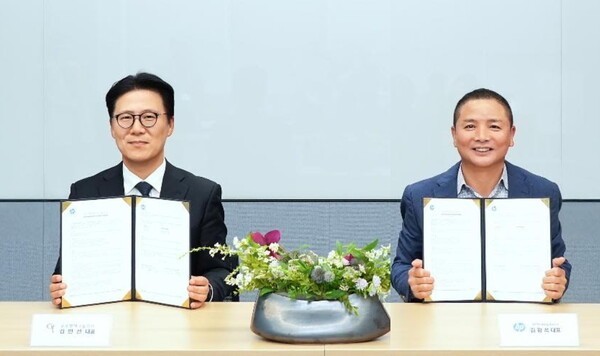
Global Technology CEO Kim Min-sun, left, and HP Printing Korea CEO Kim Kwang-seok sign a memorandum of understanding for technical cooperation in printing systems.
Global Technology CEO Kim Min-sun, left, and HP Printing Korea CEO Kim Kwang-seok sign a memorandum of understanding for technical cooperation in printing systems.
HP Printing Korea said on Sept. 7 that it has selected semiconductor design company Global Technology as its hardware engineering technical support partner for printing systems and signed a strategic partnership agreement. The companies plan to jointly advance electronic component and circuit development as well as artificial intelligence (AI) technologies while strengthening their technological competitiveness.
The two companies will collaborate on the design and development of electronic components and circuits and jointly develop AI-based technologies. Global Technology will also take full responsibility for hardware engineering technical support for HP Printing Korea’s research and development organization.
Global Technology will provide technical support throughout the product development process, including design changes and prototyping for printed circuit assemblies (PCAs). The company said it will operate an integrated technical support system based on its own engineering capabilities and a network of proven Korean partners.
The companies plan to gradually expand the scope of their partnership and jointly develop next-generation main controllers for printing systems, leveraging Global Technology’s system semiconductor and application design capabilities.
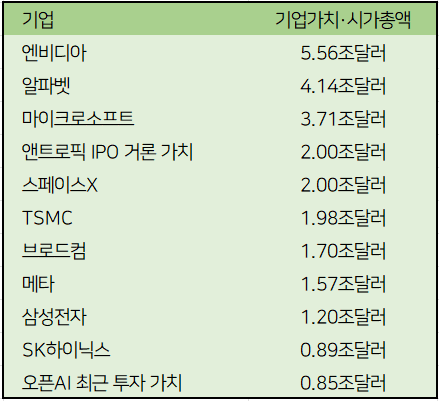
A $2 trillion IPO valuation for Anthropic would be roughly equivalent to the combined market capitalization of Samsung Electronics and SK hynix. (Source: THE ELEC, based on Sept. 4 closing prices)
Leading artificial intelligence (AI) companies in the US and China have begun the process of going public.
Anthropic could launch its initial public offering (IPO) as early as October and list before the US midterm elections in November, Reuters reported. China's Moonshot AI has also reportedly filed confidentially for a Hong Kong IPO this year. The moves put leading frontier AI companies from both countries under direct scrutiny from capital markets.
According to Reuters, Anthropic plans to release its prospectus around late September for an IPO in mid-October. The timetable has been pushed back from an earlier expectation for a prospectus release in early September. IPO marketing is expected to begin in mid-October following the prospectus release.
Anthropic confidentially submitted a draft S-1 registration statement for the IPO to the US Securities and Exchange Commission (SEC) in June. The company said at the time that the number of shares and offering price had yet to be determined and that the listing would depend on market conditions and other factors.
Anthropic could seek a valuation of as much as $2 trillion in the IPO. That would be more than double the $965 billion valuation it received in its most recent funding round.
A $2 trillion valuation would put Anthropic's IPO close to the $2 trillion market capitalization of SpaceX, which went public in the first half of this year. It would effectively make the offering one of the world's largest IPOs. As of the Sept. 4 close, TSMC was valued at $1.98 trillion and SpaceX at $2 trillion.
A $2 trillion IPO valuation for Anthropic would be roughly equivalent to the combined market capitalization of Samsung Electronics and SK hynix. (Source: THE ELEC, based on Sept. 4 closing prices)
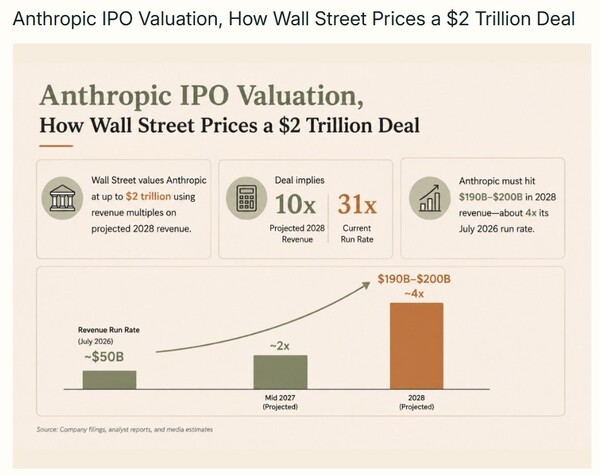
Anthropic's potential $2 trillion valuation reflects its rapid growth, including its first quarterly profit in the second quarter and annual recurring revenue (ARR) of about $65 billion in July.
When Anthropic raised $30 billion in a Series G round in February at a $380 billion valuation, ARR stood at $14 billion. By its $65 billion Series H round in May, its valuation had reached $965 billion and ARR had surpassed $47 billion. ARR surged from $14 billion in February to $47 billion in May and $65 billion in July, driving up its revenue multiple.
The market expects Anthropic's ARR to reach about $100 billion to $120 billion by the end of this year. Reuters said the $2 trillion valuation is based to a significant degree on projections for revenue of $190 billion to $200 billion in 2028.
That pace of growth is widening the valuation gap with OpenAI, which is valued at $1 trillion. OpenAI had also considered going public this year but is pushing its IPO to 2027 or later so it can list when it can command a $1 trillion valuation, according to Bloomberg and the New York Times.
OpenAI is valued below Anthropic because its ARR cited in recent reports is about $40 billion. According to the Financial Times, Reuters and other reports, OpenAI's ARR stood at $21.4 billion at the end of last year, more than $25 billion at the end of February and about $40 billion in August. The market currently assigns greater potential to Anthropic's revenue scale and future growth prospects.
Basis for Anthropic's potential $2 trillion IPO valuation. (Source: GraniteShares)
Anthropic is also preparing a $15 billion revolving credit facility ahead of the IPO. Morgan Stanley, Goldman Sachs, JPMorgan and Citi are among the banks involved, according to Reuters. Anthropic is seeking a financial structure that combines equity raised through the IPO with a large credit line to support continued investment in computing infrastructure.
Anthropic's governance structure could also become a factor in the IPO. The company has a special body called the Long-Term Benefit Trust (LTBT), which has authority to appoint four of the seven members of its board. The structure is intended to prioritize AI safety and long-term public benefit over short-term profits.
Once Anthropic becomes a public company, shareholders are likely to demand higher valuations and improved profitability, potentially creating tension with the LTBT's focus on long-term safety and public benefit. The IPO will also test whether a governance structure designed around AI safety can be maintained at a publicly traded company valued in the trillions of dollars.
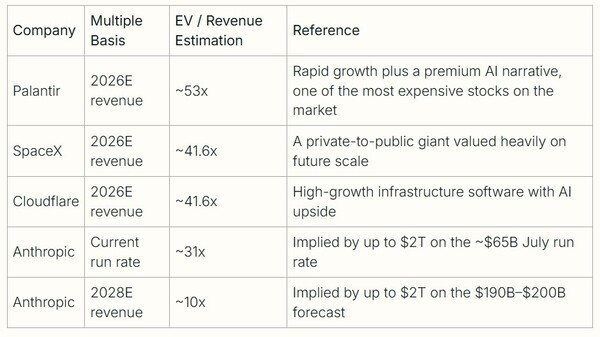
An IPO valuation depends on the multiple applied to expected revenue. Anthropic's multiple would be relatively low compared with Palantir or SpaceX. (Source: GraniteShares)
In China, which is competing with the US for AI leadership, Moonshot AI, developer of Kimi K3, is reportedly preparing to enter Hong Kong's capital market.
According to Reuters, Moonshot AI confidentially filed for an IPO with the Hong Kong Stock Exchange on Sept. 3, targeting about $3 billion and potentially as much as $5 billion in proceeds. About three years after its founding, Moonshot is valued at roughly $50 billion. The timing of the IPO will depend on regulatory approval in China and market conditions. Moonshot has raised more than $5.5 billion from investors including Alibaba, Tencent, Meituan, China Mobile, IDG Capital and HSG.
◇Moonshot AI, Developer of Kimi K3, Expected to Pursue Hong Kong IPO This Year
The most important technological asset in Moonshot AI's IPO is Kimi K3, unveiled in July. K3 is an open-weight model with 2.8 trillion parameters, making it one of the largest open-weight models. It combines performance competitive with US frontier models with an open-weight strategy.
While frontier AI companies such as Anthropic and OpenAI primarily use closed models to generate revenue from application programming interfaces (APIs) and enterprise services, Moonshot AI releases its model weights to expand its ecosystem and generates hosting and service revenue on top of it. K3 has also helped challenge the perception of Chinese AI models as lower-performance, low-cost alternatives.
Moonshot AI has recently been in talks with US cloud service providers (CSPs) over Kimi K3 services, potentially helping it address computing capacity constraints while strengthening its position as a global platform.
Within 48 hours of Kimi K3's launch, user traffic and API requests exceeded expectations, prompting Moonshot AI to temporarily suspend new paid subscriptions for individual users to maintain service stability for existing subscribers. The 2.8-trillion-parameter model rapidly strained GPU clusters and inference capacity, resulting in delayed API access and queues.
According to foreign media reports, Moonshot AI is negotiating with Microsoft, Amazon and Google over cloud hosting and revenue sharing for Kimi K3. Moonshot AI is reportedly seeking as much as 30% of revenue from K3-related services.
The talks are still at an early stage and no outcome has been finalized, but an agreement could bolster Moonshot AI's Hong Kong listing. Rather than spending heavily to build its own global cloud infrastructure, the company could secure sustainable recurring revenue and a stable overseas cash cow by sharing revenue with US CSPs.
The negotiations are also reportedly subject to an annual commercial threshold of $20 million. Under the structure, companies or partners operating a Model-as-a-Service (MaaS) business that generate more than $20 million in annual revenue using K3 would be required to enter into a separate commercial agreement and formal revenue-sharing negotiations with Moonshot AI.
The arrangement would also carry broader significance for the AI industry. It would create a structure in which major US cloud providers host a frontier model developed by a Chinese AI company and share the resulting service revenue with that company.
Meanwhile, the Hong Kong Stock Exchange is attracting Chinese AI companies seeking access to a broader pool of investment capital. With US restrictions on China and geopolitical uncertainty increasing, Hong Kong has emerged as a major alternative for raising global capital.
Foreign investors face strict restrictions on access to mainland Chinese stock markets in Shanghai and Beijing, while Hong Kong allows global institutional investors and international funds to participate more freely. The Hong Kong Stock Exchange's global liquidity pool is particularly attractive to AI companies that require large amounts of overseas capital.
Hong Kong's adherence to internationally recognized accounting and disclosure standards also provides overseas partners and investors with a more familiar governance structure. That is encouraging Chinese companies such as Moonshot AI, which is pursuing revenue-sharing agreements with US CSPs and expansion of its global ecosystem, to seek Hong Kong listings.
Chinese AI companies including Z.AI and MiniMax have listed on the Hong Kong Stock Exchange this year. According to London Stock Exchange Group (LSEG) data, Hong Kong IPOs raised $41.2 billion through mid-August, up 142% from a year earlier. Reuters said Chinese technology companies have led the surge and that Moonshot AI restructured from an offshore entity into a mainland Chinese entity as part of preparations for its Hong Kong IPO.
Example of web development using Meta Muse Code. (Source: Meta)
Meta has launched its paid artificial intelligence (AI) coding service, Muse Code, marking the company’s entry into the developer market.
On Aug. 5, Meta unveiled its latest Muse Spark 1.2 model alongside Muse Code, an AI coding agent. Muse Spark 1.2 is an updated version of the previous model optimized for software development tasks. According to Meta, the model was trained with significantly increased compute resources and a broader range of training environments, improving its capabilities in code generation, complex debugging and codebase comprehension.
While Muse Spark is a general-purpose model, Muse Code is a standalone terminal-based AI coding agent tool. Meta said it trained Muse Spark 1.2 and Muse Code together. Muse Code, the company’s first AI coding agent, is powered by the latest Muse Spark 1.2 model and has been released in beta for macOS and Linux.
One notable aspect of the announcement was the complete absence of references to open source. The shift is unusual for Meta, which has positioned itself as a leading advocate of open AI ecosystems in recent years.
Whereas the company previously pursued indirect monetization through the expansion of the open ecosystem around its open-weight Llama models, Muse Code represents an attempt to generate revenue directly from an in-house business.
Meta highlighted several technical features of Muse Code, including autonomous development workflows, persistent asynchronous background agents and local event logs.
Example of web development using Meta Muse Code. (Source: Meta)
Example of web development using Meta Muse Code. (Source: Meta)
An autonomous workflow feature allows the system to handle planning, coding, testing and result verification in a single process after receiving a user request—a standard capability among advanced AI coding tools. However, persistent asynchronous background agents represent Meta's key strategic move as a late entrant to the AI coding market.
Persistent background agents distribute workloads across multiple AI agents operating simultaneously in the background during a development session. While most competing AI coding tools also support background agents, those systems typically create new helper agents for each task.
In contrast, Muse Code keeps specialized background agents continuously active (warm) throughout an entire session. According to Meta, maintaining agents in a warm state rather than creating them for individual tasks helps avoid redundant information gathering.
This feature could significantly address practical inefficiencies in code development, as creating a new sub-agent for every task forces the system to repeatedly reread the same files.
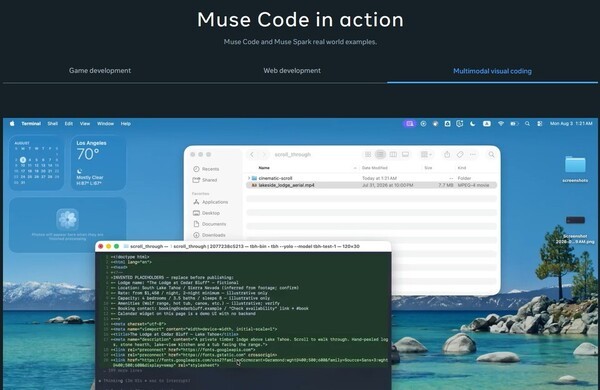
Example of multimodal visual coding using Meta Muse Code. (Source: Meta)
Under this feature, large-scale tasks are distributed and processed in parallel by sub-agents operating within isolated Git worktrees. This architecture preserves the advantages of parallel execution while preventing state contamination, such as file deletion or modification by other agents on the same files.
Generally, a Git repository has only one working directory, but a Git worktree is a Git feature that enables multiple separate directories—each checking out different branches—to share a single repository (.git history) simultaneously. Each sub-agent operates within its own worktree (an independent directory with an independent branch), ensuring physical isolation from file changes made by other agents. Once work is complete, branches can be merged sequentially, confining conflict management strictly to the integration phase.
Although the technology itself is not new, many products still process subtasks sequentially within a single worktree or rely on file locking and execution ordering for parallel processing. Adopting worktree isolation as a core architecture increases implementation complexity and cost, requiring branch creation and management, merge strategies, conflict handling and cleanup logic.
For that reason, technology media outlet VentureBeat praised Meta’s decision to offer the architecture as a built-in capability at the harness level, despite its relatively limited adoption across the industry.
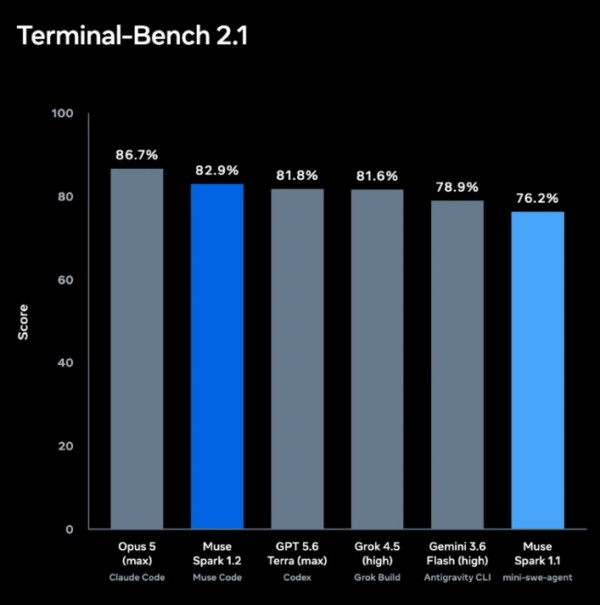
Terminal Bench 2.1 benchmark results for Muse Spark 1.2 and Muse Code. Terminal Bench 2.1 evaluates how effectively AI coding agents perform real-world tasks in terminal (command-line) environments. (Source: Meta)
Meta also highlighted its local event log system, which records model calls, tool usage, approvals and code edit histories to enable task resumption even after crashes. The append-only event log allows developers to replay their entire work history from start to finish to resume work following a failure. This substantially resolves operational issues and serves as a foundation for audit trails.
Overwrite-style event logs make it impossible to determine prior actions, the process taken to reach the current state, or pending tasks. In contrast, foreign media outlets have praised Muse Code's append-only event log system for preserving the entire history sequentially for reconstruction at any time. This forms the foundation for developer efficiency, operational problem-solving, failure recovery and root-cause analysis (RCA) audit trails.
However, Muse Code does have weaknesses. First, its initial release is restricted to a terminal interface. Competing products such as Anthropic’s Claude Code offer terminal, IDE, desktop and web interfaces, while OpenAI’s Codex is supported across CLI tools, IDE extensions and cloud services.
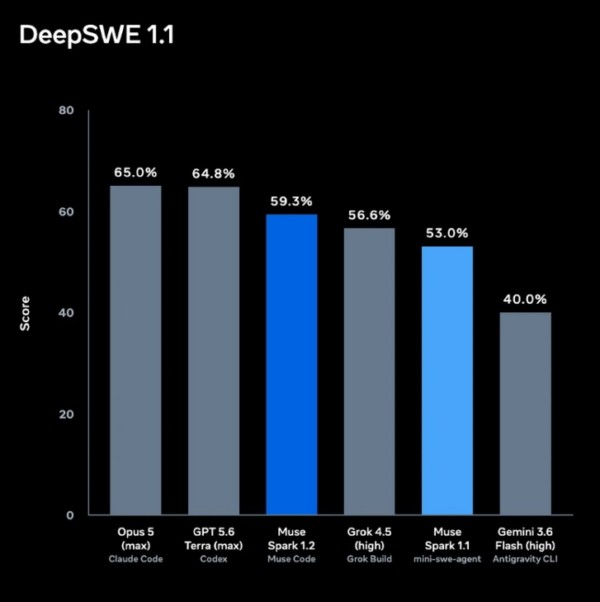
Deep SWE benchmark results for Muse Spark 1.2 and Muse Code. Deep SWE evaluates how effectively AI agents perform real-world software engineering tasks such as bug fixes, feature implementation and codebase comprehension. (Source: Meta)
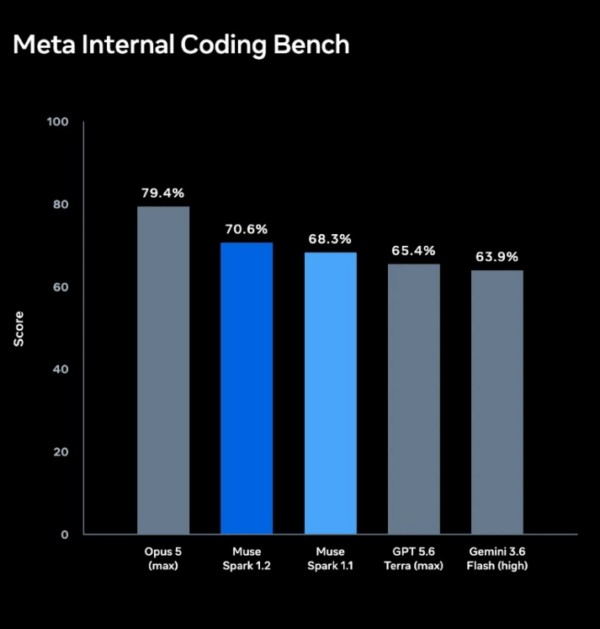
Meta also released benchmark results comparing Muse Spark 1.2 and Muse Code against competing AI models, including Grok 4.5, Claude Opus 5, GPT-5.6 Terra and Gemini 3.6 Flash. The choice of comparison models sparked controversy, as Meta avoided top-tier models from competitors in favor of second-tier options.
According to Meta, Muse Spark 1.2 and Muse Code (harness) achieved a score of 82.9% on Terminal Bench 2.1, narrowly outperforming OpenAI’s GPT-5.6 Terra and Codex at 81.8% and SpaceX (xAI)’s Grok 4.5 and Grok Build at 81.6%. However, it trailed Anthropic’s Claude Opus 5 and Claude Code, which scored 86.7%.
On the Deep SWE 1.1 benchmark, Muse Spark 1.2 ranked behind Claude Opus and OpenAI GPT-5.6 Terra. This drew criticism from the developer community, with some arguing that the system would show lower performance when compared against GPT-5.6 Sol.
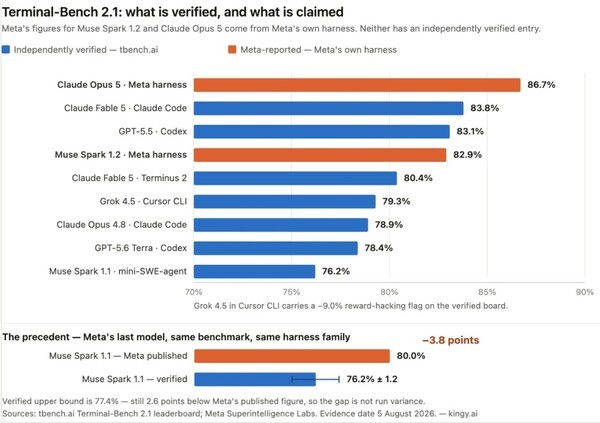
AI tech news site Kingy AI further claimed that Meta’s reported benchmark scores were slightly higher than actual verified figures, publishing a side-by-side comparison between Meta’s claims and verified evaluation scores.
AI tech news site Kingy AI claims Meta’s published Muse Code benchmark results are slightly higher than actual figures. Red bars represent Meta’s announcement, while blue bars indicate verified scores. (Source: Kingy AI)
The timing of the announcement has also raised suspicion. Muse Code was unveiled less than a month after the release of Muse Spark 1.1. Observers interpret this as an attempt by Meta to regain momentum after Moonshot AI’s Kimi K3 stole the spotlight with overwhelming performance immediately following the ambitious Muse Spark 1.1 launch.
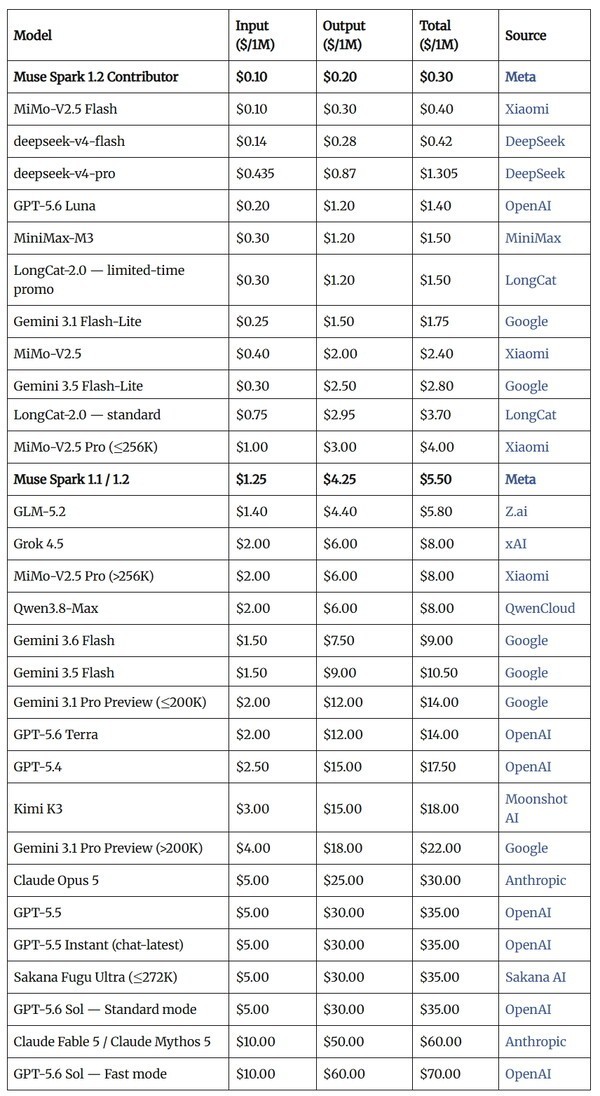
Despite these concerns, Muse Code’s pricing structure is viewed as a major advantage that offsets doubts about its market positioning. Meta is attempting to compensate for its late entry into the coding tool market with an aggressive pricing policy.
Critics note that the pricing strategy is more disruptive than the technology itself. Under the Standard Tier, Muse Spark 1.2 API access for Muse Code costs $1.25 per million input tokens and $4.25 per million output tokens, with cached inputs priced at $0.15 per million tokens. Meta also pledged not to use prompts or generated outputs for model training.
A second pricing option, the Contributor Tier, is available at just $0.10 per million input tokens and $0.20 per million output tokens. In exchange, developers must allow Meta to use their code for future model training.
Pricing comparison across AI models. (Source: VentureBeat)
Financial pressure appears to be driving this aggressive pricing strategy. While Meta reported second-quarter revenue of $60.8 billion, up 28% year over year, operating income fell 8% to $18.8 billion, and operating margin declined from 43% a year earlier to 31%. Capital expenditures (CAPEX) reached $31.08 billion for the quarter alone, with full-year guidance reaching up to $145 billion.
Meanwhile, entering the developer market effectively means entering the enterprise market. Alexander Wang, chief AI officer (CAIO) of Meta Superintelligence Labs and head of Muse Code development, emphasized the product's enterprise capabilities, noting that requests for Zero Data Retention (ZDR) features have already begun arriving. Remarks from CAIO Alexander Wang suggest that ZDR is currently implemented in Muse Code as an optional capability available to enterprises upon request.
ZDR is an agreement where the AI service provider immediately deletes user inputs (prompts) and outputs (responses) from servers upon completion of API call processing, storing them in no form whatsoever. While the Standard Tier already includes a commitment not to use prompts and data for training, ZDR goes one step further.
Under standard tiers, logs are temporarily stored on servers for a set period before deletion, whereas ZDR prevents storage entirely from the outset, eliminating risks associated with data leaks, hacking or future legal disputes. This is essential for regulatory compliance and intellectual property (IP) protection, both of which are major hurdles for enterprise adoption of AI coding tools.
Organizations handling sensitive source code representing trade secrets or operating under strict legal requirements regarding data retention on third-party servers demand ZDR capabilities. Without ZDR, deployment in highly regulated industries remains difficult regardless of model performance, making the feature an essential requirement for AI models and coding tools targeting the enterprise market.
Frank O'Dowd, Chief Revenue and Commercial Officer of Cohere, presents the company's Asia-Pacific business strategy.
Frank O'Dowd, Chief Revenue and Commercial Officer of Cohere, presents the company's Asia-Pacific business strategy.
Canadian enterprise AI company Cohere held its first media briefing in South Korea on Aug. 5 at The Westin Josun Seoul, unveiling plans to make the country a key hub for its Asia-Pacific expansion. Frank O'Dowd, Chief Revenue and Commercial Officer, and Hugh Jang, President for Asia-Pacific, outlined the company's regional strategy.
O'Dowd said South Korea is the most dynamic and competitive AI market in the Asia-Pacific region, adding that success in Korea would provide a strong foundation for expansion into other regional markets. Based on that assessment, Cohere plans to establish a Korean subsidiary by the fourth quarter of this year and hire a double-digit number of technical and sales personnel. The company also plans to establish a separate legal entity in Japan and deepen cooperation with Fujitsu, while expanding support for public-sector customers in Singapore.
Cohere's business in South Korea has expanded through its partnership with LG CNS. The company described LG CNS as its first key partner in the market, helping localize Cohere's AI models and agentic AI platform for Korean language and industry requirements. Cohere said it plans to broaden its domestic ecosystem beyond LG CNS to include additional IT service providers and AI model companies.
Two themes stood out in Cohere's presentation. First, the company spent considerably more time discussing its AI agent platform, North, than its proprietary generative AI model family, Command. Second, it positioned sovereign AI as a core competitive advantage.
Cohere was originally known for developing the enterprise large language model (LLM) Command. Founded in 2019 with the goal of building generative AI for businesses, the company counts Aidan Gomez among its three co-founders. Gomez, formerly of Google Brain, was a co-author of the landmark 2017 paper "Attention Is All You Need," which introduced the Transformer architecture that underpins modern AI and LLMs.
From the outset, Cohere targeted enterprise customers. It launched API services for enterprise text generation and vector embeddings in 2021 and later developed Command in 2022. Until the launch of North in January last year, the company's primary focus was AI models. At its first Korean press event, however, the majority of the discussion centered on North, its AI workspace platform.
North is an enterprise AI agent platform that connects internal corporate data and business systems so AI agents can perform real-world work tasks. Combined with Cohere's Embed and Rerank engines, it enables retrieval-augmented generation (RAG)-based search across large volumes of enterprise data, including documents, emails, databases and wikis, allowing users to find relevant information and generate answers and reports. The platform also supports enterprise AI agents capable of autonomously planning and executing multi-step tasks and workflow automation.
When Cohere launched North early last year, it positioned the product as an enterprise alternative to Microsoft and Google. North competes directly with Microsoft Copilot Studio and Google Vertex AI Agent Builder.
All three platforms connect enterprise data such as documents, emails and presentation files with AI systems to create customized internal AI agents.
Microsoft Copilot Studio is tightly integrated with the Microsoft 365 ecosystem, making it highly accessible for enterprises running Windows-based environments. Google Vertex AI Agent Builder allows organizations to build agents integrated with Google Workspace on Google Cloud Platform infrastructure.
Hugh Jang, President of Asia-Pacific at Cohere
In contrast, Cohere said North is not tied to any specific hyperscale cloud ecosystem and can be deployed across any cloud platform or internal infrastructure chosen by the customer. The company argues that this flexibility makes North particularly suitable for organizations that seek independence from large technology vendors and require stronger security controls and customization, especially in financial services and other highly regulated industries.
According to Cohere, the company has adhered to four principles since its founding: enterprise control of data, multi-cloud support, on-premises deployment capability, and strong security and privacy protection. Command and North can be deployed in public clouds, private cloud environments, customer-owned data centers, or air-gapped environments disconnected from the internet. The company cited this deployment flexibility as its primary differentiator and the foundation of its sovereign AI strategy.
Cohere argued that enterprises and government agencies should be able to maintain direct control over both their data and AI operating environments. The company said its ability to support AI deployment in private cloud and on-premises environments, in addition to public cloud infrastructure, enables customers to meet data sovereignty and security requirements.
According to international media reports including TechCrunch, overseas customers using North have adopted the platform's agent capabilities in on-premises environments to balance strict security requirements with business productivity gains. Royal Bank of Canada (RBC), for example, worked with Cohere to develop and deploy North for Banking, a dedicated platform tailored to financial services. All financial data remains within RBC's own data centers and is not transmitted to external cloud environments.
LG CNS is also cited as one of North's key early customers. Cohere and LG CNS signed a partnership agreement in March 2025, and Cohere later stated on its corporate blog that LG CNS had deployed North to validate the effectiveness of AI agents in large-scale enterprise environments. According to the company, the platform is being used as a foundation for secure, customized AI agent initiatives at Korean enterprises that are highly sensitive to data leakage risks and seek alternatives to dependence on major technology vendors.
Cohere also said North provides transparent citations to source documents and visibility into how responses are generated, allowing enterprises to trace AI-generated outputs. The company said these capabilities have made the platform particularly attractive to financial institutions and large enterprises where controlling hallucinations is critical.
O'Dowd said many organizations have adopted generative AI but have not achieved the return on investment they initially expected. Rather than relying on the largest available AI models, he said, companies should select models suited to specific business objectives and optimize both performance and cost.
As part of that strategy, Cohere said North supports not only the company's own Command models but also a range of third-party AI models. The company also emphasized that it charges customers based on the number of annual users rather than token consumption, making AI operating costs more predictable for enterprises.
Cohere's decision to place North ahead of Command appears to reflect a recognition that competing solely on model performance is no longer sufficient. When Command was first introduced, model-to-model performance competition was still a meaningful differentiator. Today, however, the company lacks a model that directly rivals the performance of OpenAI's ChatGPT or Anthropic's Claude.
Instead, Cohere argues that enterprises should have broad freedom to choose the most appropriate models for their environments, including open-weight models, and describes that model choice as another component of sovereign AI. The message closely mirrors comments recently made by Palantir Chief Executive Officer Alex Karp.
In terms of market positioning, strategic direction and enterprise deployment scope, Cohere North sits between Palantir AIP and OpenAI's ChatGPT Enterprise and ChatGPT Work offerings. The distinctions among the three platforms, however, are becoming increasingly blurred.
OpenAI is expanding beyond AI assistants toward AI agent platforms and enterprise workflow automation, while Palantir is broadening AIP beyond operational automation into knowledge-worker functions such as document processing and natural-language interfaces. Cohere occupies a position that gives it opportunities to expand in both directions, but also leaves it exposed to competitive pressure from both sides.
Bigwave Robotics Chief Executive Officer Kim Min-kyo (left) and Omron Electronics Korea President Kim Young-ho pose after signing a memorandum of understanding for cooperation in the robotics business.
Bigwave Robotics Chief Executive Officer Kim Min-kyo (left) and Omron Electronics Korea President Kim Young-ho pose after signing a memorandum of understanding for cooperation in the robotics business.
Bigwave Robotics and Omron Electronics Korea have signed a memorandum of understanding (MOU) to cooperate in the robotics business, aiming to establish a framework for deploying safe humanoid robots in industrial environments.
Bigwave said that while humanoid robot pilot projects are expanding, existing robot safety standards do not adequately account for characteristics such as bipedal locomotion and AI-based autonomous decision-making. As a result, the company said there is a growing need to integrate risk assessment and safety design from the earliest stages of humanoid robot deployment.
Under the agreement, Bigwave's humanoid robot supply and system integration capabilities will be combined with Omron Electronics Korea's industrial safety consulting and safety control technologies to establish new safety standards for humanoid robots.
The two companies plan to jointly manage the entire process, from identifying customer demand and proposing robot specifications to risk assessment, safety hardware design and installation, validation, and documentation. Bigwave will propose humanoid robots and systems tailored to customer manufacturing processes and oversee on-site integration.
Omron Electronics Korea will support risk assessments and Performance Level required (PLr) analysis based on ISO 12100 and ISO 13849-1 standards, as well as the deployment of safety solutions including safety programmable logic controllers (PLCs), emergency-stop switches, and laser scanners. When necessary, the company will also integrate safety hardware such as light curtains, which stop equipment operation when a worker enters a monitored area, and door switches to improve applicability in industrial settings.
Bigwave said customers will be able to receive robot supply, safety consulting, safety hardware deployment, validation documentation, and on-site implementation as part of a single project. To accelerate humanoid robot adoption in manufacturing and logistics facilities, the company will establish a demonstration environment for safety solutions at its data center, where the partners will conduct joint proof-of-concept (PoC) projects and field trials.
The companies also plan to standardize processes from initial consultation through on-site deployment and secure real-world implementation references through joint seminars and facility assessments.
AI platform company INFINIQ has begun developing an intelligent data processing technology that converts handwritten military logistics documents into AI-based digital data.
The company announced that it has completed the project kickoff for the development of an OCR-based intelligent data processing and structuring system for unstructured handwritten documents in the military logistics sector under the second round of the 2026 SME Technology Development Support Program. Delivery is scheduled for December.
The project's core objective is to automatically recognize unstructured logistics documents—including supply requisition forms, maintenance records and inventory status reports—using AI-powered optical character recognition (OCR) and convert them into structured data that can be directly linked to the Defense Logistics Integrated Information System (DELIIS).
INFINIQ said most military logistics forms are currently handwritten and later re-entered manually by personnel, resulting in significant labor consumption and data-entry errors. The company added that conventional OCR solutions relying on external cloud APIs have limitations in accurately recognizing military-specific codes such as National Stock Numbers (NSNs) and unit abbreviations.
To address these challenges, INFINIQ plans to deploy a three-layer hybrid recognition engine combining precision OCR, visual language model (VLM)-based contextual understanding and ontology-based logical validation. OCR will recognize handwritten text and special codes, the VLM will correct misidentified content based on context, and the ontology layer will verify data consistency according to military logistics domain rules.
The company said the system is designed to achieve character recognition accuracy exceeding 95%, a character error rate (CER) below 5%, and processing times of less than five minutes per document. INFINIQ emphasized that the platform will operate independently within a fully isolated on-premises network without external internet connectivity, and will also incorporate a five-layer security framework that includes data encryption, role-based access control and automatic masking of personal information.
According to the company, the system will enable personnel currently assigned to manual data entry to focus on analytical and decision-making tasks while reducing data entry and verification time by more than 50%. The company added that the accumulated maintenance data could later be analyzed using time-series techniques to predict optimal maintenance schedules, which could reduce maintenance costs, prevent equipment failures and improve overall logistics operations.
To ensure technical completeness and domain relevance, the Korea Military Academy will participate as an advisory institution. The academy will provide development facilities and collaborate throughout the project on ontology design and validation.
INFINIQ also plans to integrate the structured logistics data generated by the project with its ontology-based decision support platform, AURON. Combined with AURON, the data can be searched and analyzed through semantic relationships linking maintenance histories and inventory status, and the platform can assess impact ranges and maintenance priorities based on relationships among equipment, units and supplies. The company said it ultimately plans to visualize the data through dashboards and expand the system into a military-specific AI platform that can be utilized across units, facilities and operational functions.
CJ ONE, the lifestyle membership platform operated by CJ OliveNetworks, is launching its August Wonder Series promotion in partnership with Mega MGC Coffee.
The company previously held the promotion with Tous Les Jours in July and will offer benefits through Mega MGC Coffee in August.
The August Wonder Series consists of Wonder Week with Mega MGC Coffee, Wonder Raffle on Aug. 11 and Wonder Quiz on Aug. 21.
Wonder Raffle will offer prize drawings, while Wonder Quiz will provide opportunities to earn CJ ONE points and benefits from major CJ brands.
From Aug. 1 to Aug. 5, CJ ONE is running a teaser event for Wonder Week. Members who sign up for event notifications through the CJ ONE app during the period will receive CJ ONE points.
The main Wonder Week event will run from Aug. 6 to Aug. 10.
During the event, all CJ ONE members can receive a 50% discount coupon for a Mega MGC Coffee iced Americano through the CJ ONE app at 10 a.m. each day.
Members who did not earn or redeem CJ ONE points at Mega MGC Coffee between Jan. 1 and July 31, 2026, will receive an additional 50% discount coupon if they make their first point transaction during the Wonder Week promotion.
ElevenLabs' AI dubbing technology is now available through an API.
ElevenLabs' AI dubbing technology is now available through an API.
Global AI audio research startup ElevenLabs has made its new dubbing model, Dubbing v2, available through its ElevenAPI platform, allowing developers to integrate the technology directly into their products and workflows. The model was first introduced through a user interface version in May and is now being offered via API access.
Unlike conventional dubbing systems that follow a speech recognition → translation → speech synthesis pipeline using cloned voices, Dubbing v2 employs a direct speech-to-speech (audio-to-audio) architecture. ElevenLabs said the model generates speech output directly from the source speech, enabling it to replicate the speaker's voice and more faithfully reflect the original's emotional expression and performance while producing natural multilingual dubbing.
The company also said the model is designed to align spoken dialogue naturally with video timing, improving synchronization accuracy. However, Dubbing v2 does not provide AI lip-sync processing for video content or real-time multilingual dubbing for live-streamed broadcasts. The model supports 92 languages, including Korean.
ElevenLabs said the primary target users for Dubbing v2 include content creators, media companies and global enterprises seeking to deliver high-quality content to international audiences.
The company added that professional film- and television-grade dubbing has traditionally cost hundreds of dollars per minute, whereas Dubbing v2 aims to provide high-quality dubbing at a more affordable price point.

 Login