Deep within Indonesia’s Leuser Ecosystem, one of the most important peat swamp forests left on Earth is being cleared, drained, and burned. The Singkil peat swamp is the largest of three remaining coastal peat swamp forests on Sumatra’s west coast, alongside Kluet and Tripa. Together, these extraordinary peatlands form what’s been called “the orangutan capital of the world,” supporting some of the highest densities of Sumatran orangutans (Pongo abelii) ever recorded. But Singkil is being destroyed. A worker inside the Singkil peat swamp, a legally protected wildlife reserve and crucial orangutan habitat, July 2026. Image by Global Conservation. The Rawa Singkil Wildlife Reserve is nationally protected under Indonesian law. Clearing forest and establishing oil palm plantations inside the reserve is illegal. Yet forest is being cleared and burned, peat is being drained, and canals are being dug into the swamp, lowering water tables and transforming ancient forests into land for agriculture and oil palm. Satellite investigations have documented extensive illegal clearing and plantation expansion inside the reserve. And Indonesia’s fire season has now begun. Fires are lit and illegal clearing is taking place in the Singkil peat swamp, Leuser Ecosystem. Image by Global Conservation. An orangutan seen in the Leuser Ecosystem, the last place on earth where tigers, orangutans, elephants and rhinos still coexist. Image by Global Conservation. For peatlands, fire can be devastating. Once drained, peat dries out and becomes highly flammable. Fires can smolder deep underground for weeks or even months, continuing to burn beneath the surface and…This article was originally published on Mongabay
TANGGAMUS, Indonesia — For more than a decade and a half, forest ranger Wandi Harmoko has walked the ridges and valleys of Batutegi, a landscape in southern Sumatra. He is one of only a handful of officers tasked with patrolling almost 60,000-hectares (148,300 acres) of forest that is not only ecologically significant but also economically vital to Lampung province. The forest Wandi protects today has been shaped by decades of disturbance. Since the turn of the century, waves of encroachment cleared large areas of forest to accelerate conversion to coffee plantations. Nevertheless, the forests here still harbors endangered wildlife, including Sumatran tigers (Panthera tigris sumatrae), siamang (Symphalangus syndactylus), pangolins (Manis javanica), Sumatran slow lorises (Nycticebus coucang) and sun bears (Helarctos malayanus). The survival and recovery of what remains in Batutegi depend on a fragile collaboration between a limited number of rangers, technology-driven monitoring systems, and social forestry farmers whose livelihoods are tied to the landscape. “What affects me most are the moments when we still encounter forest encroachment,” Wandi told Mongabay after joining his team for a day patrol inside Batutegi’s core zone. “It creates an inner conflict, because sometimes we have to arrest people and see them go to prison, even though we understand their situation.” Wandi Harmoko has patrolled the forest of Batutegi for over a decade. Image by Basten Gokkon. The Batutegi landscape, including a reservoir with the same name, stretches across 81,741 hectares (202,000 acres) jointly overseen by two forest management units (KPH), namely KPH Batutegi…This article was originally published on Mongabay
Forest canopies create the conditions for an extraordinary diversity of life to thrive. By casting shade and retaining moisture in the air and soil, they generate cool and stable understory environments. In the tropics, this regulating effect is particularly crucial for countless species that otherwise would be unable to survive in the extreme heat of surrounding open landscapes. However, forest scientists are increasingly concerned that the combined pressures of global warming and habitat degradation could undermine forests’ critical thermal buffering capacity. New research from Southeast Asia predicts forests across the region will experience unprecedented peak temperatures over the next three decades. Heat levels beneath the canopy could hit new highs even within currently intact ecosystems by 2050, the study found, potentially exposing forest-dwelling animals, plants and fungi to severe levels of heat stress. “Our findings show that climate change is not only warming the atmosphere globally, but also reshaping the local conditions that species experience inside forests,” said Erone Ghizoni Santos, who led the study while he was a Ph.D. student at the University of Helsinki in Finland. Clouded leopards are one of many forest-dependent mammals that could be impacted by shifting understory microclimates. Image by Rhett A. Butler/Mongabay. Region-wide warming Prior research in Malaysian Borneo has demonstrated that when forests are degraded, such as through logging, they become more affected by climate shifts in the surrounding landscape. Depleted canopies allow more sunlight to reach the ground and trap less moisture, allowing heat to permeate the ecosystem. What was missing,…This article was originally published on Mongabay
In a forest reserve in northeastern Bangladesh, two Chinese pangolins rescued from trafficking have been given a second chance at life in the wild. As poaching pushes the critically endangered species toward extinction, the releases aim to do more than boost flagging local populations. With the help of tiny radio transmitters, scientists are tracking each individual to learn about their survival, movements and behavior. Equipped with an armor-plated body, elongated snout and sticky tongue the length of their body, Chinese pangolins (Manis pentadactyla) are beautifully adapted to a life spent grubbing out ant and termite nests and resting in burrows dug into the forest floor. However, like all eight of the world’s known pangolin species, Chinese pangolins are among the most trafficked mammals on Earth. They’re plucked from forests across their range to feed an illegal trade driven by demand in China and Vietnam for pangolin meat, and scales and other body parts used in traditional medicines. While no global population counts exist, the IUCN, the global wildlife conservation authority, classifies the species as critically endangered, due to the combined threats of poaching, habitat loss and deforestation. High poaching rates in China in the late 20th century caused local extinctions, displacing hunting pressure to other parts of the species’ range, which spans from northern India and Nepal, through Bangladesh and northern parts of Southeast Asia to southern China and Taiwan. Yet very little is known about the species in many countries, including Bangladesh, says Shahriar Caesar Rahman, co-founder and CEO…This article was originally published on Mongabay
KRABI, Thailand — Beneath a humid canopy of rubber trees, Sathit Phromraksa pauses to inspect a coagulated ball of rubber in a palm-sized bowl fastened to a trunk. Last night, he and his wife worked their way through the plantation, carefully carving a line in the bark of each tree to stimulate the flow of milky latex. With a total 500 trees to tap in their 1.6-hectare (4-acre) plantation, their work took them from midnight to 3:30 a.m. “I inherited this rubber farm from my father,” says 59-year-old Sathit, a lifelong resident of Namgaan subdistrict in Thailand’s Krabi province. “Back then, my family used a lot of chemicals to control weeds and pests, but now, we follow organic practices.” Sathit is one of roughly 1.7 million smallholders who produce 90% of Thailand’s natural rubber supply across millions of individual plantations, most of them no bigger than his. For many, staying profitable is a constant challenge amid fluctuating market prices, crop diseases and climate change. Now, the EU Deforestation Regulation (EUDR) is poised to add to the pressures facing small-scale producers like Sathit. Under the law, set to take effect in January 2027, only suppliers who can prove their land wasn’t cleared after Dec. 31, 2020, will be allowed to continue selling rubber to EU markets. As the world’s leading natural rubber producer, the economic implications for Thailand are significant. While the bulk of its exports go to China and Malaysia, the value of Thai rubber entering the EU increased by…This article was originally published on Mongabay
TANGGAMUS, Indonesia — When Sri Atmiatun arrived in the hills of the Batutegi region in southern Sumatra’s Lampung province in 2017, the coffee trees were already there, overgrown and neglected, slowly fading back into scrub. Her uncle had asked her to take over the plot. Sri agreed, trading years of labor on oil palm plantations in the central Sumatran province of Riau. Nearly a decade later, she still walks the same uphill path each morning. Now 45, Sri manages more than 3 hectares (7.4 acres) of land within the 1,400-hectare (3,460-acre) Sumber Makmur social forestry area. Sumber Makmur itself sits on the edge of the more than 80,000-hectare (198,000-acre) Batutegi forest landscape, where some areas are strictly protected while others are managed by communities through agroforestry systems. Under the social forestry program, the land remains state-owned, but local communities like Sri’s are granted the right to manage it for their livelihoods under rules designed to protect the forest and its ecological functions. “I stayed because this land feeds us,” Sri told Mongabay in early March. “If I leave, who will take care of it?” Sri’s story reflects a broader shift. Across the Batutegi landscape, land that was once cleared for coffee is now being restored and managed under Indonesia’s social forestry program. Legal recognition has given farmers access to support and training from the government and private organizations. In return, forest clearing and expansion into protected core areas have been reduced, allowing the forest to remain a safe habitat for…This article was originally published on Mongabay
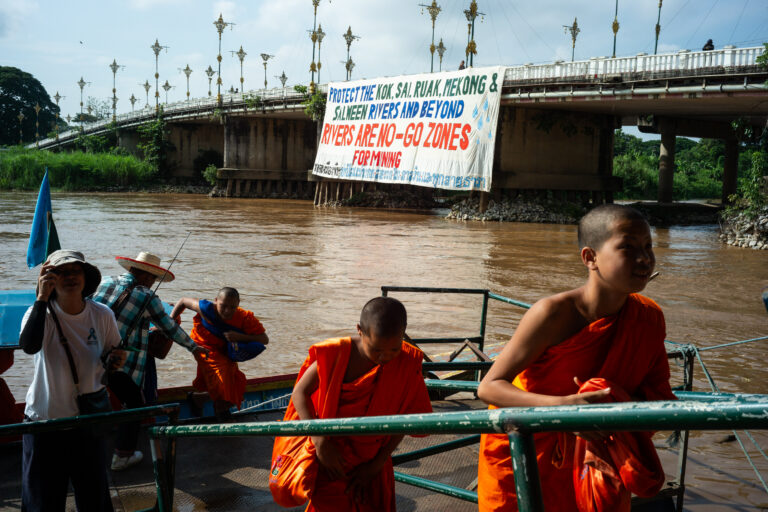
BANGKOK — More than 600 residents of Chiang Mai and Chiang Rai provinces embarked May 31 on a roughly 68-kilometer, six-day ‘peace walk’ to demand the Thai government take action on the river pollution crisis that has seen Thai rivers polluted with heavy metals. The ensemble of affected residents, civil society groups, monks and students marched from Tha Ton subdistrict in Chiang Mai to the city of Chiang Rai in northern Thailand, reaching their destination on June 5, World Environment Day. For more than a year, Thailand’s Pollution Control Department has reported dangerous levels of arsenic, mercury, cadmium and other heavy metals in rivers across northern Thailand, with mining operations across eastern Myanmar suspected to be responsible for the pollution. “We are walking because our rivers are slowly dying,” Pianporn Deetes, executive director of the Rivers and Rights Foundation, which helped to organize the peace walk, told Mongabay by phone. “Toxic contamination from unregulated mining upstream is already affecting water, fish, food, livelihoods, and public health. We do not want to wait until more people become sick. This is an emergency.” Pianporn said the walk (42 miles) was about taking collective action to share information, document impacts and build public pressure in a bid to force the government to address the issue, which Pianporn said has, so far, been lacking. “Monitoring has improved, but action has not matched the scale of the crisis,” she said. “We need urgent diplomatic engagement with neighboring countries, stronger health monitoring, transparency, and action to…This article was originally published on Mongabay
BANGKOK — Seven hundred days after activists from the environmental group Mother Nature Cambodia were imprisoned on charges widely regarded as retaliatory for their activism, 73 international and Cambodian civil society organizations have renewed calls for their unconditional release. After a trial lasting just over a month, 10 activists from Mother Nature Cambodia were sentenced on July 2, 2024, to between six and eight years in prison. Only five of the defendants attended the hearings, which saw Long Kuntha, 28, Ly Chandaravuth, 26, Phuon Keoraksmey, 25, and Thun Ratha, 34, each sentenced to six years behind bars for plotting against the government; fellow activist Yim Leanghy, 36, received an eight-year sentence for both plotting against the government and insulting the king. The five activists who did not attend the trial were sentenced in absentia. The appeals hearing for all 10 convicted activists was slated to take place on June 2, but has been postponed indefinitely by the Phnom Penh Court of Appeals. “The MNC5 are incarcerated in prisons in overcrowded and harsh living conditions, separated from each other and spread out all across Cambodia, hundreds of kilometers away from their families and legal counsel,” wrote the 73 NGOs in an open letter addressed to Prime Minister Hun Manet. “The … NGOs who have signed this letter sincerely request you take immediate action to ensure the unjust convictions of these five activists are reversed either prior to or at their upcoming appeals court hearing in Phnom Penh, and that their freedom…This article was originally published on Mongabay
Sat Born, 56, recalls freezing at the forest’s entrance when he first saw it. “Its head was this big,” he says, wide-eyed, spreading his hands to show the animal’s size. Recollecting that eventful morning in 2001, Born, who now farms bananas and durians, retraces his steps from his home in Trapeang Chheu Trav village in the rainforests of the Cardamom Mountains in southwestern Cambodia. As he walks up a hill rising above the forest canopy, he points to a spot on the road. “It’s over here. When I saw the tiger, it was 9 a.m.,” he says. “I was really shocked … I couldn’t tell if the tiger was coming towards me.” In 2007, just six years after this fleeting encounter, Cambodia’s last confirmed tiger sighting was logged by a camera trap. In the 1990s, the country was estimated to host hundreds of wild Indochinese tigers, but decades of poaching pressure took a heavy toll. In 2016, tigers (Panthera tigris) were formally declared extinct in Cambodia. That may be set to change with the imminent translocation of a small population of Bengal tigers from India. Although many reintroductions are success stories, this one raises some serious concerns. Why would Cambodia bring in a nonnative tiger? Have the people living in these areas been adequately consulted? Will these translocated tigers be able to adapt to this new habitat? Is there enough prey to sustain them, and if not, how will the government address predation when hungry cats feed on livestock? With…This article was originally published on Mongabay

 Login