❌

Reading view

Dark Energy May Not Be Constant After All, New Supernova Survey Suggests

This is an artist’s concept of a Type Ia supernova exploding in the intergalactic space between galaxies within a galactic cluster. Image credit: Alex Parker / NASA / SDSS.

Astronomers have combined 2,884 Type Ia supernovae -- which are used to measure cosmic distances -- with cosmic microwave background and galaxy-mapping data, deepening cracks in the standard ‘cosmological constant’ model.

The post Dark Energy May Not Be Constant After All, New Supernova Survey Suggests appeared first on Sci.News: Breaking Science News.

  •  

Il risveglio dopo la polvere: A un quarto di secolo dall'eruzione del 2000,…

Il risveglio dopo la polvere: A un quarto di secolo dall'eruzione del 2000, la cortina di polveri attorno al sistema binario V445 Puppis si è diradata. Un team guidato da John Mills (Università di Warwick) ha analizzato i dati combinati di VLT, Hubble, SALT e TESS, osservando per la prima volta la coppia di stelle al centro del residuo.
  •  

Voie lactée : un objet vieux de 12,5 milliards d’années révèle une surprise majeure

Une anomalie au cœur de la Voie lactée intrigue les astronomes depuis des décennies. Et les dernières observations du télescope spatial James-Webb viennent de transformer une curiosité en véritable casse-tête cosmique. De quoi changer notre vision de la formation des galaxies.

  •  
  •  

Astronomers May Have Found Supernova Remnant near Milky Way’s Central Black Hole

This composite image contains X-rays from Chandra and XMM-Newton missions (shown in blue) as well as radio data from the MeerKAT telescope (shown in red) in South Africa. These have been combined with an optical image from the Pan-STARRS telescopes in Hawai’i (red, green, and blue). Image credit: NASA / CXC / UCLA / Zhu et al. / ESA / XMM-Newton / PanSTARRS / MeerKAT / CSA / STScI / SAO / L. Frattare & P. Edmonds.

Using NASA’s Chandra X-ray Observatory and ESA’s XMM-Newton satellite, astronomers identified a possible remnant of ancient stellar explosion just a few dozen light-years from Sagittarius A*, a supermassive black hole at the center of our Milky Way Galaxy.

The post Astronomers May Have Found Supernova Remnant near Milky Way’s Central Black Hole appeared first on Sci.News: Breaking Science News.
  •  

Jupiter Accelerates Electrons to Near-Light Speed, Offering Clues to Cosmic Ray Origins

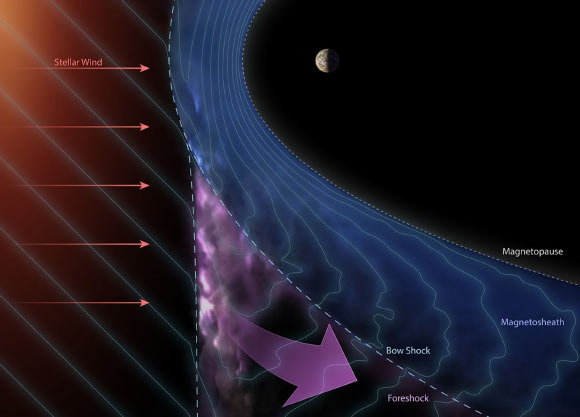
As planets and stars travel through the streams of charged particles flowing across space, their magnetic fields act like obstacles; incoming particles are slowed and deflected, forming a boundary called the bow shock; just ahead of this boundary lies the foreshock, a variable region where magnetic conditions can accelerate some particles to nearly the speed of light. Image credit: Ben C. Smith, Johns Hopkins Applied Physics Laboratory.

The giant planet’s bow shock isn’t just deflecting the solar wind, it’s acting as a powerful particle accelerator, firing electrons to relativistic energies of at least 1 MeV, according to a new analysis of data from NASA’s Juno spacecraft.

The post Jupiter Accelerates Electrons to Near-Light Speed, Offering Clues to Cosmic Ray Origins appeared first on Sci.News: Breaking Science News.
  •  

NASA’s Fermi Telescope Caught a Supernova Doing Something Never Seen Before

Supernova Starburst Space Travel Warp SpeedNASA’s Fermi telescope may have finally uncovered the magnetic powerhouse behind the universe’s brightest supernovae. An international team of astronomers analyzing observations from NASA’s Fermi Gamma-ray Space Telescope has found what appears to be the first convincing detection of gamma rays from a rare type of extraordinarily bright stellar explosion known as a superluminous supernova. [...]
  •  

The Physics of the Curse

The Curse resulted in decay, disease, and death affecting the entire creation, meaning the whole universe. The effects are seen in the cosmos and in living organisms. However a future restoration of creation is promised by God, reversing the effects of the Curse.

  •  

Scientists Find a Smarter Way To Measure the Universe Using Exploding Stars

Supernova Explosion Galaxy CenterA new method could improve cosmology research by analyzing supernovae together with the galaxies that host them. An international collaboration led by scientists at the Institute of Cosmos Sciences of the University of Barcelona (ICCUB) has created a new approach that may sharpen what researchers can learn about how the Universe expands and what dark [...]
  •  
❌