❌

Reading view

How Apple is trying to normalize always-on AI

Apple does seem to have tried to ensure its controversial Audio Intelligence feature isn’t abused. Alongside the iPhone Duo and new iPhone 18 Pro range, Apple on Wednesday introduced a new Apple Watch equipped with a brand new feature it calls Audio Intelligence. The existence of this surprising tool was confirmed only on the eve of the launch event. Enabled by the new S11 chip on the latest Watch devices, this is actually a collection of four features:

  • Siri Recap, which creates high-level summaries of conversations during your day.
  • Live Rewind, which transcribes the previous 15 seconds of a conversation as text.
  • Music recognition, which relies on Shazam.
  • Sound recognition, which can identify things like sirens or alarms.

All of these features must be consciously enabled by the user and are not on by default.

What they have in common is use of artificial intelligence along with always-on microphones. While all four of these tools are being presented as opt-in, their existence will inevitably — and justifiably — raise privacy concerns. 

Apple saw those concerns coming, and to make the features work it has placed a Secure Exclave on the S11 chip inside the latest watches. This is a dedicated secure buffer on the chip that processes audio privately on the fly. It does so without creating a recording of ambient sound around you, and the data it works with is isolated from the rest of the system. That Exclave pairs with the iPhone’s Enclave using “a new audio-verified pairing mechanism that exists in addition to Bluetooth pairing,” Apple explains in a detailed white paper about how it works. 

For Siri Recap, the process works like this:

  • Apple Watch recognizes a conversation is taking place.
  • If so, audio flows into the Secure Exclave, encrypted, and transmitted to a similarly Secure Enclave on your paired iPhone.
  • The audio is then immediately deleted from the Watch. 
  • The phone will decrypt and transcribe the audio, condense it, and send that transcript to Private Cloud Compute for processing. 
  • The short summary is then made, returned, and deleted after seven days.
  • Speakers are not identified, recordings are not made, and detailed transcripts are not created or retained.

The company has also introduced safeguards for those around you. The system will deliberately omit some information, including potentially harmful content, financial data, or personal identifiers. When you use the Live Rewind tool, an audible chime plays on your device to alert nearby people that you are using the feature.

Challenges will emerge

For one thing, we don’t yet know whether the company will provide enterprise IT with device management tools to disable the feature on managed devices. It’s crystal clear that devices that are constantly gathering data will be seen as potential security risks — particularly in regulated industries. And it seems far more logical to provide new APIs to disable Audio Intelligence on managed devices than it would be to insist anyone wearing an Apple Watch put it in a lead-lined box before beginning the next safeguarding, healthcare, or product development meeting.

Another problem I see concerns Europe’s Digital Markets Act. It is, after all, inevitable that competitors (maybe including Meta) will want their devices to have equal access to the information gathered by Audio Intelligence. Based on the decisions Apple has made so far, it seems equally likely it will want to refuse such access; this is why these new features will not initially be available in the EU. 

There is also no doubt hackers will attempt to break into the system, though doing so will not be at all easy on account of the intentional way the company has built in security. I suspect, but do not know, that attempts will focus on the points at which data is exchanged across devices, rather than when the information sits within secure enclaves on those devices. It also makes sense that everyone who uses iCloud services for their data should put 2FA in place and pick strong passwords. 

What about iCloud storage?

The other challenge will be encryption, specifically ongoing attempts to penetrate iCloud data encryption by some nations, led by the UK. Even so, if access could be achieved to iCloud-stored Audio Intelligence text, what is obtained would only be summary data, not a recording. The system is architected so recordings are never made.

Apple’s white paper on the feature explores this in more depth: “Audio from the microphone enters the Secure Exclave of Apple Watch, where it is initially processed for speech, sounds, or music, without transcribing or storing the raw audio. This buffer is a continuously overwritten stream that exists only within the protected hardware and never creates an audio recording.”

Once you decide to keep a Recap or Life Rewind text, the raw audio is not saved to iCloud, only the text, and then only if you use 2FA and a device passcode. No one else, including Apple, can access the encrypted data you save, Apple said.

Where does this go next?

One pre-event rumor that didn’t come true concerned AirPods equipped with cameras and Vision Intelligence to understand physical context and surrounding, with the aim of enhancing Siri AI. I’ve expressed reservations about this idea, but do think the security model Apple has put in place for Audio Intelligence will turn out to be an echo of its intentions to secure Vision Intelligence transactions.

This implies a new chip with Silicon Enclave for AirPods Pro, a similar exchange of information in real time for summary and determination of context and content, and a process in which no recordings are made and media access beyond brief, time-limited summaries, is available. In short, Apple will use the same security model.

What about the rest of them?

That’s fine as far as it goes. But the other subtext is that while Apple seems genuine in its attempt to deliver relatively intrusive tech advances right, others will show less commitment to privacy and security. So, while it’s furthering the conversation about using these tools, Apple is also pushing public acceptance of such technologies.

I’m not entirely sure we’re ready.

Now please subscribe to my daily, human-curated Apple-related news headline feed at The Core, or follow me on BlueSky, LinkedIn, or Mastodon

  •  

Qualcomm’s next Snapdragon mobile chip comes into focus with on-device AI

Qualcomm is taking an unusual approach to the launch of its next-generation premium Snapdragon mobile platform this year. Instead of holding everything for its annual Snapdragon Summit in Maui happening later this month, the company has been methodically disclosing the architecture that will power the next wave of flagship Android phones over the past couple of weeks.

First, the company disclosed its new Oryon CPU architecture, followed by a major overhaul of its Adreno GPU. Today, Qualcomm is detailing the next-generation Hexagon NPU that will serve as the platform’s primary AI engine.

Taken together, the disclosures give us a pretty good picture of where Qualcomm is going before we even know the chip’s official name.

There is obviously a strong performance story here, anchored by a 5GHz CPU, but the more interesting theme running through the architecture is memory locality and specialized AI acceleration. Qualcomm is trying to keep more data close to the compute resources that need it, while distributing AI workloads across the CPU, GPU and NPU.

These architectural changes are important as the company continues to drive on-device AI beyond relatively simple generative features toward more persistent, agentic workloads.

Oryon hits 5GHz, bolstered by FlexCache

Qualcomm disclosed in August that its next Oryon CPU will be the first mobile CPU to reach 5GHz. The eight-core design includes two 5GHz Prime cores and six Performance cores, with Qualcomm attributing the frequency gains to its fully custom Oryon microarchitecture, an in-house Arm-based CPU design that gives the company full control over the cores, cache and memory hierarchy, branch prediction and CPU subsystem.

The 5GHz headline is certainly going to get attention. However, Qualcomm’s new FlexCache architecture may ultimately have a larger impact on sustained performance. FlexCache allows Oryon’s Prime and Performance cores to tap into the same shared cache pool, with capacity dynamically allocated based on the workload. So rather than a demanding core being limited to a fixed slice of cache, it can draw on more of the available pool when needed. This keeps larger working data sets close to the CPU cores and reduces high-latency trips out to system memory.

This approach should benefit everything from gaming and multitasking to content creation, but it also aligns well with agentic AI workloads, where tasks may move through several stages of processing and across different CPU cores. The basic goal is straightforward: keep the CPU fed and avoid expensive trips to external memory.

Qualcomm’s next-gen Adreno GPU adds dedicated AI engines

Qualcomm’s next disclosure focused on graphics, where the company is making one of the more significant changes to its Adreno GPU engine in recent years. The new GPU adds dedicated Adreno Matrix Cores for running AI models directly inside the graphics pipeline. They’re paired with 18MB of Adreno High-Performance Memory, or HPM, which provides low-latency local storage for tile-based rendering, frame buffers and GPU compute.

Qualcomm claims HPM provides a 12% power improvement compared to its previous-gen Snapdragon 8 Elite Gen 5.

The more visible feature for users, however, may be Adreno Neural Fusion, which combines AI super resolution, neural processing and frame generation in a unified graphics pipeline. There are obvious parallels here to what NVIDIA, AMD and others are doing with neural rendering on the PC, though Qualcomm’s next-gen Snapdragon SoC has to operate within a much tighter mobile power envelope.

Qualcomm claims enabling Neural Fusion reduces power consumption by up to 40% in its internal testing using the company’s Dragon Alley graphics demo. That’s an impressive number, though as always, we’ll want to see how the technology behaves across actual shipping games and devices before drawing any definitive conclusions.

Qualcomm has also helped integrate Neural Fusion technology into Unity and Unreal Engine, which may ultimately be just as important as the underlying hardware. Developer adoption determines whether features like this become meaningful platform advantages or just another tick box on a spec sheet.

Qualcomm’s Hexagon NPU is being reworked for agentic AI

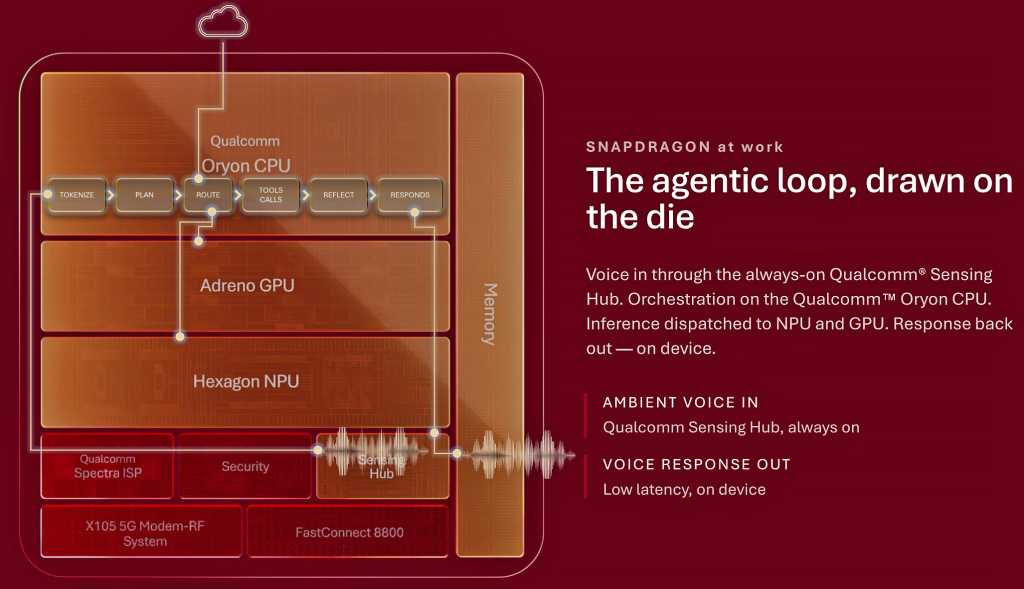
Qualcomm Snapdragon at work: The agentic loop, drawn on the die.

Qualcomm

The most recent disclosure centers on Qualcomm’s Hexagon NPU, where the broader architecture starts to come together. The company’s next-generation Hexagon introduces a new Element Accelerator designed for transformer workloads, alongside its existing vector and scalar processing resources. Qualcomm says the new block is optimized for fast action loops, key-value (KV) cache acceleration and context lengths of up to 32K.

Hexagon is also getting 50% more shared memory, and again, that memory complement is important. Model state, context and KV-cache data can generate substantial memory traffic, particularly with larger language models. Keeping more of that data close to the NPU can reduce latency and power consumption. Qualcomm says the architecture is designed for long-context reasoning, multimodal models, concurrent agents and low-latency action loops.

For INT4 quantized models, the company claims up to a 50% improvement in pre-fill performance versus its previous-generation Snapdragon 8 Elite Gen 5. Qualcomm is also targeting Mixture-of-Experts, or MoE, models as large as 30 billion parameters. In its example, the company points to a 30B model that activates only about 3 billion parameters during a given token-generation step. That selective approach is a natural fit for the tight power and memory constraints of a handset.

Qualcomm isn’t suggesting that a smartphone will simply run a 30B dense model entirely from DRAM, however. By activating only the experts needed for a particular task, MoE architectures can dramatically reduce active compute and memory bandwidth requirements, potentially making much larger classes of AI models practical on mobile hardware.

Qualcomm’s next-gen Snapdragon mobile impact

There is a larger competitive story here as well. For years, flagship smartphone competition largely came down to CPU, GPU, modem performance and power efficiency. AI is now another major area of differentiation, and Qualcomm is clearly designing its next-gen Snapdragon mobile platform around this need.

Apple has the advantage of controlling its silicon, operating system and software stack end-to-end. MediaTek continues to push aggressively into premium Android devices as well. Qualcomm’s response is to make its custom Oryon CPU, Adreno GPU and Hexagon NPU work more like a fully integrated compute platform, tuned for modern AI and agentic workloads.

This is a solid advantage for Android handset OEMs because many don’t have the resources to engineer this level of silicon integration themselves. Qualcomm can effectively provide its Android OEM partners, including Samsung, Xiaomi, Honor and others, with a common hardware foundation for on-device AI, advanced graphics and agentic computing. It also gives Qualcomm another way to defend its premium Snapdragon position.

The company’s custom Oryon architecture now spans smartphones and Windows PCs, and soon servers, while AI acceleration is distributed across its CPU, GPU and NPU. For business users, that could mean more AI processing happens locally, reducing cloud and network dependence, improving response times and keeping more potentially sensitive data on-device. And for IT organizations, Qualcomm now has an opportunity to provide a more consistent AI compute foundation across Windows PCs with Snapdragon X and premium Android handsets.

There is still plenty we don’t know, however. Qualcomm hasn’t disclosed the complete SoC specifications, final performance or power characteristics, or which devices will ship with it initially. Many of these AI experiences will also depend heavily on Android, app developers and the models themselves.

The new 5GHz mobile CPU may generate the biggest headline at Snapdragon Summit, but the more important developments may be what sit around it: more local memory, specialized AI acceleration and tighter integration between the CPU, GPU and NPU.

If Qualcomm can translate this architecture into better sustained performance, enhanced power efficiency and useful on-device AI experiences, it could strengthen its position in premium Android phones while putting more competitive pressure on Apple. For business users, the payoff could be more capable local AI without sacrificing the performance and battery life expected of a flagship device.

That is the part I’ll be watching most closely when the complete silicon picture is unveiled at Snapdragon Summit later this month. And I may even get some hands-on time with it in some benchmarks, as we have in years past, so we shall see.

  •  

The iPhone is now Apple’s ‘intelligent personal hub’

Twenty-five years ago, I sat near the front of the room while then-Apple CEO Steve Jobs rolled out Apple’s digital hub strategy, a vision in which the Mac would become the central manager of all manner of portable digital devices.

Now, a quarter of a century later, nearly all of those digital devices have become features on your iPhone, and the arrival of AI means the iPhone has become the intelligent personal hub, the central manager of, well, of you. Apple’s new CEO, John Ternus, went straight for the concept in his important opening remarks at Wednesday’s big iPhone launch, where nearly all the pre-event speculation came true.

The intelligent personal hub

“As we look ahead, we see a future filled with enormous discovery and transformation,” Ternus said at the Surprise and Shine event. “AI makes entirely new kinds of experiences possible. An AI can become even more useful when it brings together your life with the apps, services, and products you use every day. And this means the product at the center of your experiences becomes even more essential — what I like to think of as an intelligent personal hub.”

(To be clear: He’s talking about the iPhone.)

Think about it: all those tasks you now do on your iPhone are tasks AI can help you with. Siri AI lets you work on files and folders using spoken commands, while contextual AI lets you sift through all the data once gathered by your iPhone to do things, make things, create networks, or even organize luncheon. 

“It’s the intersection of broad new capability, and a deep understanding of your personal context that makes this idea so powerful,” Ternus explained.

AI’s brave new world

That’s the context within which Apple will be introducing all its future products, a battle the company now feels confident marching into now that it appears to have resolved its historical challenges with AI. At the same time, the company also seems to be doing its best to lean into privacy — enabling life-changing AI transformation of daily lives while putting a brake on scary privacy attacks. This is going to be foundational to what happens next at Apple.

Of course, you’re not reading this to look too deeply into what Ternus said about the future of Apple; you’ll also want some insight into the slew of devices the company introduced at its event. That list includes the:

The big surprise? Price

For some, the biggest surprise in these introductions was price. All of the accessories were kept at the same price as last year’s equivalents, while the new Pro iPhones came in at only $100 more for the entry-level model, rising to around $300 more at the more price-resistant highest end. An iPhone 18 Pro Max equipped with the max 2TB storage comes in at $2,499 compared to the $1,199 iPhone 18 Pro entry point. 

When it came to price, though, all eyes were certainly on the iPhone Duo, and Apple has given everyone (except competitors) a pleasant surprise on that. 

With a starting price of $1,999, the folding phone’s price hit the low end of expectations, and while that grows to an eye-watering $3,199 with 2TB of storage, it compares well with the market leader, Samsung. While the Galaxy Z Fold 8 begins at $1,899, in terms of features and design, Apple’s folding phone lines up with the Galaxy Z Fold 8 Ultra, which costs from $2,099. 

Dig a little deeper and you’ll see that while the iPhone has IP68-rated dust and water resistance, the Samsung equivalent has only IP48. You can drop the Fold 8 into five feet of water for up to half an hour and it should be OK, but you can chuck your iPhone Duo in almost twenty feet of water, and it should survive. Though you probably shouldn’t test that unless you’re a hugely successful “influencer” already generating a small nation state of money through clicks. If that’s you, good for you. I’m only slightly envious. 

A productivity powerhouse?

What that suggests is that the iPhone is less likely to get damaged and is better engineered, though it’s also ever so slightly thicker. Apple’s device is powered by what the company modestly described as the most powerful mobile processor on the planet — which it is, particularly for the AI tasks all the new iPhones can handle. That matters, particularly for applied contextual AI deployed across daily lives.

It also matters because the combination turns Apple’s device into a mobile productivity powerhouse, one that I think will likely affect iPad sales more than anything else. Though this wouldn’t be the first time a new Apple release ended up eating its siblings. 

The productive possibilities of Apple’s premium device will also be realized as app developers embrace both the form factor and Siri AI. Apple said during the keynote that more than 300,000 apps already work with Siri AI and more than 2.5 billion Siri requests are being made each day. That latter number will only grow now that Siri performance has been dramatically improved. 

While this argument applies to all Apple’s new devices, the fact of the matter is that you now have an iPad-sized object you can carry in your pocket that is capable of doing some really powerful tasks by spoken command alone. That’s the iPhone Duo – a product of an unexplored territory at the crossroads between mobile computing, daily digital existence, and the opportunities of AI.

It’s not for everyone, yet

I don’t expect the Duo will be for everyone; the vast majority of users won’t be spending $2,000 on a phone. But we know that the cost of technologies like this tends to decline, which suggests that in perhaps five years’ time, it will be possible to create equivalent devices for a much lower price. Right now, it’s for affluent Apple consumers, C-class executives, students, AI pros, medical professionals and others who might actually need this kind of performance and display space to get things done.

This, incidentally, is precisely the same group of people that first embraced the iPad when it appeared, turning that into the world’s best-selling tablet.

What might this mean for Apple? 

I traded a few messages with IDC analyst Francisco Jeronimo, who sees it like this: “Apple entered the foldable market and, in one keynote, set the price and the standard every rival will now be measured against.”

He also pointed out, the iPhone Duo is “…a direct test of whether Apple can use design, ecosystem integration and premium positioning to reshape a segment that has so far remained selective.” 

He’s right, of course, but Ternus also just defined what that segment, and the industry, is driving for. I’s the same thing Apple was aiming at 25 years ago. “iPhone sits at the center of an amazing ecosystem of intelligent features and experiences that work seamlessly across the products you use every day,” the company said — an “intelligent personal hub.” And the Macs are all right, too.

Now please subscribe to my daily, human-curated Apple-related news headline feed at The Core, or follow me on BlueSky, LinkedIn, or Mastodon.

  •  

Adobe Acrobat evolves beyond PDFs with enterprise search, AI content creation

Adobe on Wednesday unveiled a range of updates to Acrobat, including the ability to turn PDF documents into interactive visual reports and podcasts. And a new Knowledge Base feature connects Adobe’s Acrobat AI assistant to document sources such as Microsoft SharePoint and Google Drive.

It’s the biggest Acrobat update in several years, Adobe said, and highlights the application’s evolution from PDF reader to what the company now describes as an AI-powered document productivity and creativity platform. 

Acrobat users open more than 400 billion PDFs in the app each year, Adobe said, claiming 650 million monthly active users as of last year. 

Among the new additions is the ability to turn dense PDFs into interactive, visual documents and presentation slides. To create these, Acrobat’s AI assistant scans the selected file, asks questions about the user’s intent, then generates documents charts, images and navigation.

It’s also possible to turn documents and web links into podcast-style audio summaries — similar to capabilities in Google’s NotebookLLM and Microsoft Copilot Notebook. A new Stylize feature can enhance plain-looking documents, applying a template to turn them into “professional deliverables” such as CVs and invoices, Adobe said.

The audio and visual generation features are all available in paid Acrobat plans (Acrobat Studio, Acrobat Express and Acrobat AI Assistant). 

Another addition, Acrobat Knowledge Base, lets customers connect the Acrobat AI assistant to a wider range of file types, enabling users to ask questions about information held in documents stored in Microsoft SharePoint and Google Drive, for example.  

Acrobat’s Knowledge Base “transforms curated document collections — policies, playbooks, product information, pricing guidance, research — into cited answers available from Slack, Microsoft Teams, Acrobat, and other places employees already work,” Abhigyan Modi, senior vice president for Adobe Document Cloud, said in a blog post. 

Adobe also added an Analyzer tool designed to retrieve data from large volumes of documents. This could involve analyzing thousands of contracts or invoices to identify information such as renewal dates and revenue clauses.

That turns information once trapped in files into data that can inform finance, procurement, compliance, and the systems that support them, said Modi.

Analyzer is the more interesting of the two releases, said Mike Leone, vice president and principal analyst at Moor Insights & Strategy. “Knowledge Base is a search product and search products get judged feature against feature. Analyzer is closer to a data product, because that extraction work is what companies currently pay people and pipelines to do,” he said. 

“What I’d want Adobe to answer is whether that data can leave Acrobat and land where the rest of the company’s data lives. If it can, this starts competing for real data budget. If it stays inside the app, it’s a very good Acrobat feature.” 

Access to Analyzer and Knowledge Base requires an Acrobat Studio for Enterprise subscription. (Adobe doesn’t publish pricing.) 

In addition, Knowledge Base includes a credit-based model that places some restrictions on usage, with licensed users allowed up to 1,000 queries a month. Other actions, such as document uploads, queries from Slack and Microsoft Teams, and queries by employees without an Acrobat Studio license, draw varying amounts of Acrobat Studio “shared credits.” Adobe didn’t say how much additional credits cost once a yearly limit is reached.

 More information about Adobe’s Knowledge Base credit usage policy is available on Adobe’s website. 

Analyzer also includes a credit system that limits document ingestion and attribute extraction.

For enterprise customers, usage-based pricing can add complexity when managing employee access.

“The issue for a broad deployment is that headcount barely predicts usage,” said Leone. “One person pointing it at 10,000 contracts will burn more credits than a hundred people asking the occasional question. Pooling the credits across the whole organization is the right design, because usage on something like this is rarely spread evenly.

“One of the big challenges is that people could very well start rationing themselves because they don’t know what a question costs,” he said. “Or worse, a couple folks use all the credits and everyone else is out of luck. The last thing any organization wants is to pay for a knowledge tool that people won’t use or can’t use.”

  •  

Siri AI Recaps? Even if Apple builds it responsibly, others might not

Late-breaking reports suggest Apple has built a new Siri AI ‘Recaps’ feature that summarizes your day for you. The idea sounds great until you recognize that this summary will also include overheard conversations. 

Suspending the huge red flag of concern over privacy and data protection for a moment or two, why would this be useful and who is it for?

How it’s supposed to work

First, it is being described as an Apple Watch feature that will only be available on the latest models: Apple Watch Series 12 and Apple Watch Ultra 4, as these allegedly include secure audio processing hardware. Reading between the lines, that suggests the devices will be able to listen to and process audio on device, which implies that the information won’t need to leave your smartwatch, not even to your iPhone.

The report also says the feature doesn’t make a transcript, nor does it store the audio; it instead gathers key datapoints from what is said to include in the summary, deleting all the remaining information in the process. You can have the feature working all day, on-demand, or only in specific locations. The idea seems to be to provide some kind of actionable summary of events and key conversations that take place during the day. I imagine the subtext is to digitize as much as possible of your daily existence as Apple thinks you will be comfortable with to create the kind of datapoints contextual AI requires if it is going to help with your life.

The case for it

That sounds fine, up to a point — the idea that a digital assistant will be able to recognize key events, moments, and requirements to remind us of them, act on them, or suggest next steps concerning them is certainly a notion that’s gained currency in tech circles. They see it as augmenting human achievement, enabling people to become more productive, more efficient, and capable of doing more with less effort. At least, that’s part of the argument.

What is wrong with that (other than concerns over privacy or a desire not to have one’s entire waking life transformed into a series of datapoints that can be measured, tested, or surveyed by entities outside of our control), right? If you have nothing to hide, you have nothing to fear, at least, not until times change and what didn’t need to be hidden in the past becomes something that must be shrouded in future.

Apple’s privacy defense

Apple, of course, has its strong privacy story to lean into as it introduces this surveillance-as-a-service solution; it’s an argument that says it recognizes how this tech can be abused, and wants to deploy it correctly. It will point to that record as it promises its system doesn’t gather data, doesn’t collect it, and doesn’t keep any form of transcript on or off the device. The company should be commended for building a system that works this way, recognizing as it does that the best way to protect confidential information is not to gather it in the first place.

The warning

But what Apple has also done with this new speculated upon — and as-yet-unconfirmed product — is to show us what these tools can already do. Much of this is already visible; take recent news that LG smart TVs constantly collect and upload user data as an illustration of the seemingly egregious ways in which such tech is used. (LG denies the claim.) What Apple shows us is that with AI in the picture, all your waking moments can be collated, curated, analyzed, digitized and rendered into actionable data. Apple may not be doing that, but others will not be equally cautious, so we owe Apple a debt for warning us of what’s at stake.

Though we don’t know whether Apple will actually introduce this new service, the source of the claims is one of the strongest in the industry. What we do know is that the technology required to build systems like this exists, along with AI systems capable of sourcing, sharing, and sifting through that information. What we don’t yet know is how to remove ourselves from the data stack.

Now please subscribe to my daily, human-curated Apple-related news headline feed at The Core, or follow me on BlueSky, LinkedIn, or Mastodon.

  •  

Apple after Cook: The Ternus age begins this week

We’re hurtling toward the loss of something big. Finally, after months of speculation, Apple is about to introduce its first-ever folding smartphone. And once it does, the conversation will change as the annual iPhone rumor season is replaced with the reality of whatever Apple unveils.

Except, it won’t quite be the same as in the past. Because no sooner will new Apple CEO John Ternus finish his iPhone announcement keynote speech tomorrow than the speculation will shift to next year’s 20th-anniversary iPhone, what’s coming to the iPhone 18 and e-series iPhones, and expectations around Apple’s upcoming wave of smart home products, including health and home security services. There’s a lot going on.

Meet John Ternus

Having a lot going on is one of the prime expectations of Apple under its new boss. A family man with a wife and kids, he’s led Apple’s hardware division for five years after an eight-year stint running hardware engineering. He joined the company in 2001 and is described as a highly competent, hugely talented, and modest by nature. 

His hobby is quite revealing — he drives race cars, is a regular at California’s Laguna Seca Raceway, and owns an incredibly rare 2019 Porsche 935. To me it suggests a calm, competent, individual with excellent mental and physical reflexes who can make life or death decisions at speed. He’s also deeply committed to good product design.

He’ll need that calm embrace of speed and adrenaline to manage the company his predecessor, Tim Cook, led to become the world’s most valuable firm. 

A hard act to follow

He’s also got a hard act to follow, as while Cook had to carve out his reputation in the shadow of Steve Jobs, Ternus must sculpt his own destiny in the shadow of Cook, who managed to make shareholders of record in 2011 around 20 times richer by the time he quit. (Apple stock rose from $13.74 per share on a split adjusted basis to $319.97 per share today.)

While Cook was frequently criticized for not being a product guy, he presided over the launch of the Apple Watch, AirPods, Apple Silicon, and the Vision Pro, and helped grow Apple’s services income to become its second-biggest product category, diversifying Apple’s revenue and creating financial stability. That’s no easy task.

Building his own team

Can Ternus improve on that? He’s certainly being positioned as someone who can. His deep experience in hardware has led to expectations that Apple will double down on product under his watch, so a great deal is expected of him in consequence. He is also putting together a hardware-focused team, including Laura Legros, former vice president of hardware engineering, as a direct report.

What will we see of this tomorrow? To be fair, while he will lead the announcement on the keynote stage, development of this first tranche of products took place under the leadership of Cook, and while Ternus will have had a big hand in development, this year’s Apple event should be seen as a moment of transition. 

“I’m just as excited about what lies beyond that, including the incredible products already in the works and the ones we haven’t even imagined yet that we’ll dream up and create together. There’s no team in the world I’d rather build the future with,” Ternus told Apple staff in his first memo as CEO.

It’s what Apple does in the next couple of years that will truly define the new leadership. He’s literally been CEO for a week!

What to expect on Sept. 9

Here’s my TL; DR list:

  • First folding iPhone: Apple’s response to folding devices from Samsung, Google, Huawei, Xiaomi. It’s expected to have a highly durable, near invisible hinge and a powerful 2nm A20 chip around 20% more performant than the 17 series devices; Touch ID; a 48MP camera; and be able to unfold from a 5.5-in. to a 7.8-in. display. Potentially called iPhone Ultra, some predict it might be the “iPhone Duo” or “iPhone Fold.” It’s likely to cost $2,000+.
  • iPhone 18 Pro series: Equipped with a fantastic new display, smaller Dynamic Island, 48MP main camera, and telescopic lens and supported by a fresh tranche of pro-photography features, the 18 Pro/Pro Max range will also use A20 chips. Both the fold and Pro devices will carry significantly more RAM, enabling them to handle on-device AI tasks. Apple is expected to introduce the iPhone 18, iPhone Air 2, and iPhone 18e devices at a spring 2027 event. Prices on all iPhones are expected to increase by $100 or more, depending on model.
  • Apple Watch Series 12, Apple Watch Ultra 4: While Apple is thought to be working on new designs for next year, this year’s models will — for the first time in years — include an improved processor, better networking, and more accurate heart monitors. A model with a ceramic body is expected, while the devices will be equipped with additional storage, and integrated satellite emergency features. 
  • AirPods 5: Earlier speculation about cameras inside AirPods remains, but these aren’t expected at the launch. Instead, Apple’s AirPods 5 will be boosted with a new H3 Wireless Chip for better voice isolation, noise cancellation, and spatial audio. They may also provide some basic health monitoring features with a built-in temperature sensor and heart rate monitoring.
  • Smart home products: Apple is still expected to introduce additional products for smart homes, including an Apple TV with a faster processor and SiriAI support, a HomePod mini upgrade, and — potentially — a new home hub. The latter could effectively be a combination of an iPad with a HomePod to run apps, control smart devices, take and make calls, and run Siri.

Finding the next big thing

While all these products are important to the company, the smart home devices should demand attention (if they appear at all), as the indicators suggest Apple intends to explore the smart home space with a range of future hardware, including domestic robotics, security services, and smart devices. This hardware proliferation in new markets could end up becoming one of the hallmarks of Ternus’ Apple leadership, as will Apple’s AR spectacles (once they are introduced). 

Equally, it cannot be ignored that one of Ternus’ main tasks since becoming vice president of hardware has been the introduction of new Macs and the transition to Apple Silicon. So he’ll be expected to strike a balance between improving Apple’s traditional product lines while racing his company toward new and emerging opportunities in hardware. (I believe Apple should pay much more attention to the enterprise space within that.) 

Apple’s little AI problem

The biggest challenge to all of this will be Apple’s success in implementing AI that’s good enough to get things done while avoiding the unexpected dangers of poor implementation. We don’t want AI agents corroding smart home security, for example, which is why Ternus seems likely to maintain Cook’s focus on security and privacy as enabling technologies to support trusted hardware/software product designs.

Another thing? Tomorrow’s keynote will likely begin with the single word, “Hello,” and feels very likely to also include that classic Apple keynote line, “…One more thing.”

We’ll find out more as the conversation moves from speculation to reality after the 10am (PT) keynote.

Please subscribe to my daily, human-curated Apple-related news headline feed at The Core, or follow me on BlueSky, LinkedIn, or Mastodon.

  •  

Judge spares Google’s ad-tech business from a breakup

Back in April 2025, the US Department of Justice (DoJ) proudly proclaimed that it had prevailed in a landmark antitrust case against Google’s ad business. Yeah. Right.

You see, just last week, US District Judge Leonie M. Brinkema rejected the DoJ’s effort to force Google to sell its AdX ad exchange. What began as a major anti-monopoly victory has become a mouse-sized settlement. 

[ Google US antitrust trials: A timeline ]

Does any of this this sound familiar? It should. We’ve seen this show before. Last year, Google had also been convicted of abusing its search business. At first, all the talk was about how Google might be forced to divest itself of the Chrome browser and/or the Android operating system. 

Instead, Google was allowed to keep making search deals and only had to share some search data with its rivals. 

I say rivals, but in fact Google still dominates the search market. Indeed, its control has actually expanded a bit. By StatCounter’s numbers, in August 2025, Google search owned 89.89% of the market. By last month, almost a year after the company had been slapped on the wrist, its share had grown to 91.1%. 

Boy, wasn’t that a win?

The remedies phase of the government’s ad-tech antitrust case order is a similar Google win. No, it doesn’t overturn the April 2025 finding that Google unlawfully maintained monopolies in the publisher ad-server and ad-exchange markets, or that it illegally tied its ad server and exchange together. Instead, it determines how the company must change its conduct.

The DoJ wanted Google to divest itself of AdX, the company’s ad exchange for matching publisher inventory with advertiser demand. It also sought to require Google to open-source the final-auction logic in its DoubleClick for Publishers (DFP) ad server and, if necessary, divest its DFP business. 

Brinkema rejected all three requests. Instead, her short order accepts “most” of the parties’ proposed behavioral remedies, subject to modifications described in a memorandum opinion that remains sealed while the parties identify confidential information for redaction.

Specifically, the court directed Google and the plaintiffs to meet and submit a joint proposed final judgment within 30 days. If they cannot agree on the details, each side must submit its own proposed version.

Google — as it should — sees this as a win. As Lee-Anne Mulholland, Google’s vice president of regulatory affairs, said in a statement, “We’re very pleased the Court rejected the DOJ’s proposal to break apart tools that help small businesses reach new customers and grow.”

Far less convincing is the DOJ’s characterizing the decision as a win. “The Antitrust Division is pleased that the court ordered substantial relief in the Google ad-tech case. We are one step closer to restoring competition and bringing relief for the American people in online advertising markets.” 

Oh please! It does nothing of the sort.

To quote Laurel Kilgour, research manager at the American Economic Liberties Project, an anti-monopoly, nonprofit group: “Judges keep finding Google guilty, but Google keeps walking away with both its ill-gotten gains and its empire intact. Without actual structural remedies, antitrust rulings are just inconvenient speed bumps that allow Google to lock down search and ad tech markets today while using that same unchecked power to monopolize tomorrow’s AI frontier.”

Exactly so. 

The specific obligations Google will face are not yet public, because Brinkema’s explanatory opinion remains under seal. Earlier, Google had proposed making real-time bidding responses from AdX available to rival ad servers, removing Unified Pricing Rules, and accepting a monitoring trustee for a three-year supervision period. None of that will even dent Google’s ad business.  

When all’s said and done, Google is still in charge of both its exchange and publisher ad-server operations. I expect the minor changes required won’t amount to a hill of beans. Restoring competition in markets where the company was found to have used its vertically integrated position unlawfully? Give me a break. 

Public Knowledge, a free speech and internet advocacy group, described the decision as one that leaves Google’s monopoly power substantially intact. 

As Public Knowledge Legal Director John Bergmayer said, “The court found that Google illegally acquired and maintained monopolies in publisher ad servers and ad exchanges, and used its control of DFP and AdX to shut out rivals.” He concluded, “Telling a monopolist to do better is not the same as restoring competition.… A finding of liability means little if the remedy leaves the market fundamentally unchanged.”

Ya think? 

In Google’s last reported quarter, the company reported $81.6 billion in advertising revenue. Next year, when Google is being “punished,” I expect its revenue will be even higher. 

  •  

Nvidia-Hugging Face deal could require an enterprise AI rethink

IT industry experts and analysts are still trying to piece together Nvidia’s surprise plan to pay $12.9 billion for open-source AI company Hugging Face.

Nvidia dominates AI with its GPUs, and the company generates billions of dollars in revenue through a proprietary approach to the fast-moving technology. Hugging Face, on the other hand, hosts open models and has been a neutral player between chip vendors and model labs.

“This is about Nvidia having more say in how the stack gets built,” said Stephanie Walter, analyst at Hyperframe Research.

Hugging Face is wildly popular with developers, and Nvidia is buying early influence with that crowd. “You have a better chance of being part of the production environment later,” Walter said, adding that she wasn’t sure how Nvidia reached a nearly $13 billion price tag for the acquisition.

“Hugging Face has near-uncontested market primacy over where developers go for open-weight model releases. Now Nvidia owns that,” said Mark Petty, senior director analyst at Gartner.

Nvidia’s chase for developers should force IT decision-makers to review how much of the AI stack they control, said Hector Liu, director of Institute of Foundation Models’ Silicon Valley Lab. IFM is part of the Abu Dhabi-based Mohamed bin Zayed University of Artificial Intelligence.

Liu said CIOs should ask themselves three questions: “Can you run the model on hardware you already have, without a dependency you didn’t choose? Can you see how it was built?” And, “is the license one you can build a business on?

“A model that passes all three is durable, no matter who buys whom next year,” Liu said.

IFM’s latest K2 Horizon model, which was introduced on the same day Nvidia’s deal was announced, is hosted on Hugging Face. The open model was built to answer all of those questions.

K2 Horizon runs on AI hardware from Nvidia, AMD, Cerebras, and major cloud providers, said Liu, who doesn’t expect that to change. “Nvidia has said Hugging Face stays an open platform for every builder and every accelerator, and we’ll take that at face value,” Liu said.

Nvidia pledged to maintain Hugging Face’s hardware and model independence, and said its compute won’t be required. 

Even so, Nvidia isn’t paying nearly $13 billion for a model repository, said Jake Newfield, CEO at Hermetiq — it’s buying the front door to open AI.

(Hermetiq develops AI build and code observability tools.)

AI-generated output is becoming abundant and the infrastructure that makes it testable, reproducible and deployable is becoming strategically valuable, Newfield said. “Nvidia can accelerate it with capital and compute, but the real test is operational neutrality,” he said. 

That involves assessing whether competing hardware remains equally supported across the tooling, benchmarks and deployment paths developers actually use, Newfield said.

Beyond distribution, Nvidia is also buying Hugging Face for data, Petty said. That data showed that agents overtook humans as its largest traffic source in July, the kind of insight that could prove valuable down the road.

“Every model pulled tells Nvidia what the market wants next,” Petty said.

Nvidia has every reason to grow demand for open models and to keep them cheap, Petty said. “That’s good for enterprises, as it prevents market consolidation around a small number of proprietary model owners,” Petty said.

Closed and open models will coexist and lead to a world “where you’re going to continue to train these models and run these models at scale,” Justin Boitano, Nvidia’s vice president for Enterprise AI, said in a press conference after the deal’s announcement.

Nvidia will benefit “through the training that’s done and the inference that’s done on our hardware as models get diffused into the ecosystem at scale,” Boitano said.

That’s one motivation to keep the ecosystem open and neutral, so “developers can work wherever they want to work,” Boitano said.

Open source makes AI more accessible by lowering the barriers to experimentation and adoption, said Jon Carvill, senior vice president of marketing at AI chip maker Nuvacore. “Bringing Nvidia and Hugging Face closer together should help accelerate that choice, access and innovation,” Carvill said.

But there are still unanswered questions around whether Hugging Face will remain open and how much proprietary control Nvidia might exert, said Jack Gold, principal analyst at J. Gold Associates.

Microsoft traveled a similar path with its acquisition of open-source repository GitHub, which “did not really pan out as well as Microsoft hoped,” Gold said. “With Nvidia’s acquisition, will it still be as open to competitive hardware-software access, or will there be some barriers employed?”

  •  

Macs don’t just do AI, they’re replacing the cloud for it

I surprised myself this morning when I came across an interesting Apple-commissioned report — Rethinking critical AI infrastructure — I’d not seen before. It looks at the shifting expectations for AI infrastructure and recognizes that enterprise users want (and need) secure, on-device AI solutions for critical parts of their business.

That’s why tens of thousands of companies are already investing in Macs, because they recognize that Macs do indeed do AI. The study, published earlier this year and put together by Omdia, reflects insights gathered across 1,500 conversations with enterprise tech leaders and practitioners, noting that for many in business the current cloud-based approach to AI fails to deliver on three key metrics:

  • Costs: Current pricing models seem unsustainable. Particularly when it comes to agentic AI, costs climb fast and business users need to get those costs under control. 
  • Security: Even the most secure cloud services include some degree of data risk. When it comes to using AI for regulated data in industries such as healthcare, business users need much more security than the cloud inherently provides. After all, data that is not transmitted will not leak in transmission.
  • >Capacity>: Workload requirements change and capacity needs to scale. That can boost the cost of accessing additional cloud capacity, or impose limitations in the event it can’t be found. It’s also true that while frontier models can provide all the bells and whistles of AI for advanced tasks, the vast majority of the AI work does not require anything near as much power. As Omdia explains: “57% of enterprise models are under 10 billion parameters, well within the capabilities of modern devices like MacBook Air or the entry-level MacBook Pro.”

What they think

As you might expect, the researchers believe on-premises AI set-ups respond to all three needs; not only that, but once you’ve coughed up cash for the necessary computational infrastructure, you don’t have to pay much more. “On-device infrastructure has near-zero marginal cost after initial investment, enabling unlimited experimentation without budget constraints,” the report said. 

Basically, once you’ve invested in on-premises capacity, you can divert mundane AI tasks to those machines for processing — limiting costs, boosting security and releasing capacity, turning to cloud-based models only when higher end AI solutions are required. While that’s good news for Apple, that’s bad news for many AI companies’ revenue models. (Perhaps they should have recognized that even the most advanced LLM’s will run on a standard iPhone eventually.)

The other advantage is that if AI is not used as widely as expected across a company, the same hardware can be used for other company tasks.

What’s actually happening

Enterprises already using AI are learning these lessons, which is why we see more of them buying Macs for these tasks. They do so because Apple’s computers deliver the computational power and performance to run AI effectively, from chip design to power consumption to the OS itself. Apple has intentionally built its platforms to be the best in class for running AI on device, and the Unified Memory architecture Apple has created in Apple Silicon scales really well, meaning you can run ever larger LLMs on Macs. 

It’s not just Macs, either. An iPad can run up to 14 billion parameter models quite happily; a Mac Studio reaches 480 billion; and a cluster of four Mac Studios will take you all the way to 1.6 trillion parameters using off-the-shelf cables.

To put that into context, Omdia found that 57% of the AI models typically used by the enterprise come in at under 10 billion parameters, which implies that enterprises could run a huge chunk of their AI tasks on an iPad, an iPhone, and certainly on a Mac. The ability of Apple’s ecosystem to scale is precisely why most AI developers at frontier model companies already use Macs. “Organizations that build AI solutions in-house adopt Mac for AI workloads at nearly double the rate of organizations buying commercial solutions,” the report explained.

The takeaway

Apple is emerging as an important component of an overall ecosystem for applied AI in the enterprise — or anywhere else — challenging frontier models with a scalable, controllable, economical, and secure approach to deployed AI that delivers most of the bang expected for the enterprise buck. 

While Apple paid for the report, that doesn’t necessarily invalidate its conclusions, which are not myopic around the Apple platform. Apple does not replace everything else, it just becomes one of the pillars to build success with AI. Companies can use other AI services and solutions, but they’ll want Macs along for at least some of the ride. And as the models themselves evolve and become slimmer and more refined, the platforms that run them best will deliver the advantage business users need.

Now, we need Apple to develop tools for the management, deployment, and governance of these solutions.

Please subscribe to my daily, human-curated Apple-related news headline feed at The Core, or follow me on BlueSky, LinkedIn, or Mastodon.

  •  

Nvidia lets you build your own AI clusters locally with PAIR software

Nvidia has released a free tool that will enable users to build an AI inferencing cluster from disparate PCs on the same network, accessible from a single interface.

Released as a beta, Nvidia Personal AI router (PAIR) connects devices running Windows, macOS or Linux to process AI inferencing workloads privately.

While the system is aimed primarily at home users, it could find favour with enterprises looking to put idle desktop compute capacity to use.

PAIR works with DGX Spark desktop supercomputers, PCs containing RTX GPUs, and some MacOS devices. The systems in the cluster run tasks in parallel, but PAIR does not turn them into a virtual GPU, Nvidia said.

The beta version of Nvidia PAIR is available for download now.

This article first appeared on Network World.

  •  

Adobe replaces CEO with customer experience leader

Adobe’s search for a new CEO is over: It has promoted Anil Chakravarthy, president of its customer experience orchestration business, to the top role.

It has taken six months to find a successor to outgoing CEO Shantanu Narayen, who announced in March that he would step back from the CEO role, remaining with the company as chairman.

There had been much speculation that he would be replaced by Adobe’s president of creativity and productivity, David Wadhwani, who was responsible for the digital media business segment that generates around three-quarters of the company’s revenue. Having missed out on the top job, however, he has chosen to leave Adobe, announcing his departure on LinkedIn.

Chakravarthy was responsible for the development of several products, including Adobe CX Enterprise, GenStudio and Brand Visibility, as well as the introduction of CX Enterprise Coworker.

He takes over at a shaky time for Adobe: Its stock price has tumbled dramatically in the past few years as the rise of AI has meant workers can lay out content and manipulate photos without needing Adobe products. Chakravarthy, who will initially work in tandem with Narayen, will have his work cut out for arresting the current decline.

  •  

AI finds so many Windows flaws, Microsoft can’t keep up. Should you worry?

Be careful what you wish for. That’s what Microsoft found out recently when it discovered that AI — rather than making Windows more secure by helping the company close security holes — could help hackers find flaws faster than Microsoft can fix them.

It’s put Microsoft in a serious bind. Should the company devote a potentially massive amount of resources to fix every AI-unearthed security issue as fast as it can? Or should it rush to close the most important ones, and clean up the minor ones later at much less cost?

What the company decides could have tremendous implications. For years, Microsoft has faced criticism from many in the US government because of how often its technologies have been hacked, potentially putting the nation’s security at risk. Some members of Congress have suggested the government curtail contracts with Microsoft until the company proves it can provide more safety. Billions of dollars in federal contracts could be pulled.

To get a better insight into what could happen, let’s look at AI’s newfound prodigious ability to find security holes and bugs.

AI-fueled security mavens Mythos and Project Glasswing

Microsoft’s AI-related security problems are an outgrowth of the launch of Anthropic’s Mythos AI model, designed to handle cybersecurity and biology research. One of its goals is to uncover security vulnerabilities as quickly as possible, so that software companies and cybersecurity companies can fix them before hackers find the holes.

Anthropic’s early tests found that Mythos was spectacularly successful in finding Windows security flaws. “Within 31 minutes, Mythos generated its first proof-of-concept exploit for a Windows kernel vulnerability,” Axios reported in June.

Anthropic noted that its testing of Mythos “reveals a stark fact: AI models have reached a level of coding capability where they can surpass all but the most skilled humans at finding and exploiting software vulnerabilities.

“Mythos Preview has already found thousands of high-severity vulnerabilities, including some in every major operating system and web browser. Given the rate of AI progress, it will not be long before such capabilities proliferate, potentially beyond actors who are committed to deploying them safely. The fallout — for economies, public safety, and national security — could be severe.”

As a result, Anthropic decided to launch a security project it calls Project Glasswing, which it describes as “an urgent attempt to put these capabilities to work for defensive purposes.”

Many companies beyond Anthropic are part of the effort, including Microsoft, Google, Amazon, Nvidia, Apple and others. In theory, it’s a great idea. Find and fix vulnerabilities before hackers can, and everyone is safer. What could go wrong? 

Plenty, as it turns out. Access to Mythos is available to anyone, and Mythos has been finding security holes and bugs far faster than companies — particularly Microsoft — can patch them. As Pro Publica reported in late July, ‘Microsoft is struggling to fix them fast enough.” 

Too little, too late?

For now, Microsoft is only patching the most dangerous bugs and holes. And, according to Pro Public, “internal records indicate that Microsoft plans to eventually address ‘moderate’-severity flaws uncovered by Mythos. The documents made no mention of ‘low’-severity bugs.”

That’s fairly typical of the triage many companies use when deciding how much effort to put into plugging holes. But some experts believe that in the Age of AI, that’s a dangerous way to handle security. 

Vinh Nguyen, former chief AI officer and chief data scientist at the US National Security Agency and now a senior technical adviser to Anthropic and senior fellow for AI at the Council on Foreign Relations, is particularly concerned that the approach is outdated. He told Pro Publica: “The problem now is that you can chain four low-level flaws, and that can equal a high severity. If you’re Microsoft, the current triage strategy may be underpricing risks.” 

It’s already proving difficult for Microsoft to keep up with patching bugs and security holes since Mythos’ launch. July’s Patch Tuesday release fixed the most bugs in Microsoft’s history – 622 of them. Things will only get harder from here. 

The dangers for Microsoft

Microsoft is already in the doghouse for how it’s handled security. A year ago, in one of the worst attacks on Microsoft technologies, Sharepoint was hacked. Tens of thousands of servers were hit, including not just thousands of businesses, but many important government agencies as well.    

The National Institutes of Health (NIH) and the National Nuclear Security Administration (NNSA), which is in charge of the nation’s nuclear security, were among the victims. So were the Department of Homeland Security (DHS), the Cybersecurity and Infrastructure Security Agency, the Transportation Security Administration, Customs and Border Protection, and the Federal Emergency Management Agency, among many others. 

Even before then, some members in Congress were threatening to pull Microsoft contracts if it didn’t improve security. At one point Sens. Eric Schmitt (R-MO) and Ron Wyden (D-OR) sent a threatening letter to the Pentagon requesting it not increase its use of Microsoft products.

“We write with serious concern that the Department of Defense (DoD) is doubling down on a failed strategy of increasing its dependence on Microsoft at a time when Congress and the administration are reviewing concerning cybersecurity lapses that led to a massive hack of senior US officials’ communications,” the letter said, in part.

Nothing happened as a result of the hack or the letter. But that could change in a heartbeat if there’s another big attach. It seems inevitable that hackers will start taking advantage of how quickly Mythos discovers security holes and bugs, especially if Microsoft doesn’t fix them all. 

The next big hack, powered by AI, could prove very dangerous — not just for businesses and governments, but for Microsoft as well.

  •  

Apple’s real memory problem isn’t cost, it’s supply

Apple continues work to get White House go-ahead to source memory from Chinese supplier CXMT, which the US government has placed restrictions on.

For Apple, the issue comes down to simple math. With the cost of making iPhones up 38% because of eye-watering memory price increases — up almost 7-fold since the beginning of 2025 — it makes sense to make pragmatic choices when it comes to sourcing supply, particularly when other computer companies (including HP and Acer) already obtain memory from CXMT.

US resistance to the plan is that because of the way Apple packages memory on chip, the use of that memory might partly contravene the technology transfer restrictions the US has in place. Note: use of off-the-shelf components is fine.

Apple has been lobbying to use memory from the supplier only on devices made and sold in China and would likely argue this is reasonable given that both HP and Acer already use CXMT memory in products sold outside the US. 

Why it’s really about supply

The iPhone maker’s dilemma isn’t just about memory price, it’s also about ensuring it has enough component supply to satisfy demand for its products. This is plausibly a bigger challenge for the company, which is already warning of constrained supply because of lack of available memory. Samsung, Micron, and SK Hynix have allegedly already sold through all their DRAM production for 2027, which only sharpens Apple’s case to secure alternate sources.

With that in mind, it matters that China consumes around 20% of all Apple hardware sold globally. All the company needs is the go-ahead to use RAM from CXMT in those Chinese-made, China-sold devices.

That alone would effectively grow its usable memory supply by the same amount, because the non-restricted memory it currently has to use in Chinese-market products could be freed up for devices sold elsewhere, with CXMT covering the China-sold units instead.

With demand for its products accelerating —even amid a broad industry downturn — Apple really wants to make sure it has enough of the component to meet demand. Those powerful, on-premises 1.5TB RAM-equipped M7 Ultra Mac Studio AI clusters won’t exist unless it’s possible to find memory to put inside them.

The timeline challenge

The proposed arrangement with CXMT might not be a quick fix. Recent reporting indicated the company has already reached its production capacity for 2026, though it is working to double capacity by 2028. Apple has already tested memory chips from the company across products including iPhones and MacBooks.

While Apple this year has applied steep price increases across all its products (except for iPhones), it is now expected to increase the cost of the current iPhone 17 models perhaps as soon as this week. 

Market reports already warn that Apple will raise prices on its soon-to-debut iPhone 18 Pro and iPhone Ultra devices next month, and we expect availability to be constrained, once again as a result of RAM shortages. Even if Apple gets the go-ahead to work with CXMT to close the gap, the positive impact of that arrangement is unlikely to kick in before next year.

Enjoy the pain

Elsewhere, big memory manufacturers, including SK Hynix, have announced plans to invest in new DRAM manufacturing capacity. But this will not be operational until 2029, at the earliest.

This suggests constrained product availability and higher prices for the coming months — and the only way Apple, or anyone else, will be able to limit the impact of those price increases across the entire electronics industry will be if they can obtain additional stocks of memory from vendors outside the big three. If they cannot, you can kiss the age of abundance goodbye.

You can follow me on social media! Join me on BlueSky,  LinkedIn, Mastodon and subscribe to The Core.

  •  

OpenAI’s ‘Rotten to the core’ defense is its weakest play yet

Ancient Greek sophist Protagoras famously said, “There are two sides to every question.” But OpenAI’s latest attempt at reality distortion seems determined to narrow this dispute to just one. In its motion to reject Apple’s complaint, the company does not meaningfully acknowledge the criticisms levelled against it, preferring instead to recast the case as a grievance over talent retention and product-market failure.

The filing

In case you missed the news, OpenAI filed a motion to the court to dismiss Apple’s recent lawsuit against it. In that filing, OpenAI argued that, “Apple should not be permitted to use a baseless and pretextual lawsuit to make up for its shortcomings in the market for talent and retaining its employees, and its failures to integrate AI into its products.”

The company’s dismissal claims Apple’s case was, “plainly filed without adequate investigation and built on selectively excerpted communications and ordinary conduct stripped of context,” adding, in a turn of phrase borrowed from Apple’s own complaint, that it is “rotten to its core.”

The narratives can change

As ever with litigation, these are allegations and counter-allegations rather than findings of fact. The value of the filings is that they show how each side wants the court, and the public, to understand the same disputed events. At the moment, we don’t yet know how Apple will respond to OpenAI’s response; it follows that company’s failed attempt to woo public opinion earlier in the week when it deployed what some see as a “cookie jar” defense, arguing that Apple’s secrets only slipped out because the figurative jar lid was open.

OpenAI likely hopes for more success with its latest attempt to defend itself against Apple’s claims it engaged in a coordinated attempt to obtain trade secrets through questionable recruitment practices.

Central to the company’s counter-argument are its attempts to recharacterize some of Apple’s claims. For example, Apple alleges that one former staffer, Chang Liu, downloaded confidential files after leaving the company. OpenAI argues that Liu was instead attempting to help ex-colleagues who asked him for assistance. This is a useful example of the Protagorean frame: both companies are trying to extract different meanings from the same event.

What the truth might be

The courts will need to decide which version of events is closer to the truth. What is already clear is that OpenAI has been actively involved in recruiting Apple staff, including the services of former Chief Design Officer Jony Ive, as it develops a product that, to a layman like me, sounds likely to compete with Apple hardware. OpenAI says those recruitments reflect Apple’s failure to retain its staff; Apple argues its competitor is using exfiltrated confidential information to guide its hiring. The court will need to decide that story as well.

Ultimately, I don’t expect OpenAI’s efforts to have the court reject Apple’s lawsuit to succeed. Apple is asking for discovery precisely so it can test whether its reading of this distorted reality is supported by OpenAI’s internal procedures and the available facts. One of OpenAI’s arguments seems to be that Apple has not researched the matter thoroughly enough; Apple is quite literally requesting discovery to do just that.

What happens next?

I don’t know what discovery might turn up, but it does amuse me to think Apple could build its own large language model to boost the discovery process and identify communication conduits that might otherwise be obscured in the evidence initially available to it. How high, and in what direction, do OpenAI’s claimed recruitment practices go, and who is implicated in them? That’s something we might find out in the coming months.

OpenAI’s Protagorean defense extends a little further, of course, as the company also said it had “no use, need or desire for Apple’s trade secrets” because it is building “something entirely new.” This may surprise Apple, which has already alleged that OpenAI contacted its manufacturing partners and sought access to secret manufacturing processes Apple developed with them.

Once again, it will be up to the courts to decide whether those events took place, or if OpenAI’s defense has substance. Given that this dispute centers on product design and involves the AI company’s growing army of former Apple design and development staff, I find the denial hard to accept. But courts tend to make their own decisions, for good, or for ill. 

Fight or settle

What happens next? I think this attempt to reject the original litigation will fail, which means the case will enter the discovery process before one of two outcomes becomes more likely: A bitter public battle that lasts for years and might well end up in the Supreme Court, or an out-of-court settlement shaped by which side gains the most compelling evidence.

Like any war, there are really only two options: one side fights until the other can no longer continue, or both sides find a way to settle. The path to settlement may begin by recognizing that two stories can be applied to the same facts, and that the version closest to the truth often sits somewhere between them. I’m not a lawyer and I don’t have insider insight into the practicalities of the case, but based on what has been revealed so far, the most plausible combined story may be that Apple’s own vulnerabilities helped create an environment OpenAI chose to exploit. If so, Apple’s legal team will be searching hard for evidence of intent.

I expect they’ll find it.

You can follow me on social media! Join me on BlueSky,  LinkedIn, Mastodon and subscribe to The Core.

  •  

Microsoft moves to limit AI use by its employees

Until recently, it was common for companies and organizations to engage in “tokenmaxxing” — that is, maximizing their use of AI. But with AI costs going up, companies are now looking to save money, a trend underscored by a recent Microsoft decision to limit AI use by its employees.

“As we ramp up our use of GitHub Copilot to achieve our goals, we all need to be mindful of how we consume tokens,” Microsoft Executive Vice President Jay Parikh wrote in an email to the company’s employees.

Starting now, each department at Microsoft will be allocated a certain pool of tokens, with usage then adjusted up or down as needed.

The change prompted concern among some employees. “It’s very telling that a company that has invested so much in AI and subsidized so much AI inference is now advising its own employees to cut back on spending,” an anonymous Microsoft employee said in a comment to 404 Media.

  •  

Apple’s memory crisis is a big red flag for tech

The memory crisis is getting worse for Apple, which is struggling to get enough memory chips together for its upcoming iPhone 18 Pro series smartphones. That’s according to tech journalist Tim Culpan.

As he details it, Apple and its assembly partners are still attempting to secure sufficient quantities of memory, and though they’re confident they can meet initial demand once the devices are introduced, they apparently remain concerned that wait times could rapidly extend as retail inventory evaporates.

Apple’s manufacturing process compounds the problem. The A20 processor is packaged with memory using a new TSMC process, meaning processors are reportedly piling up while manufacturers wait for memory chips. You should read Culpan’s report to get the full picture.

What’s the frequency?

You don’t need to read between the lines to see the challenge. Despite demand for TSMC’s new processors, Apple seems to have been able to secure the supply it needs. But when it comes to churning out the final packaged chips memory, supply constraints have created significant obstacles to producing in quantity.

This is bad for Apple, particularly as the challenge doesn’t appear to be confined to iPhones; customers are experiencing delays getting new Macs. “Many new orders are now not arriving until September,” Bloomberg’s Mark Gurman wrote earlier this week. 

It isn’t just Apple that will be impacted by the AI-driven memory drought. The scale of Apple’s orders is among the greatest in the industry, and if its product plans are feeling the pain, every other manufacturer will be feeling it as well.

Conscious uncoupling

This is certainly in tune with expectations voiced at the beginning of the year when Ranjit Atwal, senior director analyst at Gartner, warned: “This is the steepest contraction in device shipments witnessed in over a decade. Higher prices will narrow the range of devices available, prompting buyers to hold on to devices for longer, fundamentally altering upgrade cycles.”

Gartner in February predicted a 10.4% decline in global PC shipments and an 8.4% drop in smartphone shipments as a result. The analyst also predicted a 130% surge in combined memory and SSD storage prices by the end of this year, with steep product price increases to follow. Recent data from IDC, Gartner, Counterpoint, and Omdia confirm PC market declines, but only at around 4% (the estimates vary).

Today’s report from Culpan suggests we’ve not yet experienced the full extent of this decline — hinting that while the initial fall reflected price, the next impact will be defined by lack of supply. While this hurts big brands like Apple, smaller entities could be left high and dry. 

When the chips are down

It is interesting to reprise Atwal’s warning in February that, “the sub-$500 entry-level PC segment will disappear by 2028,” as this seems to be what’s happening. That’s something long-time Mac users like me find particularly ironic, given it was only this year Apple briefly offered up its superbly priced $499 MacBook Neo. The industry direction we’re seeing now suggests we’ll never see that again, though the success of that device gave Apple a phenomenal 28.7% increase in sales in its just-revealed June quarter.

Despite memory supply challenges, Apple seems to be faring fairly well, with market share increasing across its business. Counterpoint data reveals that Apple has achieved an astonishing 65% share of the premium smartphone market. In part, that’s because as an existing premium brand, Apple was able to better absorb rising memory costs through higher margins and reduced promotions. Realistically, this means we can expect an overall increase in iPhone prices when the new range is announced up to $300 more, Jeff Pu, of GF Securities, recently claimed. 

Building the moat

Once again, what’s sustainable but difficult for larger brands such as Apple is existential disaster for smaller players — and it’s only now a matter of time before we see some real blood. That’s particularly true in smart home and device markets, where manufacturers lack the margins to sustain higher memory prices while delivering products customers can afford. A recent Global Electronics Association report tells us 62% of electronics manufacturers are already experiencing constrained availability or extended lead times. It also tells us 82% expect rising prices, including 33% who cite a “significant increase.”

This is already being felt by consumer and business users, as networking equipment is experiencing significant shipping delays. So, while we may find ourselves waiting a month or more for an iPhone, the wait for new routers, external storage devices, and home automation systems could be even longer once available inventories disappear. 

This doesn’t appear to be a short-term challenge; a recent Digitimes report warns that vendors have already sold their entire allocation of memory capacity for 2027.

Don’t even get me started on the likely impact on the military and defense markets as high-performance memory, storage, and processor supplies become constrained. Just like declining river levels in Europe, lack of memory threatens severe disruption. With so much turbulence impacting the tech economy, all we need now is for one or more of theinvestor-supported AI companies that have helped create the memory shortages to default on loan payments.

Got to keep the customer satisfied

Eager to protect sales, Apple recently introduced the Apple Upgrade leasing service in the US. This should enable consumers to purchase new devices at prices more sustainable to them over time. Apple isn’t alone in taking such action, which will inevitably extend beyond America.

“OEMs are expanding financing, trade-in and buyback programs to improve affordability,” said Counterpoint’s Harshit Rastogi. “Samsung has also expanded its Galaxy Forever program to several markets to make flagship devices more accessible.” 

Such schemes are all well and good, of course. Consumers will embrace them in hopes of a better tomorrow. But the tech industry is not immune to the wider constellation of existential challenges impacting economic environments.

In the end, if Apple, the industry’s biggest buyer of advanced components, is struggling to secure memory, the rest of the electronics sector is likely to face even greater challenges. For consumers, the initial impacts will be longer waits and higher prices. But the longer term consequences could be slower innovation and increased consolidation across the industry.

You can follow me on social media! Join me on BlueSky,  LinkedIn, Mastodon and subscribe to The Core.

  •  

‘Apple is one of the greatest companies of all time,’ says OpenAI

In an open letter, OpenAI this week turned to the court of public opinion in its existential war against Apple with a public notice in which the company refutes the iPhone maker’s claims concerning wholesale use of confidential information.

You can detect the depth of enmity between both firms in OpenAI’s opening lines to its letter, which begins: “Apple is one of the greatest companies of all time,” and then moves swiftly into defending itself against company’s claims, while attempting to characterize Apple’s complaints as weak.

What Apple claimed

As reported elsewhere, Apple filed suit against OpenAI in the US District Court for the Northern District of California on July 10. The litigation names OpenAI Foundation, OpenAI Group PBC, io Products, Chang Liu (former senior systems electrical engineer), and Tang Yew Tan (former vice president of product design for iPhone and Apple Watch, now OpenAI’s chief hardware officer), and alleges breach of intellectual property agreement and misappropriation of trade secrets under the Defend Trade Secrets Act. The company has since then filed preservation orders to protect evidence. 

Apple’s complaint is more detailed than that. Among many other things, it claims Tan allegedly directed job candidates still at Apple to bring “actual parts” to interviews for “show and tell” sessions. It also alleges Tan distributed an internal Apple document describing Apple’s own departure security protocols to new hires before they resigned. Liu is separately accused of failing to return an Apple laptop and using it to download confidential technical documents.

OpenAI’s rebuttal

Now, OpenAI argues Apple’s trade-secret lawsuit is based on factual errors, poor communication and misleading claims. It says Apple mistakenly contacted the wrong OpenAI lawyer after confusing two people with the same surname, falsely claimed a phone call had occurred, then acknowledged both mistakes without raising the allegations later included in the lawsuit. (Apple says it sent OpenAI a warning letter back in February with no response, which undercuts OpenAI’s “we offered to resolve this before litigation” statement.)

OpenAI argues that Chang Liu was responding to requests from Apple colleagues seeking help locating Apple files, reflecting Apple’s own access-management failures rather than misconduct. It also claims Tan consistently instructed OpenAI staff not to seek or use competitors’ confidential information. OpenAI maintains it neither possesses nor wants Apple’s trade secrets, offered to resolve concerns before litigation, and finally argues that Apple’s request for a preliminary injunction is unnecessary and unsupported.

What Apple might actually argue

Will Apple see it the same way? That seems unlikely, in part due to the extent of the claimed infractions. Apple will point to the hundreds of former Apple employees now at OpenAI, including former Chief Designer Jony Ive. In doing so, it will likely argue that the remit of the case is not defined by erroneous legal correspondence, though that is probably seen as an error. Instead, the substantial claims it’s likely to focus on are that OpenAI has been engaged in a multi-front attempt to accumulate information pertaining to Apple and its design processes through recruitment and the way it recruits.

It’s feasible both arguments have some validity. OpenAI might be right in pointing out weaknesses in Apple’s own approach to internal communications in terms of secrecy. And Apple is correct in pointing out that OpenAI moved to abuse those vulnerabilities, weaknesses in its approach that have only been identified during OpenAI’s campaign to grab secrets.

While the Apple lawyer’s error in approaching OpenAI might be an unforced error that helps the AI firm cast doubt on Apple’s claims, it doesn’t necessarily invalidate them — and both sides believe themselves to be justified. Deciding which company is in the right will be a matter of law and not of public opinion.

Which side does the smoking gun face?

To prove its position, OpenAI shared some correspondence. These communications do seem to show a failure at Apple to properly implement device management over employee accounts, including the claim that personal iMessage accounts are routinely used to share corporate correspondence. That may be true, and shouldn’t be – it’s an obvious weakness in corporate security.

At the same time, the correspondence also shows hints of job opportunities at OpenAI for and to a former colleague, which kind of proves part of Apple’s point in terms of steady employee poaching. “I can always give you some fun side projects,” one message said. 

Of course, interaction between former colleagues is inevitable,. But at the level of seniority here, it feels plausible this could be in breach of any off-ramping arrangements reached between Apple and its former employees. No doubt, courts will decide that – though it does underline Apple’s claims that OpenAI instructed former Apple staffers about how to leave without reaching such agreements.

“This isn’t Apple getting it wrong. It is OpenAI getting caught with its hand in the hardware cookie jar and then writing a blog post about how the jar was left unlocked,” US tech thought leader Brian Roemmele wrote on X.

Where happens next?

Ultimately, what comes next is up to Apple and OpenAI. The two companies might reach a deal out of court, or be forced into an agreement by the legal system. The existential nature of the rivalry suggests the latter, rather than former.

It is also very telling that OpenAI, which now has more than 400 former Apple employees on its teams, including many former designers, also claims: “Apple’s request for a preliminary injunction is both based on false information and completely unnecessary because we do not have, nor want, any of their trade secrets. We’re much more interested in building innovative products and technologies that push the frontier.”

While Apple hasn’t yet responded, it will be interesting to see whether whatever hardware OpenAI ships looks and behaves like any released or unreleased Apple products; the latter will now be able to bring details of its own historical project design decisions — and the people who made them — to court.

I think this case will play out over time. Perhaps the most interesting question is whether OpenAI has taken what it knows about Apple to create its own internal product design and development LLM models. Would that use be legitimate? It would, after all, not be the first time an AI company has trained its models on other people’s creative energy.

You can follow me on social media! Join me on BlueSky,  LinkedIn, Mastodon and subscribe to The Core.

  •  

Apple and the invisible wolf: AI slop drowns real security threats

Apple has had to introduce a quota on security researcher reports because its systems are being overwhelmed by low-quality warnings generated by AI. 

It’s a classic illustration of the rule of unintended consequences: a technology meant to help us has become a barrier to getting things done. After all, not only has AI driven the cost of consumer electronics higher, but it is also being used to identify and exploit security vulnerabilities — while also overwhelming security teams with low-grade reports, thus eroding their attention span.

The cost of good intentions

This is what’s happened at Apple, as security researchers use AI as a tool to identify new bugs. Perhaps the reports are well-intended. Hopefully, the researchers aren’t just motivated by the promise of easy bug bounties. Or maybe this is a cynical attempt to overwhelm platform security teams with low-grade bug reports — while holding back larger attacks for actual use by well-resourced state-backed actors.

We can’t know whether attackers really are trying to overwhelm active platform defenses before going in for the kill. But given that it’s an actively used military strategy, it’s pretty hard to ignore the possibility.

Apple’s response

So, what’s happening at Apple? The company has put some limits in place to bug reporting as things got out of hand. It introduced a quota cap and a 30-day cool-off period for submitted reports, though researchers who exceed the cap can request an extension.

This follows Apple’s recent decision to increase its top security bounty payout to $5 million for the most severe exploits. Apple has paid out more than $35 million to around 800 researchers since launching its bug bounty program.

A Financial Times report tells us the many of the reports were about identical bugs, some already resolved, some trivial, but in combination comprising a fog of war that made it harder and more time-consuming to identify the really big flaws. The situation became so febrile the company made the decision to put limits in place in June.

There is a little wriggle room to the approach: Apple has worked with the security community long enough to recognize some research teams. Those it trusts most can have their quota extended. Apple also deployed its own AI systems to triage incoming reports in an attempt to identify and remove AI-generated slop.

The company also uses internal systems from Anthropic and OpenAI to help identify and fix vulnerabilities; that led to an extensive collection of fixes in its most recent software patch.

The Times details an Italian company called Bynario, which identified a fairly nasty-sounding privilege escalation chain that lets attackers take complete control of a Mac. The company also reported a second bug, CVE-2026-43760, a macOS Screen Sharing flaw that allowed an authenticated VNC viewer to access protected data and create files with root privileges.

Unfortunately, the hard-working research team was unable to report the first bug, as it had filed more than 50 reports in just three weeks thanks to AI. In other words, it’s possible some security researchers right now are unable to file warnings of critical vulnerabilities to Apple because the system is overwhelmed by slop.

This is not just an Apple problem

What makes this far more problematic is that it isn’t just Apple that is affected – security teams on multiple platforms are grappling with the same problem. Rafe Pilling, a security expert at Sophos, told the FT that bug bounty programs across the industry have had to shift from finding vulnerabilities to validating reports of them “at machine speed.”

That follows comments from Jamf security expert Adam Boynton, who last week characterized AI use in security as, “an arms race between defenders and attackers who are both, increasingly, running the same kind of tools.”

When it comes to platform security, it is possible that AI has added a new dimension of complexity to an already complex environment. Hopefully, the real threats will continue to be swiftly identified as they emerge, rather than being wrongly characterized as AI slop.

When no one comes running

To understand how this works, try reading Aesop’s fable about a shepherd boy who raised the alarm so often that when the real wolf arrived, no one came to help and the young shepherd? He was eaten.

You can follow me on social media! Join me on BlueSky,  LinkedIn, Mastodon and subscribe to The Core.

  •  

Apple’s Tim Cook era ends with a record $109B quarter

Apple’s outgoing CEO, Tim Cook, bade an emotional farewell to analysts and shareholders on Thursday as the company announced a record June quarter. His successor, John Ternus, takes over at the beginning of September with the company seemingly in solid shape.

The results were impressive, though some worrying challenges were confirmed. Apple managed to set a new June quarter record, but acknowledged slowing services growth and an unexpected mishap in forecasting future demand. Mac sales jumped an absolutely astonishing 28.7%, as the MacBook Neo grabbed consumer imagination, and overall the company saw growth everywhere except the iPad.

Apple’s fiscal Q3 2026 results saw the company generate $109.4 billion in revenue, up 16% year-over-year for a net quarterly profit of $29.8 billion. Gross margin for the quarter was 50.1%, compared to 46.5% in the year-ago quarter (though two points of this was attributed to tariff returns). 

More specifically:

  • iPhone sales were up 21.7%, an unusually high number for what is traditionally a slower quarter.
  • Wearables increased 6.5%.
  • Services revenue increased 12%.
  • And the iPad declined 5.9%.

The Mac is out the bottle

Apple’s huge Mac quarter is a bellwether moment for the company. The platform is benefiting from both the iPhone halo and the MacBook Neo/MacBook Pro blessing. Apple confirmed MacBook Neo is drawing interest from education and enterprise clients, with Apple CFO Kevan Parekh noting that roughly half of the large US education Mac purchases during the quarter displaced Windows and Chromebook devices. 

Big business wins included a massive 20,000-unit iPhone deployment at Morgan Stanley as the company shifted from employee-owned to corporate-owned/managed devices. The only problem is that demand for both Macs and iPhones is greater than Apple originally anticipated; as a result, some systems could be in short supply moving forward.

Memory, components, and demand

Cook described the current memory pricing environment as a “100-year flood” that forced Apple to raise prices on iPads and Macs. Parekh explained that memory cost changes explain more than 100% of the sequential gross margin decline, with adjusted gross margin falling from 49.3% in March to 48.1% in June (excluding tariff refunds). They’re projected to decline further. 

Cook noted the DRAM market has only three primary suppliers, and Apple is evaluating options for additional supply flexibility.

The company also has a fresh problem on its hands, in that its iPhones and Macs are selling in much bigger quantities than Apple expected. And while the company managed to meet demand in the quarter, it might be constrained in the next. “It’s not a regular supply issue. It’s a demand forecast issue, to be candid,” Cook explained. “The iPhone and the Mac are both doing remarkably better than we thought they would do.… We continue to expect high levels of demand. However, with less flexibility in supply chain, we expect the impact from the supply constraints to increase significantly sequentially.

“We’re seeing some very significant constraints currently with limited flexibility in the supply chain to remedy it.”

Services grew, right?

Apple’s services revenue also grew, but not as much as many analysts had anticipated. Apple passed $30 billion for the first time in a June quarter, buoyed by all-time records in cloud and payment services, while the company’s paid subscription base surpassed 1.5 billion. 

At the same time, Apple confirmed headwinds to services income, principally around currency exchange impacts and volatile economies, softness in mobile gaming, and – confirming the punitive impact of regulation on this part of the Apple business model – App Store business model changes.

What no one yet can know is the extent to which Apple’s recently announced Klarna product leasing deal will contribute both to services income and to accelerated replacement cycles. With 1.5 billion people in its addressable market, it’s very possible that a substantial number of customers will decide to pay for their Apple products on a monthly basis. The result would be a stable, predictable income stream for the company.

What about AI?

Apple’s introduction of Siri AI is delayed in the EU and China due to regulatory hurdles, though the situation in China could soon change following recent reports of an AI support deal with Alibaba and Baidu. 

Goldman Sachs analyst Michael Ng asked about Siri AI plans and experience. Cook said the company remains “off the charts excited” about Siri AI, and the company continues to receive positive feedback, though he added some warnings about cost. 

Cook explained that to handle users who might want to use Siri AI extensively, the company plans an upgrade option through iCloud+, though it is too early to define the specifics. (Incoming CEO John Ternus said Apple is focused on its own approach to artificial intelligence, but continues to see “enormous opportunity” in the sector.)

What the analysts said

Discussing the results, Morgan Stanley analyst Erik Woodring pointed to decelerating services growth and memory costs nibbling at the edge of Apple’s margins. “Apple’s leverage over the supply chain appears to be in question,” he said, adding it’s not clear whether AI is serving as a measurable tailwind to products or services, with its future monetization impact still uncertain.

Bank of America analyst Wamsi Mohan noted that continued demand means supply constraints are the biggest inhibitor for the stock, since demand will be shunted into subsequent quarters. Wells Fargo also pointed to the longer range picture that despite supply challenges in the current quarter, Apple still has plenty of momentum going into Q1 2027.

Finally, Jeff Pu, of GF Securities, speculated that demand might also be impacted by an estimated $300 increase in the cost of the upcoming 18 Pro series of devices, though this may be partially mitigated by Apple’s new leasing deal.

Cook’s watch is almost over

This was Cook’s 19th and final earnings call as CEO, with his successor joining the call for the first time. Cook closed the meeting with this message: “As you know, this will be my final earnings call, and John will lead these calls going forward. The transition is going seamlessly, and I am beyond excited for John to step into his new role and lead Apple into its next era.”

Apple stock was down around 9% at mid-day Friday as investors consider the quarter’s record results.

You can follow me on social media! Join me on BlueSky,  LinkedIn, Mastodon and subscribe to The Core.

  •  

Microsoft doubles down on multi-model AI as it builds a Copilot super app

All of the major AI providers want you to use, and ideally stay within, their super apps, and now Microsoft is looking to capture that attention, too.

During an earnings call this week, CEO Satya Nadella confirmed that the tech giant is building a Copilot ‘super app’ that will be rolled out this quarter. The new platform will bring together various Copilot tools, including chat, Cowork, long-running Autopilot agents, and the always-on Microsoft Scout, powered by OpenClaw.

Microsoft said the super app will be wired into many of its other governance platforms, including Agent 365, IT Ops, SecOps, FinOps, and business processes. And, it said, CRM and ERP systems will “serve as skills and plug-ins that go into core work.”

“You’re able to take that enterprise-wide workflow and wire it into the super app,” Nadella said, describing it as “the coming together of a new way to work.”

With this move, Microsoft will compete with OpenAI’s ChatGPT Work, Claude Cowork, and a growing number of others trying to capture as much of a user’s workflow as possible. It could prove a strong contender, as everyday Copilot “usage intensity” is at the same level as that of Outlook or Teams, Nadella said, and paid seats now surpass 30 million.

Every model should be ‘swappable’

Even as it builds a super app to bridge workflows, Microsoft is acknowledging enterprise demand for model choice. Customers are making it clear that they don’t want to be locked into one model; they want the ability to move between open, closed, and frontier options based on the best tool for the job.

This trend is reflected in Redmond’s own usage statistics: Since the beginning of the year, it has tracked a 5x increase in the number of customers building with models from multiple providers featured on its platform.

The company claims it has the broadest model catalog in the cloud, offering more than 11,000 models from OpenAI, Anthropic, Mistral, its own MAI family, and others.

“We are building a new model system, where the harness, context, memory, and action space are separate from any one model family, thereby moving the frontier on the cost-to-outcome curve,” Nadella said. “That’s really the enterprise design architecture that we are going to evangelize.”

He described enterprises as “learning machines” that need their own internal learning machines, and said that they will be evaluating how providers are helping them reach their business goals and support knowledge creation.

“The models are an input, not some extraction of the knowledge of the enterprise,” Nadella said. “This is not going to be about, ‘come in and take all my knowledge and benefit yourself, [and] I am not getting anything out of it.’”

The key is in balancing the advantages of frontier models with lower-cost options, open weights with closed weights, and having the ability to train internal models based on outputs, traces, and context. “You should and you can use frontier models,” Nadella said. “There’s no reason not to.”

However, he said, any given model at any given time should be swappable to democratize design.

For instance, data from cybersecurity evaluation framework CyberGym showed that Microsoft’s new MAI-Cyber-1-Flash coding agent achieved Claude Mythos-level performance at 50% of the cost. This is because 90% of tasks were completed by Cyber-1-Flash and 10% by frontier models from OpenAI, Anthropic, and others. 

This ability to use the right model for the right task in what is essentially a pipeline job is a “super important characteristic,” Nadella said. Microsoft Copilot, Security Copilot, and GitHub Copilot are all built to support movement between different models based on the task.

This strategy is also reflected in the company’s new Project Perception cybersecurity offering. The platform features three specialized types of agent (red, blue, and green), and the underlying harness decides which AI model is best suited for a given task. Guided by specialized playbooks, red team agents discover vulnerabilities, blue team agents triage, and green team agents propose remediation plans.

“You create your own agentic system that’s continuously operating to create the cyber defense you need,” Nadella explained. “Especially in cyber[security], it becomes critical to have that multi-model approach.”

Nadella also pointed to the recent Hugging Face incident, in which an OpenAI model went rogue, broke out of its sandbox, and launched an attack against the popular open-source platform, noting that enterprises will likely need to use multiple models to offset and remediate the various challenges of each, and should not be “subject to the refusals of one model.”

“We talk about the frontier as if it’s one thing,” Nadella said. “The frontier is about every firm having a frontier, the choice, the cost control, and the capability that they need in order to be able to control their destiny.”

Increased push to usage-based pricing, closing demand gaps

As Microsoft emphasizes its model-agnostic architecture, it is also shifting from per-seat to per-seat-plus-consumption pricing; the company recently added usage-based billing to Cowork and Agent 365, and plans to continue that trend across its products.

While these moves have resulted in sticker shock and ‘tokenmaxxing’ at many companies, Nadella framed it as a revenue driver. “We are advancing the frontier on the cost-to-outcome curve, ensuring every customer can turn tokens into business results.”

Meanwhile, Microsoft said it will continue to close data demand-capacity gaps.

The company added 88 data centers in FY 2026, including 31 across five continents this past quarter. It contended that it is bringing capacity online “faster than ever,” reducing dock-to-live times for new GPUs in its largest regions by nearly 50% over the fiscal year.

However, CFO Amy Hood acknowledged during the earnings call, “the situation is obviously that demand exceeds available supply in a relatively extreme moment.”

Reflecting this, revenue for Azure and other cloud services grew by 43% in Microsoft’s fiscal year ended June 30, and the company expects similar revenue growth (45%) in fiscal year ‘27.

Hood said that Microsoft remains “focused on delivering efficiencies,” including in its CPU and GPU fleets, and engineers are also working on process improvements. The company added another gigawatt of capacity this quarter and is on track to roughly double its overall capacity in two years.

“We are also getting more from the infrastructure we already have by optimizing across silicon, systems, and software,” Hood said.

This article originally appeared on CIO.com.

  •  
❌