
❌

Reading view

Hubble and Webb Team Up to Spy Tiny Frozen Worlds beyond Neptune
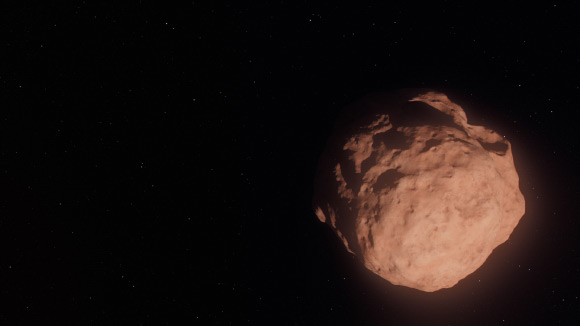
This artist’s concept depicts a trans-Neptunian object. Image credit: NASA / ESA / Leah Hustak, STScI.

For the first time, astronomers combined Hubble and Webb space telescopes to hunt down some of the smallest, faintest objects ever spotted in the outer Solar System.

The post Hubble and Webb Team Up to Spy Tiny Frozen Worlds beyond Neptune appeared first on Sci.News: Breaking Science News.
  •  

Asteroid Donaldjohanson is Wobbly, Peanut-Shaped Object with Watery Past, Scientists Say

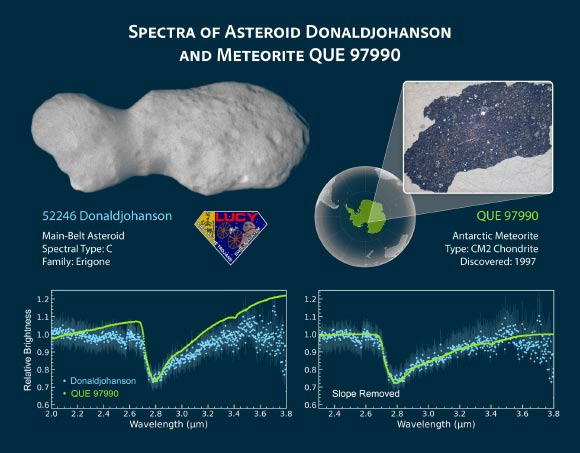
The asteroid Donaldjohanson is composed of two heavily cratered lobes, connected by a smoother neck, with overall dimensions 8.8 km by 4.4 km by 3.1 km. Image credit: NASA / Goddard / SwRI / Dan Gallagher.

The main-belt asteroid Donaldjohanson, a heavily cratered fragment born from a catastrophic breakup 155 million years ago, appears to wobble through space while preserving clues to the migration of water-rich worlds in the early Solar System, according to a new analysis of images and data from NASA’s Lucy spacecraft.

The post Asteroid Donaldjohanson is Wobbly, Peanut-Shaped Object with Watery Past, Scientists Say appeared first on Sci.News: Breaking Science News.

  •  

Lunar Meteorite Preserves Evidence of Colossal Asteroid Strike

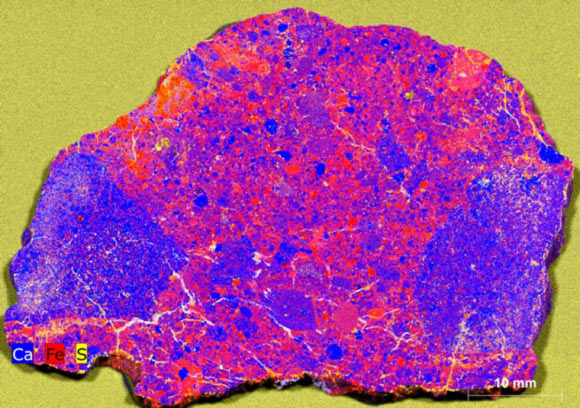
XRF map of 7.53 g slice of NWA 12593: calcium (Ca) and iron (Fe) illustrate the location and diversity of clasts; sulfur (S) highlights the location of cracks and terrestrial weathering. Image credit: Crow et al., doi: 10.1130/G54386.1.

Planetary scientists analyzing a lunar meteorite known as Northwest Africa (NWA) 12593 have uncovered evidence of an asteroid impact that occurred 3.5 billion years ago on the Moon, helping to reconstruct a period of intense bombardment that left lasting marks across the inner Solar System.

The post Lunar Meteorite Preserves Evidence of Colossal Asteroid Strike appeared first on Sci.News: Breaking Science News.

  •  

Meteorite Found in Africa Preserves Evidence of Long-Lost Massive Protoplanet

This is an artist impression of the protoplanetary disk around HD 107146. Image credit: A. Angelich / NRAO / AUI / NSF.

The Northwest Africa (NWA) 12774, an angrite meteorite discovered in the Sahara Desert, likely in Mauritania, appears to be a fragment of a vanished protoplanet, offering the strongest evidence yet that a large planetary body formed and was later destroyed during the Solar System’s chaotic infancy.

The post Meteorite Found in Africa Preserves Evidence of Long-Lost Massive Protoplanet appeared first on Sci.News: Breaking Science News.

  •  
❌