Login

Korea’s Display Innovation Center Starts Revenue-Generating Operations
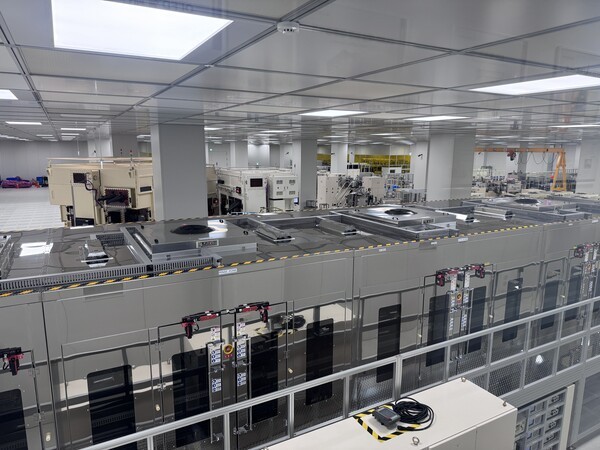
The Display Innovation Process Center at Chungnam Techno Park is starting revenue-generating operations. The center aims to secure operating funds following completion of its infrastructure project by attracting demand for process development, prototype production support and materials evaluation.
According to Chungnam Techno Park on Sept. 8, the center is developing an operating model under which three to five companies would continuously use its fab. It plans to provide various processes according to each company’s development schedule while supporting individual process evaluations for other companies between equipment-use periods. The goal is to maintain a steady equipment utilization rate.
The center plans to cover operating expenses through equipment-use fees and follow-up research and development projects. Electricity alone costs about 1.3 billion to 1.5 billion won annually. Equipment must remain powered even when not in use to maintain its condition, while air conditioning, cooling and wastewater treatment also add costs.
Passing all fixed costs on through usage fees would impose a heavy burden on companies that require only small samples. The individual publicly funded projects currently underway are also too small to cover operating expenses. The center plans to pursue corporate development projects alongside large-scale follow-up projects.
The center opened in April last year and completed setup of individual processes around October. It began full-scale support for materials, components and equipment companies this year. The center is currently preparing the final report for its infrastructure project and coordinating schedules for internal performance reviews with relevant organizations.
CLAP, a tenant company, is using the center’s fab and office space to develop prototypes with the goal of supplying a South Korean automaker. It has also relocated its chemical synthesis laboratory to the center. CLAP is responsible for product development, while the center provides facilities and process support. Several other companies have also expressed interest in using the production line, and the center is discussing equipment and process support tailored to their development needs.
The center is addressing demand from both companies that need only individual processes and those seeking to relocate their development operations. Its model combines individual equipment-use fees with revenue from projects that provide long-term process development and prototype production support.
The center has also secured evaluation projects linked to Samsung Display. Samsung Display used laser equipment at the center to evaluate a crystallization process and confirmed favorable results. It has also advised suppliers of polyimide (PI) materials for flexible organic light-emitting diode (OLED) substrates to provide evaluation data generated at the center.
The center provides process equipment and analytical facilities to materials, components and equipment companies that have difficulty securing opportunities for customer evaluations. Companies can verify the process characteristics of products under development without building their own fabs. Equipment utilization has increased as a result. From last year through April this year, 85 companies used the facilities, excluding duplicates. Process equipment utilization rose to a cumulative 65.8% as of April this year from 59.7% last year, while utilization of testing and evaluation equipment increased to 73.3% from 64.0%.
The center is also carrying out eight projects, including government-funded programs, to prepare for emerging technologies. In a project to develop 2,500-pixels-per-inch (PPI) glass-based displays, researchers are evaluating the characteristics of technologies originally developed on wafers when applied to second-generation rectangular substrates.
Researchers aim to improve the cost and productivity of displays for extended reality (XR) applications through ultra-high-resolution glass-based processes. The center is also supporting a project to develop immersive spherical free-form displays by implementing foundational technologies on second-generation substrates.
The center also operates professional training programs. It trained 122 people through its Display Academy last year and aims to train 150 this year. Courses cover OLED process equipment, oxide processes and materials analysis. Current three- and five-day programs provide explanations of the entire process and opportunities to observe equipment inside the fab. To expand the scope of corporate support, the center is establishing process conditions required to produce complete panels. It has evaluated red, green and blue (RGB) illumination using its own test substrates and produced prototypes for exhibition.
Corporate support currently focuses on individual processes and multilayer structure evaluations. The center has yet to establish a track record of supporting companies through an integrated end-to-end process. Engineers are repeatedly conducting deposition and patterning while adjusting film quality, alignment and etching conditions.
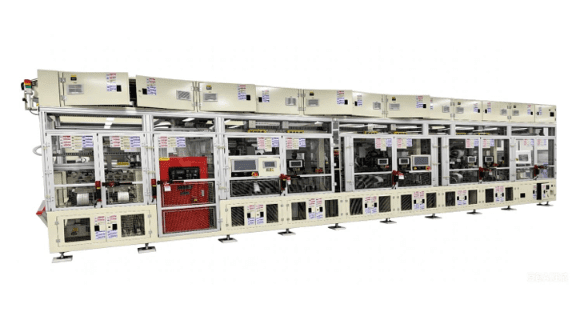
The central government, local governments and the private sector have invested a total of 528.1 billion won since 2019 in the Display Innovation Process Platform project, including 377 billion won in central government funding. The project includes R&D for core OLED technologies and construction of the center’s infrastructure. The center is equipped with 65 units across 63 types of process, testing, evaluation and utility equipment.
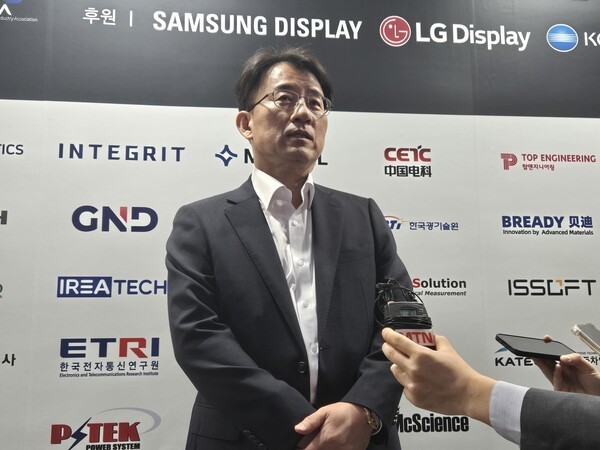
“The center’s role is to evaluate products developed by materials, components and equipment companies so they can secure preliminary data to present to Samsung Display and LG Display,” said Jung Byung-hwa, head of the Display Innovation Process Center. “Our engineers can also enhance their technical capabilities by responding to requests from various companies and evaluating process results.”