❌

Reading view

MNRC MN300S Review: 1:12 4WD RC Crawler With Proportional Control

Not every remote-control vehicle is designed to be fast. Some are more interesting when the terrain becomes difficult.

MNRC MN300S rc truck takes that approach. Rather than focusing on high top speed, this 1:12 4WD RC crawler combines four-wheel drive, proportional rc controls, a two-speed transmission and a relatively large body to create a platform aimed at climbing, trail driving and technical off-road play.

Its specifications suggest a vehicle intended for users who enjoy controlling an RC crawler through uneven ground rather than simply racing it across a flat surface. The manufacturer lists a maximum speed of 8 km/h, a climbing capability of up to 45 degrees, a control distance of around 50 meters and approximately 45 minutes of driving time from its included 7.4V 1200mAh lithium-ion battery.

The MN300S Is More About Control Than Speed

The first thing to understand about the MN300S is its character.

With a claimed top speed of 8 km/h, this is not positioned as a speed-focused RC truck. Instead, the combination of 4WD and proportional control gives the vehicle a more deliberate operating style.

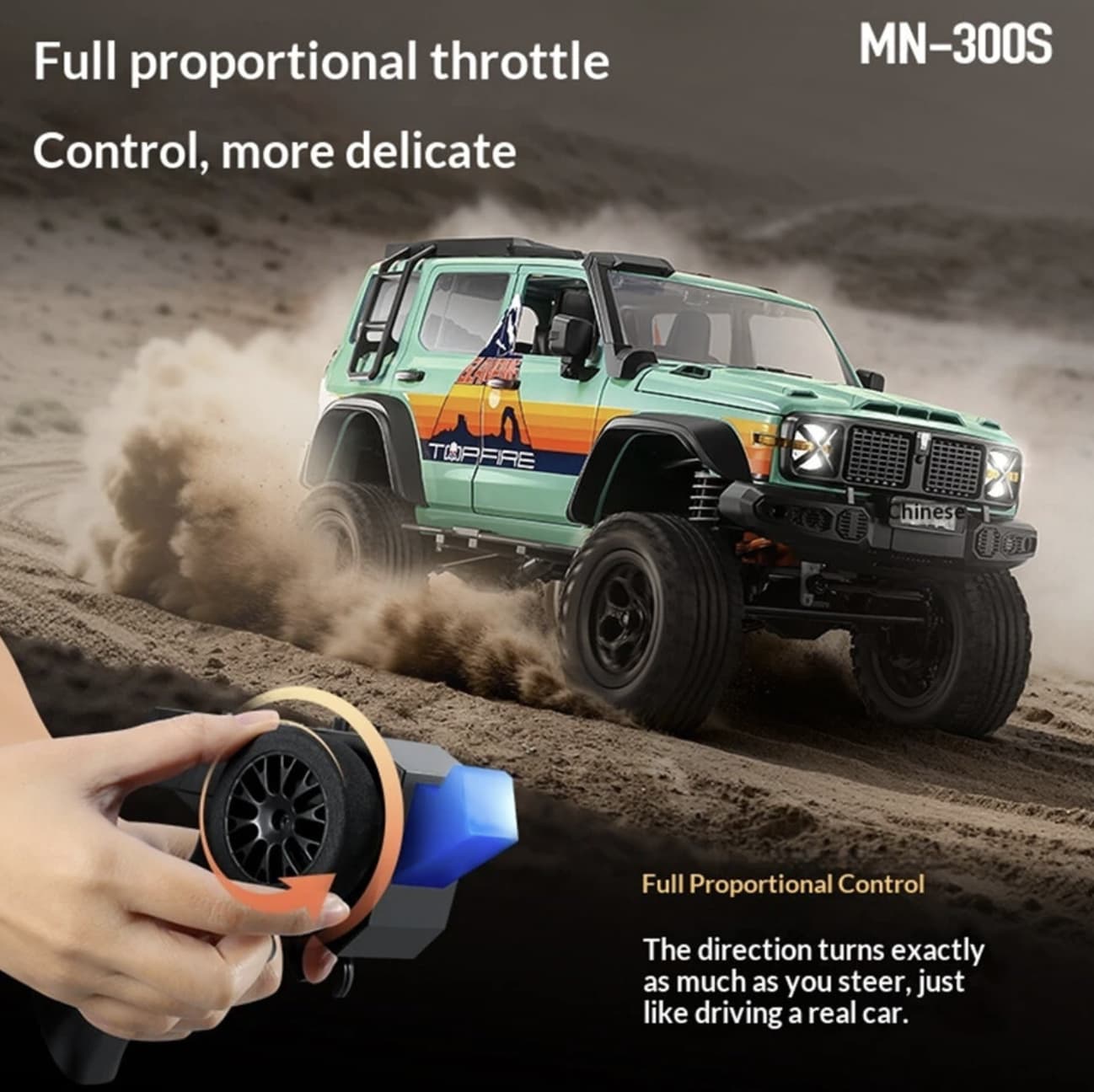
Proportional control matters when navigating obstacles. Instead of treating steering and throttle as simple on/off commands, the controller allows the driver to make smaller adjustments. That is particularly useful when the vehicle is approaching a rock, climbing a slope or trying to keep its wheels positioned on a narrow section of trail.

For casual driving, this can make the MN300S feel more predictable. For hobbyists, it also creates more room to develop driving technique.
1:12 Scale Gives It a Substantial Trail Presence

The MN300S measures approximately 38.78 × 16.84 × 18.5 cm, putting it firmly into the larger end of casual RC toys while remaining manageable for outdoor use.

Its 1:12 scale is also important from a visual perspective. The body is designed around an officially licensed, high-simulation appearance, so the vehicle is intended to work in two different ways: as something to drive and as a model that can be displayed when it is not being used.

That combination should appeal to hobbyists who care about the appearance of their RC vehicles as much as the driving experience.

4WD Is the Key to Its Off-Road Personality

The MN300S uses a four-wheel-drive system designed for uneven outdoor terrain.

On a smooth floor, the difference between 2WD and 4WD may not be especially important. On loose soil, grass, stones and other irregular surfaces, however, maintaining traction across multiple wheels becomes much more relevant. It comes with 4WD RC cars for off-road driving.
The listing gives the vehicle a maximum climbing angle of 45 degrees. This figure should be viewed as a manufacturer specification rather than a guarantee that the vehicle will climb every 45-degree surface, because actual performance depends on terrain, tire grip, battery condition, surface material and driving technique.

Still, the specification clearly shows where MNRC expects the MN300S to be used: on terrain where traction and controlled wheel movement matter more than outright speed.

Two-Speed Transmission Adds Another Layer of Control

Another interesting feature is the two-speed transmission.

A crawler benefits from having different driving characteristics for different situations. A lower-speed setting can be useful when negotiating obstacles that require careful throttle control, while a faster setting makes ordinary trail movement less tedious.

This is one of the details that separates the MN300S from very basic RC cars. The vehicle is not simply designed around maximum acceleration. Its controls are intended to give the driver more influence over how the truck responds to the terrain.

A 7.4V Battery Provides Around 45 Minutes of Claimed Runtime

Power comes from a 7.4V 1200mAh lithium-ion battery, which is included with the vehicle. Banggood lists approximately 45 minutes of playtime and around 210 minutes of charging time.

The real runtime will naturally vary according to driving conditions. Continuous climbing and frequent throttle changes can consume more energy than relaxed driving on relatively flat ground.

The roughly three-and-a-half-hour charging time also means owners should plan charging before an outdoor session rather than expecting a quick top-up between short drives.

The transmitter itself requires two AA batteries, which are not included.

LED Lighting Makes the Vehicle More Than a Daytime Toy

The MN300S includes a remotely controllable lighting system with front lights, turn signals and rear lights.

That is more than a cosmetic detail. Lighting gives the vehicle a more realistic appearance and makes it easier to distinguish the front and rear of the model when driving at a distance.

For hobbyists who enjoy filming RC rock crawler or creating miniature trail scenes, the lighting system can also add visual interest without requiring additional accessories.

Built for Hobbyists Who Like to Modify Their Vehicles

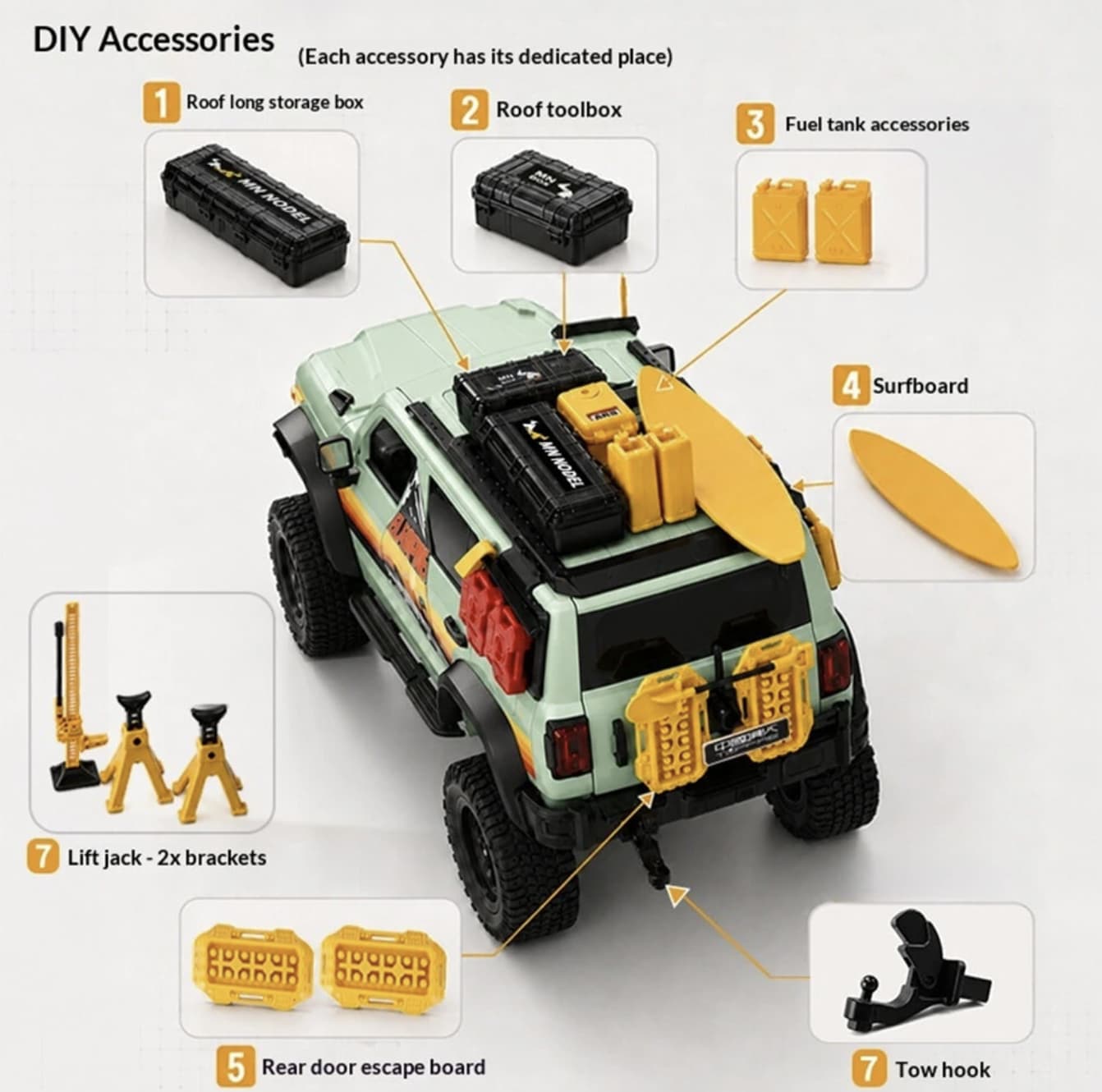
One of the more interesting aspects of the MN300S is its stated support for customization and upgrades.

That makes the platform potentially more attractive to hobbyists than a completely closed RC toy. Owners who enjoy changing components, experimenting with setup or gradually improving a vehicle have more reason to keep working with the same chassis.

The product listing also describes the vehicle as using a combination of PA, alloy and electronic components, while the body is described separately as a sturdy ABS structure.

This suggests a design that tries to balance visual detail with the demands of outdoor driving.

50-Meter Control Range Is Enough for Trail Driving

The included 2.4GHz transmitter operates across four channels and has a listed control distance of approximately 50 meters.

For a crawler, that is a sensible range. Unlike a fast RC racer, the MN300S does not need to travel huge distances before reaching its intended driving environment.

A 50-meter range gives the driver enough room to send the vehicle along a garden path, park trail or open outdoor area while maintaining a practical distance for observing obstacles.

What the MNRC MN300S Is Actually Good At

The specifications point toward a particular type of RC experience.

The MN300S makes the most sense for:

  • Technical off-road driving
  • Rock and trail crawling
  • Outdoor RC sessions
  • Hobbyists who enjoy proportional controls
  • Drivers interested in customization
  • Collectors who want a realistic 1:12 model
  • Users who prefer controlled driving over high speed

It is less compelling if the main goal is racing. An 8 km/h maximum speed places it firmly in the crawler-oriented category rather than the high-speed RC category.

MNRC MN300S Specifications

Feature Details
Model MN300S
Brand MNRC / MNR/C
Scale 1:12
Drive 4WD
Frequency 2.4GHz
Channels 4CH
Motor 280 brushed motor
Steering servo 17g
Maximum speed Up to 8 km/h
Control distance About 50m
Car battery 7.4V 1200mAh Li-ion
Claimed runtime Approx. 45 minutes
Charging time Approx. 210 minutes
Climbing angle Up to 45°
Steering angle Up to 28°
Load weight Up to 3kg
Traction weight Up to 5kg
Vehicle size 38.78 × 16.84 × 18.5cm
Transmission Two-speed
Lighting Front lights, turn signals and rear lights
Control Proportional
Recommended age 15+

Specifications are based on the current product listing and should be treated as manufacturer/retailer claims rather than independent performance measurements.

Final Take

MNRC MN300S is interesting because it does not try to compete with RC vehicles by chasing an impressive top-speed number. Its appeal comes from a different combination: 1:12 scale, four-wheel drive, proportional control, two-speed gearing and a design intended for climbing and outdoor terrain.

The included battery and transmitter also mean the package is relatively straightforward for someone who wants to start driving without assembling a complete RC system from individual components. The addition of controllable lighting and upgrade potential gives the platform more personality than a basic entry-level RC car.

For someone looking for a realistic RC crawler to take onto trails, grass, dirt and moderate obstacles, the MN300S has a specification sheet that makes sense as a hobby-oriented off-road platform. Its relatively modest speed is not necessarily a weakness—it is part of the reason the vehicle is better understood as a technical crawler rather than a racing truck.

The post MNRC MN300S Review: 1:12 4WD RC Crawler With Proportional Control appeared first on IGeeKphone China Phone, Tablet PC, VR, RC Drone News, Reviews.

  •  

« Un test décisif de la théorie d’Einstein » : le trou noir géant de la Voie lactée fait tourbillonner l'espace-temps !

Autrefois dissimulée par d'épais nuages de poussière dans le bulbe central de la Voie lactée et trop proche de son trou noir central pour être observable, même avec de grands télescopes, l'étoile S301 a finalement été débusquée avec les progrès des instruments de mesure équipant le VLT de l'ESO,...

  •  

Nova estação de carregamento da UGREEN oferece 300W, display, modos de operação e mais

A conhecida marca UGREEN lançou uma estação de carregamento da linha Nexode Pro, a qual é equipada com seis portas USB-C, uma porta USB-A e uma saída CC (corrente contínua) dedicada, oferecendo uma potência combinada de até 300W.

Assim como um novo modelo de carregador da Satechi que cobrimos recentemente, a estação da UGREEN ostenta uma tela colorida que exibe a potência total de saída, tensão, corrente e o protocolo de carregamento de cada dispositivo conectado. Ela também conta com controles sensíveis ao toque na parte superior, que permitem alternar entre cinco modos de operação.

UGREEN Nexode Pro 300W Charging Station with Smart Display
Divulgação/UGREEN

As portas USB-C1, USB-C2 e USB-C3 suportam até 140W cada uma. Já as portas USB-C4 e USB-C5 fornecem até 100W cada, enquanto a USB-C6 tem capacidade de 30W. A porta USB-A, por sua vez, fornece 22,5W e está localizada ao lado da saída CC, de 240W.

UGREEN Nexode Pro 300W Charging Station with Smart Display
Divulgação/UGREEN

Segundo a fabricante, a estação de carregamento consegue recarregar dois MacBooks Pro em até 50% em cerca de 28 minutos. O carregador também conecta-se ao aplicativo da UGREEN via Bluetooth ou Wi-Fi, permitindo monitorar dispositivos conectados, alternar modos de operação, personalizar a tela e instalar atualizações de firmware.

Medindo 133x90x42mm, o Nexode Pro 300W está disponível na Amazon americana por US$170 — um desconto de 15% em relação ao valor comum (US$200).

NOTA DE TRANSPARÊNCIA: O MacMagazine recebe uma pequena comissão sobre vendas concluídas por meio de links deste post, mas você, como consumidor, não paga nada mais pelos produtos/serviços usando os nossos links de afiliado.

via TudoCelular.com

  •  

Tribunal dos EUA obriga Meta, TikTok, Google e Snapchat a enfrentar mais de 3.000 processos judiciais por dependência das redes sociais

O 9.º Tribunal de Recurso dos EUA recusou ontem o recurso das empresas tecnológicas, concluindo que a Secção 230 oferece uma defesa de responsabilidade, e não imunidade total. O julgamento que envolve 29 procuradores-gerais estatais começa esta quarta-feira em Oakland.

The post Tribunal dos EUA obriga Meta, TikTok, Google e Snapchat a enfrentar mais de 3.000 processos judiciais por dependência das redes sociais appeared first on Tek Notícias.

  •  

Bluesky ganha opção para ocultar reposts de usuários no feed

O Bluesky anunciou um novo recurso que permite ocultar as repostagens de um determinado usuário no feed. Aos moldes da ferramenta equivalente do X, ele permite que a sua página inicial não seja inundada com compartilhamentos de posts de terceiros feitos por pessoas que você segue.

Para aplicar a ação a um determinado usuário, basta abrir as opções do perfil (os três pontos ao lado do botão “Seguindo”) e selecionar “Hide reposts in feeds”.

v1.130 is live!Want to follow someone for their posts but not their reposts? Now you can — turn on "Hide reposts in feeds" for any account you follow.

— Bluesky (@bsky.app) 2026-08-10T18:23:59.962Z
v.1.130 está no ar!
Quer seguir alguém pelos seus posts e não pelos seus reposts? Agora você pode — ligue o “Hide reposts in feeds” para qualquer conta que você segue.

A opção foi liberada na atualização mais recente (como mencionada, a versão 1.130.0) do Bluesky na App Store e na versão web da rede social.

Ao The Verge, os desenvolvedores anunciaram que estão lançando um recurso beta que exibe automaticamente uma contagem de postagens para threads (seu equivalente da Meta, o Threads, também conta com essa opção). Ele pode ser habilitado nas configurações do app.

  •  

Ford Apple Maps Deal Puts $30,000 EV in the iPhone Family

Ford Apple Maps integration will place the navigation service directly inside a new family of affordable electric vehicles, beginning with a midsize pickup expected to start at approximately $30,000 in 2027.

The truck will not depend on CarPlay or a connected iPhone to access Apple Maps. Ford plans to embed the service through MapKit for Automotive, allowing the automaker to incorporate Apple navigation into its own displays, controls and software environment.

CarPlay will remain available for drivers who want to use iPhone apps, messages, calls and media. The native integration, however, means Apple Maps can continue providing directions when no phone is connected or when the driver uses a device from another manufacturer.

The partnership extends beyond dashboard navigation. Ford also intends to use road-level information from Apple Maps while developing future versions of BlueCruise, connecting Apple mapping data with the driver-assistance technology planned for its Universal Electric Vehicle Platform.

Ford Apple Maps Moves Beyond CarPlay

Ford Apple Maps represents a different approach from the familiar relationship between an iPhone and a vehicle.

CarPlay runs from the phone and presents selected apps through the dashboard. The embedded version of Apple Maps will operate as part of the truck software, giving Ford greater control over how directions, charging information and vehicle data appear across its displays.

Drivers can expect turn-by-turn guidance, live traffic conditions, incident reports and detailed destination information. Ford will be able to adapt the visual experience to match the interface created for its new electric platform rather than reproducing the standard CarPlay layout.

EV routing may become the most practical benefit. The system can consider available range, charging locations and route conditions before recommending where a driver should stop.

When supported by the vehicle, navigation can also trigger battery preconditioning before arriving at a fast charger. Bringing the battery toward an appropriate temperature can reduce charging time, particularly during cold or extremely hot conditions.

Integrating those functions removes part of the planning burden from longer electric trips. Drivers will not need to move constantly between a navigation app, charging network software and separate vehicle menus to understand whether a station is suitable.

The native experience also gives Ford an alternative to building a complete mapping platform internally. Apple already maintains search, traffic, routing and place information across a large geographic network, while Ford can concentrate on vehicle-specific functions.

Apple, meanwhile, gains a route into factory-installed automotive software without needing to produce its own car.

A Different Strategy From CarPlay Ultra

The Ford arrangement should not be confused with CarPlay Ultra.

CarPlay Ultra expands the iPhone experience across multiple vehicle screens and can combine phone content with information supplied by the car, including speed, fuel or battery levels and climate controls.

Ford is taking a more selective path. Apple Maps becomes a native service, but the broader dashboard remains a Ford environment.

That distinction may appeal to automakers reluctant to hand control of the cabin interface to another company. Ford can use Apple technology for navigation while preserving its own identity, subscription services and software architecture.

Drivers still receive a recognizable Apple product, but the vehicle manufacturer determines where it appears and how it interacts with charging, driver assistance and other functions.

The arrangement could provide a model for other automakers that want access to individual Apple services without adopting the complete CarPlay Ultra experience.

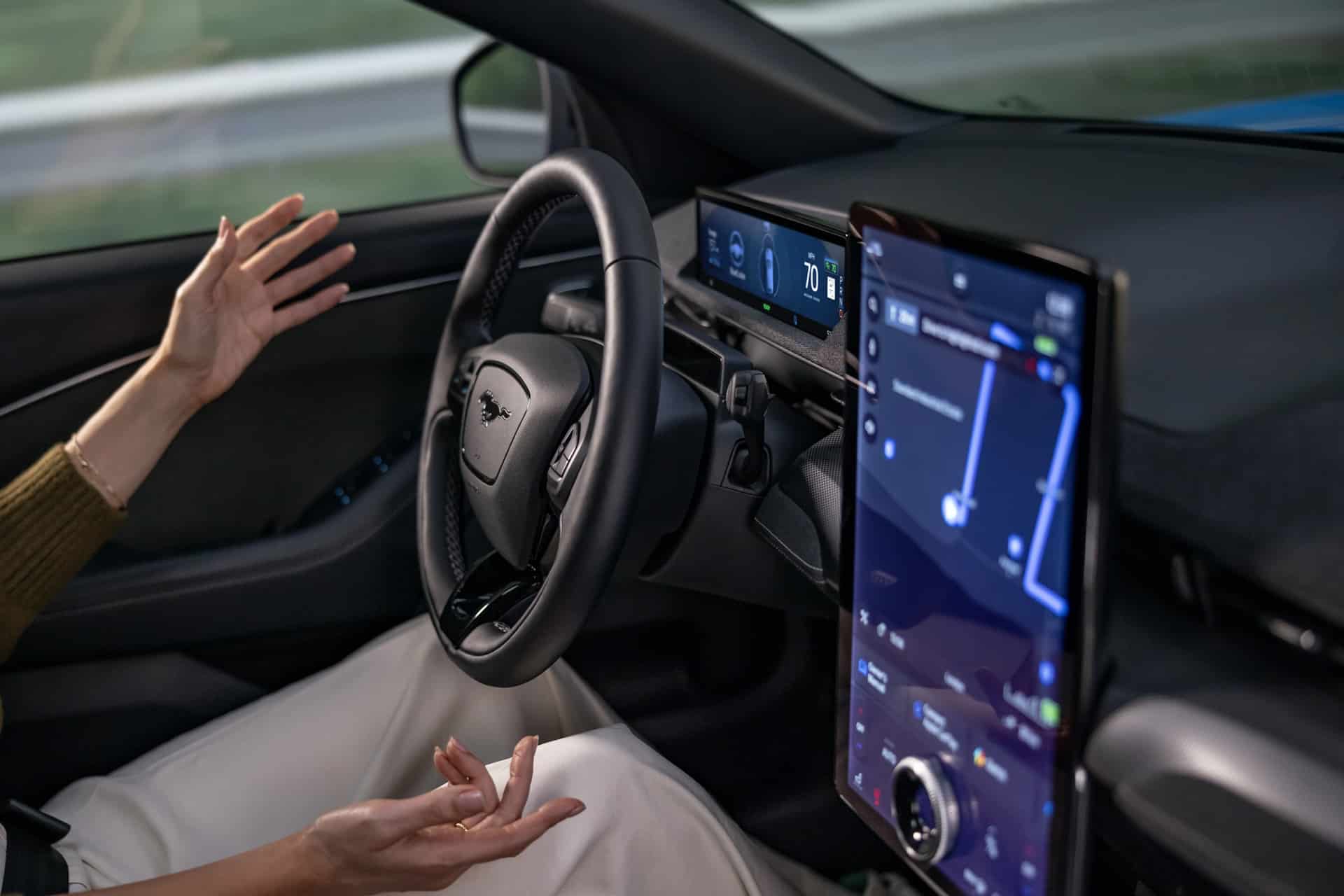
A person sits in the driver's seat of a car with their hands off the wheel, indicating autonomous driving. The dashboard displays speed and navigation on a large touchscreen, featuring Ford Apple Maps integration for seamless route guidance.
Image Credit: Ford

A $30,000 Electric Truck Needs More Than a Low Price

Ford plans to introduce the unnamed four-door pickup as the first vehicle based on its Universal Electric Vehicle Platform.

The targeted price of approximately $30,000 would place it below many electric pickups currently available in the United States. Ford is aiming at drivers interested in an EV but unwilling or unable to spend the amounts associated with large premium trucks.

The company says the vehicle will provide more passenger space than a recent Toyota RAV4 while including a front storage compartment and a conventional truck bed. Performance is expected to compare with a Mustang EcoBoost, giving the pickup a stronger argument than affordability alone.

Reaching the price target requires changes throughout the vehicle rather than a smaller battery placed inside an existing truck design.

Ford has reduced the number of components, fasteners and assembly operations involved in the new platform. Its zonal electrical architecture is intended to shorten wiring and simplify how software-controlled systems connect across the vehicle.

Lithium iron phosphate batteries will form part of the structural floor. The chemistry avoids nickel and cobalt, generally costs less than alternatives focused on maximum energy density and can offer strong durability for repeated charging.

Production is planned for the Louisville Assembly Plant in Kentucky, where Ford is introducing a manufacturing process that separates major vehicle sections before bringing them together later in assembly.

Apple Maps supports the same cost-conscious strategy. Ford can offer a mature navigation experience without financing the creation of every mapping layer from the beginning.

Apple Maps Will Support BlueCruise Development

The partnership becomes more significant when mapping information begins supporting driver assistance.

Ford Latitude AI plans to use road-level Apple Maps data while developing future BlueCruise capabilities. The objective is to create smoother hands-free travel from a highway entrance ramp through the eventual exit.

Apple Maps can provide advance knowledge of road layouts, interchanges, curves and exits. Ford sensors and onboard systems must still identify vehicles, pedestrians, construction and unexpected changes in real time.

Apple is not developing or controlling BlueCruise. Ford remains responsible for the cameras, sensors, processors and driving decisions used by the system.

The maps provide another layer of context. A vehicle that understands the route in advance can prepare for lane changes, merges and exits before its sensors reach them.

Ford is also developing a large driving model through Latitude AI using extensive road data. Combining that work with detailed maps could allow the company to improve assistance without depending entirely on moment-to-moment visual detection.

The Universal Electric Vehicle Platform is expected to support more capable automated driving in later models. Ford has discussed eyes-off operation from 2028, although final hardware, pricing and regulatory approval remain unresolved.

Introducing that technology through an affordable platform would represent a departure from the usual industry pattern. Advanced driver assistance often begins in expensive vehicles where premium pricing absorbs the cost of sensors and computing.

Ford wants to distribute the development expense across a larger family of electric products.

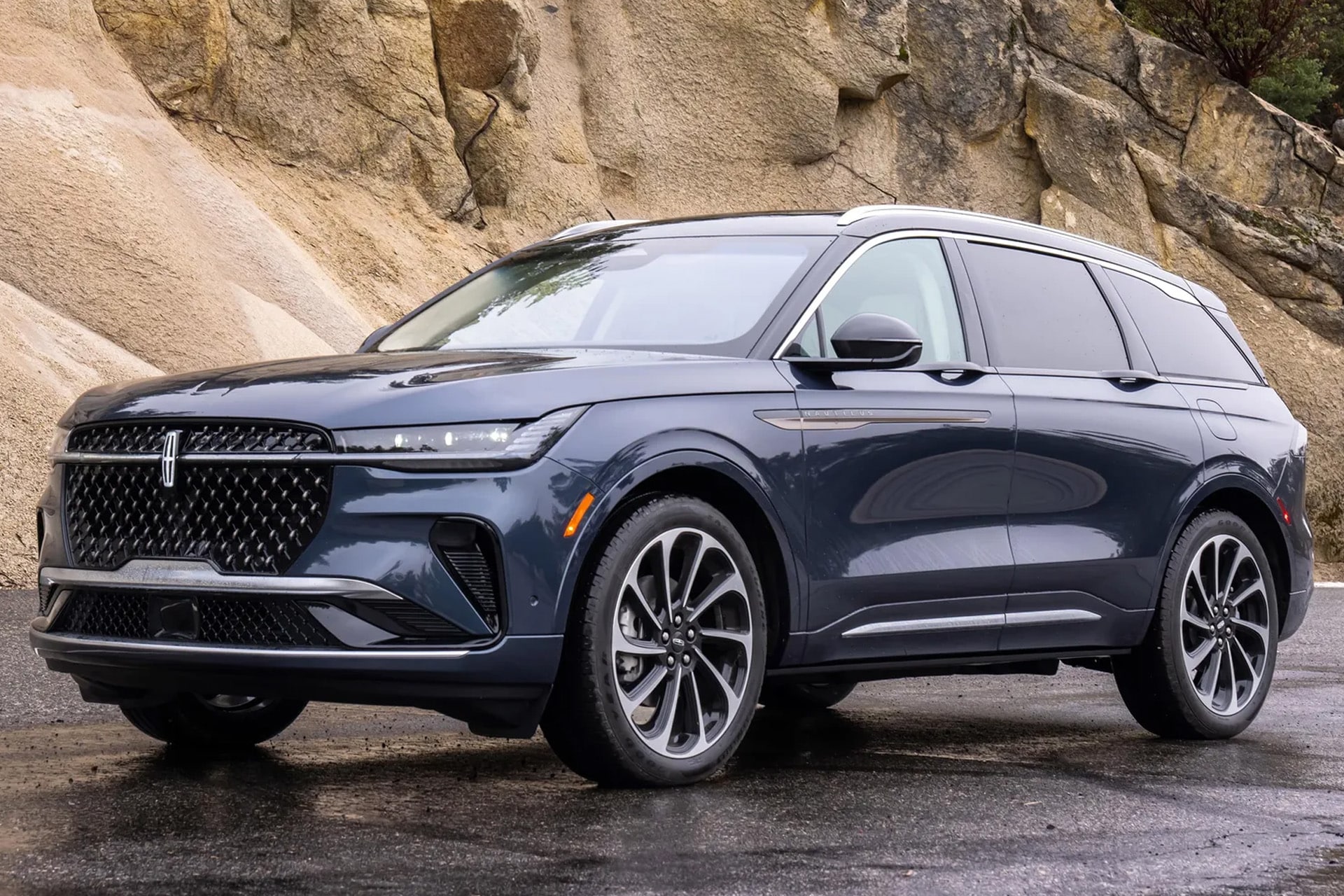
A dark blue SUV with chrome accents is parked on a wet road in front of a rocky hillside. The vehicle features a large front grille, sleek, modern design, and seamless Apple Maps integration for enhanced navigation on every journey.
Image Credit: Ford

Apple Maps Gives the Truck a Familiar Entry Point

The Apple Maps name may make the new truck feel less unfamiliar to customers buying an electric vehicle for the first time.

Charging behavior, range estimation and route planning can create hesitation among drivers accustomed to gasoline vehicles. Presenting those functions through a navigation service already used on millions of iPhones reduces the number of unfamiliar interfaces introduced at once.

Existing Apple Maps users may also recognize saved locations, search behavior and visual guidance, although Ford has not explained which personal features will require an Apple Account or connected iPhone.

The embedded service will still need reliable integration with vehicle range, charger availability and battery temperature. A familiar logo alone cannot compensate for inaccurate charging information or route estimates.

Ford has not yet announced the truck name, final driving range, battery capacity, production specifications or confirmed base price. Those details will determine whether the pickup can combine its promised affordability with enough capability for everyday work and travel.

The first production model is scheduled for 2027, leaving Ford time to refine the software and reveal how Apple Maps will appear across the dashboard before the Louisville assembly line begins building customer vehicles.

The post Ford Apple Maps Deal Puts $30,000 EV in the iPhone Family appeared first on AppleMagazine.

  •  

U.S. lawmakers urge President Trump to strike back against EU tech regulation with trade probes

President Donald Trump holds a signed executive order on tariffs, in the Rose Garden at the White House in Washington, D.C., April 2, 2025.

A group of 25 U.S. lawmakers has sent a letter to President Trump calling on his administration to confront the European Union’s digital regulations, which they describe as discriminatory policies aimed at American technology giants.

In the letter, obtained by Reuters, the Republican lawmakers – including key members of the House trade subcommittee – urged the president to consider launching Section 301 investigations under U.S. trade law. Such probes could pave the way for tariffs or other retaliatory measures against the EU if talks fail to resolve the issues.

The central target of the complaint is the EU’s Digital Markets Act (DMA), which designates major U.S. companies – including Amazon, Apple, Google, Meta, Microsoft, and Booking Holdings – as “gatekeepers” subject to strict behavioral rules. Lawmakers argue the rules unfairly burden American firms while sparing European and Chinese competitors.

Key concerns raised in the letter:

• Cloud services: The likely inclusion of Amazon Web Services and Microsoft’s cloud business under DMA oversight would impose “unprecedented regulatory burdens” not faced by European or Chinese rivals.

• Google fines: An expected European Commission fine against Google this week for alleged DMA violations ignores the company’s significant changes to its search services.

• Inconsistent enforcement: Apple, Meta, and Amazon have been labeled gatekeepers based on user numbers in Europe, while Chinese platforms like Temu and AliExpress have been excluded.

“We write to bring to your attention the many ways the EU continues to pursue anti-competitive acts, policies, and practices as a tool of economic extraction and regulatory coercion against American firms,” the letter states. It warns that EU access to the U.S. market “is not guaranteed” if the discriminatory practices continue.

The pressure on the issue predates Trump’s return to the White House. In October 2024, even before the election, Apple CEO Tim Cook personally called then-candidate Trump to voice concerns over EU fines and regulations affecting the company, including the Digital Markets Act and a major tax ruling. Trump later publicly referenced the call, signaling his willingness to push back against what he viewed as unfair European penalties on U.S. firms.

The European Commission has not yet responded to the letter. It maintains that its rules apply neutrally to promote fair competition and do not single out any country.

This latest congressional push aligns with President Trump’s long-standing criticism of EU digital policies and could signal a more aggressive U.S. trade posture toward Brussels in the coming months. Lawmakers emphasized that dialogue should be attempted first, but “all available tools” – including tariffs – remain on the table if needed.

The move highlights ongoing transatlantic tensions over technology regulation, data privacy, and market access that have persisted for years and are now poised to test the new Trump administration’s approach to international trade.

MacDailyNews Take: Good. The DMA does far more harm than good.

The European Union arose because the Europeans couldn’t compete on their own with the rest of the world, so they each lined up to surrender their national sovereignty, unique cultures, and dignity for an undemocratic, opaque, wasteful, bloated, bureaucratic quasi-governmental blob – and, even with the EU’s thumbs all over the scale, they still can’t compete. – MacDailyNews, March 4, 2024


‎
Please help support MacDailyNews — and enjoy subscriber-only articles, comments, chat, and more — by subscribing to our Substack: macdailynews.substack.com. Thank you!

Support MacDailyNews at no extra cost to you by using this link to shop at Amazon.

The post U.S. lawmakers urge President Trump to strike back against EU tech regulation with trade probes appeared first on MacDailyNews.

  •  

Volvo EX30 Plus: Um SUV elétrico com muito para gostar, mas com algumas decisões confusas para a marca mais segura do Mundo

O EX30 é o Volvo mais pequeno e mais acessível da gama, e um dos SUV elétricos compactos mais interessantes do mercado. Testámos a versão P5 Plus, com bateria de 55 kWh, e ficámos rendidos ao bom ambiente a bordo, e com a eficiência superior à anunciada. Mas não conseguimos ignorar algumas decisões de design que dão que pensar numa marca com o histórico de segurança da Volvo.

The post Volvo EX30 Plus: Um SUV elétrico com muito para gostar, mas com algumas decisões confusas para a marca mais segura do Mundo appeared first on Tek Notícias.

  •  

Astronomers Discover Four New White Dwarfs in Solar Neighborhood

An artist’s impression of a red dwarf with a white dwarf binary companion peeking out from behind. Image credit: Mark A. Garlick / University of Warwick.

Using near-UV spectroscopic data from the Space Telescope Imaging Spectrograph (STIS) on the NASA/ESA Hubble Space Telescope, astronomers discovered four white dwarfs orbiting nearby red dwarf stars.

The post Astronomers Discover Four New White Dwarfs in Solar Neighborhood appeared first on Sci.News: Breaking Science News.

  •  

Logitech G completa a Série G3 com o rato G305 X SUPERLIGHT e o teclado G316 X 98

Depois dos auscultadores G325 X, lançados no início do ano, a Logitech G fecha o ecossistema da Série G3 com a chegada de um rato sem fios de 59 gramas e um teclado mecânico com ecrã de matriz de pontos. Ambos estão preparados para uma taxa de atualização de 8 kHz.

The post Logitech G completa a Série G3 com o rato G305 X SUPERLIGHT e o teclado G316 X 98 appeared first on Tek Notícias.

  •  

The WEF’s Endgame | Total Control of Your Life

The World Economic Forum is accused of promoting a totalitarian agenda disguised as sustainability, controlling lifestyles through carbon tracking and resource regulation. A senior Archbishop, Viganò, condemns global elites for seeking dominance via Agenda 2030, labeling it a 'global coup.' He urges resistance against these oppressive measures and defends truth-tellers like Rainer Füllmich.

  •  

Agenda 2030 | Digital ID Equals the Mark of the Beast

Agenda 2030 mission goals? First is a digital ID, to get everyone signed up to the universal blockchain. That is equal to the mark of the beast system of total control. Second is elimination of all cash and the implementation of digital programmable centralised currencies (CBDCs). Resist it all!

  •  

New World Order | The Final Empire

The emergence of a global government driven by technocracy, through UN Agenda 2030 with digital currencies and IDs is coming quickly. I highlight the role of the Satanic oligarchs from the synagogue of Satan. However only faith in Jesus Christ can repel the darkness.

  •  

A Modern Perspective on Daniel 11:30-39

I discuss a prophecy in the book of Daniel on how it connects to current events. It has fulfilment in modern persecution of the followers of Christ, and the synagogue of Satan’s actions against the covenant between God and mankind.

  •  

Mpox Pandemic? COVID Scam Round 2

The latest global health concern, "mpox," declared a public health emergency by the WHO, has sparked fears of another orchestrated crisis by globalist powers. The rebranded disease raises suspicions of a planned "PCR-demic" for global depopulation, resonating with biblical prophecies of toxic agents as weapons of conquest and devastation.

  •  
❌