Login

Kakao to Integrate Agentic AI With Coupang Eats for In-Chat Food Ordering
Kakao plans to introduce an agentic artificial intelligence (AI) service that can identify food-ordering intent within KakaoTalk conversations and connect users from menu recommendations to payment through a partnership with Coupang Eats.
The company disclosed during its second-quarter 2026 earnings conference call on Aug. 6 that it has signed an agent-to-agent (A2A) partnership agreement with Coupang Eats. Under the envisioned model, KakaoTalk’s on-device AI will analyze conversational context and user preferences to recommend menu items, while the Coupang Eats agent will handle ordering and payment functions.
The two companies are currently discussing implementation details. Beginning with food delivery, Kakao plans to expand its agentic AI ecosystem into other frequently used consumer services, including commerce, reservations, travel and payments.
KakaoTalk will incorporate the company’s on-device AI model, Kanana 2 1.3B, along with long-term memory technology. The system is designed to understand schedules and interests scattered across multiple conversations as a unified context and provide increasingly personalized services based on accumulated user behavior and preferences. Kakao plans to introduce related experiences gradually in the second half of the year and is targeting more than 10 million monthly active users (MAUs) for its AI services by year-end.
Kakao said it will focus its resources on AI services that directly interact with consumers rather than infrastructure businesses such as AI data centers, graphics processing units (GPUs) and cloud computing. The company believes large upfront investments and ongoing capital expenditures are required for AI infrastructure, while rapid technology refresh cycles for GPUs and AI servers make the long-term sustainability of current profitability uncertain.
As a result, Kakao intends to prioritize AI services at the user interface level rather than capital-intensive infrastructure investments. The company plans to strengthen its in-house capabilities across the AI value chain, from models to services, leveraging its strengths in business-to-consumer (B2C) platforms.
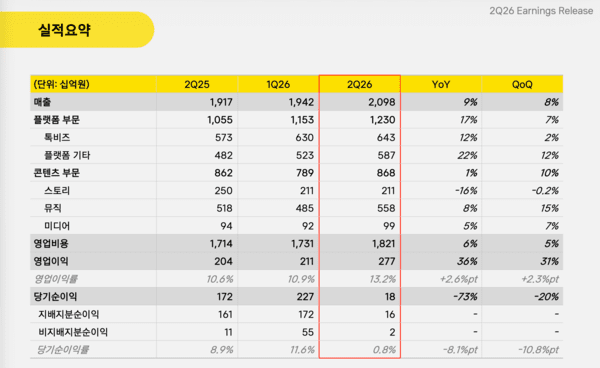
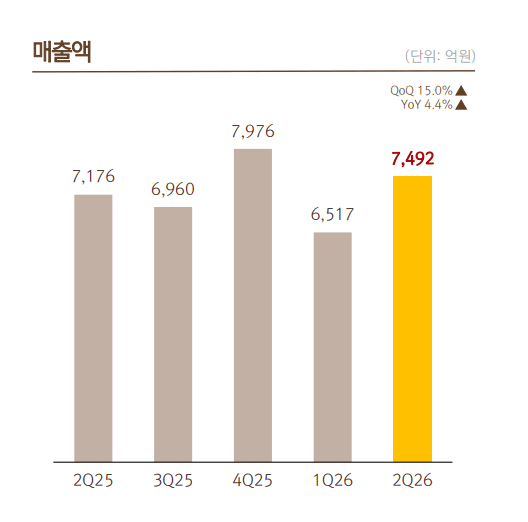
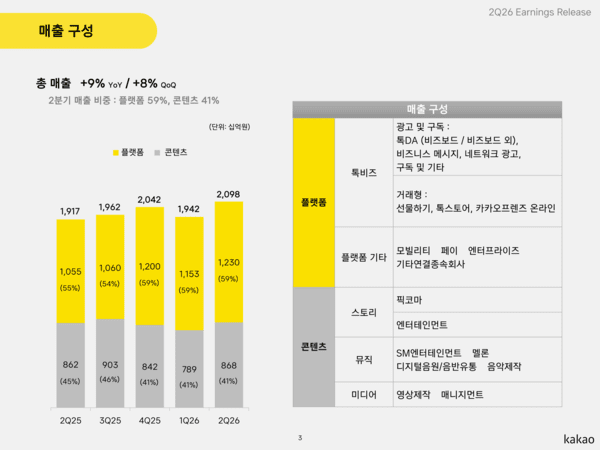
Kakao reported second-quarter revenue of 2.0985 trillion won and operating profit of 277.0 billion won, both record highs for a single quarter. The figures increased 9% and 36%, respectively, from a year earlier.
Revenue from the platform segment rose 17% year over year to 1.2303 trillion won. Talk Biz revenue reached 643.2 billion won, while advertising and subscription revenue hit a quarterly record of 399.9 billion won. Business messaging revenue and display advertising within KakaoTalk grew 20% and 28%, respectively.
Revenue from the content segment totaled 868.2 billion won, remaining broadly in line with the previous year. Music and media revenue increased, while story revenue declined 16%.
“Considering the direction of Kakao’s AI strategy and the speed of execution, we expect the foundation for AI mass adoption to be established by the end of this year and full-scale monetization to begin next year,” Chief Executive Officer Chung Shin-a said.
Kakao aims to increase the share of AI-related revenue within its Talk Biz segment to double-digit percentages by 2028 through transaction fees, subscriptions and AI-powered advertising, positioning AI as a key driver to reignite Talk Biz growth and serve as a major revenue source.