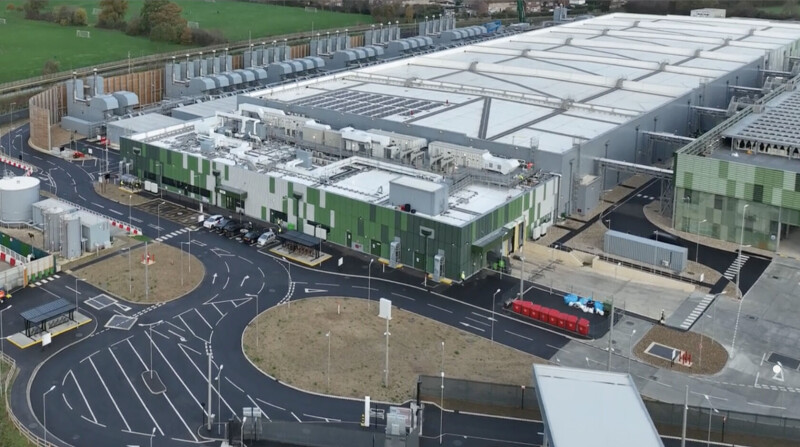
The Green Party of England and Wales wants the government to end the blanket designation of new bit barns as “critical infrastructure” and change planning rules to stop such facilities taking precedence over households for water and energy. The current UK government designated datacenters as critical national infrastructure (CNI) back in 2024, putting them on the same footing as essential services such as water and power. This made them eligible for special protection, but may also make it easier for developers to overcome any local objections to their construction, as The Register pointed out. The Green Party claims that CNI status means that server farms are prioritized for access to water and energy, even when ordinary households are hit with drought restrictions, as over 27 million people currently are in England. It wants to see planning permission for new facilities granted only when the developer can show it will meet the highest environmental standards, and there has been full community consultation. “We need to slam the brakes on the rampant building of new datacenters which could put our communities at risk of water shortages and drive up energy bills – and yet are currently being waved through by our government,” said Green Party leader Zack Polanski. “Data should serve people, not the other way around – but right now, because datacenters are designated as critical infrastructure, people come a poor second, with datacenters even being given priority for water and electricity.” “We need clear criteria to distinguish between datacenters vital to national security or public services, and those that simply serve private tech companies and private profit,” Polanski added. There was certainly talk earlier this year of prioritizing "strategically important" grid connections, which would include data campuses, and a report published by the London Assembly late last year highlighted the pressure on the power supply in the capital, with some areas of West London having to put a hold on new housing developments. On the water side, MPs were warned earlier this year that official forecasts of England's future water needs excluded datacenters, despite the growing number of them, and that they could end up competing with homes and businesses for supply. The Green Party claims that a single large-scale datacenter can use around 1.5 million liters (396,258 US gallons) of water per day, comparable to the daily water needs of a town of around 10,000 people. Yet bit barn construction is projected to expand rapidly, with growth often concentrated in areas already classified as water-stressed, like London and the South East. But water consumption can vary, depending on the cooling systems in use at specific facilities. In theory, newer campuses should require less water, especially if they are deploying AI infrastructure that uses so-called direct-to-chip cooling, where fluid is circulated through a closed-loop system. A government spokesperson told us: “A pause on building new datacenters would simply send investment and good jobs abroad, while leaving Britain dependent on overseas computing for the processing of sensitive health and defense data. Put simply, it would be a disaster for jobs and national security.” However, the spokesperson added: “This does not mean a blank cheque for Big Tech or that every datacenter should be approved. Developers should prioritize clean power, use water responsibly, create British jobs and supply chains, and provide investment to the communities in which they are built." The Green Party is also calling on the government to urgently develop a comprehensive national strategy for AI infrastructure, as the country is currently dependent on foreign-owned infrastructure for critical services, from healthcare to public safety – something the Institute for Public Policy Research was warning about just this week. ®
Apple’s stock rebounds after recent product price increases, prompting a discussion of customer loyalty, upgrade timing, refurbished options, and long-term confidence in the company. Chuck Joiner, David Ginsburg, Eric Bolden, Jim Rea, and Marty Jencius also examine why advanced Home features may require a 2TB iCloud+ plan, then debates Apple’s rumored foldable iPhone, including price, […]
The MacVoices Live! panel dives deep into Apple’s across-the-board price increases, weighing rising RAM, storage, inflation, shareholder obligations, and product value. Chuck Joiner, David Ginsburg, Brian Flanigan-Arthurs, Ben Roethig, Eric Bolden, Marty Jencius, Jeff Gamet, Norbert Frassa, Jim Rea, and Web Bixby debate whether higher prices are a short-term reset or the new normal, how buyers may react, why the MacBook Neo increase stings, and whether refurbished or education pricing may become more important.
At MacPaw’s Flip the Script event in San Francisco, Junior iOS Engineer Tymofii Bezverkhyi shares how his path from Ukraine’s Kyiv School of Economics to studying in Ireland, winning Apple’s Swift Student Challenge, and attending WWDC led to a role at MacPaw. Tim discusses his passion for Apple development, his work on MacPaw’s AI Eney, and why he appreciate’s the company’s responsibility and growth objectives.
The sharpest images ever taken of the Sun’s surface reveal ribbons of solar plasma curling into tight, wave-like vortices near the edge of a sunspot — a pattern never before seen on our star. The experiment behind the discovery was designed to push the technical limits of a new camera system, not hunt for newContinue reading "World’s largest solar telescope reveals the Sun’s hidden texture"
De acordo com uma reportagem da Reuters, a Apple poderá usar uma estratégia híbrida na adoção de recursos de inteligência artificial na China. Em vez de confiar apenas em plataformas de terceiros chinesas, a Maçã pretende também adotar sua tecnologia proprietária no país.
Segundo a agência de notícias, a Maçã estaria treinando seu próprio modelo de IA especificamente para a China — algo que a permitirá ter um maior controle sobre a Apple Intelligence em seu mercado mais competitivo fora dos Estados Unidos (mas sem abrir mão das parcerias).
Esse modelo teria sido desenvolvido em parceria com o Alibaba (e treinado com o apoio da empresa). Caso seja aprovado, ele será o primeiro modelo proprietário de uma empresa estrangeira a ser aprovado no país e permitirá à Apple lidar com as muitas barreiras regulatórias chinesas.
Isso indica que a Apple não pretende substituir por completo as tecnologias de terceiros em seu conjunto de IA no país, mas que poderá usá-las em conjunto com seus modelos proprietários e escolher o mais apropriado para tarefas diferentes a serem realizadas nos seus sistemas.
A alternativa permite, por exemplo, checar os status de um determinado contato, ou habilitar que ele veja determinadas informações do seu perfil (como o seu ícone ou o campo de recado) caso a visibilidade esteja restrita à sua lista de contatos — coisas que só eram possíveis antes ao salvar seu número de telefone.
WhatsApp launches a username field for new contacts, compatible with Status Sharing!
On Android and iOS, WhatsApp has introduced a new field for the contact creation screen that lets users save a contact's username alongside their name.https://t.co/5hSI6SUrs0pic.twitter.com/InGkJzgI7W
O WhatsApp lançou um campo de nome de usuário para novos contatos, compatível com o Compartilhamento de Status.
No Android e no iOS, o WhatsApp introduziu um novo campo na tela de criação de contato que permite aos usuários salvar o nome de usuário do contato junto do seu nome.
O novo campo está disponível tanto no iOS quanto no Android na tela já conhecida do público para adicionar novos contatos (ela pode ser acessada tocando no botão “+”, na seção “Conversas”, e depois selecionando a opção “Novo contato”).
Embora ainda não haja uma previsão oficial quanto à disponibilidade geral da novidade, o campo já foi notado por algumas pessoas que instalaram a versão mais recente do WhatsApp na App Store e pelos usuários da versão beta (via TestFlight).
Saudações de boas-vindas em grupos chegando ao iOS
Já presente na versão beta para Android, o mensageiro da Meta está testando no iOS um recurso que permite aos administradores de um grupo enviar uma mensagem automatizada de saudação para cada novo membro que integra a conversa coletiva.
O WhatsApp identifica a mensagem com um balão que inclui o texto “saudação automática”, e ela não poderá ser vista pelo restante do grupo (embora o usuário possa interagir com o recado).
WhatsApp is testing greeting messages for group chats on iOS!
Mesmo que um grupo tenha vários administradores, haverá apenas uma mensagem de boas-vindas para todo o grupo. Todos os administradores compartilharão o mesmo texto e qualquer um deles poderá editá-lo.
Ainda em desenvolvimento, a ferramenta não foi sequer disponibilizada para testadores do app, embora tenha sido notada na versão 26.31.10.73 beta.
A shortage of one common nutrient could help cancer cells and viruses hide from the immune system. Researchers at Rockefeller University found that a shortage of arginine, an amino acid obtained from food and produced by the body, can interrupt the cellular machinery needed to make MHC-I proteins. These proteins act as a surveillance system, [...]
As câmaras dos drones de vigilância K3 Scout, usados pelas forças especiais da Marinha britânica, tinham componentes de origem chinesa quem estavam a enviar dados para a China, obrigando o Ministério da Defesa a cortar a ligação à internet dos equipamentos.
This image of the sun — the sharpest ever snapped — was captured by the NSF Inouye solar telescope. (Image credit: NSF, NSO, AURA, MPS, Inouye Tel)
Scientists have captured the sharpest image ever of our sun's surface. This view has revealed incredible new details about the inner mechanisms driving stellar activity.
What is it?
An international team of researchers using the U.S. National Science Foundation's Inouye Solar Telescope has captured the highest-resolution view of the sun's surface.
In analyzing observations from this telescope, the team, made up of researchers from the National Solar Observatory, the NSF NCR High Altitude Observatory and the German Max Planck Institut für Sonnensystemforschung, discovered strange patterns on the sun's surface. The whirling patterns, they found, are actually evidence of what's called Kelvin-Helmholtz instability (KHI), or instability that happens when there is a change in velocity of fluids.
Why is it incredible?
This image is groundbreaking. Capturing the highest-resolution view of the sun's surface is a massive accomplishment, and in the time-lapse video above, you can even see the fluid dynamics on the surface of the sun in motion.
But this view is much more than a beautiful, high-resolution image. These observations have revealed swirls on the sun's surface at the edges of the magnetic areas, allowing the team to identify KHI on the sun's surface. This fluid instability has long been suspected on the sun, but these observations are the first time they have ever been directly seen like this.
“We believe that the discovery of Kelvin-Helmholtz Instability in the solar photosphere, backed up by analysis of numerical simulations, is a major step forward in our understanding of the dynamics and evolution of solar and stellar plasma, and will serve as a basis for future discoveries," David Boboltz, the deputy director at the National Solar Observatory, said in a statement.
A paper describing these findings was published recently in the journal Nature.
Pluto's atmosphere appears to be freezing out as the dwarf planet moves ever further away from the sun, according to careful observations of Pluto astronomers made as it was seen passing in front of stars in the sky.
Pluto is already cold. Its surface temperature is about –382 degrees Fahrenheit (–230 degrees Celsius), while its upper atmosphere is a little warmer at –333 degrees Fahrenheit (–203 degrees Celsius). As Pluto moves away from the sun it will grow even colder and its nitrogen-rich atmosphere should start to collapse and freeze out, condensing as frost on the frigid surface.
Now, a team led by Amanda Sickafoose of Arizona's Planetary Science Institute believe they have seen the onset of this process. "We're at a particularly interesting point for Pluto," said Sickafoose in a statement. "Our work suggests that the atmosphere has recently started decreasing in pressure."
Pluto's orbit is highly elliptical and very oblique to the ecliptic plane of the solar system. In fact, so eccentric is Pluto's orbit that for ten years either side of its perihelion in 1989 (when Pluto was closest to the sun), it was actually closer to the sun than Neptune was.
However, ever since 1989 Pluto has been moving away from the sun on its 248-year-long orbit – we've not even seen Pluto complete half of its orbit yet since its discovery in 1930. Pluto will reach its furthest point from the sun – called aphelion – in the year 2114 when it will be about 49 astronomical units (7.3 billion kilometers/4.6 billion miles) distant.
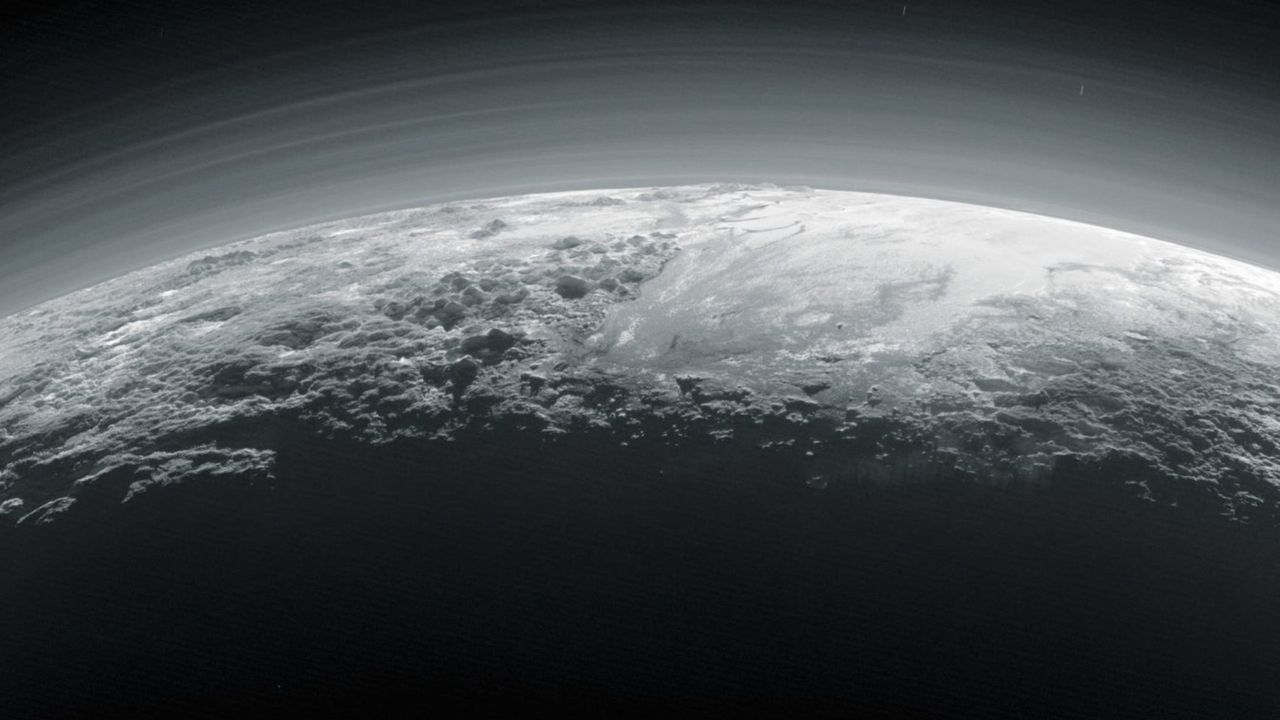
When NASA's New Horizons mission flew past Pluto in July 2015, it measured Pluto's atmospheric pressure to be 10 microbars. This is a tiny amount, millions of times lower than the atmospheric pressure on Earth, resulting from Pluto's thin nitrogen atmosphere that also contains hazes made from organic molecules including methane and carbon monoxide.
An image taken by NASA's New Horizons spacecraft that offered scientists the first look at Pluto's atmosphere in infrared wavelengths when it was taken in July 2015. (Image credit: NASA/JHUAPL/SwRI)
With New Horizons now having flown past Pluto and deeper into the Kuiper Belt, astronomers have to instead rely on more distant and less direct means of keeping tabs on Pluto's atmosphere. From our point of view on Earth, Pluto is sometimes seen to pass in front of a distant star. This is called a stellar occultation. When an airless body, such as an asteroid, occults (or hides) a background star the star's light winks out in an instant, before suddenly reappearing. When there is an atmosphere involved, however, the light of the star doesn't go out all at once when blocked by Pluto, but steadily fades as the atmosphere scatters and refracts the starlight before the star vanishes behind the dwarf planet's solid body.
Between 2017 and 2023, Sickafoose's team probed Pluto's atmosphere during ten occultations of stars ranging in brightness from about magnitude 12 to magnitude 18, far below naked-eye visibility.
Observing stellar occultations is not always a simple matter. They are not visible from everywhere on Earth, but only along narrow tracks, often in difficult to reach areas. The tracks, which are just a few kilometers wide, are effectively Pluto's shadow falling on the Earth. By spacing observers across the width of the track, it is possible to measure the extent of Pluto's atmosphere (there usually also has to be an unlucky observer just outside the track to confirm that is indeed the edge of the shadow track).
"I'm constantly amazed at how the simple technique of watching starlight dim and reappear allows us to study a thin atmosphere – a few millionths of the Earth's – on a world two-thirds the size of our moon and 30 times farther from the sun," said Sickafoose.
Of the ten occultations, four could be seen from observatories in multiple locations, which meant that the different observatories could confirm each other's results.
"We often prefer to observe predicted occultations that have shadow paths over large observatories because that equipment and data have proven successful," said Sickafoose. "Then, we try to improve those datasets by collaborating with local observers in the shadow paths."
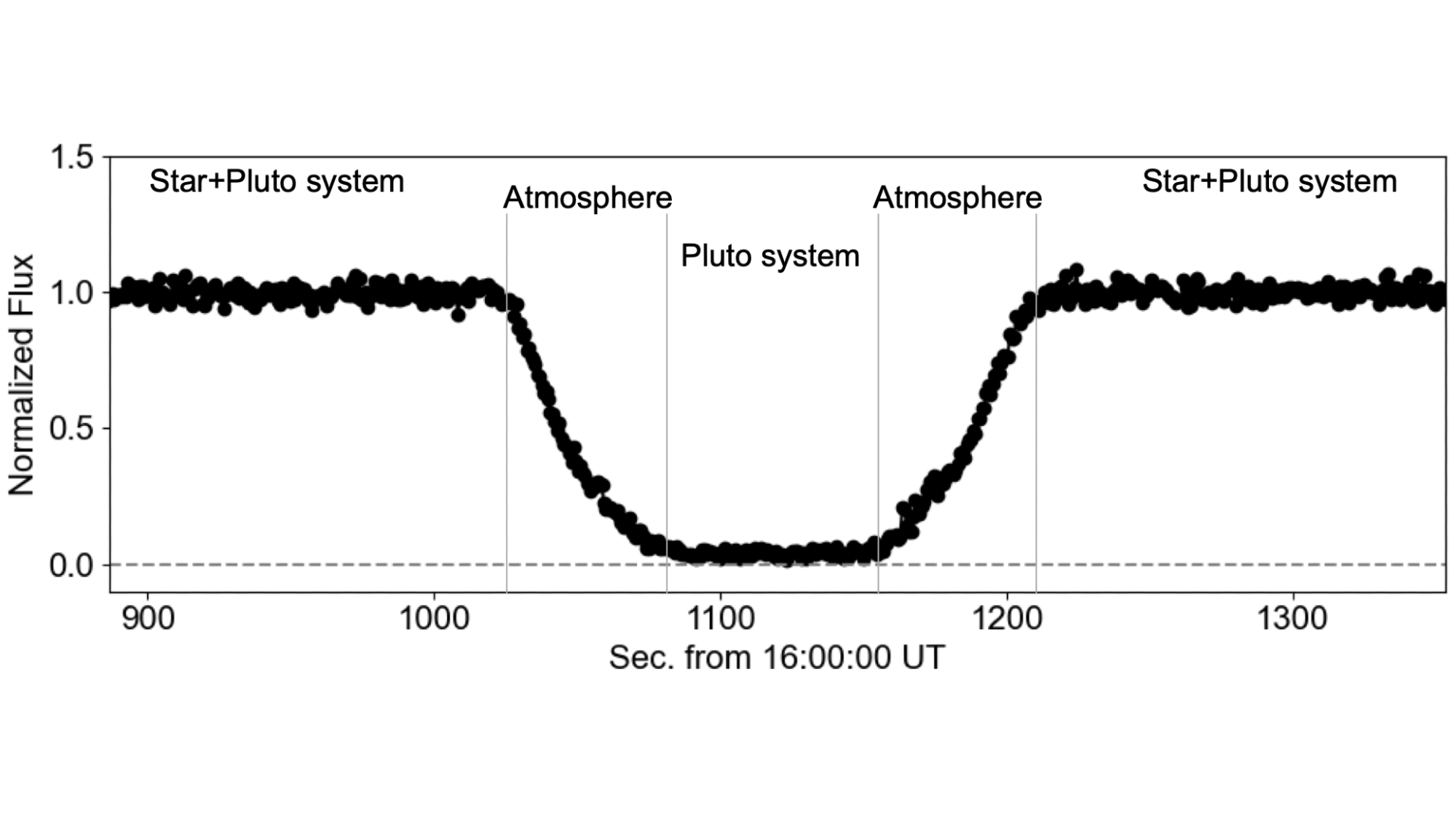
Light curve from the June 1, 2026 occultation, observed from Savannah Skies Observatory in Chillagoe, Queensland, Australia. The gray vertical lines indicate different stages of the occultation. The baseline flux level contains combined light from the star and the Pluto system (Pluto plus all of its moons). The flux drops gradually as the starlight bends and scatters in Pluto's atmosphere, reaching nearly zero flux as defined by only light coming from the Pluto system. As the star appears on the other side of Pluto, the light gradually reappears in the atmosphere before returning to full strength. (Image credit: A. Sickafoose/Planetary Science Institute)
Previous work had suggested that Pluto's atmosphere began freezing out in 2018, but Sickafoose's team found that actually, Pluto's atmosphere remained constant from 2015 to midway through 2021. However, between mid-2021 and the last occultation that Sickafoose's team observed in 2023, Pluto's atmospheric pressure dropped by 16 per cent.
The pressure drop was deduced from the light curves, which show how the star's brightness changed with time during an occultation. The light curves revealed that while the structure of Pluto's upper atmosphere remained fixed, the lower atmosphere changed.
Sickafoose's team interprets this as being the haze particles settling towards lower latitudes. This is what is expected to happen when the atmospheric pressure drops.
"I am hopeful that we'll be able to get more data in the next years to decades to specifically confirm or refute this trend," said Sickafoose.
It is thought that Pluto's atmosphere won't have completely frozen onto the dwarf planet's surface by the time it reaches aphelion, and then as Pluto begins moving in towards the sun once more the feeble solar heating that Pluto receives will slowly begin to increase, causing nitrogen frost to sublimate from the surface and thicken the atmosphere once more.
The Oort Cloud is one of the strangest places in the Solar System because it has never been seen directly. Astronomers infer its existence from the paths of long-period comets: icy bodies that spend most of their lives in deep space and only occasionally fall toward the Sun. NASA describes the Oort Cloud as a […]
Planetary researchers analyzing images from NASA’s New Horizons spacecraft have found evidence that liquid nitrogen may still be seeping up from beneath the dwarf planet’s giant glacier, Sputnik Planitia, marking the first suggested case of recently flowing liquid on Pluto’s surface.
It makes sense to think that the T3SS didn’t evolve into the bacterial flagellum, but that the bacterial flagellum shed some protein parts to become a T3SS.
O Bluesky anunciou um novo recurso que permite ocultar as repostagens de um determinado usuário no feed. Aos moldes da ferramenta equivalente do X, ele permite que a sua página inicial não seja inundada com compartilhamentos de posts de terceiros feitos por pessoas que você segue.
Para aplicar a ação a um determinado usuário, basta abrir as opções do perfil (os três pontos ao lado do botão “Seguindo”) e selecionar “Hide reposts in feeds”.
v1.130 is live!Want to follow someone for their posts but not their reposts? Now you can — turn on "Hide reposts in feeds" for any account you follow.
v.1.130 está no ar! Quer seguir alguém pelos seus posts e não pelos seus reposts? Agora você pode — ligue o “Hide reposts in feeds” para qualquer conta que você segue.
Ao The Verge, os desenvolvedores anunciaram que estão lançando um recurso beta que exibe automaticamente uma contagem de postagens para threads (seu equivalente da Meta, o Threads, também conta com essa opção). Ele pode ser habilitado nas configurações do app.
Como ele já havia relatado anteriormente, a ideia da Apple é lançar os modelos Pro do ano que vem (chamados internamente de V73 e V74) com um design majoritariamente de vidro — material que estará tanto na parte frontal quanto na traseira, bem como na lateral, que será curva.
Essa lateral deverá contar com uma faixa metálica adicional para lhe dar suporte — uma adição que teria ocorrido no meio do projeto, depois que a Apple passou a enfrentar problemas na tentativa de conectar os dois painéis de vidro sem qualquer material intermediário.
Em resumo, o roteiro de produtos planejados pela Apple não teria mudado — os iPhones de vidro já estariam em fase avançada de testes e praticamente finalizados — e fontes na empresa afirmaram que ela espera “causar impacto” com a mudança no ano que vem.
Antes desse lançamento, no entanto, a Apple deverá lançar neste ano o primeiro iPhone dobrável (junto aos novos modelos Pro, com visual semelhante aos da geração atual), bem como o “iPhone 18”, o “iPhone Air 2” e o “iPhone 18e” — estes, porém, apenas no início do ano que vem.
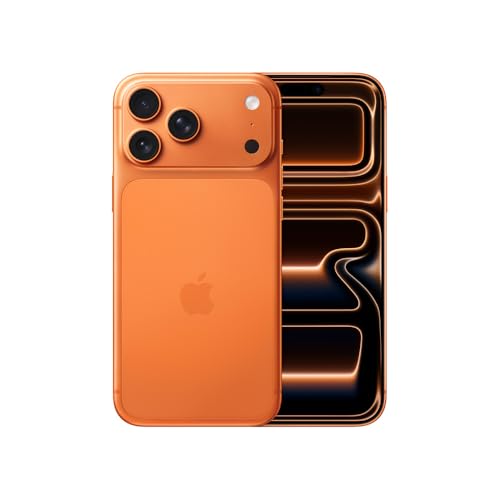
iPhone 17 Pro Max
Cores: prateado, laranja-cósmico ou azul-intenso Armazenamento: 256GB, 512GB, 1TB ou 2TB
NOTA DE TRANSPARÊNCIA: O MacMagazine recebe uma pequena comissão sobre vendas concluídas por meio de links deste post, mas você, como consumidor, não paga nada mais pelos produtos/serviços usando os nossos links de afiliado.
Um dia desses, falamos sobre o CloudGear, uma plataforma cuja proposta é funcionar como uma alternativa mais poderosa que o Safari para jogos na nuvem — basicamente um navegador mais otimizado para esse tipo de atividade em relação ao browser nativo da Apple.
Falaremos hoje sobre um app ainda mais completo, o Portal: Remote Play. Além de uma plataforma para cloud gaming, ele suporta também o streaming de jogos remoto — que é quando o game é executado no próprio console do usuário, o qual funciona como um servidor.
Outro diferencial importante é o suporte a mais plataformas para além do GeForce NOW e do Xbox Cloud Gaming, já que usuários também podem jogar títulos elegíveis do PlayStation — e nas duas modalidades oferecidas pelo app: remotamente e via nuvem (Cloud Streaming).
O Portal também suporta HDMI e UVC — o que o permite receber e exibir no iPhone, iPad, Vision Pro ou Apple TV o sinal de jogos executados em outros dispositivos por meio de uma placa de captura compatível, sem depender de transmissão de streaming pela internet.
O Portal: Remote Play é gratuito para baixar na App Store e experimentar, mas para desfrutar do conjunto completo de recursos oferecidos por ele é necessário aderir a um dos planos de assinatura premium (semanais, mensais, trimestrais e anuais) ou adquirir um pacote por uma compra vitalícia.
Começando pela parte visual, a Apple continua a fazer ajustes em alguns ícones de aplicativos — como o Safari, o app da Siri, os Ajustes (Settings), o Controle Remoto, a App Store e o Pré-visualização (Preview), entre outros.
O ícone do Safari está em um azul mais claro, com linhas e setas da bússola mais detalhadas, enquanto o ícone do app da Siri se parece mais com o “balão” que aparece quando ela está ativada.
Can you actually spot the difference between Safari app icon:
O ícone da App Store está mais translúcido para que você possa ver melhor cada linha que compõe o “A”, enquanto o do app Ajustes também ficou mais translúcido em algumas partes.
Já o ícone do app Pré-visualização tem uma aparência completamente diferente, com uma lupa sobre um fundo colorido, enquanto o ícone do Controle Remoto também ganhou mais detalhes e foi atualizado com um fundo cinza em vez de preto.
A quinta beta do iOS 27 também expandiu ainda mais as opções de personalização da voz da Siri. Em versões anteriores, os controles deslizantes de Ritmo e Expressividade estavam disponíveis apenas para as vozes da Siri com sotaque americano.
Agora, essas opções de ajuste estão disponíveis para qualquer voz americana, além de todas as vozes com sotaque britânico já existentes. Isso significa que agora há 11 vozes compatíveis que permitem escolher diferentes configurações de ritmo (velocidade da fala) e expressividade (nível de emoção e ênfase).
iOS 27 Beta 5 expands Siri voice customization.
Pace and Expressivity can now be adjusted across more Siri voices, including all seven American voices and all four British voices. pic.twitter.com/Ma0aZDRHio
Conforme observado pelo pessoal do 9to5Mac, o código da quinta beta iOS 27 mostra que a Apple está trabalhando em algo chamado “Imagem de Referência” (Apple Reference Image), um possível novo recurso projetado para autenticar a origem das fotos usando dados vinculados ao hardware da câmera do iPhone.
Para isso, o sistema enviará a imagem ao Private Cloud Compute para autenticação, sendo que certas informações do sensor e metadados da foto são enviados de volta para a Apple — embora ela garanta que não acessará a foto original.
Atualmente, o recurso está desativado por padrão e, quando for lançado, poderá ser ativado em Ajustes » Câmera » Imagem de Referência e tocando em “Modo de Referência”.
Essa verificação só será possível se as fotos forem capturadas com o referido modo ativo. Isso significa que as fotos tiradas normalmente não conterão as informações de procedência necessárias para a autenticação posterior; além disso, se a Apple determinar que um sensor pode ter sido comprometido, ela poderá revogar as autenticações anteriores associadas a esse sensor.
As fotos autenticadas também poderão ser compartilhadas com outras pessoas, de modo que as informações incluídas no compartilhamento variarão dependendo do método usado (AirDrop, Mensagens, etc.) e se a foto é uma versão original, editada ou autenticada. Se o usuário optar por compartilhar “Todos os Dados de Fotos”, a Apple afirma que a transferência também pode incluir identificadores de hardware exclusivos e qualquer vídeo não cortado associado à imagem.
Por fim, a reportagem aponta que a Apple também está adicionando uma opção “Transferir com Procedência” (Transfer with Provenance) para transferências feitas a partir de um cabo USB. Quando ativada, as fotos autenticadas transferidas para um Mac ou PC incluirão os dados de Imagem de Referência, enquanto as fotos não autenticadas ainda poderão conter informações de procedência, como identificadores de hardware exclusivos e qualquer vídeo não cortado.
RCS da Claro
Como notado por testadores da nova beta, a Claro começou a testar o suporte ao padrão RCS 1Rich communications service, ou serviço de comunicação rico., o que indica que ela pretende cumprir a promessa de liberar essa funcionalidade ainda neste ano.
Outras novidades menores vistas com as novas betas incluem novas telas de apresentação quando os aplicativos Carteira (Wallet), Apple Music, App Store e Fotos são abertos pela primeira vez após o update.
iOS 27 beta 5 includes new Splash Screens for Calendar, Photos, and Apple Music pic.twitter.com/TVSytZQJbg
A Apple também fez ajustes na Central de Controle com a beta mais recente. Os tipos de rede celular não são mais exibidos — então você não verá “5G” ou “LTE” quando seu telefone estiver conectado a uma rede Wi-Fi. Ademais, a Central de Controle e a barra de status agora apresentam novas barras de ícones de rede celular.
Apple increased the height of the Cellular Data signal bars in the Status Bar and added a matching Control Center icon in iOS 27 Beta 5. pic.twitter.com/LabNcVkR8F
Na seção Busca do aplicativo Ajustes, a Apple adicionou uma nova opção chamada “Antes de Buscar” (Before Searching), permitindo que os usuários escolham quantos aplicativos aparecem como sugestões durante as buscas, entre outras coisas.
🚨 New feature Alert 🚨
iOS 27 Dev Beta 5 lets you devices how many apps spotlight suggests when first opening it up. You can keep it at 8, switch to 4 or just say none
No app Contatos (Contacts), caso um contato criado por você tiver uma empresa associada, o nome da empresa aparecerá na lista — abaixo do nome — e nos resultados de busca.
New in iOS 27 beta 5: If a contact has a company name added, it now shows in the main view pic.twitter.com/xNtSXnYY5E
Há uma fonte mais espessa para a seção de Alarmes e Timers do aplicativo Relógio (Clock).
A configuração mais transparente do Liquid Glass está mais translúcida do que na versão beta anterior.
Agora existe uma opção para ativar ou desativar o recurso “Personalizar Respostas Inteligentes” no aplicativo Mail. O recurso vem desativado por padrão e pode ser ativado na seção Mail do aplicativo Ajustes.
iOS 27 beta 5 adds a new setting for mail called Personalize Smart Replies
“Smart Reply can learn from your sent Mail messages to suggest responses that sound more like you” pic.twitter.com/LvD6NNkJod
A seção Bateria do aplicativo Ajustes agora informa se uma conexão de rede móvel ruim está causando consumo excessivo de bateria.
O aplicativo Ajustes agora também mostra quando a atualização mais recente do iOS foi instalada.
O recurso de criação de passes do app Carteira já está disponível fora dos Estados Unidos.
A fonte San Francisco dos números do indicador de bateria foi trocada por uma versão mais arredondada.
They swapped SF Pro to SF Pro rounded for the battery percentage on beta 5 Certainly looks better pic.twitter.com/6cK6asCtGH
— ShrimpApplePro 🍤 ずっと真夜中でいいのに (@VNchocoTaco) August 11, 2026
Foram encontradas referências à disponibilidade da Apple Intelligence na China, incluindo menções a “mecanismos de segurança” disponibilizado por empresas locais.
iOS 27 beta 5 preps support for Apple Intelligence in China
"Apple Intelligence is built for privacy. To comply with laws and regulations, Apple Intelligence in China uses a safety mechanism provided by a local company. Your requests are processed on-device and not sent to Apple… pic.twitter.com/mCwiwZqqMi
A protein called TRAILshort may act as a central immune brake that limits T-cell responses and CAR-T therapy. Cancer cells can weaken the immune system by producing a protein that prevents its most important defenders from attacking. Mayo Clinic researchers have identified how this protein works, revealing a possible target for treatments designed to improve [...]
Today was a cloudy and rainy day In my part of Florida and I was bored, so I decided to try Tahoe 27 Beta 2. I did a thorough cleaning of my Mac mini, made two SupeDuper clones and Time Machine backup. I'm happy to report the download and installation went as smooth as maple slurple! I'm still working my way through it but so far all seems well. I'm sure some minor glitches may occur along the way, but overall it seems solid.

 Login