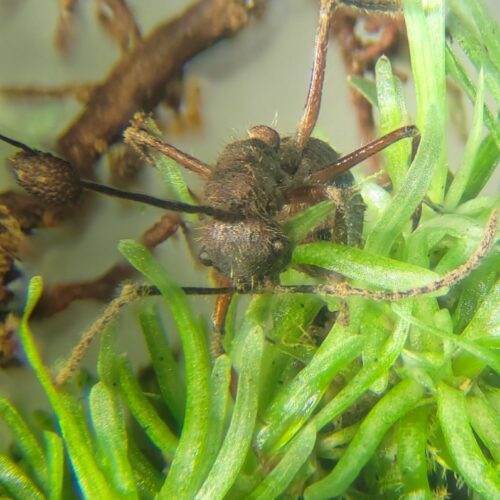
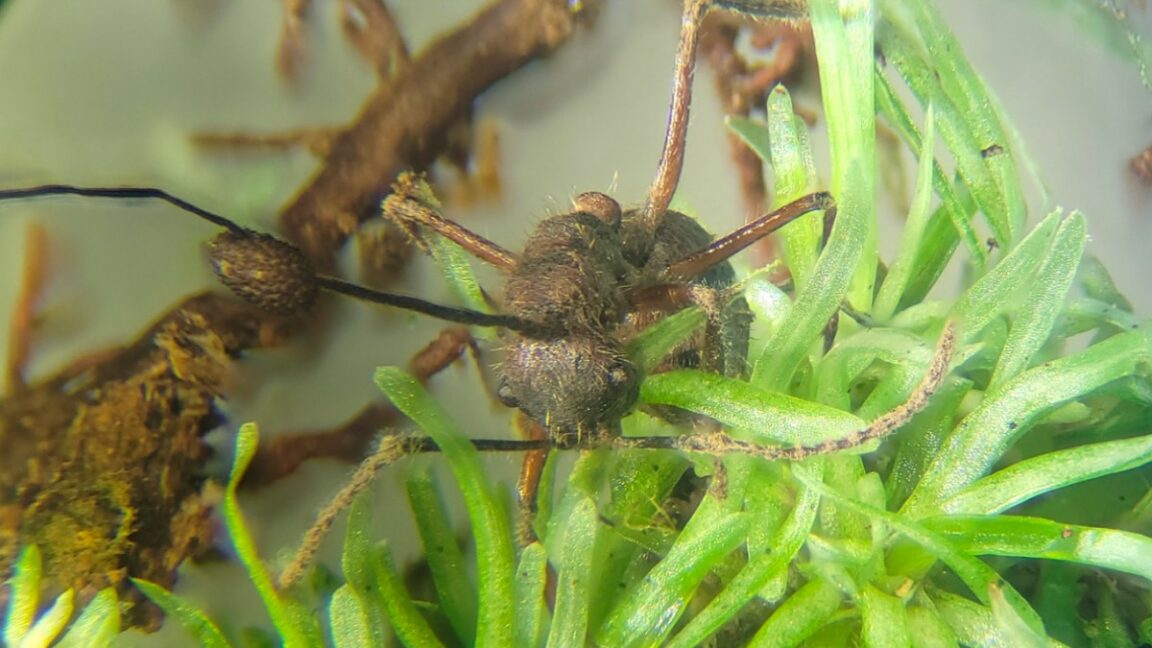
The parasitic fungi in the Cordyceps genus are a favorite subject of nature documentaries. They've also infiltrated popular culture via the zombie-apocalypse video game The Last of Us (2013) and its TV adaptation, in which a parasitic fungus mutates to infect humans. Scientists are keen to study Cordyceps to learn more about the origins and intricate mechanisms underlying these pathogen-based diseases.
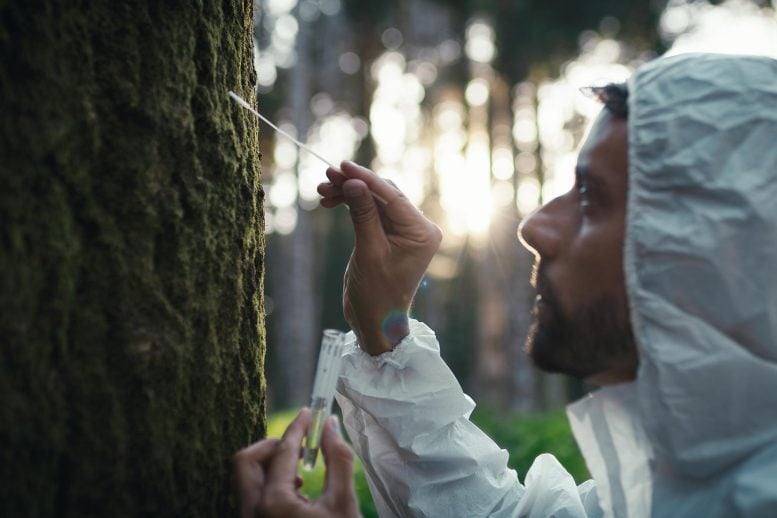
The latest finding: DNA analysis revealed the same fungus in both parasitized insects and surrounding mosses, according to a paper published in the journal IMA Fungus. (Yes, really.) This suggests a second life stage during which the fungus lives inside the moss, possibly an evolutionary adaptation to survive when insect hosts may be scarce. It could also explain why the host species seems to prefer biting into mosses during their final death throes.
As we've previously reported, there are more than 400 different species of Cordyceps fungi, each targeting a particular insect species, like ants, dragonflies, cockroaches, aphids, or beetles. The spores attach to the target insect, such as a carpenter ant, and germinate, spreading through the host’s body via long tendrils called mycelia. Cordyceps essentially turns its host into a zombie slave, compelling the ant to climb to the top of the nearest plant and clamp its tiny jaws in a death grip around a leaf or twig.
Botanists are still proving Charles Darwin right with their recent identification of a new carnivorous plant growing in China’s mountainous forests.
Saxifraga candelabrum is a small, yellow flower with a taste for flesh that may one day help protect endangered crops, and researchers have revealed their detailed analysis of the carnivorous plant, conducted both in the field and the laboratory, in a recent paper published in Nature Communications.
The carnivorous plant attracts, traps, and finally digests prey, typically consisting of fruit flies and other small insects, breaking them down with a caustic enzyme that it produces.
Charles Darwin and Carnivorous Plants
Although it was philosopher Herbert Spencer who actually coined the phrase “survival of the fittest,” it was Charles Darwin who developed the concept behind it in his work on natural selection. With an eye towards survival in a harsh natural world, Darwin suggested in 1875 that some plants in the genus Saxifraga may be more than just beautiful flowers—they may also be very patient hunters.
Darwin’s suspicion centered on Saxifraga species other than S. candelabrum, the plant examined in the new study. However, the basis for his hypothesis holds true: the father of evolutionary biology focused on the microscopic hairs covering the plants’ surfaces, a feature shared by both the species he studied and the newly confirmed carnivorous plant.
Darwin suggested these hairs acted as a trap, capturing insects drawn to the flowers and holding them in place as the plants slowly absorbed nutrients from them. He was right.
A New Take on Carnivorous Plants
Most carnivorous plants rely on highly specialized structures to capture prey. The iconic clamping leaves of Dionaea muscipula, better known as the Venus flytrap, are one example. Another is Low’s pitcher plant, which lures insects into its pitcher-shaped trap before digesting them.
S. candelabrum, however, employs a far subtler strategy. Rather than relying on elaborate trapping structures, it uses innocuous-looking hairs covering its flowers and stems. Once insects land on them, they discover the bristles are exceptionally sticky, trapping them until the plant can digest them.
“The discovery of Saxifraga candelabrum reminds us that many inconspicuous carnivorous plants, or plants with partial carnivorous traits, may still exist in nature,” said lead author Hang Sun, a botanist at the Kunming Institute of Botany at the Chinese Academy of Sciences.
Investigating a Hidden Hunter
The team’s research involved a great deal of fieldwork, observing S. candelabrum consuming insects in the mountain forests of China. However, it was their detailed genetic analysis in the lab that later showed how similar the plant was to other carnivorous species, despite its unusually benign appearance.
As part of their laboratory experiments, the researchers fed the plants fruit flies while closely monitoring their behavior. These observations allowed the team to identify digestive enzymes secreted by the plant to break down nitrogen-rich nutrients from its prey.
Identifying a new carnivorous plant species is an uncommon achievement for botanists, with the last such discovery occurring only five years ago. Even more remarkable is that the finding so closely aligns with Charles Darwin’s century-old prediction.
The researchers say the discovery is more than a botanical curiosity. A better understanding of how carnivorous plants digest insects could eventually aid the development of natural pesticides and other agricultural tools, potentially transforming these tiny predators into allies for protecting the world’s food supply.
Ryan Whalen covers science and technology for The Debrief. He holds an MA in History and a Master of Library and Information Science with a certificate in Data Science. He can be contacted at ryan@thedebrief.org.
More than 500 meters beneath the Earth’s surface, a dark and ancient world teems with fungal life on a scale scientists had never imagined. A research team led by the University of Michigan has, for the first time, quantified the abundance of fungi in a deep subsurface site, reaching depths of up to 500 meters, […]
When Mount Vesuvius erupted in 79 CE, it spewed molten rock, pumice, and hot ash over the cities of Pompeii and Herculaneum, killing thousands of people. It's one of the most famous natural disasters in human history, so naturally there have been countless documentaries about Pompeii (and at least one popular song). But only one features actor Tom Hiddleston taking on the role of a "time detective" to bring the people of Pompeii to vivid life. That would be National Geographic's new three-part docuseries, Pompeii: Out of Time.
The Marvel connection made Out of Time happen. Executive producer Kevin Wright was also a producer on the Disney+ series Loki, which included a scene where Hiddleston's Loki travels through time to visit Pompeii. Hiddleston also studied classics at Cambridge University and had visited the Pompeii archaeological site as a teenager, which the Marvel star attributes to indirectly influencing his career path into acting.
"There is just a passion to the way Tom tells stories that's infectious," Wright told Ars. "We knew that if we could capture that and put it into [the series], it might interest people who wouldn't normally want to watch a documentary about Pompeii. "
A surprising discovery inside desert mosses could reshape scientists’ understanding of plant evolution. In some of the driest places on Earth, the ground itself can be alive. What looks like a thin, dark crust on desert soil may actually be a miniature ecosystem, packed with mosses, fungi, bacteria, algae, and tiny animals. These biological soil [...]

 Login