❌

Reading view

New class of magnons live a hundred times longer

University of Vienna researchers
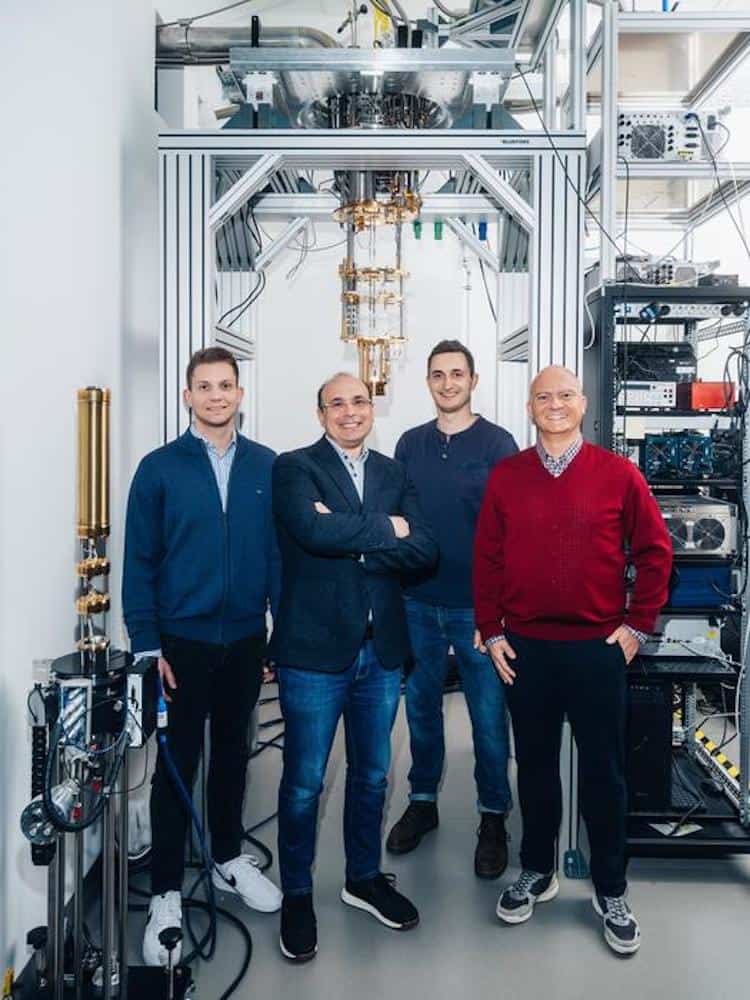
From left to right: University of Vienna researchers Rostyslav Serha, Andrii Chumak, David Schmoll and Sebastian Knauer standing in front of a cryostat. (Courtesy: Ian Ehm)

Bosonic quasiparticles such as magnons show much promise for enabling on-chip quantum information technologies that can be scaled down to the nanoscale, but their too-short lifetime has held back such applications until now. An international team of physicists says it has now increased this lifetime by a hundredfold, thanks to the discovery of a new class of magnons known as short-wavelength dipole-exchange magnons.

Magnons are the collective oscillations of coupled magnetic spins in a material. They are particularly promising for next-generation computing because they could allow for information processing based on the wave-like dynamics of these spins rather than the flow of electrons, thereby significantly reducing energy losses. They can also naturally couple to many other fundamental quasiparticles, such as phonons and photons, which makes them ideal as the building blocks for hybrid quantum systems.

The main drawback of magnons, however, is that they die too fast, explains Andrii Chumak of the University of Vienna, who led this latest study. “Indeed, their lifetimes are typically limited to a few hundred nanoseconds, something that puts a hard ceiling on what we can do with them in a quantum architecture.”

A lifetime of up to 18 µs

In this work, which is detailed in Science Advances, the researchers discovered short-wavelength dipole-exchange magnons in highly pure, single-crystal yttrium iron garnet (YIG) spheres held at millikelvin temperatures. These magnons last for up to 18 µs, which is nearly two orders of magnitude longer than that previously observed for these quasiparticles.

As often in science, the discovery was accidental, says Chumak. “We had prepared three YIG spheres with varying degrees of purity for planned quantum experiments with superconducting qubits, and we simply wanted to characterize these spheres and identify the one that hosted the longest magnon lifetime,” he recalls.

“An 18 microsecond lifetime places magnon coherence on a par with that of typical transmon superconducting qubits used in today’s quantum processors,” he tells Physics World. “This reshapes the role magnons can play in hybrid quantum architectures – from lossy intermediaries to robust quantum memories and low-loss links able to mediate interactions between distant qubits on a chip.”

A programmable on-chip “quantum bus”

And that’s not all: long-lived magnons coupled to superconducting circuits could act as a programmable on-chip “quantum bus”, entangling many distant quantum bits (qubits) made from these hybrid structures along a common waveguide, rather than only nearest neighbours, he adds. The results also point to a clear materials-science route to push magnon lifetimes even further, in particular by continuing to reduce rare-earth impurity concentrations in YIG.

There is a way to go before real-world applications see the light of day, however. For one, the researchers still have some physics to understand, but that is what makes the project so intriguing for them, they say.

Chumak says that the most immediate future step in his team’s work will be an echo-type experiment to measure the lifetime of these magnons directly, rather than inferring it from the so-called parametric instability threshold, as was done in this work. “In parallel, we will need to learn how to excite and detect these short-wavelength magnons efficiently using nanoscale transducers, which is essential before they can be integrated with superconducting qubits.”

“The field of quantum magnonics is still very young compared to other quantum platforms,” Chumak notes, “so it will take some time before we reach actual quantum computing applications – but the path is now much more concrete than it was a year ago.”

The post New class of magnons live a hundred times longer appeared first on Physics World.

  •  

Altermagnets can turn neighbouring materials altermagnetic, too

Altermagnets can transfer their unusual magnetic properties to nonmagnetic materials placed next to them, say theorists in China and the US. This so-called “proximity effect” had already been observed in ferromagnets and superconductors, but it is new for altermagnets, which were only recognized as a distinct class of magnetic materials in 2024. If confirmed experimentally, the team says the effect could aid the development of advanced quantum materials with applications in fields such as spintronics, valleytronics and fault-tolerant quantum computing.

In ferromagnets, proximity effects make it possible to tune properties such as magnetic anisotropy, coercivity and exchange bias in nonmagnetic materials that have acquired magnetic polarization from a neighbouring ferromagnet. Similarly, ordinary materials that have picked up superconducting correlations from a nearby superconductor are a mainstay of experiments on topological superconductivity and topological quantum computing.

In the latest research, physicists led by Tong Zhou of the Eastern Institute of Technology in Ningbo sought to understand whether altermagnets could likewise transfer their behaviour to a neighbouring material. To do this, they created a model of a van der Waals bilayer heterostructure in which the bottom layer is a two-dimensional (2D) altermagnet, V2Se2O, while the top layer is a non-magnetic semiconductor, PbO.

Zhou explains that the vanadium atoms in V2Se2O form two opposite-spin sublattices that are connected by rotational symmetry rather than by simple translation or inversion. This complex structure is what gives V2Se2O its characteristic altermagnetic spin splitting, with a band structure in which spin-up and spin-down electrons have different energies that vary in periodic patterns. V2Se2O also has a so-called spin texture, which is a pattern of spin polarization that produces a net zero magnetization in the material.

First-principles calculations

Using first-principles calculations, the researchers found that the distinctive symmetry-patterned magnetism of V₂Se₂O can indeed transfer into the PbO layer across the interface between them. As a result, Zhou says the originally spin-degenerate bands of PbO develop a clear momentum-dependent spin splitting.

Importantly, this pattern is not arbitrary. Instead, it follows the symmetry expected from the altermagnetic order of V2Se2O. What is more, the real-space spin density of the PbO mirrors the symmetry of the V2Se2O, showing that it has inherited altermagnetism rather than simply becoming generically spin polarized.

When the researchers rearranged the V2Se2O into a conventional antiferromagnetic configuration with no alternating spin splitting, they found that the induced splitting in PbO disappeared. They also observed that the degree of induced splitting decreases when the PbO is placed further away from the V2Se2O, confirming the proximity effect.

As a final piece of evidence, the researchers searched for similar proximity effects in other altermagnetic systems, ranging from insulators to metals and covering material platforms with 3D architectures as well as 2D ones. “Even graphene, one of the most common 2D materials, can acquire altermagnetic characteristics when interfaced with CrSb, which is an experimentally well-established altermagnet,” Zhou notes.

Altermagnets as interfacial “spin-pattern generators”

One of the work’s main implications is that altermagnets could be used to generate spin patterns in many otherwise non-magnetic materials, Zhou tells Physics World. “This means that instead of searching only for intrinsic altermagnets, we can now design ‘proximitized’ altermagnetic systems by combining an altermagnet with a semiconductor, metal or superconductor,” he says.

In semiconductors, Zhou notes, the altermagnetic proximity effect can induce controllable spin and valley splitting, which are promising for spintronics and valleytronics devices, respectively. In superconductors, meanwhile, the effect can generate momentum-dependent spin splitting without the need to apply an external magnetic field or introduce net magnetization – something that Zhou says offers a new route toward topological superconductivity and the Majorana modes that could revolutionize fault-tolerant quantum computing. “More generally, this effect provides a versatile platform for designing field-free spin devices, topological quantum devices and multifunctional van der Waals heterostructures,” he says.

Looking ahead, Zhou and colleagues say they would now like to observe the altermagnetic proximity effect in heterostructures fabricated in the laboratory. They also want to find out how to control the strength of the effect – for example, by changing interlayer spacing, stacking, strain, gating and possibly even layer twisting.

“More fundamentally, an important question is how fast and how reversibly altermagnetic order, and therefore the altermagnetic proximity effect, can be reconfigured dynamically,” Zhou says. “That would be especially interesting for controlling spin-dependent transport and topological phases in real time.”

The research is described in  Physical Review Letters.

The post Altermagnets can turn neighbouring materials altermagnetic, too appeared first on Physics World.

  •  

Pigeons’ immune system can sense Earth’s magnetic field, study suggests

Some animals could sense Earth’s magnetic field by using the superparamagnetic properties of white blood cells in their livers, a new interdisciplinary study has revealed. Led by Clivia Lisowski at the University of Bonn, the team’s insights into homing pigeon navigation could help scientists resolve the decades-old mystery of how animals can sense magnetic fields. The research also shines new light on the inner workings of the immune system.

Animals ranging from sharks to bats appear to use Earth’s magnetic field to navigate during long migratory voyages. However, the nature of this magnetoreception is poorly understood.

“How they sense Earth´s magnetic field has been a mystery,” Lisowski explains. “Several hypotheses were suggested, but these have often resulted from laboratory experiments. They were hardly ever done in the field, and so couldn’t explain how migration would work at night or in dark environments.”

In their study, Lisowski’s team investigated the origins of magnetoreception in homing pigeons. These birds are famous for finding their way back home after being released in unfamiliar locations. “We combined expertise from research fields that usually are not intersected, namely immunology, physics and animal behaviour,” Lisowski explains. “[This gave] us a truly interdisciplinary approach to solve the mystery of magnetoreception in homing pigeons.”

Searching for magnetism

As part of this approach, the researchers searched for magnetism in several different tissues of the bird – including the liver, spleen, muscle, and beak. They used vibrating-sample magnetometry (VSM), whereby samples are placed in a constant magnetic field and vibrated up and down. If the sample is magnetic, it will induce an electric field that is proportional to its magnetization.

The team also did field studies of homing pigeon flight patterns and studied the birds’ anatomy. The latter involved using dyes to visualize microscopic structures embedded in tissues along with genomic assays of the tissues.

This combined analysis revealed the presence of superparamagnetic macrophages in homing pigeon livers. Macrophages are specialized white blood cells whose primary function is to engulf and digest pathogens. They are a cornerstone of the immune system. Superparamagnetic means that the macrophages are very easily magnetized.

“The macrophages are superparamagnetic due to their physiological function of degrading old and damaged red blood cells,” Lisowski explains. “They sequester and store the iron from red blood cells as oxide nanoparticles in ferritin proteins.”

Connecting to the brain

Within homing pigeon livers, the researchers found that these macrophages were often in the vicinity of – and sometimes even in direct contact with – nerve fibres in liver tissue. This could allow magnetic information to be passed from macrophages to the brain.

At the atomic level, Lisowski’s team proposes that the effect emerges from unpaired electrons in ferritin proteins, which interact with each other through magnetic dipole–dipole coupling to enhance their magnetic susceptibility. This subatomic effect could in turn explain the distinctive circling behaviour observed in pigeons after they take off. This circling could allow these unpaired electrons to be imprinted with magnetic information, before the birds settle into a more uniform flight.

The research could also improve our understand of the immune system. The team suspects that the sensing abilities imparted by their superparamagnetic properties could enable macrophages to better gauge their surrounding environments: distinguishing between what to fight, and what to tolerate.

“Our finding that the immune system can also sense the Earth´s magnetic field is a completely new layer in this concept of ‘immuno-sensation’, and opens the door to new research,” Lisowski says.

The research is described in Science.

The post Pigeons’ immune system can sense Earth’s magnetic field, study suggests appeared first on Physics World.

  •  

Pluto’s Moon Charon May Still Be Slowing Its Spin, Study Suggests

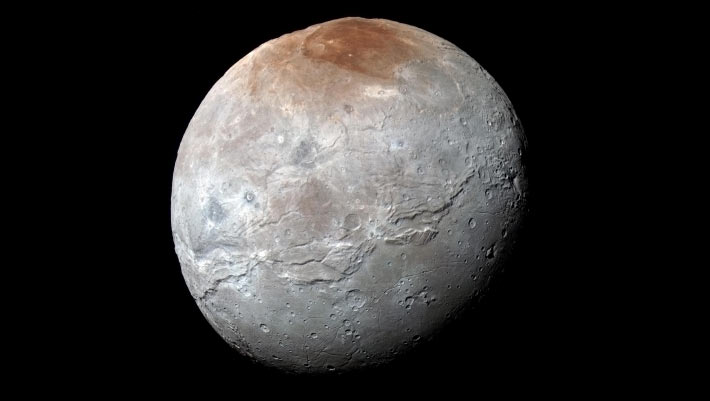
This impressive view of Charon was captured on July 14, 2015. Charon’s color palette is not as diverse as Pluto’s; most striking is the reddish north (top) polar region, informally named Mordor Macula. Image credit: NASA / Johns Hopkins University Applied Physics Laboratory / Southwest Research Institute.

New research indicates that Pluto’s largest moon, Charon, may continue to lose rotational energy despite the pair’s long-standing tidal lock, offering scientists a rare glimpse into the hidden interiors of distant icy worlds.

The post Pluto’s Moon Charon May Still Be Slowing Its Spin, Study Suggests appeared first on Sci.News: Breaking Science News.

  •  

The Black Hole Tango: Kicks and Spins in Hierarchical Mergers

Artist's impression of a group of black holes in a globular cluster

Editor’s Note: Astrobites is a graduate-student-run organization that digests astrophysical literature for undergraduate students. As part of the partnership between the AAS and astrobites, we occasionally repost astrobites content here at AAS Nova. We hope you enjoy this post from astrobites; the original can be viewed at astrobites.org.

Title: Gravitational-Wave Kicks Impact Spins of Black Holes from Hierarchical Mergers
Authors: Angela Borchers, Claire S. Ye, and Maya Fishbach
First Author’s Institution: Max Planck Institute for Gravitational Physics
Status: Published in ApJ

The room is large and densely packed. As you twirl across the floor, someone extends their hand, inviting you to dance. The two of you spin around each other, the tension building with every step. As you draw closer and closer, you realize this isn’t a ballroom, and you’re not people. This is outer space, and you and your partner are black holes, spiraling toward one another in one of the most energetic events in the universe: a black hole merger.

In this cosmic dance, black holes in a binary system orbit each other while also spinning around their own axes. Their spins are inherited from the angular momentum of the massive stars that collapsed to form them. After the two black holes merge, the remnant black hole also spins. The final spin depends on the spins of the two merging black holes and the ratio of the mass of the larger black hole to that of the smaller one. The higher the mass ratio, the more the larger black hole dominates the final spin. To quantify how fast black holes spin, physicists use a dimensionless spin parameter that ranges from 0 (not spinning at all) to 1, the maximum allowed by general relativity.

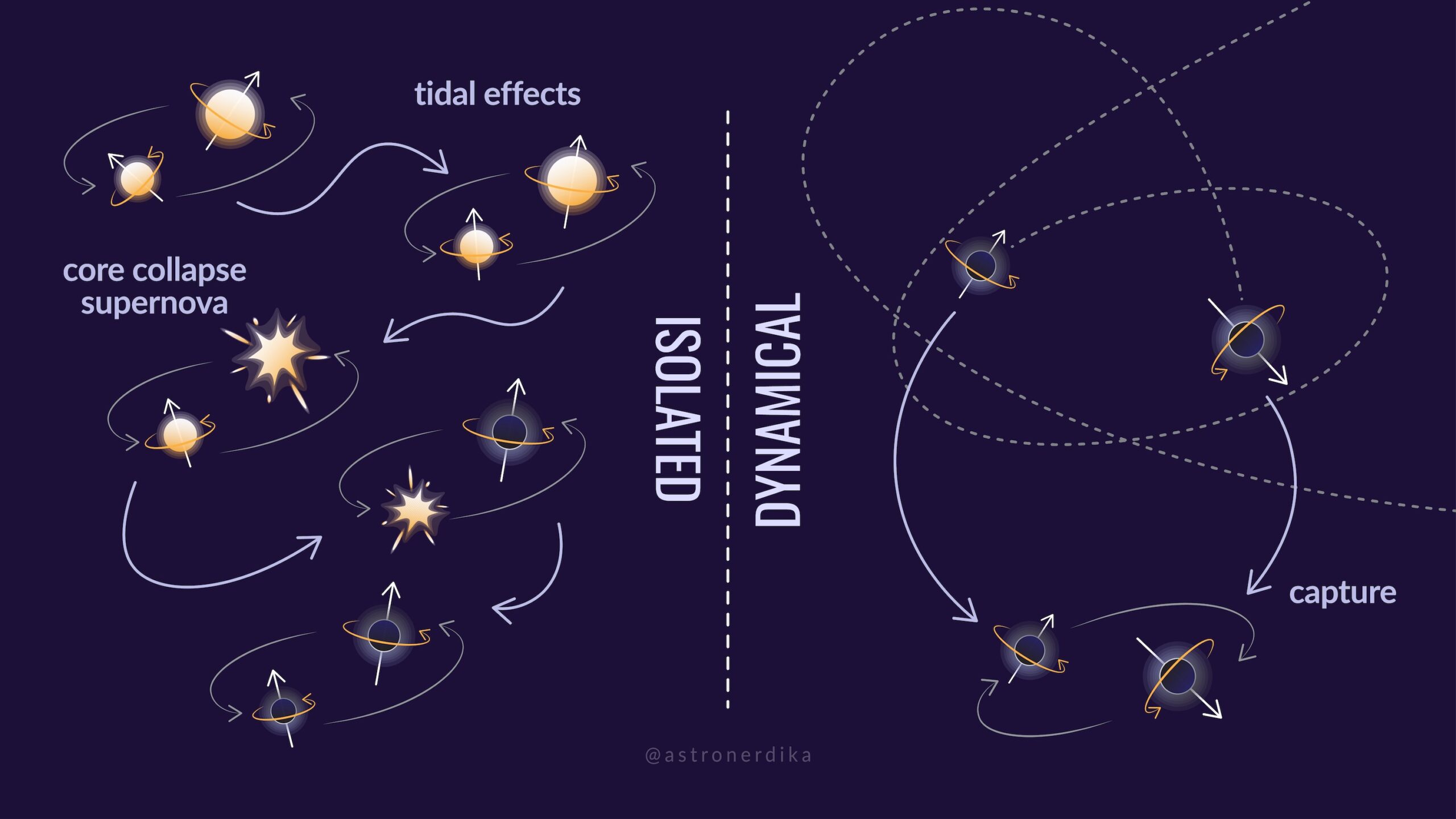
Observing the distribution of black hole spins helps us understand how binary systems form. For example, binaries formed through isolated channels, where the black holes are born and evolve together, are likely to have similar spin magnitudes, and the directions of their spins tend to align with their orbital motion. In contrast, black holes that form separately and later become a pair through dynamic encounters in dense environments typically have randomly oriented spins (see Figure 1). To determine which formation channels are more common, we need accurate predictions of the expected spin distributions for each scenario to compare them directly to merger observations from detectors like LIGO/Virgo or future gravitational-wave observatories.

infographic showing formation channels for black hole binaries

Figure 1: Graphic showing two main formation channels of black hole binaries. [Reproduced with permission from Shanika Galaudage/Space Australia]

In a dense environment, such as a globular cluster, black holes can undergo multiple consecutive mergers, known as hierarchical mergers. With this in mind, we assign “generations” to black holes: first-generation (1G) black holes have never merged, second-generation (2G) black holes are the product of one previous merger, and so on. After several generations, the spin distribution of black holes has been shown to peak at approximately 0.7, independent of the mass ratios and spins of the first-generation binaries. However, studies have often overlooked an important factor that may impact this distribution: recoil kicks.

After a merger, the newly formed black hole receives a “kick” velocity — a shove that sends it moving through space. This happens because gravitational waves carry away linear momentum asymmetrically during the merger, and to conserve momentum, the remnant black hole recoils in the opposite direction. If its kick exceeds the escape velocity of its cluster, the remnant is ejected, making it unlikely to merge again. However, remnants that receive smaller kicks are retained and can go on to merge again, contributing to the spin distribution over multiple generations. The authors of this article study the final spin distribution of black holes that remain within a cluster after forming from hierarchical mergers.

Simulating Binaries in a Globular Cluster

The authors simulate a first-generation population of one million black holes that are assumed to all have the same initial spin, labeled ai. The authors use data from globular cluster simulations to determine the properties of binaries found in dense environments. The final spin, af, and kick velocity of the black holes are calculated using a high-accuracy model of black hole merger remnants. Only black holes with kick velocities less than the escape velocity of typical globular clusters are kept in the population for future mergers. For their analysis across multiple merger generations, the authors test escape velocities of 50, 100, and 200 km/s.

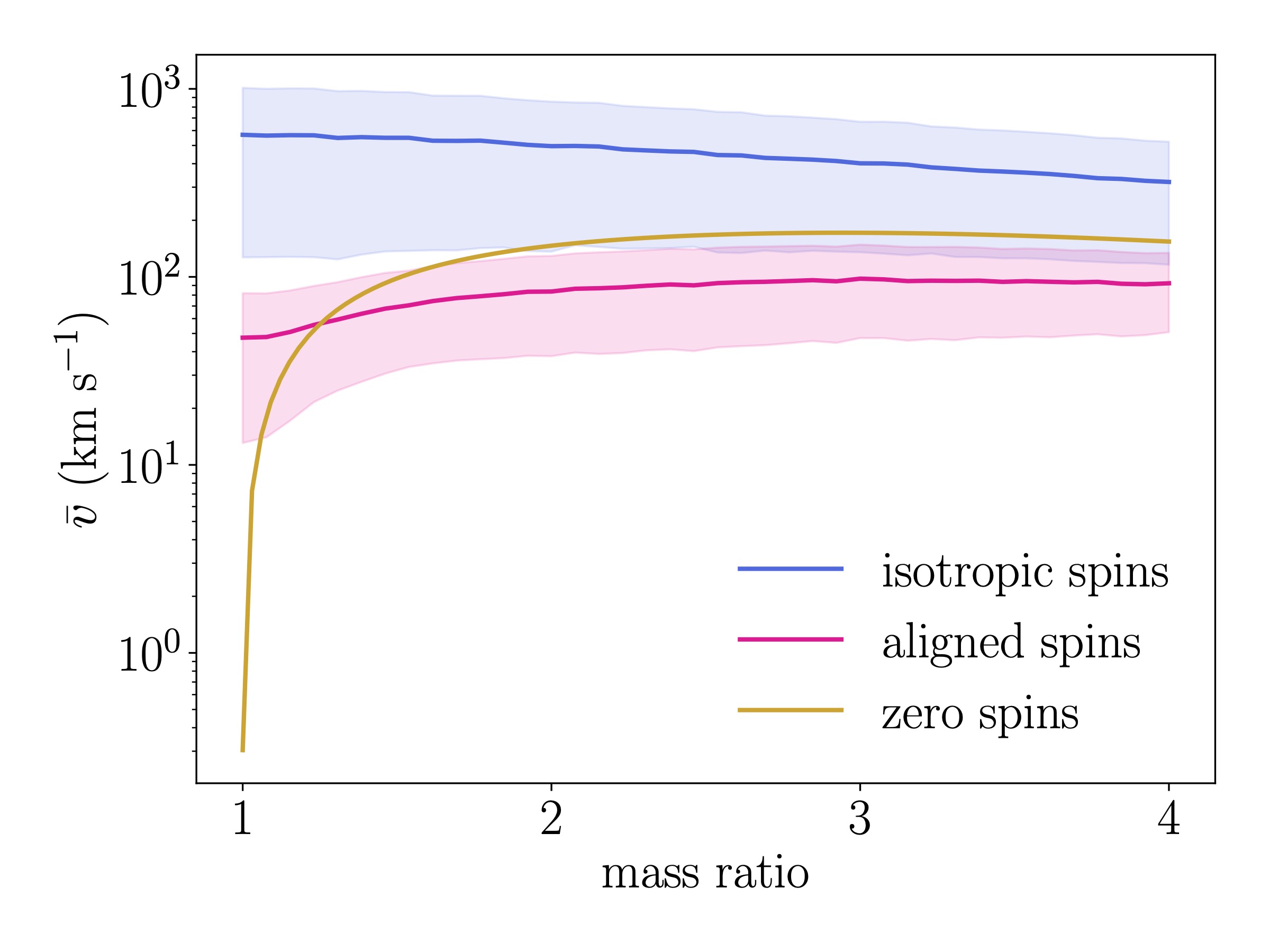
Some initial binary configurations are more likely to produce high kick velocities that could eject the remnant from the cluster. Figure 2 shows that binaries with isotropic (randomly oriented) spins tend to produce larger kicks than those with spins aligned with the orbital motion.

plot of kick velocity as a function of mass ratio

Figure 2: Kick velocity as a function of mass ratio for three types of black hole binaries: ones with random spin directions (blue), ones with spins aligned with the orbital motion (pink), and ones with zero spin (yellow). Each point shows the average from 10,000 simulated binaries, with spin magnitudes up to 0.8. Solid lines show the average kick velocity; shaded regions show the spread. [Borchers et al. 2025]

Spin Distribution of 1G + 1G Mergers

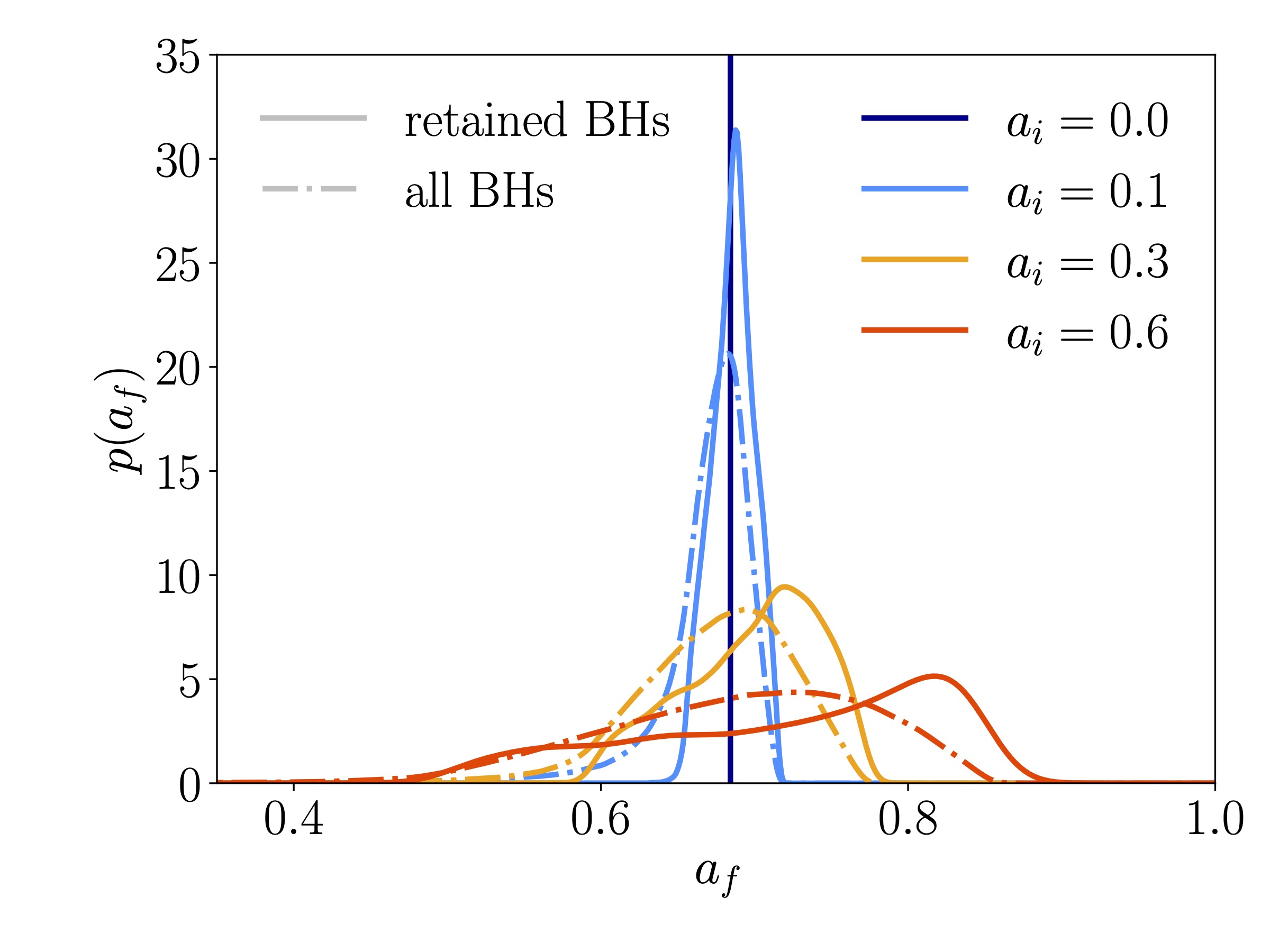
Figure 3 shows the final spin distribution from mergers between two first-generation black holes for different initial spin values. It compares all merger remnants (global population) to those that stay in the cluster (retained population). As expected, the distribution peaks around 0.7 for the global population. However, the peak shifts to higher spin values when only retained remnants are considered.

plot of spin distribution of black hole merger remnants

Figure 3: Spin distribution of 1G+1G merger remnants with different initial spin magnitudes and randomly oriented spins. The dashed lines show the distribution for all remnants, while the solid lines show the distribution for those that remain in the cluster. For the ai = 0.0 case, the vertical line is centered at af = 0.69. [Borchers et al. 2025]

This happens because, as Figure 2 shows, binaries with aligned spins tend to produce lower kick velocities, making them more likely to stay in the cluster. At the same time, aligned spins lead to remnants with higher final spins, so the retained population is biased toward higher spins.

The authors also examine the effect of escape velocity on the spin distribution. Higher escape velocities make the distribution more similar to the global population, while lower escape velocities lead to broader distributions with more support at higher and lower spins.

Spin Distributions of Higher-Generation Mergers

Figure 4 shows how the spin distribution changes over several generations of black hole mergers. As more generations pass, the spin distribution of the retained black holes starts to look quite different from the global one. In particular, it spreads out and shows a broader range of spin values.

plot of probability distribution of final black hole spins

Figure 4: Final spin distribution for different merger generations. The dashed lines show the distribution for all remnants, while the solid lines show the distribution for those that remain in the cluster. [Adapted from Borchers et al. 2025]

The authors also test different starting spin values and escape velocities. While the global spin distribution tends to settle into a consistent shape after a few generations, the authors find that the retained spin distribution does not. Instead, the spin distribution of black holes that stay in the cluster depends on several factors: the binaries’ initial spins and mass ratios, what generation they belong to, and the escape velocity of the cluster. So, there isn’t a single “universal” spin distribution for retained black holes — it changes depending on the environment and merger history.

Hierarchical mergers are considered a pathway to forming intermediate-mass black holes, potentially explaining events like GW190521. Current gravitational-wave detectors are observing more and more black hole mergers, and future detectors will measure their spins more precisely. Accounting for the spin distributions of black holes that remain in clusters rather than the universal distribution will help us better understand and measure how hierarchical mergers contribute to the gravitational-wave population.

Original astrobite edited by Ryan White.

Authored by Viviana Cáceres.

The post The Black Hole Tango: Kicks and Spins in Hierarchical Mergers appeared first on AAS Nova.

  •  

A New Way to Measure Black Hole Spin

Messier 87 jet

Upgraded interferometers will give researchers a never-before-seen view of the jets of active supermassive black holes. By modeling what might be seen when these instruments come online, researchers have discovered a new way to measure black hole spin.

Black Holes and Relativistic Jets

Closeup of Messier 87's relativistic jet

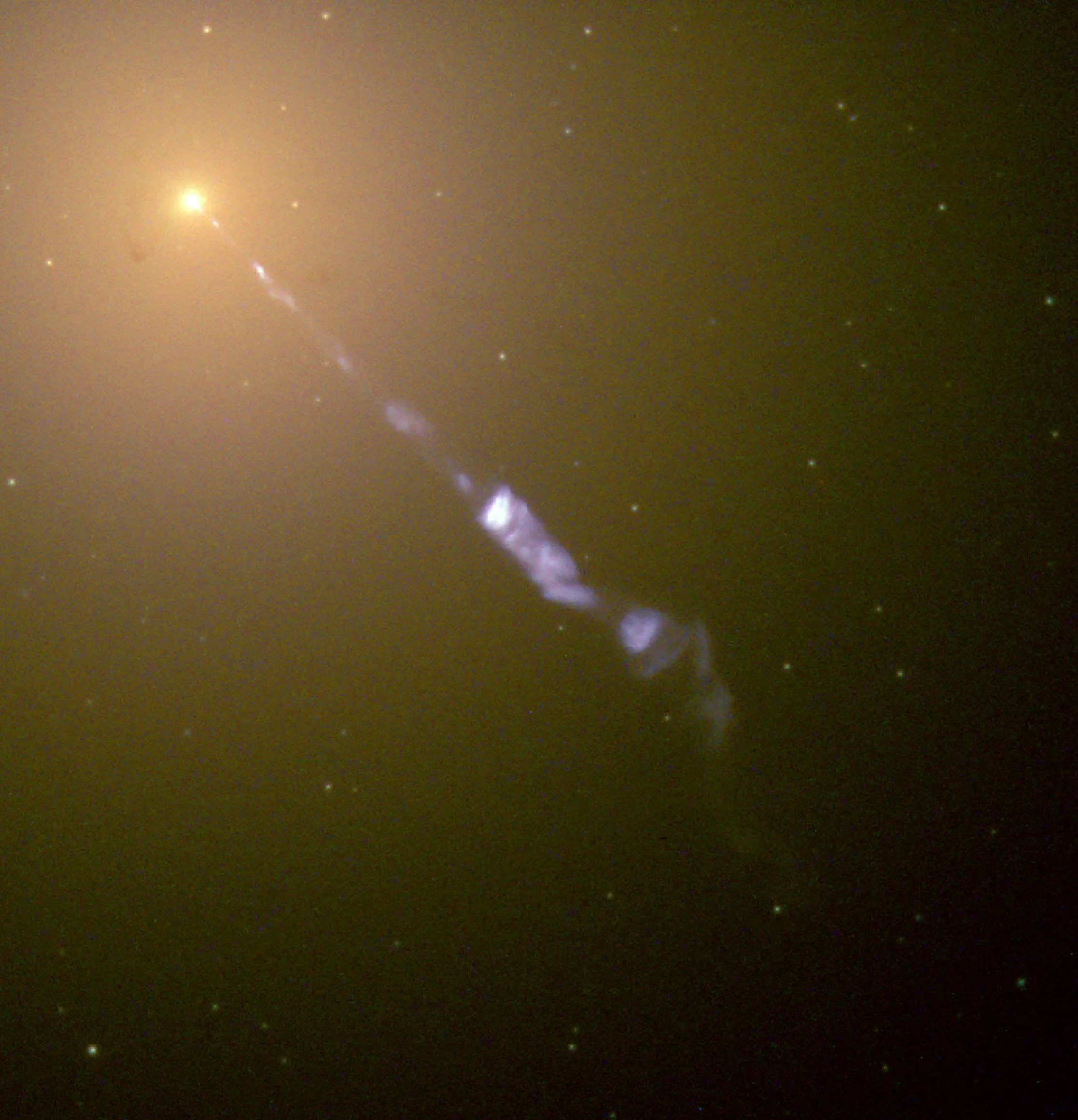
Closeup of Messier 87’s relativistic jet. [NASA and the Hubble Heritage Team (STScI/AURA)]

Galaxies across the universe harbor supermassive black holes. Determining the properties of these black holes — their masses and spins — is key to understanding the formation and evolution of supermassive black holes and how they shape the evolution of their host galaxies.

Some supermassive black holes produce relativistic particle jets that are thought to be powered by the black hole’s spin. This means that precise observations of black hole jets could provide a potential way to measure the spin of a black hole.

Planned and proposed interferometers will stretch observing baselines to great distances — even into space — to attain the high resolution necessary for this sensitive measurement. Building on the successes of the Event Horizon Telescope, a planet-spanning interferometer that has revealed images of the supermassive black holes at the center of the giant elliptical galaxy Messier 87 and the Milky Way, observatories like the Next-Generation Event Horizon Telescope and the Black Hole Explorer will advance our understanding of supermassive black holes and relativistic jets.

Tracing Rays from Modeled Jets

To learn what might be gleaned from future images of black holes and black hole jets, Zachary Gelles (Princeton University) and collaborators developed a model of a nearly face-on relativistic black hole jet, much like the jet from Messier 87’s black hole. The team’s model incorporates both general relativistic magnetohydrodynamics, which describes a magnetized fluid subjected to the rules of Einstein’s General Theory of Relativity, and force-free electrodynamics, which focuses on the dynamics of the system’s electromagnetic fields.

ray-traced polarized image of a relativistic jet

Ray-traced polarized image of a collimated black hole jet. The white bars show the direction of polarization, while the color scale shows the normalized intensity. Several abrupt changes in the polarization direction as a function of radius are visible. Click to enlarge. [Adapted from Gelles et al. 2025]

With this model in hand, the team used ray tracing — following the paths that photons would take through the modeled jet — to predict how the jet would appear in polarized light. Examining the results for jets with varying degrees of narrowness, or collimation, the team noted that the polarization of the most collimated jet behaved strangely, with the polarization angle changing dramatically with position.

Gelles and coauthors demonstrated that one of these sudden polarization changes happens at the black hole’s light cylinder, or the radius at which the jet becomes relativistic and the magnetic field switches from being mostly poloidal to mostly azimuthal. Because the position of the light cylinder is dependent upon the spin of the black hole, measuring the location of this polarization swing allows for a measurement of the black hole’s spin.

The Promise of Polarization

This method has several potential advantages over other methods. Unlike the current leading method for measuring black hole spin, X-ray spectroscopy, this method applies to low-luminosity active black holes, which are thought to be common throughout the universe. And while the model includes a number of simplifications, the team asserts that incorporating features of more realistic jets, such as asymmetry, is unlikely to change the outcome.

plot of polarization angle as a function of impact parameter

Polarization direction as a function of impact parameter, showing the locations and causes of the abrupt changes in polarization angle. Click to enlarge. [Gelles et al. 2025]

Gelles’s team also showed that the location of the polarization flip for slowly spinning black holes is 10 times farther out than it is for rapidly spinning black holes. What this means in practice is that determining whether a black hole is slowly or rapidly spinning doesn’t require extraordinarily high resolution, just a general sense of where the flip happens.

Looking forward, Gelles’s team plans to continue their simulations, shoring up their predictions until they can be tested when future interferometers come online.

Citation

“Signatures of Black Hole Spin and Plasma Acceleration in Jet Polarimetry,” Z. Gelles et al 2025 ApJ 981 204. doi:10.3847/1538-4357/adb1aa

The post A New Way to Measure Black Hole Spin appeared first on AAS Nova.

  •  
❌