Reading view
The Friday File: Starlink; Verizon; World Bank
Mobile World Live (MWL) brings you our top three picks of the week as SpaceX CEO Elon Musk outlined Starlink’s global broadband ambitions, Verizon lifted the lid on the network behind the FIFA World Cup 2026 and the World Bank urged developing nations to boost AI adoption.
Musk targets global broadband domination with Starlink
What happened: Musk outlined plans to increase Starlink’s network capacity 100-fold, claiming the satellite broadband business could eventually “deliver a majority of the world’s internet”.
Why it matters: The tech mogul said the goal hinges on the rollout of an expanded V3 satellite constellation capable of delivering around 10 times the performance of current V2 models. To support the plan, the company asked the US Federal Communications Commission (FCC) for approval to deploy up to 100,000 low-Earth-orbit V3 satellites, supplementing the roughly 9,600 V2 satellites already in orbit. Musk argued the additional capacity would allow Starlink to eventually carry a majority of global internet traffic in countries where the service is authorised to operate, while driving a tenfold increase in Starlink revenue even if revenue per bit falls by 90%. Quilty Space founder and CEO Chris Quilty told MWL that the company’s “bold claim” flouts its “prior statements that Starlink was most appropriate for rural user”. While V3 satellites are expected to provide a “10x boost”, he noted “aggregate network capacity is a misleading metric because capacity is geographically distributed while demand is geographically concentrated”. Earlier this week, SpaceX president Gwynne Shotwell claimed that Starlink Mobile could compete directly with operators including AT&T, Verizon and T-Mobile US using upgraded satellites and additional spectrum.
Podcast: Inside Verizon’s World Cup connectivity
What happened: In the latest edition of the MWL podcast, Kavit and Justin sat down with Verizon wireless chief network officer Srini Kalapala, who detailed how the operator delivered connectivity as the official network provider for the FIFA World Cup 2026.
Why it matters: Earlier this month, the operator revealed its network carried almost 500TB of data across all US host stadiums, including 29.2TB during the final between Argentina and Spain. To handle demand, Verizon boosted stadium capacity by three to five times, installed thousands of under-seat antennas, deployed nearly 140 small cells around venues and fan zones, and laid 80,000 miles of fibre to transport broadcast feeds from all World Cup stadiums. In the podcast, Kalapala described the tournament’s “104 games in 39 days across 18 different stadiums in three countries” as “probably one of the largest projects that we worked on.” He explained Verizon had to ensure stadiums comprising 70,000 to 85,000 people could access “good quality mobile connectivity”, while also delivering “the most reliable network” for broadcasters and powering private 5G applications including referee cameras.
World Bank urges lower income nations to grasp AI opportunity
What happened: The World Bank called on developing economies to accelerate AI adoption, arguing low-cost, locally adapted tools could accelerate economic development without requiring frontier models or hefty AI infrastructure investments.
Why it matters: In its World Development Report 2026: The Promise of Artificial Intelligence, the organisation said AI “could allow developing countries to do in a decade what might otherwise take a century”, provided governments address gaps in electricity, internet access, digital skills and institutions. World Bank SVP and chief economist Indermit Gill said AI has “thrown developing economies a lifeline”, but warned countries “must hurry” because the technology is “spreading faster and is more context-specific than earlier general-purpose technologies”. He added many high-impact use cases do not require large models or data centres, instead relying on “small, low-cost AI tools” tailored to local conditions. The report highlighted applications across healthcare, agriculture, tax collection and judicial services, while warning AI could also deepen inequality and weaken public trust without appropriate action. Foresight Communications Consultancy CEO Howaida Nadim argued the World Bank’s framework recognises that “greater opportunity lies in adopting proven tools and adapting them to local languages, data, institutions and development priorities”. She added “the next AI divide” might be “between those that successfully adapt AI to their development needs and those that remain primarily consumers of systems built elsewhere”.
The post The Friday File: Starlink; Verizon; World Bank appeared first on Mobile World Live.
Musk targets global broadband domination with Starlink
SpaceX CEO Elon Musk (pictured) highlighted an ambitious growth plan for the company’s Starlink broadband service, forecasting a hundredfold increase in total delivered bandwidth driven by its next-generation V3 satellite constellation.
Speaking on SpaceX’s first earnings call as a public company, Musk and president Gwynne Shotwell detailed a long-term strategy to capture a majority of global internet traffic in accessible markets.
To support the push, the operator recently applied to the Federal Communications Commission seeking approval to deploy up to 100,000 low-Earth-orbit satellites for its V3 satellite network, supplementing the approximately 9,600 broadband V2 birds currently in orbit.
SpaceX’s Starlink broadband customers doubled to 12 million year-over-year despite price increases for the service. Starlink ended Q2 with service availability in 167 markets “with some very exciting announcements coming soon,” he said.
Those numbers are the tip of the iceberg, according to Musk.
“This is a big deal,” he said. “It’s kind of hard for people to wrap their minds around this, but it’s not out of the question that at some point, Starlink will deliver a majority of the world’s internet, at least in countries where we’re allowed to operate.”
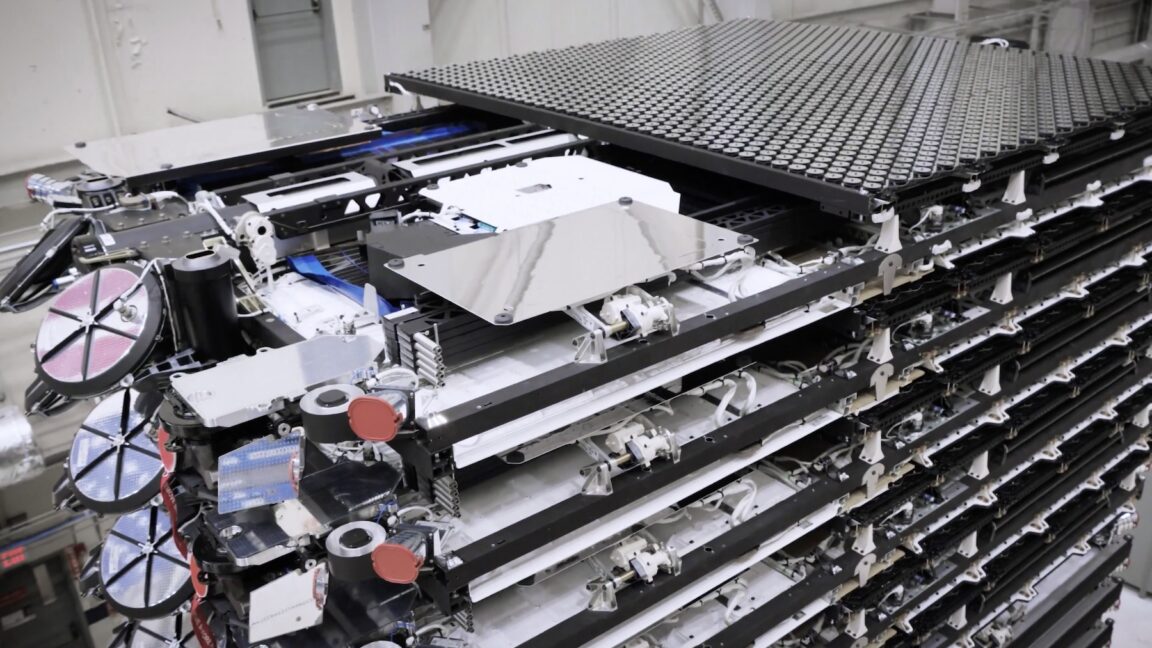
Musk stated individual Starlink V3 satellites deliver roughly 10 times the performance of V2 models. While V2 hardware typically maxes out between 100Mb/s and 450Mb/s depending on network congestion, the V3 constellation deployment is designed to unlock gigabit-class downlinks for standard end users.
Musk stated a V3 Starlink bird will launch on Starship flight 14, but this time they’ll enter an “operational orbit.” Last month’s Starship flight sent up a batch of V3 satellites as part of a suborbital test.
“The Starlink V3 satellite is about an order of magnitude more capable than the Starlink V2 satellite, which was already a very capable satellite,” he explained. “And we expect to launch about an order of magnitude more Starlink V3 satellites.
Combined with plans to launch 10 times as many V3 birds, the upgraded constellation is projected to increase overall bandwidth capacity by two orders of magnitude. He emphasised that even if revenue per bit decreased by 90%, the expansion will still drive a tenfold increase in Starlink revenue.
“It’s certainly a bold claim and one that contravenes the company’s prior statements that Starlink was most appropriate for rural users,” Quilty Space founder and CEO Chris Quilty told Mobile World Live. “Starlink V3 will provide a 10x boost, reaching 8Pb/s of downlink capacity, but aggregate network capacity is a misleading metric because capacity is geographically distributed while demand is geographically concentrated.”
AI compute capacity
SpaceX ended Q2 with 1.4 gigawatts of compute capacity, up from 1 gigawatt in the prior quarter and 400 megawatts a year ago.
“We expect to end this year with over 2 gigawatts of compute,” Musk stated.
Asked about the outlook for compute capacity, Musk revised his earlier target upward on the call. Rather than the roughly 10 gigawatts previously floated for the end of 2027, he said SpaceX is now aiming for approximately 15 gigawatts of power and cooling capacity online by the end of next year, with a stretch goal of 20 gigawatts.
“We’re actually aiming to far exceed that gigawatt number in terms of power online, power cooling, and electrical equipment,” he explained.
“I don’t think we’re going to achieve 20 gigawatts, but we want to have a series of projects that cumulatively come to 20 gigawatts by the end of next year,” he added. “Our goal is to have far more power, cooling, and electrical equipment than we have GPUs. That’s a logical thing to do given the relative expense of GPUs.”
He said SpaceX is taking the expertise it uses for rockets and satellites and applying it to scaling terrestrial data centres.
“SpaceX as a company is incredibly good at hardware,” Musk said.
Going forward on data centres, Musk said SpaceX has decided “to build exclusively on Nvidia, because we think the Vera Rubin is the best architecture.”
The post Musk targets global broadband domination with Starlink appeared first on Mobile World Live.
Finding room in Starlink’s shadow

Another wave of constellations has staked claims for communications satellites in non-geostationary orbit (NGSO), but what hope do newcomers have alongside the industry’s entrenched, vertically integrated giants? A mix of […]
The post Finding room in Starlink’s shadow appeared first on SpaceNews.
Report: Apple’s Private Relay may not be as private as thought ↦
A story by 404 Media’s Joseph Cox, who last month broke the news about a flaw in Apple’s Hide My Email feature, is now back to report that iCloud Private Relay, a feature that is supposed to obfuscate users’ IP addresses, may not be so private:
A series of issues in Apple’s web browser engine — the tech underlying all browsers on iOS — means that Apple’s iCloud Private Relay tool, which is supposed to hide a user’s IP address, in many cases doesn’t actually work. Instead, the issues mean a malicious attacker can set up a website to learn a Private Relay user’s real IP address, or that many websites have also already collected this information incidentally. The issues also impact OnionBrowser, an iOS app for browsing the web through the Tor anonymity network, the researchers who discovered the issues say.
Fascinatingly, this flaw seems to be due to the implementation of passkeys: the authentication happens out of band, in a separate connection, and therefore never runs through Private Relay.
The security researchers who uncovered the issue have put up a site that lets you check if you’re affected; I wasn’t able to test it this morning, as the Wi-Fi network I’m using as of this writing doesn’t support Private Relay at all. (Joke’s on me, I guess!) They’ve also reported the vulnerability to Apple, who did not provide a timeline for fixing it, but allowed them to disclose the issue nonetheless.
Cox points out that along with the Hide My Email bug, this is the second time that a vulnerability has affected Apple’s paid privacy features, since both are part of the iCloud+ subscription. Though Apple did finally patch the Hide My Email flaw late last month, a second flaw is not a great look for a company that prides itself on privacy and security.
SpaceX spooks investors with debut earnings report
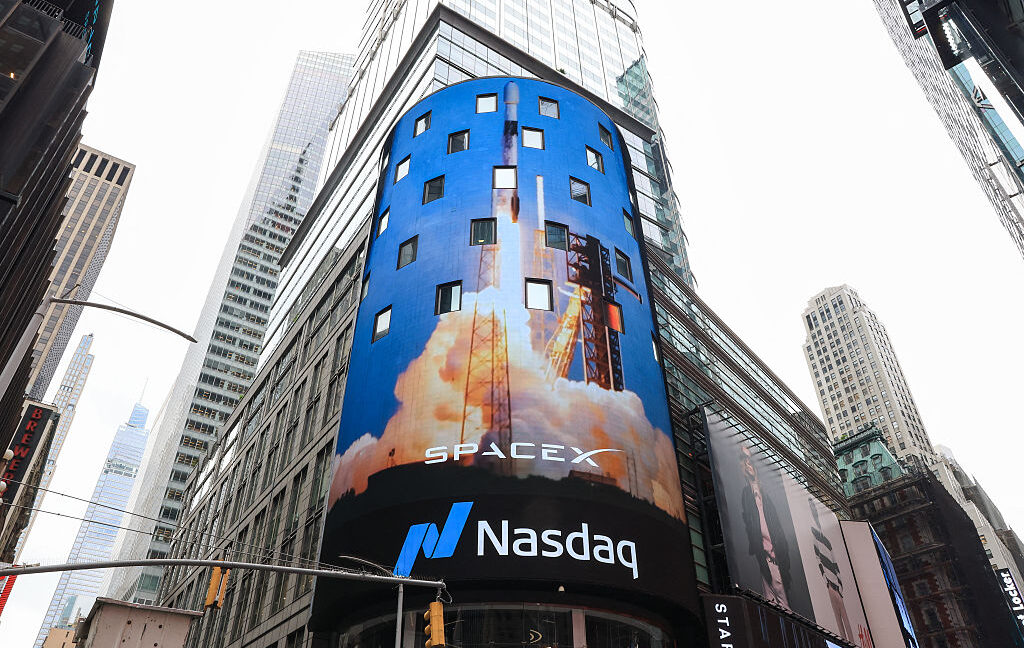
SpaceX shares dropped on Wednesday after Elon Musk’s plans for blockbuster spending to position his AI and rocket company as a data center developer spooked investors.
SpaceX surpassed analysts’ expectations in Tuesday’s debut earnings report, posting quarterly revenues of $7.8 billion, well above analysts’ estimates of $6.82 billion and up 92 percent from a year earlier. It posted a net loss of about $541 million, better than estimates of $2.12 billion.
But shares in SpaceX fell 10 percent in early trading after it reported capital expenditure of almost $16 billion on AI, double the previous quarter and well above Wall Street’s expectations. It said spending would persist at current levels for at least two more quarters.


© Timothy A Clary/GEtty
SpaceX claims Starlink Mobile will rival AT&T, Verizon, T-Mobile US
SpaceX president Gwynne Shotwell claimed Starlink Mobile is positioned to compete directly with AT&T, Verizon and T-Mobile US, pointing to the trio’s roughly $600 billion in combined annual revenue as a measure of the opportunity.
Speaking on SpaceX’s Q2 earnings call, Shotwell said the service’s capability could improve roughly 100-fold once the company deploys next-generation birds and spectrum acquired from EchoStar, with commercial service targeted to begin by the end of next year.
Shotwell said the current direct-to-cell system operates using around 5MHz of bandwidth through local telco partners, but SpaceX now has access to 65MHz of bandwidth via the EchoStar spectrum deal, alongside plans to deploy roughly 10 times as many satellites.
“So, simplifying, you could look at Starlink Mobile leveraging the next-generation satellite and the EchoStar spectrum as being 100 times better, 10 times 10 better than what we’ve got right now,” she said, adding the upgraded service already supports voice and video calls over apps such as Signal and WhatsApp.
Shotwell described a terrestrial deployment approach built around Starlink’s existing broadband hardware rather than a conventional cell tower build-out.
“You could put a base station, a cellular base station on the gear that holds a Starlink broadband dish,” she said. “You can have kind of these little femtocells around the country and you deploy that as you need it. You don’t have to necessarily spend many billions of dollars in low band spectrum all upfront before you deploy your system.”
She was reluctant to give a specific capex figure for the terrestrial build-out.
“We have a lot of really kind of great and new ideas for how we’re going to do that,” she said. “And I think it will be quite capex efficient.”
CEO Elon Musk elaborated on the same point, saying it was worth emphasising given its importance to the economics of the rollout.
Rather than deploying expensive, hard-to-site large cellular base stations, he said SpaceX expects to deploy a large number of small stations which are effectively Starlink dishes also equipped to provide connectivity in mobile spectrum bands.
“The Starlink antennas are located on the roofs of houses and businesses,” he said. “So, they’ve got a sort of a clear view for providing connectivity directly to cell phones on the ground.”
Musk expects the resulting service to offer “better and higher bandwidth than what is currently available from cellular providers”.
Shotwell stated SpaceX expects strong customer uptake once the improved service launches.
“I anticipate us to be able to acquire quite a few of their customers, because I think our service will be better,” she said, citing Starlink Mobile’s ability to eliminate dead zones and maintain service during natural disasters, given the relative stability of the satellite environment compared with terrestrial infrastructure on the ground.
Q2 numbers
SpaceX reported Q2 revenue of $7.8 billion, up 92 per cent year-on-year from $4.1 billion, in the company’s first results release since going public in June.
Net loss narrowed to $541 million, an improvement of $467 million from the $1 billion loss posted a year earlier.
Capex surged to $18.4 billion for the quarter, up from $2.8 billion a year earlier, driven overwhelmingly by the AI segment where it reached $15.8 billion. Space segment capex came in at $1.2 billion and Connectivity capex at $1.4 billion.
The AI division, spanning Grok, X, cloud infrastructure and advertising, posted revenue of $2.6 billion, up 247%, driven by new Cloud Services Agreements and Grok/X subscription growth.
The business generates compute-contract revenue from customers including Anthropic, Google and Reflection AI, though some recurring revenue has yet to be recognised.
The segment narrowed its operating loss 49% quarter-on-quarter to $1.3 billion, though SpaceX cautioned the unit needs sustained investment to turn profitable. It signed $14.1 billion in contracted Cloud Services Agreements and announced a $60 billion deal to acquire coding tool Cursor.
Connectivity, the Starlink-led segment, generated $4.3 billion in revenue, up 66%, with operating income up 79% to $1.7 billion. Starlink subscribers doubled to 12 million.
The Space segment posted revenue of $962 million, up 29% with an operating loss of $542 million as the company invested heavily in Starship.
SpaceX ended the quarter with $100 billion in cash and marketable securities, and a $47.5 billion backlog.
The post SpaceX claims Starlink Mobile will rival AT&T, Verizon, T-Mobile US appeared first on Mobile World Live.

SpaceX to begin Starship orbital flights

SpaceX plans to start deploying upgraded Starlink satellites into orbit on the next flight of its Starship vehicle, scheduled for as soon as the end of the month.
The post SpaceX to begin Starship orbital flights appeared first on SpaceNews.
OpenAI: “Apple is getting this wrong” ↦
From an un-bylined post on OpenAI’s site:
Apple’s request for a preliminary injunction is both based on false information and completely unnecessary because we do not have, nor want, any of their trade secrets. We’re much more interested in building innovative products and technologies that push the frontier.
The post itself includes numerous transcripts of message conversations1 and emails that supposedly bolster OpenAI’s case that it studiously avoided using Apple information.
This is, as The Verge’s Jess Wetherbed notes, a pure public opinion play. Because if they have evidence, the only correct answer is “we’ll see you in court.”
What kept running through my head while reading this was the old legal chestnut: “If you have the facts on your side, pound the facts. If you have the law on your side, pound the law. If you have neither on your side, pound the table.”
-
I can’t call them screenshots because even though they superficially resembles Messages, they are subtly off—the font, for example, is not correct.
I’m not sure if it’s a screenshot of a third-party app that looks like Messages, or a wholesale re-creation of the conversations in a Messages-like format. My hunch is the latter, but I don’t know.As my pal Lex Friedman points out, it’s all done in HTML, so clearly just a re-creation. ↩
Como gerar um código QR para uma página no Mozilla Firefox pelo Mac
Além de compartilhar uma página da web usando um link normal, o navegador Mozilla Firefox também permite enviar um endereço da web de outra forma.
Mais precisamente, trata-se da geração de um código QR (QR code) — que pode, posteriormente, ser lido a partir de qualquer câmera ou compartilhado em uma postagem, por exemplo.
Veja como fazer isso no seu Mac! 👨💻
Posts relacionados
- Com o Firefox aberto no seu computador, siga um dos seguintes procedimentos:
- Clique com o botão direito em cima da aba;
- Vá até “Arquivo”, na barra de menus;

- Selecione “Compartilhar” e “Gerar código QR…”.

- Clique em “Salvar” para fazer o download do código ou em “Copiar” para que ele seja copiado para a área de transferência.


The new space wars: lessons from Ukraine and the Middle East

In March 2021, while serving as a senior fellow at the Brookings Institution, I hosted a discussion with General Chance Saltzman, now Chief of Space Operations for the United States […]
The post The new space wars: lessons from Ukraine and the Middle East appeared first on SpaceNews.
MailMaven adds POP, AppleScript, and AI interaction ↦
Back in April of this year, I suggested that the MailMaven email app for macOS might become my new best friend. Months later, with continuous minor and major improvements, the friendship has only grown richer. MailMaven 1.1 in April added POP support for those people who rely on the ancient email mailbox protocol. But MailMaven 1.2, out last week, packed more punch: fully realized AppleScript support coupled with the open standard Model Context Protocol (MCP) to allow large language model AIs to engage with MailMaven. Michael Tsai evaluated the AppleScript support and wrote that it is “really impressive.”
Support for MCP via AppleScript means that you can have AI agents communicate directly with MailMaven to improve spam detection, recognize important messages, collect order or financial information, or perform an infinite number of other tasks in which your incoming or outgoing email acts as the hub of knowledge. SmallCubed, the app’s developer, has created a basic MCP server for Claude as a working example. You can write AppleScript from scratch using its terse, thorough guide, or point a code chatbot at the page to write AppleScript for you. I currently have a few nightly scripts that collate book sales and archive the day’s email by digging into MailMaven’s database; I need to rewrite those to use AppleScript instead!
Neuralink avança nos testes com implantes cerebrais e mostra como é possível controlar uma cadeira de rodas com a mente
Num novo vídeo, a Neuralink de Elon Musk mostra como a sua tecnologia de implantes cerebrais já permite que participantes com paralisia controlem cadeiras de rodas elétricas com a mente.
The post Neuralink avança nos testes com implantes cerebrais e mostra como é possível controlar uma cadeira de rodas com a mente appeared first on Tek Notícias.
Ils photographiaient la Terre depuis l'orbite, ils ont capté un satellite Starlink en plein vol : voici l'image rare qu'on ne devait pas voir

Apple tech will underlie Ford’s EV platform ↦
Apple and Ford today announced that Apple Maps will be integrated directly into Ford’s upcoming Universal Electric Vehicle (UEV) Platform through Apple’s new MapKit for Automotive SDK. Coming to Ford’s UEV Platform in 2027, this integration will deliver a beautiful and easy-to-use navigation experience powered by Apple Maps directly to the vehicle’s displays. Road-level Maps information will also enable Ford’s Latitude AI team to build a seamless hands-free driving experience.
This shouldn’t come as a huge surprise: Ford CEO Jim Farley has been bullish on CarPlay and the UEV project was previously headed up by Doug Field1, who spent several years at Apple both on the Mac hardware team and, more significantly, leading up the abandoned car effort.
This integration is interesting, though, because of the lukewarm reception of CarPlay Ultra in the automotive industry. The new “MapKit for Automotive SDK”, which as far as I can tell is being announced in this press release, seems more like the Android Automotive approach of building in support at a low level, though here it’s predominantly focused on navigation rather than providing the full stack for the car. Here’s how Apple describes it:
This integration is made possible by Apple’s new MapKit for Automotive SDK, which allows automakers to embed and customize Apple Maps. The SDK also enables automakers to deliver a cohesive navigation experience for drivers that is consistent with the look and feel of their vehicles, and provides road-level information to help automakers build hands-free driving experiences.
I also appreciated this little tidbit nestled at the very end of the press release:
In addition to the integration of Apple Maps into Ford’s UEV Platform, CarPlay will continue to be available on Ford vehicles, providing drivers with a safe and smart way to use their iPhone in the car.
Translation: Eat it, GM.
- Field announced his departure earlier this year. ↩
Origin Story: ‘Rage Against the Machine’ ↦
The season finale of Ian Dunt and Dorian Lynskey’s excellent Origin Story podcast is about the Luddites, and why the name doesn’t mean what you think it means.
It’s really about people reacting negatively to new technology that threatens their jobs, and therefore their livelihood. This might be extremely relevant to some modern technology topics, come to think of it.
(Available on Apple Podcasts / Spotify / Overcast / YouTube and everywhere else.)
Could China and Russia really destroy Starlink? Only with a boomerang.
One week ago, three widely respected European news outlets published the results of an investigation into what they described as a "joint plan" by China and Russia to "defeat Elon Musk's Starlink."
The story was the product of a long-running inquiry by The Insider, Der Spiegel, and Le Monde. Reporters at those publications said they reviewed a cache of documents detailing growing military cooperation between China and Russia. The documents covered discussions between the nuclear powers on integrated air and missile defense systems, autonomous "swarm" loitering munitions, next-generation armored vehicles, and military aviation, the report said.
According to the papers, the investigation found evidence of a partnership between China and Russia in the field of space weapons far deeper than either country has acknowledged. One particular focus for China and Russia has been developing strategies to counter SpaceX's Starlink satellite broadband network.


© SpaceX
China “finta” os Estados Unidos e implanta o primeiro chip cerebral comercial do mundo
Ao longo dos anos a Neuralink de Elon Musk tem partilhado casos de sucesso nos testes dos seus implantes neurais. Mas foi a chinesa Neuracle que aplicou o primeiro chip cerebral comercial.
The post China “finta” os Estados Unidos e implanta o primeiro chip cerebral comercial do mundo appeared first on Tek Notícias.
SpaceX aborts Starship Flight 13 launch attempt

SpaceX aborted the launch of its latest Starship test flight July 16 when some of the vehicle’s engines failed to ignite.
The post SpaceX aborts Starship Flight 13 launch attempt appeared first on SpaceNews.
Could China and Russia really destroy Starlink? Only with a boomerang.
One week ago, three widely respected European news outlets published the results of an investigation into what they described as a "joint plan" by China and Russia to "defeat Elon Musk's Starlink."
The story was the product of a long-running inquiry by The Insider, Der Spiegel, and Le Monde. Reporters at those publications said they reviewed a cache of documents detailing growing military cooperation between China and Russia. The documents covered discussions between the nuclear powers on integrated air and missile defense systems, autonomous "swarm" loitering munitions, next-generation armored vehicles, and military aviation, the report said.
According to the papers, the investigation found evidence of a partnership between China and Russia in the field of space weapons far deeper than either country has acknowledged. One particular focus for China and Russia has been developing strategies to counter SpaceX's Starlink satellite broadband network.


© SpaceX