❌

Reading view

Courtside Seats on Mars

A photograph of an entire visible hemisphere of Mars.

When the third known object from the galactic space beyond our Sun barreled through the solar system last year, Earth was in a terrible spot to view its flyby. Thankfully, however, a spacecraft that was previously busy mapping Mars took advantage of much better positioning for a closer look.

Cheap Seats

Astronomers have now observed three interstellar objects as they’ve flown through the solar system: 1I/ʻOumuamua, which shocked astronomers in 2017; 2I/Borisov, which followed in 2019 and behaved almost identically to a solar system comet; and now 3I/ATLAS, which was found buzzing toward the Sun in July 2025. As soon as 3I/ATLAS was spotted, pretty much every telescope on the planet took a look. The data swiftly revealed much that intrigued astronomers: while 3I/ATLAS was behaving essentially like a standard comet, its chemistry was nothing like its solar system counterparts, and its coma and dust outflow were strangely shaped. Among other oddities, it seemed to counterintuitively have a dust tail that pointed toward the Sun.

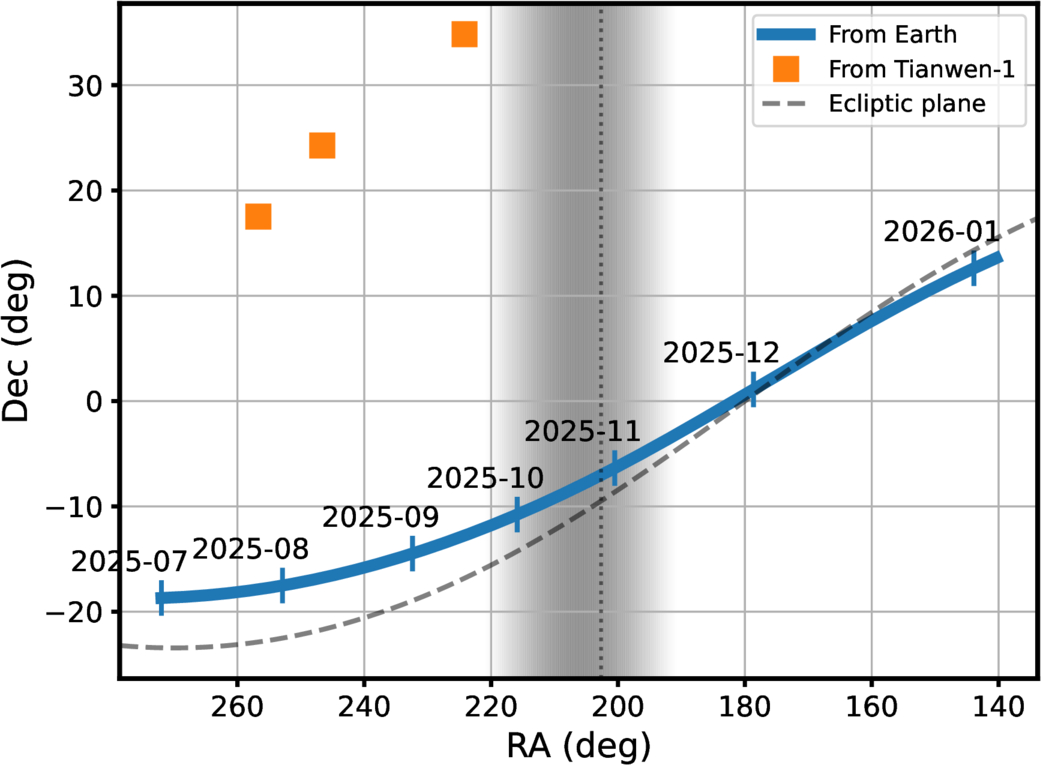
A plot showing that Earth-based observations could only get as best a 20-degree out-of-plane view, while Mars-based observations could get up to nearly 40.

3I/ATLAS’s path across the sky as seen from Earth versus the clearer line of sight from Mars. The shaded region represents the times where the comet was too close to the Sun for viewing. [Xin Ren et al. 2026]

Unfortunately for astronomers, 3I/ATLAS didn’t make it easy for them to study the shape of its coma. Thanks to a cosmic coincidence, the interstellar visitor was traveling almost perfectly within the plane of our solar system, and Earthbound observers were often limited to an edge-on view of its tail. Even worse, 3I/ATLAS looped around the back of the Sun from our perspective, meaning no one on the planet could observe the comet for a few weeks in the fall. This led a group of astronomers to consider their assets that are farther from home.

Better View from Mars

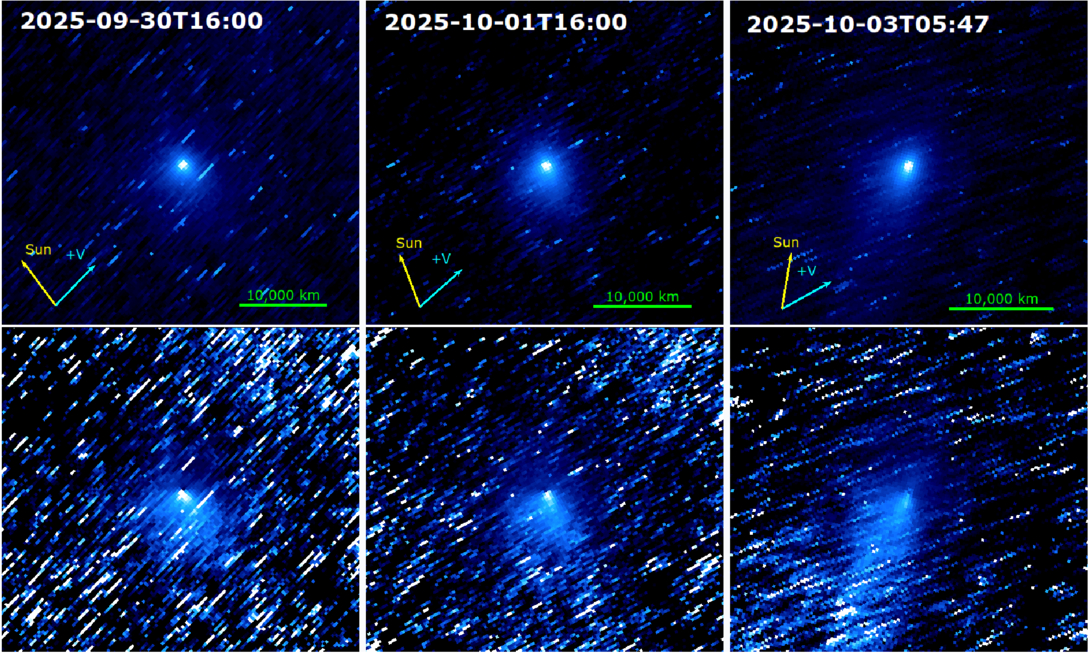
The Tianwen-1 spacecraft, which entered Martian orbit in early 2021 and has been diligently mapping the Red Planet ever since, has a high-resolution camera that’s normally pointed at the planet’s surface. By spinning the spacecraft around, a team of researchers led by Xin Ren (National Astronomical Observatories, Chinese Academy of Sciences) repurposed the camera to act as a small telescope when 3I/ATLAS flew by. In another cosmic coincidence, 3I/ATLAS happened to pass very near Mars last fall, and this close approach gave Tianwen-1 a great out-of-plane view of the coma. The orbiter managed to capture 57 images of 3I/ATLAS over three days last fall, representing China’s first-ever observations of an object from an asset in deep space.

Multi-panel photographs of a comet against a background of streaked stars.

Stacked images of 3I/ATLAS from the Tianwen-1 orbiter across three epochs; the tail’s apparent shape shifts as the viewing geometry changes. Click to enlarge. [Xin Ren et al. 2026]

The team took full advantage of the great view and leveraged the spacecraft’s unique perspective to extract some intriguing results. By tracking how the gentle pressure of sunlight nudged the escaping grains, the researchers found that the coma is dominated by surprisingly large dust. With an average size of hundreds of microns across, the dust is more like coarse sand than smoke, and they found that it ambles away from the comet at just 3–10 meters per second. All told, 3I/ATLAS was shedding dust at roughly 1,000 kilograms every second. The big grains may be a fingerprint of a cold, distant birthplace: models suggest such grains collect in the frigid outer reaches of planet-forming disks, hinting that 3I/ATLAS was forged far from its parent star before being flung into the dark.

As new surveys begin to turn up interstellar interlopers more often, this improvised observation makes a tidy point: the spacecraft already scattered across the solar system can double as a fleet of opportunistic comet-watchers, each offering a view we simply can’t get from home.

Citation

“Interstellar Object 3I/ATLAS Observed from Mars by China’s Tianwen-1 Spacecraft,” Xin Ren et al 2026 ApJL 1003 L10. doi:10.3847/2041-8213/ae61b3

The post Courtside Seats on Mars appeared first on AAS Nova.

  •  

Interstellar Comet 3I/ATLAS Through the Eyes of Rubin Observatory

Rubin Observatory with star trails

The NSF–DOE Vera C. Rubin Observatory has yet to begin its 10-year Legacy Survey of Space and Time, but it’s already keeping an eye on the sky. Astronomers recently described Rubin’s serendipitous spotting of 3I/ATLAS days before the interstellar object’s discovery.

3I/ATLAS

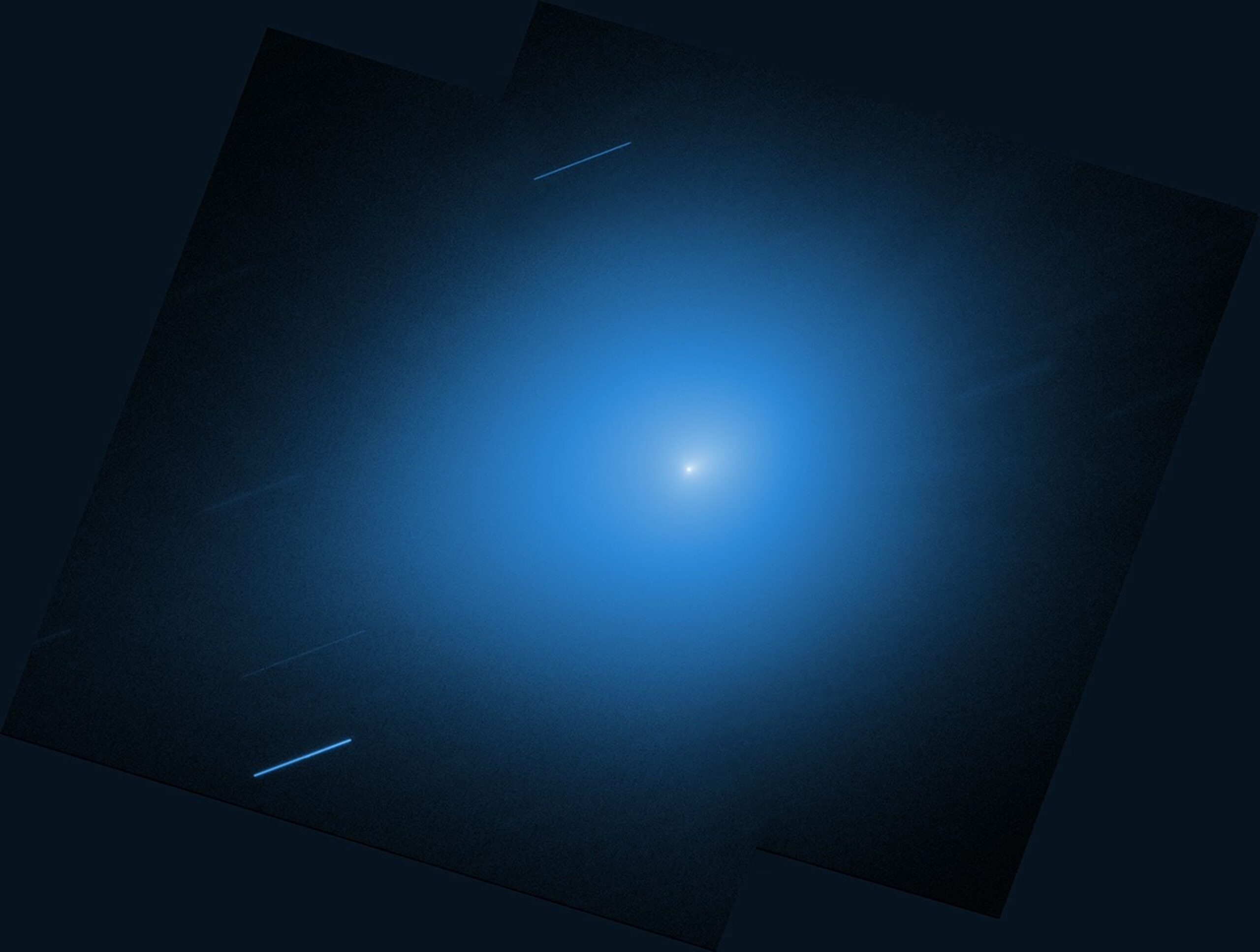
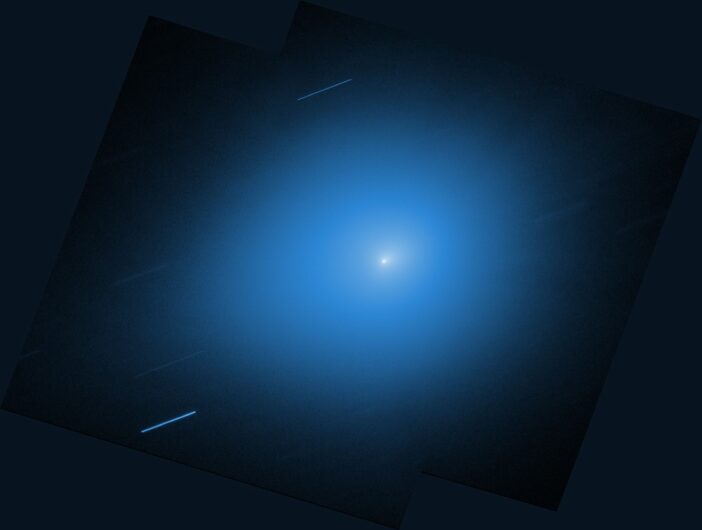
Interstellar comet 3I/ATLAS as seen by the Hubble Space Telescope on 30 November 2025. [NASA, ESA, STScI, D. Jewitt (UCLA), M.-T. Hui (Shanghai Astronomical Observatory). Image Processing: J. DePasquale (STScI)]

Welcome, 3I/ATLAS

Our solar system has been playing host to a rare interstellar tourist: 3I/ATLAS. Just the third known interstellar object to have passed through our star system, 3I/ATLAS was discovered on 1 July 2025 by the robotic telescope network of the Asteroid Terrestrial-impact Last Alert System (ATLAS). After making its closest approach to the Sun in October 2025, 3I/ATLAS is now journeying out of the solar system and is currently located beyond the orbit of Jupiter.

While astronomers would likely grumble about hosting a human guest for nearly a year, they’ve been thrilled with 3I/ATLAS’s lengthy visit and have turned countless telescopes toward the rare interstellar object. They’ve also turned to the archives, searching for pre-discovery sightings of the object — and finding them in the commissioning data from one of the most highly anticipated observatories on the planet: Rubin Observatory.

A Serendipitous Sight

3I/ATLAS from Rubin Observatory

3I/ATLAS as seen by Rubin Observatory on 3 July 2025. [Chandler et al. 2026]

In the months since the release of Rubin’s exceptional first images, its 8.4-meter telescope and array of instruments have undergone rigorous testing to ensure they can meet the high standards required for the upcoming survey.

For most of 2025, Rubin was in its commissioning phase, carrying out science validation observations — a critical period during which instruments, procedures, and pipelines are fine tuned, and the quality and quantity of data collection can vary. On 20 June 2025, the very first night of its science validation survey, Rubin happened to turn toward the small patch of sky containing the as-yet undiscovered 3I/ATLAS.

More to Come

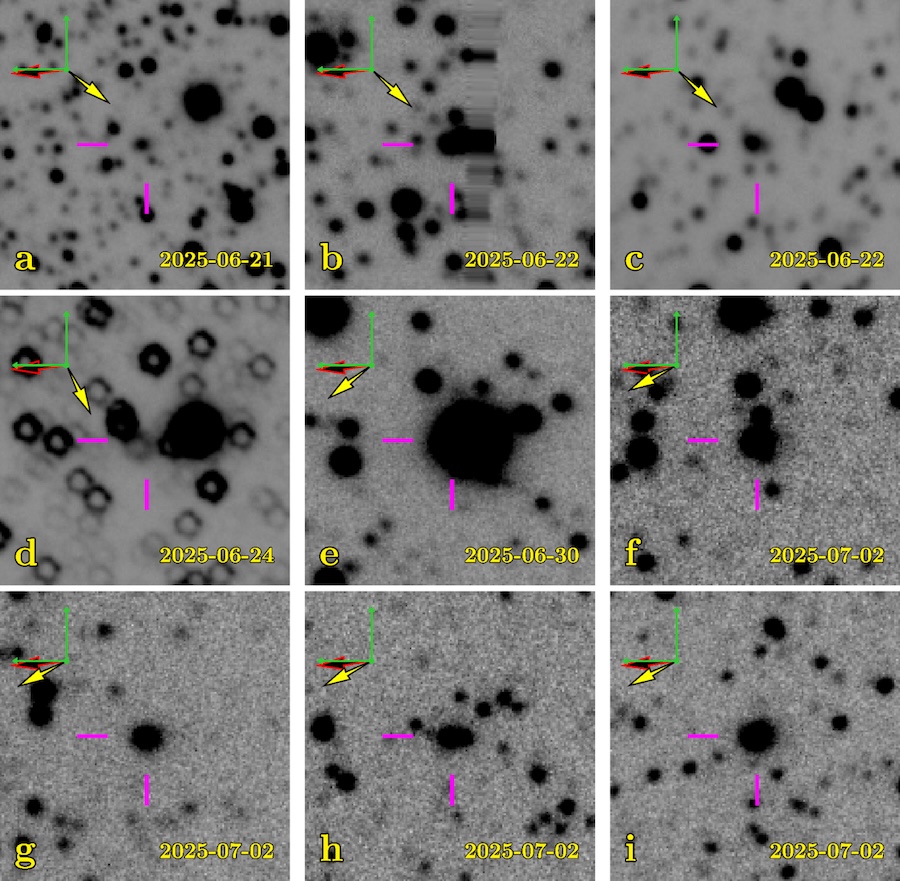
In a recent article, Colin Orion Chandler (LSST Interdisciplinary Network for Collaboration and Computing Frameworks; University of Washington) and collaborators described how they tracked down 3I/ATLAS in Rubin’s commissioning data after the object’s discovery was announced. In total, the observatory serendipitously spotted 3I/ATLAS nine times between 21 June and 2 July, then several more times — some on purpose, some by chance — between 3 and 20 July.

Serendipitous observations of 3I/ATLAS by Rubin

Serendipitous observations of 3I/ATLAS by Rubin. [Chandler et al. 2026]

Analyzing Rubin’s observations of 3I/ATLAS required the development of custom techniques, since the observatory’s pipeline for handling observations of rapidly moving solar system objects was not in operation at that time. Despite these challenges, Chandler’s team successfully made astrometric measurements, collected photometry, determined 3I/ATLAS’s orbit, and studied the comet’s structure and nucleus. Among other findings, these data clearly show the presence of the object’s fuzzy coma, providing the earliest high-resolution evidence of cometary activity.

In their analysis of Rubin’s observations of 3I/ATLAS, Chandler and collaborators found that had the science validation survey started sooner, and had the analysis pipelines been operational, Rubin might have been the first to welcome humanity’s third interstellar visitor. Findings like these heighten the anticipation for the start of the Legacy Survey of Space and Time, during which Rubin will surely build upon its already impressive record of interstellar object observations.

Citation

“NSF-DOE Vera C. Rubin Observatory Observations of Interstellar Comet 3I/ATLAS (C/2025 N1),” Colin Orion Chandler et al 2026 ApJL 1001 L35. doi:10.3847/2041-8213/ae4b3a

The post Interstellar Comet 3I/ATLAS Through the Eyes of Rubin Observatory appeared first on AAS Nova.

  •  

We Have Visitors: Interstellar Material from Nearby Debris Disks

'Oumuamua

Traversing the galaxy from places yet known, a few interstellar objects have taken a quick dip into our solar system. These objects have inspired a frenzy of questions regarding their origins and paths that led them here. A recent study took to nearby planet-forming stellar systems as possible launching posts.

Interstellar Object Origins

As 3I/ATLAS was first spotted entering the solar system in July 2025, all eyes turned to the curious interstellar visitor. Just the third interstellar object astronomers have observed, 3I/ATLAS joins 1I/ʻOumuamua (2017) and 2I/Borisov (2019) in capturing our attention and igniting many questions regarding their origins and journeys to our corner of the Milky Way. While astronomers have characterized these objects’ compositions, sizes, and paths through the solar system, the mechanisms by which these objects leave their origin systems and travel the galaxy before arriving here are not well constrained. 

These three large bodies are just part of the interstellar material visiting the solar system — spacecraft have detected an influx of small interstellar dust particles, and while not yet directly confirmed, interstellar meteoroids burning up in Earth’s atmosphere are possible. This loose material likely originates in dusty, planet-forming disks (debris disks) around stars — rubble kicked out into interstellar space, sending chemicals, organic compounds, and perhaps even the precursors of life to other nearby systems. Understanding the origins and trajectories of such material will allow us to investigate planet formation and how developing systems may impact their environments.

Deliveries from Debris Disks

Debris disks offer ideal testbeds for tracing small bodies and dusty material through the galaxy. Interactions with large planets in debris disks can launch loose material like planetesimals and dust into interstellar space. To explore how debris disks may drive interstellar visitors to our solar system, Cole R. Gregg and Paul A. Wiegert (The University of Western Ontario) simulated how much material the 20 nearest debris disks would contribute to the interstellar object population of our solar system.

sky projection for particle arrival directions

Arrival direction on the sky for particles that reach the solar system from the 20 debris disks studied here. The arrival locations for 1I/ʻOumuamua, 2I/Borisov, and 3I/ATLAS are shown for comparison. Click to enlarge. [Gregg and Wiegert 2025]

The authors modeled the trajectories of ejected material from each debris disk within a simulated Milky Way, running the simulations backward and forward in time to trace the ejecta over 100 million years. These simulations show that material from each of the 20 systems is currently expected to be within our solar system. For interstellar objects (≥100 meters), the simulations predict that about two objects from these debris disks are currently within the inner solar system.

Trickier to spot, smaller meteoroids (≥200 microns) that would appear as meteors in Earth’s atmosphere are also expected. The only way to observationally confirm interstellar origins for meteors is based on how fast they are moving relative to the material in our solar system, or their excess velocities. Based on the simulations, many of these smaller particles have low excess velocities, making them observationally difficult to distinguish from bound solar system objects.

Observational Connections and Expectations

'oumuamua zoom in plot

Zoomed-in view focusing on the direction where 1I/ʻOumuamua entered the solar system. The interstellar object falls near the arrival directions of particles from HD 38858 and HD 166. Click to enlarge. [Gregg and Wiegert 2025]

How do these simulations compare to observations? From their analysis, the authors identified where the interstellar material from each debris disk would first enter the solar system. Comparing these to the entry locations of 1I/ʻOumuamua, 2I/Borisov, and 3I/ATLAS, ʻOumuamua appears near the entry locations for debris from HD 166 and HD 38858. (2I/Borisov and 3I/ATLAS had no such match up in this sample of debris disks.) However, tracing ʻOumuamua’s travel backward, its closest approaches to these systems are about 32 and 18 light-years away, respectively — likely too far to have originated from either system but still a clear proof of concept that we can place interstellar objects near potential systems of origin. 

Where are the expected interstellar meteoroids? Current meteor detectors including the Canadian Meteor Orbit Radar (CMOR) and the Global Meteor Network (GMN) search the sky for incoming material. While the simulations predict hundreds of meteoroid-sized particles from each debris disk currently in the inner solar system, the small collecting area of CMOR and the limiting size of grains detectable by GMN statistically require decades of observations to detect even a single interstellar meteoroid. Thus, the lack of detections thus far is not surprising, but with advanced instrumentation, discoveries of more interstellar particles and objects are imminent.

Citation

“A Catalogue of Interstellar Material Delivery from Nearby Debris Disks,” Cole R. Gregg and Paul A. Wiegert 2025 PSJ 6 309. doi:10.3847/PSJ/ae284f

The post We Have Visitors: Interstellar Material from Nearby Debris Disks appeared first on AAS Nova.

  •  

Monthly Roundup: Interstellar Visitor 3I/ATLAS

3I/ATLAS

Editor’s Note: After a short hiatus, the Monthly Roundup is back! This series of articles, which began in 2023, examines multiple perspectives or findings on a single topic.
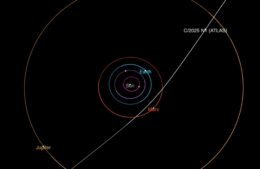
Interstellar object 3I/ATLAS's trajectory through the solar system

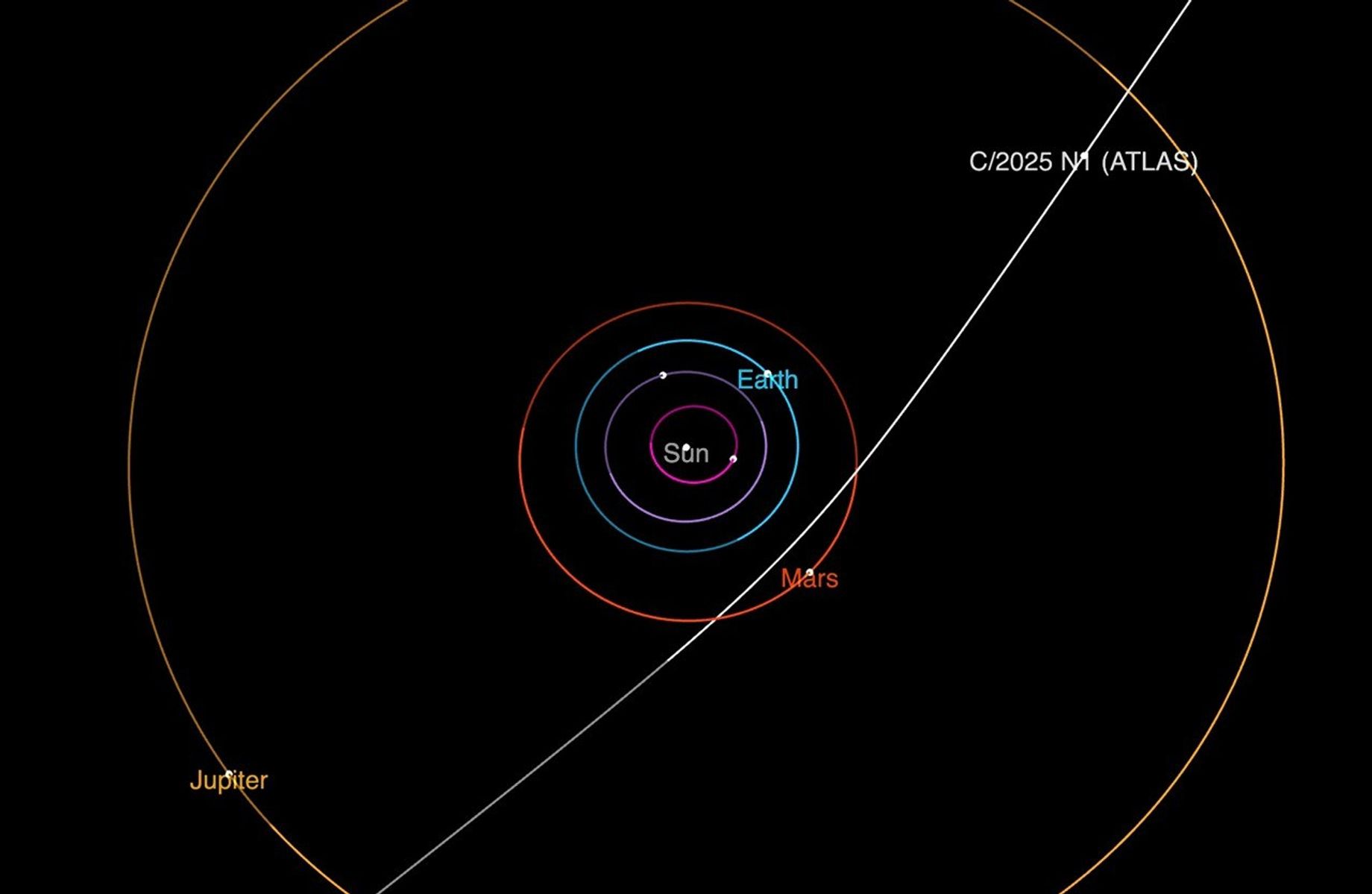
Interstellar object 3I/ATLAS’s trajectory through the solar system. Click to enlarge. [NASA/JPL-Caltech]

The discovery of interstellar object 3I/ATLAS on 1 July 2025 was one of last year’s top astronomy stories. First identified by the Asteroid Terrestrial-impact Last Alert System (ATLAS), 3I/ATLAS is just the third interstellar object that astronomers have seen speeding through our solar system; it was preceded by 1I/ʻOumuamua in 2017 and 2I/Borisov in 2019.

Last summer, professional and amateur astronomers worldwide rolled out the red carpet in 3I/ATLAS’s honor, enlisting a pack of ground-based and spacefaring paparazzi to capture its every move. Observations in the first few months after 3I/ATLAS’s discovery revealed cometary features, including a fuzzy coma of gas and dust, a tail that trailed behind the object, and a plume of dust on the side facing the Sun.

With 3I/ATLAS having now made its closest approach to the Sun, venturing within 1.36 au of our star on 29 October 2025, the comet is wrapping up its tour of the solar system and heading back out to interstellar space — but the research continues. Today, we’re taking a look at five of the more than three dozen research articles published in the AAS journals that have examined 3I/ATLAS and its journey through our solar system. As always, this Monthly Roundup contains only a short summary of each article, so be sure to check out the full research articles linked at the bottom of this post!

Early Spectra of 3I/ATLAS

Bin Yang (Diego Portales University and the Planetary Science Institute) and collaborators obtained spectra of 3I/ATLAS less than two weeks after it was discovered, when it was 4.0–4.4 au from the Sun. Using the Gemini South telescope and the Infrared Telescope Facility (IRTF), Yang’s team sought to characterize its coma, the dusty envelope of gas that puffs out from the icy nucleus as the comet warms up.
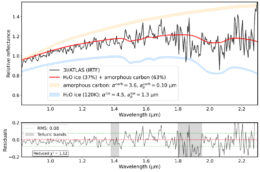
3I/ATLAS spectrum and model fit

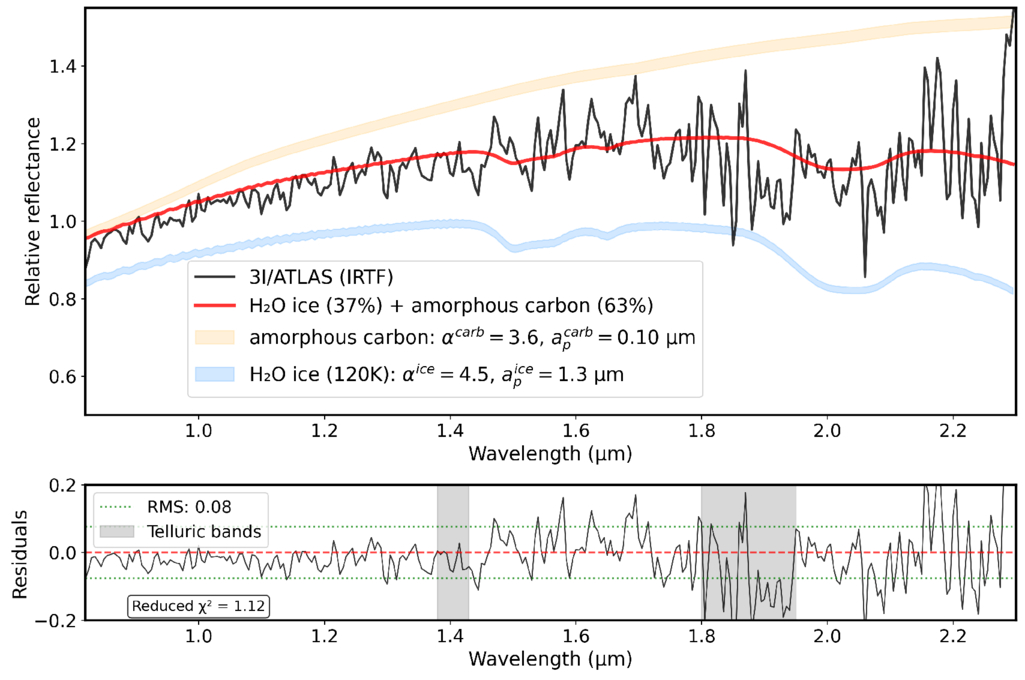
IRTF spectrum of 3I/ATLAS (black line) with the best-fitting model (red line). Click to enlarge. [Yang et al. 2025]

These observations showed that 3I/ATLAS has a relatively featureless, red-sloped spectrum from 0.5 to 0.8 microns, similar to certain asteroids and active comets in our solar system. In the near-infrared, 3I/ATLAS’s spectrum was flatter, with a broad absorption feature around 2.0 microns.

Yang and coauthors found that the near-infrared spectrum was well fit by a model including a blend of amorphous carbon and water ice (63% carbon and 37% water ice by volume) at a temperature of 120K. 3I/ATLAS’s spectrum bears certain similarities to well-studied solar system comets like C/2006 W3 and 6P/d’Arrest, which suggests that the particles in these objects’ comae are similar in size or composition. Ultimately, the discovery of abundant water ice in 3I/ATLAS’s coma, along with the carbon dioxide spotted in other studies, suggests that the comet formed in the cold, volatile-rich outer regions of its home system.

Unique Polarization Properties

3I/ATLAS is the second interstellar object for which astronomers have obtained polarization information. The first, 2I/Borisov, showed a high degree of positive polarization, comparable to the exceptional solar system comet Hale–Bopp.
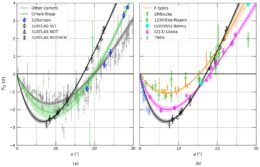
plot of polarization as a function of phase angle

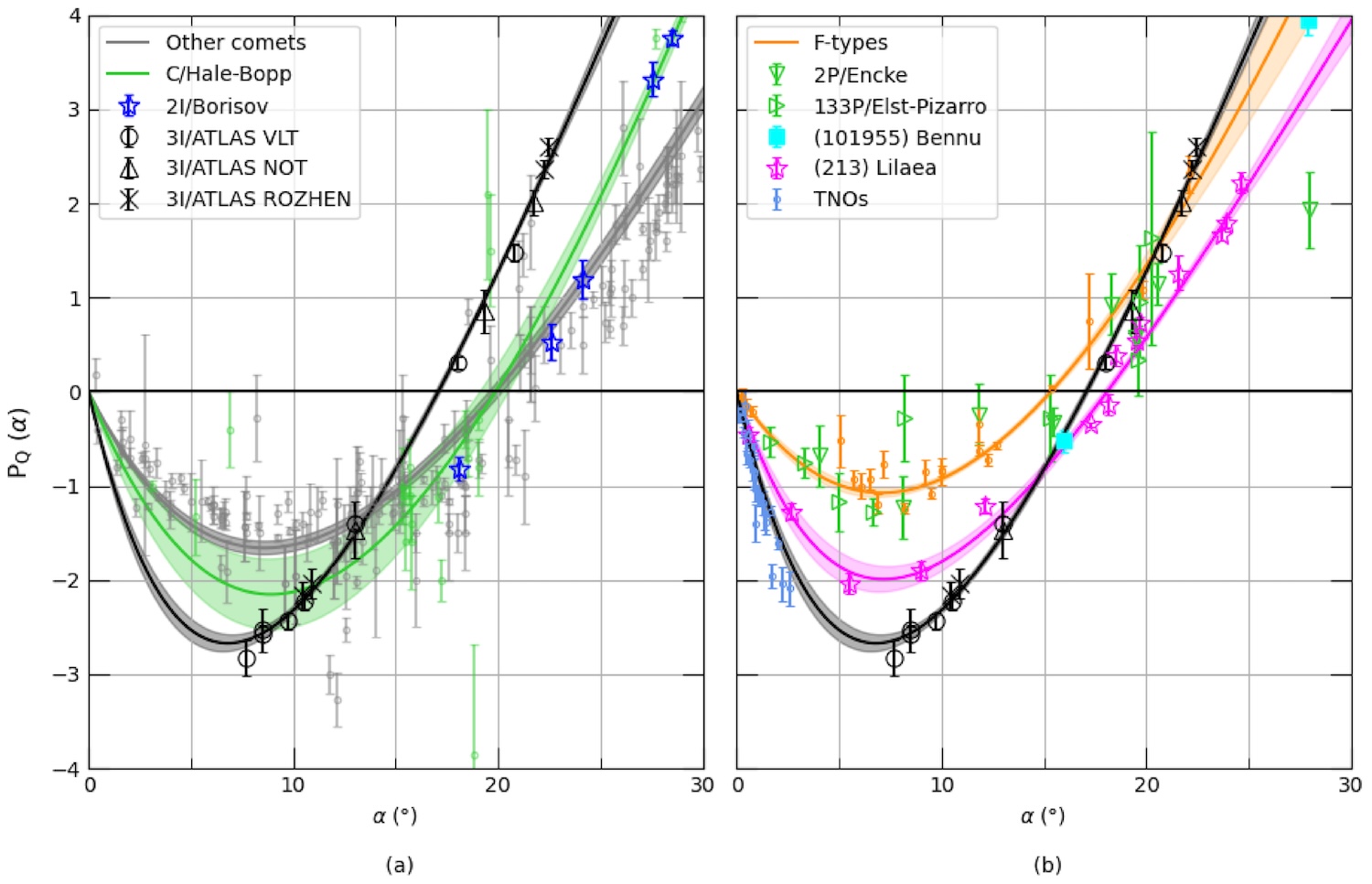
Comparison of 3I/ATLAS’s polarization (black) to measurements of 2I/Borisov (blue) as well as solar system comets and asteroids. Click to enlarge. [Gray et al. 2025]

Using the Very Large Telescope, the Nordic Optical Telescope, and the 2m Ritchey-Chrétien-Coude telescope to study 3I/ATLAS’s polarization between 17 July and 28 August 2025, Zuri Gray (University of Helsinki) and coauthors showed that 3I/ATLAS is also exceptional — but in the opposite direction. In contrast to 2I/Borisov’s strong positive polarization, 3I/ATLAS is strongly negatively polarized, with an unusually deep and narrow polarization profile. The narrowness of 3I/ATLAS’s polarization profile is similar to that of certain rare asteroids and cometary nuclei, but 3I/ATLAS is more strongly negatively polarized than these objects.

Gray’s team suggested that 3I/ATLAS’s extreme polarization behavior could be evidence for a mixture of large icy and dark particles in its coma. It’s also possible that it’s the first identified member of a new class of comets, distinct from both solar system comets and interstellar comet 2I/Borisov.

Is 3I/ATLAS Truly a Pristine Relic of the Star System It Came From?

Interstellar objects like 3I/ATLAS have been hailed as pristine beacons that grant us a rare glimpse into the conditions of other star systems. But as new work by Romain Maggiolo (Royal Belgian Institute for Space Aeronomy) and collaborators shows, 3I/ATLAS was likely greatly altered by its journey through interstellar space.

Spectroscopic measurements from JWST suggest that 3I/ATLAS has extremely high abundance of carbon dioxide and carbon monoxide compared to water. A comet’s chemical abundance ratios can be either inherited from the material from which the comet formed, or they can be due to processing after its formation. The team finds that comet 3I/ATLAS’s extreme abundance ratios can be attributed to the comet being pummeled by galactic cosmic rays — high-energy charged particles — as it cruised through interstellar space.

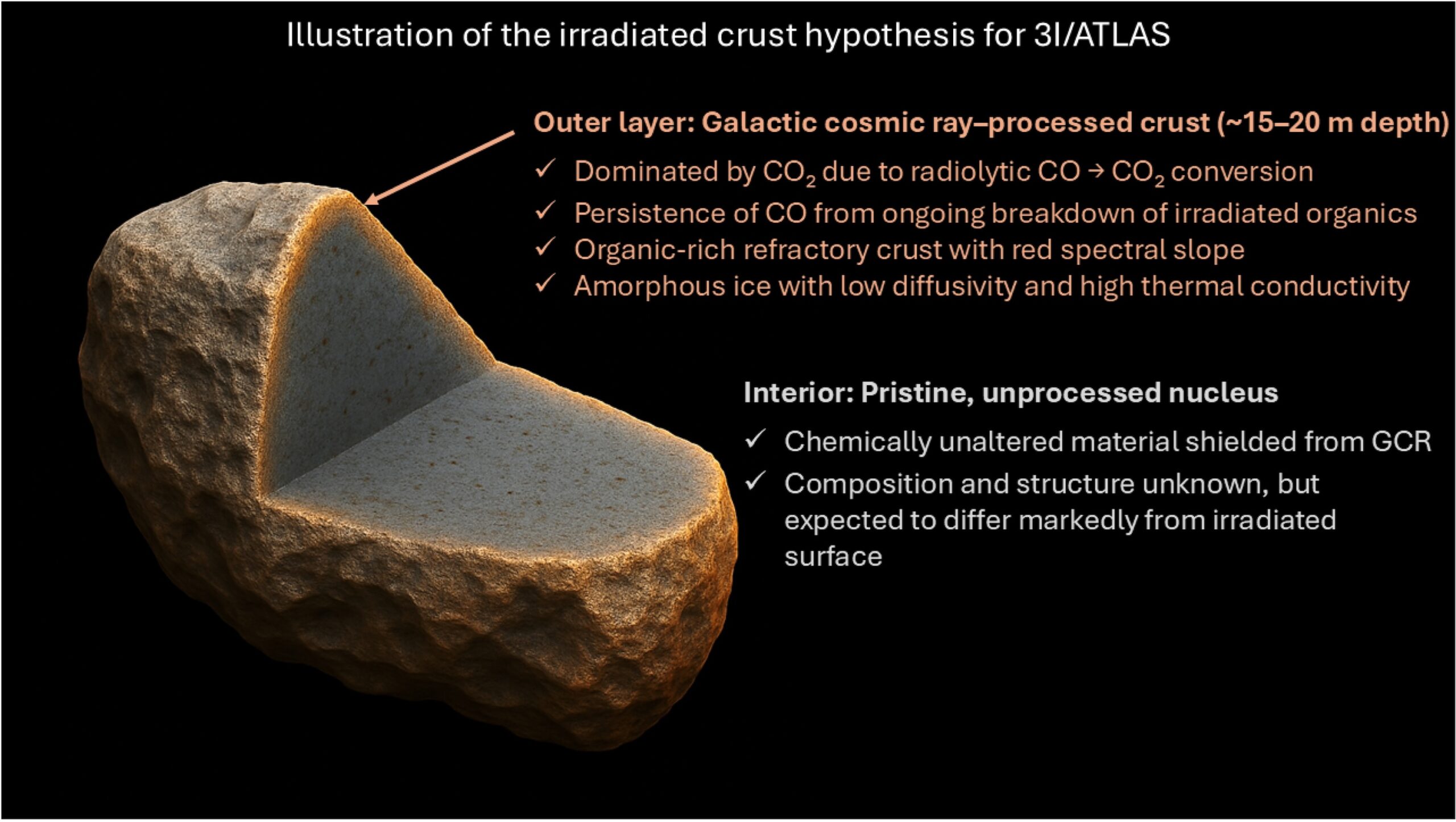
illustration of 3I/ATLAS

Illustration of the nucleus of 3I/ATLAS, featuring a pristine core encased in a crust that has been irradiated by cosmic rays. Click to enlarge. [Maggiolo et al. 2026]

This means that 3I/ATLAS’s current composition doesn’t match its initial composition at the time of its formation, and the cosmic-ray-altered layer of the comet’s nucleus may be 15–20 meters thick. Could volatile outgassing and dust ejection scratch away enough of the comet’s outer layers to expose its pristine interior? This depends on the level of activity the comet experienced as it passed close to the Sun in October 2025. If the comet outgassed strongly, it could have shed tens of meters from its irradiated shell, exposing the pristine core material. Under low to moderate outgassing scenarios, however, the pristine inner material remains hidden beneath the processed shell. Now past the comet’s closest approach to the Sun, we’ll soon know more about whether the composition of the outgassed material has changed as the comet has moved through the solar system.

3I/ATLAS as a Template for Future Encounters: Planning a Potential Rendezvous

It’s only a matter of time before the next interstellar object pays our solar system a visit, and researchers are already thinking about how they’ll study the next visitor. One of the best ways to learn about an interstellar interloper would be to send a spacecraft to rendezvous with it and collect data from up close.

To plan for possible future rendezvous, Atsuhiro Yaginuma (Michigan State University) and collaborators considered what it would have taken for an existing spacecraft to meet up with 3I/ATLAS shortly after it was discovered. The team considered ready-to-launch spacecraft on Earth as well as operational spacecraft currently orbiting Mars.

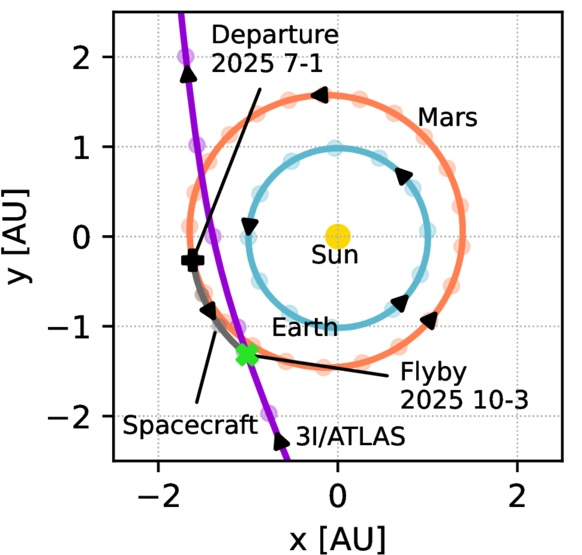
illustration of the trajectory of a spacecraft rendezvousing with 3I/ATLAS from Mars

Illustration of the trajectory for the minimum-energy rendezvous with 3I/ATLAS launched from Mars on the day the comet was discovered. [Adapted from Yaginuma et al. 2025]

Their calculations showed that meeting up with 3I/ATLAS from Mars would have required less energy than launching a new spacecraft from Earth, with Mars-originating flybys potentially possible with existing technologies. For Earth-originating flybys launched on or after the discovery date of 1 July, linking up with 3I/ATLAS is likely beyond current capabilities — but if the comet had been discovered earlier, a rendezvous launched from Earth may have been possible.

This highlights the importance of detecting interstellar objects as early as possible, as well as the advantage of stationing well-fueled spacecraft at key locations around the solar system; these spacecraft could be deployed rapidly after an interstellar object is discovered, enabling the collection of valuable data. (This is similar to the premise of the European Space Agency’s Comet Interceptor mission, which will wait at one of the Sun–Earth Lagrange points for the arrival of a long-period comet; such a mission could be repurposed to track down an interstellar comet.)

So, About Those Aliens…

Like its predecessor 1I/ʻOumuamua, 3I/ATLAS prompted speculation that it’s not a natural object, though there’s no compelling evidence that it’s anything but a comet. If 3I/ATLAS were an interstellar probe, we might be able to unmask it as such by intercepting its radio communications. In a recent Research Note, Ben Jacobson-Bell (University of California, Berkeley) and coauthors described their search for narrow-band radio signals — the communication medium for all spacecraft in our solar system — from 3I/ATLAS.

The Breakthrough Listen project pointed the 100-meter Green Bank Telescope in 3I/ATLAS’s direction, just one day before the object made its closest approach to Earth at a distance of 1.8 au. The team identified nine possible “events” in their data, all of which were ruled to be radio-frequency interference. Based on this non-detection, Jacobson-Bell and collaborators ruled out the presence of isotropic, continuously outputting radio transmitters with power greater than 0.1 watt. (For comparison, a cellphone puts out approximately 1 watt, and spacecraft radios tend to put out a few dozen watts.) Other searches for radio transmissions from 3I/ATLAS have similarly detected no signals.

Citation

“Spectroscopic Characterization of Interstellar Object 3I/ATLAS: Water Ice in the Coma,” Bin Yang et al 2025 ApJL 992 L9. doi:10.3847/2041-8213/ae08a7

“Extreme Negative Polarization of New Interstellar Comet 3I/ATLAS,” Zuri Gray et al 2025 ApJL 992 L29. doi:10.3847/2041-8213/ae0c08

“Interstellar Comet 3I/ATLAS: Evidence for Galactic Cosmic-Ray Processing,” Romain Maggiolo et al 2026 ApJL 996 L34. doi:10.3847/2041-8213/ae2fff

“The Feasibility of a Spacecraft Flyby with the Third Interstellar Object 3I/ATLAS from Earth or Mars,” Atsuhiro Yaginuma et al 2025 ApJ 995 64. doi:10.3847/1538-4357/ae11b2

“Breakthrough Listen Observations of 3I/ATLAS with the Green Bank Telescope at 1–12 GHz,” Ben Jacobson-Bell et al 2025 Res. Notes AAS 9 351. doi:10.3847/2515-5172/ae3083

The post Monthly Roundup: Interstellar Visitor 3I/ATLAS appeared first on AAS Nova.

  •  

Selections from 2025: Hubble Observes 3I/ATLAS

3I/ATLAS

Editor’s Note: For the remainder of 2025, we’ll be looking at a few selections that we haven’t yet discussed on AAS Nova from among the most-downloaded articles published in AAS journals this year. The usual posting schedule will resume January 2nd.

Hubble Space Telescope Observations of the Interstellar Interloper 3I/ATLAS

Published August 2025

Main takeaway:

3I/ATLAS

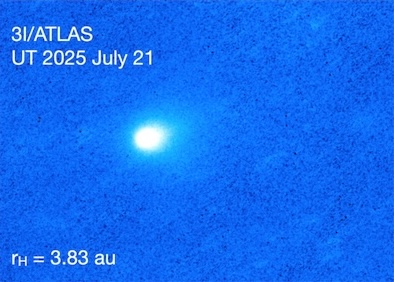
3I/ATLAS as seen by Hubble on 21 July 2025, when the comet was 3.83 au from the Sun. [Adapted from Jewitt et al. 2025]

David Jewitt (University of California, Los Angeles) and collaborators used the Hubble Space Telescope to observe the interstellar object 3I/ATLAS just a few weeks after it was discovered. These observations allowed the team to constrain the object’s mass-loss rate and the size of its nucleus, placing its radius between 0.22 and 2.8 kilometers.

Why it’s interesting:

3I/ATLAS is just the third known object to visit our solar system from another planetary system. With such a small sample size, every interstellar object discovered is a source of fascination. Are these objects more like comets or asteroids? How many of them roam the space between the stars? What, exactly, launches them into interstellar space? Using all available tools, including powerful observatories like Hubble, researchers can extract as much information as possible when interstellar objects make their brief journeys through our solar system, and get us closer to answering these key questions.

How these observations were planned, and what happened afterward:

After interstellar objects 1I/ʻOumuamua and 2I/Borisov zipped through the solar system in 2017 and 2019, respectively, researchers knew it was only a matter of time before the next interstellar interloper paid a visit. In preparation for the next arrival, Jewitt’s team proposed a target-of-opportunity observation with Hubble. This allowed them to disrupt the telescope’s planned observing schedule once 3I/ATLAS was discovered, getting an early high-resolution look that could guide further observations. Since then, researchers have published more than 30 articles in the AAS journals alone about 3I/ATLAS. In these articles, researchers have sought to understand where 3I/ATLAS came from, investigated its polarization properties, collected JWST data of the object, found it in pre-discovery data, and much more, crafting a comprehensive view of a rare visitor to our neighborhood.

Citation

David Jewitt et al 2025 ApJL 990 L2. doi:10.3847/2041-8213/adf8d8

The post Selections from 2025: Hubble Observes 3I/ATLAS appeared first on AAS Nova.

  •  
❌