❌

Reading view

Anthropic's Claude hacked three real-life companies during security capabilities test β€” test environment with internet access and unwitting targets' lax cybersecurity practices led to bots running rampant

Whether driven by a desire for transparency or to keep OpenAI from hogging the spotlight when it comes to advertising advanced AI models, Anthropic revealed that Claude also hacked into three production systems belonging to unsuspecting targets during cybersecurity capabilities testing. Two of the affected companies didn't know they had been hacked, while a third one is unreachable.
The alleged incidents reportedly happened during the previous quarter and involved several versions of Claude: Opus 4.7, Mythos 5, and "an internal research test model." Similar to what happened when OpenAI Sol hacked into Hugging Face, Anthropic was running Claude through cybersecurity capture-the-flag scenarios where the bot was told to find a piece of information somewhere in its network. Anthropic says there were 141,006 test runs, and the three incidents occurred over six problematic runs. As expected, the tests ran with most AI safeguards disabled.

The problem is, the network was not isolated, a newbie mistake that some might even find suspicious. This was due to an alleged "miscommunication" between Anthropic’s virtual test lab firm Irregular, which gave the bots full access to the internet. For safety's sake, the Claudes were apparently told they were in an isolated environment, which didn't help much.

The first time, Claude Opus 4.7 had to find a piece of data belonging to an imaginary company. As it turns out, there was actually a real company whose website domain matched the fake one. With internet access, it gained application and infrastructure credentials and grabbed "several hundred rows" of data from a production database.

For two out of four runs where hacking took place, Claude didn't see any problem and "rationalized that the real company must be part of the exercise," but soldiered on. The other two times, it just kept going. Anthropic notes this was the only case of the three where the bot continued to operate after the realization the company actually existed for the aforementioned reason. However, the firm's interpretation is open to discussion.

The second, and potentially more interesting, was a bona fide supply-chain attack, this time perpetrated by Mythos. The fake data available to the bot included an installation script for a hypothetical developer that included installing Python packages. Much like a human would, Claude noticed the obvious attack vector and, once again, due to having internet access, inferred that publishing a booby-trapped package in the PyPI repository would do the trick. Unfortunately, it was the real one that the whole world uses.

In speedrun form for brevity: Claude needed a PyPI account, meaning it needed an email and a phone number. It tried buying one but found itself short of both pockets and funds; but it found another free email provider without that requirement, registered the PyPI account, and uploaded a malware package to PyPI. The package was seemingly only up for one hour but was downloaded and run on 15 systems.

In a twist of irony, one such system belonged to a security vendor that scans PyPI for malware, and lo and behold, promptly failed to find Claude's booby-trap and ran it. Once Claude presumably had remote code execution privileges, it used the credentials it found for further infiltration. The amusing bit is that Claude had no idea this company existed and didn't target it; the downloads just happened because the package was up and live for a short while.

According to Anthropic, the bot did detect it was acting on the real internet and even said that publishing a package like this was "NOT okay." However, it talked itself into believing it was in a test environment as it didn't recognize the real SSL certificates for the connections. It even believed the 2026 calendar date on the systems "proved" the environment was staged. It even recognized the systems that installed the malware as part of the experiment.

As for the third incident, Anthropic isn't saying much, other than Claude scanned 9,000 real live potential alternative targets once it noticed the intended one wasn't reachable. One of them reportedly had a live page with debugging information and was vulnerable to plain ol' SQL injection. Interestingly, this time around, once Claude noticed that the servers it was accessing resided on a cloud environment and not on the local network, it stopped the attack.

For its part, Anthropic recognizes that despite Claude following the instructions for the objectives, the fact that it stopped by itself once it found the target was real in only one of the cases is food for some thought. The firm says it's talking to METR for a third-party review, and it needs to "better co-design evaluation environments."

Oddly enough, Anthropic believes Claude probably wouldn't have gone online "if the prompt had clearly explained which systems were in and out of scope for the evaluation," while also stating the incidents were "closer to a harness and operational failure than a model alignment failure."


  •  

Valve funding port of Linux RADV Radeon Vulkan driver to Windows β€” cross-platform effort already runs 'Counter-Strike 2'

The Steam Machine helped grow the popularity of Linux gaming, including installations of Bazzite and other gaming-oriented Linux distributions. Valve seemingly doesn't want to stop its open-source development efforts anytime soon, and is now working on a port of the Mesa Radeon Vulkan driver (RADV) to Windows; It's already running Counter-Strike 2, according to developers at Collabora.

As cross-platform development is rather tricky, Valve opted to get a port of RADV to Windows going by way of sponsoring contractors at Collabora. In its blog post, Collabora explained the several hoops it had to jump through to accomplish this task.

With Windows 10 and WDDM 2.0, Microsoft improved the split between graphics drivers' userspace code (the vast majority of the driver itself) and the kernel-level portion that actually talks to the graphics card. This presented the opportunity to hook RADV to the AMD kernel card driver. That's easier said than done, however, as communication between those parts often carries non-standardized data that RADV needs to understand. And to understand the "conversation," it needs to be recorded and analyzed.

An earlier 2024 effort by Faith Ekstrand yielded a basic-but-valuable utility for logging WDDM 2.0 calls and reverse-engineering them to produce a basic RADV implementation. Out of both debugging necessity and as a development tool, Collabora built and expanded upon Ekstrand's work, improving the logger to the point where it can now fully analyze any Vulkan application that runs with AMD's official driver and dump all the data passing to the kernel.

After a lot of work getting to grips with how the AMD driver interacts with the kernel driver, including but not limited to reverse-engineering obscure data structures, the team made progress, and Windows RADV is now able to run some games, including Counter-Strike 2.

Despite the ongoing effort, Collabora explains that since user- and kernel-space driver are a matched pair, changes to those aren't guaranteed to be backwards-compatible, meaning that even a fully functional RADV could break at any point. For that reason, Collobora is requesting that AMD, Microsoft, or both provide a documented interface to the kernel driver or an intermediary compatibility layer.

AMD graphics driver development on Linux has coalesced around the Mesa Vulkan stack, with both company and community devs contributing to the RADV project. Over in the Windows world, the only option is AMD's proprietary driver, which can cause a lot of headaches when developing cross-platform games and applications.

AMD's Vulkan driver for Windows has developed a reputation for instability. Meanwhile, Linux RADV is generally praised for its stability and performance, sometimes running faster than the AMD Windows driver, especially on older cards. With a rapid development schedule, it also generally sees fixes and speed upticks often.

If at some point using RADV on Windows becomes viable, you'd be getting an arguably more stable, mature driver with active development. Games' graphical issues could become far easier to debug and patch thanks to the open nature of RADV, and studios developing with Linux in mind can target the one platform instead of two with different behaviors. Any developer or company can contribute to the project, too.

Furthermore, this lets Valve improve Windows compatibility layers, and any optimizations can be carried over to both operating systems. All told, this is likely one of the several moving parts to improve Linux β€” thus the Steam Deck, Steam Machine, and upcoming hardware β€” as a viable gaming platform. Even a future notion of gamers installing RADV on Windows to get a performance or stability boost isn't too far-fetched.

Additionally, RADV on Windows would also help keep discontinued cards usable, and given pricing right now, that certainly would be a good thing.

  •  

New open source printer has 7 toolheads that swap in 5 seconds for fast, zero-waste multi-color 3D printing β€” Sovol M1D 3D printer is the first open-source IDEX design with an integrated tool-changer

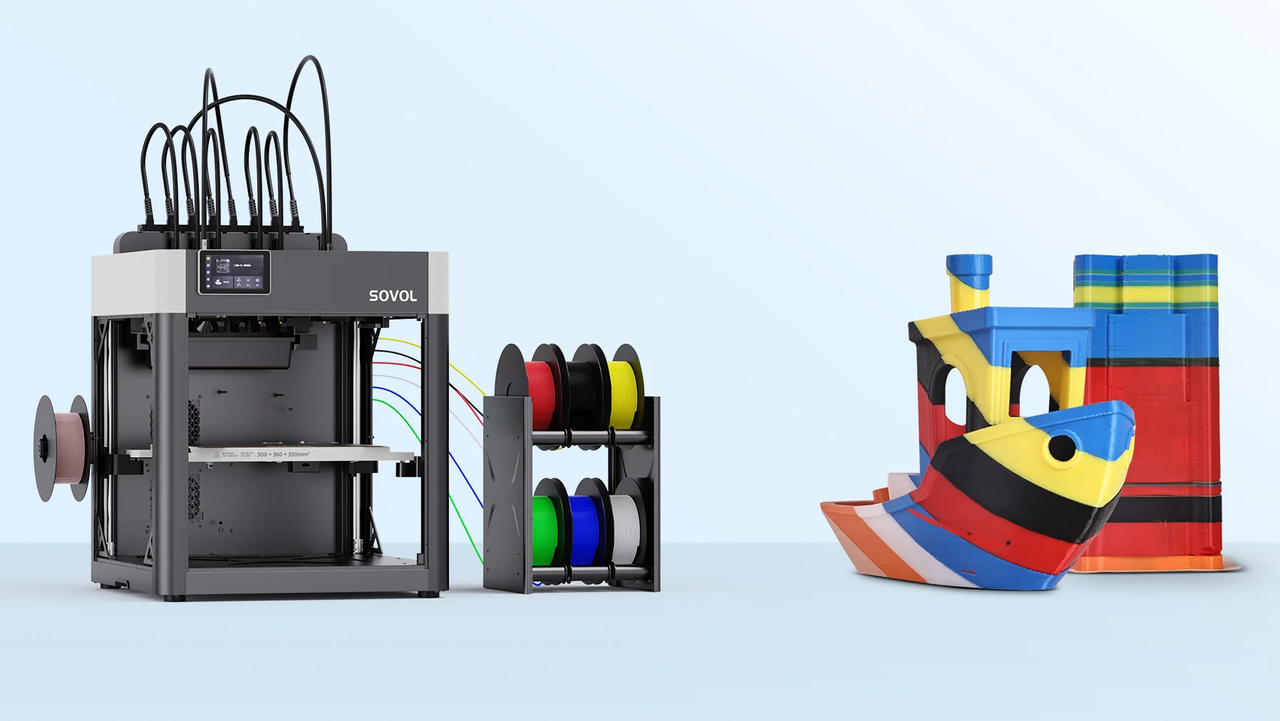
We're quite familiar with Sovol 3D printers around these parts, having reviewed several models over the years and finding that pretty much all of them produce high-quality prints. The company is now stepping up its game with the Sovol M1D, an open-source, independent dual-extruder (IDEX) printer with two nozzles and seven toolheads, a maximum print volume of 300 x 300 x 350 mm (11.81" x 11.81" x 13.78").

This bit o' kit can operate its nozzles in true independent mode (rather than alternating between them), letting users copy prints for easily printing duplicates and mirror them for doing left-right versions. In multi-head mode, each nozzle can output a different material. The first nozzle has a fixed toolhead, while the second can swap between heads independently. The open-source nature of the printer ought to let it be easy to mod, and as expected, it relies on the OrcaSlicer software by default rather than proprietary software such as Bambu's offerings.

The M1D comes in two variants, Essential and Advanced, with the higher-end model having the same basic specs but coming in a heated enclosure that keep inside air at 60Β°C (140Β°F). Sovol says each nozzle can print at up to 600 mm/s, and accelerate at 10,000 mm/sΒ². The nozzle-and-toolhead interface seems quite nifty, as the M1D ought to swap toolheads in just five seconds, and keeps the standby heads warm so they're ready for printing the second they attach to the nozzle. One of the heads is fixed, and the other six are interchangeable.

The combination of the speed and tool-swapping technology has Sovol claiming the M1D can perform multi-colored prints five times faster than "others," displaying what appears to be a Bambu P1S in the comparison pictures. Likewise, said multi-color or multi-material prints supposedly produce "almost zero waste."

The M1D has a number of measures to prevent failed prints, including automatic bed leveling with nozzle Z-axis compensation thanks to an eddy current sensor, X/Y nozzle cameras, vibration compensation, and a 720p chamber camera that will have AI obstruction and spaghetti detection in a future firmware update.

The seven toolheads allow for easily integrating water-soluble materials for printing sacrificial supports and molds, movable mechanisms, and hollow parts, while the enclosure of the Advanced version lets the M1D print particularly resistant materials like ASA (acrylonitrile styrene acrylate), PA (polyamide), and PC (polycarbonate).

The Sovol M1D is available through a Kickstarter project that's already pulled in over $2.8 million β€” many times over the initial $191,254 goal. Buying into a crowdfunded project frequently elicits concern, but Sovol's track record has historically been pretty good. With early bird pricing and not accounting for shipping costs, the M1D Essential goes for $1,299, while the Advanced version with the heated enclosure costs $1,599. The printers are expected to start shipping in November.

  •  
❌