 Login

Restoring Our Vision: Michael Behe and Darwin’s Black Box
What has always stirred me with a deep set of conflicting emotions is his reference to the “elephant in the room.”



Not all meteorites are created equal, and one that crashed through the roof of a New Jersey home is giving scientists a rare glimpse into the chemistry of an ancient asteroid while offering new clues to the puzzle of how life began on Earth.
On July 16, 2024, a daytime meteor streaked across the sky and produced a sonic boom as it passed south of the Statue of Liberty.
“A forensic study of the fragments revealed that they contained preserved bits from near the surface of a primitive asteroid where it experienced concentrated salty fluids—a process not previously known from this type of proto-planet world,” said lead author and meteor astronomer Peter Jenniskens of the SETI Institute and NASA’s Ames Research Center in California’s Silicon Valley in a statement.
Two years later, after analyzing fragments from the event, researchers found that the meteorite contained evidence of ancient salty fluids, complex organic chemistry, and processes that occurred on a primitive asteroid billions of years ago.

Daytime meteor (left), impact site, and a fragment of the Hillsborough meteorite (Image Credit: (A) M. Kirschner and M. Hankey, American Meteor Society; [(B) to (D)] A. Gordon/SETI Institute).The findings, published in the journal Science Advances, come from an international team led by meteor astronomer Peter Jenniskens of the SETI Institute and NASA Ames Research Center.
“Our cameras in Northford, Connecticut, and Douglassville, Pennsylvania, as well as a doorbell camera in Wayne, New Jersey, captured the meteor, and from that we measured its trajectory,” said American Meteor Society operations manager Mike Hankey.
Traveling at approximately 32,000 miles per hour (14.4 kilometers per second), witnesses from the surrounding areas, including New York, New Jersey, Connecticut, Rhode Island, and Pennsylvania, reported seeing a bright fireball that broke apart while a part of it broke through the roof of a New Jersey residence.
“The path traced back to low in the asteroid belt,” Hankey adds.
Using footage from meteor cameras, including systems in Connecticut and Pennsylvania, researchers reconstructed the meteor’s path. The trajectory traced back to a region of the asteroid belt between Mars and Jupiter. The space rock disappeared from view about 22 miles above the surface. Shortly afterward, weather radar at Newark Airport detected a cloud of falling debris stretching from Staten Island into New Jersey.
The homeowner acted quickly, handling the space rock with gloves and aluminum foil before placing it in a glass container to protect the material from contamination.
The meteorite was classified as a CM1/2 carbonaceous chondrite, a rare type of primitive meteorite known for containing organic compounds and evidence of water weathering.
According to researchers, the Hillsborough meteorite is only the second witnessed fall of a CM1/2 carbonaceous chondrite ever recorded. Most known CM meteorites belong to the less-altered CM2 category, while no CM1-type meteorite fall has ever been observed.

“A high fraction of compounds were the product of organic chemistry with minerals,” said organic mass spectrometry specialist Phil Schmitt-Kopplin of Technical University Munich. “We do not know if these magnesium organic compounds were contributed by brine chemistry or were simply left over from earlier impact shock processes.”
The final analysis showed tiny salt-rich pockets inside the meteorite, pointing to a formation where water once evaporated on its parent asteroid, leaving behind highly saline fluids. Scientists are comparing these minerals with samples from the asteroids Ryugu and Bennu to better understand early solar system chemistry.
These ancient salty waters may have helped protect and change the molecules needed for life before life first began. The meteorite contained carbon, nitrogen, amino acids, and other organic compounds, many of which appear to have formed through interactions between water, minerals, and carbon-rich chemistry.
“We are thrilled that nature delivered such a precious asteroid sample on our doorstep,” said curator Denton Ebel from the Department of Earth and Planetary Sciences at the American Museum of Natural History.
The recent paper, “Meteor over New York City: Brines in a primitive CM asteroid,” appeared in the journal Science.
Chrissy Newton is a PR professional and the founder of VOCAB Communications. She currently appears on The Discovery Channel and Max and hosts the Rebelliously Curious podcast, which can be found on YouTube and on all audio podcast streaming platforms. Follow her on X: @ChrissyNewton, Instagram: @BeingChrissyNewton, and chrissynewton.com. To contact Chrissy with a story, please email chrissy @ thedebrief.org.
Science word of the day: Covalent
Pronunciation: Coh-VAY'-lent
What it means: In chemistry, a covalent bond occurs when two atoms share a pair of electrons. Electrons zip around atomic nuclei at different energy levels, or "shells." An atom fills its shells with electrons starting from the lowest-energy shell to the highest-energy one, which is called the valence shell. Valence-shell electrons can interact with the valence shells of other atoms. When two atoms get close enough, their valence electrons can feel the pull from both nuclei at once, binding the two atoms together into a stable molecule.
How to use it in a sentence: When atoms share electrons in a covalent bond, they form some of the most stable bonds in chemistry — which is good news, because these bonds are also the basis of most organic molecules and organisms, including you.
Can you crack our science word of the day puzzle, Chain Word?

 A microscopic grain preserved an atomic structure created inside Hiroshima’s fireball.
Breathing clean air depends on filters that do more than trap particles—they must hold them. In many conventional systems, captured dust can loosen under airflow and mechanical disturbances, which lowers filtration efficiency, shortens service life, and forces more frequent replacement. The bottleneck is not capture alone, but durable retention of what the filter catches.
A research team led by Professor Sanghyuk Wooh and Professor Chae Bin Kim has introduced a dynamic imine bond adhesive (DIBA) designed to keep airborne particles embedded. The concept is to marry solid-like stability with liquid-like adhesion, so the filter surface can “refresh” itself while working.
The coating is built by crosslinking polydimethylsiloxane (PDMS) via dynamic Schiff base chemistry. This chemistry enables bond exchange at the interface, allowing adhesive sites to reorganize over time rather than degrade into inert residue. The result is a coating that is both mechanically robust and chemically active.
When sprayed onto commercially available filter media, the DIBA layer behaves like an internal reservoir of stickiness. As particles are collected, they are drawn into the adhesive film rather than remaining only on the exterior fibers. Capillary-driven wetting then forms adhesive bridges around individual particulates, increasing the real contact area that governs holding strength.
Performance tests combined chemical, mechanical, and interfacial characterization—rheology, FTIR, atomic force microscopy, and microscopy—with filtration trials. The coating boosted particle adhesion dramatically, approaching a nearly seventy-fold improvement compared with typical behavior. Importantly, the adhesive renewal process helps counteract the gradual loss of attachment that plagues standard filters.
Filtration efficiency improved by roughly 10–30% across multiple commercial materials, without raising pressure drop. The upgrade is significant in practical terms: one reported shift is from MERV 6 toward MERV 11, indicating better capture at the same airflow penalty.
The coated filters also sustained operation under high-speed airflow (up to 20 m/s) and delayed pore clogging. By maintaining effective particulate capture for longer intervals, the DIBA approach extended filter lifespan by nearly a factor of two relative to conventional designs.
Because DIBA is applied through simple spray-coating, it is compatible with existing manufacturing and retrofit workflows. The researchers highlight applications ranging from HVAC and air purifiers to cleanrooms, industrial dust collectors, automotive cabin filters, and personal protective equipment.
More broadly, the work suggests a platform for next-generation filtration where energy use and replacement schedules improve simultaneously. The dynamic adhesive strategy could be adapted to other separations, including water purification and environmental remediation, wherever particles need to be captured and kept immobilized.
Subject of Research: Not applicable
Article Title: A Super-Adhesive Air Filter With Capillarity-Mediated Spontaneous Particle Absorption via Dynamic Bond Exchange
News Publication Date: 22-Apr-2026
Web References: https://doi.org/10.1002/adma.202600006
References: DOI: 10.1002/adma.202600006
Image Credits: Professor Sanghyuk Wooh from Chung-Ang University, Republic of Korea and Professor Chae Bin Kim from Pusan National University, Republic of Korea
Air filtration, dynamic adhesive chemistry, Schiff base, PDMS, particle retention, capillarity, MERV, particulate matter, surface engineering, polymers

Hydrogen peroxide is a common chemical found in hospitals, factories and laboratories around the world. It is used to disinfect medical equipment, make paper, clean semiconductor chips and support many other industrial processes. Although it is widely used, making hydrogen peroxide usually requires large factories, high energy use and complicated manufacturing methods. Now, researchers have […]
The post Scientists find way to produce hydrogen peroxide without electricity appeared first on Knowridge Science Report.


A couple of decades after the discovery of systems that could selectively target DNA, we're starting to see the first therapies based on gene editing. One challenge these developments have faced is safety. While we can make them pretty specific to the gene we want edited, the human genome is very large, and even rare DNA sequences can appear a couple of times by chance.
As a result, all the original gene-editing systems had known rates of what are called off-target effects, in which they simply edit the wrong sequence. This may be a low-probability event, but edit enough cells—and therapies generally have to edit many—and errors become inevitable.
A lot of effort has gone into finding ways to minimize or eliminate off-target edits. In a recent issue of Nature, researchers described modifying the AI protein-folding software AlphaFold to help identify key areas of gene-editing proteins responsible for off-target effects. Those areas were then modified to reduce the problems.


© Anton Vierietin
A couple of decades after the discovery of systems that could selectively target DNA, we're starting to see the first therapies based on gene editing. One challenge these developments have faced is safety. While we can make them pretty specific to the gene we want edited, the human genome is very large, and even rare DNA sequences can appear a couple of times by chance.
As a result, all the original gene-editing systems had known rates of what are called off-target effects, in which they simply edit the wrong sequence. This may be a low-probability event, but edit enough cells—and therapies generally have to edit many—and errors become inevitable.
A lot of effort has gone into finding ways to minimize or eliminate off-target edits. In a recent issue of Nature, researchers described modifying the AI protein-folding software AlphaFold to help identify key areas of gene-editing proteins responsible for off-target effects. Those areas were then modified to reduce the problems.
© Anton Vierietin
 Researchers have detected a sugar in the interstellar medium for the first time. Sugars are central to life. They help form the structural backbone of DNA and RNA and participate in essential metabolic reactions. They are also thought to have been necessary for the formation of the earliest nucleic acids. Yet researchers studying life’s origins [...]
 Study suggests a new method for tracking electronic and vibrational dynamics in real time. Within a few trillionths of a second after absorbing light, a molecule bends out of shape, shifts its electrons, and converts electronic energy into vibrations. These changes happen too quickly for ordinary instruments to follow, but flashes from the European XFEL [...]
 Researchers are turning toxic, centuries-old ammunition into highly efficient and cheap solar panels.
Turning low-energy light into higher-energy light seems to break the usual rules of physics, since energy is supposed to run downhill, not uphill. Yet a process called photon upconversion achieves exactly this, without breaking any laws of thermodynamics. Instead of absorbing one photon and releasing a single photon of lower energy, as most light-absorbing molecules do, an upconversion system absorbs two lower-energy photons and combines their energy to release one higher-energy photon. Because it takes two photons to make one, the total energy is still conserved; the trick is repackaging it into a more useful form. The phenomenon was first observed in the 1960s in simple organic mixtures cooled to very low temperatures, but it only became practical decades later, once chemists identified metal-containing dyes able to hold their excited states at room temperature. Since then, scientists have pursued upconversion as a way to make better use of sunlight, to power light-driven chemical reactions, to improve imaging inside living tissue, and to build new kinds of optoelectronic devices.
The most developed route to upconversion relies on a process called triplet-triplet annihilation. A light-absorbing molecule known as a sensitizer first captures a low-energy photon and passes that energy to a second type of molecule, the annihilator. The annihilator settles into a triplet excited state, an unusually long-lived condition that allows it to persist until it meets a second annihilator molecule in the same state. When two such molecules collide, one drops back to its ground state while the other is pushed up into a higher-energy singlet state, from which it emits a photon of higher energy than either of the photons that started the process.
A long-standing problem with this scheme is that ordinary sensitizer molecules lose a portion of the absorbed energy internally, as the initially excited state converts into the lower-energy triplet state that gets passed along. This loss caps how large an energy jump the whole system can ultimately achieve. One promising way around the problem is to replace the conventional sensitizer with an organic radical, a molecule carrying a single unpaired electron. That unpaired electron gives radicals unusual electronic and magnetic behavior and can make the conversion from absorbed light into a usable excited state considerably more efficient, since it opens transitions that are otherwise very weak in conventional molecules.
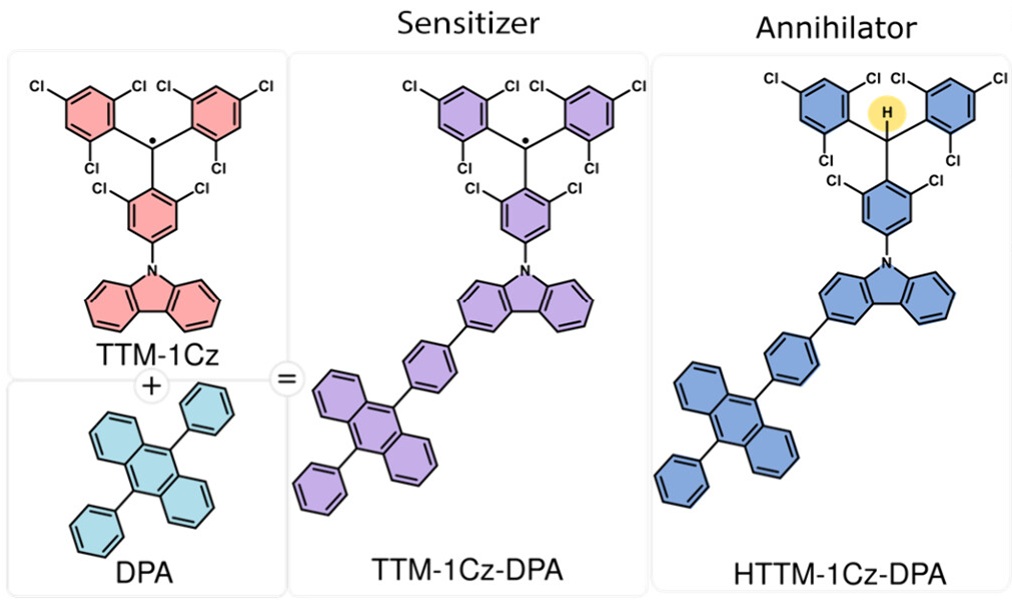
To work out why, the investigation combined light-based spectroscopy, electron spin resonance (a technique that detects unpaired electrons), and quantum chemical calculations. After the radical absorbs red light, its excitation transfers within about ten picoseconds (ten trillionths of a second) to the attached anthracene unit, creating a long-lived excited state that still carries some radical character. This internal handoff stretches the effective excited-state lifetime to more than 250 nanoseconds, roughly ten times longer than the 27 nanoseconds measured for the radical unit on its own. A longer-lived excited state gives the sensitizer far more opportunity to encounter another molecule and hand off its energy before simply decaying back to the ground state. The calculations independently pointed to the same conclusion, showing that energy transfer to a nearby annihilator proceeds far more readily through this long-lived triplet-like state than directly from the radical’s first excited state.
The work also tested an idea proposed in earlier research, that a single radical-containing molecule of this kind might act as both sensitizer and annihilator on its own, a so-called single-component upconversion system. The new experiments argue against this. Solutions containing only the radical molecule, across a range of concentrations, showed no detectable upconverted light, consistent with the radical’s higher excited states relaxing away too quickly for the necessary emission to compete.
Efficient upconversion instead required mixing the radical sensitizer with its hydrogen-added counterpart, or with the well-established annihilator 9,10-diphenylanthracene. Because the two molecules share nearly the same molecular framework, this two-molecule mixture is described as a “pseudo-single-component” system. Shining red light at 658 nanometres onto the radical paired with its hydrogenated twin produced blue emission at 450 nanometres, an apparent energy gain of about 0.9 electronvolts, with 7 percent of absorbed photon pairs converted into upconverted light. Pairing the same radical sensitizer with 9,10-diphenylanthracene instead produced blue emission at 437 nanometres, a slightly larger energy gain of about 1.0 electronvolt, with 12 percent efficiency. Both figures mark a large improvement over earlier all-organic radical sensitizers, which had reached efficiencies of only a few tenths of a percent, and the upconverted emission remained stable over hours of continuous illumination.
Beyond these specific molecules, the study illustrates how a minimal change in molecular structure, adding or removing a single hydrogen atom, can completely redirect a molecule’s photochemical role, switching it from an energy donor to an energy acceptor. Combining optical measurements, spin resonance, and computation made it possible to trace exactly why this switch occurs at the level of electronic structure, rather than simply observing that it happens.
The findings offer a clearer picture of how organic radicals can be harnessed for photon upconversion and point toward a practical strategy for building more efficient materials from radicals and their closed-shell relatives together. Such materials could eventually help capture more of the solar spectrum, drive light-powered chemical synthesis, or improve the efficiency of light-emitting technologies, by putting to use photons that would otherwise be wasted.
Author: César Tomé López is a science writer and the editor of Mapping Ignorance
Disclaimer: Parts of this article may have been copied verbatim or almost verbatim from the referenced research paper/s.
The post A new route to photon upconversion appeared first on Mapping Ignorance.


Researchers have detected molecules containing rings and chains of carbon atoms in the vicinity of a rare pair of quasars. The trends in the distribution of these molecules are unexpected, suggesting that more work is needed to understand the conditions surrounding active supermassive black holes.
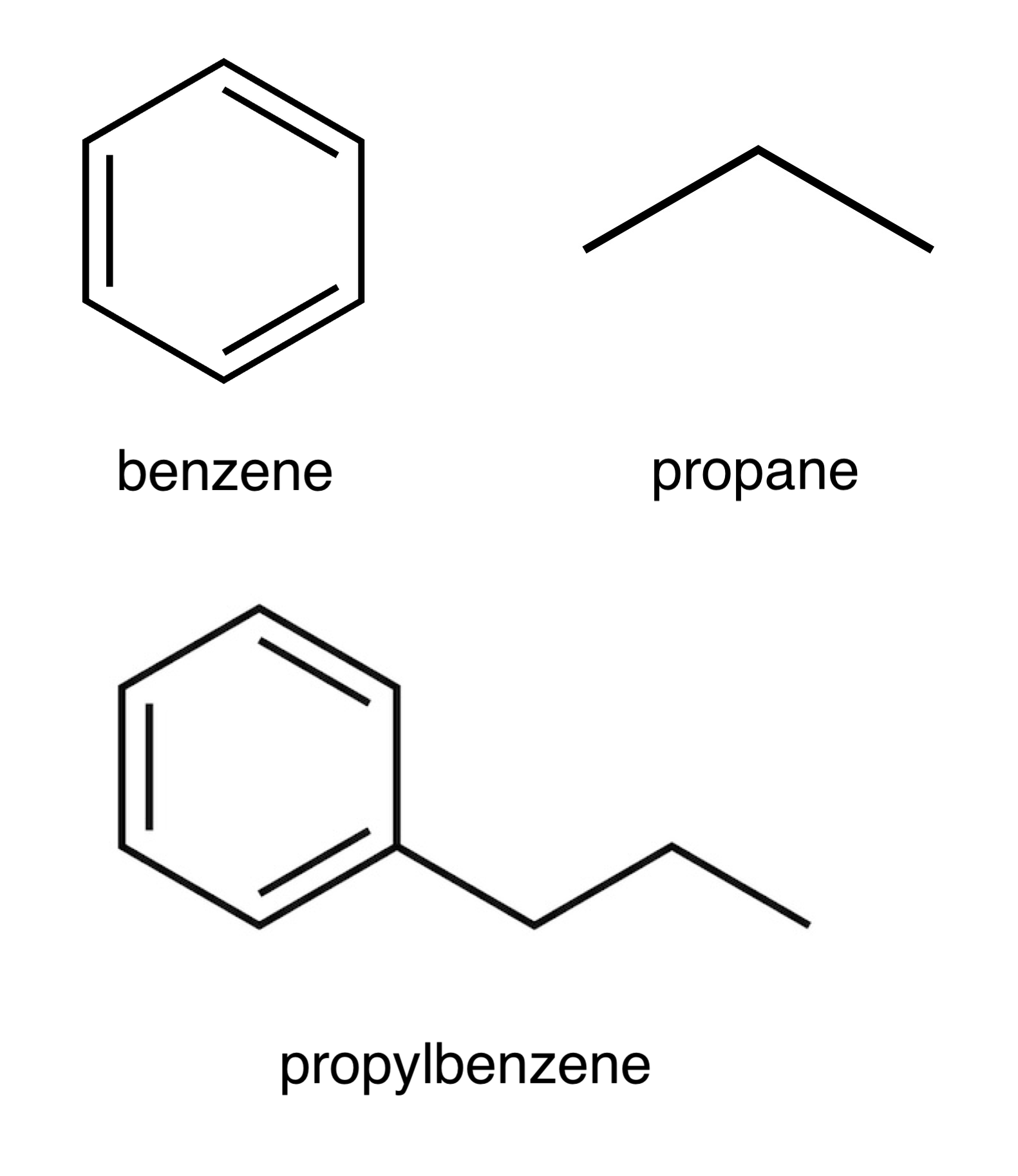
Examples of aromatic and aliphatic hydrocarbons. Benzene (top left) is the simplest aromatic molecule. Propane (top right) is a simple aliphatic molecule. Propylbenzene (bottom) is an aromatic molecule with an aliphatic chain branching off of it. In these “skeletal” formulae, there is a carbon atom at each vertex, and the remaining atoms (not depicted) are all hydrogens. Single lines indicate single chemical bonds, and double lines indicate double bonds. [Wikipedia; Public Domain]
JWST’s sensitive infrared eyes have allowed researchers to study the distribution, creation, and destruction of both aromatic (containing one or more rings of carbon atoms in which certain electrons spread out within the ring) and aliphatic (containing chains of carbon atoms) hydrocarbons. These molecules have been spotted in a wide array of environments, and now, astronomers are finding them in more distant and more extreme environments than ever before.
SDSS J074922.96+225511.7, or J0749+2255 for short, is a quasar pair seen 3 billion years after the Big Bang. The two feasting supermassive black holes are roughly 12,000 light-years apart, giving researchers a glimpse into the late stages of a galaxy merger and a harsh environment in which to study the survival and destruction of molecules.
Researchers studying J0749+2255 with JWST have previously reported the detection of a 3.3-μm emission feature from aromatic molecules. Now, C. E. Mentzer (University of Missouri), Aigen Li (University of Missouri), and Xuejuan Yang (Xiangtan University) have analyzed JWST spectra of J0749+2255 and found not just widespread aromatic emission at a rest-frame wavelength of 3.3 μm, but also aliphatic emission at 3.4 μm, which they attribute to carbon chains branching off from the aromatic molecules. This likely makes J0749+2255 the most distant galaxy in which both aromatic and aliphatic emission has been detected.
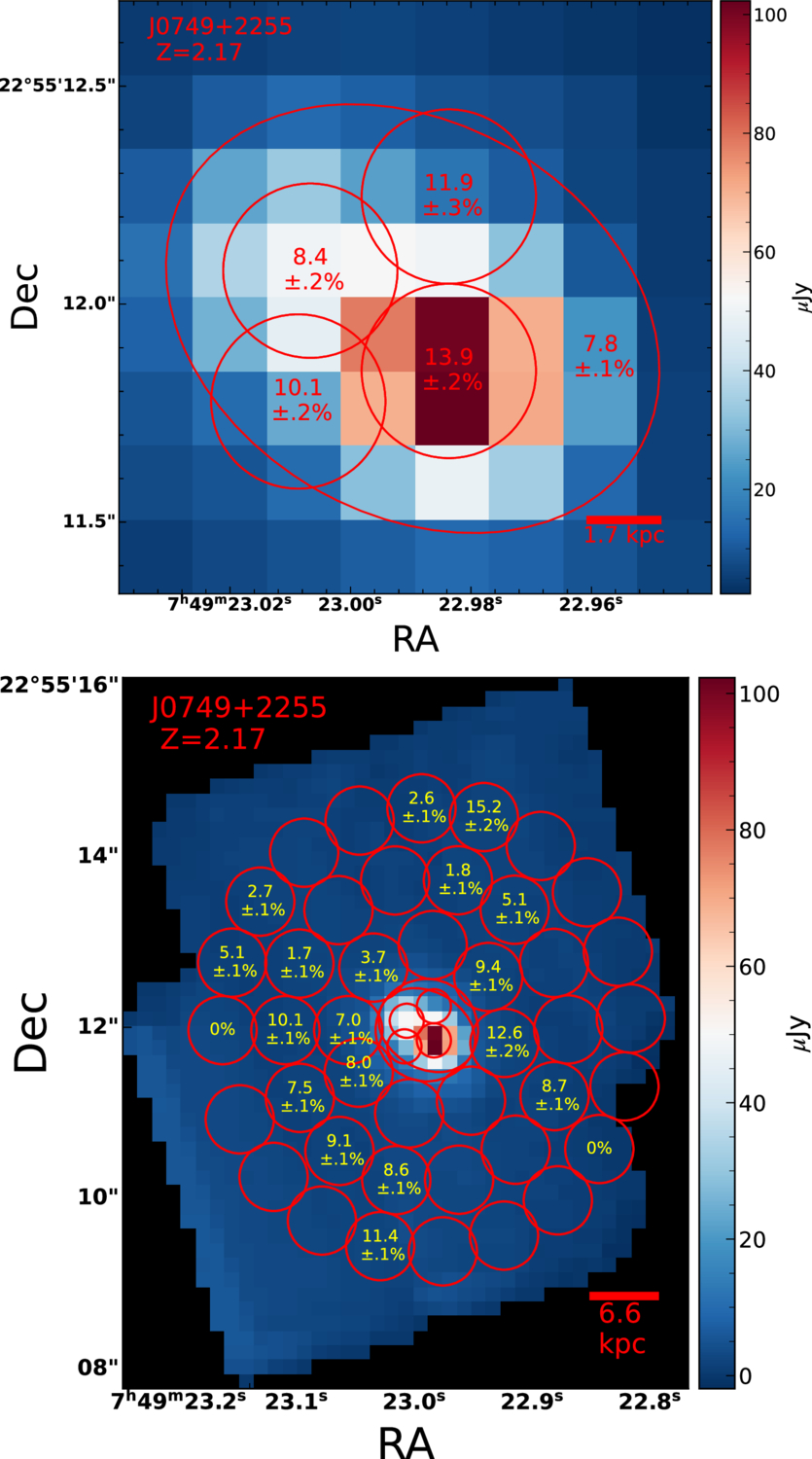
Aliphatic fractions in the bright central region surrounding the two quasars (top) and in the outer regions (bottom). [Mentzer et al. 2026]
Mentzer, Li, and Yang subdivided the observations into 47 regions and measured the strength of the 3.3- and 3.4-μm features in each region. This analysis found strong aromatic emission nearest the quasars and showed that the fraction of carbon atoms bound up in aliphatic chains is highest close to the quasars.
Both of these findings are unexpected: the harsh radiation environment near the two active black holes is thought to break apart chains of carbon atoms attached to aromatic rings (which should decrease the 3.4-μm emission) and possibly destroy small aromatic molecules (which should decrease the 3.3-μm emission) — yet both of these features are strongest near the quasar cores where the radiation should be most capable of molecular destruction.
The authors speculated that the analysis regions centered on the quasars are large enough that they contain gas that hasn’t been pummeled by the quasars’ intense radiation and outflows, leaving molecules intact and able to produce the observed emission. However, this doesn’t explain the trend of stronger 3.3- and 3.4-μm emission closer to the quasars — necessitating further research into the emitting behavior of aromatic and aliphatic molecules under the extreme conditions of a dual quasar’s neighborhood.
“Widespread Detection of Aromatic and Aliphatic Emission in the Dual Quasar J0749+2255 at Cosmic Noon,” C. E. Mentzer et al 2026 ApJL 1005 L38. doi:10.3847/2041-8213/ae7e86
The post Researchers Spot Hydrocarbons Surprisingly Close to a Quasar Pair appeared first on AAS Nova.
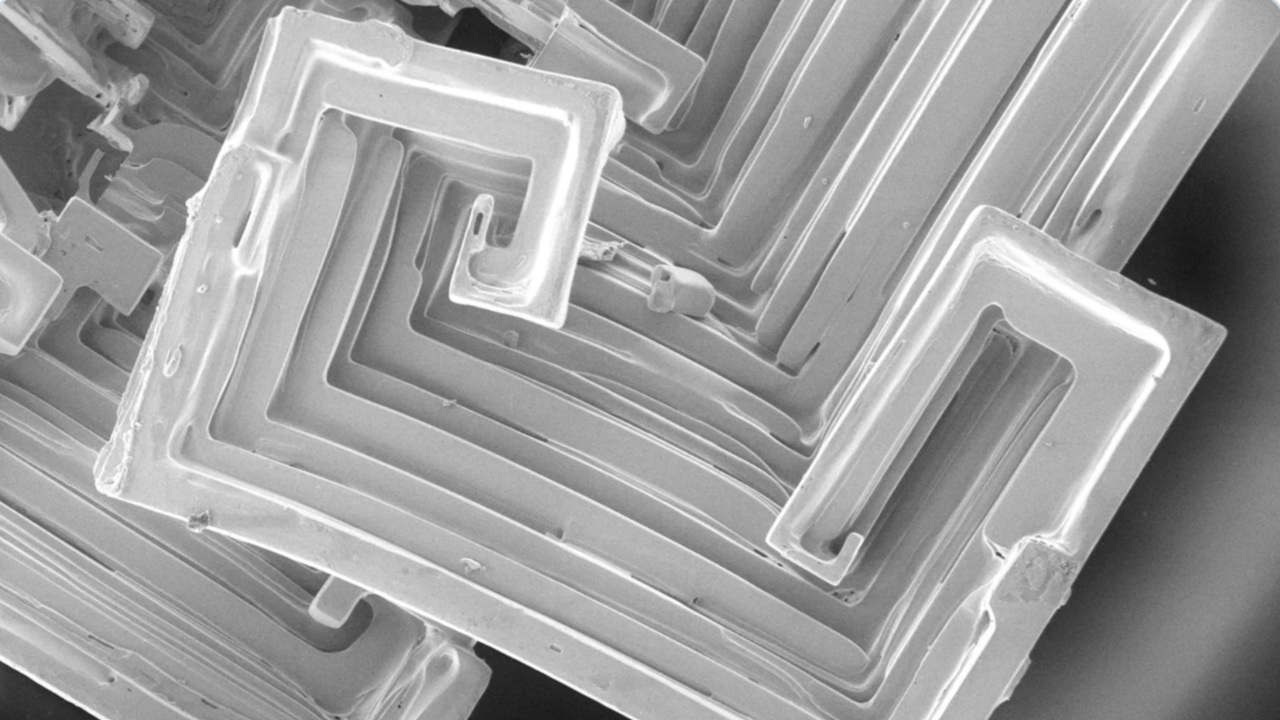
Astronauts have grown a common crystal in space — but this extraterrestrial version is exhibiting a very uncommon behavior. Under a microscope, the crystal looks more like a tiny futuristic sculpture than something that formed naturally. The pyramid-like assembly curls in on itself in stair-stepped layers, seeming almost too orderly to be real. But according to scientists, the striking shape is what happens when gravity stops calling the shots.
The image, shared on July 18 by NASA astronaut Don Pettit, and accompanying video were captured aboard the International Space Station (ISS) and show potassium chloride crystals growing in microgravity — the near-weightless environment experienced in orbit.
Microgravity isn't quite zero gravity; astronauts experience a gravitational pull roughly a million times weaker than on Earth's surface, Anne Wilson, a professor of chemistry and biochemistry at Butler University, told Live Science. That reduction in gravity's tug has profound impacts on the human body, and, as the new image shows, completely changes how liquids and crystals behave as well.
"[Other] forces start to become far more pronounced than gravity forces," Wilson said, pointing to molecular attraction and polarity as two influences that suddenly take over once gravity fades into the background.
Those conditions enable potassium chloride — a common salt used as a sodium substitute in foods and sports drinks — to crystallize in ways that are nearly impossible to reproduce in a terrestrial lab.
On Earth, growing crystals eventually get heavy enough to sag, break or settle at the bottom of their container. But in microgravity, they keep growing outward from wherever they started.
Potassium chloride naturally forms cube-shaped crystals, Wilson said. In microgravity, those crystals grow mainly from their edges and corners instead of across their faces, leaving the center hollow and creating the striking pyramid-like structures seen in the image.
In microgravity, crystals experience "hopper growth," where the outer edges and corners grow at faster rates than the flat faces, creating a step-like appearance. This timelapse records their growth inside a thin water film. Look closely, and you will see the patterns emerge! pic.twitter.com/iSlqJvke1GJune 6, 2026
Scientists call this pattern hopper growth, and it isn't unique to potassium chloride (ordinary table salt forms the same way). As new corners emerge during growth, the crystal can change direction entirely, producing the elegant scrolling pattern visible in the new image.
While the crystal is visually stunning, the science behind it could prove just as valuable. Materials grown without gravity's interference often form with fewer defects, giving researchers a rare look at what a truly "ideal" structure looks like. This insight could help refine manufacturing processes for semiconductors and other advanced materials back on Earth.
For Wilson, images like this serve another purpose: inspiring curiosity.
"I love seeing videos of how things behave in space," she said. "Who would think that something as simple as potassium chloride could still be super cool?"
ISS astronauts spend a significant amount of their time conducting science experiments that would be near-impossible on Earth. Recently, astronauts used the space station’s newly upgraded Cold Atom Laboratory to create and study an elusive fifth state of matter called the Bose-Einstein condensate. And last year, researchers demonstrated how moss spores exposed to space for nine months on the outside of the ISS continued to grow after being returned to Earth.
The post Astronomers find sugar floating in space appeared first on MIT School of Science.
