
❌

Reading view

Potential Atmosphere Detected on Habitable-Zone Exoplanet LHS 1140b
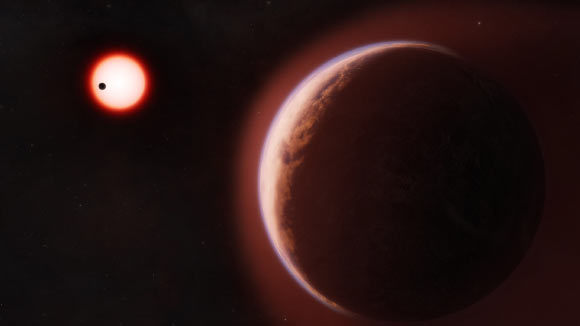
An artist’s concept of rocky planets LHS 1140b and LHS 1140c. Image credit: Melissa Weiss / Harvard & Smithsonian’s Center for Astrophysics.

Using spectral data from the Magellan Clay telescope at Las Campanas Observatory, astronomers detected helium escaping from LHS 1140b, a rocky exoplanet that orbits in the habitable zone of the nearby low-mass star LHS 1140.

The post Potential Atmosphere Detected on Habitable-Zone Exoplanet LHS 1140b appeared first on Sci.News: Breaking Science News.

  •  

Astronomers May Have Found Supernova Remnant near Milky Way’s Central Black Hole

This composite image contains X-rays from Chandra and XMM-Newton missions (shown in blue) as well as radio data from the MeerKAT telescope (shown in red) in South Africa. These have been combined with an optical image from the Pan-STARRS telescopes in Hawai’i (red, green, and blue). Image credit: NASA / CXC / UCLA / Zhu et al. / ESA / XMM-Newton / PanSTARRS / MeerKAT / CSA / STScI / SAO / L. Frattare & P. Edmonds.

Using NASA’s Chandra X-ray Observatory and ESA’s XMM-Newton satellite, astronomers identified a possible remnant of ancient stellar explosion just a few dozen light-years from Sagittarius A*, a supermassive black hole at the center of our Milky Way Galaxy.

The post Astronomers May Have Found Supernova Remnant near Milky Way’s Central Black Hole appeared first on Sci.News: Breaking Science News.

  •  

Astronomers Finally Find Milky Way’s Missing Black Hole Wind

This image shows the evidence for the wind blowing away from Sagittarius A*: the white dot in the center of the image shows the supermassive black hole; in orange is data from ALMA, mapping the location of cold gas composed of carbon monoxide in the image; in blue is X-ray data from Chandra; a large cone-shaped cavity, visible as an absence of cold gas in the ALMA data, is filled by hot X-ray-emitting gas in the Chandra data. Image credit: NASA / CXC / UMass / Wang et al. / ALMA / ESO / NAOJ / NRAO / Longmore et al. / Minniti et al.

After a 50-year search, astronomers have uncovered evidence that Sagittarius A* -- the 4.3-million-solar-mass black hole that resides at the center of our Milky Way Galaxy -- is blowing a hot cosmic wind into its surroundings, carving out a giant cavity near the Galaxy’s heart.

The post Astronomers Finally Find Milky Way’s Missing Black Hole Wind appeared first on Sci.News: Breaking Science News.

  •  
❌