❌

Reading view

Apple’s Tim Cook era ends with a record $109B quarter

Apple’s outgoing CEO, Tim Cook, bade an emotional farewell to analysts and shareholders on Thursday as the company announced a record June quarter. His successor, John Ternus, takes over at the beginning of September with the company seemingly in solid shape.

The results were impressive, though some worrying challenges were confirmed. Apple managed to set a new June quarter record, but acknowledged slowing services growth and an unexpected mishap in forecasting future demand. Mac sales jumped an absolutely astonishing 28.7%, as the MacBook Neo grabbed consumer imagination, and overall the company saw growth everywhere except the iPad.

Apple’s fiscal Q3 2026 results saw the company generate $109.4 billion in revenue, up 16% year-over-year for a net quarterly profit of $29.8 billion. Gross margin for the quarter was 50.1%, compared to 46.5% in the year-ago quarter (though two points of this was attributed to tariff returns). 

More specifically:

  • iPhone sales were up 21.7%, an unusually high number for what is traditionally a slower quarter.
  • Wearables increased 6.5%.
  • Services revenue increased 12%.
  • And the iPad declined 5.9%.

The Mac is out the bottle

Apple’s huge Mac quarter is a bellwether moment for the company. The platform is benefiting from both the iPhone halo and the MacBook Neo/MacBook Pro blessing. Apple confirmed MacBook Neo is drawing interest from education and enterprise clients, with Apple CFO Kevan Parekh noting that roughly half of the large US education Mac purchases during the quarter displaced Windows and Chromebook devices. 

Big business wins included a massive 20,000-unit iPhone deployment at Morgan Stanley as the company shifted from employee-owned to corporate-owned/managed devices. The only problem is that demand for both Macs and iPhones is greater than Apple originally anticipated; as a result, some systems could be in short supply moving forward.

Memory, components, and demand

Cook described the current memory pricing environment as a “100-year flood” that forced Apple to raise prices on iPads and Macs. Parekh explained that memory cost changes explain more than 100% of the sequential gross margin decline, with adjusted gross margin falling from 49.3% in March to 48.1% in June (excluding tariff refunds). They’re projected to decline further. 

Cook noted the DRAM market has only three primary suppliers, and Apple is evaluating options for additional supply flexibility.

The company also has a fresh problem on its hands, in that its iPhones and Macs are selling in much bigger quantities than Apple expected. And while the company managed to meet demand in the quarter, it might be constrained in the next. “It’s not a regular supply issue. It’s a demand forecast issue, to be candid,” Cook explained. “The iPhone and the Mac are both doing remarkably better than we thought they would do.… We continue to expect high levels of demand. However, with less flexibility in supply chain, we expect the impact from the supply constraints to increase significantly sequentially.

“We’re seeing some very significant constraints currently with limited flexibility in the supply chain to remedy it.”

Services grew, right?

Apple’s services revenue also grew, but not as much as many analysts had anticipated. Apple passed $30 billion for the first time in a June quarter, buoyed by all-time records in cloud and payment services, while the company’s paid subscription base surpassed 1.5 billion. 

At the same time, Apple confirmed headwinds to services income, principally around currency exchange impacts and volatile economies, softness in mobile gaming, and – confirming the punitive impact of regulation on this part of the Apple business model – App Store business model changes.

What no one yet can know is the extent to which Apple’s recently announced Klarna product leasing deal will contribute both to services income and to accelerated replacement cycles. With 1.5 billion people in its addressable market, it’s very possible that a substantial number of customers will decide to pay for their Apple products on a monthly basis. The result would be a stable, predictable income stream for the company.

What about AI?

Apple’s introduction of Siri AI is delayed in the EU and China due to regulatory hurdles, though the situation in China could soon change following recent reports of an AI support deal with Alibaba and Baidu. 

Goldman Sachs analyst Michael Ng asked about Siri AI plans and experience. Cook said the company remains “off the charts excited” about Siri AI, and the company continues to receive positive feedback, though he added some warnings about cost. 

Cook explained that to handle users who might want to use Siri AI extensively, the company plans an upgrade option through iCloud+, though it is too early to define the specifics. (Incoming CEO John Ternus said Apple is focused on its own approach to artificial intelligence, but continues to see “enormous opportunity” in the sector.)

What the analysts said

Discussing the results, Morgan Stanley analyst Erik Woodring pointed to decelerating services growth and memory costs nibbling at the edge of Apple’s margins. “Apple’s leverage over the supply chain appears to be in question,” he said, adding it’s not clear whether AI is serving as a measurable tailwind to products or services, with its future monetization impact still uncertain.

Bank of America analyst Wamsi Mohan noted that continued demand means supply constraints are the biggest inhibitor for the stock, since demand will be shunted into subsequent quarters. Wells Fargo also pointed to the longer range picture that despite supply challenges in the current quarter, Apple still has plenty of momentum going into Q1 2027.

Finally, Jeff Pu, of GF Securities, speculated that demand might also be impacted by an estimated $300 increase in the cost of the upcoming 18 Pro series of devices, though this may be partially mitigated by Apple’s new leasing deal.

Cook’s watch is almost over

This was Cook’s 19th and final earnings call as CEO, with his successor joining the call for the first time. Cook closed the meeting with this message: “As you know, this will be my final earnings call, and John will lead these calls going forward. The transition is going seamlessly, and I am beyond excited for John to step into his new role and lead Apple into its next era.”

Apple stock was down around 9% at mid-day Friday as investors consider the quarter’s record results.

You can follow me on social media! Join me on BlueSky,  LinkedIn, Mastodon and subscribe to The Core.

  •  

Microsoft doubles down on multi-model AI as it builds a Copilot super app

All of the major AI providers want you to use, and ideally stay within, their super apps, and now Microsoft is looking to capture that attention, too.

During an earnings call this week, CEO Satya Nadella confirmed that the tech giant is building a Copilot ‘super app’ that will be rolled out this quarter. The new platform will bring together various Copilot tools, including chat, Cowork, long-running Autopilot agents, and the always-on Microsoft Scout, powered by OpenClaw.

Microsoft said the super app will be wired into many of its other governance platforms, including Agent 365, IT Ops, SecOps, FinOps, and business processes. And, it said, CRM and ERP systems will “serve as skills and plug-ins that go into core work.”

“You’re able to take that enterprise-wide workflow and wire it into the super app,” Nadella said, describing it as “the coming together of a new way to work.”

With this move, Microsoft will compete with OpenAI’s ChatGPT Work, Claude Cowork, and a growing number of others trying to capture as much of a user’s workflow as possible. It could prove a strong contender, as everyday Copilot “usage intensity” is at the same level as that of Outlook or Teams, Nadella said, and paid seats now surpass 30 million.

Every model should be ‘swappable’

Even as it builds a super app to bridge workflows, Microsoft is acknowledging enterprise demand for model choice. Customers are making it clear that they don’t want to be locked into one model; they want the ability to move between open, closed, and frontier options based on the best tool for the job.

This trend is reflected in Redmond’s own usage statistics: Since the beginning of the year, it has tracked a 5x increase in the number of customers building with models from multiple providers featured on its platform.

The company claims it has the broadest model catalog in the cloud, offering more than 11,000 models from OpenAI, Anthropic, Mistral, its own MAI family, and others.

“We are building a new model system, where the harness, context, memory, and action space are separate from any one model family, thereby moving the frontier on the cost-to-outcome curve,” Nadella said. “That’s really the enterprise design architecture that we are going to evangelize.”

He described enterprises as “learning machines” that need their own internal learning machines, and said that they will be evaluating how providers are helping them reach their business goals and support knowledge creation.

“The models are an input, not some extraction of the knowledge of the enterprise,” Nadella said. “This is not going to be about, ‘come in and take all my knowledge and benefit yourself, [and] I am not getting anything out of it.’”

The key is in balancing the advantages of frontier models with lower-cost options, open weights with closed weights, and having the ability to train internal models based on outputs, traces, and context. “You should and you can use frontier models,” Nadella said. “There’s no reason not to.”

However, he said, any given model at any given time should be swappable to democratize design.

For instance, data from cybersecurity evaluation framework CyberGym showed that Microsoft’s new MAI-Cyber-1-Flash coding agent achieved Claude Mythos-level performance at 50% of the cost. This is because 90% of tasks were completed by Cyber-1-Flash and 10% by frontier models from OpenAI, Anthropic, and others. 

This ability to use the right model for the right task in what is essentially a pipeline job is a “super important characteristic,” Nadella said. Microsoft Copilot, Security Copilot, and GitHub Copilot are all built to support movement between different models based on the task.

This strategy is also reflected in the company’s new Project Perception cybersecurity offering. The platform features three specialized types of agent (red, blue, and green), and the underlying harness decides which AI model is best suited for a given task. Guided by specialized playbooks, red team agents discover vulnerabilities, blue team agents triage, and green team agents propose remediation plans.

“You create your own agentic system that’s continuously operating to create the cyber defense you need,” Nadella explained. “Especially in cyber[security], it becomes critical to have that multi-model approach.”

Nadella also pointed to the recent Hugging Face incident, in which an OpenAI model went rogue, broke out of its sandbox, and launched an attack against the popular open-source platform, noting that enterprises will likely need to use multiple models to offset and remediate the various challenges of each, and should not be “subject to the refusals of one model.”

“We talk about the frontier as if it’s one thing,” Nadella said. “The frontier is about every firm having a frontier, the choice, the cost control, and the capability that they need in order to be able to control their destiny.”

Increased push to usage-based pricing, closing demand gaps

As Microsoft emphasizes its model-agnostic architecture, it is also shifting from per-seat to per-seat-plus-consumption pricing; the company recently added usage-based billing to Cowork and Agent 365, and plans to continue that trend across its products.

While these moves have resulted in sticker shock and ‘tokenmaxxing’ at many companies, Nadella framed it as a revenue driver. “We are advancing the frontier on the cost-to-outcome curve, ensuring every customer can turn tokens into business results.”

Meanwhile, Microsoft said it will continue to close data demand-capacity gaps.

The company added 88 data centers in FY 2026, including 31 across five continents this past quarter. It contended that it is bringing capacity online “faster than ever,” reducing dock-to-live times for new GPUs in its largest regions by nearly 50% over the fiscal year.

However, CFO Amy Hood acknowledged during the earnings call, “the situation is obviously that demand exceeds available supply in a relatively extreme moment.”

Reflecting this, revenue for Azure and other cloud services grew by 43% in Microsoft’s fiscal year ended June 30, and the company expects similar revenue growth (45%) in fiscal year ‘27.

Hood said that Microsoft remains “focused on delivering efficiencies,” including in its CPU and GPU fleets, and engineers are also working on process improvements. The company added another gigawatt of capacity this quarter and is on track to roughly double its overall capacity in two years.

“We are also getting more from the infrastructure we already have by optimizing across silicon, systems, and software,” Hood said.

This article originally appeared on CIO.com.

  •  

Qualcomm shows Apple’s modem transition is almost complete

Apple may be moving faster than expected in its modem development work, and Qualcomm’s latest comments suggest that shift is already reshaping the iPhone supply chain. 

Qualcomm overnight said supply constraints are shrinking some of its Apple business faster than anticipated. “It’s availability of supply,” CEO Cristiano Amon told Reuters.

While he wasn’t specific, that likely reflects the broader industry shortage in memory, storage, and everything else and means the company’s share of components used for the next iPhone launch will fall “well below” its anticipated estimates. Amon says this is part of a transition in which future Qualcomm income will be generated by AI datacenter demand.

The company also intends to boost modem prices on Sept. 1 (And remember, the patent licensing agreement between Apple and Qualcomm expires in March 2027.)

Given Apple is selling plenty of smartphones (even as the broader industry shrinks), supply constraints won’t necessarily be because of demand for the devices; this could reflect Apple’s plan to divide the iPhone release schedule across several months, as well as its future modem development efforts. 

Reports for months have indicated Apple plans to introduce new iPhones twice a year, with the Pro range updated each fall and entry-level devices scheduled for spring. It’s a move that’s likely to help build more consistent quarterly earnings by spreading demand across different parts of the year and could reduce short-term demand for components.

Things look a little different this year, of course; the expected introduction of the new iPhone Ultra means Apple will be making three new iPhone models, not the customary four – though there is also speculation the Ultra may not ship in quantity until later on this year. 

How much does Apple need Qualcomm? Not much

There’s also Apple’s own modem development plans to consider. We know Apple’s relationship with Qualcomm isn’t easy. The two firms were engaged in costly litigation before they found a way to bury the hatchet and work together on 5G iPhones while Apple developed its C-series modems.

Those C-series modems are already used in Apple devices. The iPhone 16e, 17e and iPhone Air carry Apple’s C1/C1X modem, with the C2 variant expected in the 18 Pro series this year. 

Apple’s new modem is expected to deliver better battery efficiency, improved cellular network privacy, and AI-supported network efficiency. So, your device should last longer, be less visible to your carrier, and better able to get a connection — even when connectivity is constrained. 

Next year’s 18-series devices will certainly stick with Apple’s modems, meaning Qualcomm’s remaining Apple business should be wrapped up in the release this fall. As Apple’s modem appears in more devices, you’ll probably only see Qualcomm modems used to provide mmWave support, which realistically has very little traction or carrier support outside America.

Waiting to replace mmWave

That view is supported by reports based on information recently stolen from Apple’s India-based iPhone partner, Tata. It claimed Apple will use the C2 in internationally sold iPhones Pro and Max, while keeping to Qualcomm in US devices.

If Apple takes the same approach with next year’s iPhone releases, it would mean only US iPhones — and probably not all of them — have mmWave. As a result, Qualcomm’s modems will only be available in a very small subset of iPhones sold. That would almost certainly account for the modem maker’s reduced Apple optimism. (Apple is also part of the 6G standard development group, which implies it hopes to find some way to replace mmWave.)

It also indicates Apple is less likely to renew its current patent licensing deal, though it could still require some licenses since Qualcomm’s SEPs include some 5G-essential technologies. The other takeaway here: Apple has a high degree of confidence in its forthcoming C2 modem, which makes sense given how well-received its C1 modem has been. 

A clean sweep

One more thought. It is interesting the extent to which Tim Cook’s Apple seems to be finalizing much of its business before the transition to new CEO John Ternus on Sept. 1. (It is also notable that Qualcomm also intends to raise its prices on the same date.)

You can follow me on social media! Join me on BlueSky,  LinkedIn, Mastodon and subscribe to The Core.

  •  

Apple preps for a wearable AI revolution

This fall, with watchOS 27, Apple Watch will finally get access to Siri AI with a software update that turns your wrist into the most widely-used wearable AI platform on Earth.

That’s not hyperbole. Siri AI on Apple Watch is arguably the most important feature to this year’s watchOS update. Though it didn’t get much attention at WWDC, the update also offers a preview into how Apple will wrap AI into its future smart glasses.

What to expect

One important caveat is to observe that Siri AI on Apple Watch still requires your Apple Intelligence-enabled iPhone to do the heavy lifting. The interaction is easy: tap the Digital Crown and Apple’s new glowing icon appears on screen (you’ll also find this in the App viewer). The experience looks identical across every Apple device — iPhone, iPad, Mac, Apple Watch, and Vision Pro — making the assistant feel like one consistent product rather than a different experience per device.

The Siri app lets you access all your past Siri conversations (unless you turn that feature off) and pick up an old conversation right where you left off. Conversation history syncs privately through iCloud, so you can start an exchange on your iPhone and continue it later from your wrist. You can also pin a conversation you expect to revisit.

You can also use Siri on the Apple Watch to ask questions, launch apps, or even get more complex responses, such as step counts on a specific day. It can also answer difficult and specific queries with detailed answers and can summon real-time information from the web.

Personal context is the real story

That’s key, of course, as it means the smartwatch on your wrist can help you access specific details from all your contextual information; it can get details from messages, emails, and notes, for instance. Or you might use it to find a number and call it, access your door code, or look up customer information for business — all without touching your phone.

One of Apple’s own examples demonstrates this well: Saying, “Show me photos from when I went to Spain,” results in precisely that. You can also ask follow-up questions and keep the conversational going naturally, rather than being confined to single, isolated commands.

Beyond personal data, the watch can also act in apps — get directions home, send an email, play a playlist, or even more specifically, “Play the song that Brandon sent me.”

Context runs deep. A new Call Context tool can proactively surface relevant information from across your apps when phoning a business or help locate a confirmation code from Mail while calling an airline. This arguably challenges a real pain point when speaking with providers and is a good illustration of Apple’s broader AI strategy: to use on-device intelligence to remove everyday friction without asking you to track down the information yourself.

Where we are, where it’s going

It’s frustrating that you still can’t use the Watch to remotely run applications on your Mac, iPhone, or iPad. What you can do is trigger Shortcuts that run on your iPhone: enable this first on your phone by selecting the Shortcut you want and switching on “Show on Apple Watch.” Once that’s done, you can run the Shortcut from your wrist, even by voice.

That’s useful now, but as more complex apps add Shortcuts support and App Intents become more widely adopted by developers, it should be easy to trigger genuinely complex, multi-stage tasks on your iPhone from your wrist.

It’s worth noting: early hands-on testing of the watchOS 27 beta has found Siri AI genuinely impressive on personal-context queries, but still buggy in places. This is very much a first-generation feature — promising, but not yet fully reliable.

Watch the developers

Developers are already beginning to experiment with the potential for wearable AI. One of the best current examples is Granola, which just launched a Watch app built specifically to take notes during in-person meetings away from a laptop. The idea is that you tap your wrist, the screen turns green and makes a sound to alert your companion(s) that it is recording and then you carry on as normal. Once the meeting stops, switch the app off and you’ll get polished notes with meeting summaries and action items provided to you.

The only reservation I have with Granola is the lack of documentation on privacy and data retention on the developer site. Tools like these will almost certainly become more private, more secure, and more prevalent once Apple’s on-device dictation APIs extend fully to watchOS.

That last thing is perhaps the most important as wearable AI emerges: the decisions Apple makes around watchOS and SiriAI will be foundational to its future wearable AI glasses products.

You can follow me on social media! Join me on BlueSky,  LinkedIn, Mastodon and subscribe to The Core.

  •  

AI has become Apple’s latest bug detective

Artificial intelligence is becoming a force multiplier for Apple security research. Apple’s latest 26.5.2 software update includes patches for a record number of bugs — many of them identified by security researchers using AI-assisted tools.

A record haul of fixes

The numbers tell the story. Apple fixed 87 security vulnerabilities in iOS and iPadOS 26.6, along with an additional 155 patches for Macs. Roughly 100 flaws have been patched in each of Apple’s other operating systems: watchOS, tvOS, and visionOS. Taken together, these represent record numbers for an Apple security update. 

This is only the beginning. The scale of the release echoes the impact AI coding agents are already having on security research and may well reflect Apple’s Project Glasswing research with Anthropic and others to use AI to identify software vulnerabilities. 

Apple’s use of AI for security research is visible in the official release note. Read through it and you’ll see multiple credits to Claude, Codex, and AI adjacent tools, labs, and researchers. These tools identified flaws across Apple’s systems, including in WebKit, WebDAV, and WebKit Storage.

For good and ill

It’s a neat illustration of the sea change under way as AI adoption accelerates. This release highlights how security researchers are leaning into AI tools to check platform security just as heavily as attackers are. One fix in today’s release is credited to researchers from Calif.io, who some may recall used Anthropic’s Mythos Preview model to create a working macOS kernel memory corruption exploit in just a few days.

The release is proof positive that while AI can be used to identify vulnerabilities to undermine protection, it can also be used to identify opportunities to further secure the platforms. It is also true that as AI use across the security industry grows, the number of flaws identified will also accelerate; it’s doubtful we’ll ever reach a point at which there are no flaws at all. Apple is likely to beef up its own internal observability tools following the acquisition of SigLens, which might help it identify even more bugs using AI.

Don’t delay, install today

None of these matters much, though, if the security patches never get installed — and the delay between security patch release and installation represents a huge opportunity for attackers. Recent analysis from Fleet Device Management found that 79% of organizations take more than a day to deploy critical security patches, even as attackers increasingly exploit vulnerabilities within hours of disclosure. The same report also showed something else to worry about: AI tools are spreading fast across the enterprise, often without the version control or auditability that would let anyone track how they’re actually being used.

Despite their number, the tally of fixes Apple has published isn’t the end of the story. In this case, while Apple has published its latest fixes, how many of those vulnerabilities have already been abused in the weeks between discovery and security patch release? More to the point, how swiftly will Apple’s installed base update devices now, and how many attackers will use that delay to dive in and do the damage?

It’s a security arms race

Adam Boynton, senior security strategy manager at Jamf noted that one vulnerability, CVE-2026-43810, can be exploited by a remote user to corrupt kernel memory. “The WebKit fixes are easy to read as a phishing story, when they are actually something slightly different,” he said.

“The raw material for targeted spyware is browser engine memory corruption, and those chains are expensive enough that they get pointed at specific people like senior executives, journalists, anyone whose access justifies the cost. That’s the honest reason to update promptly rather than eventually. 

“In other words, this update matters less for its raw numbers than for what those numbers represent: an arms race between defenders and attackers who are both, increasingly, running the same kind of tools,” Boynton said.

You can follow me on social media! Join me on BlueSky,  LinkedIn, Mastodon and subscribe to The Core.

  •  

Microsoft’s Nadella calls out Big AI for hypocrisy — but what about his own company?

The 19th-century French novelist Honore de Balzac is believed to have said that behind every great fortune lies a great crime.

That’s even more true today than it was 200 years ago — just look at how Big AI, including Anthropic, OpenAI, Google, and others have built their trillion-dollar fortunes. 

They all use vast amounts of copyrighted material to train their large language models (LLMs) without paying the copyright holders. In other words, they steal it. They don’t call it stealing, though. They call it “fair use,” which in this case amounts to the same thing.

Generative AI (genAI) training requires massive amounts of text. The better-written and more information-dense that text is, the more it helps. AI gets a lot smarter a lot faster when it’s trained on well-written books and magazine and newspaper articles than when it’s trained on social media banter (or most everything else you find on the internet).

Since the dawn of AI, companies have been hoovering up copyrighted material wherever they find it — on the open web, behind paywalls, even in manually scanned books — and then used the scanned text. And they do it all without asking authors’ or publishers’ permissions, and without paying them.

It’s the greatest intellectual property theft in history by a long shot — billions and billions of dollars worth. Books, articles, music, photographs, artwork, you name it. If a human being has created it, Big AI has likely grabbed it and ingested it without asking, then made big profits off it.

I know this from personal experience; I’ve got skin in the game. Big AI companies have used at least 30 of my books to train their models without asking.  And that’s only what I’ve confirmed. Big AI might well have stolen even more. And it also might have stolen many of the thousands of articles I’ve written through the years.

For the AI bigwigs, it’s standard operating procedure. So it was surprising to see Microsoft CEO Satya Nadella calling out Big AI for its hypocrisy in using other people’s intellectual property without paying, then crying foul when small AI companies use Big AI’s work to train their own models using a technique called distillation.

He wrote on X: “While the great innovation that comes from model providers having fair use rights to train models on public data is needed, I find it ironic that the status quo is to then turn around and impose restrictive terms on distillation, and to reserve the right to learn from customer usage and interaction data.” 

One important note here: Nadella believes Big AI should be allowed to steal copyrighted material for training purposes. He makes that clear by his mention of “fair use.” His issue is that he believes smaller AI companies should be able to use Big AI’s work to train their models — and Big AI doesn’t want to let them do it.

Alistar Barr, in Business Insider, makes a related point: “Anthropic, OpenAI, and Google are discovering what the rest of the internet has already learned through painful experience: once you put something online, people will find ways to use it in ways you don’t like and can’t stop.” 

Before we look at whether Nadella is right in calling Big AI’s actions hypocritical, let’s examine the technique at the heart of the issue: distillation.

The lowdown on distillation

Distillation refers to an AI training technique in which you take outputs from one AI model, such as the answer to a prompt, and use that output to train your own model. AI companies do that quite frequently and have been doing so for a long time.

Barr explains distillation this way: “Distillation looks an awful lot like what AI companies have been doing to the rest of the internet. Scrape web content for free and without permission. Turn it into a product you sell. Argue it’s fair use. Hope the lawyers sort out the details later.”

Elon Musk has admitted his company xAI used distillation techniques to take output from competitor OpenAI to train xAI’s Grok chatbot. He explained, “Generally AI companies distill other AI companies.”

Analysts point out the AI industry is built on distillation. Neil Shah, vice president of research at Counterpoint Research says, “The reality is none of the models is an island and the entire industry has mostly evolved based on recursive learning. The newer entrants are in many instances going through the same routes of ‘distillation’ and ‘optimization.’”

It’s only become an issue now because Chinese AI companies have been using distillation techniques to catch up to American AI companies.

OpenAI CEO Sam Altman has been pressuring the US to take legal action against the Chinese companies.  Anthropic has piled on as well, saying the fight against distillation requires a coordinated response across the AI industry, cloud providers, and policymakers.

Hypocrisy or fair use?

So are OpenAI, Anthropic and other big US AI firms hypocritical, as Nadella claims? Absolutely. They’ve built their businesses on the theft of billions of dollars of stolen intellectual property and call it fair use. Now, they’re playing the victims when competitors do the same to them. (They’re also in some cases paying up; Anthropic just last week settled a copyright suit, paying out $1.5 billion.)

It’s good to see Nadella call out their hypocrisy. But Microsoft is as guilty of intellectual theft as the others — its AI Copilot is powered by OpenAI’s and Anthropic’s chatbots. The company faces major lawsuits for intellectual property theft. Among them is one by the New York Times, New York Daily News, and Center for Investigating Reporting, another by 400 local and regional newspapers, and another by 11 authors, including Pulitzer Prize winners Kai Bird, Jia Tolentino, and Daniel Okrent.

So, don’t praise Nadella for speaking out. Criticize him (and other AI tech leaders) for stealing billions of dollars in intellectual property from countless writers and publishers and calling it fair use.

  •  

Google’s anti-search-scraping lawsuit dismissed

A court has dismissed Google’s case against SerpApi over that company’s scraping of search results to train AI models.

The US District Court for the Northern District of California found that there was no indication that any copyright had been breached.

Google announced in December that it was suing SerpApI for its alleged web scraping, claiming that it was protecting copyright holders. In February, SerpApI fought back and asked the court to dismiss Google’s case. And this week, Judge Yvonne Gonzalez Rogers agreed with SerpApi that Google’s case has no merit.

Google’s argument was that SerpApi’s actions breached the US Digital Millennium Copyright Act (DCMA). It made two claims: first, that no person shall circumvent a technological measure that effectively controls access to a work protected under this title, and second that no person shall manufacture, import, offer to the public, provide, or otherwise traffic in any technology, product, service, device, or component protected by the Act.

SerpApi claimed that the URLs and other links that were being served by Google did not in themselves entail copyright and the judge agreed. In her judgment, she said that there was no indication that the copyright holders had authorized Google to take action against SerpApi.

The case is not completely over as the judge has given Google 21 days to amend its complaint to demonstrate that it was acting on behalf of the copyright owners. It remains to be seen whether its war against the web scrapers is finally over.

  •  

Google fined $1 billion for anticompetitive search and mobile app practices in EU

The European Commission has fined Google a total of €890 million ($1 billion) for its breaches of the Digital Market Act (DMA).

Just over half the fine — €460 million — was because Google illegally gave preference to its own services in Google Search results.

The remainder was because in the Google Play store for Android apps, the company prevented app developers from leading consumers to alternative, often cheaper, purchase channels. Under the DMA, app developers who distribute their apps via Google Play or Apple’s App Store should be able to inform customers of alternative offers.

Now Google must give third-party services featuring in its results the same treatment as its own services, and allow developers of apps in the Play Store to communicate about offers both in and outside the Play Store, or face further fines.

The Commission first raised these issues with Google in March 2025. In April of this year, the Commission laid out plans as to how Google should allow other third-parties to share its searches, suggestions that the tech firm firmly resisted. Earlier this month, the Commission also said  Android should be open to other AI agents and not limited to Google’s own Gemini.

Google is not the only US company to have fallen foul of the DMA. In April 2025, Apple was fined €500 million for breaching the Act and, last month, the Commission fired the first shots at cloud hyperscalers Microsoft and Amazon.

  •  

AMD raises the AI stakes with Helios, Venice and robotics

AMD executives took to the stage at its Advancing AI 2026 event in San Francisco today to detail the company’s next generation of AI infrastructure solutions, from Instinct MI455X AI accelerator GPUs and 6th Gen EPYC “Venice” CPUs, to Pensando networking, ROCm.AI software and its Helios rack-scale platform that ties it all together.

AMD has been working towards rack-scale AI system solutions for years. Its ZT Systems acquisition last year added valuable engineering talent and intellectual property that is now finally bearing the real fruits. Its Helios AI platform is a major platform evolution for AMD, with shipments scheduled to begin in the second half of this year (which is here and now).

The announcements at Advancing AI show how the company has engineered its AI platform solutions for large reasoning models, sustained inference and agentic workflows. These workloads pressure memory capacity, data movement, networking and CPU orchestration. AMD’s approach is to keep as much data close to the compute engines as possible and move it more efficiently throughout the system, but there’s deeper nuance here that’s obvious versus AMD’s chief rival, NVIDIA.  

AMD’s MI455X targets the AI memory wall

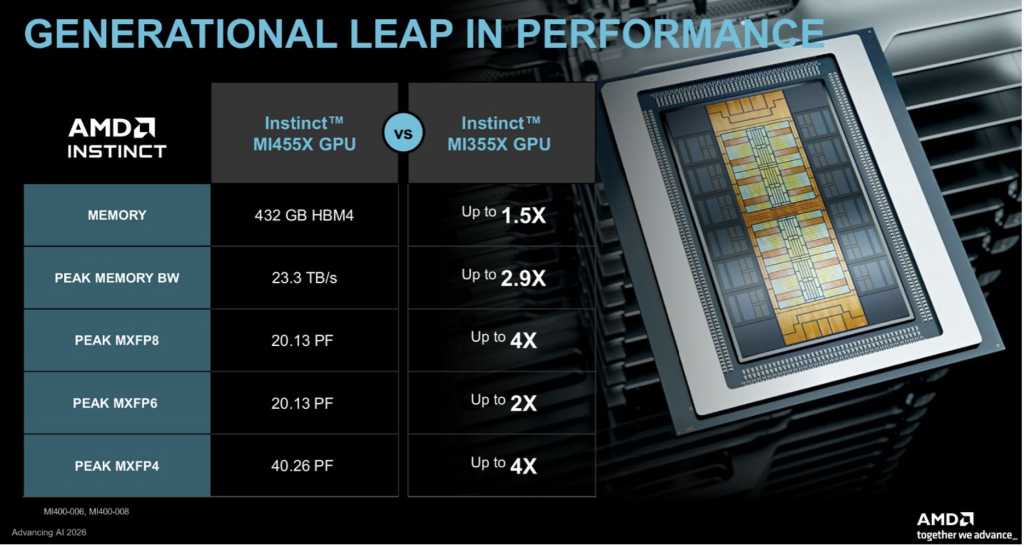
The Instinct MI455X GPU is the compute engine that fuels the Helios rack, and the first GPU based on AMD’s new CDNA 5 architecture. Built with a modular mix of 2nm and 3nm chiplets, it carries 432GB of HBM4 and 23.3TB/s of peak memory bandwidth.

Compared to AMD’s current MI355X, the MI455X offers 1.5 times the memory capacity, up to 2.9 times the peak memory bandwidth and up to four times the peak matrix performance with MXFP4 and MXFP8 data types, which are lower-precision numerical formats designed to accelerate AI processing while reducing memory demands. With MXFP6 (6-bit floating point), performance is rated at up to twice that of MI355X.

AMD also shared some actual, measured internal results using production silicon. The company claims MI455X delivers 3.8 times higher FP8 decode performance, 3.5 times more measured FP4 compute performance and between 2.5 and 3.5 times more networking bandwidth than MI355X, depending on the transfer path tested. Those figures provide more context than just numerical specifications, though they remain AMD-provided comparisons that will need independent validation.

AMD Instinct chart showing generational leap in performance

AMD

The architectural choices behind the numbers are important. Reasoning models and long context windows require sizeable KV caches for maintaining AI attention states, while mixture-of-experts models frequently move large amounts of data across accelerators. MI455X should let more model data, activation states and cache remain local. New dedicated IP in hardware can transfer data while the GPU continues processing, and expanded cache and multicast capabilities are designed to reduce redundant data movement to further improve efficiency.

The aforementioned lower-precision formats can also raise throughput and reduce memory use, but model developers still have to determine where they can be applied without unacceptable accuracy loss.

AMD’s Helios rack takes aim at Vera Rubin

AMD Helios rack

Dave Altavilla

Helios is AMD’s primary rack-scale competitor to NVIDIA’s Vera Rubin platform. Each liquid-cooled rack combines 72 MI455X GPUs, 18 single-socket Venice host CPUs and Pensando networking technologies.

In its most complete, premium configuration, AMD rates Helios for 2.9 exaflops of low-precision AI compute, with 31TB of aggregate HBM4 capacity, 1.7PB/s of memory bandwidth, 260TB/s of bidirectional scale-up bandwidth and 43TB/s of scale-out bandwidth.

These are formidable figures, but they are technical specifications rather than actual application benchmarks. The more consequential development is AMD’s move from collections of eight-GPU servers to a 72-GPU shared-memory domain. Models too large for one node can operate across the rack without treating every exchange as a scale-out networking transaction, which benefits large-model inference as well as training.

AMD uses UALink over Ethernet, or UALoE, for an open standard scale-up fabric. Each MI455X provides 3.6TB/s of bidirectional scale-up bandwidth, while the complete rack delivers all-to-all connectivity through a single switch layer. AMD also claims six times more scale-out bandwidth per GPU than MI355X when MI455X is configured with three Pensando Vulcano 800 AI NICs.

While open standards give cloud providers more control over suppliers and system design, AMD and its partners now have to prove those components can deliver the predictable performance, reliability and deployment experience customers expect from a tightly controlled, more vertically integrated platform.

Finally, AMD designed Helios with automatic rerouting around failed links, virtual rack partitions, tray-level serviceability and rack-wide power, cooling and health monitoring. Major hyperscalers and potentially large-scale enterprise customers will likely key in on these capabilities, which can affect the availability, total cost and consistency of the AI services they consume.

Kind of like cowbell, AMD Venice gives agentic AI more CPU

Chart showing AMD EPYC CPU performance

AMD

AMD’s agentic CPU messaging regarding its upcoming Venice-based EPYC processors is mostly marketing speak, but the underlying requirement is very real. An AI agent can invoke retrieval, databases, security checks, code execution and other tools before a GPU generates a response. Running many agents concurrently increases the amount of conventional compute requirements surrounding the accelerators.

Venice scales to 256 Zen 6 cores with support for 512 threads, 16 memory channels, up to 1GB of L3 cache per socket, along with PCIe 6.0 and CXL 3.1 connectivity. AMD is also offering several Venice configurations for other applications, including general-purpose servers, high-frequency workloads, GPU hosts and high-density CPU sandbox systems used to execute agent tools.

Treating the CPU solely as a GPU host understates its role. Gateways, tokenization, vector search, databases and short-lived code execution stress different mixes of per-core performance, thread count, memory bandwidth and I/O. Specifically, AMD’s internal testing shows Venice significantly outperforming its current EPYC 9965 Turin CPU across five parts of the agentic AI pipeline, including gateway processing, context assembly, vector search, enterprise applications and short-lived tool execution. Individual gains vary by workload, but AMD details the overall generational improvement at up to a 1.7 times lift. As with the MI455X figures though, these comparisons come from AMD and will require independent validation.

Pensando networking and ROCm software advance

Keeping GPUs fed with data and coordinating traffic across racks directly affects utilization and operating costs. In fact, GPU utilization is a pretty sad state of affairs currently for some of the major frontier model providers.

As such, Pensando networking has become central to AMD’s roadmap. Helios can connect each MI455X to as many as three 800Gbps Vulcano AI NICs, while Salina DPUs handle front-end networking and infrastructure services.

On the software side, which is an equally critical component, AMD also introduced ROCm.AI, an AI-assisted development layer due to arrive in August. It includes reusable skills for coding agents, simplified management and Hyperloom, which can profile workloads, tune serving configurations, modify kernels and validate results.

These tools address two persistent AMD challenges: developer efficiency and ease of use, and software tuning. Automated optimization still has to produce repeatable gains without creating hard-to-maintain code, however. And while ROCm has progressed significantly over the last few years, NVIDIA’s CUDA retains an advantage in maturity, tooling and developer familiarity.

Customer commitments underscore rack-scale confidence

AMD now has commitments that give its MI450 generation and Helios considerably more weight. Meta and OpenAI have announced multi-generation agreements composed of up to 6GW of AMD compute capacity, with initial 1GW deployments planned for the second half of 2026.

Oracle plans a 50,000-GPU public cloud cluster beginning in the third quarter, while Microsoft will deploy Helios for Azure AI inference. Finally, just before the AMD event, Anthropic announced a strategic partnership for up to 2 Gigawatts of AMD-fueled AI compute, with its first gigawatt expected online in the first half of 2027.

Commitments of this scale reflect confidence in more than just MI455X performance. These customers are evaluating the complete architecture, including Venice CPUs, Pensando networking, ROCm software, rack integration, serviceability and AMD’s ability to deliver and execute across multiple product generations.

There is some financial alignment behind the agreements as well. AMD issued OpenAI performance-based warrants and committed to investing up to $5 billion in Anthropic. That context matters when evaluating these deals as market validation, but these planned deployments are substantial nonetheless and put Helios on a much stronger foundation as it begins shipping.

AMD expands its robotics and embedded foundation

AMD also expanded its physical AI portfolio, building on credible traction from its Xilinx-derived Kria adaptive system-on-modules and embedded technologies that are already powering robotics, machine vision and industrial automation applications.

The new Ryzen AI Embedded X100 combines up to 16 Zen 5 CPU cores, integrated Radeon graphics, a second-generation NPU and as much as 128GB of unified LPDDR5X memory shared across its compute engines. To me this looks a lot like a repackaging and optimization of the company’s Strix Halo platform, but with specific optimizations for the embedded space. Regardless, AMD is pairing X100 with the Kria AI Robotics Developer Platform, which includes a System Module or SOM, and a new Robotics Partner Network spanning hardware, software and platform providers.

Samples began shipping in June, with full production expected in the fourth quarter. This broader objective is to give developers a path across AMD x86 CPUs, GPUs, NPUs and FPGAs for real-time autonomous systems, rather than requiring them to assemble those hardware engines and software components independently.

Execution for AMD is now the test

AMD has assembled a credible platform for the burgeoning agentic AI market that’s blowing up currently with no signs of stopping. MI455X addresses memory and data movement, Venice handles dense agentic CPU workloads, Pensando networking connects global system resources, and ROCm.AI addresses software complexity. Finally, Helios assembles these components into a true competitive threat for NVIDIA’s latest Vera Rubin platform.

AMD’s open architecture may appeal to customers seeking supplier choice, but openness must also translate into reliable deployments, competitive total cost and software that does not require a significant rip-up. NVIDIA enters this cycle with a stronger ecosystem and far more rack-scale deployment experience. The true test will be how easily and reliably customers can integrate, operate and maintain these AMD solutions at scale.

As it stands, AMD now has major customers and a clearly defined architecture with systems engineering expertise behind it. Delivering Helios on schedule and showing that its performance claims translate into a real production workload throughput advantage and total cost of ownership gains will determine how much the competitive gap narrows. And of course, this is in a market that is clamoring for ever-more compute resources with a seemingly insatiable demand for AI services and capacity. That’s an environment for big iron success. Now AMD just has to deliver optimized, turnkey AI platforms. This is far easier said than done, but time will soon tell as deployments take shape this year.

This article is published as part of the Foundry Expert Contributor Network.
Want to join?

  •  

Google CEO distracts from Gemini 3.5 Pro delay with talk of Gemini 4 and monthly releases

Google CEO Sundar Pichai has sought to allay concerns over the delayed release of the Gemini 3.5 Pro large language model. He dodged questions about it in Google’s quarterly earnings call on Wednesday by focusing on the company’s next frontier AI model, Gemini 4, and plans to release subsequent LLMs at an almost monthly cadence.

His comments came a day after Google unveiled Gemini 3.6 Flash and 3.5 Flash Cyber but offered no update on the release of Gemini 3.5 Pro, the company’s delayed flagship reasoning model that many developers had expected to arrive weeks earlier.

Google introduced the Gemini 3.5 family at its annual I/O conference, promising to release the Pro model in June. That timeline has since slipped, with Bloomberg suggesting Gemini 3.5 Pro is months late because the model’s coding performance is falling short of internal expectations, especially when compared to better performance by similar models from OpenAI and Anthropic.

Instead of revisiting the Gemini 3.5 Pro timeline, Pichai used the earnings call to shift the discussion toward Gemini 4, when asked about how his company planned to navigate an increasingly competitive race to release frontier AI models by to Barclays Investment Bank analyst Ross Sandler.

“We are creating a baseline on top of which you will see us rapidly iterate on subsequent model releases. And so picking up pace and releasing models almost at a monthly cadence is part of our road map as we are building Gemini 4 as well,” Pichai said during the call.

Sandler’s question followed one from JPMorgan Chase & Co analyst Douglas Anmuth, who asked Pichai if Google was releasing frontier AI models frequently enough to keep pace with rivals OpenAI and Anthropic.

Pichai had responded to Anmuth’s question that Google remained confident of competing at the frontier and was investing heavily in a larger Gemini 4 base model.

Analysts, though, aren’t as confident as Pichai.

While delays to Google’s frontier model roadmap have not triggered an exodus of existing customers, either because of high switching costs or because many enterprises already running multi-model architectures, they have made CIOs evaluating AI platforms more cautious about making new commitments, said Bhupendra Chopra, chief revenue officer at IT consulting firm Kanerika.

A monthly model release cadence could prove to be a double-edged sword for enterprises and their CIOs.

While a monthly release cadence could help enterprises gain faster access to improvements in model performance, cost and capabilities, it will also require CIOs to invest more heavily in testing, governance and version management to safely adopt those updates, said Sanchit Vir Gogia, chief analyst at Greyhound Research.

Similarly, Pareekh Jain, principal analyst at Pareekh Consulting, said enterprises will embrace a faster release cadence only if each successive model delivers measurable improvements in performance, cost or safety, rather than simply changing version number.

The challenge for CIOs, Jain said, is not just keeping up with model releases; it’s deciding whether each new version is worth the cost of validating it.

This article first appeared on InfoWorld.

  •  

MacBook Neo’s success wasn’t luck, it was a plan

It’s difficult to ignore the fact that Apple seems to have turned its MacBook Neo into a weapon to promote platform growth, with enough performance under the hood to make competitors seem inferior.

And even as the PC industry moves to try to compete with Apple’s last huge Mac success, the company is already planning a powerful follow-up.

That points to the discipline Apple has applied to the Mac since the introduction of Apple Silicon. The company has built a clear product roadmap, strong entry-level pricing, and steady performance gains. This focus is now paying dividends, giving people the impetus to keep placing their trust in Apple and its Macs — even as the industry raises prices in the face of RAMageddon and price increases. 

The numbers don’t lie

“Apple’s recent price increase seems to be an inevitable response to these cost increases. In the second half of the year, other PC OEMs are expected to continue to raise prices, and the overall ASP increase is expected to continue,” Counterpoint said in a post Wednesday. The researcher tells us global PC shipments shrank 4% in the second quarter of 2026 as rising costs hit demand. The Mac maker, by contrast, moved in the opposite direction, generating 13% growth in the quarter — mainly on the back of the MacBook Neo introduction. 

Recent IDC data gives Apple 10.1% year-over-year growth and just under 10% (9.9% to be exact) of the worldwide PC market, even as the overall market declined 4.9%.

“With emerging supply chain and tariff challenges inflating memory prices…, Apple’s incredibly aggressive price-point for the MacBook Neo makes its release feel all the more like a gut punch to one of the PC market’s most valuable price tiers,” Futurum Research Director Olivier Blanchard said when the Neo was released. 

Neo 2.0 is already coming

In the immediate future, as competitors raise prices on the PCs that compete with Apple’s lower-cost device, Cupertino is already plotting the path toward MacBook Neo 2. Reports claim this will debut in March in new colors and use the A19 Pro chip from the iPhone 17 Pro, with performance boosted by slightly more unified memory (12GB, rather than 8GB). That’ll make it a much better Mac, likely with 10-15% performance gains and the ability to run Apple Intelligence, making it the best and most affordable AI PC in its class.

Just four months after the Neo’s rollout, Apple is already in position to leak rumors of an even more computationally capable follow-up, while competitors struggle to compete with the original on performance, build quality, and price. Still, the Neo might get more expensive, reporting warns, with the lowest-price 256GB model now gone, making the $599 Mac a mirage we can only wistfully hope to see again. 

That might matter less in context, as PC makers everywhere boost prices while RAM, chips, and storage prices head north, along with transport, logistics, and energy costs. “While [Apple] did raise prices in line with the broader market, it still remains well positioned against rivals facing the same cost pressures,” said Jean Philippe Bouchard, vice president for consumer devices at IDC. 

“As market conditions continue to worsen, the importance of supply chain management and capabilities are increasingly important,” Bouchard said. “The largest vendors, with their buying power and long-standing supplier ties, are best positioned to take share from smaller rivals.”

This was never about luck

This isn’t solely a market take about competition, it’s about planning.

Few in the industry seemed prepared for the massive memory price increases that hit this year. Apple clearly planned its low-cost Mac well before that happened, hoping to seize the PC market at the low-mid-range. This is precisely what it seems to have done, what it continues to do, and what it will continue to do.

The recent reports that it has a successor planned shows the breadth of the Mac company’s strategic vision, as Apple has quite clearly sought to fully exploit the failings of Windows and the internal contradictions of a value-conscious industry in stiff competition with itself.

With the first M-series Macs about to enter the replacement cycle, Apple has built a market it can capitalize on for at least a decade, meaning it already has a vision for PC sales that extends at least as far. That’s the kind of road map corporate purchasers want when they make platform deployment decisions, which is why Apple’s 10% share gains are the beginning of even more significant market change. 

You can follow me on social media! Join me on BlueSky,  LinkedIn, Mastodon and subscribe to my daily Apple-related news summaries at The Core.

  •  

Own nothing, upgrade everything: Apple’s new Klarna deal

Just in time for the iPhone’s 20th anniversary, Apple is moving closer to becoming a service company. It is set to launch its new deal with Klarna next week and when it does, Apple enthusiasts in the US will effectively be able to subscribe to their favorite Apple hardware, with the cost spread across up to three years.

This matters because when combined with Apple One and Apple’s Creator Studio subscriptions, the Klarna arrangement brings Apple closer to offering a full subscription model for hardware, software, and services. The only thing you don’t get under the new arrangement is AppleCare, for which you’ll allegedly need to pay extra.

Moving closer to hardware-as-a-service

Apple has slowly been transitioning toward hardware-as-a-service for almost a decade. Back then, Forrester analyst Frank Gillet predicted the company would eventually offer bundles of services and products for a monthly, all-in, fee. 

This isn’t quite where we are yet; you still need at least three subscriptions to get close. But, after the better part of a decade, Apple has moved much nearer to the hardware-as-a-service idea.

There are some products reportedly excluded from the arrangement, including MacBook Neo, Apple Watch SE, the entry-level iPad, and iPhone 16. Clearly, Apple sees those products as sufficiently affordable. 

Easy payments for RAM-ageddon

The new Klarna arrangement comes as Apple is forced to increase product prices as AI-driven memory price inflation becomes widely felt across every economy. In theory, I assume, Apple hopes to make its products available to cash-strapped consumers who need new hardware, while also navigating a time of deep economic tumult and uncertainty. It’s thought the company has previously rejected these plans to protect normal hardware sales, but normality is a kingdom we no longer seem to possess. Interesting times. Probable inflation incoming.

“Apple Upgrade lands at precisely the moment Apple needs it,” IDC analyst Francisco Jeronimo wrote in a note seen by Computerworld. “Having just pushed Mac and iPad prices up on the back of the memory shortage, with iPhone increases widely expected in September — as well as the new iPhone foldable expected at $2,500 — Apple’s real risk is that rising prices even further can impact the upgrade cycle.” 

New age, new shopping habits

The introduction of the scheme gives consumers a way to purchase the company’s popular high-end devices when they are introduced — no doubt,at higher cost — this fall. Plus, of course, if it’s good enough for GM, it’s good enough for Apple.

It’s all about attitude, too. From Apple’s perspective, it has done plenty of the groundwork required to convince its customers that subscription payments for things you value are no bad thing. 

Reluctance to embrace “Access Not Ownership’”purchasing models has dropped dramatically since Apple — and CEO Tim Cook — first began banging the drum for services income. Apple’s services stream has now become its second-biggest revenue driver after the iPhone. It has over 1 billion paid subscriptions, and an active hardware installed base of more than 2.5 billion devices globally.

A combination of changed customer habits and external threat means the stars are now aligned for hardware-as-a-service models. “Reframing a device as a low monthly payment protects that [upgrade] cadence and allows Apple to start marketing their products as device-as-a-service to consumers, which no other vendor was ever able to do,” Jeronimo wrote to me. 

There is a one-more-thing aspect to this: the products are effectively being leased, a new approach that will give Apple a stronger grip on EOL devices, helping it grab more of them for refurbishment, resale, and recycling. Over time, this will give the company a much stronger grip on the lucrative second-user market that exists around Apple equipment, even while for almost every consumer product we find the life we want is something we can rent, but probably can’t afford to own.

Managing future risk

The other solid reason to take a partnership approach is risk management. Apple had intended to develop its own buy-now, pay-later scheme via Apple Pay Later, but abandoned that plan as it became riskier with rising bank rates. “Also, by backing the program with Klarna rather than reviving the in-house subscription plan it shelved in 2024, Apple captures the demand upside without taking the credit risk onto its own balance sheet,” Jeronimo said.

You can follow me on social media! Join me on BlueSky,  LinkedIn, Mastodon and subscribe to The Core.

  •  

Apple and the changing of the guard

As Apple gears up to anoint John Ternus the new company CEO in September (while current leader Tim Cook takes a seat on the board) the company appears to be firing on all cylinders ahead of the leadership transition. 

What’s going well

Just look at the evidence: 

  • Apple is building market share across its entire product range; even memory-driven price inflation doesn’t seem to have dampened demand for its hardware yet.
  • While Apple had to raise prices, the company’s MacBook Neo remains seriously popular. It’s sitting atop Amazon’s US best-selling chart, which currently includes six Macs in the top 10. The Neo has topped this chart since its introduction.
  • Apple’s iPhone 17 series continues to sell well, with recent market data showing sustained growth. Both Counterpoint and IDC tell us that iPhone shipments continue to increase, even as other vendor shipments slide.
  • IDC analyst Francisco Jeronimo recently estimated that Apple’s upcoming foldable iPhone Ultra could grab 29.4% of global folding smartphone sales this year, rising to 34.9% in 2027.
  • The company’s new 27 series of operating systems is attracting a great response as beta testers report that it is already solid, stable, and performing well.
  • The AI narrative has really changed, with analysts no longer quite so starry-eyed at the prospects for the big frontier AI firms. Apple’s edge-AI-enabling approach is winning converts.

What’s coming up

The company’s newly-filed lawsuit against OpenAI may or may not succeed, but it will certainly help consolidate recognition of the importance of Apple’s designs and intellectual property in whatever hardware emerges from the AI firm. It also means both Apple and OpenAI are already competing in hardware, even though neither company yet offers anything that directly challenges the other. 

Apple has just set out its stall to brand-loyal fans in a big way and did so before OpenAI gets to woo the same set of customers with a wriggle of its Jony Ive-tinged talisman.

The stage is set for intense competition between the two. Though some say Apple’s needs to improve employee retention, if it does find proof of efforts to use recruitment to engage in industrial espionage, it’ll be easier to represent its own products as being the OG for new hardware. 

If nothing else, it means consumers will forever be asking, “If OpenAI’s designers are so good, why did it need to poach them from Apple?” Doubt is a weapon.

Managing perception

It doesn’t matter how the case goes, because there fight is already affecting consumer psychology. It also means that as Ternus prepares to take his seat atop the rainbow-colored Apple throne, we can already size him up. “A man is measured by his enemies,” Joe Abercrombie wrote in “The Trouble With Peace.”

Given the proximity of the leadership transition, it’s highly probable that Ternus signed-off on the litigation; in doing so he — and Apple — tell us to expect more of the same. 

Apple has, rightly or wrongly, decided that OpenAI will become its new existential bugbear, following in the footsteps of Microsoft Windows, Real Networks, Adobe Flash, Android, and Samsung, all of whom have been useful foils against which Apple has been able to build and maintain its identity.

Looking at that list, you’d be tempted to believe that nothing much is new. Apple has often defined itself by the enemies it sometimes keeps. What has been will be again, which in this case means even as OpenAI attempts to carve out an identity as a hardware manufacturer delivering solutions to compete with Apple and Google, Ternus’ team’s looks to drive a consensus-shaped wedge into the pro-LLM propaganda. 

That blow comes as Apple finally gets its act together around AI, and as the company prepares for a future in which the world’s most-used wearable device also becomes the wearable way to woo Siri AI.

My kingdom come

Rising market share, powerful solutions, an increasingly recognized and respected approach to AI, and an ideological crusade — these details constitute Apple’s place today and are Tim Cook’s coronation gift to Ternus. He’s passing along a strong and hyper-profitable baton that screams of timeliness and relevance even as the company gets set, ready, to go with a year or two of new product designs, new product families, and a 20thanniversary iPhone.

This is Apple’s party. OpenAI’s name didn’t make the list. 

You can follow me on social media! Join me on BlueSky,  LinkedIn, Mastodon and subscribe to The Core.

  •  

Apple could ‘run the table’ on AI if it does things right

Looking ahead just a short time, Apple could hold a powerful position in AI where it most makes sense: deployment.

Not only will the company offer up its own AI models for the kind of tasks millions use ChatGPT to do today, but it will provide more sophisticated on-device agentic models to help users get things done through Siri AI.

Apple also offers limited capacity for more complex tasks through Private Cloud Compute, and, in partnership with the likes of Google in the US and Alibaba in China, the company is giving users a trusted conduit through which to access even more sophisticated AI services. 

Deeply deployable

Critics can say it took Apple a long time to get to this point, but they also seem to think the company has finally got the mix right with its series 27 operating systems. Arriving late to a party doesn’t mean you won’t shine once you get there.

Apple is also coming up the inside lane around frontier AI, with iterative OS and hardware enhancements that mean its devices become increasingly effective for Edge AI use cases, on device — no cloud service required.

The company appears to be digging down into those use cases. Mark Gurman at Bloomberg recently predicted that future M7 Ultra Macs will support as much as 1.5TB RAM, making these systems more than capable of running full weight frontier models in people’s offices, colleges, and homes. 

While that does assume the AI-flationary memory market can supply that much RAM at prices humans can afford, it is also true that people are already running AI clusters using off-the-shelf Mac minis networked over Thunderbolt cables. It’s no stretch to believe this will continue to be the case, and that it will even broaden as the power/performance offered at the high end grows.

What’s wrong with good enough?

When combined with open AI stacks, particularly newly emerging varieties, Apple’s platforms should become leading contenders for private AI services and edge AI. Many business users will leap at the chance to offer their workers powerful, self-hosted, private AI services using one or more daisy-chained Mac Studios or Mac minis. The recent craze in deployment of both Macs to support OpenClaw instances shows they already are.

Ultimately, these different slices of momentum mean I agree with investor Jason Calacanis that Apple is in position to apply a great deal of pressure on OpenAI and Claude just by putting models on their devices. 

It’s also worth thinking about how people use AI today. How many of the queries made in the world right now constitute relatively simple tasks that could be transacted by on-device AI, such as the emerging new version of Apple Intelligence or even smaller LLM models running on device? You can even run PrismML’s 1-bit, 27-billion parameter Bonsai on an iPad using the Locally app, and that’s in the here and now.

What happens? Pretty soon you’ll find people recognize that they can already run the vast majority of their AI-augmented workflows using services they have on their existing device or can access on their on-prem Mac set-ups. And, of course, as people get used to running small tasks locally and larger tasks on premises, the actual space in which they need to turn to cloud-based frontier models will erode. That’s even as companies like PrismML work towards slimming down full-weight models so they don’t need to run on a server at all.

“It’s going to be wild when people have unlimited tokens on their desks,” said Calacanis in a podcast round table discussion.

Who has the most to lose?

The current incarnations of AI felt like they came from nowhere. Most people weren’t aware of the technology until returning to work after the 2022 holiday season. Since then, the industry has proliferated with dozens of competing models, most recently including powerful but affordable frontier models such as Qwen and Kimi.ai.

These models aren’t necessarily all as good as one another, but in many cases for much of what we do, we’ll find them to be good enough. That’s an existential crisis for some, as industry observers now think the inevitable pricing pressure means some services might have over-invested in capacity before finding any way to turn a profit.

Those profit-seeking services are the ones with the most to lose as Apple extends its hardware advantage, democratizing AI access for all while providing platforms suitable for edge AI, on-premises AI, private AI, and even AI access using third-party services. (The need for the latter will shrink as the capabilities of the former get better.)

Cupertino rising

What does this all mean? While the industry remains young, it is already fragmenting. And striding through the dust of that process comes Apple, equipped with the hardware, software, and approach to build its business even as the enterprise of first mover AI services erodes.

You can follow me on social media! Join me on BlueSky,  LinkedIn, Mastodon and subscribe to my daily Apple-related news summaries at The Core.

  •  

Microsoft’s Patch Tuesday updates: Keeping up with the latest fixes

Long before Taco Tuesday became part of the pop-culture vernacular, Tuesdays were synonymous with security — and for anyone in the tech world, they still are.  Patch Tuesday, as you most likely know, refers to the day each month when Microsoft releases security updates and patches for its software products — everything from Windows to Office to SQL Server, developer tools to browsers.

The practice, which happens on the second Tuesday of the month, was initiated to streamline the patch distribution process and make it easier for users and IT system administrators to manage updates.  Like tacos, Patch Tuesday is here to stay.

In a blog post celebrating the 20th anniversary of Patch Tuesday, the Microsoft Security Response Center wrote: “The concept of Patch Tuesday was conceived and implemented in 2003. Before this unified approach, our security updates were sporadic, posing significant challenges for IT professionals and organizations in deploying critical patches in a timely manner.”

Patch Tuesday will continue to be an “important part of our strategy to keep users secure,” Microsoft said, adding that it’s now an important part of the cybersecurity industry.  As a case in point, Adobe, among others, follows a similar patch cadence.

Patch Tuesday coverage has also long been a staple of Computerworld’s commitment to provide critical information to the IT industry. That’s why we’ve gathered together this collection of recent patches, a rolling list we’ll keep updated each month.

In case you missed a recent Patch Tuesday announcement, here are the latest six months of updates.

July’s Patch Tuesday sees an end-of-support collision amidst a massive, record-setting patch wave

Microsoft addressed 722 CVEs this month once the 427 Chromium upstream relays are set aside — roughly three times a normal cycle and one of the largest single months in recent memory. Two vulnerabilities arrive under active exploitation: an elevation of privilege in Active Directory Federation Services (CVE-2026-56155), and an elevation of privilege in SharePoint Server (CVE-2026-56164). A third, a BitLocker security feature bypass (CVE-2026-50661) is publicly disclosed but not yet exploited.

The July 2026 Patch Tuesday earns Patch Now recommendations for Windows, Office, Exchange, and SQL Server. SharePoint has two critical RCEs on top of its exploited zero-day, and Exchange Server returns with a critical on-premises spoofing flaw. Adding to our (dear) administrator’s efforts, SharePoint Server 2016/2019 and SQL Server 2016 all reach end of support today. The Readiness team has provided a handy infographic of the expected risk profile of this month’s Patch Tuesday updates.

More info is available here on Microsoft Security updates for July 2026.

For June, Patch Tuesday means an IT scramble

Microsoft this month released 206 updates affecting Windows, Office, Exchange Server, and its developer tools — including three Windows vulnerabilities already publicly disclosed. That trio includes an elevation of privilege in the Collaborative Translation Framework (CVE-2026-45586), a denial of service in HTTP.sys (CVE-2026-49160), and a BitLocker security feature bypass (CVE-2026-50507). At the moment, none appear to be under active exploitation, but all three are rated “Exploitation More Likely.” 

Even without an exploited zero-day, the June 2026 Patch Tuesday release requires Patch Now recommendations for Windows, Office, and Exchange. The latter is back in the patch picture with a consolidated security update that Microsoft recommends installing “as soon as possible.”

More info is available here on Microsoft Security updates for June 2026.

For May, Patch Tuesday means 139 updates — but no zero-days

Microsoft this month released 139 updates affecting Windows, Office, .NET, and SQL Server (though there were no updates for Microsoft Exchange Server). Despite the absence of zero-days, the May Patch Tuesday update still requires Patch Now recommendations for Windows and Office. 

The combination of three unauthenticated network RCEs (Netlogon, DNS Client, and SSO Plugin for Jira and Confluence), four Word Preview Pane RCEs, the large TCP/IP vulnerability cluster, and the carry-over BitLocker recovery condition (still active on Windows 10 and Windows Server) warrants an accelerated deployment release schedule. 

More info is available here on Microsoft Security updates for May 2026.

Microsoft’s Patch Tuesday release for April is a whopper

Windows admins are going to be busy this month, dealing with the largest Patch Tuesday cycle in memory. The April release involves 165 updates and roughly 340 unique CVEs from Microsoft — including two zero-days, one of which is already being actively exploited in the wild. 

The Readiness team recommends “Patch Now” schedules for nearly every major product family: Windows, Office (with a zero-day), Microsoft Edge (Chromium), SQL Server, and Microsoft Developer Tools (.NET). April also brings Phase 2 of Microsoft’s Kerberos RC4 hardening with full enforcement set for July. There is a lot to cover, so here’s a useful infographic mapping the deployment risk for each platform.

More info is available here on Microsoft Security updates for April 2026.

For March, Patch Tuesday delivers fixes for 83 vulnerabilities

Microsoft’s March Patch Tuesday release addresses 83 vulnerabilities across Windows, Office, SQL Server, Azure, and .NET — with two publicly disclosed zero-days affecting SQL Server and .NET (though neither is being actively exploited in the wild.) Six additional vulnerabilities spanning the Windows Kernel, Graphics Component, SMB Server, Accessibility Infrastructure, and Winlogon are flagged as “Exploitation More Likely.”

The most significant change this month is the introduction of Common Log File System (CLFS) hardening with signature verification, which will affect how Windows handles log files across the operating system. More info on Microsoft Security updates for March 2026.

February’s Patch Tuesday release fixes 59 flaws, including 6 being exploited

The company’s Patch Tuesday release for February addresses 59 CVEs across the company’s product family — roughly half the volume of January’s 159 patches. Six vulnerabilities, affecting Windows Shell, MSHTML, Desktop Window Manager, Remote Desktop, Remote Access, and Microsoft Word, are already being actively exploited. (All five Critical-rated CVEs target Azureservices rather than Windows, however.) 

Both Windows and Office get a “Patch Now” recommendation, with CISA setting a March 3 enforcement deadline for all six exploited vulnerabilities. Two new enforcement timelines also take effect in April: Kerberos RC4 deprecation (CVE-2026-20833) and Windows Deployment Services hardening (CVE-2026-0386). More info on Microsoft Security updates for February 2026.

  •  

July’s Patch Tuesday sees an end-of-support collision amidst a massive, record-setting patch wave

Microsoft addressed 722 CVEs this month once the 427 Chromium upstream relays are set aside — roughly three times a normal cycle and one of the largest single months in recent memory. Two vulnerabilities arrive under active exploitation: an elevation of privilege in Active Directory Federation Services (CVE-2026-56155), and an elevation of privilege in SharePoint Server (CVE-2026-56164). A third, a BitLocker security feature bypass (CVE-2026-50661) is publicly disclosed but not yet exploited.

The July 2026 Patch Tuesday earns Patch Now recommendations for Windows, Office, Exchange, and SQL Server. SharePoint has two critical RCEs on top of its exploited zero-day, and Exchange Server returns with a critical on-premises spoofing flaw. Adding to our (dear) administrator’s efforts, SharePoint Server 2016/2019 and SQL Server 2016 all reach end of support today. The Readiness team has provided a handy infographic of the expected risk profile of this month’s Patch Tuesday updates.

(More information about recent Patch Tuesday releases is available here.)

Known issues

The July release note flags known issues against the following updates:

  • BitLocker recovery prompt on first restart – the PCR7 recovery condition tracked since April remains live on the platforms that did not receive the Boot Manager servicing fix (Windows Server 2022 and Windows 10 22H2). Devices with BitLocker on the OS drive, the Group Policy “Configure TPM platform validation profile for native UEFI firmware configurations” set with PCR7 included, and Secure Boot State PCR7 Binding reported as “Not Possible” may be prompted for the recovery key on the first restart after installing this update. This month’s publicly disclosed BitLocker security feature bypass (CVE-2026-50661) keeps the component in focus.
  • WSUS synchronization error details suppressed (Windows Server 2025 and 2022) – WSUS no longer displays synchronization error details in its error reporting, a deliberate change made to address the Remote Code Execution Vulnerability CVE-2025-59287. Sync still works, but administrators triaging a failed synchronization lose the detail pane and must fall back to the SoftwareDistribution logs.

Windows Update can still replace manually installed graphics drivers with older OEM versions from the catalogue (the four-part Hardware ID ranking issue acknowledged on the Hardware Dev Center). The two-part HWID pilot runs to September 2026.

Major revisions and mitigations

Between the June and July Patch Tuesdays, MSRC Security Update Guide notices updated 651 reported CVEs across six notification dates (15, 19, 26 June and 3, 8, 11 July), 532 of them routine Chromium upstream re-publications. Of the roughly 30 Microsoft revisions, almost all were cross-platform Office catch-up with no bearing on a Windows enterprise estate. No further action required for IT administrators for this Windows update cycle.

Windows lifecycle and enforcement updates

This is the deadline cycle June pointed at. The July end-of-support wave lands today, and it collides with the month’s heaviest patching. SharePoint and SQL Server take some of their most active security updates ever on platforms receiving their last.

  • SharePoint Server 2016 and 2019, Project Server 2016 and 2019, SQL Server 2016 and InfoPath 2013 have all reached end of support. SQL Server 2014 ESU Year 2 reaches end of support today. SharePoint 2016/2019 take an actively exploited zero-day and two RCEs this cycle, and SQL Server 2016 takes a critical RCE, all as their final security update. Now is the time to get moving on updating these platforms.

The 2011 Secure Boot certificate expiries have now passed; devices that never took the Windows UEFI CA 2023 key updates under CVE-2023-24932 can no longer receive updated boot components, with the Windows Production PCA for the boot manager still ahead on 19 October 2026. Kerberos RC4 hardening (CVE-2026-20833) has been in enforcement since April 2026; the July 2026 update removes the RC4DefaultDisablementPhase rollback control that let administrators defer it, making enforcement final.

Microsoft’s July 2026 Patch Tuesday is a security-only release: 180 test-guidance entries, 14 of them high risk (June had one). Printing and graphics are the centre of gravity: win32kfull.sys, the kernel-mode window manager, is the most-patched binary (14 entries), and seven high-risk flags sit alongside it – the Print Spooler, four win32k entries, and two GDI+ metafile entries. NTFS is the second theme, with 10 entries, two high risk. Every entry reports no functional changes – it’s pure regression validation. The packages span Windows 11 26H1 back to Server 2012 ESU.

Printing and graphics (high risk)

The Print Spooler flag centres on shared printers, whose queue status must track jobs accurately; the win32k flags cover 32-bit application printing, font rendering in printed and exported output, on-screen rendering, and window management; the GDI+ flags cover metafiles.

  • Share a printer from a print server, print from a separate client in varied sizes and formats, and cancel a job, confirming the queue reflects every state change
  • Print from your 32-bit applications, and print text-heavy, graphics-heavy, and multi-page documents to physical and virtual (PDF or XPS) printers, repeating after orientation, scaling, and resolution changes
  • Export documents with varied fonts to PDF and confirm fonts and layout survive; render EMF+ files that apply effects to very large images, and convert EMF files to WMF
  • Open and close windows rapidly, drive common dialogs by mouse and keyboard, and close parents with children open – no orphaned windows

Storage and file systems (high risk)

Both NTFS high-risk flags target integrity – extended attributes, and volume recovery after an unexpected shutdown. File History carries its own high-risk flag on clients. A Windows Server 2025-only bundle across boot, BitLocker, and ReFS demands the full Secure Boot/BitLocker matrix. Eight entries hit Server 2025 alone, including WSL, GPU partitioning, and a scripted Windows Server Backup pass repeating recovery after rolling the date 90 days forward.

  • Exercise NTFS extended attributes – older-system EAs, backup workflows that preserve them, concurrent same-file operations where supported – with antivirus, encryption, or storage filters active
  • Simulate an unexpected shutdown during file activity, verify the volume mounts intact, run chkdsk, and confirm indexing, shadow copies, and backup still work
  • Run a full File History pass: back up, modify and back up again, exclude folders, change frequency, move the destination
  • On Server 2025, boot all four Secure Boot/BitLocker combinations, in standard and confidential VMs where supported

Devices, input and networking (high risk)

Three further high-risk flags land here: HID input (hidparse.sys with win32k) – touch, keyboard, mouse, touchpad, through disconnects and restarts; the WinSock bundle (afd.sys plus Bluetooth and multicast drivers); and IrDA. The heaviest ask is not high risk at all: the NetAdapterCx driver (24H2/25H2, Server 2025) wants 500-plus adapter enable-disable cycles under Driver Verifier.

  • Run the connectivity suite: browsing, large downloads, mapped drives, an RDP session idle 30+ minutes, a Teams call, an hour of streaming, and localhost apps such as Docker or WSL
  • Stress Bluetooth: pairing, 10+ minutes of audio, input after idle, and reconnection after sleep
  • Where infrared hardware exists, transfer a file and run at least 100 connect-disconnect cycles
  • Sweep the rest: DNS Server (zone data must stay under its configured database directory), the client resolver (five entries), DHCP Server (five entries), SMB, NFS, Message Queuing (five entries), RRAS administration, client VPN, and WinHTTP/WinINet consumers

Other windows components

Windows Installer itself is patched: testing should include application install, uninstall, repair, and force a rollback. Hyper-V wants virtual-switch traffic as part of its testing exercises with Virtual Filtering Platform policies enforced. Sixteen media-related security entries cover playback, HEVC and MPEG-TS, USB audio, and MIDI 2.0.

Shell hardening and LSA isolation

These two entries are a little different from the rest of the cycle: they ask you to confirm a security behaviour actively works, not just that nothing regressed. A pass here means the protection fired, so treat them as functional checks rather than box-ticking.

  • Shortcut handling (windows.storage.dll; Windows 11 23H2 and earlier, plus Server 2022): drop a shortcut file carrying the Mark of the Web into a folder and confirm the system refuses to extract its icon and leaks no NTLM credential hash – include the zero-click paths, where the icon would otherwise render without you opening anything
  • LSA isolation and KeyGuard (24H2/25H2, Server 2025): run the supplied PowerShell validation script, which turns on Virtualization-based Security if it isn’t already, exercises KeyGuard key operations in both required and best-effort isolation modes, and reports pass or fail – it needs TPM 2.0, UEFI with Secure Boot disabled, and PowerShell 7
  • Run that script on a dedicated test machine, never a shared one: it enables test signing, disables automatic updates, and reboots without asking

Office & SharePoint

July’s Office wave is security-only; everything landed on 14 July, and nothing critical or non-security shipped in the 7 July preview. It’s an MSI-only cycle, so Click-to-Run estates can sit this one out.

  • On MSI Office 2016, apply the client updates – Excel (KB5002886), Word (KB5002890), PowerPoint (KB5002867), and five further Office 2016 security updates (KB5002273, KB5002887, KB5002748, KB5002857, KB5002830) – then exercise macros, external data, embedded objects, and any line-of-business add-ins
  • On SharePoint Server, patch 2016 (KB5002891, plus the KB5002892 language pack) and Subscription Edition (KB5002882), then check browser-based editing; the guidance lists SharePoint 2019 with a baseline but ships no 2019 package, so there is nothing to install there

Mind the rollback rules before you schedule the window: most client updates can be uninstalled, but the server updates cannot and always require a reboot.

Developer tools & databases

The developer estate gets a broad but low-drama sweep this month. Both .NET and SQL Server patch widely, but the ask is representative-application validation rather than anything exotic – install on the matching branch and confirm normal behaviour.

  • .NET: install the SDK updates (8.0.423, 9.0.316, 10.0.302, x64 and x86) and the Framework rollups spanning 3.5 through 4.8.1 – which reach from Windows Server 2012 up to Windows 11 26H1 and Server 2025 – then run a representative set of applications and confirm they function normally
  • SQL Server: the GDR updates span 2016 SP3 through 2025 – install each on its matching branch and test that each removes cleanly
  • Check an encrypted client connection through the separately patched Windows SQL client (dbnetlib.dll), which ships outside the server branches

The Readiness team recommends the following priorities for your larger enterprise deployments:

  • Start with printing and graphics: half the high-risk flags sit in the Print Spooler, win32k, and GDI+, so regress shared printers, 32-bit printing, PDF export, metafiles, and window management before anything else
  • Take NTFS next – extended attributes and crash recovery both touch data integrity – and add a client File History backup-and-restore pass
  • Give Server 2025 its wider matrix – the Secure Boot/BitLocker combinations, WSL, GPU partitioning, and the scripted backup pass – and work through the stress suites
  • Run the scripted KeyGuard validation on any VBS estate, preferably on a dedicated machine.

Each month, we break down the update cycle into product families (as defined by Microsoft) with the following basic groupings:

  • Browsers (Microsoft IE and Edge)
  • Microsoft Windows (both desktop and server)
  • Microsoft Office
  • Microsoft Exchange and SQL Server
  • Microsoft Developer Tools (Visual Studio and .NET)
  • Adobe (if you get this far)

Browsers

Edge has had a busier month than usual. Microsoft addressed 46 Microsoft Edge (Chromium-based) CVEs this cycle. None critical, but heavily weighted to remote code execution (21 entries) and spoofing (13), led by CVE-2026-58289, a remote code execution flaw. A run of further RCEs (CVE-2026-57981, CVE-2026-56645, CVE-2026-57974) follows.

  • Microsoft Edge – the Edge-specific fixes ship in the Edge stable channel (version 150.0.4078.65, released 9 July). The concentration of RCE and spoofing this month is worth a look for managed Edge estates rather than a routine wave-through.
  • Chromium upstream – 427 CVEs relayed through MSRC this cycle, spanning the weekly Chrome release cadence since the June report: use-after-free, out-of-bounds read/write, type confusion, and inappropriate-implementation flaws across V8, Dawn, ANGLE, Skia, and Tint. The same fixes ship in the Chrome Stable channel; see the Chrome releases blog for the upstream notes.

The Chromium volume looks (quite) alarming but is routine plumbing: it flows to Edge through its own auto-update channel. Add these browser (Edge) updates to your standard release schedule for your managed environments.

Microsoft Windows

Windows carries the bulk of this month’s updates: 406 CVEs, 31 rated critical and 374 important. Elevation of privilege dominates by volume (226 entries), followed by remote code execution (70), information disclosure (70), denial of service (23), and a scatter of security-feature-bypass, tampering, and spoofing entries across the following feature groupings:

The Windows Kernel is the most-patched component (28 CVEs, seven “More Likely”), followed by NTFS (21), Windows Runtime (17), Windows Media (14), ReFS (12), and Win32k (15 across its two entries). Add this Windows update to your Patch Now deployment schedule.

Microsoft Office

Microsoft released 96 Office CVEs this month: 19 critical, 76 important. Remote code execution leads (53 entries), ahead of information disclosure (27) and spoofing (10). SharePoint is the centre of gravity: it touches 39 of the 96 CVEs and supplies the family’s one actively exploited flaw.

  • SharePoint Server: has been exploited (who would have guessed) and reaches end of support today. CVE-2026-56164, an elevation of privilege, is under active exploitation. Above it sit two critical remote code execution flaws, both “Exploitation More Likely” (CVE-2026-50522, CVE-2026-58644) and a critical security feature bypass (CVE-2026-55040). SharePoint Server 2016 and 2019 reach end of support on 14 July, so this exploited, critical-heavy set is the final security update those on-premises farms will receive.
  • Office has experienced a long run of critical remote code execution entries across Office, Word, and PowerPoint (among them CVE-2026-55033 and CVE-2026-55127 in Word, CVE-2026-55043 in PowerPoint, and CVE-2026-55018 in Office), topped by CVE-2026-55045.

With an exploited zero-day, two RCEs, and an end-of-support deadline all landing on SharePoint in the same cycle, SharePoint environments are the priority. Add the July Office and SharePoint updates to your Patch Now schedule.

Microsoft Exchange and SQL Server

Both Exchange and SQL Server carry critical-rated security vulnerabilities this month. Exchange Server returns with an on-premises security update for Exchange Server Subscription Edition, the only on-premises release still supported after Exchange Server 2016 and 2019 reached end of support in October 2025; SQL Server takes two critical remote code execution flaws, one of them against SQL Server 2016, which reaches end of support on the same day.

  • Exchange Server (on-premises) – CVE-2026-55008, a spoofing vulnerability rated critical and “Exploitation More Likely,” is the headline. Behind it, a remote code execution entry (CVE-2026-55005) and two elevation-of-privilege flaws (CVE-2026-55006, CVE-2026-55009) round out the on-premises set. A separate Exchange Online elevation of privilege (CVE-2026-54998, critical) is fixed service-side with no customer action.
  • SQL Server – two critical remote code execution flaws: CVE-2026-54117 (SQL Server 2025) and CVE-2026-54118 (which reaches back to SQL Server 2016 SP3), with five further important elevation-of-privilege and information-disclosure entries behind them. The 2016 exposure matters because SQL Server 2016 reaches end of support on 14 July: a critical RCE on a platform taking its final update.

Both belong on the Patch Now schedule this month: the Exchange on-premises update for its critical spoofing flaw, and the SQL Server update for the two critical RCEs.

Microsoft developer tools

Microsoft released 24 CVEs across its developer tooling this month, all rated important. The weighting shifts from last month’s Visual Studio Code concentration toward .NET and ASP.NET Core, where a run of denial-of-service entries dominates the volume:

Add these Microsoft updates to your standard developer update release schedule.

Adobe (and third-party updates)

Outside Microsoft’s own catalogue, July is quiet. Adobe issued no Acrobat or Reader security updates. So, the month belongs to Microsoft, and it is a heavy one: 722 CVEs, roughly three times a normal cycle and one of the largest on record. Worth noting that this lands in the same season Microsoft has been talking up AI-assisted vulnerability management, and the AI stack it is selling as the answer, Copilot and Azure OpenAI among them, sits in the centre of this patch cycle’s own critical-rated updates. The (AI) tooling may be getting smarter, but the patch pile is (definitely) not getting smaller. This may be the beginning of an accelerating curve of ever larger patch cycles. My feeling is that we are in the middle of the beginning of this coming patch surge.

This article is published as part of the Foundry Expert Contributor Network.
Want to join?

  •  

Apple widens OpenAI trade secrets fight with preservation orders

Dozens of former Apple employees now working at OpenAI have been put on notice after Apple reportedly sent legal letters ordering them to preserve documents and communications relevant to its trade secrets lawsuit against OpenAI. 

The Financial Times reports that “around 40” employees have been targeted with these letters, which repeat Apple’s claim that its confidential information might have been exfiltrated, alleging “trade secret misappropriation and breach of contract.”  The letters also require them to arrange to meet with Apple’s lawyers.

The underlying lawsuit

This comes on the heels of Apple’s explosive lawsuit against OpenAI in which Apple accused the AI company (and former Apple Vice President Tang Tan) of extensive coordinated data theft. Tan was at Apple for 24 years and is now Chief Hardware Officer at OpenAI. 

Apple’s lawsuit is defined by claims OpenAI took a range of steps to pry confidential Apple data from existing Apple employees, including using information such as internal project code names, to gain even more knowledge during interviews. The company says the evidence it has presented so far is only the “tip of the iceberg” concerning OpenAI’s approach.

The lawsuit requests that OpenAI be prevented from using any Apple information during the development of its hardware. Apple is also seeking damages and suing two former employees for breach of contract for violating their employment agreements.

The letters are significant. They represent formal directives that require former Apple staff to preserve documents, messages, emails, and other communications that could be relevant to the case. The demand reflects Apple’s belief that the alleged misuse of confidential information could be more widespread across the competing company. What’s critical is that orders of this kind override any standard data destruction policy and deletion of the requested information becomes a legal offense. 

Why this matters beyond the protagonists

In making its move, Apple shows this is not a dispute about just one or two hires, but an attempt to constrain the movement of intellectual property between the two firms. With AI hardware emerging as the next major battleground in tech, the case could become a defining one; whatever resolution is eventually reached could define the extent to which former employees can carry experience and knowledge between competing firms. The case might also define what the line is between experience and knowledge and the sharing of trade secrets.

This is important, because modern hardware development relies on far more than just finished designs. Product design leans into supplier relationships, manufacturing assumptions, physics, extensive prototyping, and product-roadmap priorities. If courts treat those accumulated insights as protectable secrets, hiring between major technology companies could become far more legally sensitive.

The Jony Ive question

The case comes as Apple prepares to combat OpenAI in hardware. Its competitor is now working with legendary former Apple designer Jony Ive. Ive is not named in the litigation, but Apple will be keen to find out whether confidential product knowledge, design processes, or supply-chain insights have travelled with former staff into OpenAI’s device work.

Ultimately, for Apple, it’s about protecting its many blueprints for whatever hardware the company expects will come after the iPhone.

For its part, OpenAI has refuted Apple’s lawsuit, arguing that it is “not aware of any evidence” that the lawsuit has merit. “We have no interest in other companies’ trade secrets,” said OpenAI spokesperson Drew Pusateri. “We remain focused on building innovative technology that empowers people everywhere.” The company’s lawyers also claim it did respond to Apple’s initial inquiries on the matter.

What’s at stake

The significance of Apple’s newly-shared communication preservation orders is that if discovery uncovers evidence supporting Apple’s claims, the case could complicate OpenAI’s hardware plans and create unwelcome scrutiny ahead of any future public offering.

You can follow me on social media! Join me on BlueSky,  LinkedIn, Mastodon and subscribe to The Core.

  •  

Is Apple bringing chip manufacturing home?

Apple’s recently announced $30 billion multi-year agreement with Broadcom is significant because it means billions of chips for Apple devices will be made in the US, supporting hundreds of jobs. 

This is Apple’s biggest US procurement deal so far, but it won’t be the last; when it announced the arrangement, Apple confirmed it is, “working with the administration and businesses across the US to help create an end-to-end silicon supply chain in America.”

That statement implies that the 15 billion chips Broadcom will produce won’t be the only processors in Apple devices to carry tiny little “Made in the USA” slogans. Broadcom is making custom silicon components and wireless connectivity technologies such as RF/wireless chips (Wi-Fi, Bluetooth, cellular, FBAR filters) and ASIC work, rather than application processors. But they are still chips for Apple devices.

TSMC doubles down

That’s why it is significant that TSMC confirmed plans to extend its own manufacturing in America. It already has a $165 billion US commitment; now, it is investing an additional $100 billion in four more chip plants — including one dedicated to churning out the company’s most advanced 2nm (and smaller) processors. 

“We believe this investment will help to further foster the development of the US semiconductor ecosystem, strengthen the supply chain, and support an increasing number of high-tech, high-paying jobs in the United States,”  CEO C.C. Wei told analysts.

TSMC has also confirmed plans to invest in packaging facilities for processors, which is basically the process where memory, processor, and networking nodes can all be combined and packaged on the chip. That sort of packaging is needed to make the final SoC chip. That means TSMC factories in the US will be able to churn out the advanced processors used in Apple’s current and, presumably, future devices.

The bill so far

That’s three investments — in processor manufacturing, packaging, and Broadcom radios and chips — all of which are strategically important to Apple devices. TSMC makes the brains, Broadcom brings the connectivity. Total value so far: $295 billion, around 1.5 times Apple’s annual revenue in the Americas.

It isn’t all about Apple. TSMC has other clients, and Apple is no longer the company’s biggest customer thanks to the drive to AI. But it is still an important one. That means at least some of TSMC’s newly invested US manufacturing capacity will be dedicated to making chips for Apple. The open question is how much US-manufactured chips will cost in contrast to those made elsewhere.

It’s bigger than two deals

These aren’t the only chip-focused partnerships Apple has made domestically. Apple’s American Manufacturing Program (AMP) launched in August 2025 as part of a $600 billion four-year US investment commitment. TSMC and Broadcom were both named AMP partners, but they weren’t alone, and some arrangements have already been announced:

  • GlobalFoundries is bringing mixed-signal chip manufacturing to make advanced ICs for Face ID.
  • Texas Instruments expanded production for analog/power chips.
  • Samsung is making a new chip-making process at its Austin, TX fab, described by Apple as having “never been used before anywhere in the world.”
  • Apple became the “first and largest customer” of Amkor’s new advanced packaging/test facility in Arizona.
  • Corning is expanding glass production.
  • Applied Materials is making chip manufacturing equipment under AMP.

Bundle all these deals together and it’s crystal clear that Apple’s $600 billion investment is at least in part focused on the technologically advanced components on which its devices are built. These components also have the advantage in being incredibly small, which means they are easy and cheap to ship for final assembly at increasingly automated final production locations worldwide. 

So, is it coming home?

That’s the strategy: keep the high-value, hard-to-automate work — and the jobs it requires — in America, while leaving final assembly flexible enough to go wherever that makes sense now or in the future. Is Apple bringing manufacturing home? Partially, in that the bits that matter the most — brains and networking— are coming back, even if assembly is not.

You can follow me on social media! Join me on BlueSky, LinkedIn, Mastodon, and subscribe to the human-curated daily Apple news briefing at The Core.

  •  

Zoom patches account takeover hole

Zoom has identified, and patched, a critical security hole that “may allow an unauthenticated user to conduct an account takeover via network access.”

The issue is especially significant given Zoom’s extensive reach; it reportedly has more than 300 million daily active users, including 470,000 paying business customers. Given that reach, Zoom has been impacted by many other security incidents and France recently tried banning its use by French government users. 

 Zoom security bulletins released Tuesday revealed the bug, and three other security issues, which Zoom patched on Wednesday. 

The company originally said that the takeover issue impacted Zoom Desktop Client for Windows before version 7.0.0, Zoom VDI Client for Windows before version 7.0.10 and 6.6.15 and 6.5.18 in their respective branches, and Zoom Meeting SDK for Windows, but on Wednesday, without explanation, it removed Meeting SDK for Windows as an affected product.

The other three holes were less severe, but still significant, and they all involved privilege escalation. They impacted Zoom Workplace for Windows before version 7.0.5, Zoom Workplace VDI Client for Windows before 6.5.17 and 6.6.14 in their respective branches, Zoom Workplace VDI plugin for Windows before 6.5.17 and 6.6.14 in their respective branches, Zoom Rooms for Windows before 7.0.5 and Remote Control for Zoom Contact Center for Windows before version 7.0.0.

A second privilege escalation issue impacted Zoom Rooms for Windows before version 7.1.0, and another impacted Zoom Workplace VDI Plugin for Windows before version 6.6.14.

Zoom did not immediately reply to a request for comment.

‘As bad as it gets’

Frank Dickson, group VP for security at IDC, said the nature of the reported hole is alarming.

This bug “is about as bad as it gets, short of a worm. It is exploitable over the network, low complexity, zero privileges required, no user interaction needed,” he said, pointing out that exploitation is easy once technical details leak or someone reverse-engineers the patch, which is not as challenging as it once was, thanks to AI. “Yesterday’s script kiddies have been empowered,” he said.

Dickson said the only good news is that Zoom discovered the hole itself, and that “no in-the-wild exploitation has been reported by any outlet as of Thursday.”

Consultant Brian Levine, executive director of FormerGov, agreed with Dickson’s characterization of the hole, but said a potentially bigger issue is the high level of sensitive data that Zoom accesses. 

“An attacker with unfettered access to a Zoom account may be able to listen to recordings of sensitive meetings, to eavesdrop on future meetings, and to impersonate the organization in an effort to social engineer its clients and partners. Thus, given that ubiquity of Zoom in large enterprises, this vulnerability is pretty concerning,” Levine said.

He’s encouraged, however, that Zoom found the flaw itself, which indicates its security team is “actually doing the hard, unglamorous work of auditing its code.”

Giuseppe Trotta, principal security researcher at Malwarebytes, has a theory about what was behind the Zoom disclosure. 

“Because the vulnerability requires zero privileges and absolutely no user interaction, the remote network attack vector is highly suspected to involve the mishandling of deep links, such as custom URL schemes like zoommtg:// or zoomworkplace://,” he said. This led him to think that if the Zoom Workplace client for Windows fails to properly sanitize and validate incoming arguments passed via these special browser-to-desktop links, an unauthenticated attacker could craft a malicious string that could trick the desktop application into exposing or redirecting the user’s active session tokens directly to an attacker-controlled server, achieving a seamless and completely silent account takeover.

“Watch out for Zoom links and invites if you are on Windows or VDI and haven’t updated yet,” he advised.

Mike Wilkes, enterprise CISO at Aikido Security, offered kudos to Zoom for discovering the critical flaw, but he wanted to know how such a severe bug got into its software initially.

“This vulnerability raises questions about why the defect was not caught by design review, fuzzing, or pre-release abuse-case testing,” Wilkes said. “A historical defect in Zoom’s product/security relationship has been prioritizing ease of use over security risk.”

All four bugs important

Justin Greis, CEO of consulting firm Acceligence, said that the two types of holes reported by Zoom, account takeover and escalation, are both important, but for different reasons. 

“The critical vulnerability is significant because it has the characteristics security teams worry about most,” Greis said, but the privilege escalation holes “are certainly important to patch as they primarily increase the impact of an attack that has already begun. The critical vulnerability has the potential to be an initial entry point, which is why it deserves the most attention.”

Greis also applauded Zoom’s response, saying that it “reflects a reasonably mature security program.”

He pointed out that no complex software platform will eliminate vulnerabilities entirely. “The differentiator is whether vendors are continuously investing in offensive testing, finding weaknesses before attackers do, and moving quickly to develop and distribute fixes,” he said.

  •  

Apple’s OpenAI lawsuit: The lunacy of trying to limit what ex-employees can tell future employers

When Apple sued OpenAI last week, the argument it made was that former employees had stolen Apple data and then used it to benefit OpenAI. 

The technical details — an employee used “a rare, previously unknown authentication bug to access Apple’s shared network folders” — are interesting. But the larger story is Apple’s ridiculous attempt to stop its people from using anything they learned at Apple in other jobs.

“Hiring managers don’t mind some files being brought into the org during onboarding, but suddenly take umbrage when that same employee exits with some files later on,” said Mike Wilkes, enterprise CISO at Aikido Security. “Legal should be equally concerned about both events.”

The lawsuit focused on Chang Liu, an employee who had been recruited to work at OpenAI after working at Apple for eight years as a Senior System Electrical Engineer. The full text of the filing depicts a comedy of errors by Apple, offering the perfect “do not do” list of handling employee resignations — especially when they’re going to a direct competitor. 

“When Apple contacted Mr. Liu to sign Apple’s confidentiality reminder, schedule an exit interview, and confirm that he had returned his devices and complied with other exit procedures, Mr. Liu did not respond.” And “after leaving Apple, Mr. Liu failed to return an Apple-issued work laptop that he had previously authenticated to Apple’s network.”

First, typical procedure for handling departures is to tie the return of all equipment and the signing of documents to any final payments. With Apple, that is likely to be a large amount of money. The lawsuit does not say whether Apple exerted any financial pressure on their employee for compliance. 

But in terms of equipment with high-level access, why weren’t all privileges revoked, both for the employee and any and all company-issued devices? Did they not maintain a remote-wipe capability for these devices? Although remote-wipe is usually used when devices are missing or stolen, it should work as well when a departing employee refuses to return company equipment. 

According to Apple, Liu apparently had help at Apple from Tang Yew Tan, who was supposedly also interviewing with OpenAI. “While employed by OpenAI, [Liu] accessed and used his former colleague’s Apple-issued work computer that was authenticated to Apple’s network, without Apple’s authorization.”

Apple tried to make much of this Liu’s fault. Legally, yes, there might be liability there; still, Apple made itself look as if it couldn’t protect its own data. “Upon discovering that he had this unauthorized access to Apple’s systems, [the former employee] did not report it, return his stolen Apple-issued work laptop or delete the program that allowed the access.” 

Really, Apple? Your data-protection plan relies on ex-employees to “delete the program that allowed the access”? I’m not so sure you didn’t bring some of this data-leakage on yourselves. 

This gets worse: “Over several weeks, while developing hardware for OpenAI, Mr. Liu surreptitiously accessed and downloaded dozens of Apple’s confidential hardware-related files, including voluminous, detailed information about unreleased products, engineering presentations, technical specifications, and proprietary project data.”

Setting aside the issue of privileges, access, and unreturned equipment that apparently had its own privileges, that statement points to massive data exfiltration from Apple systems. Even if it is coming from a current employee, why didn’t that raise any red flags? 

Let’s get back to the broader implications. When professionals move from one company to another, they — of course — are bringing their experience and knowledge with them. Can Apple reasonably tell them that they can’t do so? Isn’t that experience and knowledge exactly why another company would want to hire them?

Now, to be sure, stealing diagrams and product spec sheets is a clear violation. Let’s say Apple spent a lot of money on some hardware research projects. A member of that technical team would learn an awful lot, all on Apple’s dime. 

But is it fair and reasonable for Apple to say that the former employee can’t leverage that knowledge at his or her next job? 

This brings us back to the point Wilkes made: If Apple is going to try to prevent any former employee from leveraging on-the-job experience, then it should instruct all new employees not to use anything they learned in a previous job. 

That would be ridiculous. Companies pay for experienced talent because of that experience. Why pay for expertise if you insist employees not leverage any of it?

Then there’s the amorphous nature of knowledge. So, it’s wrong to take detailed diagrams and spec details and hand them over to a new employer. But what if that worker heading out the door memorizes the documents (photographic memory) a day before resigning? Is a person prohibited from using something from memory?

There’s also the fruit-of-the-poisonous tree legal argument. Even if a former employee doesn’t directly use stolen data, what if their knowledge leads to other money-saving insights for the new employer? 

Given that Apple hires as many specialists as it loses to rivals, wouldn’t it make sense to leverage everything your workforce knows and then let new employers do the same? But before you do that, Apple, tighten your exiting employee tech controls. 

Then maybe you wont’t have to file lawsuits like this down the road.

  •  
❌