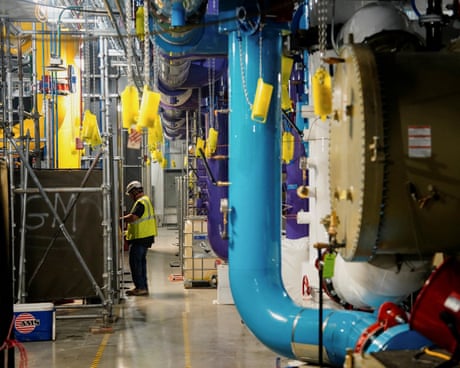
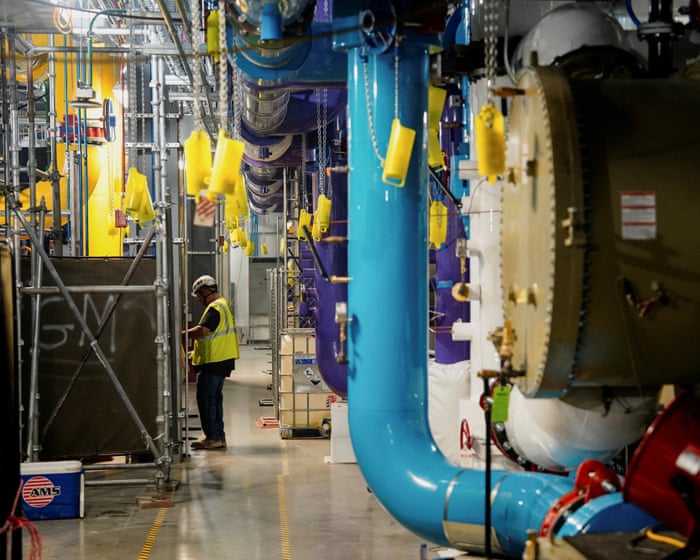
In the latest example, the Energy Department will convert a shuttered Cold War-era uranium enrichment facility into a data center campus and gas plants.
President Trump and Energy Secretary Chris Wright during a White House event last week in which 200 companies vowed to prevent A.I. data centers from driving up power costs.
In the latest example, the Energy Department will convert a shuttered Cold War-era uranium enrichment facility into a data center campus and gas plants.
Queensland and the Northern Territory have rejected the federal government’s plans to mandate that AI datacentres use renewable power, rubbishing Anthony Albanese’s proposals to regulate the booming technology as “underdeveloped ideas that hand increased power to Canberra”.
The latest federal-state stoush on energy comes as S&P Global, the economic rating agency, warns that power use from datacentres could rise five-fold by 2035 to 10% of Australia’s total consumption, and that a mismatch between delivery timelines for datacentres and renewable projects could lead to energy bills skyrocketing.
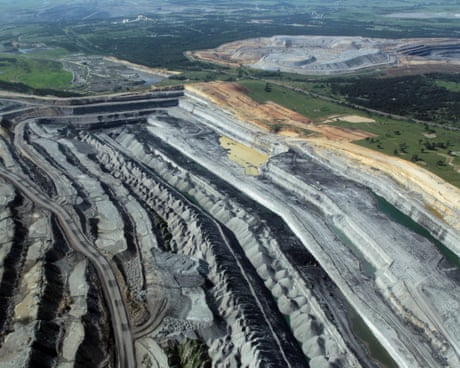
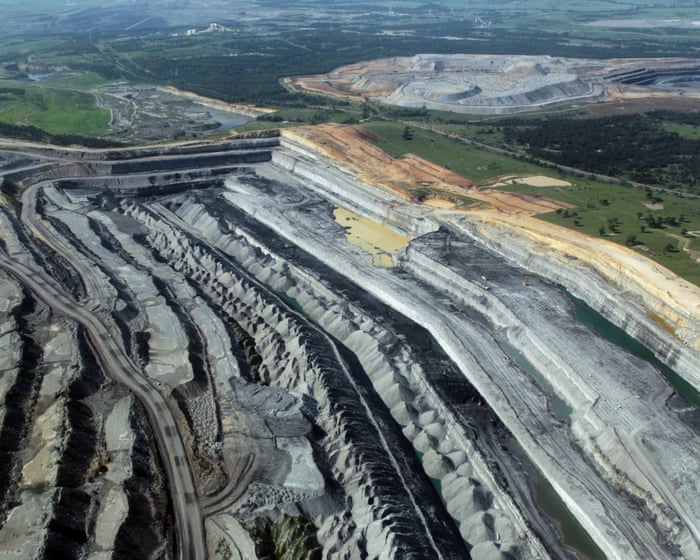
At Branxton community hall in the New South Wales Hunter Valley last week, local resident Janet Murray was given five minutes to speak about plans for the state’s biggest coalmine extension.
Before her were dozens of people, also there to share their views about whether the 19-year extension proposed by Hunter Valley Operations (HVO) should be allowed to proceed.
The president joined Republican officials who slammed the National Academies of Sciences for a chapter about climate science in an educational guide for judges.
The predicted £264bn cost by 2050 could be even higher, plus renewables avoid a far higher total of emissions than can be captured, writes Andrew Boswell, while Simon Oldridge calls out vested interests
Prof Myles Allen and colleagues, in their letter (12 July) on carbon capture and storage (CCS), propose licensing gasfields on condition that producers store an increasing proportion of “the carbon dioxide their products generate”. Their proposal only considers CO2. Methane is excluded by choice although it leaks throughout global fossil-fuel supply chains, including during extraction, processing, liquefaction and shipping.
A growing academic literature, supported by satellite observations of major methane plumes, shows that these emissions can be very substantial, and are the dominant near-term climate impact for gas supplied as liquefied natural gas.
The president joined Republican officials who slammed the National Academies of Sciences for a chapter about climate science in an educational guide for judges.
An oil refinery in Punto Fijo, Venezuela. In a meeting with the president, the Chevron chief executive pushed for an extension of the company’s license to operate in the country.
Prof Myles Allen, Stephanie Loo and Toby Lockwood, and Olivia Powis, respond to an article by George Monbiot about ‘the great carbon capture con’
George Monbiot suggests that we can solve climate change without carbon capture and storage (The great carbon capture con: behold the wasted billions Burnham could claw back, 8 July). Physics says otherwise. The world is going to generate more carbon dioxide than we can safely dump into the atmosphere, and we can’t rely on our stressed biosphere and oceans to mop up the excess. Stopping global warming will therefore require capturing and durably disposing of carbon dioxide on a huge scale, which right now means injecting it back underground.
Where George does make a good point is in questioning whether carbon dioxide disposal should for ever be paid for using public money. Why should private companies be allowed to make large profits taking carbon out of the ground while the taxpayer foots the bill to put it back? The obvious solution: require those who extract fossil fuels to pay for the disposal of the carbon dioxide their products generate. If the fraction they store rises to 100% by mid-century, fossil fuel use would cause no further warming thereafter.
Microsoft, Amazon and Google say they still aim to achieve net zero output despite construction boom
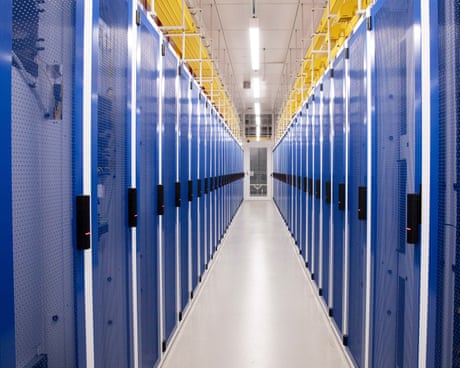
Microsoft, Amazon and Google’s collective carbon emissions have increased by nearly a fifth in the past year, driven largely by datacentre construction.
In the financial year ending March 2026, the three tech companies emitted 119m mTCO₂e (metric tonnes of carbon dioxide equivalent), or about a third of those of France.

 Login