❌

Reading view

GPS particle detectors track space radiation over two decades

Researchers in China have cross-calibrated radiation detectors on 25 navigation satellites. Data from two decades of measurements have been combined to create a record of the flux of relativistic electrons that impinges on Earth’s atmosphere. The technique can be applied to other satellite data, and could boost our understanding of the threat that this radiation poses to satellites and shed light on the solar processes that generate the electron flux.

The Global Positioning System (GPS) uses signals from a constellation of satellites to locate the position of receivers on the Earth’s surface to within several metres. There are currently 32 GPS satellites orbiting about 20,000 km above the Earth and each of them carries a radiation detector. These detectors allow scientists to observe changes in radiation levels in space. Much of this radiation comes in the form of high-energy electrons from the Sun, which can disrupt the operation of satellites and even damage them.

The electron flux rises and falls with the solar cycle. This has a period of about 11 years and involves the waxing and waning of sunspots, solar flares and coronal mass ejections.

For those who design and operate satellites, it is crucial to understand this electron flux. However, it has proven difficult to make full use of the data generated by these detectors because the instruments had not been cross calibrated. Indeed, measurement values of high-energy electrons can vary between satellites by several orders of magnitude when the flux is low. One important issue is that not all satellites use the same detectors – with two different instruments having been deployed.

Cross calibration

Now, researchers in China have done a cross-calibration of the particle detectors on 25 GPS satellites. The result is a calibrated dataset of relativistic-electron flux that spans two complete solar cycles (2000–2020).

To do this, the team looked at two different measurements made by the detectors. One is the differential electron flux at 2 MeV arriving from one specific direction. The other is the integral electron flux electrons arriving from all directions at energies greater than 2 MeV.

Because electron flux is affected by Earth’s magnetic field, the team had to consider its effect on measurements. This was done using a concept called magnetic local time, which accounts for the fact that Earth’s magnetic poles are offset from our planet’s axis of rotation.

The team used a satellite called NS59 as the reference for their study because its detector has produced a consistent set of data from 2004 – overlapping in time all other satellites in the study. By doing several statistical analyses, the team was able incorporate data from 24 of the 25 satellites. One detector, however, remained problematic and the researchers recommend that data from this satellite not be used.

The team says that their technique can now be used to cross-calibrate the detectors at other energies – there are 14 differential and 29 integral channels that can be also be analysed. They have already used the same techniques to cross-calibrate the GPS data with measurements made by satellites in  China’s BeiDou positioning system  and observations made by NASA’s two Van Allen Probes.

The research is described in Satellite Navigation.

The post GPS particle detectors track space radiation over two decades appeared first on Physics World.
  •  

Quarks and qubits: how quantum computing could transform particle physics

Simulating quantum systems is something that classical computers struggle with. Not surprisingly, quantum computers are expected to do a much better job – particularly when a quantum-computer’s architecture is designed to solve a specific type of physics problem.

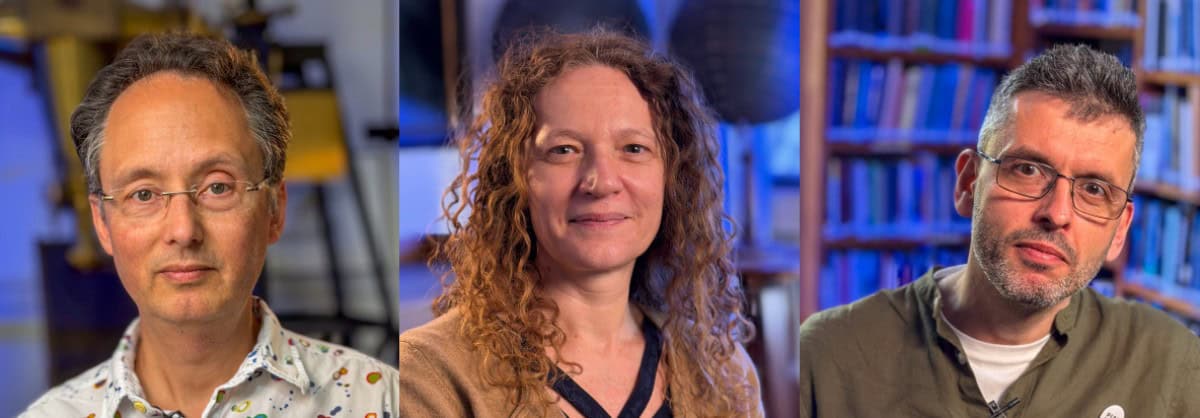
My guest in this episode of the Physics World Weekly podcast is Ross Jenkinson of the UK’s University of Manchester. He talks about the challenges and rewards of using quantum computers in particle physics – a field where classical supercomputers can struggle to simulate simple systems.

We also explore how quantum information theory is being combined with Einstein’s general theory of relativity to shed light on the nature of space and time.

Courtesy: American ElementsThis podcast is supported by American Elements, the world’s leading manufacturer of engineered and advanced materials. The company’s ability to scale laboratory breakthroughs to industrial production has contributed to many of the most significant technological advancements since 1990 – including LED lighting, smartphones, and electric vehicles.

The post Quarks and qubits: how quantum computing could transform particle physics appeared first on Physics World.

  •  

Large physics models boost the performance of passenger cars

This episode of the Physics World Weekly podcast explores how artificial intelligence can be used to improve the aerodynamics of passenger cars and other vehicles. My guest is David Wheater, who is vice president automotive at UK and US-based PhysicsX.

An aeronautical engineer by training, Wheater spent much of his career using aerodynamics to improve the performance of Formula 1 racing cars for several F1 constructors.

Now, his focus is on using AI-based “large physics models” to improve the performance of mass-produced vehicles. This involves combining computational fluid dynamics simulations with wind-tunnel experiments and real-world testing. In this wide-ranging conversation, Wheater explains the need for high-quality training data and we also explore career opportunities for physicists in this multidisciplinary industry.

The post Large physics models boost the performance of passenger cars appeared first on Physics World.

  •  

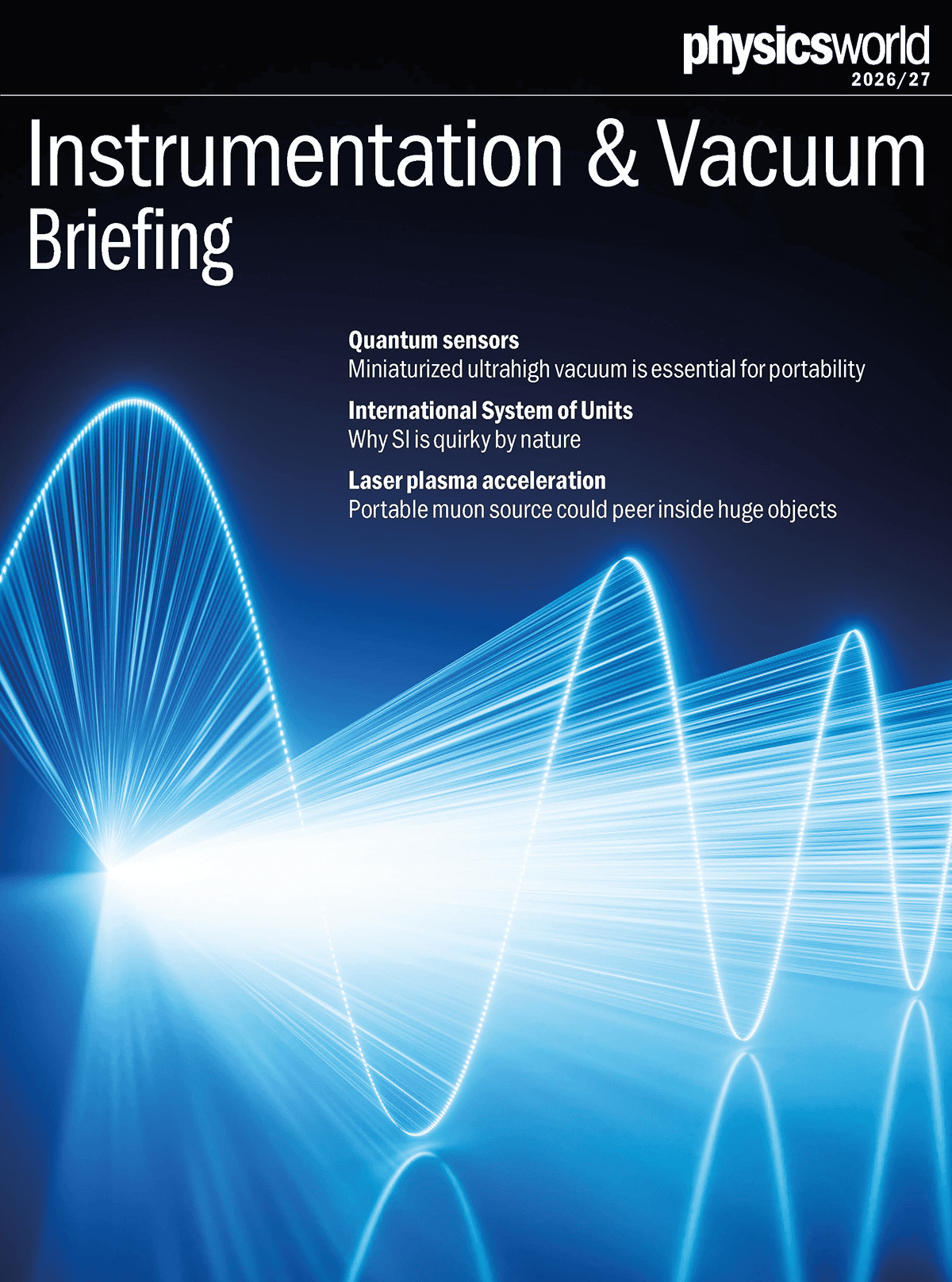
The 2026 Physics World Instrumentation & Vacuum Briefing is out now

The free-to-read Physics World Instrumentation and Vacuum and Briefing 2026 is now available. It includes R&D updates, interviews that explore technology commercialization, and a fun look at the quirky side of SI units.

One topic covered in the briefing is the world of quantum sensors. Over the years, physicists have developed some amazing quantum sensors, but many of the technologies have stayed in the lab because of the challenges of miniaturizing key components. With ultrahigh vacuum (UHV) playing an important role in quantum sensors based on cold atoms, Florence Concepcion of the UK-based firm Aquark talks about her mission to reduce the size and energy consumption of UHV systems.

Elsewhere in the issue, we look at how manipulating individual living cells plays an important role in biology and medicine. Trouble is, cells tend to stick together when grown in vitro and separating them often involves using harsh chemicals that can damage cells or modify their properties. In a special interview, Luke Cox, who co-founded the UK-based firm Impulsonics, discusses its system that uses ultrasound to gently separate living cells.

Physics World Instrumentation & Vacuum 2026 coverAnother entrepreneur featured in this briefing is Brian Pogue, co-founder of DoseOptics. The US-based company has developed a system that detects the extremely faint Cherenkov light that is emitted when a radiotherapy beam strikes a patient’s skin. This allows the radiotherapy to be monitored in real time, ensuring that the beam passes through the target tissue and avoids healthy areas of the body.

Also included is a look at the use of intense laser light to accelerate particles. Find out how researchers in the US have created a compact, free electron laser that is driven by a laser plasma accelerator (LPA) – and it has also been used to create a beam of muons.

Finally, you can explore some of the curiosities of the International System of Units (SI), which is the bedrock of metrology. Although SI and its predecessors have been honed and re-defined over the centuries, it still has some surprising quirks. Ben Stein from the US National Institute of Standards and Technology explores some of these oddities including how the candela was derived from the brightness of a candle made from whale fat and beeswax – and the ongoing debate about using the dimensionless radian as the SI derived unit for planar angle.

The post The 2026 <em>Physics World Instrumentation & Vacuum Briefing</em> is out now appeared first on Physics World.

  •  

Physics World’s Margaret Harris honoured for ‘Feature of the Year’

Congratulations to Margaret Harris for winning the “Feature of the Year – specialist audience” award from the Association of British Science Writers (ABSW). The Physics World online editor was cited for her article “The physics Nobel prizes you’ve never heard of”. The ABSW describes the article as: “A refreshing angle to Nobel prize reporting. It was an eye-opener, told a great story and gave some deep historical context to the murky world of who wins the Nobels and why.”

In the run-up to each year’s Nobel prize announcements, Physics World editors explore aspects of the award that have often been neglected. As well as her award-winning article from 2025, Harris has argued the case that Lise Meitner should have won a Nobel for her work on nuclear fission (“Overlooked for the Nobel: Lise Meitner”). On a lighter note, Harris has described an e-mail exchange with physics laureate Brian Josephson about his tongue-in-cheek “paper” on mattress rotation (“How to rotate your mattress like a physics Nobel prizewinner”).

The post <em>Physics World</em>’s Margaret Harris honoured for ‘Feature of the Year’ appeared first on Physics World.

  •  

Ken’ichi Nomoto and Stanford Woosley share the 2026 Shaw Prize in Astronomy

The 2026 Shaw Prize in Astronomy has been awarded to Ken’ichi Nomoto and Stanford Woosley. They share the prize “for their studies of stellar explosions and the origin of the elements”.

In this episode of the Physics World Weekly podcast, Woosley and Nomoto talk about the astrophysics of supernovae – exploding stars – and what these spectacular events tell us about the elemental composition of the universe and how it has expanded since the Big Bang.

Nomoto is emeritus professor and visiting senior scientist at the Kavli Institute for the Physics and Mathematics of the Universe, at Japan’s University of Tokyo. Woosley is professor of astronomy and astrophysics at the University of California, Santa Cruz in the US.

This podcast is sponsored by the Shaw Prize Foundation.

  • The Shaw Prize is an international prize based in Hong Kong. Currently, it consists of three annual awards. The Shaw Prize in Astronomy; The Shaw Prize in Life Science & Medicine; and The Shaw Prize in Mathematical Sciences. In 2027 a fourth prize will be awarded for work in computer science. Each prize carries a monetary award of $1.2m. The prize was established by Runrun Shaw, a media mogul and philanthropist. It was first awarded in 2004 and since then 121 prizes have been given individuals from across the world.


The post Ken’ichi Nomoto and Stanford Woosley share the 2026 Shaw Prize in Astronomy appeared first on Physics World.

  •  

‘Galactic archaeologists’ share the 2026 Kavli Prize in Astrophysics

The 2026 Kavli Prize in Astrophysics is awarded to Vasily Belokurov, Amina Helmi and Rodrigo Ibata, “for uncovering the fossil evidence of past mergers proving that the Milky Way galaxy was built through hierarchical accretion”.

Belokurov is at the UK’s University of Cambridge; Helmi is at the Kapteyn Astronomical Institute at the Netherlands’ University of Groningen; and Ibata is at France’s University of Strasbourg.

Photo of the three Kavli laureates
Fossil hunters Left to right are Rodrigo Ibata, Amina Helmi and Vasily Belokurov. (Courtesy: The Kavli Prize)

This episode of the Physics World Weekly podcast features an interview with Helmi and Per Barth Lilje, who is chair of the Kavli Astrophysics Prize committee and is based at Norway’s University of Oslo.

In a wide-ranging conversation, we explore the history of the Milky Way and why the work of the Kavli laureates provides crucial evidence that our galaxy was formed by the merger of smaller dwarf galaxies. We talk about what hierarchical accretion tells us about dark matter and the Standard Model of cosmology – and we look forward to the future of the Milky Way.

  • Belokurov, Helmi and Ibata share the $1m prize money equally. The prize will be awarded in Oslo in September

This podcast is sponsored by The Kavli Prize.

The post ‘Galactic archaeologists’ share the 2026 Kavli Prize in Astrophysics appeared first on Physics World.

  •  

Open data: the benefits and challenges of sharing a precious resource

Data are at the core of science, but traditional journal articles normally deliver a distillation of the raw data gathered by the authors. While the movement towards open access to data is widely supported by researchers and funding agencies, a 2024 study by IOP Publishing revealed that many scientists still encounter a wide range of practical, ethical and technical barriers when it comes to sharing their data.

As a result, the publisher has launched a free online course that aims to give early-career researchers the practical skills and confidence they need to share and manage research data effectively.

To talk about the course and IOP Publishing’s open data policy I am joined by Laura Feetham-Walker, who is head of publishing strategy and performance at IOP Publishing.

IOP Publishing is a wholly owned subsidiary of the Institute of Physics and it publishes Physics World.

The post Open data: the benefits and challenges of sharing a precious resource appeared first on Physics World.

  •  
❌