❌

Reading view

NASA Science Soars During August Total Solar Eclipse

6 min read

NASA Science Soars During August Total Solar Eclipse

Each time the Moon covers the Sun during a total solar eclipse — darkening daytime skies and briefly revealing the Sun’s ethereal outer atmosphere, the corona — it presents new opportunities to better understand our star and its influence on Earth.

On Wednesday, Aug. 12, as the next total solar eclipse sweeps over Greenland, Iceland, and Spain, NASA-funded science teams will be chasing the Moon’s shadow with a high-altitude jet and scientific balloons to investigate the Sun’s dynamics and how the temporary darkening of our skies affects our atmosphere.

“From our unique perspective on Earth during a total solar eclipse, scientists can study the Sun’s corona in a way we can’t from anywhere else in the solar system,” said Kelly Korreck, eclipse program manager at NASA Headquarters in Washington. “The Sun impacts our daily life, satellites, and astronauts in space, and we can take advantage of this moment to advance our understanding of that influence.”

High-flying jet to record solar dynamics

Soaring in the nose cone of NASA’s WB-57 high-altitude research aircraft is a suite of four cameras to take high-resolution images of the corona in several different wavelengths of visible and infrared light. Part of an instrument developed by the NASA Scientifically Calibrated In-Flight Imagery (SCIFLI) team at NASA’s Langley Research Center in Hampton, Virginia, the cameras will capture at least 20 images per second, recording structures, outflows, and rapid changes in the corona during the total solar eclipse.

With these images, scientists hope to learn more about the formation of prominences (solar material that gets suspended above the Sun’s surface), better understand the corona and how it gets heated to nearly a million degrees, and investigate how material in the corona and the solar wind are related, which flows out from the Sun across the solar system.

These images of the corona and solar prominences were taken in different wavelengths of visible and infrared light by imagers aboard a NASA’s WB-57 jet during the April 8, 2024, total solar eclipse. The same cameras will fly on a NASA WB-57 jet again during the Aug. 12 eclipse.
NASA / SwRI / William Ashfield

By chasing the Moon’s shadow, the jet will extend how long the cameras can observe the corona. On the ground, the longest anyone will be able to see the corona is two minutes and 18 seconds. But flying along the eclipse path at 460 miles per hour, the jet’s view of the corona will last nearly three minutes.

NASA’s WB-57 will fly at 50,000 feet, above any clouds that might obscure the view of the corona from the ground. The altitude also allows the cameras to observe some infrared wavelengths that get absorbed by the lower atmosphere before reaching the ground, and the corona only has been observed in those wavelengths a few times before.

A small white airplane sis on a beige tarmac. It has a skinny nosecone and a fin that sticks straight up, with the NASA insignia.
One of NASA’s WB-57 high-altitude jets will carry a suite of cameras up to 50,000 feet to capture images of the solar corona during the Aug. 12 total solar eclipse.
NASA

The instrument, called SCIFLI Multispectral Airborne Imager, or SAMI, also flew on a WB-57 during the total solar eclipse on April 8, 2024, providing valuable imagery and information about the corona. However, the study’s principal investigator, Amir Caspi of the Southwest Research Institute in Boulder, Colorado, says each total solar eclipse provides new opportunities to learn more about the corona.

“The Sun is always changing,” Caspi said. “Every eclipse is different. So we could see things we didn’t see before. And we learn from each eclipse how to better observe the next one.”

Caspi’s team also is making some enhancements for the 2026 campaign based on lessons learned in 2024. For example, the team will adjust exposure times to better capture bright features that were overexposed in 2024 imagery. They will also leverage software developed since 2024 to process and analyze the data sooner than before.

The experiment is funded by NASA’s Heliophysics Low Cost Access to Space Program.

As a total solar eclipse crosses Russia, Greenland, Iceland, Spain, and Portugal on Aug. 12, 2026, some of the best views will come from 50,000 feet up, aboard NASA’s WB-57 jet. Credit: NASA’s Goddard Space Flight Center

Balloons to watch atmospheric changes

When a total solar eclipse suddenly turns daytime skies dark, our atmosphere changes in ways we don’t yet fully understand.

The NASA-supported Nationwide Eclipse Ballooning Project, led by Angela Des Jardins at Montana State University, is sending students from several U.S. universities to Iceland and Spain to launch scientific balloons before, during, and after the eclipse to better understand those changes.

A photograph shows several people in silhouette standing in a large field in front of the setting Sun, gathered around a large, round, white balloon floating just above their heads against a blue sky.
A student team from the University of Kentucky prepares to launch a ballon from Bloomington, Indiana, to take atmospheric measurements on April 8, 2024, during the 2024 Nationwide Eclipse Ballooning Project campaign.
Sean Bailey (University of Kentucky)

In Iceland, two teams will launch a total of 80 balloons starting 18 hours before the eclipse until eight hours afterward to study how the eclipse affects Earth’s “boundary layer,” the part of the atmosphere that touches the ground. The thickness of the boundary layer changes depending on factors such as surface temperature and moisture in the air.

Previous balloon flights during solar eclipses in October 2023 and April 2024 showed that the boundary layer collapsed, or decreased in thickness, in locations with clear skies but not where there were cloudy skies. Scientists wonder whether that will be different in Iceland in 2026. Changes in the boundary layer are driven by the day-night cycle. However, in Iceland in August, the days are long and nights are short, so the nighttime influences might not be as strong as in 2023 or 2024.

“Will this eclipse be able to collapse the boundary layer?” said Matthew Bernards, a chemical engineering professor at the University of Idaho, who leads one of the Iceland teams.
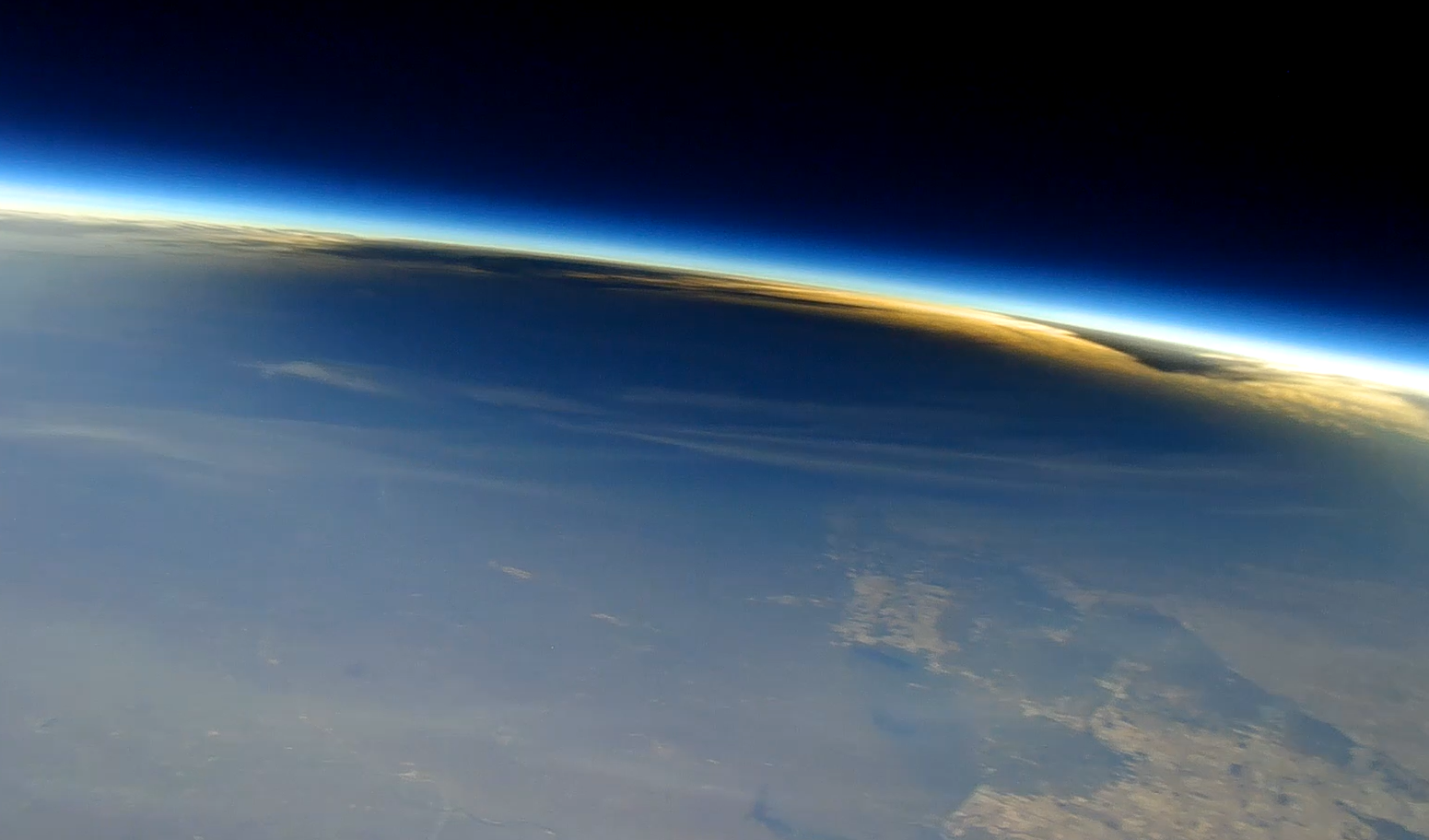
A small part of Earth appears in the lower portion of the view, with the blackness of space in the background at the top. The atmosphere appears as a thin, blue band separating Earth from space. Projected on to Earth is a dark, oval-shaped shadow cast by the Moon during a total solar eclipse.
This image shows the Moon’s shadow on Earth during the total solar eclipse on April 8, 2024, as seen from about 90,000 feet from a camera carried by a scientific balloon. Cameras carried by balloons launched from Spain will capture similar images during the Aug. 12 total solar eclipse.
Nationwide Eclipse Ballooning Project/Virginia Tech

In Spain, three balloon teams will launch a total of six balloons with 360-degree cameras to image the eclipse shadow from above. These balloons also will include instruments designed to measure levels of ozone in the atmosphere, which requires sunlight to form. Similar balloon experiments showed that ozone decreased during totality in April 2024. Scientists wonder whether there will be differences with this eclipse, particularly since it happens at a later time of day and during a different season.

The NASA-funded Nationwide Eclipse Ballooning Project will allow teams of students from across the U.S. to get a unique view of the August total solar eclipse with scientific balloons. Credit: NASA’s Goddard Space Flight Center

Follow along

While the total solar eclipse won’t be visible in the U.S., some parts of the country will be able to see a partial solar eclipse. Learn more about where to see the eclipse and how to view it safely.

by Vanessa Thomas
NASA’s Goddard Space Flight Center, Greenbelt, Md.

Lee esta historia en español aquí.
Keep Exploring

Discover More Topics From NASA

  •  

After a lifetime of waiting, I'll finally witness a total solar eclipse next month on Aug. 12

On Aug. 12, I get to fulfil a lifelong ambition. I'll take a flight to Madrid and travel northwest to the city of Valladolid by rail, before striking out for Valoria la Buena — a charming town in central Spain with a population of less than 1,000.

There, I'll bear witness to one of the most spectacular naked eye shows that the solar system has to offer: a total solar eclipse. My first total solar eclipse.

Don't get me wrong. I've been obsessed with eclipses my entire life. I just haven't found myself in the right place at the right time to experience totality until now. 10-year-old me came pretty close during a deep partial eclipse in 1999, when I caught a fleeting glimpse of the moon's silhouette taking a bite out of the sun in the cloud-ridden skies over the United Kingdom.

Smash cut 20-something years later and I'm inexplicably the Skywatching Writer for Space.com, where one of the major perks of the job is being sent to report on eclipses. Things aligned quite nicely.

For the 2026 eclipse, I'll be joining a volunteer team from NASA's Dynamic Eclipse Broadcast (DEB) Initiative led by citizen scientist Charles Greenwald.

The DEB is a network of enthusiastic solar observers led by professional astronomers who use standardized telescopes and software to share inspiring eclipse imagery to the public, while also capturing valuable scientific data on the sun's disk and golden atmosphere.

It was Greenwald who scouted Valoria la Buena as a prime location to observe the eclipse. He's since been hard at work liaising with DEB initiative leadership to test software updates and troubleshoot other issues, while also travelling to Mexico to help train student members of the team ahead of their expedition to Spain. Two more eclipse enthusiasts are due to join the group once it arrives in Madrid, making it a wonderfully international affair.

Less than a month out, things are pretty settled, and a kind of nervous anticipation has taken hold. Flights and trains are booked, and I have a pair of Celestron EclipSmart 10x42 binoculars and the EclipSmart 3-Piece Solar Eclipse Observing and Imaging Kit, courtesy of Celestron. Also hats and an ungodly amount of suntan lotion. I'm bald after all, so the sun is my greatest natural predator.

Of course, preparations can only get you so far. Once we get to Valoria la Buena on Aug. 10 there'll still be important work to do. The first order of business for Charles and his DEB team will be to stake out a location with a clear line of sight to the west for their equipment. Totality will occur with the sun less than 10 degrees above the horizon — roughly the width of your clenched fist held at arm's length — so line of sight will be everything.

We'll also be at the mercy of the weather. Clouds could easily arrive to hide the cosmic show from view — especially with the eclipse so low on the horizon. The DEB team also has to find a spot with good connectivity, which will allow them to broadcast near-live images of our parent star for the public to enjoy and scientists to pore over.

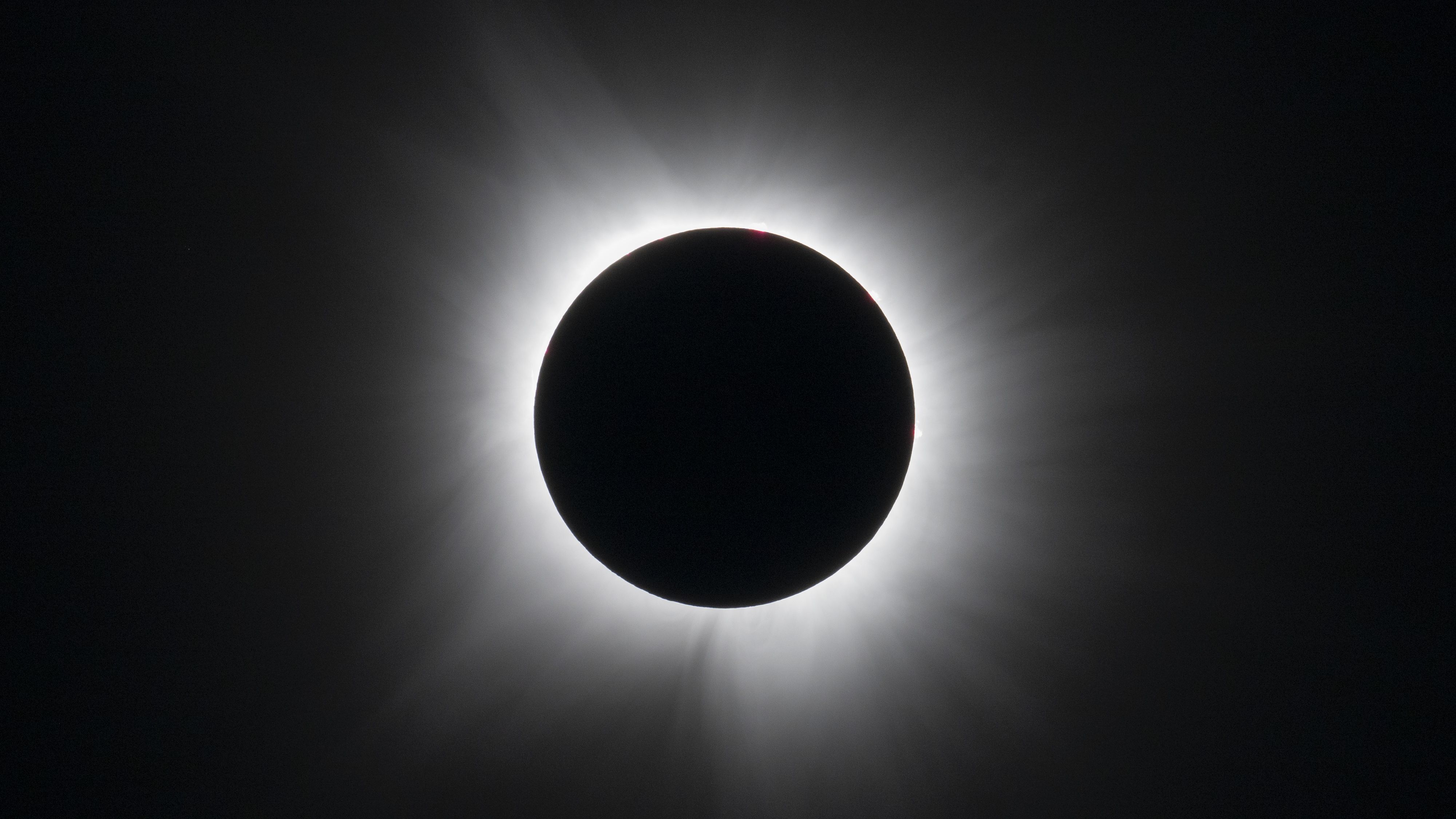
The moon is photographed blocking the sun's disk during totality at the climax of a total solar eclipse. The sun's white atmosphere haloes the moon in a black sky.

The sun's atmosphere shines out from behind the moon during a total lunar eclipse. (Image credit: Photo by Keegan Barber/NASA via Getty Images)

All being well, myself, the DEB team and over 15 million others in the path of totality will bear witness to a heartstopping display of orbital mechanics that crescendos with the fleeting artificial night of totality, as the moon blocks the last sliver of the sun from view. Space.com's Skywatching Editor Daisy Dobrijevic will also be on hand to report on the total solar eclipse as it unfolds in the skies over Greenland.

We can't wait to share our experiences with you. Be sure to stick with Space.com to discover everything there is to know about the Aug. 12 total solar eclipse, along with details on how to watch it online, which will be published closer to the event!

You should also read our guide to safely observing the sun, to ensure that you're ready to enjoy the eclipse, and our roundup of the best solar viewing equipment available in 2026 if you're looking for safe, quality gear.

Editor's Note: Want to share your eclipse photography with Space.com's readers? Then please send your photos and comments, along with your name and location to spacephotos@space.com.

  •  

The 10 best places in the UK to see the partial solar eclipse on Aug. 12

On Aug. 12, 2026, skywatchers across the U.K. will experience a rare astronomical double-header: a deep partial solar eclipse before sunset followed, hours later, by the peak of the annual Perseid meteor shower. Although the path of totality will sweep from Greenland and Iceland to Spain, it will miss Britain entirely. However, the solar eclipse will still be dramatic, with up to 96% of the sun obscured for viewers in the far southwest.

This will be the U.K.'s deepest partial solar eclipse since 2015, and timing will be everything. The eclipse reaches its peak around 7:00-7:16 p.m. BST, with the sun hanging low above the west-northwest horizon as a narrowing crescent shortly before sunset. Because the sun will be relatively low, choosing the right location will matter far more than traveling huge distances. Coastal viewpoints, hilltops and open landscapes with unobstructed western horizons will offer guaranteed views — if the sky is clear.

The locations below prioritize another crucial factor: dark skies. While the eclipse will be visible almost everywhere in the U.K. and most will be happy to see it from close to where they live, the real reward comes after darkness falls, when the Perseids begin flashing across the sky. Find somewhere remote, stay overnight — ideally camp — and this could become one of the most memorable observing sessions of the year.

Eclipse timings and sightlines are from Xavier Jubier's Interactive Google Maps; cloud cover is from Time and Date, the figures reflect long-term climatological averages for mid-August, not weather forecasts. Bortle and sky quality meter (SQM) data come from the Light Pollution map.

During a partial solar eclipse, it is NEVER safe to look directly at the sun without solar eclipse glasses designed for solar viewing. Read our guide on how to observe the sun safely.

1. Hugh Town

Small boats rest on the sandy shore of a coastal village at low tide, with waterfront buildings and a partly cloudy sky in the background.

The Isles of Scilly will see the largest eclipse in the U.K. (Image credit: Westend61 via Getty Images)

Location: St. Mary's Island, Isles of Scilly, U.K.

Max eclipse: 96.4% at 7:16 p.m. BST

Sun position: 13° above west-northwest horizon

Eclipse window: 6:19-8:10 p.m. BST

Sunset: 8:49 p.m. BST

Light pollution: 3.2 Bortle/SQM 21.86

Cloud risk: 74%

The Isles of Scilly combine Britain's deepest partial eclipse with some of southern England's darkest skies. From Hugh Town and nearby west-facing beaches on St Mary's, the eclipsed sun will hang low above the Atlantic Ocean late in the day. Later that night, with minimal light pollution and broad sea horizons, the islands are an exceptional place to watch the Perseid meteor shower beneath pristine late-summer skies.

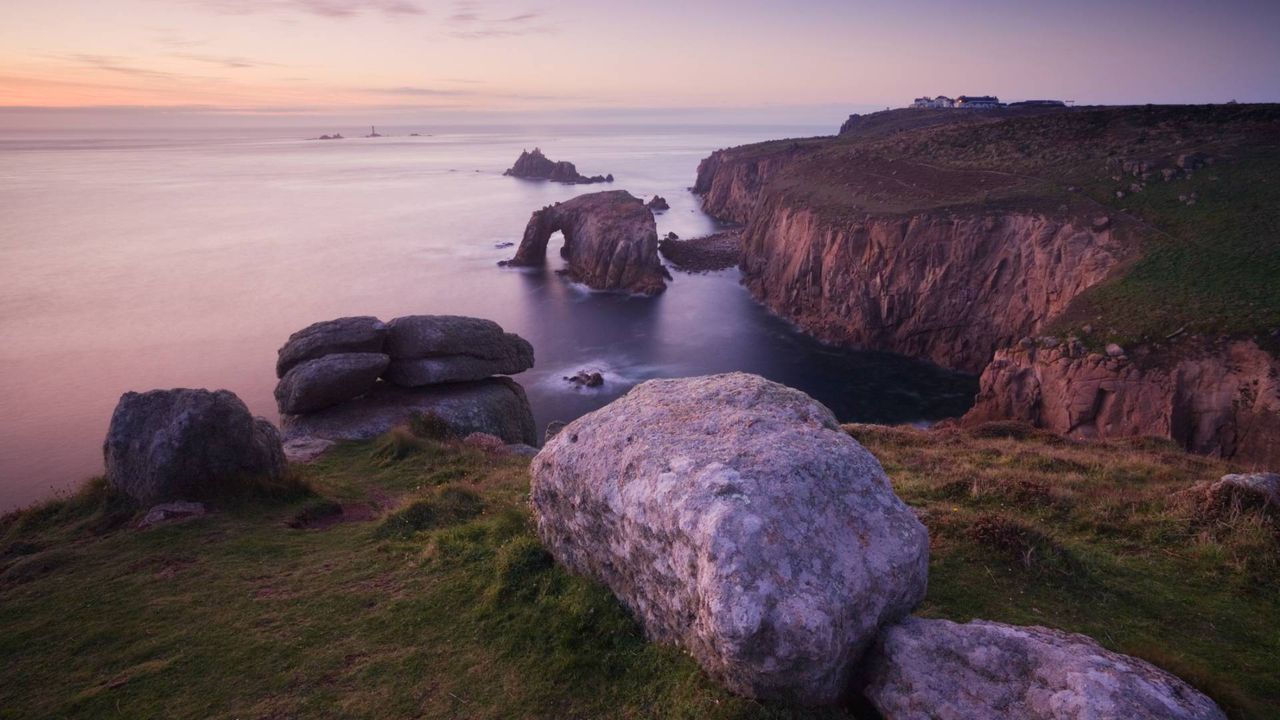
2. Land's End

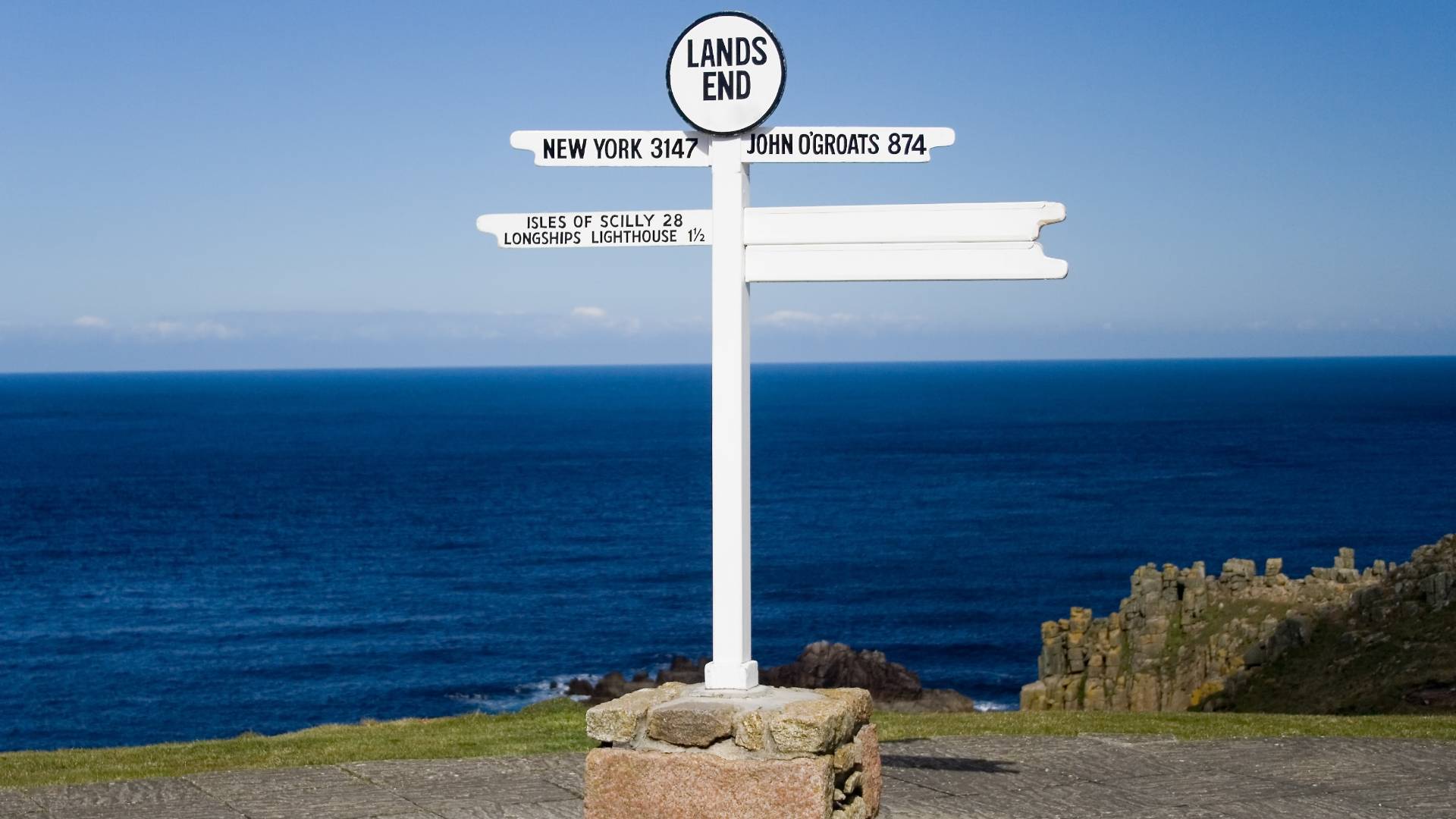
White signpost at Land's End, England, shows distances to New York, John O'Groats, Isles of Scilly, and Longships Lighthouse, with blue sea and sky in the background.

Land's End will see one of the biggest eclipses on the U.K. mainland. (Image credit: PKM1 via Getty Images)

Location: Sennen, Penzance, England

Max eclipse: 95.9% at 7:16 p.m. BST

Sun position: 13° above west-northwest horizon

Eclipse window: 6:19-8:10 p.m. BST

Sunset: 8:47 p.m. BST

Light pollution: 3.1 Bortle/SQM 21.85

Cloud risk: 71%

Land's End is one of the best places on mainland Britain to watch the eclipse because of its vast Atlantic horizon and minimal obstruction toward the west-northwest. The sun will appear heavily eclipsed as it descends toward the ocean before sunset. After dark, the remote far-western location and low levels of artificial light make this region an outstanding destination for viewing the Perseid meteor shower.

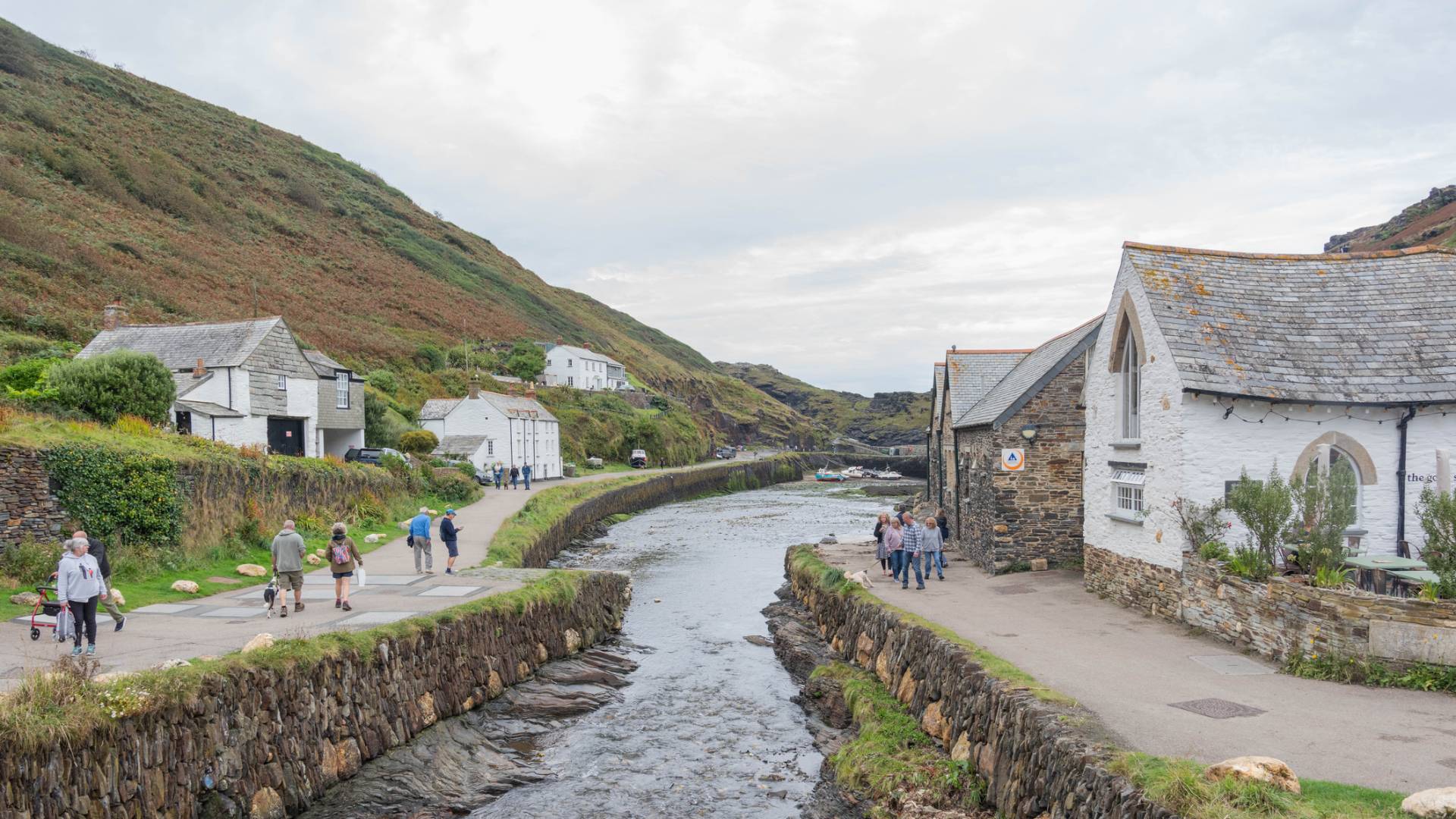
3. Boscastle

A narrow stream runs through a village with stone and white buildings on either side, set against a green hillside. People walk along the path beside the water under a cloudy sky.

Boscastle's River Valency valley will frame the eclipsed sun. (Image credit: Graham Custance Photography via Getty Images)

Location: Cornwall, England

Max eclipse: 94.7% at 7:15 p.m. BST

Sun position: 13° above west-northwest horizon

Eclipse window: 6:18-8:09 p.m. BST

Sunset: 8:45 p.m. BST

Light pollution: 4.0 Bortle/SQM 21.71

Cloud risk: 76%

Boscastle's narrow harbor and dramatic valley may create a natural frame for the eclipsed sun as it sinks toward the Atlantic. The village's northwest-facing coastline offers clear views toward the low evening eclipse, while the surrounding Cornish countryside remains relatively dark after sunset. Once twilight fades, the cliffs and headlands nearby become excellent places to watch for bright Perseid meteors.

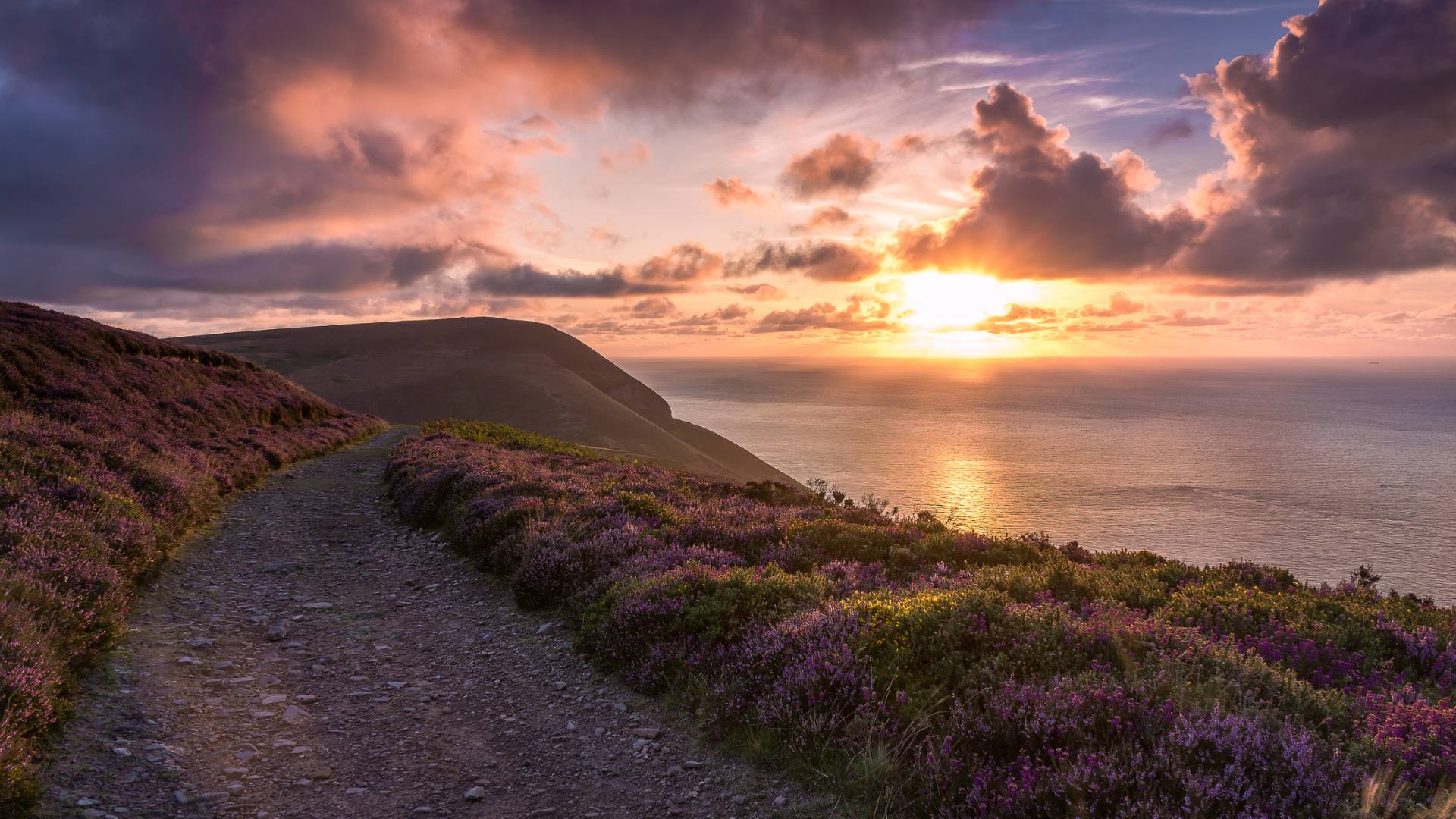
4. Exmoor Dark Sky Reserve

A dirt path winds through purple heather-covered hills, leading towards a dramatic sunset over the ocean, with golden sunlight reflected on the water and clouds tinged with orange and pink hues.

Exmoor Dark Sky Reserve is a great choice for an eclipse and the Perseids. (Image credit: Devon and Cornwall Photography via Getty Images)

Location: Exmoor National Park, Somerset and north Devon, England

Max eclipse: 93.7% at 7:14 p.m. BST

Sun position: 12° above west-northwest horizon

Eclipse window: 6:17-8:08 p.m. BST

Sunset: 8:42 p.m. BST

Light pollution: 3.9 Bortle/SQM 21.67

Cloud risk: 69%

Exmoor combines elevated moorland, dramatic coastline and protected dark skies, making it ideal for both the eclipse and the Perseids. Coastal viewpoints such as Valley of Rocks and Heddon's Mouth offer clear west-facing horizons for the low-eclipsed sun before sunset. Later that night, Exmoor's status as a Dark Sky Reserve makes it perfect for seeing bright Perseid meteors — and the Milky Way.

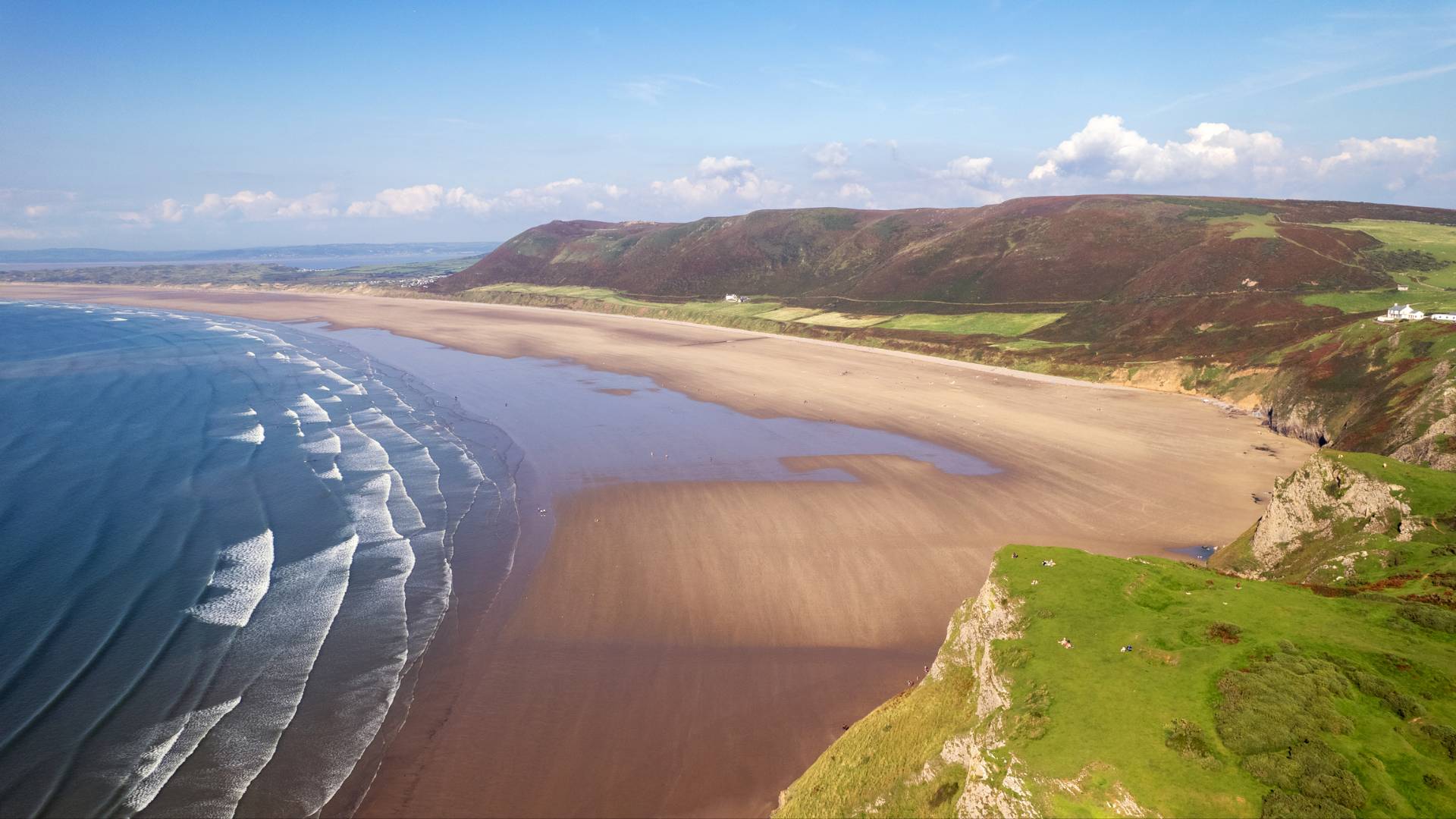
5. Rhossili Bay

A wide sandy beach stretches along the coastline with gentle waves lapping the shore, bordered by grassy green cliffs and rolling hills under a blue sky with scattered clouds.

Rhossili Bay in the Gower has a west-facing beach and dark skies at night. (Image credit: Chris Griffiths via Getty Images)

Location: Gower Peninsula, Swansea, Wales

Max eclipse: 93.8% at 7:13 p.m. BST

Sun position: 13° above west-northwest horizon

Eclipse window: 6:16-8:07 p.m. BST

Sunset: 8:46 p.m. BST

Light pollution: 4.0 Bortle/SQM 21.63

Cloud risk: 73%

Rhossili Bay's enormous west-facing beach and elevated clifftops make it ideal for watching a low eclipse unfold above the sea. Located on the Gower Peninsula, the area is a Dark Sky Community that retains relatively dark skies despite its popularity during the day. As darkness falls later that evening, the open coastal landscape provides excellent visibility for Perseid meteors.

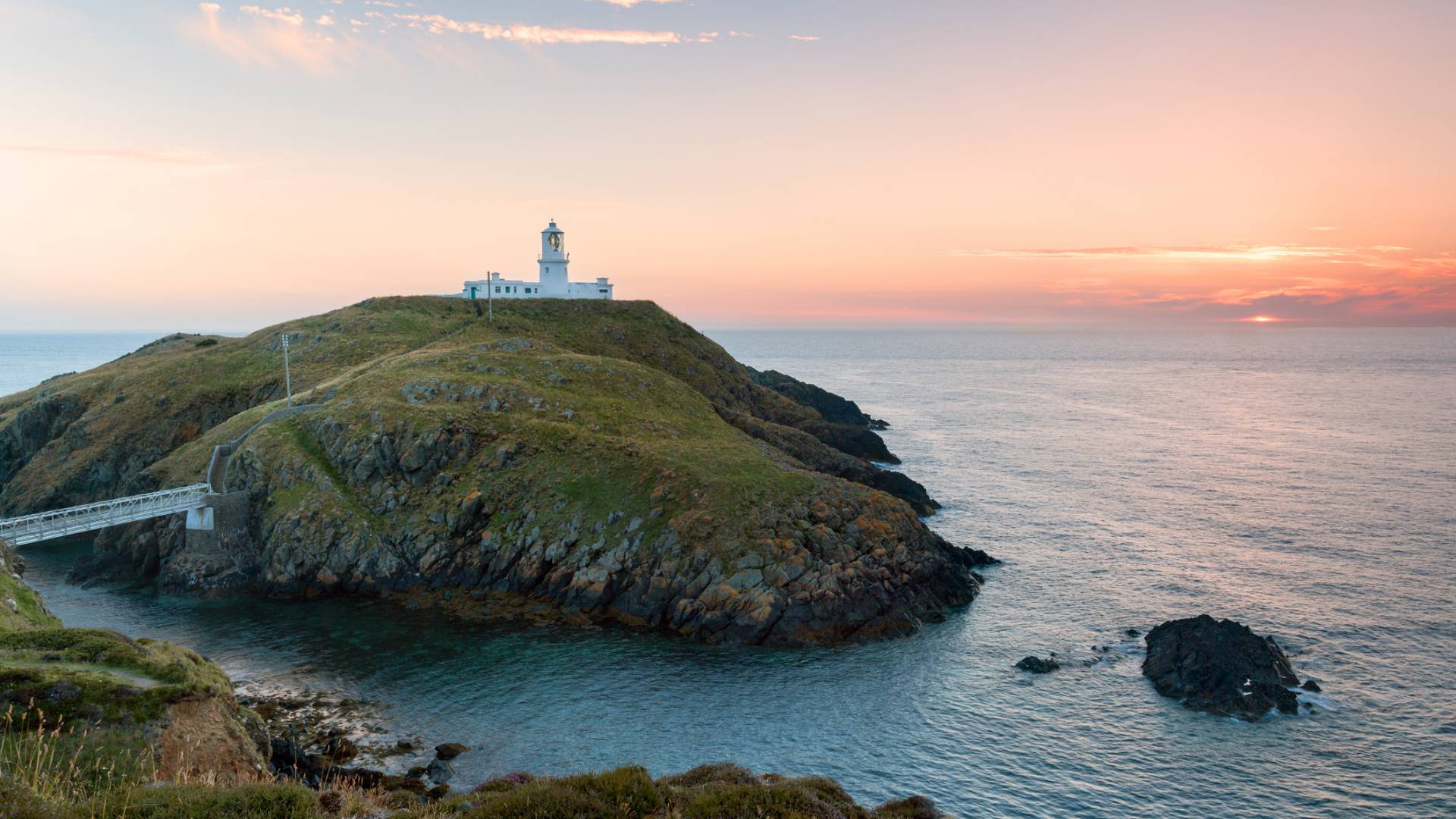
6. Strumble Head

A white lighthouse sits atop a grassy cliff overlooking the calm sea at sunset, with a footbridge connecting the island to the mainland and soft orange and pink hues in the sky.

Strumble Head in west Wales has a clear western horizon and dark skies. (Image credit: Andrea Ricordi, Italy via Getty Images)

Location: Pencaer, Pembrokeshire, west Wales

Max eclipse: 94.0% at 7:13 p.m. BST

Sun position: 14° above west-northwest horizon

Eclipse window: 6:15-8:07 p.m. BST

Sunset: 8:51 p.m. BST

Light pollution: 3.3 Bortle/SQM 21.84

Cloud risk: 70%

Strumble Head offers one of the clearest west-facing horizons in Wales, with the eclipsed sun appearing above the Irish Sea beside its iconic lighthouse. The remote Pembrokeshire coastline experiences very little artificial light, helping preserve dark skies after sunset. Once the eclipse ends, this rugged headland becomes an excellent place to watch the Perseids, with broad ocean views and little interference from nearby towns.

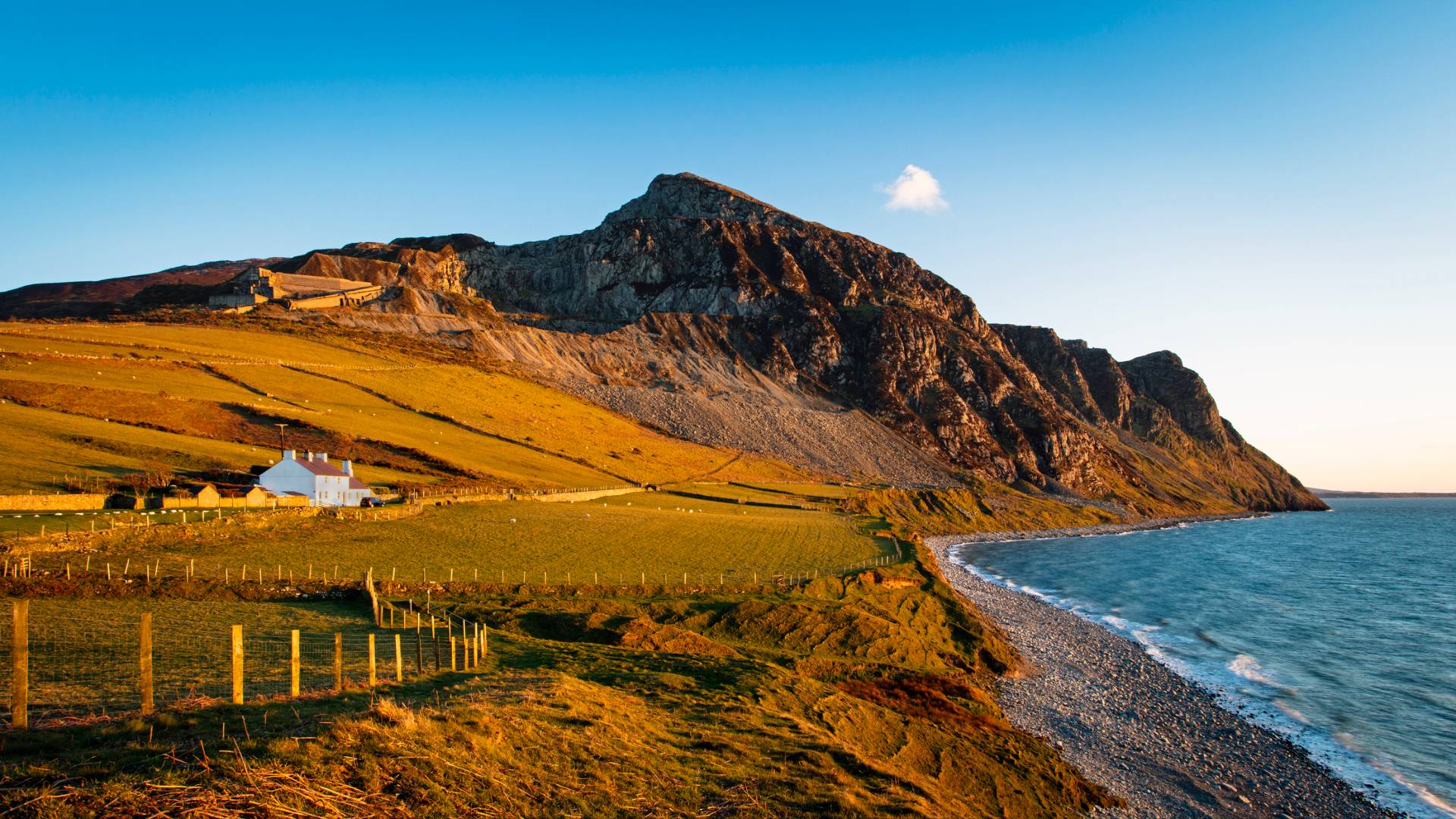
7. Llŷn Peninsula

A coastal landscape at sunset features rolling green fields, a white cottage, rocky cliffs, and a pebble beach bordering calm blue sea under a clear sky.

The remote Lleyn Peninsula is close to a Dark Sky Sanctuary. (Image credit: WLDavies via Getty Images)

Location: Llŷn Peninsula, Gwynedd, north Wales

Max eclipse: 93.3% at 7:11 p.m. BST

Sun position: 14° above west-northwest horizon

Eclipse window: 6:14-8:05 p.m. BST

Sunset: 8:52 p.m. BST

Light pollution: 2.9 Bortle/SQM 21.91

Cloud risk: 70%

The remote Llŷn Peninsula projects deep into the Irish Sea, offering expansive views toward the west-northwest horizon, where the eclipsed sun will appear before sunset. It is also one of the darkest regions in Wales, lying close to the protected skies of Ynys Enlli (Bardsey Island) Dark Sky Sanctuary. With minimal light pollution and wide rural vistas, the peninsula becomes a superb location for watching Perseid meteors later that same night.

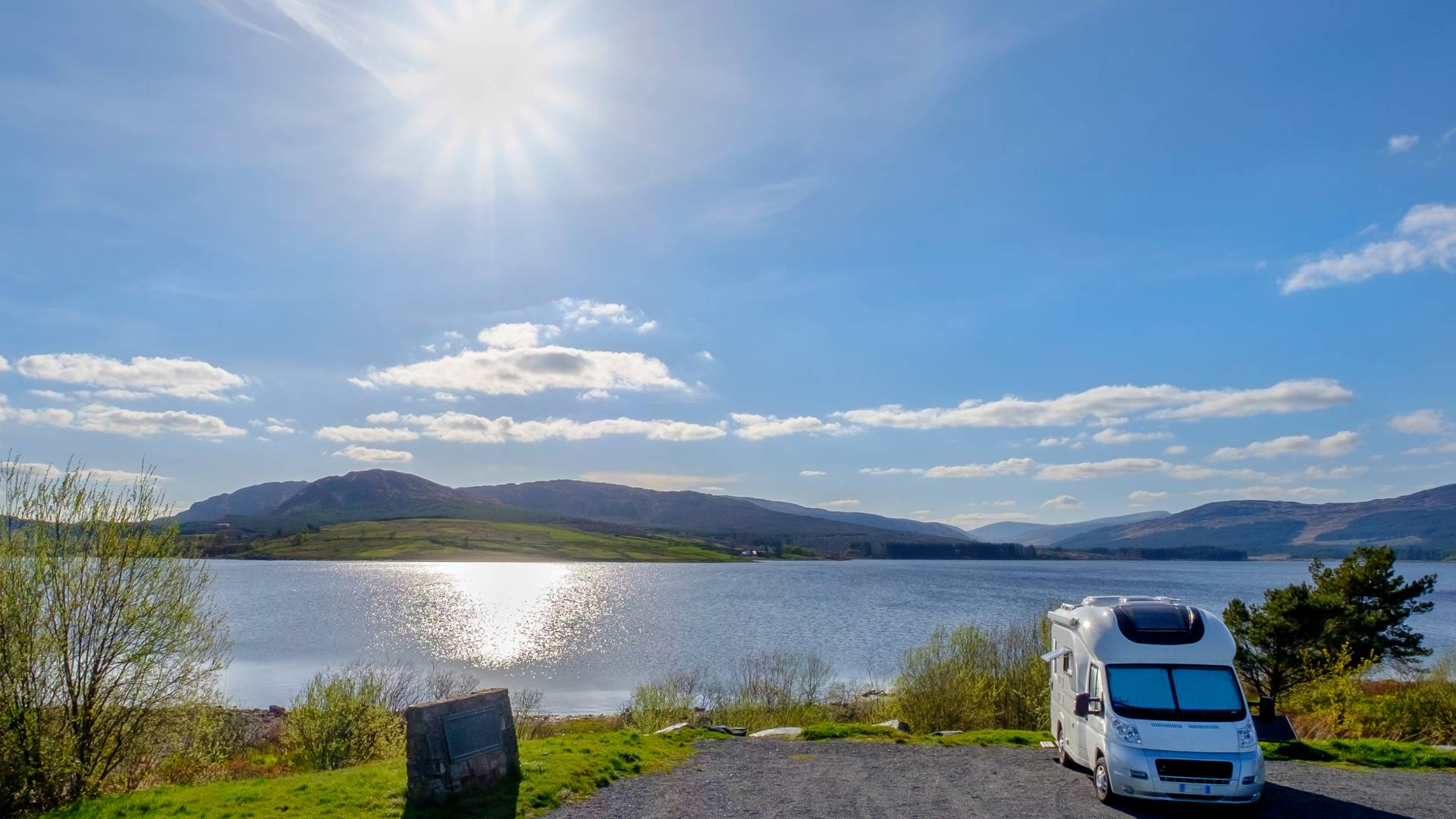
8. Galloway Forest Dark Sky Park

A white camper van is parked by a calm lake with hills in the distance, under a bright, sunny sky with scattered clouds and the sun reflecting on the water.

The shore of Clatteringshaws Loch in Galloway Forest Park. (Image credit: Flavio Vallenari via Getty Images)

Location: Galloway Forest Park, Dumfries and Galloway, Scotland

Max eclipse: 91.8% at 7:07 p.m. BST

Sun position: 14° above west-northwest horizon

Eclipse window: 6:10—8:01 p.m. BST

Sunset: 8:47 p.m. BST

Cloud risk: 85%

Galloway Forest Park was Britain's first Dark Sky Park and remains one of the country's premier stargazing destinations. Open western views around Clatteringshaws Loch, along with other viewpoints away from the forests, make it well-suited to the low evening eclipse. After twilight fades, exceptionally dark skies reveal the Milky Way in striking detail, creating near-perfect conditions for viewing the Perseid meteor shower in the early hours — if the sky is clear.

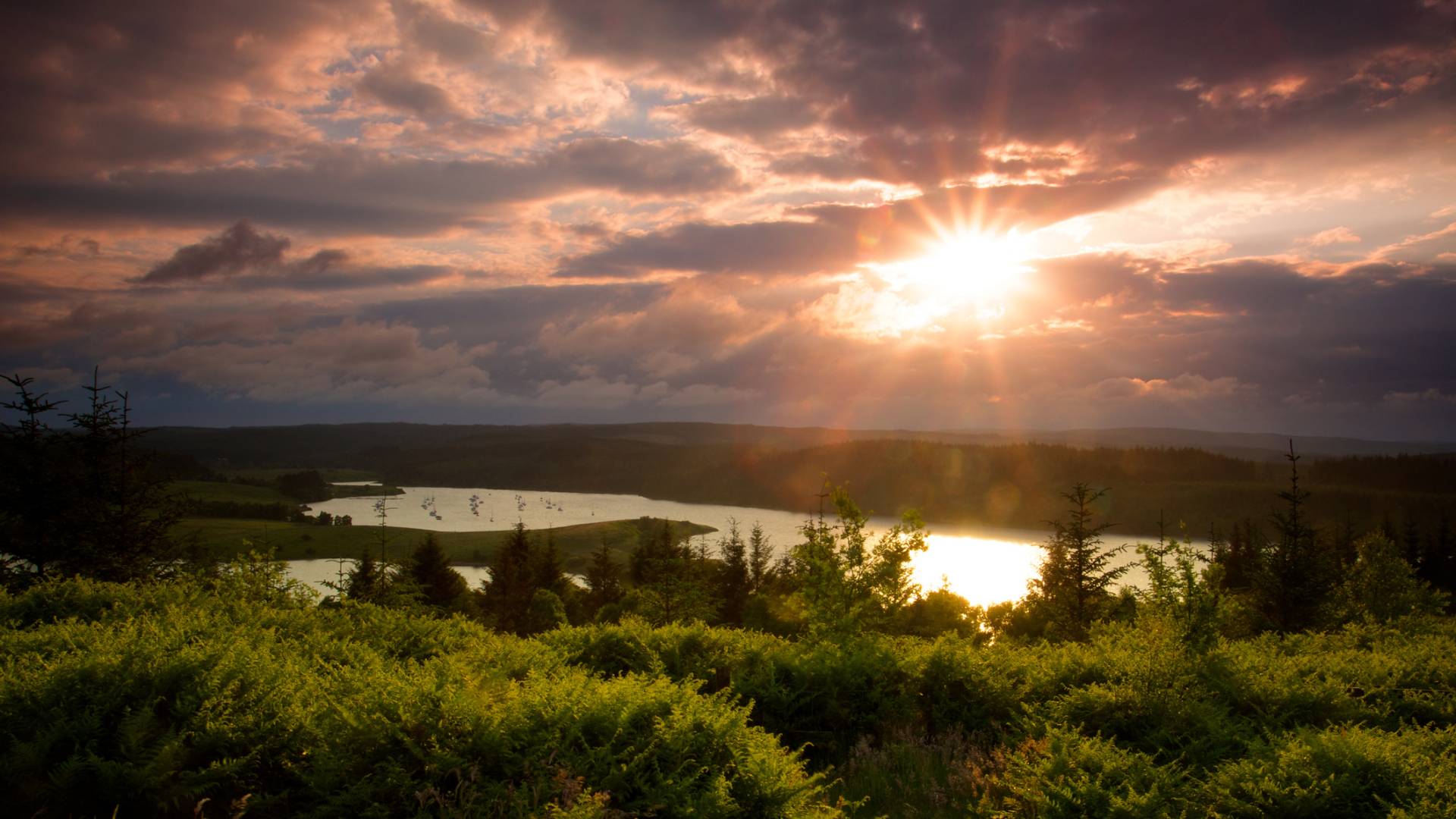
9. Northumberland Dark Sky Park

Sunset over a lush green landscape with a lake and trees; sunlight shines through dramatic clouds, casting warm light on the scene.

Sunset at Kielder Water in Northumberland. (Image credit: Paul Hayes via Getty Images)

Location: Northumberland National Park and Kielder Water & Forest Park, Northumberland, England

Max eclipse: 90.4% at 7:07 p.m. BST

Sun position: 13° above west-northwest horizon

Eclipse window: 6:10-8:00 p.m. BST

Sunset: 8:49 p.m. BST

Light pollution: 3.3 Bortle/SQM 21.82

Cloud risk: 90%

Northumberland's Dark Sky Park combines remote landscapes with some of England's darkest skies. Locations around Kielder Water and Northumberland National Park provide broad views toward the low west-northwest eclipse shortly before sunset. Later that night, the region becomes one of the finest places in Europe to watch the Perseids, with frequent views of the Milky Way and bright meteors overhead. Check for any events at Kielder Observatory.

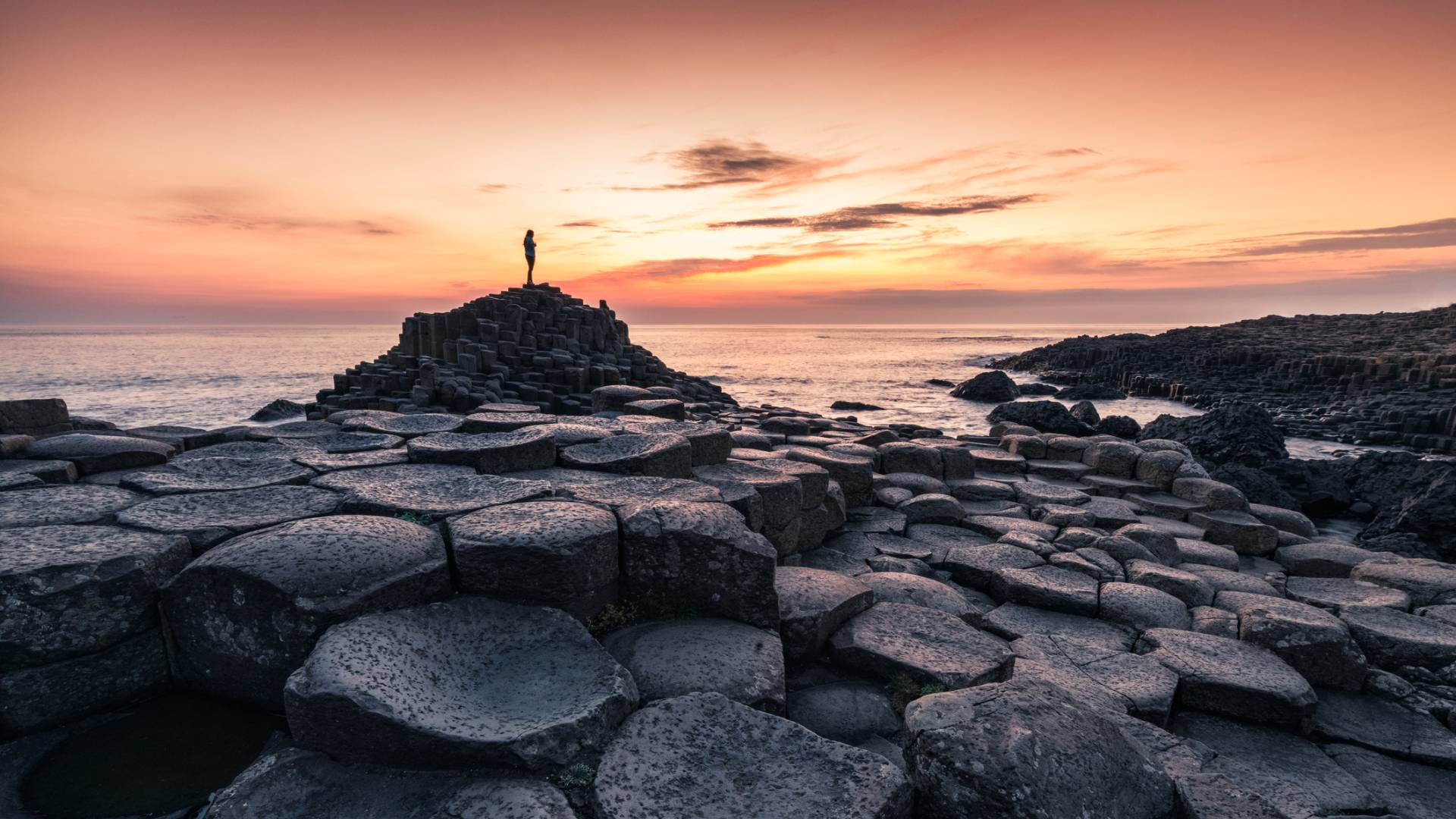
10. Giant's Causeway

A person stands atop the hexagonal basalt columns of Giant’s Causeway in Northern Ireland at sunset, with a colorful sky and calm sea in the background.

Giant's Causeway will have a great view of the eclipse. (Image credit: Francesco Vaninetti Photo via Getty Images)

Location: Bushmills, Northern Ireland

Max eclipse: 93.1% at 7:07 p.m. BST

Sun position: 16° above the west horizon

Eclipse window: 6:09-8:02 p.m. BST

Sunset: 9:31 p.m. BST

Light pollution: 4.2 Bortle/SQM 21.52

Cloud risk: 81%

The Giant's Causeway in Northern Ireland offers a spectacular foreground for the eclipse, with the sun appearing low above the Atlantic beyond the famous basalt columns. Although the skies here are not as dark as in some rural parks, the north Antrim coastline still experiences relatively modest light pollution. Nearby coastal viewpoints and beaches provide good conditions for watching Perseid meteors later that night beneath expansive northern skies.

  •  

1 month until the total solar eclipse 2026 — Here's what you need to know

One month from today, millions will turn their eyes to the skies for one of the most anticipated skywatching events of the year: the total solar eclipse on Aug. 12, 2026.

The eclipse will sweep across parts of Greenland, Iceland and Spain, briefly turning day into night for those lucky enough to be within the narrow path of totality.

It's been a long time coming for European skywatchers, as the event marks Europe's first total solar eclipse since 1999.

Where can I see the total solar eclipse?

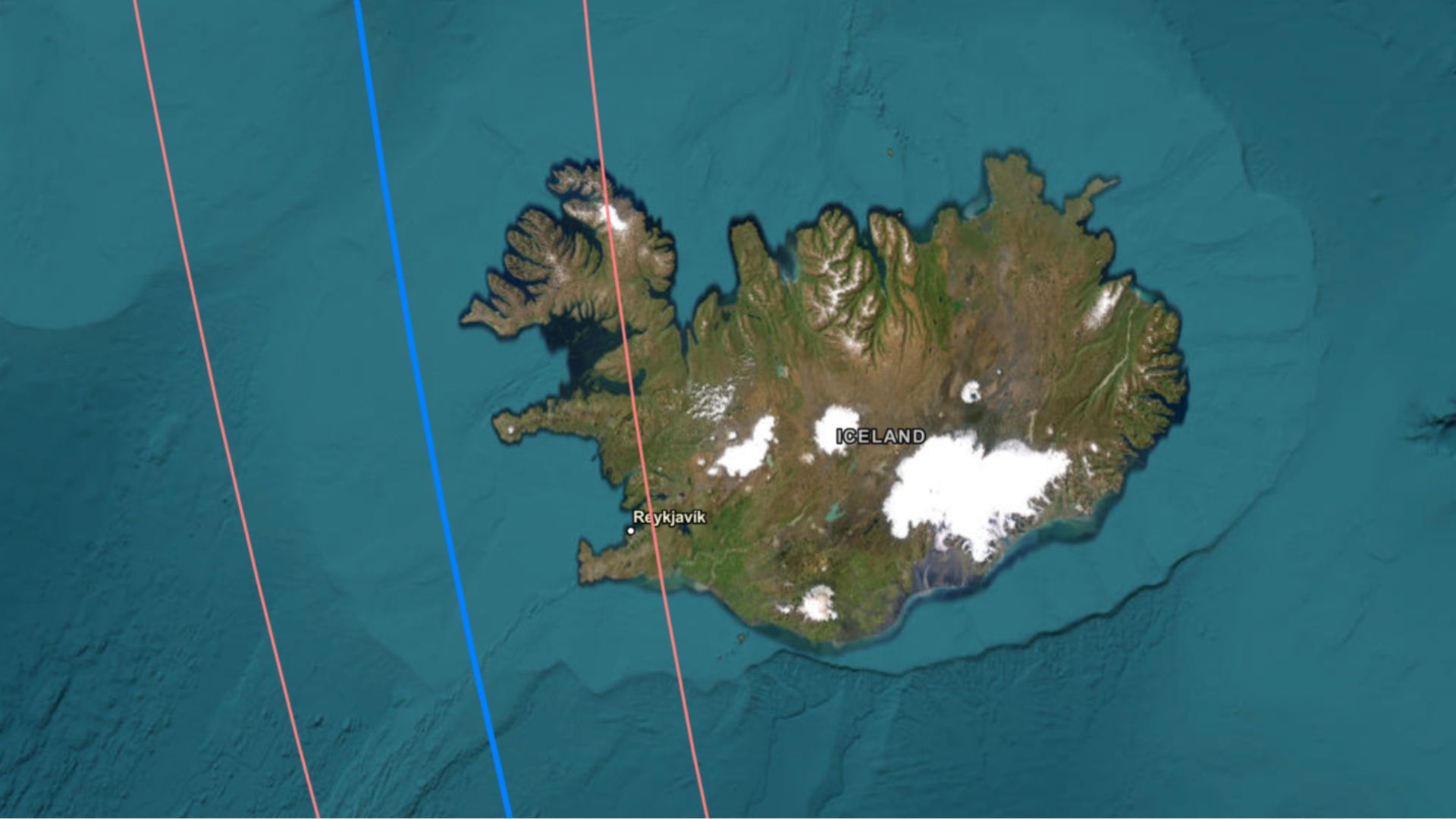
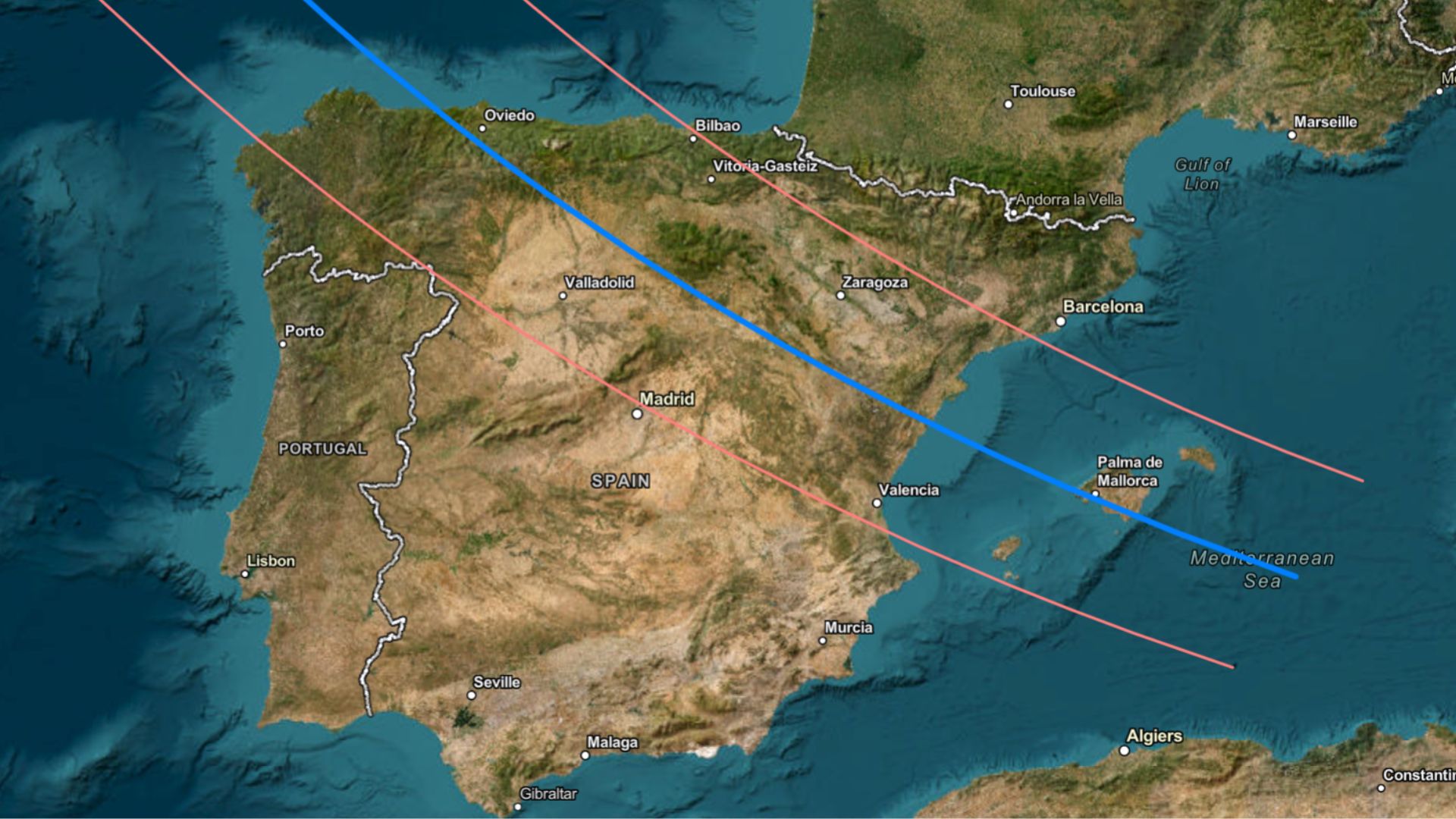
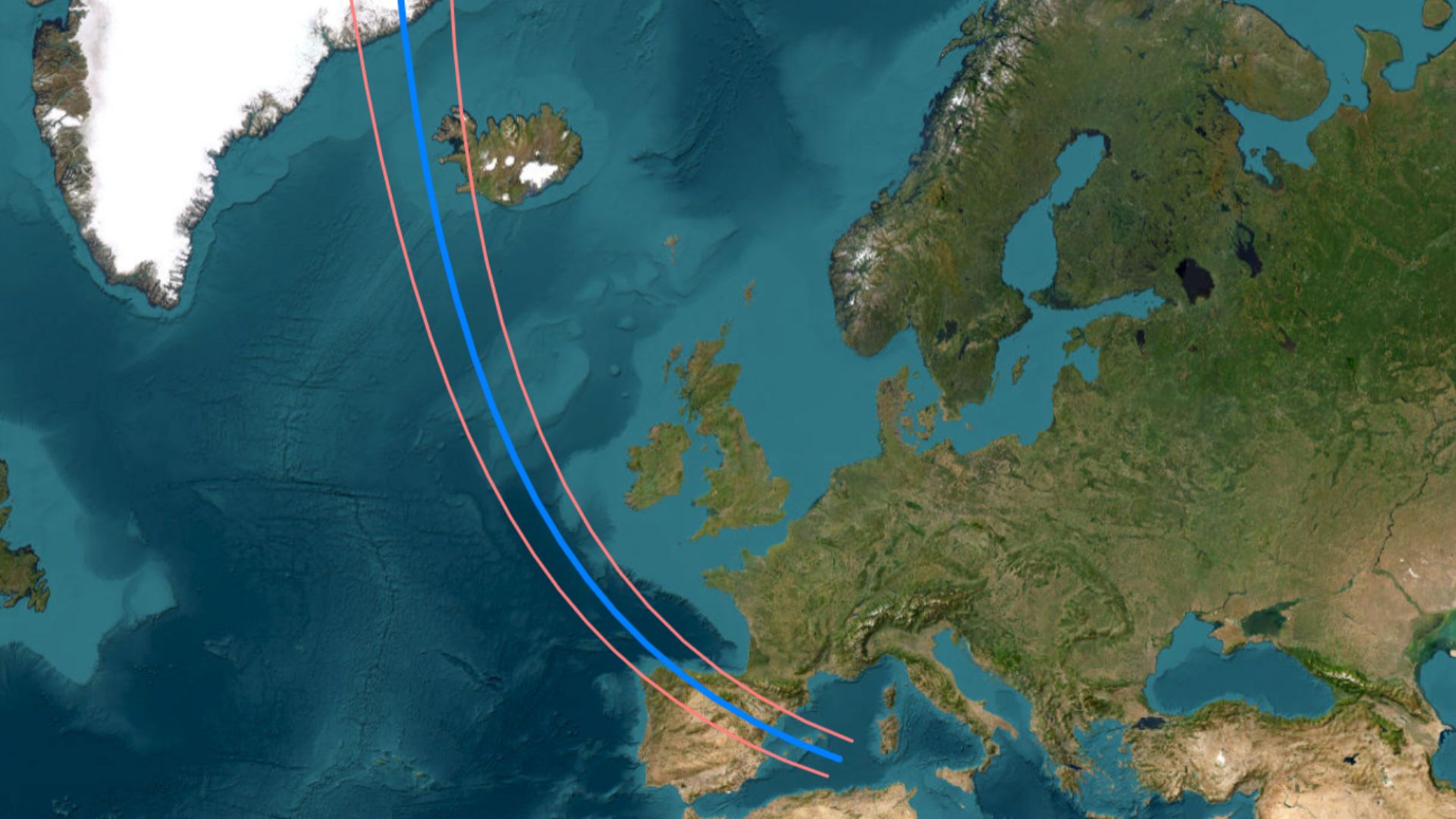
If you're hoping to experience totality, now is the time to finalize your plans. The path of totality crosses Greenland, Iceland and northern Spain, with maximum eclipse lasting up to 2 minutes and 18 seconds.

map showing the path of totality across the coast of iceland
Path of totality over Iceland.Created using MapHub.net. Source: Esri, Maxar, GeoEye, Earthstar Geographics, CNES/Airbus DS, USDA, USGS, AeroGRID, IGN, and the GIS User Community
map showing the maps of totality across northern spain.
Path of totality over Spain.Created using MapHub.net. Source: Esri, Maxar, GeoEye, Earthstar Geographics, CNES/Airbus DS, USDA, USGS, AeroGRID, IGN, and the GIS User Community
map showing the entire path of totality - it shows where the total solar eclipse is visible from Greenland, iceland and spain.
Entire path of totality. From Greenland through Iceland and Spain. Created using MapHub.net. Source: Esri, Maxar, GeoEye, Earthstar Geographics, CNES/Airbus DS, USDA, USGS, AeroGRID, IGN, and the GIS User Community

Spain is expected to be one of the most popular destinations thanks to its favorable weather prospects, though it's not without a catch! Viewers will need to secure a clear view of the western horizon because the eclipsed sun will sit very low in the sky during totality.

Notable locations and timings of totality

Location

Totality duration

What time?

Sun height

Scoresby Sund, Greenland

1 minute, 46 seconds

4:35 p.m. CGST

24 degrees above west

Reykjavik, Iceland

1 minute, 1 second

5:48 p.m. GMT

25 degrees above west

Snæfellsjökull National Park, Iceland

2 minutes, 10 seconds

5:45 p.m. GMT

25 degrees above west

Gijón, Spain

1 minute, 46 seconds

8:26 p.m. CEST

10 degrees above west-northwest

A Coruña, Spain

1 minute, 15 seconds

8:27 p.m. CEST

12 degrees above west-northwest

Palencia, Spain

1 minute, 42 seconds

8:29 p.m. CEST

9 degrees above west-northwest

Burgos, Spain

1 minute, 44 seconds

8:28 p.m. CEST

8 degrees above west-northwest

Segovia, Spain

54 seconds

8:31 p.m. CEST

8 degrees above west-northwest

Sigüenza, Spain

1 minute, 38 seconds

8:30 p.m. CEST

7 degrees above west-northwest

Mallorca, Balearic Islands, Spain

1 minute, 36 seconds

8:31 p.m. CEST

2.7 degrees above west-northwest

Will I see the eclipse from where I live?

Not inside the path of totality? Don't worry. A spectacular partial solar eclipse will be visible across much of Europe, with more than 90% of the sun covered from locations including London, Paris and Dublin.

Location

% of sun's disk covered

New York City

9%

St. John's, Newfoundland, Canada

53%

Nuuk, Greenland

79%

Oslo, Norway

83%

Berlin, Germany

84%

London, U.K.

91%

Paris, France

92%

Tangier, Morocco

92%

Dublin, Ireland

94%

Lisbon, Portugal

94%

Nice, France

95%

Madrid, Spain

99.96%

Barcelona, Spain

99.82%

If you're still deciding where to watch, we have several guides on the best viewing locations close to popular Spanish holiday destinations, the best Spanish beaches, and the best places to view the eclipse overall.

How we will be covering the eclipse

Over the coming weeks, Space.com will bring you everything you need to prepare for eclipse day. We'll publish viewing guides, safety advice and information on how to watch the eclipse online.

Closer to the event, we'll launch a dedicated live blog covering the latest eclipse news and insights from our reporters in the field.

Skywatching Editor Daisy Dobrijevic will join an eclipse expedition to Greenland with HX, while Skywatching Writer Anthony Wood will travel to northern Spain with the DEB initiative and citizen scientists to report firsthand from the path of totality.

  •  

June 15, 763 BCE: Assyrians record a solar eclipse

On June 15, 763 B.C.E., a near-total solar eclipse occurred over northern Assyria and was recorded by observers in Nineveh, the capital city. This event is preserved in the Eponym Canon, a list of historical events made by the Assyrians on clay tablets, following a specialized calendar system. The text notes: “Insurrection in the CityContinue reading "June 15, 763 BCE: Assyrians record a solar eclipse"

The post June 15, 763 BCE: Assyrians record a solar eclipse appeared first on Astronomy Magazine.

  •  

Total Solar Eclipse on August 12, 2026

August 12, 2026

Total Solar Eclipse

On Aug. 12, 2026, a total solar eclipse will sweep across Greenland, Iceland, northern Russia, the Atlantic Ocean, Spain, and a small corner of Portugal.
 
Many other places in the Northern Hemisphere will experience a partial solar eclipse that day, including parts of the northern U.S. (from Alaska to North Carolina), most of Canada, much of Europe, and northwestern Africa.
 
For many along the western part of the eclipse path (in mainland Europe and Africa), the Sun will set while it’s still partially eclipsed, creating an opportunity to see a sunset eclipse.

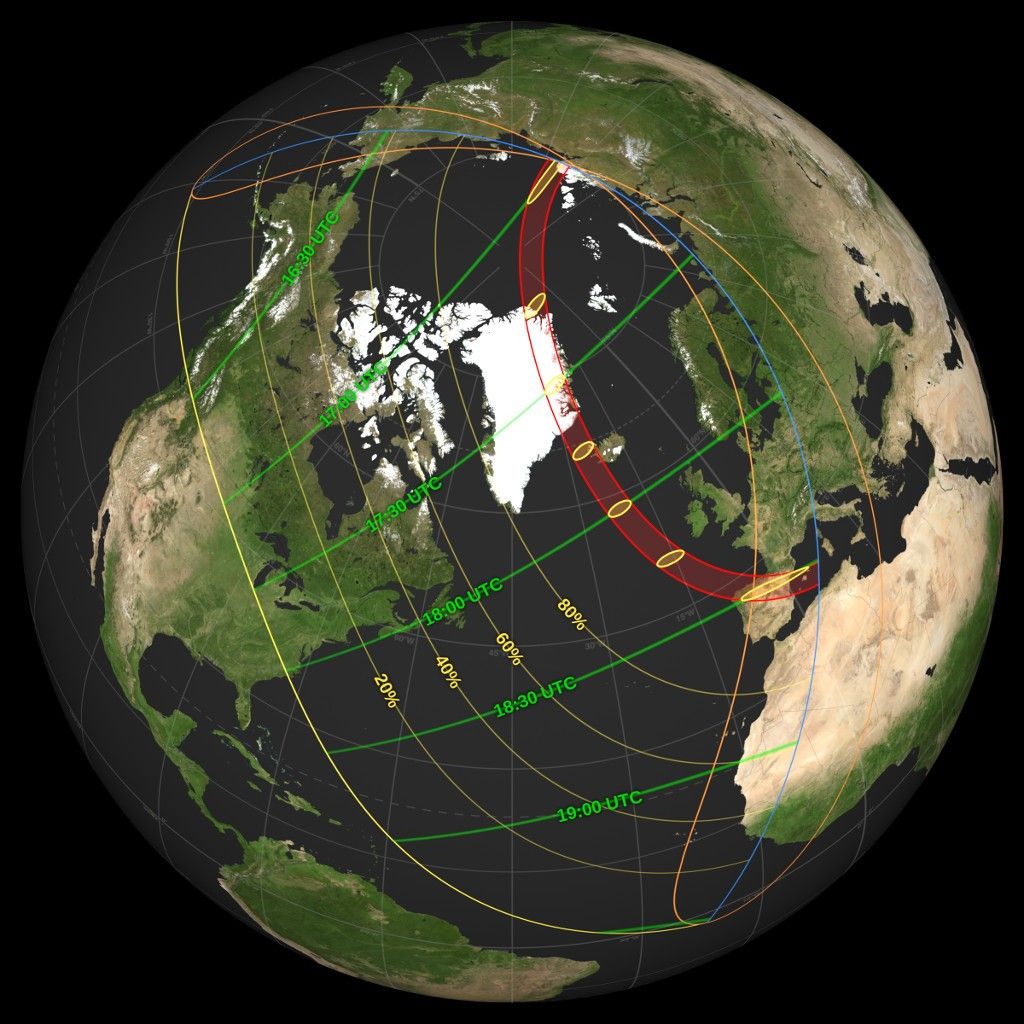
Eclipse map

A globe, centered on the North Atlantic, shows part of the Western Hemisphere including parts of North and South America, Europe, and Africa. A curved, red band runs from northern Russia, close to the North Pole, over parts of Greenland and Iceland, across the North Atlantic, and across parts of Spain. Yellow ovals appear periodically within the red band. A grid of green lines, which run roughly north to south, and yellow lines, which run roughly west to east, covers much of the rest of the hemisphere. The green lines have times on them and the yellow lines have percentages. The left, top, and right edges of the grid are bordered by a large, orange, figure-eight loop with a blue line running through the center of it.
A map shows where a solar eclipse will be visible on Aug. 12, 2026. The red band that crosses Greenland, Iceland, and Spain shows where a total solar eclipse can be seen. Yellow curves across the map show where a partial eclipse will be visible, and percentages indicate the maximum area of the Sun covered by the Moon during the eclipse along those lines. Learn more about the map.
NASA’s Scientific Visualization Studio

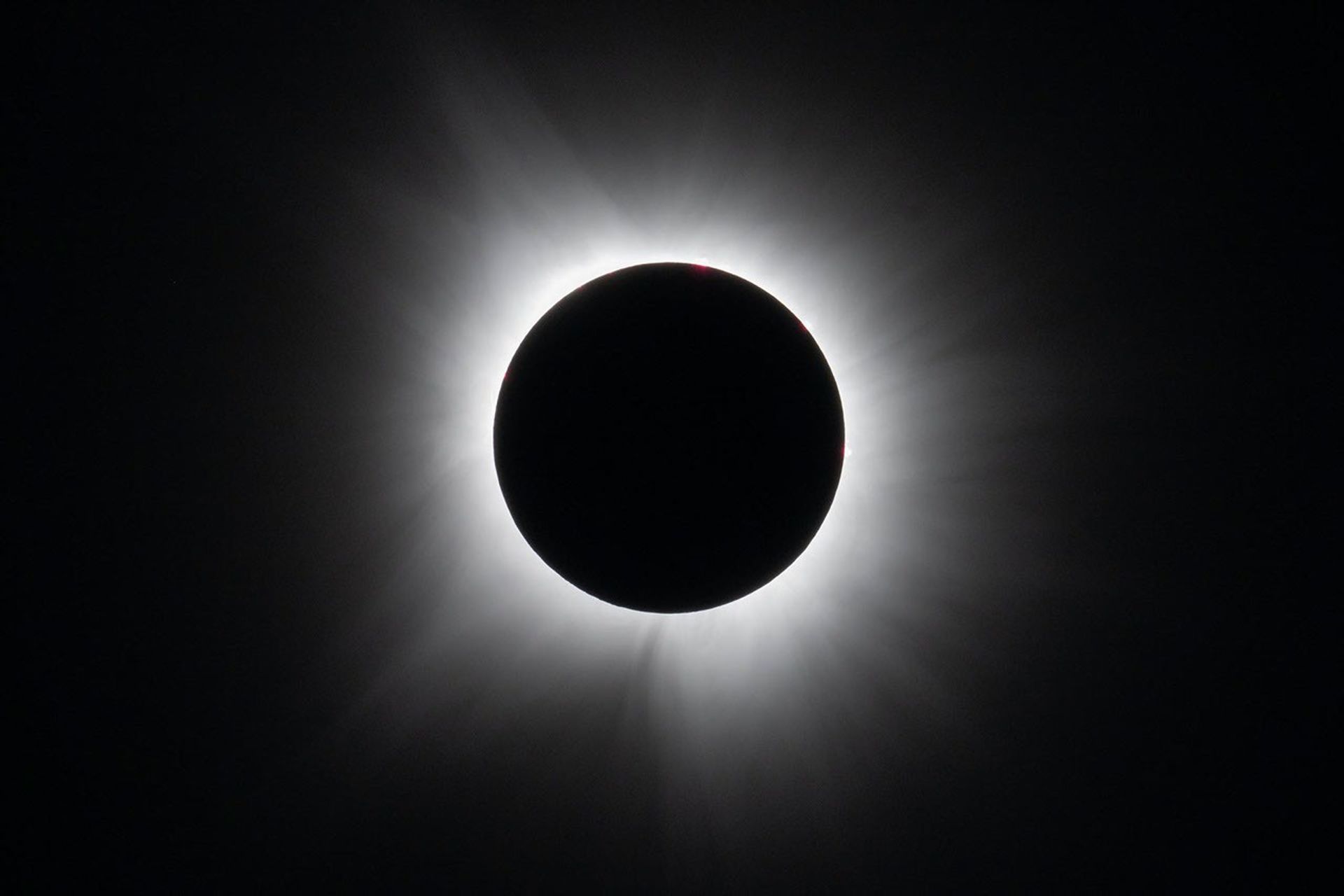
Total solar eclipse

Against a black background, the total solar eclipse. It is a black circle surrounded by white, wispy streams of light that flow away from the black circle in every direction.
A total solar eclipse was seen in Dallas, Texas, on Monday, April 8, 2024.
NASA/Keegan Barber

When the Moon slips in front of the Sun, those in the center of the Moon’s shadow will experience a total solar eclipse.

For a small, remote region in northern Russia, totality — when the Moon completely covers the Sun — will occur mid-day. For Greenland and Iceland, the Sun will go dark in the late afternoon or early evening. In Spain and the very northwestern tip of Portugal, the Sun won’t be fully eclipsed until the late evening, shortly before sunset.

For most in the path of totality, the Sun will be fully eclipsed for less than two minutes. For anyone near the very center of the eclipse path in Greenland, Russia, or the North Atlantic, totality will last a little longer (but still less than two and a half minutes).

Only during those brief moments of totality, when the Moon completely blocks the Sun’s bright face, can viewers look directly at the eclipse without eye protection.

Before and after totality, everyone observing the Sun must use eye protection to view the partial phases of the eclipse, when the Moon is covering only part of the Sun’s disk. Observers can use solar viewing glasses (often called “eclipse glasses”), handheld solar viewers, or other safe solar filters that block out most of the Sun’s light and prevent eye damage. Eclipse watchers can also use an indirect viewing method to enjoy the partial phases of the eclipse, such as making as a pinhole projector to cast images of the Sun.

Learn more about how to view a total solar eclipse safely.

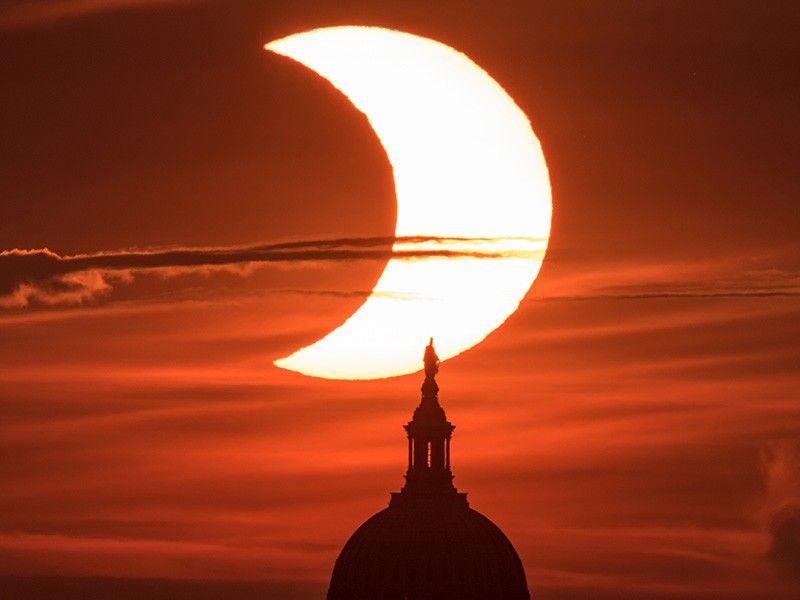
Partial solar eclipse

A reddish sky is shown with the bright circle of the Sun, a dark bite taken out of it. The dark circle covering about a third of the Sun's left side is the Moon, during a solar eclipse. In the foreground is the silhouette of the U.S. Capitol.
A partial solar eclipse emerges from behind the United States Capitol on June 10, 2021, as seen from Arlington, Virginia.
NASA/Bill Ingalls

For eclipse watchers inside the Moon’s shadow but outside the path of totality, the Moon will never completely block the Sun and the eclipse will be partial only. During a partial solar eclipse, it is never safe to look directly at the Sun without proper eye protection.

The Aug. 12 partial solar eclipse will begin as the day begins in northern Russia. In Alaska and northern Canada, the eclipse will start and end in the morning, while Canada’s eastern provinces will experience the eclipse in the afternoon. In the northern contiguous U.S., the partial eclipse will begin around midday, lingering into the midafternoon for those farther east. The eclipse will reach the U.K., Ireland, mainland Europe, and Africa in the evening.

Those in the U.S. and southern Canada will see only a small “bite” taken out of the solar disk as the Moon appears to just clip the Sun. Those closer to the path of totality — across most of Europe and in northwestern Africa — will see most of the Sun get covered up.

When watching a partial solar eclipse directly with your eyes, always look through safe solar viewing glasses (“eclipse glasses”) or a safe handheld solar viewer. Eclipse glasses are NOT regular sunglasses; regular sunglasses, no matter how dark, are not safe for viewing the Sun. Safe solar viewers are thousands of times darker and ought to comply with the ISO 12312-2 international standard.

Do NOT look at the Sun through a camera lens, telescope, binoculars, or any other optical device while wearing eclipse glasses or using a handheld solar viewer — the concentrated solar rays will burn through the filter and cause serious eye injury. A special-purpose solar filter must be attached to the front of any telescope, binoculars, camera lens, or other optics to observe the Sun safely.

If you don’t have eclipse glasses or a handheld solar viewer, you can use an indirect viewing method, which does not involve looking directly at the Sun. One way is to use a pinhole projector, which has a small opening (for example, a hole punched in an index card) and projects an image of the Sun onto a nearby surface. With the Sun at your back, you can then safely view the projected image. Do NOT look at the Sun through the pinhole! Leaves on trees act as natural pinholes, projecting the shape of the eclipse onto the surface beneath them.

Learn more about how to view a partial solar eclipse safely.

Where to watch

Below are some details about the eclipse for select cities. All times are local.  

An asterisk (*) under “Partial Ends” indicates that the eclipse will end after sunset and the time given is for sunset.

Total eclipse

CityPartial BeginsTotality BeginsTotality EndsPartial Ends
León (Spain)7:32 p.m.8:28 p.m.8:30 p.m.9:22 p.m.
Reykjavík (Iceland)4:47 p.m.5:48 p.m.5:49 p.m.6:47 p.m.
Valencia (Spain)7:38 p.m.8:32 p.m.8:33 p.m.9:01 p.m. *
Zaragoza (Spain)7:34 p.m.8:29 p.m.8:30 p.m.9:07 p.m. *

Partial eclipse

CityPartial BeginsMaximumCoveragePartial Ends
Anchorage, Alaska (USA)7:36 a.m.8:21 a.m.28%9:09 a.m.
Bangor, Maine (USA)12:54 p.m.1:53 p.m.24%2:49 p.m.
Boston, Mass. (USA)1:01 p.m.1:55 p.m.16%2:46 p.m.
Detroit, Michigan (USA)1:03 p.m.1:36 p.m.3%2:08 p.m.
Fairbanks, Alaska (USA)7:37 a.m.8:27 a.m.37%9:18 a.m.
Juneau, Alaska (USA)7:41 a.m.8:24 a.m.17%9:08 a.m.
New York, New York (USA)1:07 p.m.1:54 p.m.9%2:38 p.m.
Philadelphia, Penn. (USA)1:11 p.m.1:53 p.m.7%2:35 p.m.
Portland, Maine (USA)12:57 p.m.1:53 p.m.19%2:27 p.m.
Washington, D.C. (USA)1:17 p.m.1:53 p.m.4%2:27 p.m.
Algiers (Algeria)6:42 p.m.7:33 p.m.96%7:42 p.m. *
Barcelona (Spain)7:35 p.m.8:29 p.m.99%8:54 p.m. *
Berlin (Germany)                             7:15 p.m.8:08 p.m.85%8:38 p.m. *
Casablanca (Morocco)6:48 p.m.7:43 p.m.87%8:20 p.m. *
Dakar (Senegal)6:25 p.m.7:12 p.m.37%7:34 p.m. *
Dublin (Ireland)6:12 p.m.7:10 p.m.94%8:05 p.m.
Edmonton (Canada)10:02 a.m.10:38 a.m.6%11:15 a.m.
Halifax (Canada)1:58 p.m.3:00 p.m.31%3:58 p.m.
Kraków (Poland)7:18 p.m.7:56 p.m.64%8:04 p.m. *
Lisbon (Portugal)6:39 p.m.7:36 p.m.95%8:29 p.m.
London (U.K.)6:17 p.m.7:13 p.m.91%8:06 p.m.
Madrid (Spain)7:36 p.m.8:32 p.m.99%9:16 p.m. *
Milan (Italy)7:27 p.m.8:20 p.m.92%8:35 p.m. *
Montreal (Canada)12:50 p.m.1:45 p.m.18%2:38 p.m.
Nuuk (Greenland)3:30 p.m.4:35 p.m.79%5:39 p.m.
Oslo (Norway)7:02 p.m.7:57 p.m.83%8:49 p.m.
Paris (France)7:22 p.m.8:17 p.m.92%9:09 p.m.
St. John’s (Canada)2:28 p.m.3:35 p.m.53%4:37 p.m.
Saint Petersburg (Russia)7:59 p.m.8:51 p.m.79%9:00 p.m. *
Stockholm (Sweden)7:03 p.m.7:56 p.m.81%8:46 p.m. *
Toronto (Canada)12:55 p.m.1:40 p.m.8%2:23 p.m.
Tunis (Tunisia)6:41 p.m.7:11 p.m.50%7:14 p.m. *
Vienna (Austria)7:22 p.m.8:10 p.m.85%8:13 p.m. *
Winnipeg (Canada)11:25 a.m.12:02 p.m.5%12:40 p.m.

The post Total Solar Eclipse on August 12, 2026 appeared first on NASA Science.

  •  

June 4, 781 B.C.E: A great eclipse in China

One of the earliest recorded eclipses is found in the Shijing, a collection of ancient poetry whose compilation is credited to Confucius. The eclipse in question occurred during the Zhou dynasty. Though the exact date is uncertain, some astronomers have pointed to the total eclipse of June 4, 781 B.C.E. (though this would have only been aContinue reading "June 4, 781 B.C.E: A great eclipse in China"

The post June 4, 781 B.C.E: A great eclipse in China appeared first on Astronomy Magazine.

  •  

May 29, 1919: History’s most important eclipse

One of the most important eclipses in history happened in 1919. This particular eclipse cut a path across South America and the Atlantic Ocean, and landed on the west coast of Africa. Waiting on the island of Principe, in the Gulf of Guinea off the west coast of Africa, was a team of astronomers armedContinue reading "May 29, 1919: History’s most important eclipse"

The post May 29, 1919: History’s most important eclipse appeared first on Astronomy Magazine.

  •  
❌