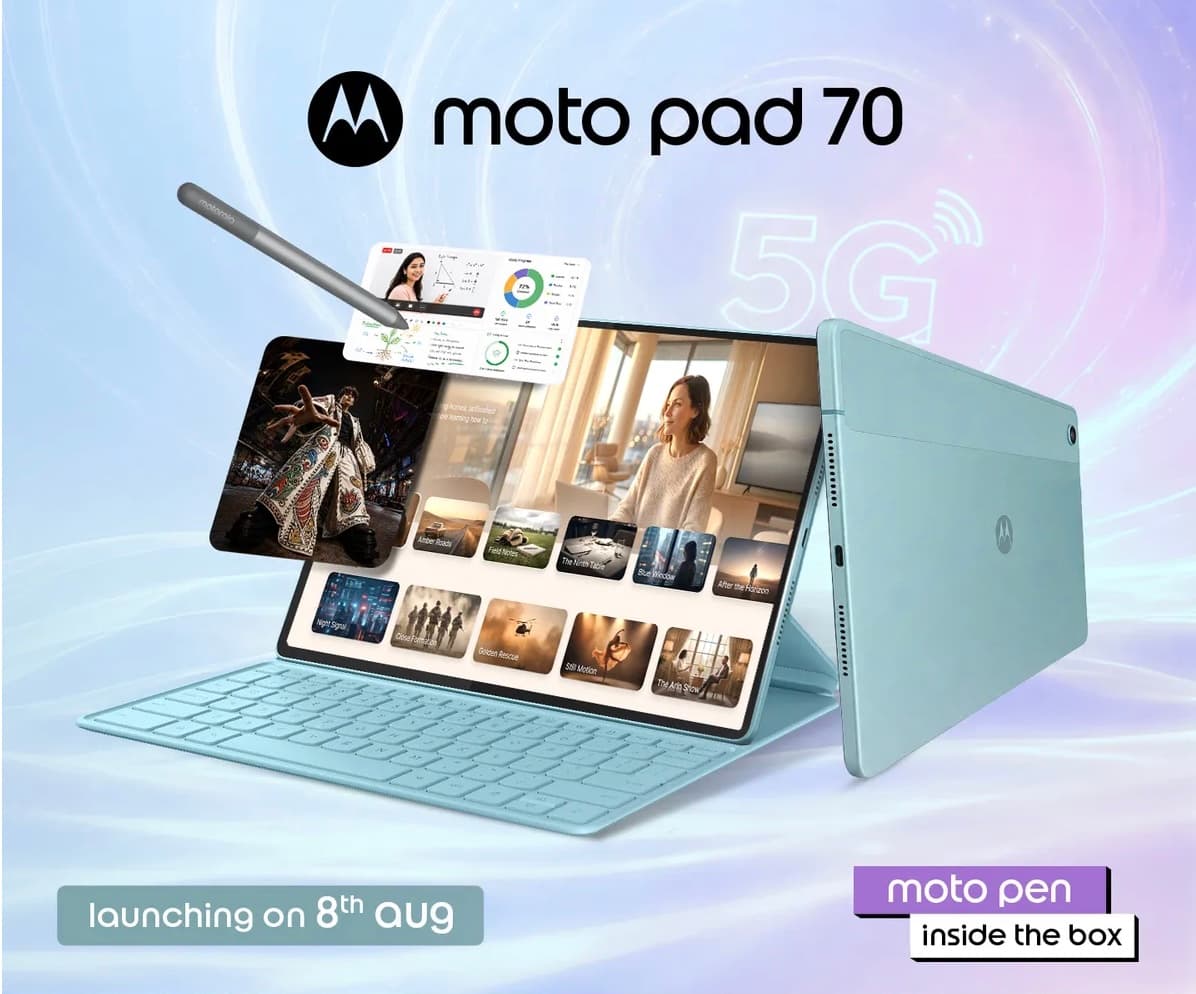
Motorola has officially begun teasing its upcoming Moto Pad 70 tablet for the Indian market, with the device scheduled to go on sale July 31. Positioned as a premium mid-range Android tablet, the Moto Pad 70 combines a high-resolution display, 5G connectivity, a large battery, and stylus support, making it suitable for both productivity and entertainment.
12.1-Inch 2.5K Display with Included Moto Pen
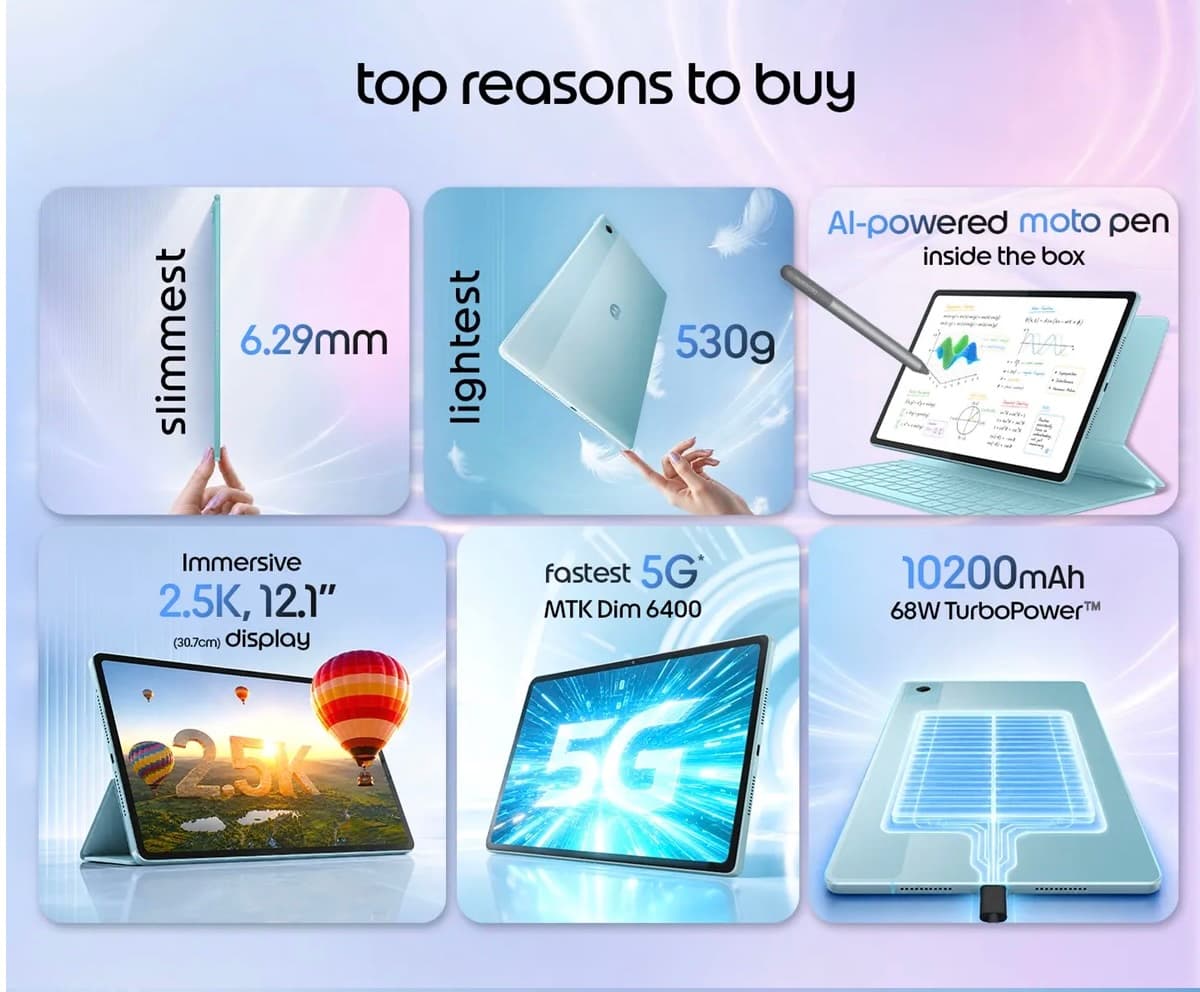
The Moto Pad 70 features a 12.1-inch LCD display with a 2.5K resolution, delivering sharp visuals for streaming, gaming, reading, and multitasking. The screen is capable of reaching up to 800 nits of peak brightness, ensuring improved visibility in bright environments.
Motorola also bundles the Moto Pen stylus with the tablet, allowing users to take handwritten notes, sketch, annotate documents, and perform other precision tasks without requiring a separate purchase.
Powered by MediaTek Dimensity 6400
Under the hood, the Moto Pad 70 is powered by the MediaTek Dimensity 6400 processor, a 6nm chipset that supports 5G connectivity. According to Motorola’s promotional materials, the chip achieves an AnTuTu benchmark score of approximately 449,000, offering solid performance for everyday productivity, media consumption, and casual gaming.
The integrated 5G modem enables high-speed mobile internet access, allowing users to stay connected without relying solely on Wi-Fi.
Large Battery with 68W Fast Charging
Battery life is another highlight of the Moto Pad 70. The tablet packs a 10,200mAh battery, providing ample capacity for extended use throughout the day.
To minimize charging downtime, Motorola includes support for 68W wired fast charging, enabling users to quickly replenish the battery when needed.
Quad Speakers with Dolby Atmos
For multimedia experiences, the Moto Pad 70 is equipped with a quad-speaker audio system enhanced by Dolby Atmos technology. The speaker setup is designed to deliver immersive sound for movies, music, video calls, and gaming.
Slim Design and Long-Term Software Support
Despite housing a large battery, the Moto Pad 70 maintains a slim profile, measuring just 6.29mm thick and weighing approximately 530 grams, making it relatively portable for a tablet of its size.
The device ships with Android 16 out of the box. Motorola has also committed to two major Android OS upgrades and four years of security updates, providing users with long-term software support and improved device longevity.
Key Specifications
12.1-inch 2.5K display
Up to 800 nits peak brightness
Moto Pen stylus included
MediaTek Dimensity 6400 (6nm) processor
5G connectivity
10,200mAh battery
68W wired fast charging
Quad speakers with Dolby Atmos
Android 16
2 major Android updates and 4 years of security patches
6.29mm thickness
530g weight
Outlook
With its combination of a large high-resolution display, bundled stylus, 5G support, long battery life, and fast charging, the Moto Pad 70 appears well-positioned in the premium mid-range Android tablet segment. Motorola’s promise of extended software support further enhances its appeal for users seeking a tablet that remains current for years.
The Moto Pad 70 is expected to become available in India beginning July 31, with pricing and availability for additional international markets yet to be announced.
What Surrounds Us takes its title literally. You play as a circle surrounding a hole in its middle - it looks like a donut with frosting. You work together with other sentient moving circles, sometimes helping them joyfully meet with others. And you traverse a large map that's composed entirely of, you guessed it, a series of circles. But the circles everywhere aren't just an artistic choice; they underscore the game's themes about working in connection with the environment and the things around us.
Despite the trippy design, What Surrounds Us has a familiar format. I kept feeling echoes of The Legend of Zelda as I trekked across three dist …
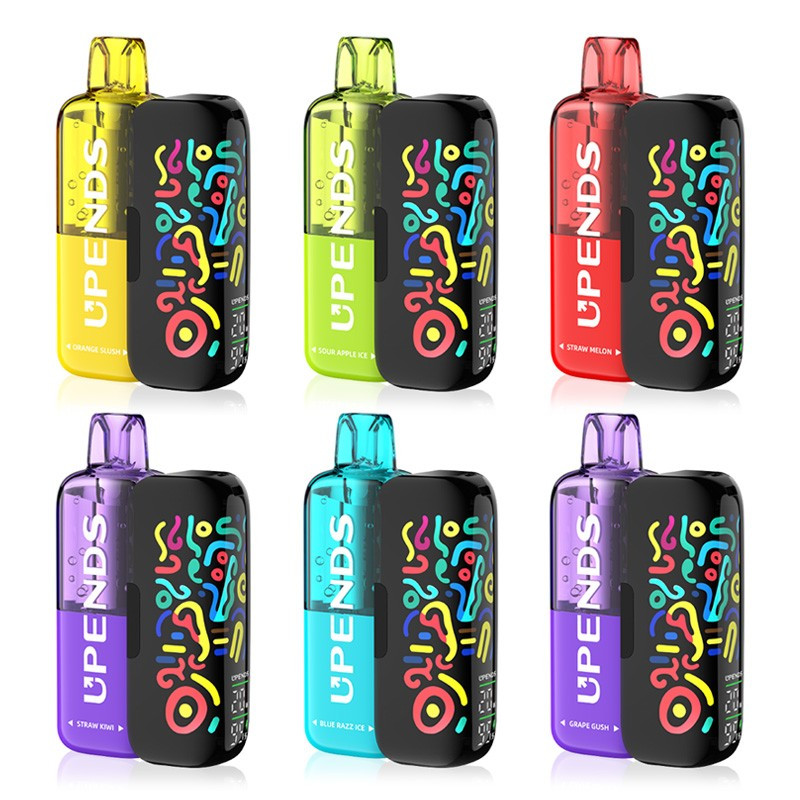
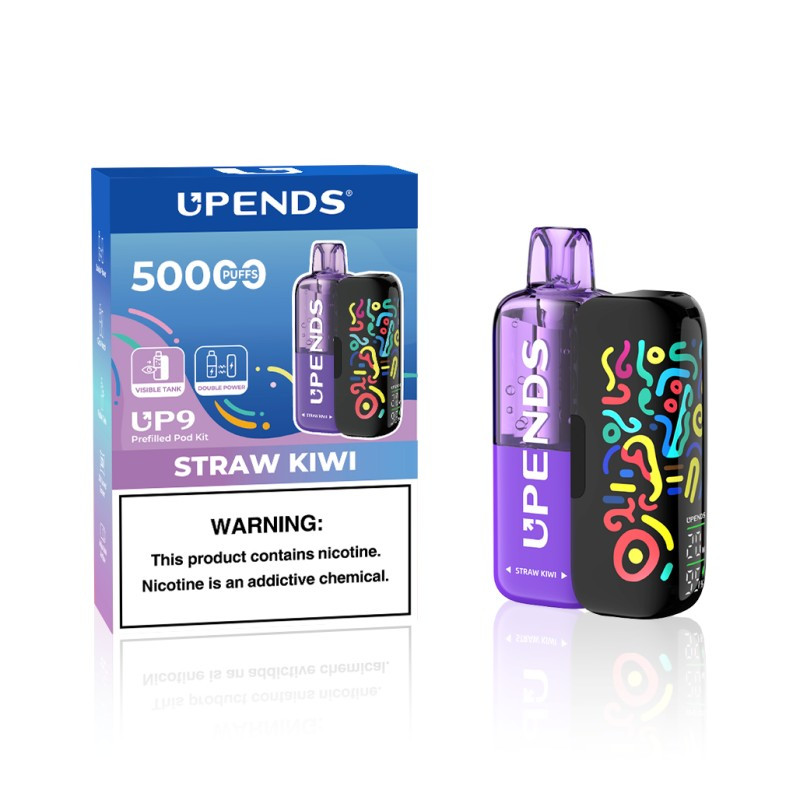
The mega-disposable vaping sector has officially entered the 50,000-puff arena, introducing complex multi-battery architectures and hyper-advanced displays. In this ultimate high-capacity clash, theUpends UP9 50K Vape Kit goes head-to-head with theNEXA Ultra II(also recognized as the Ultra 50k II). Both devices seek to eliminate the anxiety of running out of juice on a long trip, yet they treat the 50k puff milestone with distinct approach pathways. The UP9 relies heavily on a specialized dual-battery setup, whereas the Ultra II leans into its innovative locked flavor preservation design.
Design
When it comes to aesthetic footprints, both devices break away from generic box shapes, opting instead for structural elements that immediately command attention. The Upends UP9 features a striking, clear visual layout dominated by a transparent e-liquid tank and an expansive, wrap-around 270-degree 3D screen. This sweeping panoramic screen offers constant, high-definition tracking of your real-time settings and power levels from almost any viewing angle. The combination of a crystalline tank and a smooth outer framework creates a look that feels highly technical and deeply satisfying to handle.
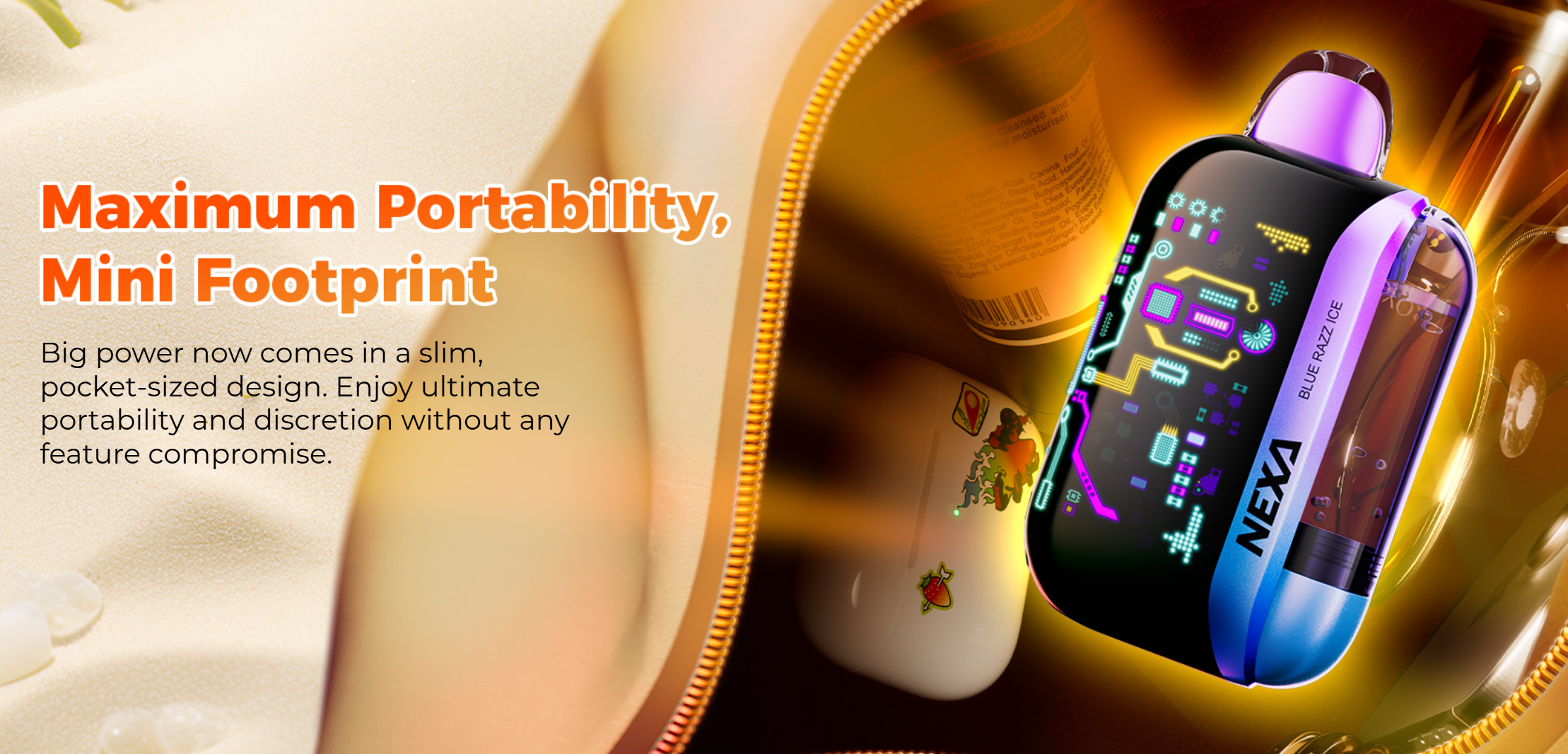
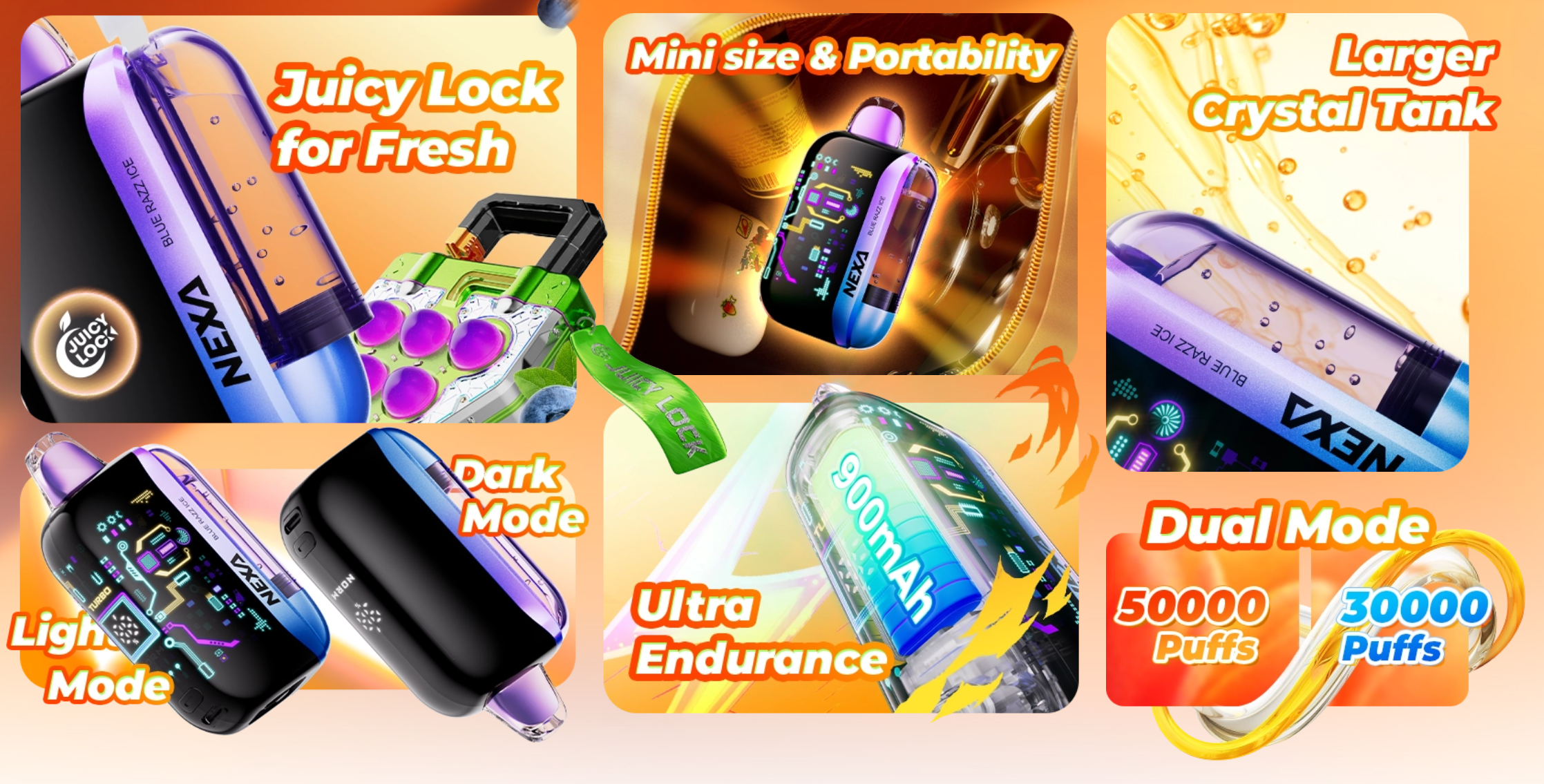
The NEXA Ultra II responds with a refined, ultra-modern polycarbonate chassis designed specifically to minimize annoying smudges and fingerprints.It is noticeably more compact than its direct predecessor, giving it a much softer, more pocketable feel.Like the UP9, the Ultra II boasts a clear, transparent tank window that lets you confidently evaluate your remaining e-juice by eye rather than guessing blindly.Its standout visual asset is a massive, smartwatch-inspired front display panel flashing crisp animated circuitry graphics.For those who prefer a stealthier approach, it introduces a convenient Dark Mode toggle that allows users to switch off the flashing lights while keeping basic stats active.
Features
Looking closely at the underlying mechanics reveals two distinctly engineered beasts designed to squeeze out maximum longevity.
The Upends UP9 is powered by a creative dual-battery system, distributing power across a built-in 850mAh base battery combined with a separate 230mAh battery tucked into the pod itself to achieve a total output pool of 1080mAh.
Capacity & Puff Count: Packs a massive 20ml e-liquid reservoir delivering a full 50,000-puff ceiling.
Adjustability: Utilizes a highly flexible Triple Power Mode scaling from a cool 15W draw (yielding 50,000 puffs) up to a punchy 25W cloud mode (dropping total yields to 30,000 puffs).
Convenience: Integrates a Smart Click Match System, Type-C fast charging, and dedicated airflow adjustments to tailor the restriction.
The NEXA Ultra II utilizes a single, robust 900mAh quick-charge battery paired with an equally impressive 20ml e-liquid capacity.
Juicy Lock System: NEXA implements a two-part assembly system featuring their proprietary Juicy Lock click-in framework.The tank and battery ship as separate components in the box, locking out leaking or stale e-juice prior to activation.
Output Modes: The Ultra II is driven by a 1.0Ω dual mesh coil system supporting two distinct operation presets.Normal Mode delivers a steady, cool vape for the full 50,000-puff threshold, while Turbo Mode instantly cranks up flavor intensity, throat hit, and vapor density (reducing life to 30,000 puffs).
Verdict
Specification
Upends UP9
NEXA Ultra II
Battery Configuration
1080mAh Total (850mAh + 230mAh Dual System)
900mAh Integrated Battery
Output Adjustability
Triple Modes: 15W / 20W / 25W
Dual Modes: Normal / Turbo
Display Style
270-degree Panoramic 3D Screen
Animated Circuit Screen with Dark Mode
Freshness Protection
Smart Click Match System
Click-in Juicy Lock Mechanical Seal
Choosing between these two 50k juggernauts hinges on your preference for fine-tuning power versus total flavor structural defense. The Upends UP9is a spectacular choice if you love deep wattage personalization, giving you three distinct power modes and a massive dual-battery reserve to play with. On the other hand, if your priority is consistent, zero-fade flavor performance protected by a physical leak-proof seal and an option to black out your display lights completely, the NEXA Ultra II stands tall as the absolute gold standard for long-haul durability.
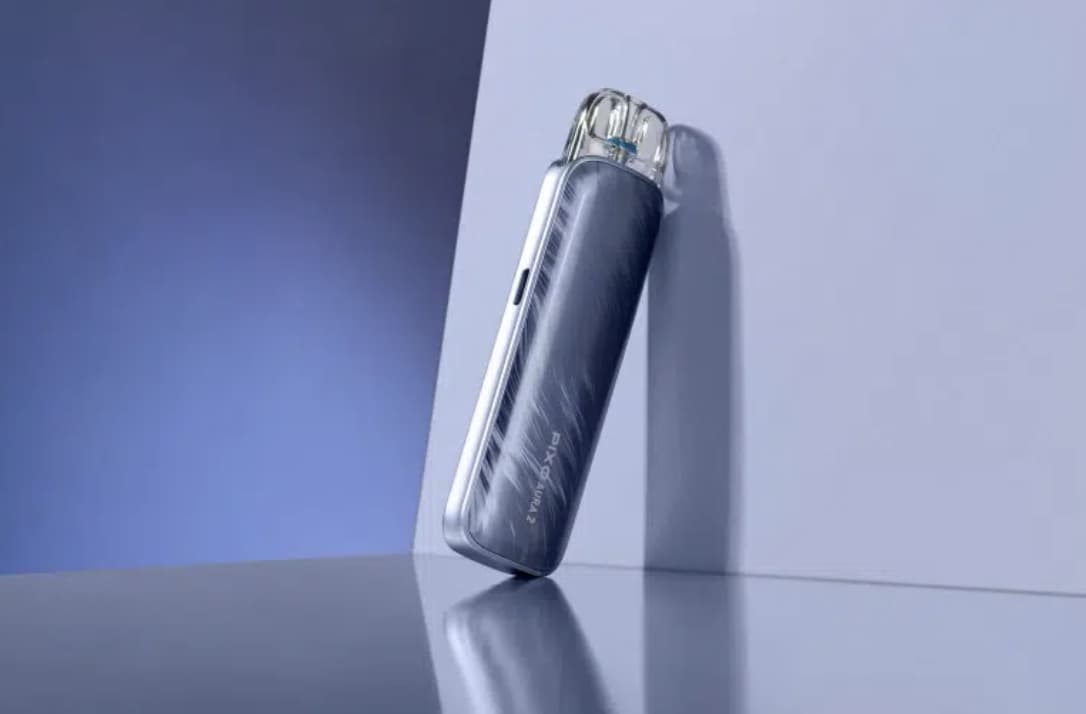
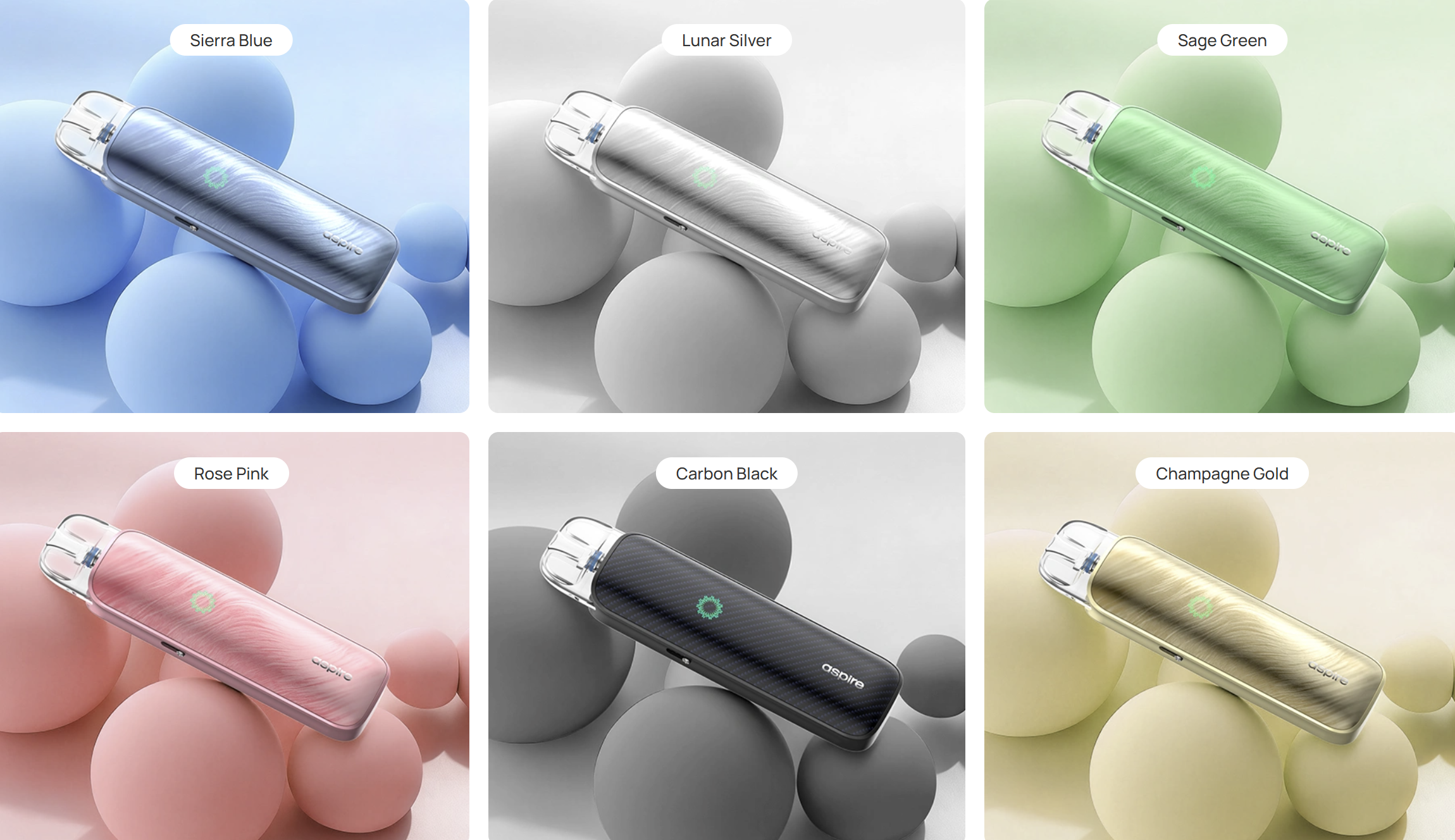
Aspire Pixo Aura 2 is a stylish and easy-to-use pod vape designed for adult users who value portability, performance, and simplicity. As the latest addition to Aspire’s Pixo Series, the Pixo Aura 2 combines a sleek ergonomic design, long-lasting battery, refillable pods, and smooth airflow to deliver an enjoyable vaping experience for both beginners and experienced users.
Whether you’re switching from disposable vapes or looking for a reliable everyday pod system, the Aspire Pixo Aura 2 offers a balance of flavor, convenience, and modern design.
Modern and Ergonomic Design
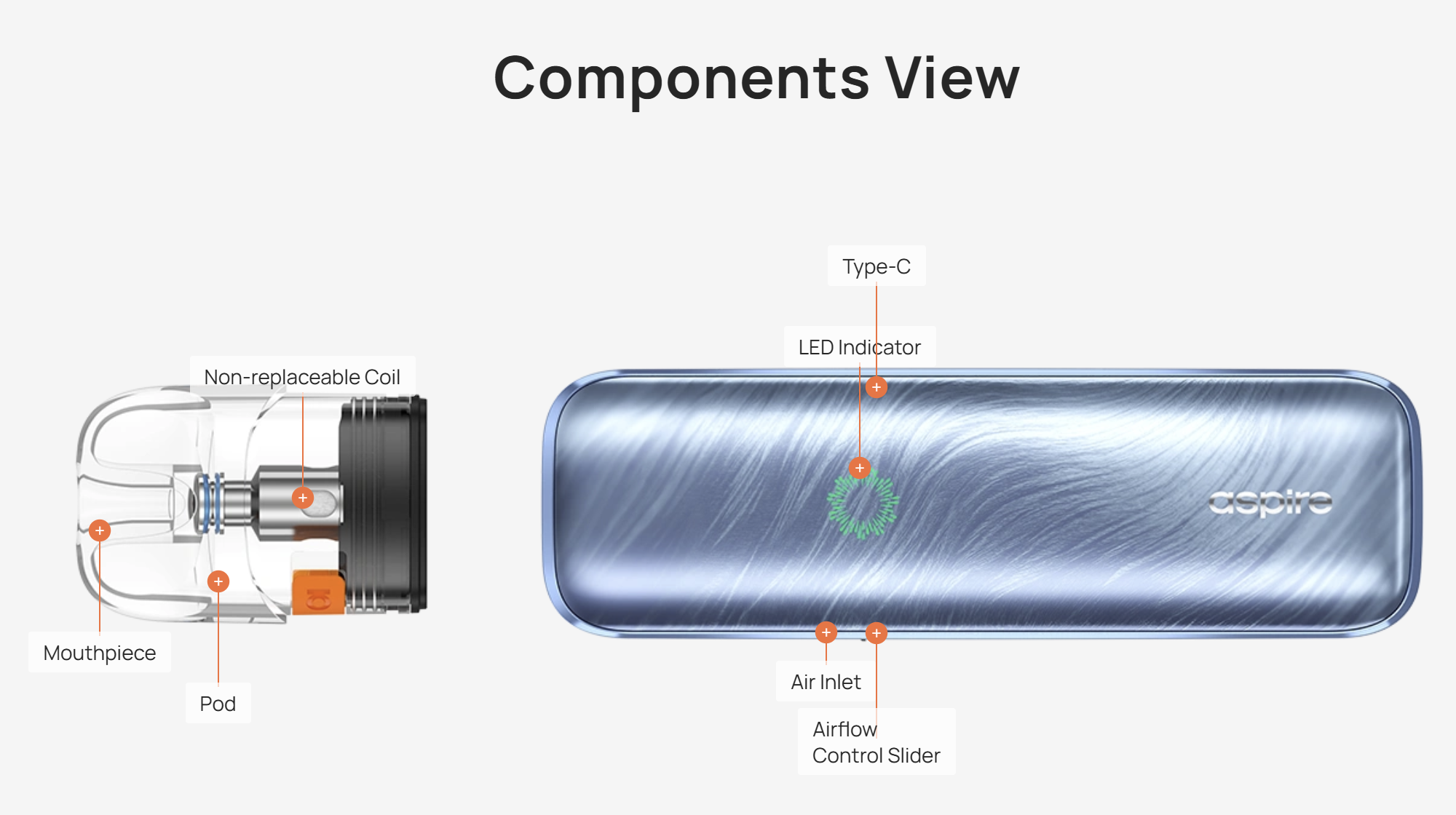
The Aspire Pixo Aura 2 features a slim, lightweight body that fits comfortably in your hand or pocket. Constructed from durable materials with a premium finish, the device is designed for everyday portability while maintaining a stylish appearance.
Its minimalist design includes intuitive controls, making it easy to operate without a complicated learning curve.
Long-Lasting Built-In Battery
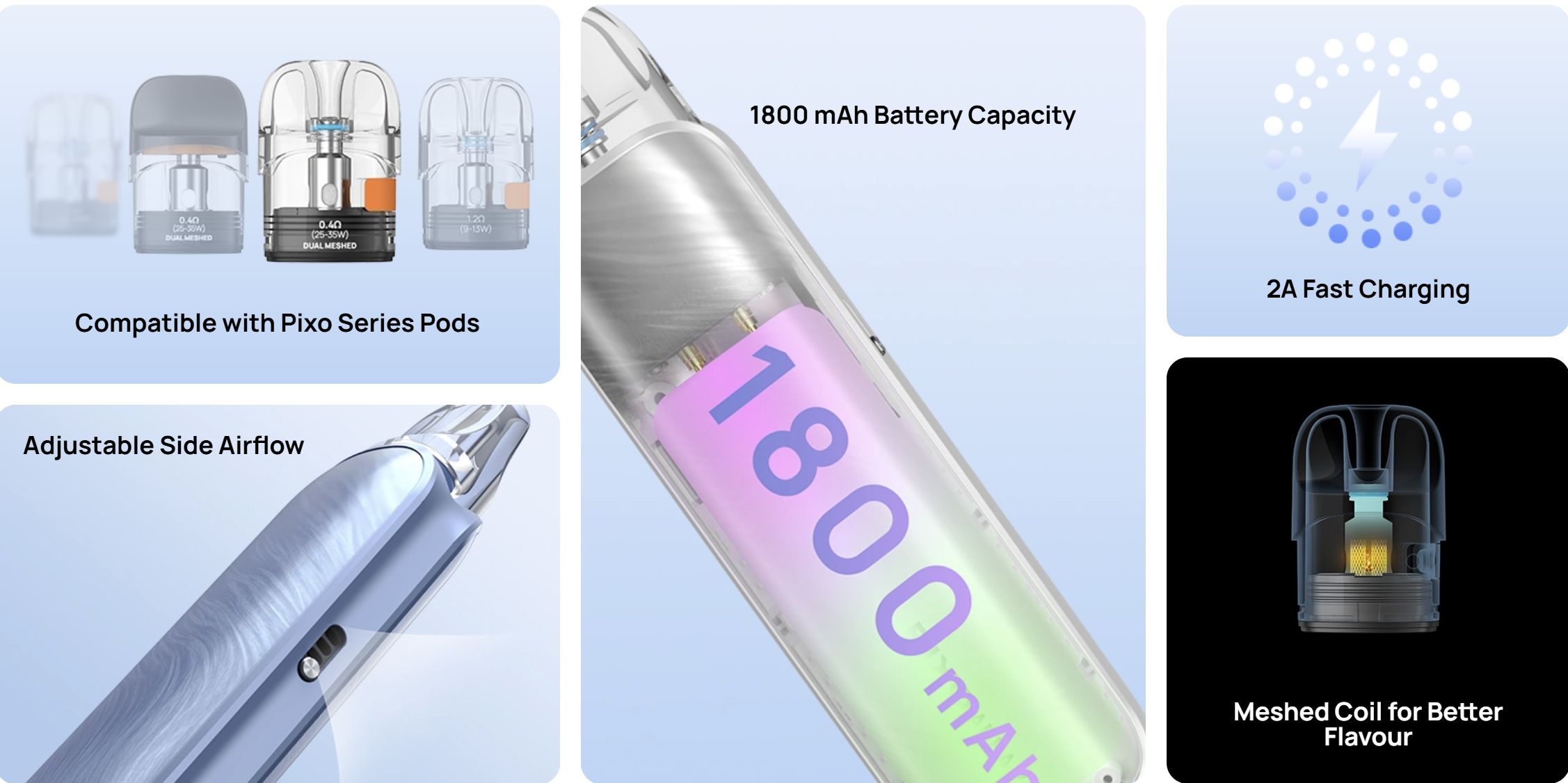
Powered by a high-capacity rechargeable battery, the Pixo Aura 2 is designed to provide all-day vaping for most users. USB Type-C fast charging helps reduce downtime, allowing you to recharge quickly and get back to vaping with minimal interruption.
Smooth and Consistent Flavor
The Pixo Aura 2 is engineered to maximize flavor delivery through Aspire’s advanced pod technology. The integrated mesh coil heats e-liquid evenly, producing rich flavor, smooth vapor, and excellent coil longevity.
Whether you enjoy nicotine salts or standard freebase e-liquids, the device is optimized to provide a satisfying vape with consistent performance.
Refillable Pod System
The refillable pod design allows users to easily fill their favorite e-liquid while reducing waste compared to disposable devices.
Benefits of the refillable system include:
Easy top or side filling (depending on pod version)
Leak-resistant construction
Transparent pod for monitoring e-liquid levels
Convenient magnetic pod connection
The pod system is designed for quick installation and effortless daily maintenance.
Adjustable Airflow
The Aspire Pixo Aura 2 features adjustable airflow, allowing users to customize their vaping experience.
With a simple airflow adjustment, you can switch between:
Tight Mouth-to-Lung (MTL) draws for a cigarette-like inhale
Restricted Direct-to-Lung (RDL) vaping for increased vapor production
This flexibility makes the device suitable for a wide range of vaping preferences.
Intelligent Performance
The device automatically detects the installed pod and delivers an appropriate power level for consistent vapor production. This smart output system eliminates complicated wattage adjustments, making the Pixo Aura 2 especially beginner-friendly.
Built-in safety protections typically include:
Overcharge protection
Short-circuit protection
Low-voltage protection
Overheat protection
Overtime vaping protection
These features help ensure reliable and safe operation during everyday use.
Easy Everyday Operation
Designed with convenience in mind, the Aspire Pixo Aura 2 offers a simple vaping experience.
Key user-friendly features include:
Draw-activated firing
Quick pod replacement
Fast USB Type-C charging
Lightweight construction
Compact pocket-friendly size
Minimal maintenance
Its intuitive operation makes it an excellent choice for users transitioning from disposable vapes to refillable pod systems.
Key Features
Compact and ergonomic design
Rechargeable built-in battery
USB Type-C fast charging
Refillable pod system
Advanced mesh coil technology
Rich flavor production
Adjustable airflow
Leak-resistant pod design
Automatic power adjustment
Suitable for MTL and RDL vaping
Multiple built-in safety protections
Who Is the Aspire Pixo Aura 2 For?
The Aspire Pixo Aura 2 is ideal for:
Adult smokers switching to refillable vape devices
Users replacing disposable vapes
Beginners seeking a simple pod system
Flavor-focused MTL vapers
Users looking for a compact everyday vape
Travelers who need a lightweight and portable device
Final Thoughts
Aspire Pixo Aura 2 combines elegant design, dependable battery life, refillable convenience, and excellent flavor performance in a compact pod system. With adjustable airflow, intelligent power delivery, and easy operation, it offers a satisfying vaping experience for both new and experienced adult users.
If you’re looking for a stylish refillable pod vape that delivers consistent performance without unnecessary complexity, the Aspire Pixo Aura 2 is a strong option for everyday use.
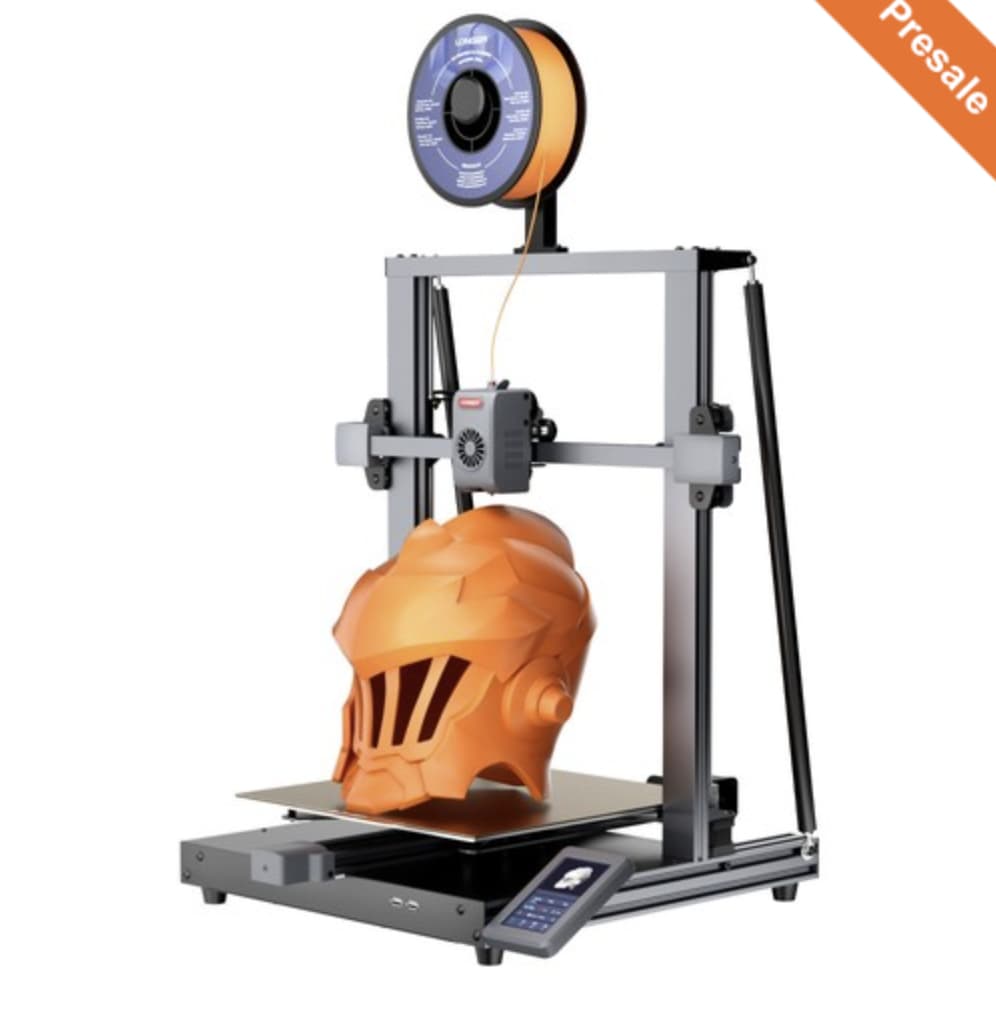
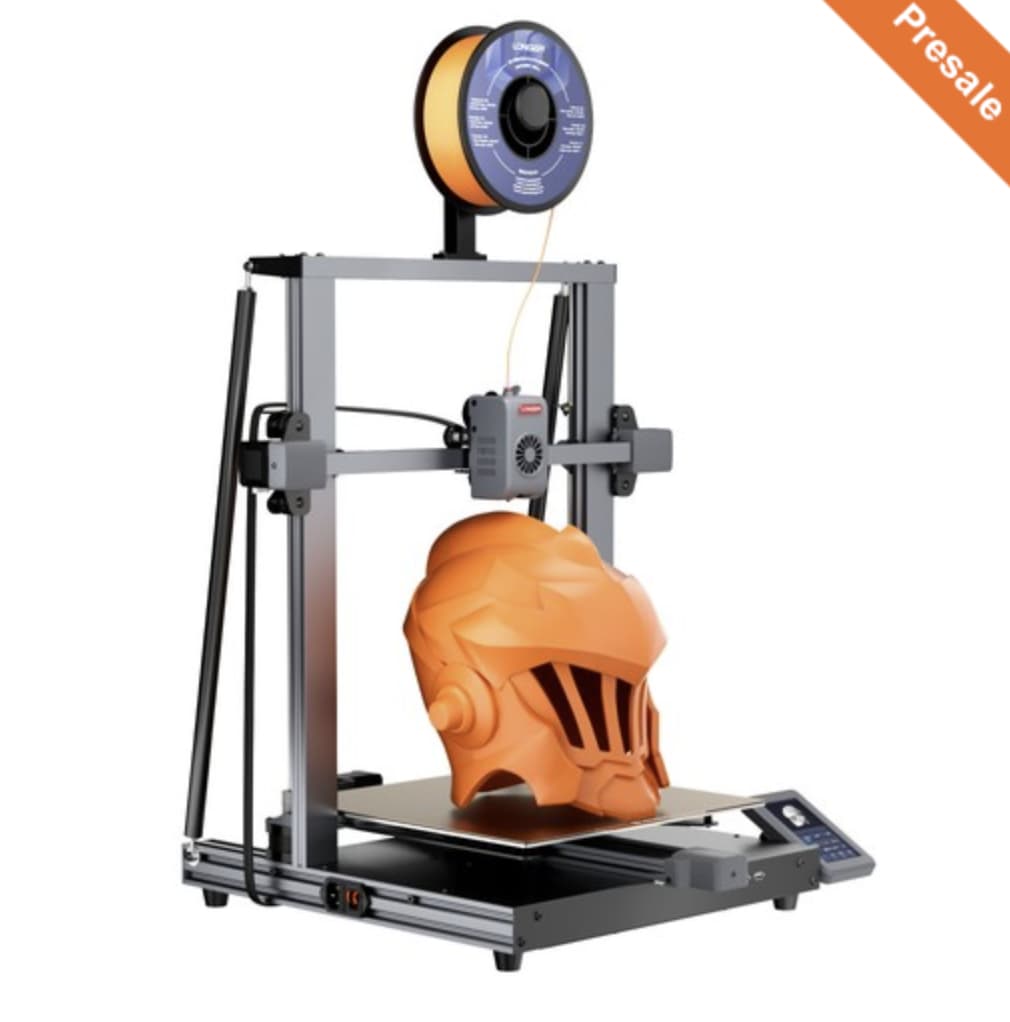
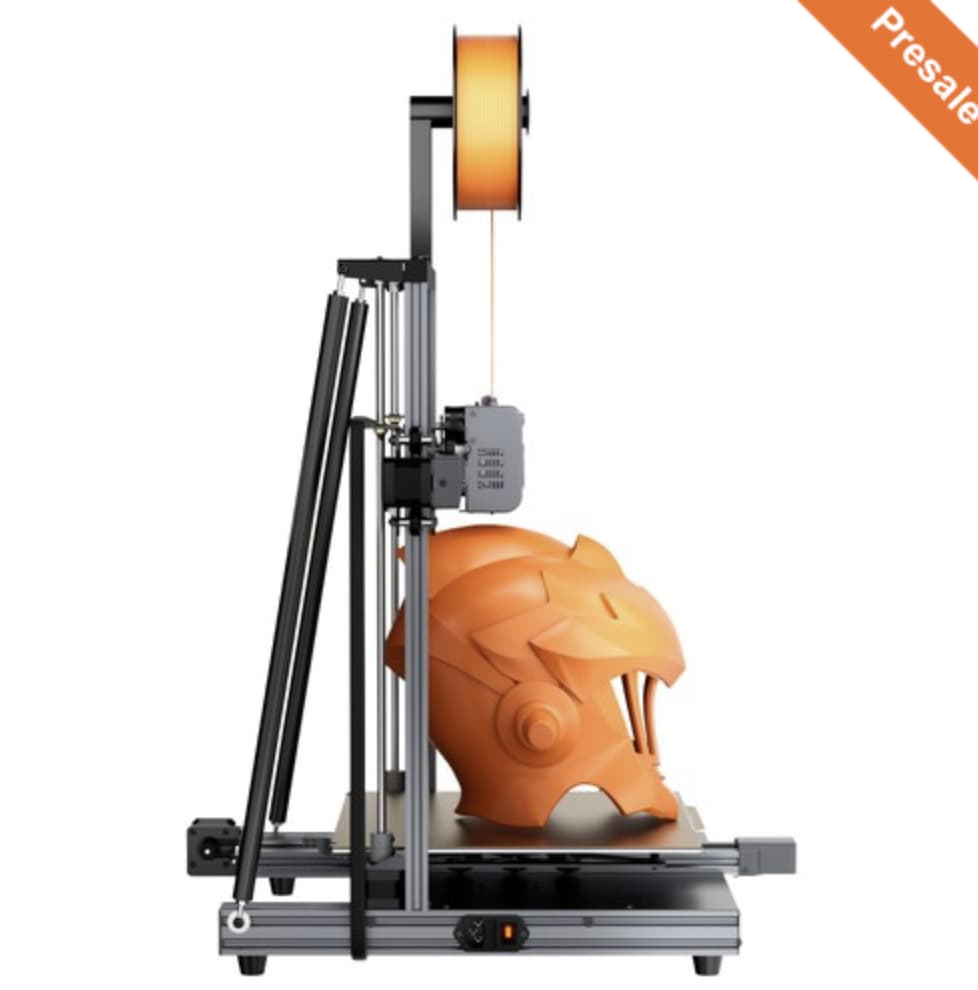
LONGER LK10 Plus is a next-generation FDM 3D printer designed for makers, engineers, hobbyists, and small businesses seeking fast printing without sacrificing quality. Featuring a generous 320 × 320 × 400 mm build volume, a maximum print speed of 500 mm/s, and an upgraded direct-drive extrusion system, the LK10 Plus delivers the performance needed for everything from large prototypes to detailed functional parts.
Large Build Volume for Bigger Ideas
One of the standout features of the LONGER LK10 Plus is its spacious 320 × 320 × 400 mm printing area. The oversized build volume allows users to create large models in a single print or produce multiple parts simultaneously, improving productivity for workshops and production environments.
Whether you’re printing cosplay helmets, architectural models, mechanical components, or educational projects, the generous build space provides greater creative freedom.
High-Speed Printing Up to 500 mm/s
Built with a Klipper-powered control board, the LK10 Plus supports print speeds of up to 500 mm/s, significantly reducing print times compared to traditional desktop 3D printers.
Advanced motion control technologies, including vibration compensation and input shaping, help maintain print quality even at high speeds by reducing ringing and ghosting effects. This combination enables users to complete projects faster while preserving precision.
High-Flow Direct Drive Extruder
The printer features an upgraded high-flow direct-drive extruder capable of delivering up to 25 mm³/s volumetric flow. This design provides consistent filament feeding, improved extrusion accuracy, and excellent compatibility with flexible materials.
Combined with a redesigned hotend and enhanced cooling system, the extruder minimizes clogging while supporting reliable, long-duration printing.
Wide Material Compatibility
With a nozzle temperature reaching 300°C and a heated PEI print bed capable of 110°C, the LONGER LK10 Plus supports a wide range of popular filaments, including:
PLA
PETG
ABS
ASA
TPU
Other 1.75 mm materials
This versatility makes the printer suitable for decorative models, engineering prototypes, and durable functional parts.
Automatic Leveling for Easy Setup
The LK10 Plus simplifies the printing process through automatic bed leveling and Auto Z-Offset calibration. These features automatically establish the correct nozzle-to-bed distance, reducing manual adjustments and improving first-layer consistency.
For beginners, this means a faster setup process and fewer failed prints. Experienced users also benefit from improved workflow efficiency.
Stable Metal Frame with Dual Z-Axis
A rigid all-metal frame provides excellent structural stability during high-speed operation. The printer also incorporates a dual Z-axis system with independent motors and lead screws, ensuring smoother vertical movement and better layer alignment.
The sturdy construction minimizes vibrations, helping maintain dimensional accuracy across large prints.
Smart Features for Reliable Printing
The LONGER LK10 Plus includes several intelligent features designed to improve reliability and user convenience:
Automatic bed leveling
Auto Z-Offset calibration
Filament runout detection
Power-loss recovery
Object exclusion during multi-part printing
Sensorless X/Y homing
4.3-inch full-color touchscreen
Together, these features reduce interruptions and make long printing sessions more dependable.
Flexible Connectivity
Users can manage print jobs through multiple connection options, including:
Wi-Fi
LAN
USB flash drive
The printer is compatible with Windows and macOS and supports common 3D model formats such as STL, OBJ, and STEP. OrcaSlicer is recommended for slicing and print preparation.
Technical Specifications
Specification
Details
Printing Technology
FDM
Build Volume
320 × 320 × 400 mm
Maximum Print Speed
500 mm/s
Extruder
High-Flow Direct Drive
Maximum Nozzle Temperature
300°C
Heated Bed Temperature
110°C
Layer Height
0.1–0.4 mm
Nozzle Diameter
0.4 mm
Supported Filaments
PLA, PETG, ABS, ASA, TPU
Connectivity
Wi-Fi, LAN, USB
Display
4.3-inch Color Touchscreen
Frame
Full Metal
Bed Surface
PEI Spring Steel Platform
Who Should Buy the LONGER LK10 Plus?
The LONGER LK10 Plus is an excellent choice for:
Hobbyists looking to upgrade to a larger, faster printer.
Designers and engineers producing functional prototypes.
Schools and makerspaces requiring reliable classroom equipment.
Small businesses creating production parts or custom products.
Cosplay enthusiasts printing oversized props and helmets.
Its combination of speed, large build volume, and intelligent automation makes it suitable for both beginners and experienced makers.
Final Verdict
LONGER LK10 Plus offers an impressive blend of speed, size, and ease of use. With a large 320 × 320 × 400 mm build volume, a high-flow direct-drive extruder, automatic leveling, Klipper-powered high-speed printing, and support for a broad range of materials, it provides excellent value for users who need a capable and dependable desktop 3D printer.
If you’re searching for a machine that can efficiently handle large-format prints while maintaining quality and reliability, the LONGER LK10 Plus is a strong contender in today’s FDM 3D printer market.
Apple’s Liquid Glass interface has always been a bold, polarizing experiment in translucency. With the iOS 27 public beta, the company is now letting users push it even further — into “More Clear” territory. One writer cranked the new slider all the way to maximum transparency and spent a full week living with the most warped, glassy, and delightfully distorted iPhone experience yet.
From notifications that ripple and refract app icons like light through actual glass, to menu bars that turn text into momentary abstract art, the clearest Liquid Glass setting revives the playful dimensionality Apple first chased more than a decade ago. It’s not the most practical choice for everyone, but for those willing to embrace the whimsy, it turns the phone into something closer to living, breathing art.
Wired‘s Reece Rogers dove in headfirst. Here’s what it felt like to go full transparent.
Fear not — if you don’t feel the same way as I do about transparency — you can drag that same slider to the right and boost the overall opacity of Liquid Glass. There’s still the option to Reduce Transparency and Increase Contrast as well.
I immediately cranked my settings to maximum clarity after I downloaded the public beta and left the setting on for a week to get the full experience. I understand why some prefer the heavily tinted version or need to switch it for accessibility reasons, yet I reveled in the warped colors and characters as I experienced Liquid Glass in its clearest glory.
The “more clear” option also added an increased depth to my device — reminiscent of an Apple update from more than a decade ago, in iOS 7, that you likely haven’t thought about in a minute: 3D apps. Apple added a parallax wallpaper effect during the iPhone 5’s heyday that used the smartphone’s gyroscope to make it appear as if app icons on your home screen floated slightly above the background, visibly shifting to the phone’s tilt.
Both Liquid Glass and 3D app icons gave the iPhone a more tactile sense of dimensionality…
Halfway through my week of testing, this option started to look so normal to me that I worried I had accidentally reset my phone to the default and checked my settings to ensure “more clear” was still enabled. It was. Which was a relief, and a sign I’d adjusted to this clearer version of Liquid Glass even faster than anticipated…
[T]his clear-minded update was delightful to try, and I’m keeping up with my transparent lifestyle even after the weeklong experiment ended.
MacDailyNews Take: You might even say that Apple’s Liquid Glass cranked up to maximum transparency makes the buttons on the screen look so good you’ll want to lick them.
Please help support MacDailyNews — and enjoy subscriber-only articles, comments, chat, and more — by subscribing to our Substack: macdailynews.substack.com. Thank you!
On Tuesday, the White House Office of Science and Technology Policy (OSTP) released a report entitled "Science: A New Golden Age," in which it lays out how it has viewed science, found it lacking, and believes the Trump administration is in the perfect position to fix things. It's a bit unexpected coming from an administration that has been proposing crippling funding cuts to research and trying to enable political appointees to terminate grants awarded based on scientific merit.
The report presents itself as the spiritual successor of "Science, the Endless Frontier," a policy document that laid out the case for government-funded science in the wake of World War II. The New Golden Age (SNGA) says that, while the concepts promoted by the original remain vital, the circumstances have changed such that we need major revisions to how the government is implementing things.
The result is an odd mix. It completely ignores or glosses over many things that the administration is doing to harm scientific progress. In some cases, it identifies issues that have already been discussed as problems within the scientific community, but misrepresents them. Elsewhere, it's a mixture of political grievances, ideas without a solid intellectual foundation, and an injection of Silicon Valley's perspective on innovation (Michael Kratsios, the director of the OSTP, formerly worked with Peter Thiel). As a result, it's unlikely to have anything like the impact of "Science, the Endless Frontier."
An e-reader magneted to the back of a smartphone, just as the prophecy foretold.
The market for small e-readers has been booming lately. Earlier this year, Jason took a look at the Xteink X4, a pint-sized reading device that was about as light and small as they come. But those maniacs at Xteink weren’t done yet: they followed it up with the $79 X3, which is unbelievably even lighter and smaller.
I wouldn’t blame you for wondering if there’s such a thing as too small and light—at 3.84 inches by 2.51 inches (and just 0.2 inches thick) the X3 is still larger than, say, a credit card, but not by much. The screen itself measures just 3.7 inches, more than half an inch smaller than the X4’s 4.3 inch, but its 259 ppi resolution still makes it plenty easy to read on.1 At that size it’s little imposition to take it with you wherever you go. Easy to lose? Maybe. Easy to love? Yes.
For one thing, this small size unlocks at least one capability that the X4 couldn’t fully deliver upon—the ability to stick to the back of your phone. Like the X4, the X3 has a MagSafe-compatible magnet in its rear case and it fits just about perfectly on the back of my iPhone 17 Pro, nestled below the camera plateau.
However, the magnet is not particularly strong, and it lacks the secondary stabilizing magnet that you see on official MagSafe accessories, meaning it wobbles around a bit. I wouldn’t call it a super secure connection, but it’s pretty good if you’re just slipping it in and out of a pocket. Just be aware that it probably will come loose.
Like the X4 before it, the X3 features a pair of rocker switches on the front for a total of four possible buttons. But they’ve opted to skip the X4’s side mounted rocker switch in favor of a single buttons on each side. There’s also an on/off switch at the top (plus a recessed button used for resetting the device). And with all of that, they somehow managed to continue to fit a microSD slot in the top. The bottom left corner also has a little set of holes for a lanyard or wrist strap.
The X3 is about the size of just the display on the X4.
The one casualty of the smaller X3, however, is the port. The X4 was big enough to accommodate a USB-C connector, but the X3’s thin profile makes that impossible. Instead, there’s a pogo-pin USB cable that connects to four magnetic contacts on the reader. Is this a step back? Strictly speaking, yes. Using a proprietary connector is a bummer in the year 2026, especially because it means having to keep track of a single-use cable. That said, once you get the X3 up and running, the only real need for the connector is charging, and the battery on this thing lasts a very long time. (I’ve yet to run it down in several weeks of usage.) Just remember to make a note of where you stow that cable for the point months down the road when you do need to charge it and find yourself wondering whatever happened to it.
As with the X4, the X3 lacks any sort of screen lighting, meaning that it’s strictly a “read in bright light” device. But don’t worry, because Xteink has already unveiled a new X4 Pro with the company’s first lit screen.2
All in all, I found the X3 very comfortable to read on, whether attached to my iPhone or not. The side buttons work great as page-turners, and the screen is high-contrast and sharp enough to make text render very clearly. All in all, it’s a great reading experience—if you take into account one major caveat.
Soft where?
The elephant in the room for the Xteink X3 is the software. Xteink ships the X3 with its own built-in firmware which, by all accounts, has improved since the first version. But I can’t really tell you, because upon opening the box and powering up the device, the first thing I did was install Crosspoint, the open-source community-built firmware that has turned this device from a curiosity into a real contender.3
Unlike a lot of other firmware replacements, Crosspoint is super easy to install; you can do it right from a web browser. While it’s not fully free of technological hurdles, I’d say that most people comfortable using an e-reader or updating their iPhones will be able to handle the process with few problems. And the benefits are manifold.
Crosspoint is extremely configurable for all your reading needs.
Crosspoint goes beyond simply turning this into a functional device and into one that is actually fun to use. It’s got a straightforward, easy to navigate interface that makes it simple to do everything from reading to loading books (accomplished via a web-based interface). For those who like to tweak their reading setup, there are plenty of configuration options, everything from screen orientation to hyphenation and, yes, custom fonts loaded via the SD card.
Even the onscreen keyboard that you need to use for various configuration tasks is pretty solid for what’s available—on par with navigating via an onscreen keyboard with a game controller, in my opinion. I wouldn’t want to have to type in my Wi-Fi password every time—and you don’t, because it saves it for you—but one time was fine.
There are also a bunch of other features that might appeal to those who want to take reading to the next level. For example, support for Open Publication Distribution System (OPDS) standard means that if you want to host your book library on your own server, you can point your reader at that and download any of the books you already own directly to your device. There’s also support for KOreader sync to help keep your place between supported devices.4
Crosspoint has been so successful, in fact, that the team at Xteink has smartened up and started collaborating. (This after a brief moment when it looked like the company might try to firmware lock its devices.) Now, not only do the “developer editions” sold directly by the company continue to allow you to install the custom firmware, the company has been working with the Crosspoint team to make sure new devices, like the X4 Pro, will already be supported when they arrive. While Xteink hasn’t quite adopted Crosspoint as the default OS, it’s not far off.
The world is not enough
Given how positive I’ve been above, you might be all too tempted to run out and snap up an Xteink X3 for yourself. I don’t blame you! At $79 (and often discounted for less than that), it’s well positioned as an impulse buy. And while I don’t want to dissuade you, I have to note the biggest caveat of all: the world.
Just try to tell me this wee fella isn’t charming.
If there’s one thing that’s holding back the X3 and the X4 and, frankly, all the other wacky readers out there, it’s the market. The e-reader space is still unquestionably dominated by Amazon purveying its razors-and-blades strategy: buy the Kindle for cheap5 and the company earns it all back when you buy your books or sign up for Kindle Unlimited’s all-you-can-eat plan. Kobo, who makes the hardware that I prefer, is a distant second, and has some advantages, but operates on roughly a similar scheme.
Both of these companies benefit from lock-in in the form of Digital Rights Management. DRM is, of course, largely pushed by publishers, who insist upon cryptographic schemes to lock down the books they sell in order to nominally protect against piracy. Never mind the fact that books are still easily and widely pirated, the DRM is relatively simple to crack6, and many of those books have been vacuumed up by the boatload by an even more insidious thief in the form of AI training data.
I come at this, of course, from the perspective of both reader and writer. As a writer, I certainly want to be compensated for all the hard work I put in to create my books, but I also want people to read and enjoy them. That’s why you’ll find no stauncher defender of libraries.
Personally, I find the industry’s insistence on DRM misplaced, just as I did with the music industry two decades ago. The lack of these security features does not automatically turn people at large into thieves and it’s insulting to think that it would. In fact, the sci-fi publisher Tor, one of the biggest names in the business and a subsidiary of Big Five publisher Macmillan, has put out its titles without DRM for almost fifteen years and I haven’t seen any significant indication that it’s harmed their business. Many of my books are also available directly from my publisher without DRM, and I don’t think that’s put a dent in my bottom line either.
I would love to be able to easily load any book I’ve ever purchased onto my Xteink devices—or, for that matter, any e-reader or e-reading app of my choice. There are, of course, extensive repositories of DRM-free public domain books available. Amazon, to its credit, does now allow you to download DRM-free copies of any book that you’ve purchased.7 I argued a few years back that this is an opportunity for Apple to distinguish its stagnant ebook marketplace from the competition. But for first-run books, your options are currently more limited (and sometimes harder to suss out).
I’d also love to somehow see support for Libby, the popular library ebook borrowing app, on Xteink devices, though I don’t see that happening anytime soon. But in my opinion, the bottom line is that more ways to read makes more readers of books, which in turn makes more customers of books.
But I digress.
The conclusion
The other week I was riding the train with my kid, our usual weekend pastime. As he was enjoying looking out the window, I was reading a book on the X3, magneted to the back of my iPhone 17 Pro. As we neared a stop, a woman nearby caught sight of it and marveled over it. “Is that a tiny e-reader?”
I extolled its virtues for a moment before they got off at their stop. But it told me one important thing: there’s a hunger for these types of devices. Because people who self-select as readers in this day and age are, above all, passionate. You have to make a choice to be sitting and reading a book when you could be watching TikTok or Instagram or listening to music or a podcast, all of which are constantly at your fingertips.
That’s where the X3 (and the X4) deliver. A Kindle or Kobo isn’t exactly bulky, but they’re not pocketable either. Being able to take your e-reader with you just as we stuffed mass market paperbacks in our back pockets in days gone by is freeing and fun. Now if the world might just shift a little bit more to meet us, maybe we could free ourselves a little further.
Fun fact: the X3’s display is 0.2 inches larger and has almost 60 percent higher pixel density than the screen on the original iPhone. ↩
Did I buy one? Yeah, I did. Because apparently these guys have my number. ↩
I should say that there are many other custom firmware projects for Xteink’s hardware, but Crosspoint is indisputably the most prominent and best supported. ↩
If you’re not familiar with KOreader, it’s an open source reading app that you can install on Kindle and Kobo, as well as other platforms; one of the features is its own syncing system. ↩
Though, to be frank, not as cheap as it used to be. ↩
Not unlike in music, the problem is that in order for someone to actually to consume your music or books, they must possess the means to unlock it. ↩
With some caveats. For example, if you’re in a household with someone else who’s purchased a DRM-free book, you can still read it on your Kindle, but only they can download the DRM-free version. ↩
On Thursday, San Francisco city attorney David Chiu sent legal notices to Apple and Google demanding that they remove from their app stores 13 face-swapping apps, which allow users to create AI-generated nonconsensual nude images. The letters say the Silicon Valley giants should stop “aiding and abetting” the sale of explicit deepfake images and “sever” business relationships with the app developers.
[…]
Researchers have repeatedly found and reported apps in Apple’s App Store and Google’s Play Store that allow people to generate sexual images using AI—including some apps being rated as suitable for use by children. While new laws and bans aim to tackle the scourge of explicit deepfakes online, technology and social media companies consistently direct millions of people toward the harmful tech.
Both Apple and Google have developer policies that prohibit pornography, abuse, and harassment on their platforms.
Burgess gives the impression, which is my base assumption, that these 13 apps were clear about what they do, so App Review has no excuse for missing them. But I’m sure it’s keeping us all safe in other regards.
Meanwhile, in a preprint research paper published in May, researchers from Cornell University and Georgetown University identified 420 apps offering general face-swapping capabilities on Google’s and Apple’s app stores. They tested 155 to see if they could be used to create face swaps with nude images; in 70 percent of cases, it was possible, with the apps not including safety measures to prevent this.
Chiu isn’t arguing that hosting an app automatically makes a platform liable for what it does. Platform operators already won that battle with Section 230 of the Communications Decency Act. That 30-year-old law says websites generally aren’t responsible for content posted by users, allowing platforms to host user-generated content without getting sued every time someone defames someone in a comment thread.
Courts have often extended those protections to cover app stores too. Apple and Google are treated as distributors of whatever a third-party developer uploads, rather than publishers.
Chiu is attempting to sidestep that argument by focusing on the companies’ payment systems, noting that Apple and Google collect a cut of every in-app purchase. According to the Tech Transparency Project (TTP), that means they profit from apps that generate revenue by creating non-consensual intimate imagery.
Finding useful software in the App Store is about to get easier. Apple is apparently preparing to remove what it describes as “opportunistic” apps that provide little value to iPhone and iPad users.
It already had a policy of not approving applications that are “indistinguishable from what’s already widely available.” This week, it quietly warned developers that it will start removing low-value software that doesn’t attract attention from users.
4.3 (b) Don’t submit apps that are indistinguishable from what’s already widely available. Opportunistically creating variants of existing app categories or popular apps degrades App Store discovery, reduces overall app quality, and harms both users and developers. Certain kinds of apps, such as dating, flashlight, sound effects, wallpaper, simple timers, and fortune telling, are well established on the App Store and we will not accept new submissions unless they offer a meaningfully different or improved experience. We may remove these apps from the App Store going forward if they are not updated, improved, or do not attract customers. Other kinds of apps, such as drinking games, Kama Sutra, fart, and burp apps, are mediocre, low-quality, or low-effort and do not add value to the App Store. Repeated submissions of this kind may lead to removal from the Apple Developer Program.
Waiting for Review enters day 3. I don’t recall when was the last time this happened for any of the apps I am working for.
[…]
I sent messages to App Review Board and received nothing in response (so far).
It seems that if Apple ever removed your app from App Store for reason of “not sending regular updates” that app is…gone. It’s not deleted but it seems to dwell in some sort of limbo.
Anya Taylor-Joy stars in “Lucky,” premiering July 15, 2026 on Apple TV.
Written by Jonathan Tropper and Cassie Pappas and based on Marissa Stapley’s bestselling novel, “Lucky” centers on a young woman (Anya Taylor-Joy) who left behind the life of crime she was raised in years ago, but must now embrace her darker, criminal side one final time in a desperate attempt to escape her past.
Apple TV’s seven-episode series premieres this Wednesday.
Anya Taylor-Joy finds herself in a familiar setting this summer: In the desert, fighting to stay alive.
She did it in “Furiosa” and the upcoming “Dune: Part Three.” Now she’s under the blazing California sun for “Lucky,” a propulsive Apple TV crime thriller that has her trading blows with goons, bloodying her otherworldly face.
“Listen, I’ve been to the desert so many times at this point it’s kind of unreal. I don’t look like a desert creature, and yet I’m always there and I love it,” says the actor. “People like to see me struggle, and they like me to survive. And, luckily, I enjoy doing it, too, so it works out.”
Reese Witherspoon’s Hello Sunshine media company approached Taylor-Joy with the book, asking her to not just consider leading the series as an actor but also offering to make her debut as an executive producer.
“I remember crossing my fingers and thinking, ‘God, I really hope I like this book.’ And then I did and I fell in love with Lucky and I felt that I had something to contribute in this space, which I think if you’re coming on as an executive producer is the feeling that you want to have,” says Taylor-Joy.
MacDailyNews Take: Congrats to Taylor-Joy on her first executive producing gig!
MacDailyNews Note: Apple TV is available on the Apple TV app in over 100 countries and regions, on over 1 billion screens, including iPhone, iPad, Apple TV 4K, Apple Vision Pro, Mac, popular smart TVs from Samsung, LG, Sony, VIZIO, TCL and others, Roku and Amazon Fire TV devices, Chromecast with Google TV, PlayStation and Xbox gaming consoles, and at tv.apple.com, for $12.99 per month with a seven-day free trial for new subscribers. For a limited time, customers who purchase and activate a new iPhone, iPad, Apple TV 4K or Mac can enjoy three months of Apple TV for free.
Please help support MacDailyNews — and enjoy subscriber-only articles, comments, chat, and more — by subscribing to our Substack: macdailynews.substack.com. Thank you!
iOS 27 Developer Beta 1 has been out since WWDC 2026, with the second beta slated to be released soon. There are a number of changes and performance improvements to be appreciated in this very first developer beta, along with oddities to be expected with prerelease software. Just like last year, I decided to take […]
It's been a good few weeks for games on rails. Nintendo's Star Fox remake wisely kept the tightly scripted, action-packed levels from Star Fox 64 largely the same, and they're still fun to fly through nearly 20 years later. Denshattack!, a new game from Undercoders, similarly features levels packed with carefully orchestrated sequences to great effect. Except instead of flying through space as an unnervingly realistic anthropomorphic fox, you're flying - and flipping, and spinning, and grinding - through Japan while driving a blindingly fast train.
Calling Denshattack! a train game radically undersells what you actually do. Across a bright …

 Login