❌

Reading view

Apple Presses for 20% Cut in iPhone 18 OLED Panel Prices on 'Chipflation'

Apple's iPhone 17 Pro. (Photo: Apple)

Apple is strongly demanding lower display panel prices as rising memory semiconductor prices push up the cost of building iPhones.

According to industry sources on July 24, Apple has proposed a price of about $70 for organic light-emitting diode (OLED) panels for the iPhone 18 Pro Max, which it will unveil this year. The industry estimates that Samsung Display and LG Display are supplying the panels at an average of $66.5, even lower than that figure. That is about 20% below the previous model.

iPhone OLED prices have fallen with each new product in the past as well. Depending on supply timing and conditions, iPhone 16 Pro Max panels at times exceeded $100, but fell to the $80 range for the iPhone 17 Pro Max. Panels for the iPhone 18 Pro Max are about 20% lower than that. On top of the usual generational price decline, the size of the reduction has grown this time, according to industry officials.

Notably, the OLED panels for the iPhone 18 will use M16, the latest organic material set, which improves luminous efficiency, lifespan and color characteristics. Panel makers must adjust process conditions and stabilize yields to suit the new material. Product specifications and production difficulty have risen, yet prices have instead fallen.

Rising memory semiconductor prices have worked as a negative factor, as smartphone makers seek to absorb the cost increase by cutting procurement costs for other components such as displays and camera modules.

Samsung Display President Lee Cheong said on July 22 at K-Display 2026 that "this year is extremely difficult because of chipflation," adding that "very strong pressure is coming in to lower component and display prices." LG Display President Jeong Cheol-dong also said of the pressure to cut prices that the company is "being affected to some degree," but that it is "at a manageable level because we are pursuing cost innovation."

According to market research firm UBI Research, Samsung Display is expected to supply 46 million OLED panels for the bar-type iPhone 18 this year, comprising 2 million for the standard model, 18 million for the Pro and 26 million for the Pro Max. LG Display's expected volume is 41.09 million panels, made up of 1.09 million for the standard model, 19 million for the Pro and 21 million for the Pro Max.

"Apple is demanding steep price cuts from panel suppliers on the grounds of rising memory prices," an industry official said. "Supply prices are falling even for high-specification products using the latest organic materials, so panel makers' second-half earnings will vary depending on supply volumes, yields and the extent of cost reductions."
  •  

Low-Res Flexible OLED Adoption Rises Amid "Chipflation"

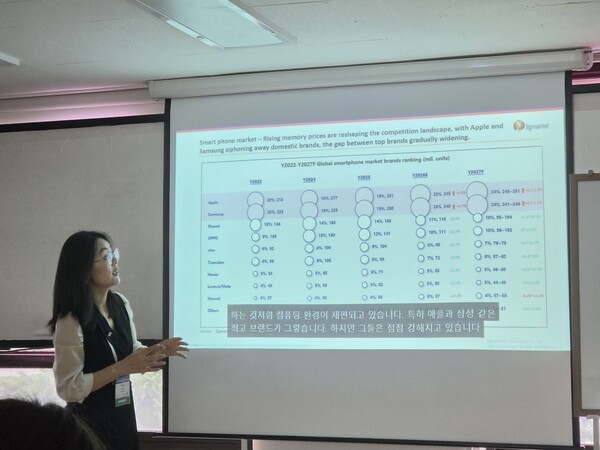
Lisa Lee, CEO of Sigmaintell, speaks during a media briefing held in Gangnam-gu, Seoul, on July 23. (Photo: THE ELEC)

Smartphone makers are expected to expand the use of lower-resolution flexible organic light-emitting diode (OLED) panels in mid- and low-end models as memory prices rise. Rather than reducing OLED adoption, companies are seeking to lower cost pressure by adjusting specifications for components such as memory capacity and display resolution.

Lisa Lee, chief executive officer of market research firm Sigmaintell, said during a media briefing held at the Fastfive shared office in Gangnam-gu, Seoul, on July 23 that "smartphone brands are considering applying flexible OLED displays with slightly lower resolutions to low-end markets." She added that "device makers are looking for ways to reduce costs by combining different specifications."

Smartphone manufacturers are asking component suppliers, including panel and camera makers, to lower prices in order to offset rising memory costs. They are also reviewing adjustments to product configurations, including system-on-chip (SoC) specifications, memory capacity and display resolution.

Sigmaintell said SoCs account for a larger share of smartphone component costs than panels and cameras, meaning manufacturers are likely to restructure the overall cost structure of products rather than seek price reductions from individual components alone. The company said product strategies may differ by segment, with mid- and low-end devices reducing memory capacity or screen resolution while premium models maintain existing specifications.

"Panels and cameras are less expensive than SoCs, limiting the potential for cost reductions," Lee said. "Brand companies are looking for ways to lower costs not only in panels and cameras but also across other components."

Smartphone makers are seeking to maintain OLED adoption partly to reduce the burden on consumers caused by higher prices. Keeping existing specifications unchanged could significantly increase manufacturing costs for budget smartphones, making price increases unavoidable.

Instead of raising prices alone, manufacturers are expected to maintain product competitiveness by offering features that consumers can directly perceive, such as OLED displays. "Even if prices increase, companies will likely provide new features along with the higher price," Lee said. "Applying OLED to new products is one possible approach."

Flexible OLED panels use bendable substrates instead of glass. They have traditionally been used mainly in premium smartphones, but their adoption has expanded into mid-range and budget devices as Chinese panel manufacturers increase supply and panel prices decline.

The smartphone market is expected to contract again next year. Sigmaintell forecasts global smartphone shipments will decline 3.3% to 1.0264 billion units next year from 1.0614 billion units this year. If rising memory prices and weakening demand for budget smartphones intensify, shipments could fall further to 975 million units.

The decline in smartphone demand is expected to continue through the first quarter of next year, with the pace of contraction slowing from the second quarter. The Chinese market is expected to experience a larger decline than the global market due to its higher share of low-end smartphones.

The memory shortage is being driven by rising demand for artificial intelligence (AI) servers. Sigmaintell said consumer memory supply is being reduced as demand for DRAM and high-bandwidth memory (HBM) used in AI servers increases.

Rising memory prices are also expected to affect smartphone shipments by manufacturer. Sigmaintell expects Apple and Samsung Electronics to maintain or expand their market shares due to stable component supply chains, while Chinese smartphone makers with higher exposure to mid- and low-end products will face greater pressure from rising costs.

However, the decline in smartphone sales is not expected to immediately translate into lower demand for OLED panels. Smartphone makers continue to transition products from liquid crystal displays (LCDs) to OLEDs, while adoption of lower-specification flexible OLED panels could increase in mid- and low-end models.

"Even if the overall smartphone market shrinks, the share of flexible OLEDs will continue to expand," Lee said. "In particular, we expect penetration of low-cost flexible OLED products to increase."

  •  

Display Industry Calls for Government Support to Foster Inorganic Light-Emitting Display Sector

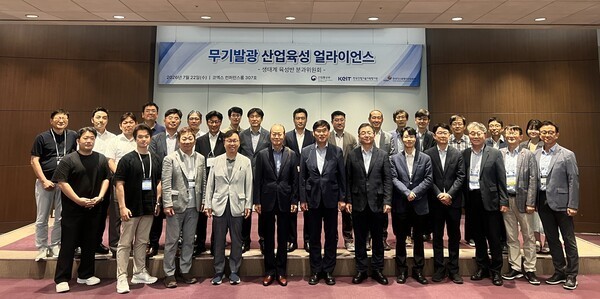
Representatives from 21 member companies pose for a group photo during the 2026 Regular Meeting of the Inorganic Light-Emitting Display Subcommittee at COEX in Seoul on July 22. (Photo: Korea Display Industry Association)

South Korea's display industry has begun formulating policy recommendations to accelerate development of the inorganic light-emitting display industry, including microLED technologies. The proposals will be submitted to the government in October.

The Korea Display Industry Association (KDIA) announced on July 22 that it held the 2026 Regular Meeting of the Inorganic Light-Emitting Display Subcommittee at COEX in Seoul.

The meeting brought together 21 companies spanning materials, components, equipment, panel manufacturing and finished products, including subcommittee chair Seoul Viosys. Participants discussed policy measures needed to expand the market for inorganic light-emitting displays and strengthen the industry's global competitiveness.

Inorganic light-emitting displays use inorganic materials as light-emitting devices and encompass technologies such as microLED, quantum dot (QD) and nanoLED displays. Compared with organic light-emitting diode (OLED) displays, they offer longer operating life and higher brightness. However, commercialization has progressed slowly because of high production costs and the lack of standardized manufacturing technologies.

The South Korean government has operated the Inorganic Light-Emitting Industry Alliance since 2023. In April 2024, it launched the industry subcommittee to collect feedback and address challenges facing companies in the sector.

During the meeting, participants identified industry needs in four key areas: infrastructure and standards, technology development, tax incentives and policy support, and workforce development. They also emphasized the need for government measures to encourage private-sector investment and research and development.

KDIA said it will consolidate the industry's recommendations and submit them as policy proposals at the next meeting of the Inorganic Light-Emitting Industry Alliance, scheduled for October.

In 2025, the government launched a 484 billion won initiative to build an ecosystem for inorganic light-emitting displays. The program aims to strengthen domestic capabilities in core technologies while developing supply chains for materials, components and manufacturing equipment.

Overseas, Taiwan's AUO launched a microLED smartwatch with Garmin in 2025, while Chinese display manufacturers are also expanding production capacity for the technology.

"Inorganic light-emitting displays are a future growth engine that South Korea must secure to maintain its leadership as an unrivaled display powerhouse," said Lee Seung-woo, executive vice president of the Korea Display Industry Association. "The association will serve as a central platform to help the government and industry work together as one team and turn that vision into tangible results."

  •  

LG Display Posts 107.7 Billion Won Operating Loss in Q2, Returns to First-Half Profit

LG Display returned to a cumulative operating profit in the first half despite seasonal weakness and one-off costs related to workforce optimization. (Photo: THE ELEC)

LG Display returned to a cumulative operating profit in the first half of the year despite the seasonal slowdown in demand and one-off costs related to workforce optimization.

The company said on July 22 that it posted revenue of 5.6121 trillion won and an operating loss of 107.7 billion won for the second quarter.

Revenue rose 0.4% from 5.587 trillion won a year earlier. The operating loss narrowed by 8.4 billion won from 116.1 billion won in the second quarter of 2025.

For the first half of the year, LG Display reported cumulative revenue of 11.1461 trillion won and an operating profit of 39.0 billion won. Compared with revenue of 11.6523 trillion won and an operating loss of 82.6 billion won in the same period of 2025, revenue declined 4.3%, while the company returned to profitability. First-half earnings improved by 121.6 billion won year over year.

The first half is typically a seasonally weak period for the display industry as device manufacturers adjust component inventories ahead of new product launches in the second half of the year. The second quarter also included one-off costs related to workforce optimization.

LG Display said it maintained first-half profitability by further strengthening its OLED-centered business structure despite seasonal weakness and one-time expenses. Excluding those one-off factors, the company's core business also remained profitable during the second quarter.

In the second half, LG Display plans to strengthen its competitiveness through technology-driven cost innovation. Beyond simple cost reductions, the company will improve efficiency across development, manufacturing and production by accelerating its AI transformation (AX), further enhancing its business fundamentals.

In its small- and medium-sized display business, LG Display will focus on differentiated technologies to strengthen competitiveness in the high-end segment. The company said its stable technology development and mass-production capabilities will allow it to respond flexibly to changes in market demand.

In the large-sized display business, LG Display aims to reinforce its leadership in the premium market with differentiated technologies and cost-competitive products. As the monitor market continues to shift from liquid crystal display (LCD) to OLED technology, the company plans to expand its lineup of high-value products, including gaming OLED monitors, and increase shipments.

"We will continue improving our full-year performance and further solidify a stable earnings structure by advancing cost innovation and strengthening business competitiveness in the second half," said Kim Sung-hyun, chief financial officer of LG Display.

  •  

LG Display Returns to Underlying Profit in Q2, Analysts See Annual Operating Profit in Mid-1 Trillion Won Range

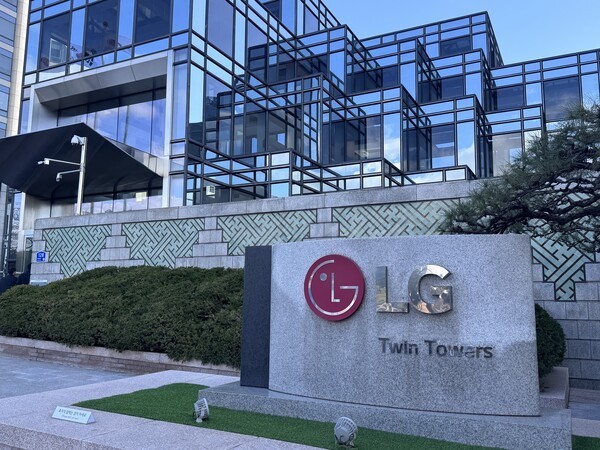
LG Twin Towers in Yeouido, Seoul. (Photo: THE ELEC)

LG Display returned to an underlying operating profit in the second quarter after excluding one-off voluntary retirement costs, reflecting the success of its OLED-focused business restructuring, yield improvements and technology-driven cost reductions. Securities analysts now expect the company to post an operating profit in the mid-1 trillion won range this year.

The company reported second-quarter revenue of 5.6121 trillion won and an operating loss of 108.0 billion won on July 22. Revenue increased 1% from the previous quarter and remained broadly unchanged from a year earlier, while the operating loss narrowed slightly from 116.0 billion won in the second quarter of 2025.

The reported operating loss included approximately 240 billion won in one-off expenses related to workforce optimization, including voluntary retirement programs. Excluding those costs, LG Display generated an operating profit from its core business.

"Over the past four to five years, we consistently recorded operating losses in the second quarter," Kim Sung-hyun, chief financial officer of LG Display, said during the earnings conference call. "The significance of this quarter is that, excluding one-time costs, we have broken out of that structural pattern of second-quarter losses."

For the first half of the year, LG Display posted cumulative revenue of 11.1461 trillion won and an operating profit of 38.7 billion won, compared with an operating loss of 82.9 billion won in the same period of 2025. It marked the company's first first-half operating profit since 2021. Although revenue declined from a year earlier, operating earnings improved by 121.6 billion won.

The results reflect the business transformation strategy championed by Jung Cheol-dong, president and chief executive officer of LG Display. Speaking to reporters after the VIP tour at K-Display 2026 on July 22, Jung said the company is strengthening its profitability by building a more resilient business structure. "We are moving toward establishing a stable earnings structure and improving profitability based on stronger business fundamentals," Jung said. "We expect to deliver solid results in the second half as well."

Jung also emphasized technology-driven cost innovation through new materials, manufacturing methods and production processes. Rather than relying solely on cost-cutting measures, the company aims to lower production costs by enhancing technological competitiveness while delivering differentiated value to customers.

Second-quarter shipment area reached 3.6 million square meters, up 12% from the previous quarter, driven by increased shipments of large-sized products, including TVs and monitors. Revenue per square meter declined 13% to $1,079, reflecting the seasonal slowdown in mobile OLED demand. OLED products accounted for 57% of total revenue.

LG Display expects shipment area to increase by the mid-single-digit percentage range in the third quarter as the mobile OLED business enters its seasonal peak. Revenue per square meter is projected to rise by the high-teens percentage range. Capital expenditures this year are expected to increase modestly to the mid-to-high 2 trillion won range.

The company said it will continue improving profitability in the second half through higher production yields, product portfolio optimization and technology-based cost innovation.

  •  

LG Display CEO Expects Stronger Second Half as Earnings Recovery Continues

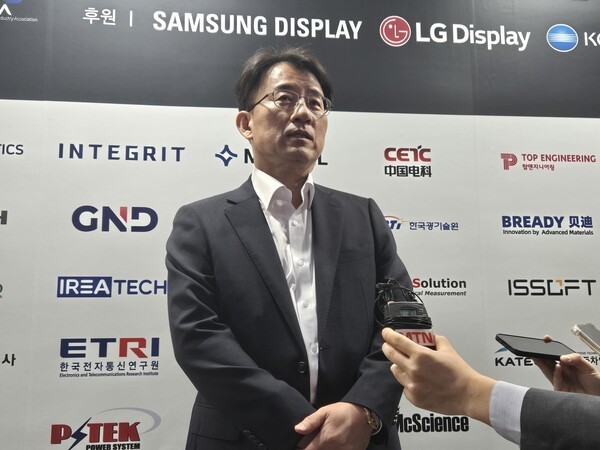
Jeong Cheol-dong, president and chief executive officer of LG Display. (Photo: THE ELEC)

LG Display President and Chief Executive Officer Jeong Cheol-dong said the company expects its performance to improve in the second half of the year, expressing confidence that its earnings recovery will continue after returning to profitability on a first-half basis despite a second-quarter loss.

Speaking to reporters at K-Display 2026 in Seoul on July 22, Jeong said, "Our second-quarter results did not meet market expectations due to one-time costs. However, we expect to achieve better results in the second half than we did in the first."

Earlier in the day, LG Display reported second-quarter revenue of 5.6121 trillion won and an operating loss of 107.7 billion won. Revenue rose 0.4% from 5.587 trillion won a year earlier, while the operating loss narrowed from 116.1 billion won in the second quarter of 2025.

Jeong said the company is focused less on short-term earnings and more on strengthening the long-term fundamentals needed to sustain its business. Employees across all business divisions are working toward the shared goals of enhancing technological competitiveness and delivering greater value to customers, he added.

LG Display is also preparing to expand its tandem OLED technology into smartphones. The company currently uses tandem OLED panels in TVs and IT products and is evaluating broader adoption in mobile devices. For Gen 8.6 OLED, Jeong said LG Display is reviewing multiple technology options and business feasibility but declined to provide specific investment plans or timelines, adding that further details will be disclosed once the technology and business plans are finalized.

The company is also developing next-generation OLED technologies. Asked about future innovations, Jeong said LG Display is preparing a range of OLED technologies, including one internally referred to as "Flip." He declined to elaborate, saying additional details will be announced when appropriate.

Jeong acknowledged that rising memory prices are increasing costs but said the impact remains manageable. He added that the company is addressing the pressure through ongoing cost-improvement initiatives.

LG Display will continue capital investment within the limits of its available financial resources, he said. Asked whether additional one-off costs related to workforce optimization could occur, Jeong said it was too early to provide a definitive answer.

"Everyone in the company is working together as one team, focusing our capabilities on technology and creating value for our customers," Jeong said. "We will continue delivering results that earn our customers' trust and recognition."

  •  

Samsung Display Moves to Resume 67 Trillion Won Asan Campus 2 Investment, Expand OLED Capacity

Lee Chung, president and chief executive officer of Samsung Display. (Photo: THE ELEC)

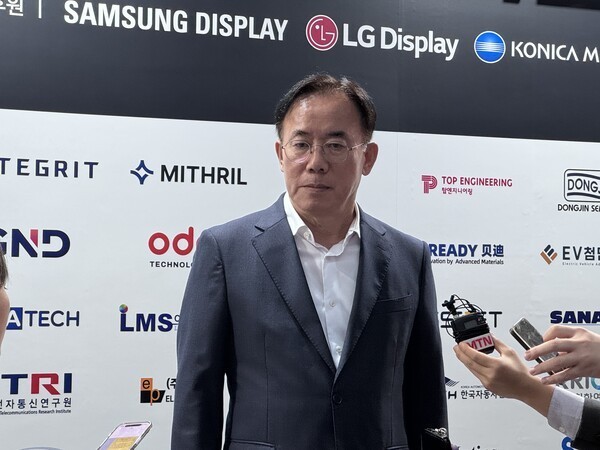
Samsung Display is preparing to resume investment in its Display City Campus 2 in Asan, South Chungcheong Province, reviving a 67 trillion won investment project that forms part of Samsung Group's 140 trillion won investment plan for the Chungcheong region.

Speaking to reporters after a VIP tour at K-Display 2026 at COEX in Seoul on July 22, Lee Chung, president and chief executive officer of Samsung Display, said preparations to restart the Campus 2 project are already underway.

"We are preparing now," Lee said. "It is something we committed to publicly, so we intend to move forward without delay."

Earlier this month, Samsung officially announced plans to invest 140 trillion won in the Chungcheong region. Under the initiative, Samsung Display will invest 67 trillion won in Asan to upgrade its existing manufacturing facilities and construct new organic light-emitting diode (OLED) production lines at Campus 2.

Campus 2 is a separate manufacturing site developed adjacent to Display City Campus 1, where Samsung Display's existing production lines are concentrated in Asan. The company began site development in 2017 but suspended construction in 2020, citing market uncertainty.

Lee also said market conditions for the display industry are expected to remain challenging in the second half of the year. Rising semiconductor prices have increased costs for smartphone and IT device manufacturers, reducing panel demand while intensifying pressure on component suppliers to lower prices.

"Demand for smartphone and IT OLED panels has declined significantly overall," Lee said. "As our customers face a difficult business environment, suppliers of components, including display panels, are also under substantial pricing pressure."

Lee expressed concern over continued investment and capacity expansion by Chinese display makers.

"Chinese companies continue to invest, and we expect their production capacity to keep increasing," he said. "That represents a major challenge for South Korea's display industry."

He added that the Korean display industry must continue leading with OLED technology while preparing next-generation technologies.

"We have maintained global leadership for more than 50 years, and we cannot afford to lose that position," Lee said.

Lee also expressed confidence in Samsung Display's technological leadership in foldable OLED panels.

"Excluding Chinese customers and Chinese panel makers, Samsung Display holds an overwhelming share of the foldable display market," he said. "We believe we remain well ahead in terms of quality, durability and overall display performance."

  •  

Samsung Display, LG Display Stay Profitable in Mobile OLED as Chinese Rivals Remain Deep in the Red

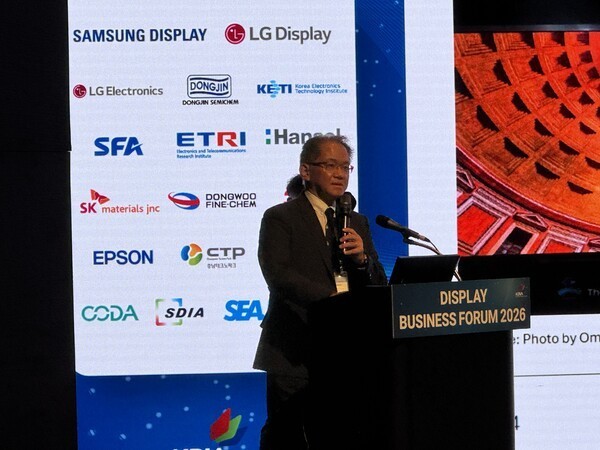
David Hsieh, senior research director at Omdia, speaks on
David Hsieh, senior research director at Omdia, speaks on "OLED Market and Technology Megatrends" at the Display Business Forum 2026 held at COEX in Seoul on July 21. (Photo: THE ELEC)
David Hsieh, senior research director at Omdia, speaks on
David Hsieh, senior research director at Omdia, speaks on "OLED Market and Technology Megatrends" at the Display Business Forum 2026 held at COEX in Seoul on July 21. (Photo: THE ELEC)

Samsung Display and LG Display were the only profitable suppliers in the mobile organic light-emitting diode (OLED) market during the first quarter of 2026, while their Chinese competitors remained heavily loss-making despite rapidly expanding shipments, according to market research firm Omdia.

Speaking at the Display Business Forum 2026 in Seoul on July 21, David Hsieh, senior research director at Omdia, said few companies are generating profits in the mobile OLED business as the industry faces rising investment requirements for next-generation manufacturing technologies.

"There are not many companies that are actually making money in mobile OLED," Hsieh said. "The industry will continue to require substantial investment in equipment, materials and manufacturing processes."

According to Omdia's estimates, Samsung Display posted a 10% operating margin in its mobile OLED business during the first quarter, while LG Display recorded an operating margin of 6%. They were the only profitable companies among the seven panel makers included in the analysis.

All five Chinese manufacturers remained in the red.

TCL CSOT posted an estimated operating margin of -7%, followed by BOE at -8%, Tianma at -15%, Visionox at -33%, and Everdisplay Optronics (EDO) at -43%. The average operating margin across the five Chinese suppliers was -21.2%, while the gap between Samsung Display and Everdisplay Optronics reached 53 percentage points.

In terms of shipments, South Korean and Chinese manufacturers each accounted for roughly half of the global market for small- and medium-sized OLED panels used in smartphones and other mobile devices.

The figures suggest that although Chinese manufacturers have largely caught up with their South Korean rivals in production volume, they continue to trail significantly in profitability.

Chinese panel makers are investing aggressively in advanced OLED technologies for foldable smartphones and other premium mobile devices while simultaneously expanding manufacturing capacity. Omdia said the combination of new capital expenditures and depreciation costs from recently built production lines has prevented higher shipment volumes from translating into stronger earnings.

The slowdown in the smartphone OLED market is adding further pressure.

Although OLED penetration in smartphone displays has already exceeded 50%, Omdia believes the market has begun to peak this year and is entering a period of gradual decline.

"Rising memory prices have contributed to slower market growth, but the bigger challenge is that consumers are replacing their smartphones less frequently," Hsieh said. "In the AI era, consumers may choose to upgrade software, applications or platforms instead of replacing their devices."

  •  

LG Display Brings Tandem OLED to Smartphones, Cuts Display Power Use by 39%

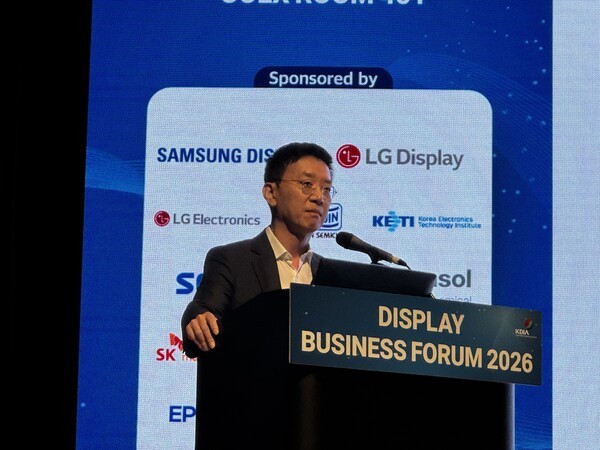
Choi Young-seok, chief technology officer of LG Display, speaks on
Choi Young-seok, chief technology officer of LG Display, speaks on "Tandem OLED Expansion and the Architecture Driving Growth in the AI Era" at the Display Business Forum 2026 held at COEX in Seoul on July 21. (Photo: THE ELEC)
Choi Young-seok, chief technology officer of LG Display, speaks on
Choi Young-seok, chief technology officer of LG Display, speaks on "Tandem OLED Expansion and the Architecture Driving Growth in the AI Era" at the Display Business Forum 2026 held at COEX in Seoul on July 21. (Photo: THE ELEC)

LG Display is extending its tandem OLED technology from TVs, automotive displays and IT products to smartphones, aiming to reduce power consumption as on-device artificial intelligence increases energy demands.

Speaking at the Display Business Forum 2026 in Seoul on July 21, Choi Young-seok, chief technology officer of LG Display, unveiled the company's Advanced Tandem OLED for smartphones.

Tandem OLED stacks multiple organic light-emitting layers to generate light, allowing the display to achieve the same brightness as a conventional single-stack OLED while using less current. The architecture reduces power consumption, extends smartphone battery life and improves panel longevity.

According to LG Display, tandem OLED panels offer more than twice the lifespan of conventional single-stack OLEDs while reducing power consumption by more than 30%. Depending on display usage, power savings can reach up to 60%.

In smartphone testing, display power consumption fell 39%, from 533 milliwatts (mW) to 315 mW. The test was conducted using a 6.7-inch-class display and a screen brightness of 100 nits. Under the same conditions, battery runtime increased from 2.6 hours to 3.9 hours.

LG Display said it developed the smartphone tandem OLED in response to rising power requirements driven by AI features. Running AI workloads directly on smartphones places heavier demands on application processors (APs), neural processing units (NPUs) and memory.

Because smartphone battery capacity is constrained by device size, reducing display power consumption allows more energy to be allocated to AI processing without sacrificing battery life.

LG Display first introduced tandem OLED technology in large OLED TVs in 2013. It later expanded the technology to automotive displays in 2019, followed by notebooks and tablets in 2024.

Its TV panels use multiple organic layers to generate white light, which passes through color filters to produce images. For automotive and IT applications, the company employs an RGB tandem OLED architecture that stacks red, green and blue emissive layers.

The smartphone panel marks LG Display's first application of tandem OLED technology in mobile devices. Commercialization would give the company a tandem OLED portfolio spanning TVs, automotive displays, notebooks, tablets and smartphones.

Competition in smartphone tandem OLED technology is also intensifying. At SID Display Week 2026 in the US in May, Chinese display makers BOE and TCL CSOT both showcased tandem OLED panels.

BOE unveiled a 6.5-inch tandem OLED for smartphones, while TCL CSOT introduced a foldable 18-inch tandem OLED display.

"We will expand tandem OLED technology across our entire product portfolio, from large-sized to small- and medium-sized displays, to meet growing demand for low-power displays in the AI era," Choi said.

  •  

Display Association to Hold K-Display 2026 Career Fair

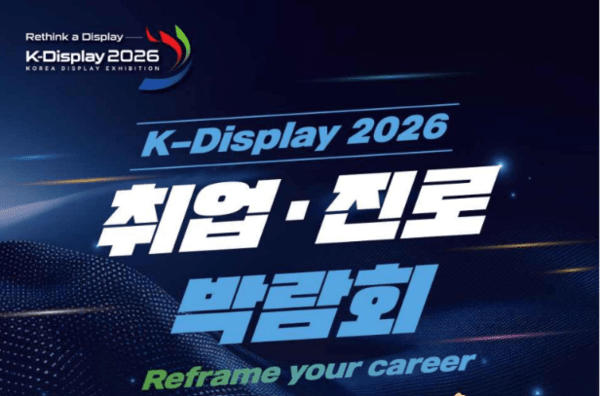
Korea Display Industry Association will hold the K-Display 2026 Career Fair at Hall C of COEX in Seoul from July 22 to 24. (Image: Korea Display Industry Association)

The Korea Display Industry Association (KDIA) announced on July 20 that it will hold the K-Display 2026 Career Fair from July 22 to 24 at Hall C of COEX in Seoul.

The event will bring together 23 display companies, including Samsung Display and LG Display, and provide recruitment consultations, job counseling and career support programs for approximately 900 students and young job seekers.

This year's event expands beyond its traditional recruitment focus by offering both employment and graduate school guidance. A newly established graduate school pavilion will feature 23 research laboratories from nine universities, providing undergraduate students with information on graduate study opportunities. Seven companies will participate in the event for the first time.

The recruitment pavilion will offer pre-arranged meetings between participating companies and job seekers for hiring and career consultations. A career development area will provide rΓ©sumΓ© reviews, job counseling, AI-powered mock interviews, mentoring sessions with industry professionals and professional headshot photography. A career talk concert featuring employees from five companies, including Samsung Display and LG Display, will also be held.

Participants will also be able to join guided tours of the K-Display exhibition and experience display manufacturing processes through extended reality (XR) demonstrations.

Following the event, participating companies will continue to post job openings and accept applications through an online recruitment platform that will remain available through December.

Lee Seung-woo, vice chairman of the Korea Display Industry Association, said he hopes the event will help companies recruit talented employees while providing students with opportunities to pursue both employment and graduate education.

  •  
❌