What if a computer did not rely on electronic chips or tiny transistors, but instead used hundreds of microscopic particles moving through a liquid? That futuristic idea has now become a reality in a laboratory, where researchers have created a completely different kind of computer that performs calculations using the natural movement of tiny particles. […]
Giovanni Kanter goes to at least one art museum whenever he visits a new city. That’s on top of his regular exploration of galleries in New York, where the 25-year-old ICU nurse lives and studies. He typically discovers new artists and gallery openings through word of mouth, though he has recently started curating his social media feed to serve relevant content (he’s currently in what he terms a “surrealism phase”).
He was raised on visual art; he's the son of painter Marianne Gargour and nephew of mixed-media artist Heather Hutchison and painter-printmaker Mark Thomas Kanter. His “exposure-oriented education” featured childhood visits to galleries and shows in and around Dallas, where he grew up, and in France, where he spent time with his grandparents.
But Kanter is an exception. Many other young people have a less immersive artistic education, perhaps shaped by occasional school trips or family visits to museums. If they haven’t internalized an instinct for what Kanter calls “moving through the art and absorbing it,” the museum experience is central to how they learn about and understand art.
In theoretical computer science, the key to cracking tough problems is finding the right tools. Most researchers gravitate toward tools that match the problems they hope to solve, and some devote entire careers to mastering a few familiar techniques. But Shayan Oveis Gharan, a computer scientist at the University of Washington in Seattle, has never been content with the familiar.
Researchers have revealed a microscopic engine that can convert heat into useful work while operating at temperatures only fractions of a degree above absolute zero.
Tinier than a single grain of sand, the machine marks the first demonstration of what researchers call a cyclic quantum heat engine composed of superconducting circuits, the technology behind modern quantum computers.
The findings, led by Academy Professor Mikko Möttönen, were published in Nature Communications.
A Sand-Grain-Sized Quantum Heat Engine
The tiny device, developed by researchers at Aalto University in Finland, relies on a single superconducting qubit, which represents the quantum world equivalent of a classical computer bit.
By heating, cooling, and extracting energy through quantum variations of the cycles that provide power to conventional engines by thermodynamic means, researchers say the machine’s demonstration of producing energy, while extremely small, marks a breakthrough that could one day allow for the simplification of much larger-scale quantum computers.
In the image above, a microscopic image of the sample is shown along with an added circuit diagram of the microwave drive and readout lines (Image Credit: Möttönen, et al, Nature Communications)
A flux-tunable transmon qubit—one of the most common building blocks of superconducting quantum processors—lies at the heart of the innovation. But as opposed to relying on separate hot and cold reservoirs, the Möttönen and the Aalto University research team used a single quantum circuit refrigerator capable of performing both roles.
The team guided the system through a sort of quantum version of what is known as an Otto cycle (the same essential process most gasoline engines employ) by leveraging precise control of the refrigerator and the qubit’s energy levels.
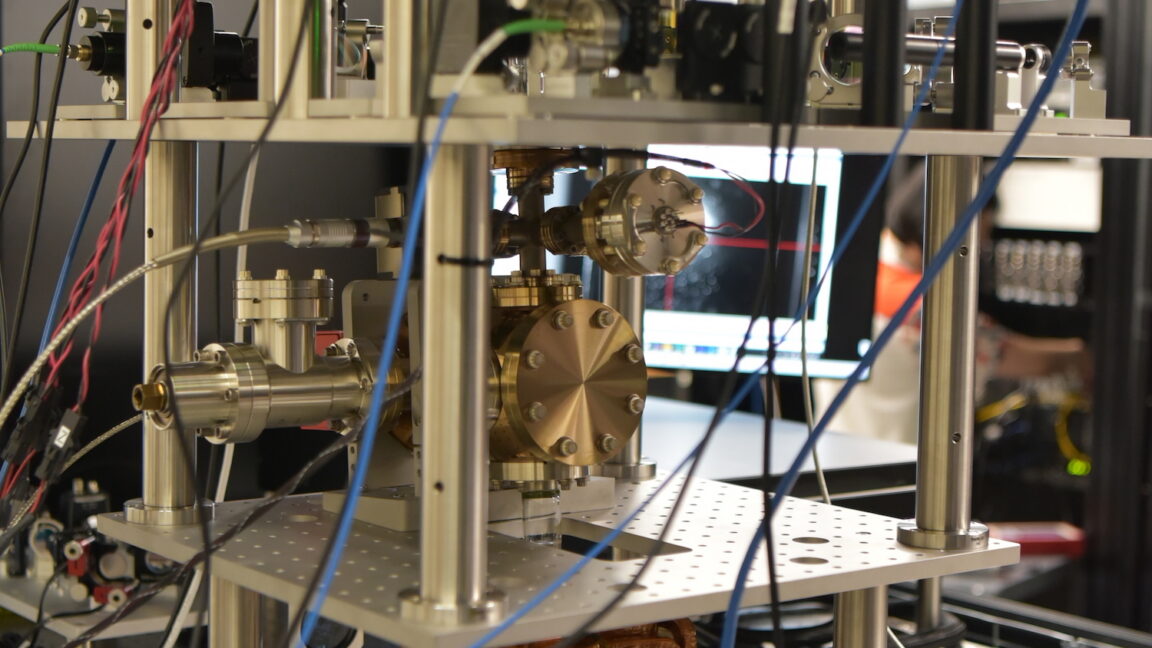
“In our experiment, we built a nanofabricated heat engine using superconducting circuits and operated it in a cryostat near absolute zero,” said lead author Tuomas Uusnäkki. “At its heart is a transmon qubit, one of the basic building blocks of modern quantum technologies.”
Single Shot Measurements on Repeat
The team also used repeated single-shot measurements to track the qubit, observing as it completed several engine cycles. This helped them calculate precisely how much heat was absorbed, as well as the amount of work produced, and the machine’s overall efficiency.
The results, they say, closely matched theoretical predictions, and now help to confirm that the device functioned as a genuine cyclic quantum heat engine.
Although this is not the first quantum heat engine, and previous demonstrations have been achieved using trapped ions, ultracold atoms, and other quantum systems, the Aalto team says this is the first that operates using superconducting circuits, which could present new possibilities for the future of quantum computing.
As quantum computers grow, such technologies could be especially helpful, since today’s superconducting processors rely on extensive networks of microwave cables connecting room-temperature electronics with processors that operate near absolute zero—the lowest temperature theoretically attainable.
These networks of cabling not only take up space, but also add to costs, while adding to the overall heat and electrical noise in systems that can also introduce interference affecting fragile quantum states.
A Look at the Future of Quantum Computing
With future refinements of their technology, the Aalto team hopes versions of their tiny engine may be able to perform control functions directly within cryogenic quantum processors, thereby reducing the need for external wiring altogether.
“Finland’s Quantum Technology Strategy envisions a quantum computer with one thousand logical qubits by 2035, which probably means hundreds of thousands of physical qubits,” Möttönen said in a statement, describing future large-scale quantum computers.
“Doing that with current technology requires millions of microwave cables costing thousands of euros each,” he added.
“The cables also introduce noise into the system,” Möttönen said. “Using autonomous devices instead would mostly eliminate the need for those cables.”
Micah Hanks is the Editor-in-Chief and Co-Founder of The Debrief. A longtime reporter on science, defense, and technology with a focus on space and astronomy, he can be reached atmicah@thedebrief.org. Follow him on X @MicahHanks, and at micahhanks.com.
There are some obvious big picture issues that stand between us and useful quantum computing. Issues like whether we can make enough high-quality hardware qubits to connect into the error-corrected logical qubits we need, and how we generate the states needed to perform universal computation on those logical qubits. But there are also many less prominent challenges that will need to be solved before we can perform calculations.
One of those challenges, which only affects some types of hardware, is calibration. For devices we manufacture, like superconducting qubits, there are always subtle variations among individual qubits. (This is not true when we use something like an atom to hold the qubit, but the lasers that control them can drift.) As a result, this hardware is put through a process called calibration, where we test different frequencies and amplitudes of the microwave pulses that control them to find the combination that produces the lowest error rates, and then save those settings for use in calculations.
However, you can't perform the typical calibration process while you're doing calculations, which means drift becomes an issue for long and complicated algorithms. Google, though, has figured out that it's possible to do calibration using the same data that's used for error correction.
Researchers at the Massachusetts Institute of Technology (MIT) have developed an ultra-efficient computer chip that could help tiny robots and lightweight devices create detailed 3D maps of their surroundings while using very little energy. The new chip could allow small drones to fly through narrow spaces, such as air-conditioning ducts or industrial pipelines, to inspect […]
Artificial intelligence is becoming increasingly important in businesses, helping employees search through large amounts of documents and answer complex questions. However, one major problem still limits the use of AI in many industries: hallucinations. An AI hallucination happens when a system generates information that sounds convincing but is actually wrong. This can be a serious […]
Most of us experience data by looking at screens filled with charts, graphs and numbers. But what if you could actually feel your data instead of just seeing it? Researchers at the University of Adelaide have developed an experimental wearable glove called ThermoPhy that turns information into physical sensations. The glove uses heat, touch and […]
Researchers have developed a new artificial intelligence (AI) system that can predict robberies and other crimes more accurately than several existing methods. By studying where crimes happen, when they occur and broader social patterns, the system achieved an accuracy rate of 86.3% when forecasting robberies in several U.S. cities. Predicting crime is extremely challenging because […]
More than 1.5 billion people around the world are expected to watch the 2026 FIFA World Cup finals. With so many fans carefully watching every pass, tackle and goal, referees are under enormous pressure to make the right decisions. To help them, FIFA is using advanced artificial intelligence and computer vision technology to improve the […]
Artificial intelligence is increasingly being used to see and understand the world around us. From facial recognition on smartphones to self-driving cars and humanoid robots, computer vision has become one of the most important technologies in modern AI. Now, researchers from the Korea Advanced Institute of Science and Technology (KAIST), working with scientists from the […]
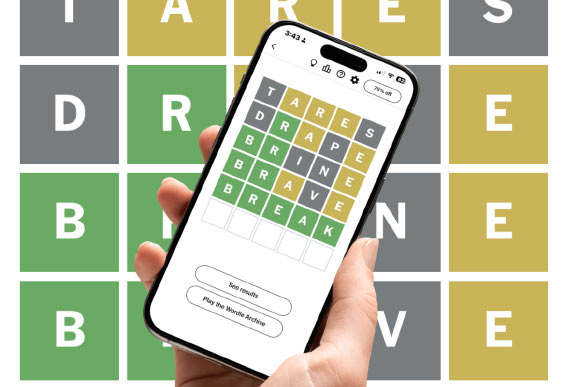
Researchers at Binghamton University have applied a 70-year-old theory of information to the viral word game Wordle, revealing how a carefully chosen first guess can dramatically improve a player’s chances of solving the puzzle.
Researchers at Oregon State University have developed a new light-sensitive electronic device that works more like the human brain. The innovation could lead to artificial intelligence systems that process information faster while using much less electricity. The new device, described in the journal Advanced Functional Materials, combines three important functions into a single component: it […]
Researchers have developed a tiny chip that could help cameras and sensors see details that are normally invisible to both people and standard imaging systems. The international study, led by Zhejiang University in collaboration with RMIT University in Australia, demonstrates a new way to build advanced light-analysis capabilities directly into camera hardware. The technology could […]
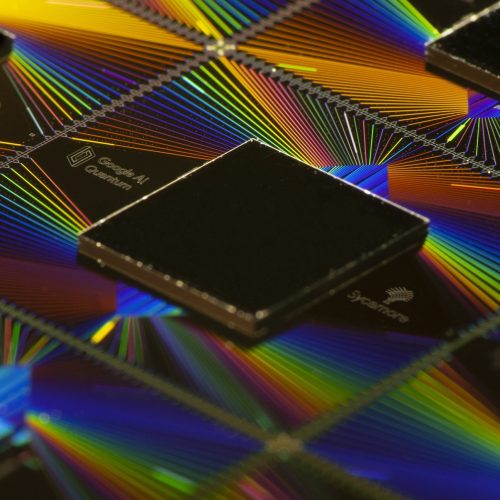
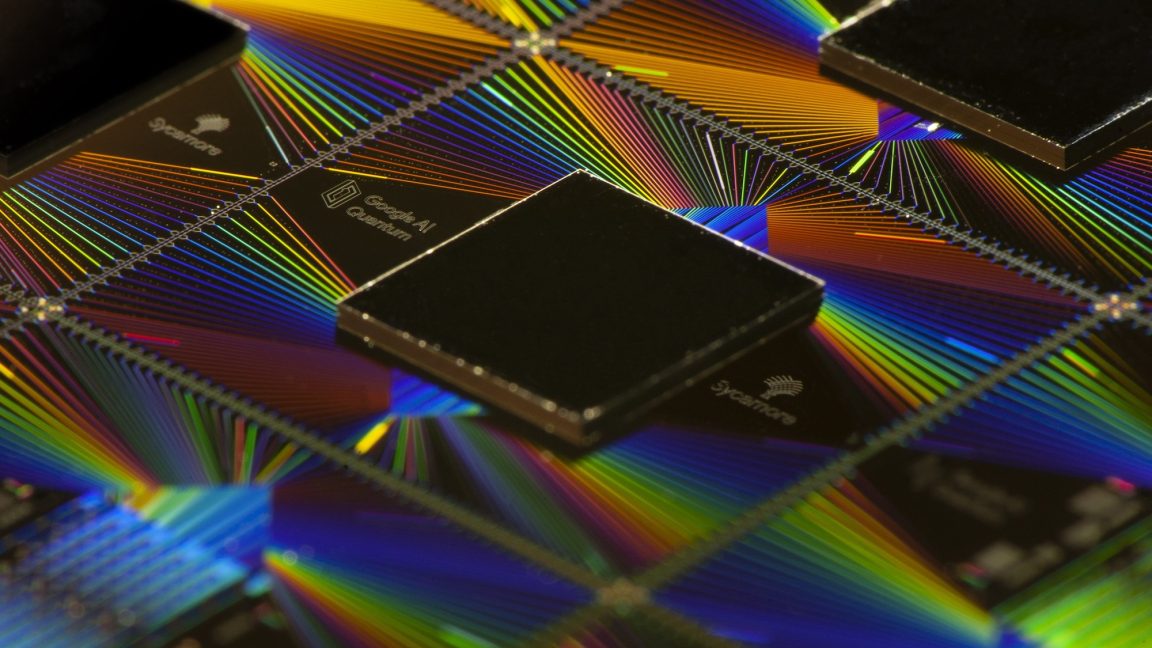
Quantum computing news usually picks up near the end of the year, as companies try to provide evidence that they are hitting benchmarks on time. However, there have been interesting announcements as the summer starts this year, from incremental progress to attention-grabbing promises. As we did earlier this month, Ars has a rundown of some of the most significant announcements.
These include a promise of useful, error-corrected quantum computing as soon as 2028, details on an updated trapped ion processor, and a case in which claims of quantum supremacy have been cut back a bit thanks to advances in more traditional algorithms.
2028 is remarkably soon
Many people in the field expect that useful quantum computers are still about five to 10 years away. While there may be a few useful algorithms that can be run on existing error-prone hardware, almost all of the interesting problems that quantum computing can be applied to will require some form of error correction enabled by linking a small collection of hardware qubits together into what's called a logical qubit. Logical qubits include the redundant storage of information along with neighboring qubits that can be measured to determine when errors occur and how to fix them.
Artificial intelligence is transforming the world, but it also comes with a growing energy problem. Modern AI systems require enormous computing power, and the powerful chips that perform these calculations generate huge amounts of heat. Keeping these chips cool has become one of the biggest challenges facing the technology industry. Researchers at the Korea Advanced […]
Watching a seabird burst out of the ocean or a mobula ray launch itself into the air makes the transition from water to sky seem effortless. For drones, however, performing the same maneuver is extremely difficult. Researchers at the University of Central Florida (UCF) are now studying how to make this challenging transition smoother and […]
Self-driving cars and advanced robots rely on cameras, sensors, and artificial intelligence to understand the world around them. However, these systems often struggle when lighting conditions change quickly or when bright and dark areas appear at the same time. A new study may offer a solution. Researchers have developed an artificial vision system inspired by […]

 Login