❌

Reading view

Natural Plant Compound Could Fight Rheumatoid Arthritis

Rheumatoid arthritis is a long-term autoimmune disease in which the immune system mistakenly attacks healthy joints. This causes pain, swelling, stiffness, and gradual damage that can make everyday activities difficult. Although modern medicines help many people, some patients do not respond well or develop unwanted side effects, creating a need for better treatments. A new […]

The post Natural Plant Compound Could Fight Rheumatoid Arthritis appeared first on Knowridge Science Report.

  •  

Migraine Headaches with Aura May Raise Stroke Risk in Older People

Migraines are far more than ordinary headaches. Many people experience severe throbbing pain, nausea, and sensitivity to light and sound that can last for hours or even days. Some people also experience an aura before the headache begins, which may include flashing lights, blurry vision, zigzag lines, or tingling sensations. A new study suggests that […]

The post Migraine Headaches with Aura May Raise Stroke Risk in Older People appeared first on Knowridge Science Report.

  •  

Nuclear Energy Revival Puts Westinghouse in Prime Position

The company, which filed for bankruptcy protection in 2017, stands to benefit from growing support for nuclear power and President Trump’s deal with Saudi Arabia.

© Mike Stewart/Associated Press

Cooling towers at the nuclear reactor facility at the Alvin W. Vogtle Electric Generating Plant in Waynesboro, Ga.
  •  

Tech layoffs: A 2026 timeline

Among a range of factors leading to a wave of tech sector layoffs in 2026 is the rapid rise of artificial intelligence and automation. Companies are reconfiguring their workforces to leverage AI for increased efficiency and reduced operating costs. This realignment and reduction is implemented even by companies reporting strong financial performance.

But it’s not just AI leading to workforce cuts. Complementing this technological shift are ongoing economic uncertainty, inflation, and higher interest rates, compounded by a chip shortage and rising energy costs. This mix is driving companies to cut costs and streamline operations for increased efficiency.

According to data compiled by Layoffs.fyi, an online tracker that keep tabs on job losses in the technology sector, 123,941 tech employees were laid off at 269 companies in 2025. The site also reports that 71,981 government employees were laid off by DOGE alone, with 182,528 total federal workers laid off.

Here is a list — to be updated regularly — of some of the most prominent technology layoffs the industry has experienced recently.

Notable tech layoffs in 2026

  • Monday.com
  • Microsoft
  • Meta
  • Cisco
  • Cloudflare
  • Oracle
  • Atlassian
  • Salesforce
  • Amazon
  • Ericsson

July 22, 2026: Monday.com cuts 20% of its workforce to restructure for the AI era

The company says the decision to cut 620 jobs isn’t about margins, but about creating a flatter organization built around AI agents, autonomous teams, and deeper customer engagement.

July 6, 2026: Microsoft cuts 4,800 jobs, primarily in sales and Xbox teams

As the company trims thousands of jobs, it’s also investing in embedded engineering teams and AI infrastructure. The layoffs come several weeks after the company offered 8,750 US employees voluntary retirement buyouts.

June 5, 2026: Tech industry cut 38,242 jobs in May, worst since 2024

AI was blamed for 40% of the job cuts in May, up from 7% in January, according to research by employment placement company Challenger, Gray & Christmas.

May 20, 2026: Meta cuts 8,000 jobs, around 10% of workforce

The cuts are expected to expected to hit Meta’s engineering and product teams the hardest, arriving as Meta pivots toward AI to boost efficiency across its organization, according to Yahoo Tech.

May 13, 2026: Cisco to cut nearly 4,000 jobs despite strong growth in AI, enterprise networking

Despite reporting positive financial news — including record third-quarter revenue of $15.8 billion, a 12% year-over-year increase — Cisco said it will eliminate almost 4,000 jobs.

May 7, 2026: Cloudflare to cut 1,100 jobs in AI-focused restructuring

About 20% of Cloudflare’s global workforce will be culled as the company pivots for the agentic AI era, Reuters reported.

April 1, 2026: Oracle to cut up to 30,000 jobs globally, putting enterprise support and roadmaps at risk

Oracle began laying off employees on March 31 in what could be the largest workforce reduction in the company’s history. Employees received termination emails at 6 a.m. local time with immediate system lockouts and no prior warning. (Note: in June, CNBC put the final layoff tally at 21,000.)

March 12, 2026: Atlassian cuts 1,600 jobs to fund AI and enterprise expansion

Atlassian will reduce its global workforce by approximately 10%, eliminating around 1,600 roles, as the collaboration software maker redirects capital toward artificial intelligence development and enterprise sales.

March 11, 2026: Tech layoffs surpass 45,000 in early 2026

A recent analysis by RationalFX found 45,363 job cuts globally so far this year—with roughly 68% or more than 30,000 occurring in the U.S. — highlighting ongoing workforce cuts even as many tech companies report strong revenue growth.

February 10, 2026: Salesforce lays off staffers as executive leadership churn continues

Salesforce has reduced close to 1,000 roles earlier this month across teams, including marketing, product management, data analytics, and its Agentforce AI unit, Business Insider reported, quoting employees familiar with the matter.

January 23, 2026: Amazon layoffs expected to disproportionately hit AWS and tech talent

As the market slows down, AWS and other Amazon units are preparing for another round of layoffs, which is expected to overwhelmingly impact tech talent. An email from HR leader Beth Galetti on Jan. 28 confirmed 16,000 job cuts.

January 15, 2026: Ericsson plans to shed 1,600 jobs in Sweden

 Ericsson lans to cut some 1,600 jobs in Sweden, the telecommunications equipment maker said doubling down on recent cost-saving measures that have helped it weather a prolonged downturn in telecoms spending, Reuters reports.

January 13, 2026: Meta plans to cut around 10% of employees in Reality Labs business

Meta plans to cut around 10% of the employees in its Reality Labs division who work on products including the metaverse, according to three people with knowledge of the discussions, according to The New York Times.

Layoffs in 2025

  • Cisco
  • Oracle
  • Windsurf
  • Intel
  • Microsoft
  • Crowdstrike
  • HPE
  • Autodesk
  • HPE
  • CISA
  • Workday
  • Salesforce
  • Meta

Global tech-sector layoffs surpass 244,000 in 2025

Economic uncertainty, elevated interest rates, and AI adoption have driven workforce reductions across tech companies worldwide, according to a RationalFX report.

October 28, 2025: Amazon to cut 14,000 jobs across company

Amazon will reduce its overall workforce by 14,000, cutting layers of management across the company and hiring in some areas to support its “biggest bets”.

August 18, 2025: Cisco and Oracle to cut hundreds of Bay Area jobs

Tech companies Cisco and Oracle are cutting hundreds of jobs across the Bay Area. Cisco will eliminate 221 positions at its Milpitas and San Francisco offices, effective Oct. 13. Oracle is reducing 101 positions in Santa Clara on the same date 

August 5, 2025: 3 weeks after acquiring Windsurf, Cognition offers staff the exit door

Cognition, the AI coding startup that acquired rival company Windsurf three weeks ago, laid off 30 employees last week and is offering buyouts to the roughly 200 remaining employees on the team, reports The Information.

July 25, 2025, Intel to lay off 22% of workforce, CEO Tan signals ‘no more blank checks’

Intel will reduce its workforce to 75,000 employees by the end of 2025 as new CEO Lip-Bu Tan implements sweeping changes designed to transform the struggling chipmaker

July 8, 2025, Intel layoffs begin: Chipmaker is cutting many thousands of jobs

Intel has begun laying off employees across the company. CEO Lip-Bu Tan told workers back in April to expect major layoffs at Intel in the coming months as the chipmaker slashes costs and overhauls its organization after years of technical setbacks and falling sales.

July 2, 2025: Microsoft will cut 9,000 workers

Microsoft will lay off about 9,000 employees, a source familiar with the workforce cut told CNBC.  The cuts will reportedly affect less than 4% of Microsoft’s global workforce and will impact different teams, geographies and levels of experience. This is the latest in a string of cuts the tech giant has made this year.

June 17, 2025: Intel looks to factory layoffs to return to profitability

Intel will lay off up to 20% of its manufacturing sector employees starting in July, according to media reports, as the company looks for options as it seeks a return to profitability. The cuts reportedly will be made around the world, but some of the layoffs will be closer to home, according to a report in The Oregonian citing an internal company memo from Intel manufacturing Vice President Naga Chandrasekaran.

May 7, 2025: CrowdStrike to lay off 5% of staff

CrowdStrike announced a plan to cut about 500 roles, roughly 5% of its workforce, to streamline operations and reduce costs. The cybersecurity company will incur about $36 million to $53 million in charges related to the layoffs

March 6, 2025: HPE cuts 2,500 jobs, remains committed to Juniper buy

CEO Antonio Neri told Wall Street analysts that HPE would begin implementing a cost-cutting program involving layoffs of about 2,500 employees over the next 18 months. HPE employs about 61,000 people worldwide.

Feb. 27, 2025: Autodesk to lay off 9% of workforce

Software maker Autodesk is laying off 1,350 staff. With the rise of subscription and multi-year contracts billed annually, and self-service enablement, it finds it needs fewer sales staff, CEO Andrew Anagnost said in a message to employees. And with its cloud, platform, and AI products proving most profitable, it’s concentrating its staff and investments there.

Feb. 27, 2025: HP to lay off 2,000 more

As part of an ongoing restructuring, HP plans to lay off up to another 2,000 workers. In recent weeks, the company has tried — unsuccessfully — to do away with telephone support staff by forcing callers to wait for at least 15 minutes if they refuse to use self-service support resources online. The company swiftly backtracked, but wider job cuts are still on.

Feb. 21, 2025: CISA lays off 130

Government employees get laid off too: In this case, 130 workers at the US Cybersecurity and Infrastructure Security Agency are being shown the door as a result of a DOGE decision. Cybersecurity experts are concerned that the cuts will harm the international collaborations that CISA has fostered, quite apart from their concerns about the security of the DOGE layoff process itself.

Feb. 5, 2025: Workday lays off 1,750

As it moves to invest more in AI and international growth, Workday is laying off 8.5% of its workforce and disposing of unused office space. Some analysts fear the cutbacks will affect the company’s customer service — unless AI can pick up the slack.

Feb. 4, 2025: Salesforce lays off over 1,000

At the same time as it’s hiring sales staff for its new artificial intelligence products, Salesforce is laying off over 1,000 workers across the company, according to Bloomberg. As of June, 2024, the company had over 72,000 employees, according to its website. Salesforce did not comment on the report. In 2024 the company reportedly laid off around 1,000 staff too, in two waves: January and July.

Jan. 14, 2025: Meta will lay off 5% of workforce

Mark Zuckerberg told Meta employees he intended to “move out the low performers faster” in an internal memo reported by Bloomberg. The memo announced that the company will lay off 5% of its staff, or around 3,600 staff, beginning Feb. 10. The company had already reduced its headcount by 5% in 2024 through natural attrition, the memo said. Among those leaving the company will be staff previously responsible for fact checking of posts on its social media platforms in the US, as the company begins relying on its users to police content.

Tech layoffs in 2024

  • Equinix
  • AMD
  • Freshworks
  • Cisco
  • General Motors
  • Intel
  • OpenText
  • Microsoft
  • AWS
  • Dell

Nov. 26, 2024: Equinix to cut 3% of staff

Despite intense demand for its data center capacity, Equinix is planning to lay off 3% of its workforce, or around 400 employees. The announcement followed the appointment of Adaire Fox-Martin to replace Charles Meyers as CEO and the departures of two other senior executives, CIO Milind Wagle and CISO Michael Montoya.

Nov. 13, 2024: AMD to cut 4% of workforce

AMD will lay off around 1,000 employees as it pivots towards developing AI-focused chips, it said. The move came as a surprise to staff, as the company also reported strong quarterly earnings.

Nov. 7, 2024: Freshworks lays off 660

Enterprise software vendor Freshworks laid off around 660 staff, or around 13% of its headcount, despite reporting increased revenue and profits in its fourth fiscal quarter. The company described the layoffs as a realignment of its global workforce.

Sept. 17, 2024: Cisco lays off 6,000

After laying off around 4,200 staff in February, Cisco is at it again, laying off another 6,000 or around 7% of its workforce. Among the divisions affected were its threat intelligence unit, Talos Security.

Aug. 20, 2024: General Motors lays off 1,000 software staff

More than 1,000 software and services staff are on the way out at General Motors, signalling that it could be rethinking its digital transformation strategy. In an internal memo, the company said that it was moving resources to its highest-priority work and flattening hierarchies.

August 1, 2024: Intel removes 15,000 roles

Intel plans to cut its workforce by around 15% to reduce costs after a disastrous second quarter. Revenue for the three months to June 29 stagnated at around $12.8 billion, but net income fell 85% to $83 million, prompting CEO Pat Gelsinger to bring forward a company-wide meeting in order to announce that 15,000 staff would lose their jobs. “This is an incredibly hard day for Intel as we are making some of the most consequential changes in our company’s history,” Gelsinger wrote in an email to staff, continuing: “Our revenues have not grown as expected — and we’ve yet to fully benefit from powerful trends, like AI. Our costs are too high, our margins are too low. We need bolder actions to address both — particularly given our financial results and outlook for the second half of 2024, which is tougher than previously expected.”

July 4, 2024: OpenText to lay off 1,200

OpenText said it will lay off 1,200 staff, or about 1.7% of its workforce, in a bid to save around $100 million annually. It plans to hire new sales and engineering staff in other areas in 2025, it said.

June 4, 2024: Microsoft lays off staff in Azure division

Microsoft laid off staff in several teams supporting its cloud services, including Azure for Operations and Mission Engineering. The company didn’t say exactly how many staff were leaving.

April 4, 2024: Amazon downsizes AWS in a fresh cost-cutting round

Amazon announced hundreds of layoffs in the sales and marketing teams of its AWS cloud services division — and also in the technology development teams for its physical retail stores, as it stepped back from efforts to generalize the “Just Walk Out” technology built for its Amazon Fresh grocery stores.

April 1, 2024: Dell acknowledges 13,000 job cuts

Dell Technologies’ latest 10K filing with the US Securities and Exchange Commission disclosed that the company had laid off 13,000 employees over the course of the 2023 fiscal year; it characterized the layoffs and other reorganizational moves as cost-cutting measures. “These actions resulted in a reduction in our overall headcount,” the company said. A comparison to the previous year’s 10K filing, performed by The Register, found that Dell employed 133,000 people at that point, compared to 120,000 as of February 2024. Dell announced layoffs of 6,650 staffers on Feb. 6, but it is unclear whether those cuts were reflected in the numbers from this year’s 10K statement.

See news of earlier layoffs.

  •  

Oracle’s July update fixes ten 10.0 vulnerabilities in Fusion Middleware

Oracle’s July 2026 Critical Patch Update, its largest ever, contains 1,449 new security patches spanning 32 product families, from Oracle Database and E-Business Suite to PeopleSoft, GoldenGate, Java SE, and Fusion Middleware.

Fusion Middleware was particularly hard hit, with new security patches for 355 security vulnerabilities, 219 of them remotely exploitable without authentication, meaning they can be exploited over a network without requiring user credentials. Ten of them scored a “perfect” 10.0 on the Common Vulnerability Scoring System (CVSS).

These included easily exploitable vulnerabilities allowing unauthenticated attackers with network access via HTTP to compromise Oracle Data Integrator, Oracle Access Manager, Oracle HTTP Server, Oracle Platform Security for Java, Oracle WebCenter Content, Service Delivery Platform, or Oracle Weblogic Server Proxy Plug-in,

No other products were found to have quite such extreme vulnerabilities, but there were plenty of others scoring almost as badly.

Two critical flaws in Oracle Database Server

The most severe flaw Oracle patched in its flagship database product is CVE-2026-61211, a vulnerability in the RDBMS component’s DBMS_CLOUD package with a CVSS score of 9.9.

This easily exploitable vulnerability allows a low-privileged attacker having Execute DBMS_CLOUD privilege with network access via Oracle Net to compromise the RDBMS, Oracle said in the patch update statement. “While the vulnerability is in RDBMS, attacks may significantly impact additional products (scope change). Successful attacks of this vulnerability can result in takeover of RDBMS,” it warned.

The flaw affects Database Server versions 19.3 through 19.31 and 23.4.0 through 23.26.2.

Sanchit Vir Gogia, chief analyst at Greyhound Research, said the 9.9 score should be read as serious but conditional. Exposure depends on configuration, he said: On customer-managed databases, DBMS_CLOUD is absent until installed, and grants and network access lists determine the radius from there. “Where DBMS_CLOUD is broadly granted and reachable, the emergency is real and the window is seventy-two hours; where it is absent, the accelerated database wave will do.”

Vibhum Dubey, a cybersecurity researcher and red teamer, said the flaw stood out to him because it checks several boxes that concern defenders.

“Database servers often hold an organization’s most valuable data, so even if exploitation is not publicly observed yet, I don’t think this is the kind of issue you leave until the next routine maintenance window if your environment is exposed,” Dubey said.

A second Database Server flaw, CVE-2026-47040, affects Connection Manager in Oracle Net Services, is remotely exploitable without credentials. Oracle’s risk matrix lists six Database Product vulnerabilities in this cycle as reachable over a network with no authentication required, the statement added.

CVE-2026-7383, an OpenSSL-related TLS vulnerability, affects two products, Database Server and Autonomous Health Framework, since both bundle the same third-party component. Oracle’s advisory notes the Database Server patch for that CVE also resolves 19 related OpenSSL CVEs bundled into the same fix.

Oracle GoldenGate received 27 new patches, nine of which do not require authentication to exploit, including CVE-2026-2332, a flaw in the Big Data and Application Adapters component tied to Eclipse Jetty, the statement added.

There were also two critical flaws in Oracle’s TimesTen in-memory database.

The remainder of the release spans E-Business Suite, WebLogic Server, PeopleSoft, Siebel, JD Edwards, Communications, Retail Applications, Utilities Applications, MySQL, Solaris and VM VirtualBox.

Volume repair

Gogia said the volume itself marks a shift.

“At 1,449 patches, against 481 in April 2026 and 309 a year earlier, patch load has outgrown the queue built to hold it,” he said. He recommended a tiered response: “The reachable and the reported inside seventy-two hours, the trusted core inside ten days, the rest by risk before the October release.”

He also flagged a specific risk in how organizations might triage E-Business Suite. “Oracle’s advisory concedes that E-Business Suite exposure sits partly in underlying Database and Fusion Middleware versions outside the E-Business Suite matrix. The fastest way to mis-prioritise this release is to patch by product logo instead of trust boundary.”

Third Tuesday, quarterly cycle

The July release is the third quarterly Critical Patch Update of 2026, and the first since the introduction in May of the monthly Critical Security Patch Update program.

Gogia said Oracle has effectively layered a second cadence on top of the existing one rather than replacing it.

“Quarterly Critical Patch Updates remain and stay cumulative; monthly Critical Security Patch Updates now sit on top,” he said, adding that enterprise adoption of the new rhythm remains low because of “certification obligations, regression exposure and scarce specialist hours.”

Dubey made a similar point about organizational readiness: “In large enterprises, patching is rarely a technical problem. It is an operational one. Database administrators, application owners, infrastructure teams, business stakeholders, and change advisory boards all have to align.”

Niyati Daftary, principal analyst at Gartner, said the release underscores a broader shift in how patching is approached.

“Patching is no longer a race to remediate every vulnerability. It is a discipline of identifying the exposures that matter most and reducing business risk as efficiently as possible,” she said, adding that organizations should prioritize based on exposure, business impact and exploitability, starting with internet-facing assets and mission-critical systems.

Daftary pointed to continuous threat exposure management and adversarial exposure validation as increasingly relevant frameworks, since CVSS scores “measure theoretical severity rather than actual enterprise risk.” Patching alone will not be sufficient, Daftary said, and organizations should continue investing in defense in depth, including behavioral threat detection and incident response.

Oracle’s next cumulative Critical Patch Update will come on Oct. 20, 2026, with smaller Critical Security Patch Updates on Aug. 18 and Sept. 15.

This article first appeared on CSO.

  •  

Oracle expands Cloud@Customer with new database service for mid-sized workloads

Oracle is expanding its Cloud@Customer on-premises portfolio with a managed database offering that it says will enable enterprises to run databases, applications, and AI agents in their own data centers, helping CIOs modernize mid-sized workloads while meeting data residency, regulatory, and low-latency requirements.

The hybrid cloud offering, Base Database Cloud@Customer, combines existing database and infrastructure services such as the Base Database Service and Data Infrastructure Cloud@Customer X11 platform. It is designed for enterprises that do not need the scale of Exadata Cloud@Customer but still want their infrastructure and AI capabilities on-premises, managed by Oracle, the company said.

The Cloud@Customer X11 platform itself consists of two Oracle X11 compute servers and shared all-flash storage, offering up to 60 usable processor cores and 660 GB of memory per server, 47.2 TB of storage, and 10/25 GbE networking.

For regulated industries or restricted connectivity

Analysts see the new offering filling a gap for enterprises that want the operational and economic benefits of the cloud but cannot send their data to a public cloud because of legal restrictions or technology limitations.

These enterprises, according to Ashish Chaturvedi, executive research leader at HFS Research, are likely to be in regulated industries such as financial services, healthcare, government, and defense that must comply with data residency requirements, or needing low-latency access from remote sites to operational databases.

The offering could also appeal to enterprises modernizing mid-sized workloads at remote locations or within individual business units that could never justify the investment in a full Exadata rack, said Amit Chandak, chief analytics officer at IT consulting firm Kanerika.

In all cases, Chaturvedi said, the appeal of the offering is its managed nature, which takes away the burden of looking after the underlying infrastructure.

Deployment and maintenance becomes easier too, said Michael Leone, principal analyst at Moor Strategy and Insights: “They get automation that mid-size teams rarely have the staff to build. Clustering, patching, standby databases, and backups arrive configured instead of hand-assembled because the offering is managed.”

The economics are equally compelling, Chaturvedi said. The pay-as-you-go pricing model, combined with online compute scaling, helps enterprises avoid overprovisioning and paying license fees for idle cores, which is a “classic waste” of fixed on-premises systems, he said.

Private AI behind the firewall

Beyond the operational and economic benefits, the architecture of the new offering enables databases, applications, VMs, and AI agents to be collocated on the same platform, removing what Chaturvedi called “the single biggest blocker” to AI adoption in regulated environments: the need to keep private data behind the firewall.

“For a CIO in a regulated sector who wants to deploy AI agents but can’t let regulated data touch an external model API, that’s a real unlock,” Chaturvedi said.

More so because most AI offerings, at least in their present form and state, cannot guarantee sensitive data protection, said Igor Ikonnikov, advisory fellow at Info-Tech Research Group.

Even if Base Database Cloud@Customer turns out more expensive than fully cloud-based options, “It’s still attractive as it eliminates reputational and economic risk caused by possible AI-induced data leakage,” Ikonnikov said.

The offering’s consolidation of databases, applications, and AI agents will also simplify deployment of AI-based workflows, said Forrester principal analyst Noel Yuhanna. “It reduces stack complexity and helps accelerate development cycles, deliver real-time data, and eliminate data movement challenges.”

Despite those advantages, Chandak cautioned that the offering is unlikely to see broad adoption outside Oracle’s existing customer base: “If a company isn’t already on Oracle, the pull is weak. You don’t buy into Oracle’s database just to get this.”

Enterprises seeking similar hybrid cloud capabilities have no shortage of alternatives: AWS, Microsoft, Google Cloud, IBM, Dell Technologies, and HPE all offer combinations of on-premises infrastructure, cloud management, and AI services.

However, those alternatives typically require customers to integrate multiple software and hardware components rather than consume them as a single managed offering.

Oracle’s differentiation, although narrow, is hard to match, Chaturvedi said: “The vertical integration of database, engineered hardware, cloud management, high-availability architecture, and now private AI, all engineered together and delivered as a managed on-prem subscription should be genuinely convenient and attractive.”

The offering is compatible with Oracle AI Database 26ai and Oracle Database 19c in Enterprise Edition and Standard Edition configurations. It also supports Oracle Real Application Clusters, Oracle Data Guard, and Zero Data Loss Recovery Appliance through Oracle-managed cloud automation for high availability and disaster recovery, the company said.

Base Database Cloud@Customer is now generally available, Oracle said. It did not provide pricing.

This article first appeared on CIO.

  •  

Cisco’s new AI model tells code reviewers where to look for vulnerabilities

Cisco has revealed a family of open-weight AI models called Antares that, it said, can help security teams isolate potentially vulnerable parts of a software repository before deeper investigation begins.

Rather than detecting a specific CVE or generating a patch, these models search a codebase using only a Common Weakness Enumeration (CWE) description and return the files most likely to contain that class of vulnerability.

“Its purpose is to reduce a large codebase to a focused set of files that a security professional or a downstream security workflow should investigate,” Cisco’s AI researcher Supriti Vijay said via email. “The goal is not to replace a security engineer’s judgement or send them on a wild-goose chase, but to reduce fatigue and workload by helping them triage an issue earlier and focus their investigation on the most relevant parts of the codebase.”

The Antares family consists of models with 350 million, 1 billion, and 3 billion parameters trained specifically for repository-scale vulnerability localization.

The company said its largest model approaches the performance of GPT-5.5 on its internal vulnerability localization (Vloc) benchmark while remaining small enough for low-cost local deployment.

A search assistant, not a vulnerability detector

Cisco is careful to define what Antares is, and what it is not.

“Antares outputs a ranked list of source files likely to contain a relevant vulnerability, along with the terminal exploration trace that led to that result,” Cisco Foundation AI Chief Scientist Amin Karbasi wrote in a blog post, adding that the models are not meant to replace the broader application security toolchain: Human analysts or downstream security tools will still be needed to confirm exploitability, identify vulnerable lines of code, assess severity and generate fixes.

Antares differs from conventional static analysis platforms such as Semgrep or CodeQL, which primarily rely on predefined rules or queries. Cisco instead describes Antares as an evidence-driven exploration agent that adapts its search as it traverses the repository.

Cisco’s argument is that large repositories often contain thousands of files, making manual reviews exhaustive and unrealistic. By reducing the search space to a manageable shortlist, the company hopes to reduce investigation fatigue without replacing human judgement.

Claims of specialization over scale

Cisco is also making a statement about how cybersecurity models should evolve.

Instead of pursuing larger foundational models, Cisco argued that specialized, task-trained models can outperform much larger open-weight alternatives for vulnerability localization. In its evaluation Antares-3B, the largest model intended for single-GPU deployments, produced results comparable to GPT-5.5 while outperforming several substantially larger open models by Google, OpenAI and Meta.

The family also includes Antares-350M for resource-constrained environments and Antares-1B for laptops and workstations, which Cisco has made available as open-weight models on Hugging Face.

The command line interface (CLI) on the models supports targeted CWE investigations, repository-wide scans, SARIF output and local inference, which Cisco said enables organizations to keep proprietary code inside their own trust boundary.

However, because Antares identifies candidate files rather than confirmed vulnerabilities, organizations will still need to understand how often such repository-wide searches should be run, how much they improve existing triage workflows, and whether the reduction in investigation effort ultimately translates into measurable security or cost benefits.

  •  

Reselling unused cloud instances is no longer easy

A client called me last week with a problem I have been hearing about more often lately. They had made significant reserved instance commitments with a major cloud provider, overbuying for what they thought would be heavy AI training workloads. Now they were sitting on thousands of dollars in idle capacity every month. Their plan was simple: resell it to someone else. Except they couldn’t.

I have been doing cloud consulting for a long time, and this situation once had a straightforward solution. You went to the marketplace, listed your unused reservations, and found a buyer. The process was a bit clunky, but it worked. These days, the answer is far more complicated, and my client learned this the hard way.

AI has made this problem increasingly common. Companies initially committed to compute capacity based on ambitious training plans. Prototype projects were expected to scale, and inference workloads were projected to grow substantially. Then reality hit. Some projects did not materialize. Some models trained faster than expected. Some inference patterns were lighter than anticipated.

Many organizations now hold reserved capacity they can’t use, discard, or share without a complex, increasingly restricted process. This reality is something every company with significant cloud spend needs to clearly understand.

The history of cloud resale

There was once a functioning resale market for cloud reserved instances. AWS, for example, maintained a Reserved Instances Marketplace where companies that had purchased reserved capacity could sell those reservations to other AWS customers. This was a legitimate, AWS-sanctioned process. Companies would register as sellers, list their unused reservations with pricing and terms, and if a buyer appeared, the marketplace would facilitate the transaction.

The resale market was useful for companies that had overestimated their needs or whose business changes reduced their cloud consumption. Instead of simply absorbing the cost of unused commitments, they could recoup some of that investment by selling to other organizations with unmet demand. It created a secondary market that added liquidity to what was otherwise a rigid financial arrangement.

My client had some experience with this resale market a few years ago and assumed they could use it again. They were unpleasantly surprised to learn that the rules had changed.

AWS changes the rules

In January 2024, AWS implemented a significant policy change that effectively shut down the resale of EC2 Reserved Instances on its platform. AWS stopped allowing companies to resell their unused reserved capacity through the Reserved Instance Marketplace or any other official channel. If you have a reserved instance commitment with AWS, you are essentially stuck with it unless you can use it yourself or modify your reservation.

This change had a real impact on companies that had relied on resale as part of their cloud financial management strategy. It reduced flexibility and increased the risk of long-term reserved commitments. When I explained this AWS policy change to my client’s representatives, I could hear the frustration in their voices. They had made their commitment in good faith, carefully modeled their expected AI workloads, and now faced the reality that there was no easy exit.

The reasoning behind this change is not entirely clear, but AWS likely viewed capacity resales as something that complicated their billing and commitment models without providing enough benefit to the overall ecosystem. Regardless of the company’s reasons, the primary resale path for the largest cloud provider has been effectively closed.

What options still exist?

What can companies do now when they find themselves with reserved capacity they no longer need? The first possibility is to work directly with the cloud provider to modify or exchange the reservation if it is convertible. Some reservation types allow modifications, such as changing the instance type, region, or tenancy. This will not eliminate the commitment, but it may help companies better align their reservations with actual workload needs.

The second option is to use third-party brokers and marketplaces that operate independently of the cloud providers. Although AWS has shut down its official resale channel, brokers and marketplaces still facilitate resale arrangements for other cloud providers and for some AWS scenarios. These arrangements can be more complex and carry more risk, but they remain a possibility for companies determined to move unused capacity.

The third alternative is to optimize usage. Companies can invest in better utilization monitoring, workload placement, and automation to ensure that reserved capacity is used as efficiently as possible. This does not recover the money already spent, but it reduces future waste.

My client explored all three alternatives and found that each had significant limitations. Modifications were possible, but only within a narrow range. Third-party brokers were interested, but the process was opaque and uncertain. Optimization helped, but it could not eliminate the fundamental overcommitment they had already made.

The broader implications

Cloud commitments are more rigid than many enterprises initially realize because they lack a liquid market and because providers control modifications, transfers, or cancellations. Right now, I see this pattern most often in the AI space. Companies commit to massive amounts of compute for training and inference based on projections that rarely reflect the actual workloads. Then they are surprised to find themselves locked into payments. The AI boom has led to significant overcommitment because enterprises remain unaware that the resale mechanisms that once existed have been largely shut down.

This is why cloud financial management has become such an important discipline. Companies need to be far more thoughtful about how they commit to cloud resources, how they model their future consumption, and how they build flexibility into their cloud strategies. The days of assuming you can always resell your way out of an overcommitment are effectively over, at least with AWS.

For Azure and Google Cloud, the resale landscape is slightly different, but the same general principles apply. These providers have their own capacity transfer policies and, like AWS, those policies can change at any time. Companies should understand their options before making large, committed purchases and build contingency plans in case their actual usage diverges from their projections—or if resale policies change.

The bottom line is that reselling unused reserved cloud instances is far more complicated than it sounds. The market is not as open as it once was, the options are limited, and the providers themselves hold most of the cards. My client got burned, and I doubt they will be the only one. Companies that want to optimize their cloud spending should focus on accurate forecasting, thoughtful commitment sizing, and ongoing optimization rather than relying on resale as a safety valve. That approach worked at one point, but those days are largely gone.

  •  

China’s trillion-parameter AI models may help enterprises with some applications

Ever since Chinese AI startup DeepSeek launched three years ago, enterprise executives have been nervous about relying on Chinese AI models. 

But now that the latest Chinese AI offerings, Alibaba’s 2.4-trillion-parameter model Qwen3.8 Max and Moonshot’s 2.8-trillion-parameter model Kimi K3, are promising even more powerful performance, those IT executives are being forced to again ask if these models are worth using, even in a limited fashion.

Former Walmart risk official Steven Eric Fisher, now an independent cybersecurity and risk advisor, thinks they should at least take another look.

“Enterprises should take these models seriously, but neither adopt nor reject them solely because they are Chinese,” he said. “They should be assessed like any other critical technology dependency: jurisdiction, ownership, training and software provenance, licensing, data handling, hosting, security, reliability, and the ability to independently test their behavior. Geopolitical exposure is a legitimate risk factor, but it should be incorporated into technical and supply-chain diligence rather than used as a substitute for it.”

Choose applications with care

He added, “Chinese models may be especially valuable for coding, multilingual processing, high-volume document analysis, research, synthetic-data generation, and privately operated security or forensic workflows, but they should be subject to task-specific testing rather than broad benchmark claims.”

Shashi Bellamkonda, principal research director at Info-Tech Research Group, agreed that the Chinese models can work well if they are only used in carefully chosen applications. 

“Although Moonshot’s K3 still trails Claude’s Fable 5 and GPT 5.6 Sol on performance and user experience, good companies that have governance and prompt guardrails will not face the instability and improvisation of [the Chinese] models,” he said. “These models will win in usage. US frontier models are leading as the best models, but Chinese models will be sufficient for high-volume, low-drama tasks that cost less for non-critical transactions.”

On the flipside, Bellamkonda suggested a variety of areas where enterprises should avoid Chinese AI models, including “customer-facing work without a human in the loop, regulated or sensitive data, and anything where a hallucinated answer creates legal or safety exposure. That is where the reliability gap and the political-radioactivity concern both bite, and where the closed American models still earn their premium.”

Bellamkonda said he didn’t see the differences in data reliability, mostly involving hallucination rates, as meaningful for enterprise AI strategy decisions.

“Every open-weight model in this class can get facts wrong or make things up. That is fixable with the right setup, so it is not a reason to avoid these models,” he said. “For high-volume tasks with clear limits, you feed the model your own trusted documents to answer from, and you keep a person checking the output. That combination is safe for production. The model on its own is not.”

Too early for enterprises to consider

However, not everyone agrees that the latest Chinese models have earned their place as enterprise AI decision options. 

Cybersecurity consultant Brian Levine, executive director of FormerGov, focused on Chinese technology concerns when he worked for the US Justice Department as its representative in the US law enforcement Joint Liaison Group (JLG) with China. 

“It is way too early for US enterprises to seriously consider these models,” he said. “Until proven otherwise, enterprises should assume that if they use these models, they may be granting China complete access to everything they do through the models, and potentially access to their networks and employees more broadly. At this point, any pros of using such models are strongly outweighed by the potential security, confidentiality, and reliability concerns.”

Tom Findling, CEO of Conifers.ai, was equally emphatic that enterprise CIOs need to steer clear of these newer Chinese models. 

“Using them inhouse? Absolutely not. You simply don’t know what is planted inside of it and you don’t know what training data is put into them,” Findling said. 

Mike Wilkes, enterprise CISO at Aikido Security, added that the very attractive pricing for these Chinese models may be appealing, but suggested that, despite the low cost, they’re ultimately too risky.

“Enterprises should take these models seriously, but not romantically. Parameter count is horsepower measured in a showroom, not braking distance in the rain,” he said. “The real tests are reliability on your data, the cost of a wrong answer, and whether the model behaves predictably under pressure.”

He noted that the benchmarks on the latest open-weights models are impressive, and very close to those of the frontier lab models, which makes the cost ”incredibly seductive, especially when a team does not want to risk their data being used to train those frontier models.”

But the Chinese models can still work in specific circumstances. “The strongest value will be in bounded, reversible and inspectable work: coding inside a sandbox, multilingual translation, document triage, data extraction and other high-volume tasks where outputs can be verified,” he said. “Cheap intelligence is valuable, but only when it is not mistaken for trustworthy judgment.”

Wilkes added that the regulatory issues surrounding Chinese models can be especially problematic. Texas, for example, has banned their usage.  

A rational choice for some workloads

However, Yuri Goryunov, CIO of consulting firm Acceligence, argued that CIOs should seriously consider these models. 

“Counterintuitively, the biggest benefit of Kimi and models like it is the lack of guardrails,” Goryunov said. “Think of it as stick shift cars in the era of automatics. If you want ease and comfort, stay with the frontiers because they have cruise control, shift the gears for you and they decide when. If you want performance and control, expand your horizons. But a stick shift assumes you know how to drive one: you bring your own governance, your own evals, your own safety layer. That’s a cost and specialized talent, which is super rare, and for the right organization it’s also the whole point.”

Goryunov’s bottom line: “For internal, high-volume, well-harnessed workloads, [the Chinese models] have moved from ‘watch list’ to ‘rational choice.’”

This article originally appeared on CIO.com.

  •  

Rewriting Apple’s TrueType Hinting Interpreter in Swift

Scott Perry:

My team rewrote Apple’s TrueType hinting interpreter in Swift, ask me anything.

[…]

I feel like naming just one would be a disservices to all of the features that made this effort possible (C interop, generics, noncopyable/nonescapable types) but at the end of the day I think the star of the show was the optimizer; despite being faster than the code it replaced, the new code is super readable and that was only possible because the optimizer was able to completely eliminate all of our abstractions.

The new version is faster, but the main motivation was security concerns.

Dmitrii Kalianov:

Is hinting useful/being used in the days of hi-dpi displays? I was under impression that Apple switched to grayscale anti-aliasing and ditched hinting.

Scott Perry:

For the most part hinting isn’t really necessary anymore, but thanks to being Turing-complete it has been Hyrum’s law-ed by at least one CJK font that uses hinting to lay out strokes in its characters.

Alex Rosenberg:

There were three major TrueType implementations at Apple IIRC:

  • The original 68K one
  • A rewrite for Copland that lived with ATS/ATSUI after Copland was cancelled
  • iPhone shipped one derived from heavily-modified FreeType that was current until today

Scott Perry:

One of the axioms for this project was that I wanted my team to write the most boring code possible—nearly identical structurally to the code it was replacing, because to do otherwise would introduce binary compatibility risk. The other axiom was 100% test coverage for all new code as it landed, with the same units testing both interpreters.

Rosyna Keller:

Is the font parsing code itself still C++?

Scott Perry:

There is also a “Safe Font Parser” for WebKit in Lockdown Mode, but it supports a subset of all the myriad features provided by font formats.

Previously:

Update (2026-06-16): Scott Perry (Hacker News):

Font parsers process data from untrusted sources, making the TrueType hinting interpreter a security-critical attack surface. To make the format more resilient on Apple platforms, we rewrote its hinting interpreter from C to memory-safe Swift for the Fall 2025 releases. In addition to memory safety, we also improved performance: on average, our Swift interpreter runs 13% faster than the C interpreter it replaced.

[…]

Binary compatibility was crucial for this project to succeed: existing programs had to continue to function the same as they did before, effectively unaware that a new implementation was in place. This means not just interface compatibility but pixel-identical glyph rendering as well, relative to the C implementation.

[…]

To ensure correctness, we developed two test suites. The first was a unit test suite that can target both implementations, providing exhaustive (99.7%) code coverage for both. This suite is included with the open source release of the Swift interpreter.

Then, to represent real-world workloads, we used a fuzzer to minimize a corpus of 10 million PDF files down to 4,200 without any loss of code coverage.

[…]

Following WebKit’s Safer Swift Guidelines, the example below demonstrates how to wrap a bridged structure from C in a projection type that uses Ref for lifetime safety, brokers bounds-safe access to the underlying data, and returns idiomatic Swift types to its callers.

The interpreter source is on GitHub.

Marcin Krzyzanowski:

@_lifetime(copy code, copy twilightZone, copy glyphZone)

See also: Phillip Tennen’s Writing a TrueType font renderer (Hacker News).

Previously:

  •  

Key Factors Driving Sustainable Stormwater Management Success

A new study in npj Urban Sustainability points to the practical levers that determine whether stormwater systems actually deliver long-term sustainability. As cities expand and rainfall extremes intensify, green and nature-based infrastructure has been promoted to capture runoff, reduce flooding, and protect water quality. But the research warns that success is not automatic: design decisions and operational realities can make or break performance.

The authors, Sun, Randrup, Blecken and colleagues, analyze what they call “decisive factors” governing sustainable stormwater management. Their central message is that the most visible features—such as bioswales, permeable surfaces, or detention basins—only work when supported by the right planning assumptions and measurable hydrological outcomes.

A key technical theme is how stormwater must be matched to system capacity under changing conditions. The study emphasizes that system sizing, soil or media properties, and infiltration or storage behavior strongly influence whether the infrastructure can handle typical storms and rare, high-intensity events. When these factors are misestimated, treatment efficiency can collapse during peak flows.

Equally important are maintenance and lifecycle considerations. Sustainable stormwater is sensitive to clogging, sediment accumulation, vegetation health, and changes in catchment behavior. The research highlights the need for maintenance regimes that reflect likely failure modes, rather than generic schedules that ignore local hydrology and traffic or land-use impacts.

The paper also stresses the value of monitoring and model-informed decision-making. Reliable data on rainfall patterns, runoff routing, and pollutant loads allow managers to validate performance and adjust operations. This feedback loop helps prevent long-term degradation that otherwise remains invisible until issues become costly.

For cities seeking viral, widely transferable “what works” guidance, the authors’ findings offer a shortlist of priorities: realistic capacity planning, robust material characterization, design for multi-storm performance, and maintenance strategies tied to specific mechanisms. Together, these elements translate sustainability goals into systems that function under real weather and real urban change.

The study’s DOI is 10.1038/s42949-026-00448-4.

Subject of Research: Sustainable stormwater management / urban sustainability
Article Title: Decisive factors in sustainable stormwater management
Article References: Sun, Z., Randrup, T.B., Blecken, GT. et al. Decisive factors in sustainable stormwater management. npj Urban Sustain 6, 104 (2026). https://doi.org/10.1038/s42949-026-00448-4
Image Credits: AI Generated
DOI: https://doi.org/10.1038/s42949-026-00448-4

  •  

Best Digital Planners for Mac and iPad 2026

The best digital planners for Mac and iPad are not necessarily the apps with the longest feature lists. A useful planner should help make the day easier to understand, keep commitments visible and reduce the number of places where tasks quietly disappear.

Mac and iPad also encourage two different planning styles. The Mac is better for typing, reviewing projects and arranging a full week across a larger screen. The iPad is more natural for handwritten notes, Apple Pencil planning and checking the day away from a desk. The strongest apps either work well across both devices or focus so successfully on one style that the compromise feels worthwhile.

Some people want a digital version of a paper agenda. Others want a visual timeline, a task manager, a calendar command center or a workspace that can hold an entire life. These are the strongest options for those different approaches.

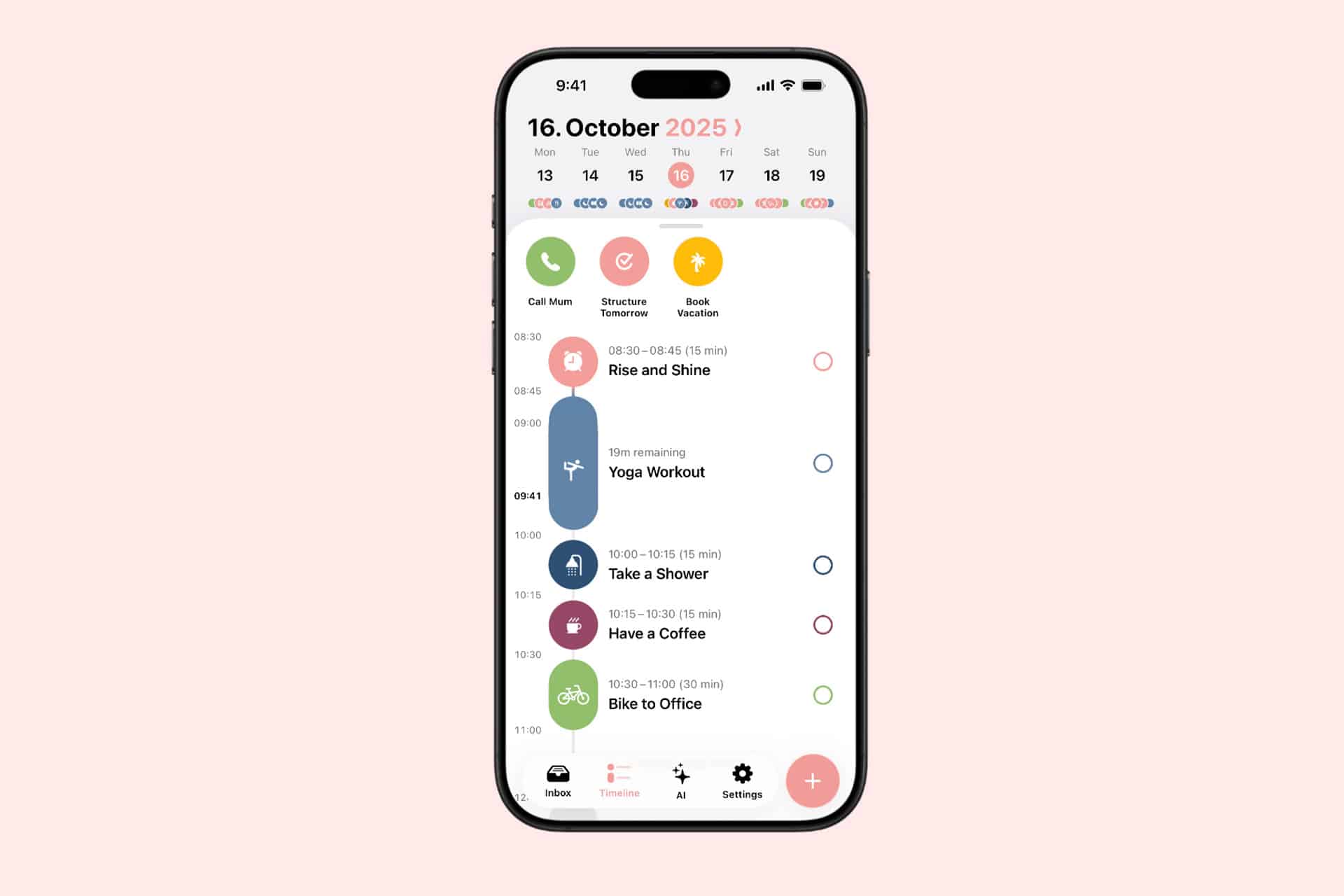
Structured Is the Best Visual Daily Planner

Structured is the easiest recommendation for users who want to see the day as one continuous timeline. Tasks, appointments and focus sessions appear in chronological order, making it immediately obvious when the schedule is overloaded or when a free hour actually exists.

The app feels particularly natural on iPad because tasks can be moved and adjusted visually. Its Mac version provides more space for planning the full day while preserving the same clean layout. Structured also offers apps for iPhone and Apple Watch, which helps keep the plan accessible without repeatedly opening the Mac.

This is a strong choice for students, busy families and anyone who struggles with traditional task lists. A list says what needs to happen. Structured shows where each task can fit.

Its limitation is scale. It handles daily planning beautifully, but users managing large professional projects may need a separate project-management system. Structured is best when the priority is today rather than the entire company roadmap.

Smartphone displaying a daily schedule app on a pink background, similar to the best digital planners or Mac planner apps, showing tasks like "Rise and Shine," "Yoga Workout," "Take a Shower," "Have a Coffee," and "Bike to Office" for October 16, 2025.
Image Credit: Structured

Goodnotes Is Best for Handwritten Planning

Goodnotes remains one of the best digital planners for iPad users who want the experience of paper without carrying notebooks. It supports Apple Pencil handwriting, PDF planner templates, typed text, images, links, stickers and searchable handwritten notes.

The experience depends heavily on the planner template selected. Users can choose daily, weekly, monthly, academic, financial or wellness layouts and import them as PDF files. Hyperlinked tabs can make a digital planner behave like a physical binder with instant navigation between months and sections.

The Mac app is useful for reviewing pages, typing longer notes and accessing the same documents at a desk. The iPad remains the better creation device because handwriting is the central appeal.

Goodnotes does not automatically manage time like a calendar-based app. Writing “meeting at 3 p.m.” on a page does not necessarily create a calendar alert. It is best for people who enjoy manually planning and reflecting rather than expecting the software to rearrange the day automatically.

Things 3 Is Best for Focused Personal Planning

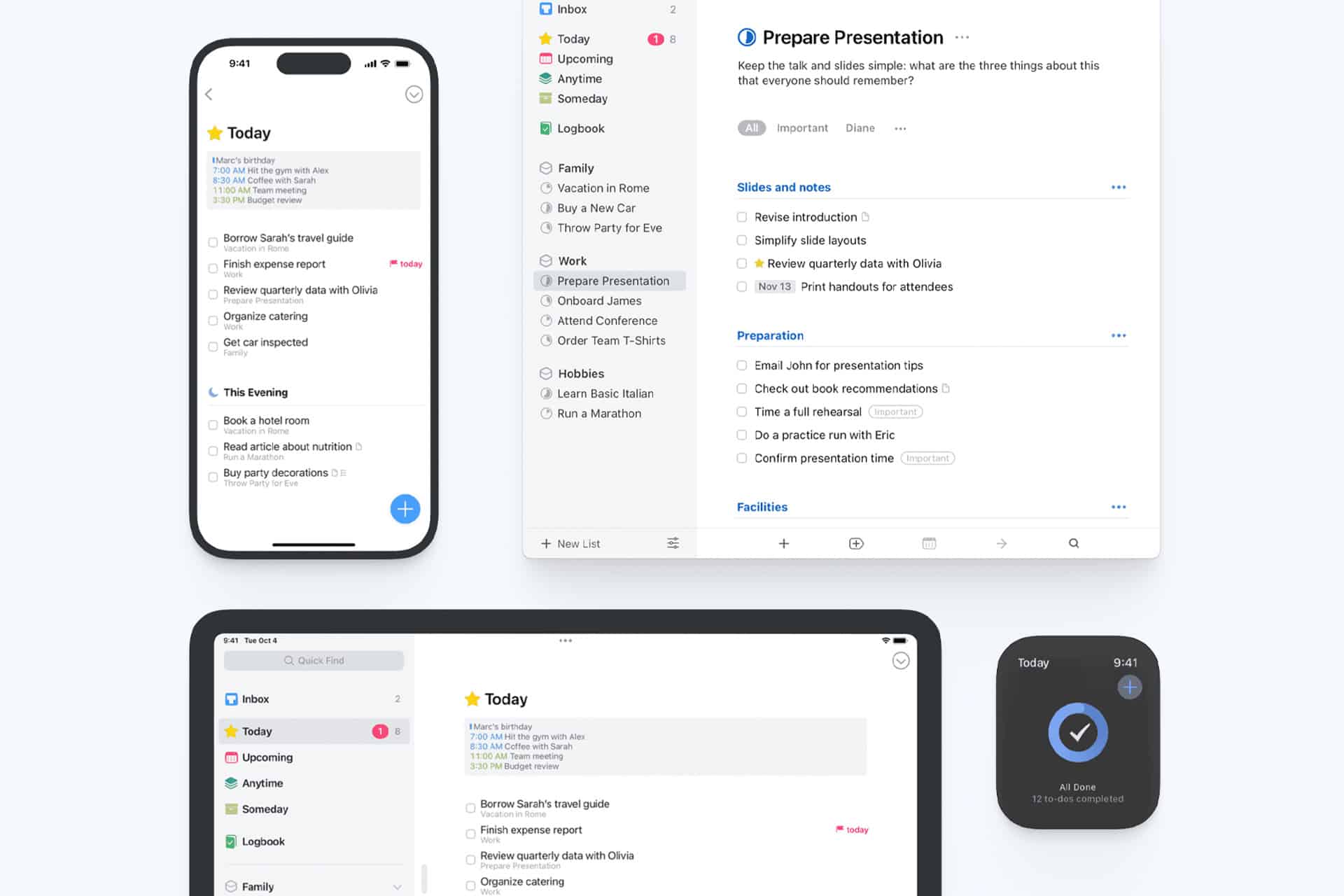
Things 3 is a task manager rather than a traditional calendar, but its Today and Upcoming views make it an excellent personal planner. The interface is calm, fast and unusually disciplined. Tasks can be collected quickly, organized into projects and areas, then scheduled without turning the app into a complicated database.

The Mac version is especially good for weekly reviews and larger project organization. On iPad, Things feels lighter and more direct, with excellent keyboard support and touch controls. Cloud sync keeps tasks aligned across Apple devices.

Things is ideal for users who want to separate tasks from appointments. Calendar events can appear beside the daily list, but the app remains focused on actions rather than becoming a full calendar replacement.

The main drawback is collaboration. Things is designed primarily for personal planning, not shared team projects or household lists. It is also sold separately for Mac, iPad and iPhone rather than through one universal purchase.

A productivity app interface is displayed on a smartphone, tablet, desktop, and smartwatch, showing task lists, checkboxes, and a schedule for today—highlighting cross-device syncing and organization features for those seeking the best digital planners. It seamlessly functions as both an iPad planner and Mac planner to keep your workflow efficient everywhere.
Image Credit: Things

Notion Is Best for Building a Custom Planner

Notion works for users who do not want to accept someone else’s idea of a planner. It can become a project tracker, editorial calendar, habit journal, reading list, weekly dashboard or all of those at once.

Templates make the starting process easier. A user can create daily pages connected to tasks, projects, goals and notes, then display the same information through calendar, table, board or timeline views. Notion Calendar adds a more conventional scheduling layer and works well on Mac.

The flexibility is both the attraction and the warning. Notion can become a beautifully organized personal operating system. It can also become a weekend-long design project that produces more templates than completed tasks.

The iPad app is useful for reviewing plans, adding notes and working with a keyboard. It is less satisfying for freehand Apple Pencil planning than Goodnotes. Notion is the better option for structured information, connected projects and users who enjoy building their own system.

Fantastical Is Best for Calendar-First Planning

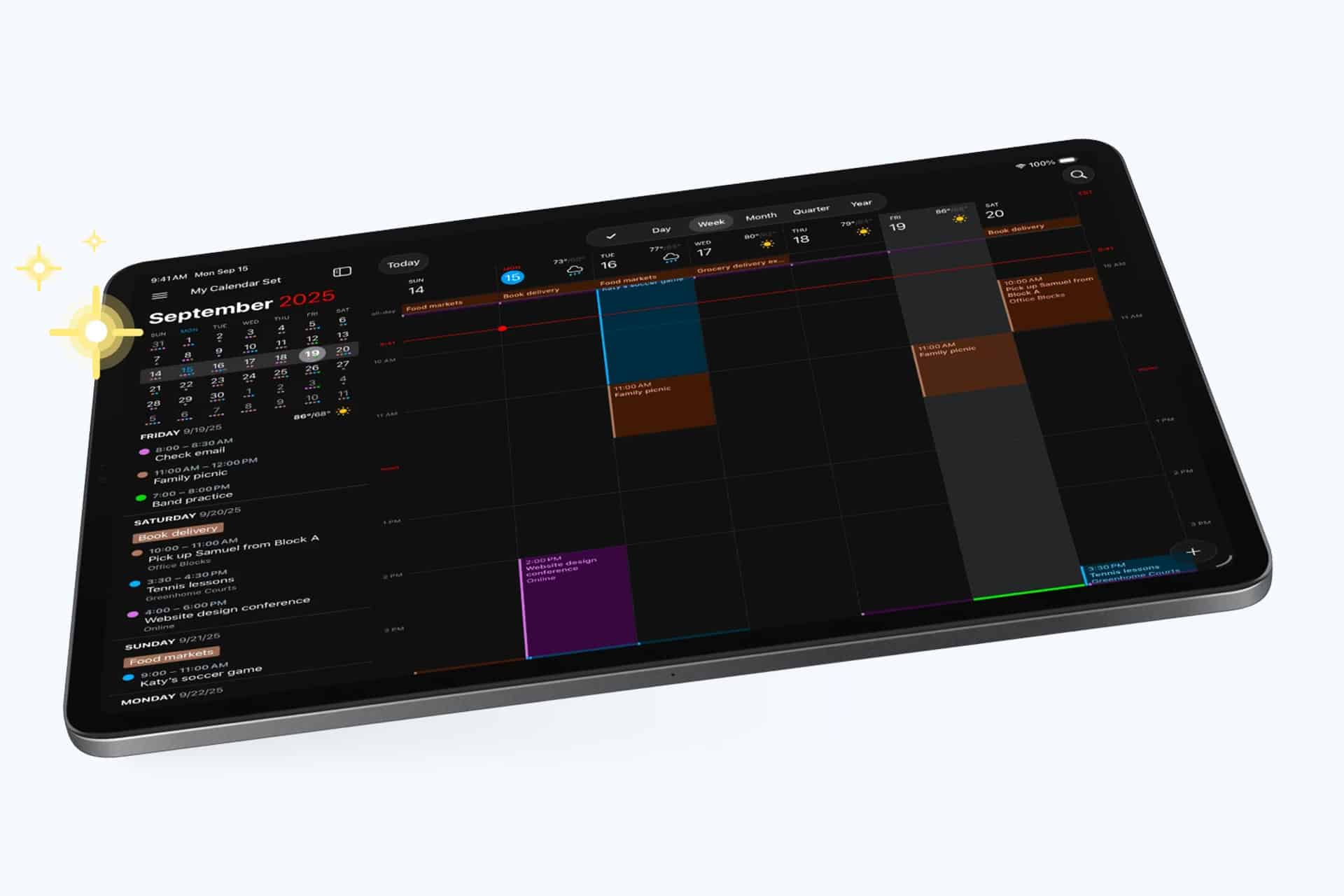
Fantastical is the strongest choice for users whose day is governed by appointments, meetings and scheduled commitments. It combines calendars and tasks in polished day, week, month, quarter and year views across Mac and iPad.

Natural-language input makes adding events fast. Typing a phrase such as “Lunch with Alex Friday at noon” can create the event without opening several fields. Fantastical also supports multiple calendar services, time zones, reminders, meeting links and scheduling tools.

The Mac app is a strong command center for professional calendars. The iPad version offers enough space to examine the week without feeling compressed. Users can also connect Apple Reminders, Todoist or Google Tasks so scheduled work appears beside events.

Fantastical is less suited to reflective journaling or handwritten planning. Its premium subscription may also be excessive for someone who only needs a basic calendar. It earns its place when the calendar itself is the planner.

A tablet displays a digital calendar in dark mode, showing a weekly schedule for September 2025 with various colored events and a highlighted date—an ideal setup for seamless digital planning with the best digital planners.
Image Credit: Fantastical

Sunsama Is Best for Deliberate Work Planning

Sunsama approaches productivity as a daily planning ritual. Each morning, users review tasks, decide what belongs in the day and place that work onto the calendar through time blocking. At the end of the day, the app encourages a review rather than allowing unfinished tasks to become permanent background guilt.

It can collect work from services such as Notion, Trello, Asana and other professional tools, then combine those tasks with calendar events. This makes it useful for people whose work is scattered across several platforms.

Sunsama is more guided than most planners. That structure can help users stop planning an impossible day. The Mac experience is the main attraction, while the iPad app keeps the plan available away from the desk.

The subscription is relatively expensive, and the deliberate workflow may feel slow to users who only want a simple task list. Sunsama suits professionals who want planning to become a daily boundary around work rather than another place to collect everything.

Which Digital Planner Should You Choose?

The right planner depends on how the user naturally thinks.

Structured works best for seeing the day visually. Goodnotes is the closest replacement for a paper agenda. Things 3 provides the cleanest personal task system. Notion offers the most freedom. Fantastical serves users who live through their calendars. Sunsama brings the most deliberate approach to professional time blocking.

Using several planners at once usually defeats the purpose. A better strategy is choosing one primary system and allowing other apps to support it. Someone might use Fantastical for appointments and Things for tasks, or Goodnotes for weekly reflection while Structured runs the actual day.

The best digital planners do not create motivation by themselves. They create a reliable place to decide what deserves time. On Mac, that place can become a detailed planning desk. On iPad, it can feel closer to a notebook held in the hand. The right app should make those two experiences feel connected rather than duplicated.

The post Best Digital Planners for Mac and iPad 2026 appeared first on AppleMagazine.

  •  

Microsoft is forcing an enterprise transition to passkeys

Passkeys have been around for some time, but enterprise-wide adoption to this point has been slow for a number of reasons. But soon, many Microsoft customers won’t have a choice.

Starting September 1, Microsoft will roll out passkeys as the default authentication method in its cloud-based identity and access management (IAM) service Entra ID. And following a transition period, Microsoft-provided SMS and voice authentication will officially end on February 1, 2027.

With this move, Microsoft seems to be underlining the urgent need for a more secure authentication standard, as attackers up their game with AI.

This is an “important milestone,” because it moves passwordless authentication from an optional security enhancement to the expected standard, noted Ensar Seker, CISO at SOCRadar. “That shift is significant as attackers increasingly rely on AI to automate phishing campaigns, generate convincing login pages, and conduct large-scale credential theft.”

Microsoft’s six-month passkey roll-out

Passkeys require users to authenticate via a fingerprint, facial scan, or lock screen mechanism, rather than a password. They can be stored on physical USB keys (like YubiKey), or as digital credentials on computers, phones, or in cloud accounts.

This method, Microsoft contended, reduces reliance on phishable authentication tools like SMS and voice, and hardens protection against credential theft.

Passkeys “work better for users and worse for cyberattackers,” Nadim Abdo, Microsoft corporate VP for identity and network access engineering, wrote in a blog post.

Microsoft’s announced timeline for rolling out passkeys is relatively aggressive:

  • September 1, 2026: All SMS or voice-enabled users will be “auto-enabled and nudged” to register a passkey upon multifactor authentication (MFA) sign-in.
  • September 18, 2026: Pricing, commercial terms, and a list of supported telecom providers will be shared for scenarios that still require SMS or voice authentication due to regulation or technical or operational challenges.
  • October 30, 2026: Enterprises still using SMS and voice must select and configure a supported telecom provider through the Microsoft Security Store. From then on, they will be responsible for any telecom-related costs.
  • February 1, 2027: Microsoft-provided telecom delivery for SMS and voice authentication ends as a native Microsoft Entra capability.

After February 1, enterprises that require SMS or voice for MFA must register a passkey before sign-in. There will be no opt-out option.

It’s important to note that these dates apply to public cloud-hosted Entra ID. Support for other cloud environments will follow a separate timeline; additional guidance and dates are to come.

While SMS and voice have served their purpose well, Abdo said, bringing MFA to billions of users who otherwise would have had none, the threat environment has changed in “speed, scale, and sophistication,” necessitating this move to passkeys.

The benefits of passkeys

SOCRadar’s Seker pointed out that passkeys fundamentally change the attack surface because, unlike with passwords, there is no transmission of shared secrets that can be stolen by threat actors. Authentication requires possession of the user’s device, along with biometric verification or a PIN.

“Even highly convincing AI-generated phishing pages cannot simply trick users into handing over a passkey the way they can with passwords or one-time codes,” he said.

So why haven’t we seen widespread enterprise adoption? Identity ecosystems are “fragmented,” Seker noted, and many enterprises still rely on legacy applications that only support passwords. They also struggle with cross-platform compatibility, lifecycle management, recovery processes, shared accounts, and employee onboarding and offboarding.

Further, “until recently, many organizations viewed passkeys as a consumer technology rather than an enterprise identity strategy,” he said.

Microsoft’s move changes that equation, because Entra sits at the center of many organizations’ identity infrastructure, Seker noted. Default settings are typically the strongest drivers of security adoption, so when passwordless authentication becomes required rather than optional, organizations are far more likely to deploy it at scale.

Its biggest benefit would be a “dramatic reduction” in credential-based attacks, Seker said. He pointed out that most successful compromises still begin with stolen credentials obtained through phishing, infostealer malware, password reuse, or adversary-in-the-middle attacks. Passkeys “eliminate or significantly reduce” many of those attack paths, while reducing password fatigue and the help desk costs related to password resets.

In addition, rather than trying to continuously improve users’ ability to detect increasingly sophisticated phishing attempts, passkeys remove the credential from the equation altogether, Seker noted. “That represents a more sustainable long-term security strategy than relying solely on user awareness training.”

Still, passkeys are not a silver bullet, as they do not stop endpoint compromise, session token theft, malicious insiders, or attackers who already have control of a trusted device. Enterprises must complement passkeys with endpoint protection, continuous monitoring, conditional access policies, and identity threat detection, Seker advised.

How enterprises can prepare

To prepare for the shift to passkeys, Microsoft advised enterprises to review their authentication policy and identify the groups still using SMS or voice authentication. They should then select the best authentication method for user devices and workflows, and ensure all employees are given passkeys and security keys.

Entra ID supports both synced passkeys (those stored in platform credential managers like iCloud Keychain and Google Password Manager), and device-bound passkeys such as Microsoft Authenticator passkeys, Entra passkey on Windows, or FIDO2 security keys.

Seker advised enterprises to evaluate support for FIDO2 and passkeys across their identity infrastructure, and to develop clear enrollment and recovery procedures. They should also educate users on what’s changing, how passkeys work, and how they can complete registration. Further, Seker said, it’s important to establish secure device management practices and to continue enforcing least privilege, conditional access, and risk-based authentication policies throughout the transition.

Ultimately, he pointed out, the move is crucial. “Over the next several years, organizations that continue relying primarily on passwords will likely face higher operational risk as AI continues to lower the cost and increase the effectiveness of credential-based attacks,” he said.

  •  
❌