O Apple TV divulgou hoje o aguardado trailer da quarta temporada de “Ted Lasso”, cujo primeiro episódio estreará no dia 5 de agosto (quarta-feira da semana que vem).
Com um total de dez episódios, os nove capítulos remanescentes chegarão ao catálogo do streaming da Maçã às quartas-feiras, até o dia 7 de outubro.
Eis o trailer:
E também a versão dublada em português do Brasil:
Tim Cook, CEO 1Chief executive officer, ou diretor executivo. da Apple, também compartilhou o trailer no X:
Welcome home, Ted! Can’t wait to cheer on the Lady Greyhounds in the new season! https://t.co/g3w8xk0tFF
Bem-vindo de volta, Ted! Mal posso esperar para torcer pelas Lady Greyhounds na nova temporada! – É bom estar de volta. #TedLasso retorna em 5 de agosto.
Estrelada por Jason Sudeikis, a nova temporada segue com o foco em Ted, que retorna a Richmond para enfrentar o seu maior desafio até aqui: comandar um time feminino da segunda divisão do futebol inglês. Com o desenrolar da história, ele e a equipe aprendem a arriscar antes de terem todas as respostas, encarando desafios que até então pareciam inimagináveis.
O roteiro é assinado por Sarah Walker e Phoebe Walsh (que também são creditadas como produtoras), ao lado de Goldstein (que também é produtor), Julia Lindon e Dylan Marron (que exerce também a função de editor de roteiro). Além de Walker, Goldstein, Hunt e Walsh, a produção executiva é assinada por Joe Kelly, Jane Becker, Jamie Lee e Bill Wrubel. O vencedor do Emmy Jack Burditt também chega para a nova temporada.
O Apple TV está disponível no aplicativo Apple TV em mais de 100 países e regiões, seja em iPhones, iPads, Apple TVs, Macs, dispositivos Android, smart TVs ou online — além de também estar em aparelhos como Roku, Amazon Fire TV, Chromecast com Google TV, consoles PlayStation e Xbox. O serviço custa R$29,90 por mês, com um período de teste gratuito de 7 dias. Por tempo limitado, quem comprar e ativar um novo iPhone, iPad, Apple TV ou Mac ganha 3 meses do Apple TV. Ele também faz parte do pacote de assinaturas da empresa, o Apple One.
NOTA DE TRANSPARÊNCIA: O MacMagazine recebe uma pequena comissão sobre vendas concluídas por meio de links deste post, mas você, como consumidor, não paga nada mais pelos produtos/serviços usando os nossos links de afiliado.
Usuários do Threads em todo o mundo já podem enviar mensagens para a Meta AI por meio da área de mensagens diretas (direct messages, ou DMs) da rede social, segundo informações do Engadget.
Antes disso, já era possível interagir com o chatbot da empresa comandada por Mark Zuckerberg em certos mercados por meio de menções em posts, mas essa nova opção permite iniciar conversas mais privadas com a ferramenta.
Segundo a Meta, é possível compartilhar posts do Threads, imagens, links e vídeos com a Meta AI, bem como manter conversas duradouras e explorar tópicos de interesse do usuário. “A experiência de mensagens diretas (DMs) oferece às pessoas maior flexibilidade sobre como e onde interagem com a Meta AI”, afirmou a companhia em um comunicado.
Divulgação/Meta
O próprio sistema de DMs é uma adição relativamente recente ao Threads, que só foi ganhar esse recurso no ano passado. Com essa atualização, a rede social fica em paridade com as outras plataformas da Meta (Facebook, Instagram e WhatsApp), que já permitem o envio de mensagens privadas para a Meta AI há algum tempo.
A empresa disse ainda que pretende continuar testando a interação com a Meta AI em feeds públicos em mercados selecionados e que considera aumentar sua disponibilidade. Nos lugares nos quais essa função já pode ser acessada, basta incluir @meta.ai na sua postagem com o prompt. Para diminuir a frequência com que ela aparece no seu feed, selecione a opção “Não tenho interesse”.
New insights into the “reverse sprinkler” problem popularized by Richard Feynman have been provided by US researchers using modified rotary sprinklers. The results, which indicate that the reverse sprinkler is driven by the angular momentum induced at its centre by water being drawn in, could shed light on the fluid dynamics of open systems.
Rotary lawn sprinklers are ubiquitous devices that eject water at an angle to the head, thereby generating the torque to rotate and water a 360° area. The puzzle is how – or whether – sprinklers rotate if the problem is inverted and they suck the fluid in rather than blowing it out. A lawn sprinkler will, of course, draw in air, but Feynman conducted experiments with a submerged sprinkler that sucked water in and arrived at conflicting results.
Applied mathematician Leif Ristroph of New York University says that the asymmetry of the problem is not in itself surprising. “You can blow out a candle but you can’t suck it out,” he points out. “When you blow out a fluid through an orifice at a high enough flow rate, it forms a concentrated jet…When you reverse the system and pull in fluid at the same flow rate, the flow does not reverse – it pulls in fluid from all directions. That comes from the irreversibility of the Navier-Stokes equation.”
The correct way to model the system, however, is less clear. Some researchers have argued that the problem should be best solved by considering the total angular momentum of the system. Others focused on the torque exerted on the outside of the structure as fluid enters the nozzles, or the angular momentum that builds up at the centre due to the fluid that flows in from the outside of the arms.
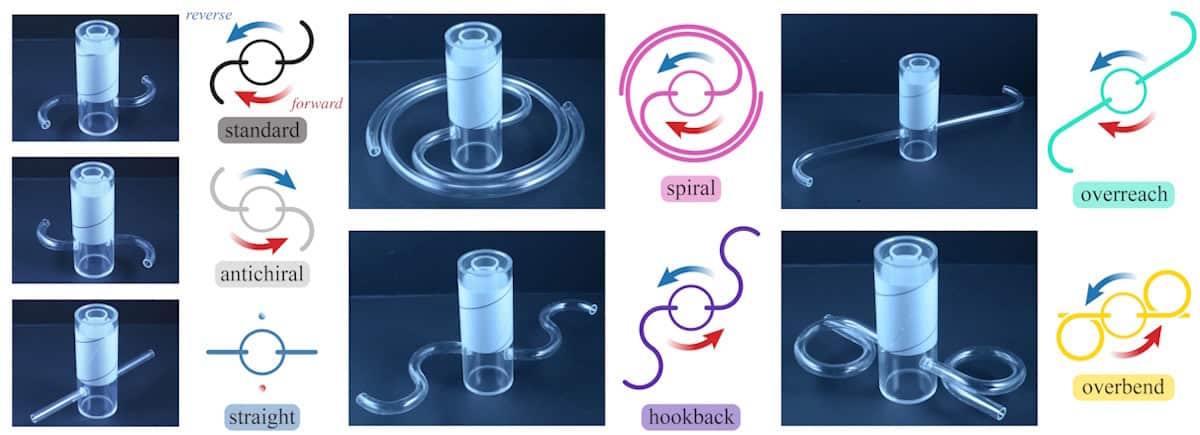
Attempting to disentangle these explanations, Ristroph and colleagues constructed a set of specially designed sprinklers. They submerged the devices before either drawing water out of the centre of each one or feeding it in. Each device’s geometry was designed either to amplify or nullify one of the effects previously proposed to determine the torque and thereby the rotation rate. For example, they tested the impact of the overall angular momentum by comparing devices with “spiral” arms (in which water travelled 360° before escaping) to those with S-shaped “hookback” arms (in which it doubled back). This did not explain the observed results.
Sprinkler geometries The studied sprinkler designs, with the observed rotation direction in the forward (red arrow) and reverse (blue) modes. (Courtesy: NYU’s Applied Mathematics Laboratory)
There was one factor, however, that correlated with torque and rotation rate irrespective of the geometry of the arms. “If you measure the angular momentum flux from any one of these designs it’s quantitatively one-to-one with the torque on the solid [in the forward case],” says Ristroph. “The beautiful thing is the same thing works in the reverse case, except now you should look at the centre where these arms begin, and there are very subtle asymmetries that inject angular momentum to the core of the device…That’s the common unifying principle: in all cases there are jets generated, but in the reverse case those jets are pointing in.” The lower torque at the centre makes the sprinkler much slower in reverse.
Mechanical engineer Earl Dowell of Duke University says that “the study in the paper is largely experimental,” although he acknowledges that “the experiments appear to have been carried out competently and the results presented in a well-organized manner”.
“What the authors call theories are notional ideas based upon highly simplified concepts that tend to be favoured by some physicists,” Dowell adds. “An expert in fluid mechanics…would attack this problem with well-established computational models for the flow field and rigid body dynamics for the sprinkler per se.” He believes that this is not, to his knowledge, being done because neither experiments nor computational simulations are expected to reveal any fundamental new concepts in fluid mechanics.
“I have a hard time thinking this going to generate a practical device,” concedes Ristroph. However, he says that entirely new methods were needed to conduct these experiments and the researchers are now developing new computer simulations of fluid dynamics, in which fluids enter and escape from the system, to apply to it. “This is a beautiful problem to test your experimental methods, your computational methods, modelling, theory…This is a place to give it the best test it can possibly have.”
Nature is always more complicated than the models we use to describe it. Ocean waves, for example, are constantly evolving. They grow when wind transfers kinetic energy to the water’s surface. They interact with each other in highly nonlinear ways. And once the wind dies down, their internal viscosity makes them dissipate away to nothing, leaving behind a surface as flat as glass.
This process is familiar to anyone who’s ever been to the seaside, yet physicists’ go-to models of water moving through the ocean essentially ignore it. Instead, the standard theory of wave transport, known as classical Stokes drift theory, concentrates on describing the flow of steady waves with finite amplitude. And while extensions of the theory incorporate complications such as nonlinear wave shapes, uneven seabeds and the inertia of particles carried along by the waves, they don’t account for waves that grow and fade over time.
For Marco Edoardo Rosti, a physicist at Japan’s Okinawa Institute of Science and Technology (OIST), this shortcoming has real-world consequences. “There is increasing interest in understanding near-surface transport processes because they are directly connected to problems such as pollutant dispersion, microplastic accumulation, sediment transport, and air-sea exchange,” he explains. “Since these processes depend sensitively on particle trajectories, even subtle modifications of the drift mechanism may become important over long times.”
Wave mechanics Team members (l-r) Tatsuo Izawa, Giulio Foggi Rota and Marco Edoardo Rosti. (Courtesy: Marco Edoardo Rosti/OIST)
In a study published in the journal EPL, Rosti and his colleagues Alessandro Chiarini, Tatsuo Izawa and Giulio Foggi Rota explored ways of remedying this deficiency. They focused on the simplest type of wave evolution: a freely decaying, single-frequency gravity wave, one where the force of gravity acts to restore equilibrium and smooth out the surface of the water. Physics World spoke with the team about the findings.
What is the most important advance in this work?
Classical Stokes drift theory predicts that on average, particles will get transported through the water horizontally, in the direction of the wave. But by combining fully nonlinear two-phase simulations with a perturbative analytical model, we demonstrate that when you allow those waves to decay, additional transport mechanisms appear.
Specifically, we identified a net vertical particle migration that arises solely from the temporal decay of the wave field, due to the interplay between fluid inertia and viscous dissipation. This migration persists even for fluids with relatively weak viscosity. Also, because the drift velocity depends on depth, even small vertical displacements alter particle trajectories and mixing properties.
International collaboration: Team member Alessandro Chiarini. (Courtesy: Alessandro Chiarini)
More broadly, our results show that unsteadiness in the wave amplitude is not a minor correction to classical Stokes drift. It’s something that can qualitatively change how an individual parcel of fluid moves through space and time – what we call Lagrangian transport. This has important implications for understanding how floating and suspended materials, including sediments, aerosols and microplastics, get redistributed near the ocean surface.
Can you say more about those implications?
Because gravity waves at the ocean surface span a broad range of wavelengths, from centimetres to hundreds of meters, even a modest fractional vertical displacement per wave cycle can significantly change the depth of a drifting particle. And because the drift velocity beneath a wave decays exponentially with depth, these small vertical excursions can substantially alter how much horizontal drift a particle accumulates. That could influence whether microplastics remain near the surface (where they are most bioavailable), or whether they instead migrate to greater depths, where different biological and physical processes govern their fate.
Why have previous studies not seen this vertical drift?
The drift mechanism we identify accumulates gradually as the wave field decays. That means it only becomes apparent when “tracer” particles in the water are exposed to the same wave as its amplitude decreases over many periods. Most wave-tank experiments and field measurements instead follow tracers as they are swept through a passing wave packet, which is a fundamentally different configuration.
In open-sea conditions, similar arguments apply, and the presence of currents, wind forcing and turbulence all complicate the picture. These effects mask a signal that only shows up unambiguously in clean, unforced conditions.
What was the most challenging aspect of this work?
The most challenging part was to bridge the limits of classical wave theories with the fully nonlinear, two-phase simulations of an air-water interface. The classical Landau wave-decay theory, for example, assumes an isolated, weakly viscous fluid (water). However, our high-resolution simulations demonstrate (as previously reported in other studies) a deviation from these idealized assumptions. In fact, the dominant viscous energy dissipation occurs in a thin layer of air just above the water surface, rather than in the bulk.
To investigate how continuous wave energy decay affects Lagrangian particle transport, we developed a perturbative analytical model based on the classical Landau framework. This was a difficult step because the framework is inherently blind to the two-phase dissipative system. As a result, its asymptotic predictions progressively diverged from simulated flow fields at long times, likely due to intrinsic limitations of the Landau decay-wave model.
What do you plan to do next?
The drift mechanism we discuss in this study applies to a very idealized form of wave decay. In the future, we would like to test whether and how this mechanism propagates in more complex but realistic wave conditions. In particular, we want to work out how to measure such mechanisms in wave-tank experiments. To do so, we will study a different setup, one in which waves decay spatially instead of temporally, since this is closer to what observed in wave tanks. We would also like to study how our mechanism affects drift in waves that vary over time, with controlled unsteadiness, rather than simply decaying.
The trap lobes of the Venus flytrap – a carnivorous plant – snap shut by the rapid softening of their outer walls. This discovery by researchers in France is at odds with previous hypotheses that the mechanism involves water transport through the lobes.
The Venus flytrap is native to temperate and subtropical wetlands in the eastern US. These habitats are very poor in nutrients, so the plants capture insects and spiders to obtain nitrogen. “[Charles Darwin] was completely amazed by the motion, and he thought that if the plant was moving that fast it was because the plant had muscle,“ says biophysicist Yoël Forterre of Aix-Marseille University. “He thought, ‘OK, if the plant has muscle then it must also have nerves’.” Darwin asked his colleagues, who had recently discovered electrophysiological signals in animals like frogs, to measure the plants, and was proved partially correct: ionic signalling in plant cells was first detected in the Venus flytrap. Nonetheless, plants have no muscles or nerves.
In 2005, Forterre and colleagues in the UK and US discovered that the trap’s rapid closure is amplified by a “snap-buckling instability”. In the trap’s open state, the two lobes adopt buckled, convex shapes that resist closure. These store elastic energy until a potential barrier is overcome. They then release the energy, suddenly becoming concave and snapping the trap shut in around 0.2 s. The underlying driving force has remained mysterious, however, and the instability makes measurement difficult.
“Many biological and chemical tools are kind of invasive and trigger the plant,” explains Forterre; “It’s not easy to probe the state of the plant before, after and most importantly during the motion.”
Poroelastic limit
One hypothesis is that osmosis causes water to diffuse from one side of the lobe to the other, causing bending. This is the most common driver of motion in plants, but its speed limit can be calculated theoretically from the permeability and elasticity of the host material. To work out whether or not the intrinsic speed of the trap exceeded this “poroelastic limit”, the researchers had to remove the amplificatory effect of the snap-buckling instability.
They devised two ways to do this. First, they cut the trap in several places, allowing it to open and close without storing elastic energy. Second, they clamped traps open between two fixed walls, one equipped with a force sensor. In both cases, they found that the closure timescale – inferred in the case of the trap that did not actually close – was around 4 s. Though much longer than in a trap with a snap-buckling instability, this time would have required water to cross the lobes more than an order of magnitude faster than the porolastic limit. This suggested osmosis could not be responsible.
Another popular hypothesis, first advanced in 1981, is that enlargement and softening of the outer walls drives the lobes into the concave shape. The researchers triggered the trap and probed the pressure of the outer surface with a nano-indenter, confirming that it did indeed decrease. However, this did not affirmatively prove that the material had become more flexible, because an osmotic pressure drop would also cause softening.
Forterre and colleagues used dental impression paste to make moulds of the topography of the cell walls before and after the trap was triggered. “If a balloon becomes softer because you have decreased the pressure, that means it has deflated,” explains Forterre; “If you keep the pressure inside the balloon constant but make the material softer, it will inflate.” The researchers confirmed using microscopy that the cells bulged more after the trap was triggered, showing that the driving force was cell-wall softening, not water movement.
Biologist Anja Geitmann of McGill University in Canada describes the new work as “paradigm changing”. “Usually we always talk about changes in turgor pressure that induce movement,” she says; “Here they show that it’s not a change in turgor pressure but a very rapid change in the mechanics of the primary cell wall. That’s completely new: I know of no other system where this happens on this kind of timescale, and they prove it in very smart and clever ways.”
Plant biologist Daniel Cosgrove of Pennsylvania State University in the US, whose group discovered the proteins that allow cell walls to expand and soften, agrees that the research proves conclusively that osmosis is not the cause of the trap’s closure. “What will complete the story is when there’s a paper out explaining the molecular mechanism of how that cell wall gets softened or loosened in a couple of seconds,” he says.
Researchers have developed a magnetic method for influencing deep-brain circuits without permanently implanted electrodes. A magnetic field may offer a new way to reach circuits buried deep within the brain without permanently implanting electrodes. An international research team injected magnetic nanoplatelets into a targeted brain region and used them to improve movement problems in mice [...]
The Varta crisis has entered another severe phase after the German battery manufacturer lost the customer responsible for nearly all production at its specialized factory in Nördlingen.
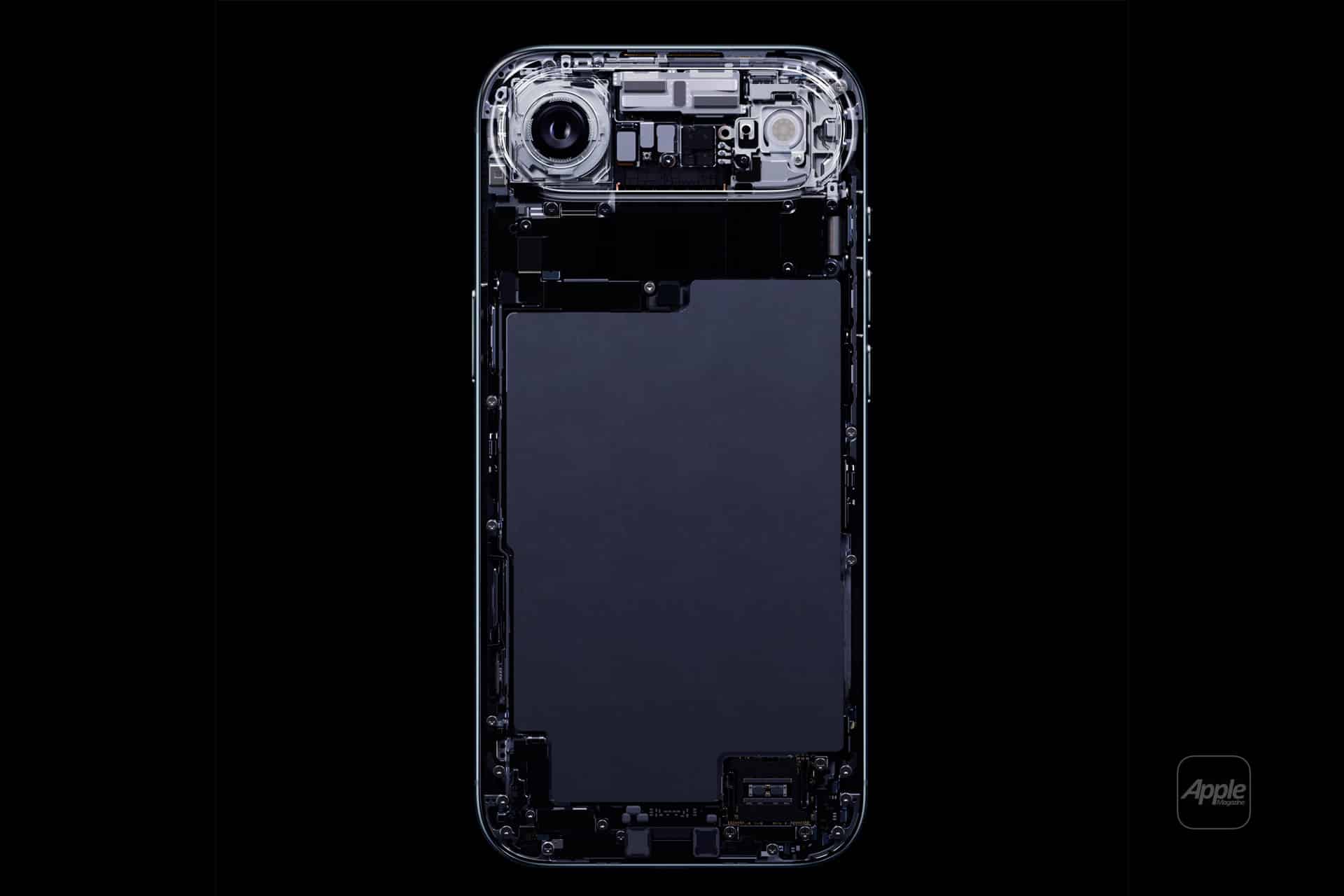
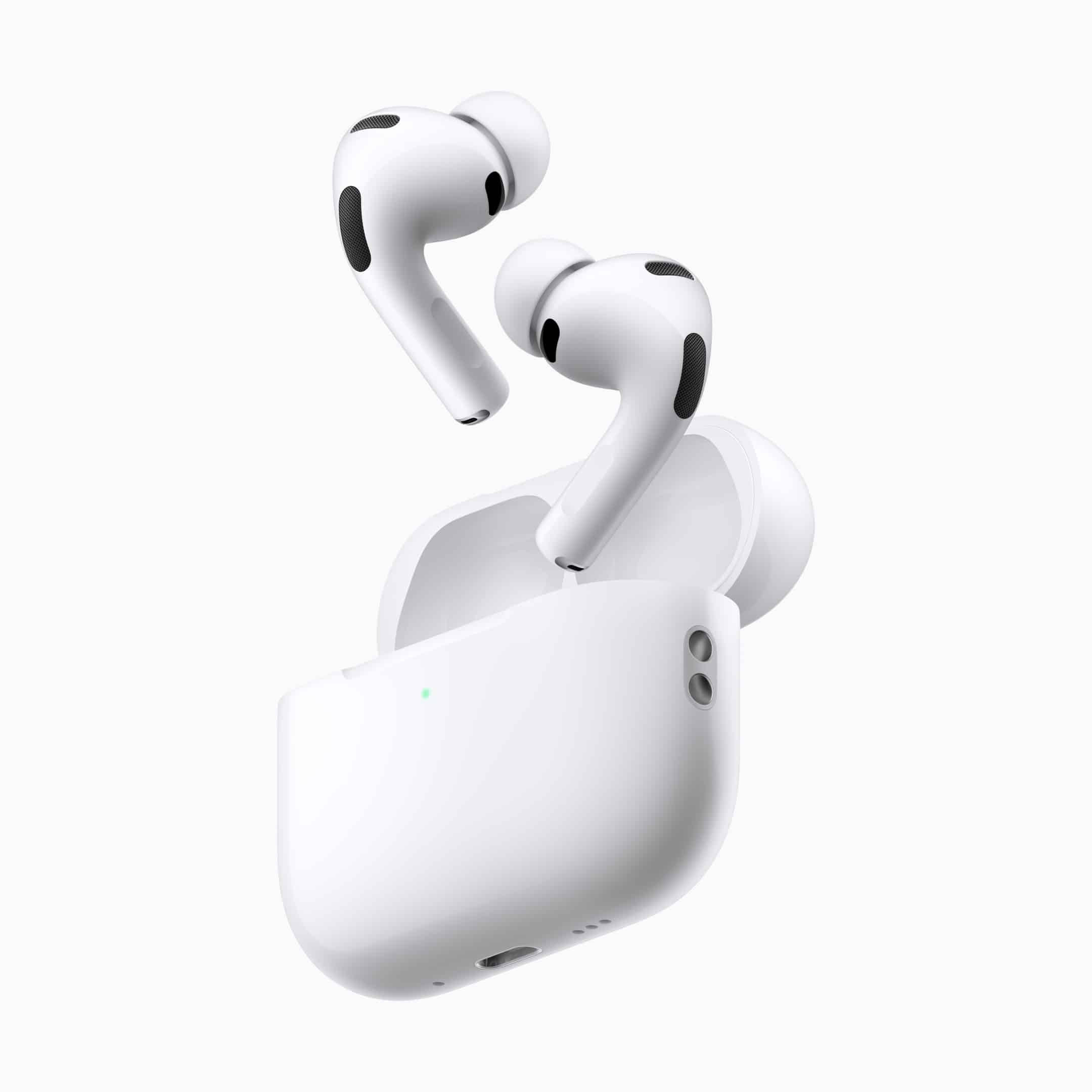
Varta has not publicly identified that customer, but reports from German media and industry sources point to Apple. The iPhone maker is reportedly moving battery orders for a future AirPods generation to a lower-cost supplier in China.
The decision will lead Varta to stop producing rechargeable button cells in Nördlingen during fall 2026. Approximately 350 jobs will be eliminated across the factory and the company headquarters in nearby Ellwangen.
Describing the development as a complete corporate collapse would go too far. Varta continues operating other battery businesses and recently completed an extensive financial restructuring backed by Porsche. The loss of Apple, however, has destroyed the economic foundation of a production site created around one highly influential customer.
Varta Crisis Exposes Dependence on Apple
The Varta crisis illustrates how a large technology customer can transform a supplier and then leave it with capacity that cannot easily be reassigned.
Varta became an important producer of CoinPower lithium-ion cells, small rechargeable batteries designed for wireless earbuds and other compact devices. Teardowns of AirPods Pro models identified Varta cells inside the earbuds, although Apple does not publicly discuss most component suppliers by product.
Demand from premium wireless headphones helped Varta expand rapidly. In 2020, its Microbatteries and Solutions division generated approximately €508 million in revenue, representing growth of 49% from the previous year.
The company invested heavily in production as wireless earbuds became a mass-market category. Apple demand provided the volume needed to justify specialized lines, equipment and hiring in Germany.
That dependence became dangerous when AirPods production weakened and Apple began adding other battery suppliers. A factory developed for unusually large orders could not operate efficiently once those orders declined.
The customer now leaving Nördlingen had previously accounted for nearly the entire capacity of the site. Varta says it has gained other customers, but their combined demand is not sufficient to keep the specialized factory running.
The plant is therefore closing not because rechargeable button cells have disappeared, but because replacing one customer of Apple scale requires far more than several smaller contracts.
Price Reportedly Decided the AirPods Order
German reports indicate that price was the decisive factor behind the supplier change.
Varta battery quality was reportedly equal to or better than the competing product. The German manufacturer could not, however, match the cost offered for the next generation of cells from China.
Battery production in Germany faces higher labor, energy and operating expenses than many Asian manufacturing centers. Chinese suppliers also benefit from extensive domestic electronics supply chains, access to materials and production volumes spread across numerous customers.
Apple has enormous leverage when negotiating component contracts. AirPods ship in sufficient quantities for a small difference in the cost of each battery to produce substantial savings across an entire product cycle.
The company regularly qualifies multiple suppliers for components when technical requirements and available capacity permit. Competition can reduce prices, protect production against interruptions and prevent one manufacturer from gaining excessive influence over the supply chain.
For Varta, that process brought the opposite effect. The supplier expanded to serve Apple and then faced declining utilization as the customer divided orders among additional manufacturers.
The latest move appears more final. Varta expects the contract to expire at the end of October, removing the volume that kept Nördlingen economically viable.
Image Credit: Apple Inc.
Apple Supplier Strategy Is Not Simply About China
The reported decision does not mean Apple is moving its complete production network toward China.
Apple has spent several years expanding device assembly and component production in India, Vietnam and other countries. AirPods manufacturing has grown in India, while Macs, iPads and wearables are assembled across a wider group of Asian locations.
The Varta case concerns a particular component for which a Chinese supplier reportedly offered a more competitive price. It shows that diversification away from one country can coexist with cost-driven sourcing from that same country.
Apple may reduce its dependence on Chinese final assembly while continuing to purchase Chinese batteries, displays, enclosures or electronic components when suppliers provide the required scale and pricing.
That balance creates a difficult environment for European manufacturers. Political interest in domestic technology production does not guarantee that major customers will accept higher component prices.
Premium engineering can protect a contract when it produces a measurable advantage in battery capacity, safety, dimensions or lifespan. Once competing suppliers reach comparable performance, procurement decisions become increasingly sensitive to cost.
The Varta crisis suggests that manufacturing location and supplier history carried less weight than the economics of the next AirPods battery.
Varta Was Already Fighting Financial Failure
Apple did not create every problem affecting Varta.
The company entered the current dispute after years of debt, costly investments, volatile customer orders, supply-chain problems and weaker demand in parts of its energy-storage business. A cyberattack in early 2024 also disrupted production and delayed financial reporting.
Varta warned that its earlier restructuring plan might fail after Apple reduced AirPods production. By mid-2024, the company had reached a point where it could no longer service its debt without another intervention.
A pre-insolvency restructuring reduced financial liabilities from approximately €485 million to €200 million. Porsche and majority shareholder Michael Tojner agreed to provide new capital, while creditors supplied additional financing.
Existing shareholders lost their investment as Varta was removed from the stock market. The process preserved the operating company but demonstrated how little financial room remained for another major disruption.
Varta reported a loss of €64.5 million for 2024. Although that was an improvement from the previous year, the business remained dependent on successful restructuring and stronger performance from its surviving divisions.
The Apple contract loss therefore did not independently bring down a healthy battery group. It struck a manufacturer that had already narrowly avoided insolvency.
Image Credit: Wikipedia
Porsche Cannot Protect Every Varta Business
Porsche participation gives Varta a future in automotive batteries, but it does not rescue the Nördlingen button-cell operation.
The automaker invested in the restructuring and took control of the V4Drive business, which develops high-performance cylindrical lithium-ion cells for hybrid and performance vehicles. Porsche gains greater access to battery technology while helping retain part of that expertise in Germany.
Varta also continues producing household batteries and energy-storage systems. Those businesses serve different customers and do not depend on the machinery used for tiny CoinPower cells.
Employees affected by the Nördlingen closure may be offered positions at other locations, although Varta has not indicated how many can realistically be transferred. The company and its works council are negotiating measures for the workers whose roles will disappear.
The shutdown leaves a modern production unit without enough demand only a few years after wireless earbuds were presented as one of Varta most promising growth markets.
Its remaining automotive operation now has the security of a strategic customer with a direct ownership interest. The microbattery division learned the cost of building a factory around a customer that never made the same commitment.
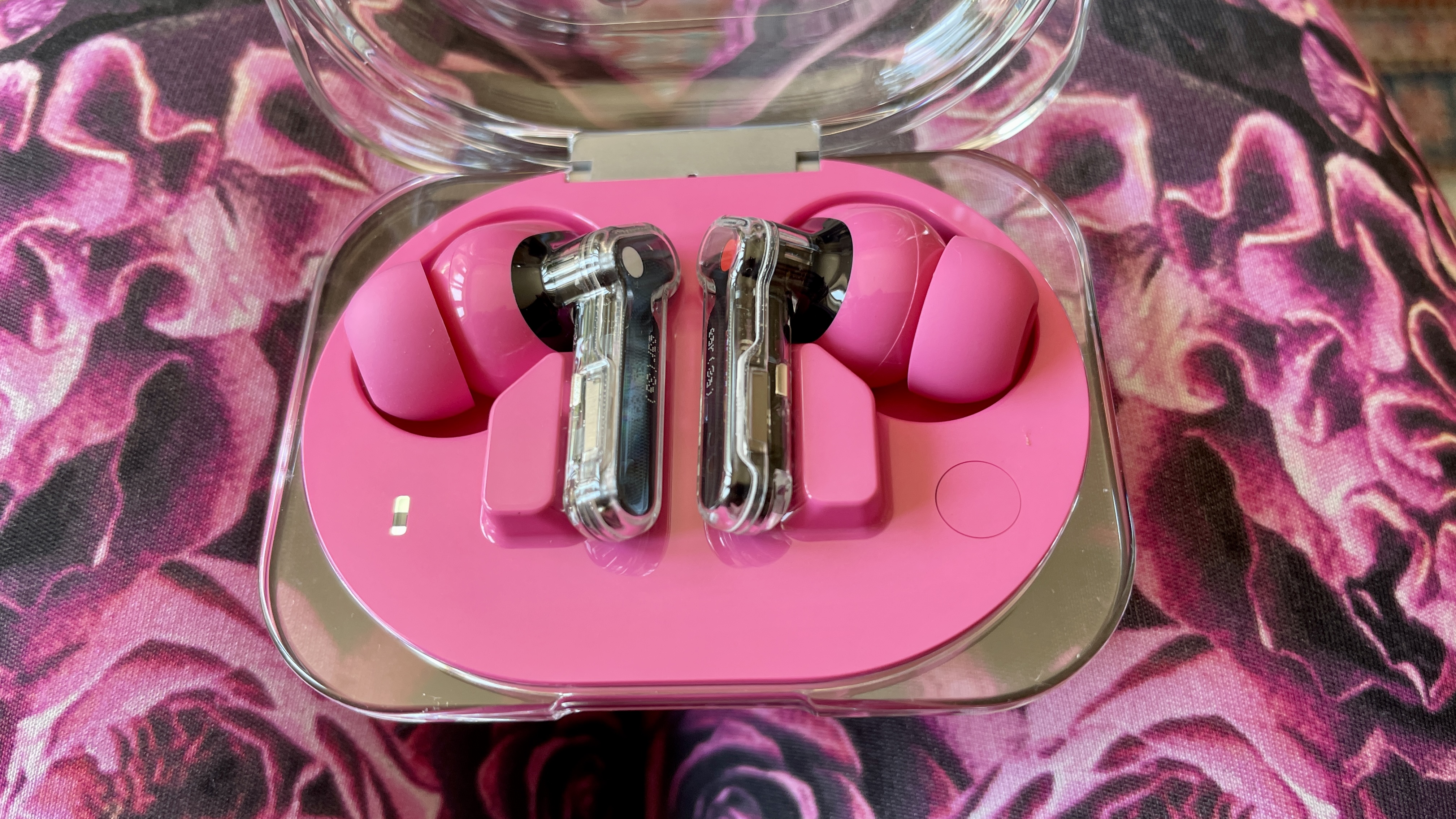
Sometimes, reviews are written with a heavy heart, and this is exactly that. I've championed Nothing's affordable "(a)" earbuds for well over two years — with the updated pink set for 2026 appearing to be right up my strasse. But all is not as it first appears.
The issues don't concern their cost. Like before, they come in at just under $100 and are therefore a candidate for our best budget earbuds guide.
Bizarrely, for the review star rating, I also have very few bones to pick with audio quality, which is still best pals with LDAC and now with Bluetooth 6.0 for a stronger connection. I recommend you tweak the sound profile from the box, mind — it's overly bassy by default — but that's hardly unheard of for earbuds at this level, and it can be rectified with a little effort.
It would have been lovely if Nothing had allowed its special sonic tests (for personalised EQ profile curation done by Nothing's software, rather than you tweaking sliders or blobs yourself) to be made available here, but the company has clearly decided that its three-minute hearing test is flagship only — although there is a new "Advanced" 8-band EQ tab with "Q factor" (more on this later).
What of the comfort levels and overall build quality? Here you get everything you'd expect of Nothing: rock-solid, colorful, and with just a couple of new flourishes to enjoy. Battery life has taken a knock, but that might possibly be down to having to work a bigger driver.
So what's the main problem? Actually there are two: Call Recording and Audio Snapshot (sometimes referred to as Audio Capture in Nothing's extensive marketing). Nobody asked for these features and, honestly, they're not the USP I wanted — even as a journalist who interviews people regularly.
None of the best noise-cancelling earbuds we recommend come with these features, but that's hardly a problem in itself. Such tech exists in the world, obviously; I point you to the Viaim RecDot, for example. But the Viaim's buds publicise their raison d'etre; there's a visible "record" button on the case, a light for in-person meetings, and a business-class $249.99 / £185 price tag. That's not the case with Nothing's version, where a surreptitious squeeze of the stem kicks off audio capture of your current call (or whatsapp voice note) in a set of buds that otherwise seem to scream "I'm a bit of fun!"
As with the RecDot, Nothing offers tech to transcribe your recordings (and not just on its own phones, either) — to a point. You get three months of its Pro Transcription service for free, with 120 minutes to use each month. And after the trial? Nothing tells me official pricing hasn't yet been finalised, but will be decided in August. If it was hard to recommend such a package before, it's even harder now when one doesn't know how much it will cost.
I can't help but feel that Nothing has taken a wrong turn here. I'd much rather have seen fan-favorite features such as personalised sound profiles and/or wireless charging rather than in-call recording. Some TechRadar team members have suggested I make like Elsa and just Let It Go, but in a year when consumer tech already feels uncomfortably intrusive (Meta, I'm looking at you with those smart glasses), adding call and voice note recording feels like a step too far. It's important to question where these features are taking us.
At $99 / £99, the price is definitely right. I'm just not sure the feature set is…
FutureFutureFuture
Nothing Ear (3a) review: Price & release date
Released on July 7, 2026
Priced $99 / £99 / around AU$192, same as the 2024 Ear (a)
The Nothing Ear (3a) cost the same as their predecessor, priced at $99 / £99.
Although the name might suggest otherwise, these are the direct successors to the excellent, five-star Nothing Ear (a) from 2024 – there was never a Nothing Ear (1a) or Nothing Ear (2a). They also slot nicely alongside the still-current but more expensive Nothing Ear (3), with the shared 3 denoting that they're part of the same generation.
The Ear (a) are some of the best budget earbuds I've ever had the pleasure of testing, and I'd looked forward to their update ever since word was out that it was coming.
Key rivals to the Nothing Ear (3a) include the Apple AirPods 4, which offer gesture control alongside a few other iPhone-exclusive features, or, for a little less, the five-star Cambridge Audio Melomania A100. If you're tempted by open earbuds instead, the Huawei FreeArc or even clip-style SoundPEATS Clip1 can both be picked up for less than the Nothing Ear (3a) right now, making them excellent-value alternatives.
Nothing Ear (a) on the left, Ear (2) on the right. Yes, there are key differences (Image credit: Future)
Nothing Ear (3a) review: Specs
Drivers
12mm custom driver
Active noise cancellation
Yes
Battery life
Up to 6 hours (ANC off); up to 4.5 hours (ANC on); up to 25 hours with case (ANC off) or up to 18 hours (ANC on)
Weight
4.53g per earbud
Connectivity
Bluetooth 6.0 with LDAC, USB-C
Frequency range
20Hz – 40kHz
Waterproofing
IP54
Other features
Wideband Active Noise Cancellation up to 45dB, 3 MEMs mics per earbuds with AI ENC, Nothing X App support, Custom 8-band EQ, Find My Earbuds, Low Lag mode, auto-off, Dual Connection, extra ear-tip, Audio Snapshot and in-call recording
Hello, yellow! (Image credit: Future)
Nothing Ear (3a) review: Features
Bluetooth 6.0 (15m range) with LDAC support
Improved ANC (cancellation up to 45 dB, effective to 5 kHz)
Pinch stems for Call Recording/Audio Snapshot, no Nothing phone required
It would be easy to say, "Look, you don't like the cutesy branding of Nothing's new 'Audio Snapshot' offering? Don't use it — there's still plenty to like for $99!" but let's dig in to see why the take is not so simple.
Firstly, we should get granular on what Audio Snapshot and Call Recording do, and what they cannot do. I mentioned above that as a journalist, I regularly record interviews, often over Zoom, Google Meet or even Microsoft Teams. When set up as an interview, my subjects usually take it as a given that I will be recording — and where I reside in the UK, it is legal to record calls, even without consent from the other party. I still always ask.
In the US, however, the laws on recording phone calls are different, varying from state to state. For calls crossing state lines, the stricter 'two party consent' law (as per the Federal Wiretap Act) applies, where both parties on a call must consent to a recording.
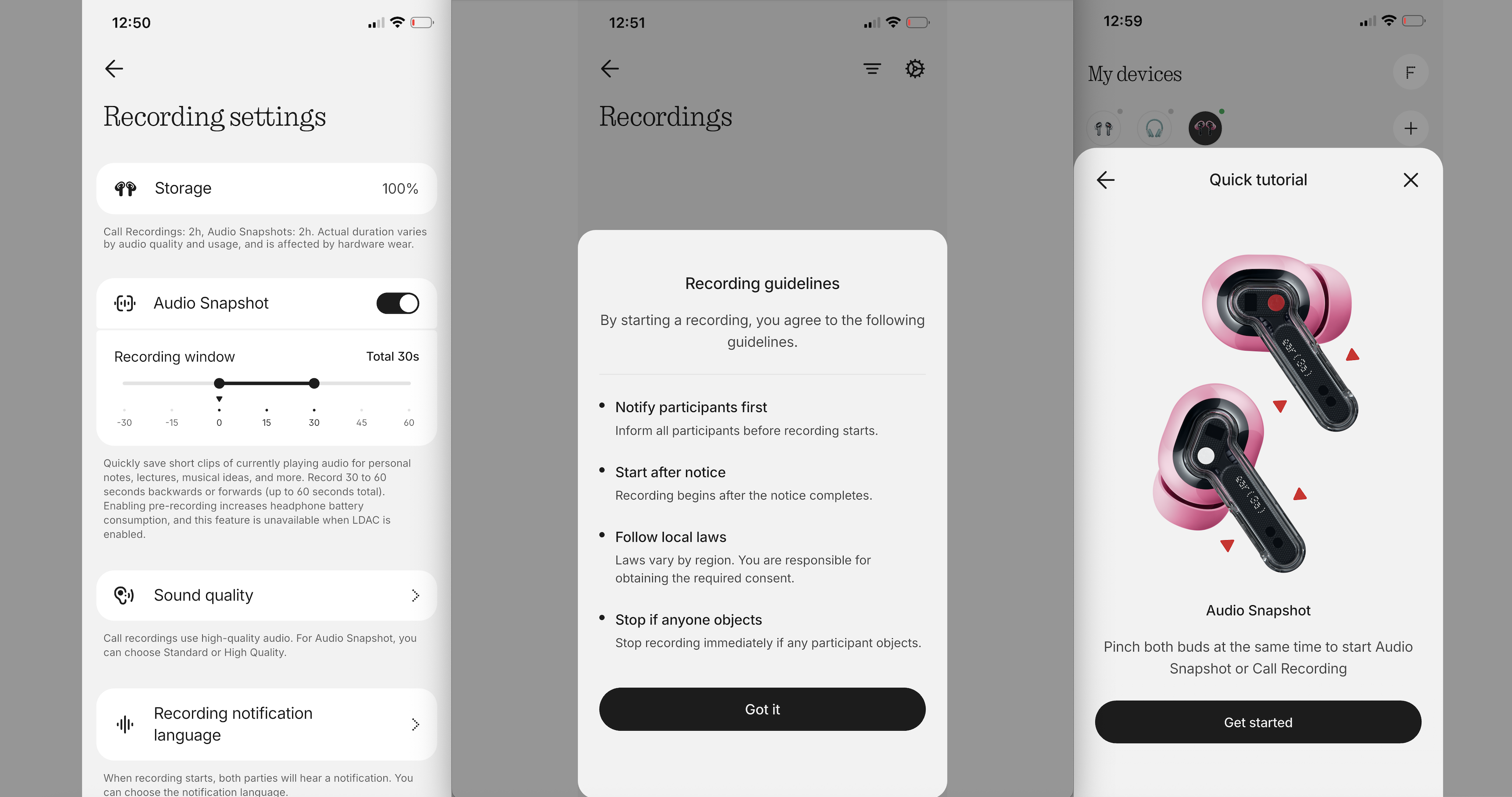
So what is Nothing doing about it? In its reviewers' guide, the company says it "aligns with internationally recognised privacy standards ISO 27001, ISO 27701 and EN 18031". To this end, during setup, the Nothing X app also displays a short tutorial reminding users to obtain permission before recording calls — as shown below.
Interestingly, on a traditional phone call made in the UK, the "prompt" Nothing promises will be played to everyone on the call is a simple beep. On Google Meet, a female voice announces "This call will be recorded in 3, 2, 1", presumably so anyone not OK with that can scream "Oh no you don't!". From smartphone to smartphone, there's no vocal.
Thanks to the Nothing Ear (3a)'s 32MB of onboard storage, you can start recording with just a pinch of the stems, storing up to two hours of audio on the earbuds themselves. You can also record and transcribe voice notes from apps such as Instagram or WhatsApp — and from August, Nothing says it will add summaries of call recordings, speaker identification and the ability to create calendar reminders based on what was discussed.
Nothing (app screen grabs by Future) Nothing (app screen grabs by Future)
What these earbuds can't do is record conversations that take place around you, or indeed your own voice. So, thankfully, there's no scope for eavesdropping around the water cooler.
However, my thoughts on this are clear— I'm not wholly OK with it. It puts the onus on buyers to adhere to laws, and opens the door for flouting rules of consent. I tried muting my mics to see whether the beep could be silenced, but it still plays for the person on the other end of the call to signal that recording has begun. Nevertheless, I think I've made my concerns around this feature clear.
Elsewhere, you get Bluetooth v6.0 and LDAC support for hi-res audio (the Sony-developed codec that lets you stream high-resolution audio up to 32-bit/96kHz over Bluetooth at up to 990kbps, if your device supports it and the file is up to scratch). While the predecessor did also include the latter, it remains a valuable inclusion here.
There's also onboard spatial audio, albeit of the "static" variety rather than head-tracked spatial audio that keeps the sound anchored to your source device as you move your head. It adds a little extra depth and height to the presentation, but for me, the effect is decidedly light-touch compared to what you get from pricier earbuds.
Note that you don't get the Ear (3)'s splendid personalized hearing tests, or the useful "walkie-talkie" Super Mic. That said, there's in-ear detection (to pause music when you remove the buds and resume it when they're in), a low-lag toggle for gaming, seamless pairing, multipoint to two devices, an ear-tip fit test and a Find My Earbuds feature, which emits a rattlesnake-style sound from whichever bud you're trying to locate, to help you find it.
Nothing's Transparency mode is decent. It's a little warm, but it still delivers a more three-dimensional presentation than many buds at this level. I could hear the placement of the TV, voices in my home and a dog outside, rather than all of these sounds appearing tinny, omnipresent and seemingly on top of one another.
When deploying ANC (rather than "Transparency" or "Off"), you can once again select from High, Mid, Low, and Adaptive noise-nixing profiles. High is decent: Nothing tells me performance is up to 45dB (effective to 5 kHz), which equates to a 17.1% improvement compared to the Ear (a), thanks to a software upgrade and improved architecture regarding where the mic sits.
The issue in 2026 is the existence of the AirPods Pro 3 and Bose QuietComfort Ultra Earbuds (Gen 2). Although it would be unfair to compare like for like, owing to the chasm in pricing, you can get better if you're willing to pay for it. That said, the ANC here is no slouch, giving a fairly clean, largely uninterrupted and issue-free neutral background for my music.
If you have a Nothing Phone, the Nothing X app and the ChatGPT app, then you can once again you can also access ChatGPT access via the Ear (3a)'s stem; simply squeeze and talk.
The new EQ tab is now an eight-band offering (up from three in the older buds), as well as the more basic audio splodge Nothing made its own — and which I rather like since it reminds me of Nura True Pro's visual depictions, rather than a mixing desk. You also get five presets in the Advanced tab, and four in the Simple tab — but you can create your custom EQ using whichever system you prefer.
And I think you'll need to get familiar with these, as I'm about to explain…
Features score: 4 / 5
Voice AI using ChatGPT is coming using Nothing Ear (a) using your Nothing smartphone… (Image credit: Future)
Nothing Ear (3a) review: Sound quality
LDAC support represents value
Fun, V-shaped sound — if a little quiet
A little bass-heavy from the box, but you can fix it
As was the case with their siblings, it would be wrong of me to knock Nothing Ear (3a) in the sonic department for this money. The sound quality is easily worthy of the outlay.
That said, there are a few points to bring to your attention.
Those with a Sony or Samsung smartphone (I used a Sony Xperia) will find much to celebrate in LDAC music streaming. In My Chemical Romance's The Ghost of You, guitars snake from my left to right ear in a cohesive mix — with Gerard Way's vocal central, petulant and every bit as emotive as I remember it in the mid-noughties.
Even when I stream Apple Music songs from my iPhone, the Nothing Ear (3a) offer ample width as my playlist continues to Thank You For the Venom and the intro guitars find a spacious home in my left ear. There's room around every stem in the mix to shine, but they're all held properly in check, even in this fast-paced and challenging song.
It's a little bass-heavy at times, though. Fleetwood Mac's The Chain is a good test of a regimented low-end, and alongside the kick-drums, I did lose just a little of Stevie Nicks, Christine McVie, and Lindsey Buckingham in that glorious upper harmony through the chorus. It seems to be Nothing's modus operandi to offer a bassy listen generally, and while I did find that the new Advanced EQ tab helped, I think the enhanced low-end went a little far here.
Nothing offers a "Q Factor" in addition to what you've just tweaked in the 8-band tab, to control the width or sharpness of your adjustment. So, imagine it as a "quality factor" (because that is what it stands for), where the number you select between 0.1 and 10 determines how wide or narrow of a frequency range is boosted or cut — all of this specific to your chosen frequency. Selecting a low Q Factor will generate a wider, more gentle curve to your adjustment, where a high Q Factor will make the change narrower, steeper and more effective around that specific frequency augmentation (or reduction).
I eased off the bass and selected a Q Factor of 3.2, but you must of course play with these things yourself — and sadly, Nothing hasn't included its hearing tests here, to check how perceptive your ears are within this particular tuning.
For dynamics and nuance, the Nothing Ear (3a) are perhaps a shade less engaging and arresting than I'm used to, owing to their volume. Once criticism often levelled at Nothing's budget earbuds is they don't go especially loud, and I frequently found myself listening above 50% volume. Also, since battery life is measured at that volume, it did mean the quoted "4.5-hour battery life with ANC deployed" claims although bang on, were still disappointing.
Sound quality score: 4 / 5
See how Ear (a) is just slightly bigger than Ear (2), across the board? (Image credit: Future)
Nothing Ear (3a) review: Design
Curvier case
That 1mm bigger driver is sucks up power
And the battery life isn't great
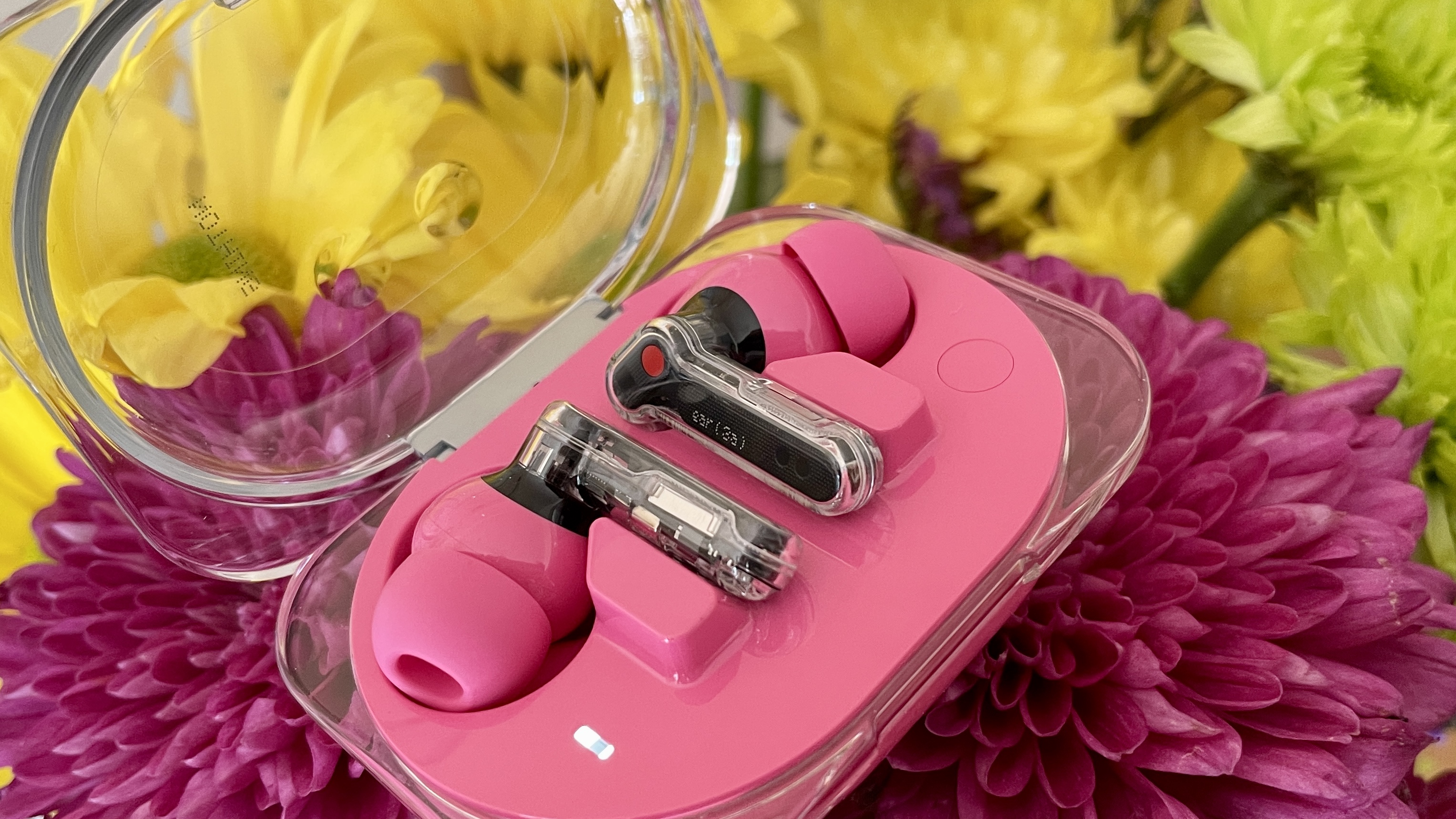
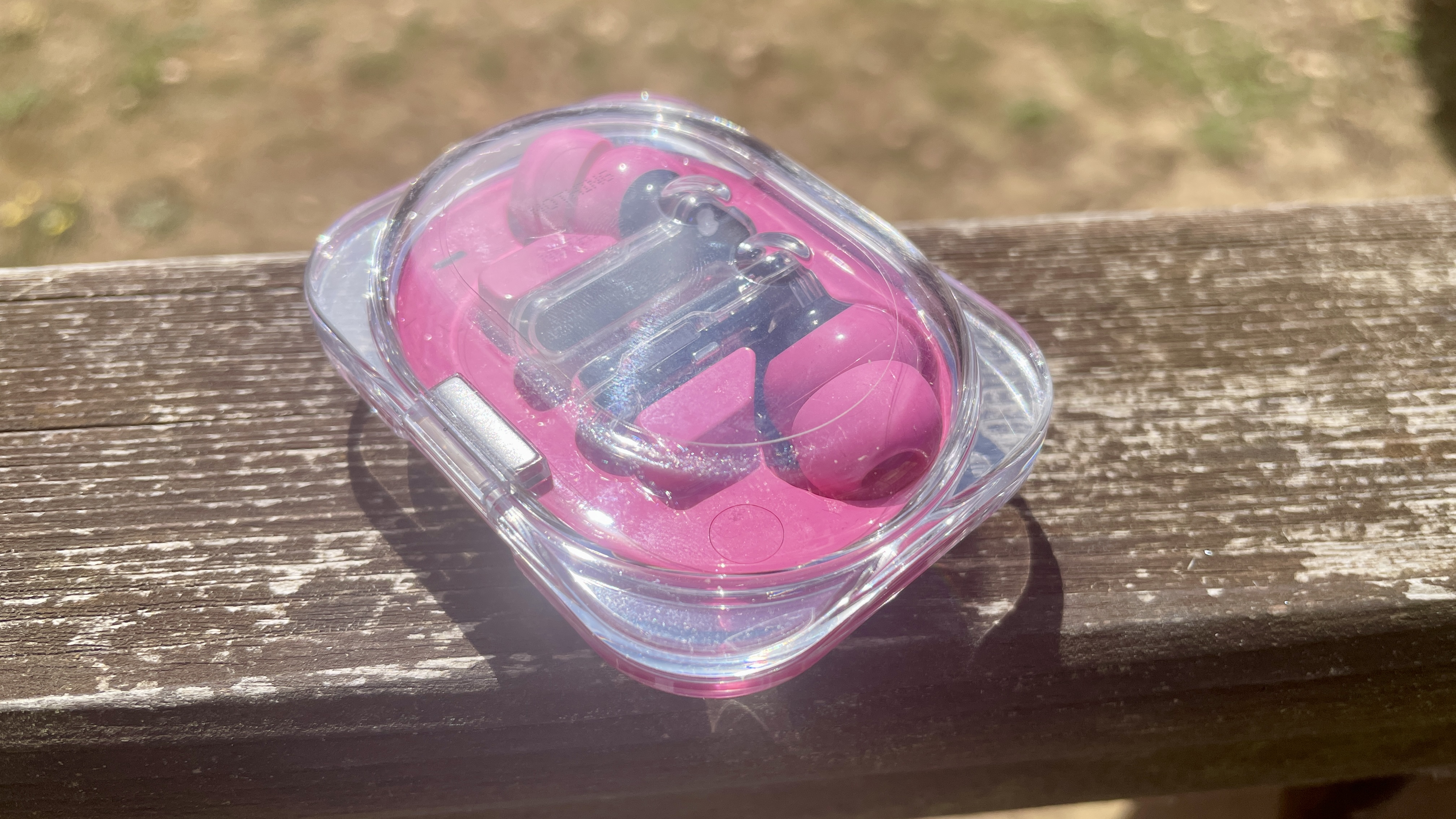
Hold the Nothing Ear (3a) earpieces and case next to their older Nothing Ear (a) and you'll certainly struggle in a game of spot the difference. There's the color, obviously — also available in black, white and a slightly different yellow to the hue I love in this older set — and the 50% curvier case. There's also a trio of LEDs on the case that deliver a total of six status indications for battery status, pairing status, charging levels and so on.
For further tweaks, we have to look deeper.
The driver is now 12mm rather than 11mm and features an "aerospace-grade diaphragm". You also get an extra set of ear-tips in the box, four in total, and although the XS will appeal to owners of small ears, the actual earpieces here aren't tiny, despite being lighter in weight than Ear (a), at 4.53g versus 4.8g. The actual design of the tips has been finessed, too: they're a little thicker and more flared across the outer wall. I found the buds very secure, if a little big to accommodate comfortably over my small-ish ears over the course of long listening sessions.
I've said it before now and I'll say it again: I think we've reached a point of diminishing — perhaps even negative — returns when it comes to ever-larger earbud drivers. Every new release seems to tout a bigger driver without adding weight, as if bigger automatically means better. But where does it end? 13mm drivers? 15mm drivers? To my ears, the Ear (3a)'s 1mm larger driver hasn't negatively impacted the sound, but I don wonder if it's contributed to sthe shorter battery life. In my briefing, I was told the buds themselves would last 10 hours — but that turned out not to be the case.
While the battery in each earpiece — along with the larger driver and onboard 16MB flash drive — works hard to power the buds, it's only good for up to 6 hours without ANC, or 4.5 hours with ANC turned on. And remember, I had to pump the volume up higher than 50%, which the level at which those measurements are typically taken. With the case, you'll get up to 25 hours with ANC off, or up to 18 hours with it on.
None of these stats is much to write home about. Take Nothing's own Ear (a), which offered up to 9.5 hours of playback on a single charge with ANC off, and about 5.5 hours with ANC on. Now, consider the very inexpensive Cambridge Melomania A100, which offer 11 hours per charge or up to 39 hours with the case, along with aptX Lossless. I know which I'd rather take on long road-trips…
Again, Nothing's pinch-to-control stems return here, and while volume controls aren't enabled by default, you can assign them in the Nothing X app — provided you're happy to sacrifice another shortcut in the process.
While I'm here, a quick note on call-handling. It's absolutely clear and clean as a whistle, thanks to the 3 MEMS mics per bud.
Design score: 4 / 5
Rarely have I had so many colleagues strike up a conversation with me over a set of earbuds (Image credit: Future)
Nothing Ear (3a) review: Value
Still very good-looking earbuds
Decent ANC; not so great for stamina
LDAC adds value, but call-recording (for me, at least) is a no
Before now, I've always championed Nothing's "(a)" buds — and while the basics in the (3a) are fine, there are a few issues that are hard to ignore.
The Call Recording feature is top of the list here. More than any technical limitation, it's the privacy implications that concern me. Much as seeing someone wearing smart glasses now makes me wonder whether I'm being recorded, these earbuds leave me asking why someone might want to capture our conversations. I appreciate that some readers may see this as an overreaction, but it's a genuine concern for me, informed by my own experiences as a woman and former dancer who had to deal with overly familiar fans.
I think the audio quality here is perfectly acceptable for $99 / £99, but the stamina and feature set can be bettered. Even in the open earbuds market, I'd happily direct you to the cheaper Huawei FreeArc or SoundPEATS Clip1 over these earbuds.
Value score: 4 / 5
Should I buy the Nothing Ear (3a)?
Section
Notes
Score
Features
I can't get behind Call Recording — although the ANC is good enough
4/5
Sound quality
An fun listen that's easy to tweak if the bass proves a bit much. Just a tad quiet overall
4/5
Design
Good-looking buds let down by disappointing stamina
4/5
Value
It's hard for me to write it, but the smart money isn't always with Nothing
4/5
Nothing Ear (3a) scores
Solid generally, but with battery concerns and a potentially problematic call recording 'feature'
Features
4
Sound Quality
4
Design
4
Battery Life
2.5
Noise Cancellation
4.5
Value
4
Overall
4
012345
Group 1 Data
Product
Features ()
Sound Quality ()
Design ()
Battery Life ()
Noise Cancellation ()
Value ()
Overall ()
Nothing Ear (3a)
4
4
4
2.5
4.5
4
4
Buy them if...
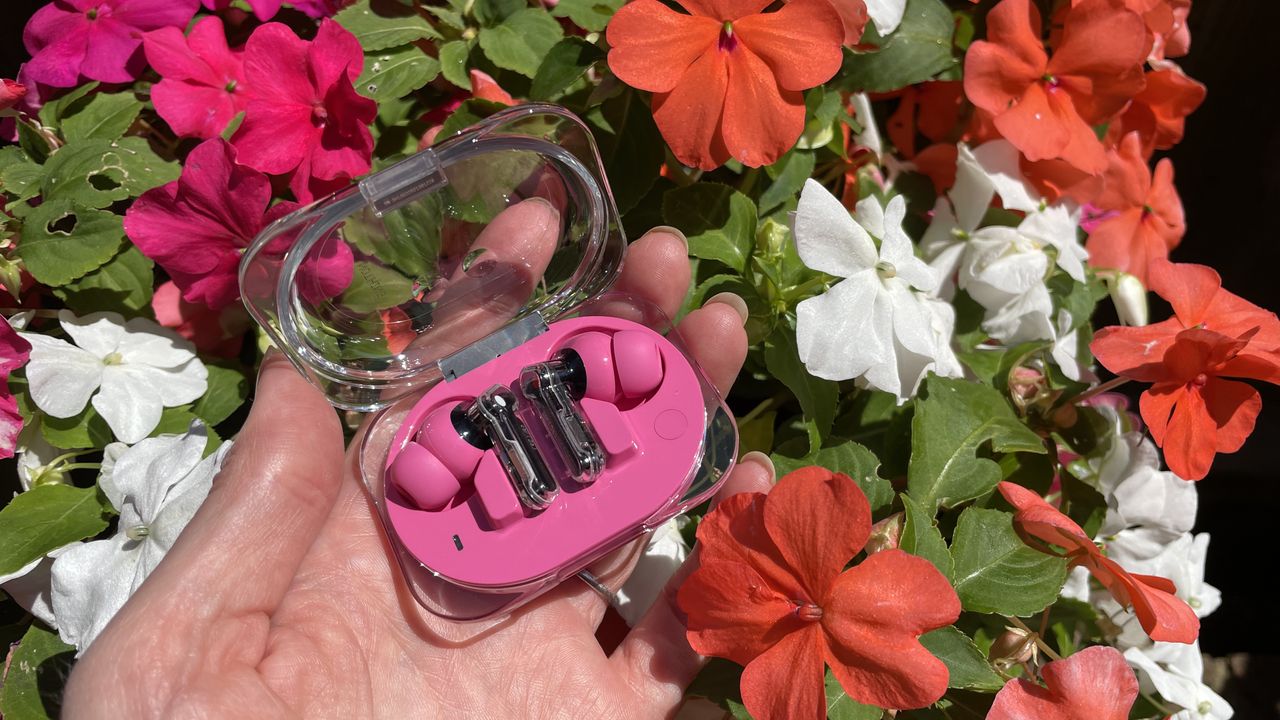
You want buds that say "look at me" The pink colorway is super-striking and fun, especially against their black/transparent stems.
You have a Sony or Samsung phone LDAC support for $99 / £99? That's good stuff.
You want to record your phone calls These buds do offer the option to record and transcribe up to 2 hours of audio from calls, songs or voice notes — and you don't need a Nothing source device to do it.
Don't buy them if...
You want extra-special spatial audio Nothing adds its "static" spatial audio profile here, for a slightly more immersive sound profile to your music. For me, though, it's a little bit lightweight.
You have bijou ears This design just about works for my smaller ears with the small ear-tips (there's even an XS option included now), but if your concha or ear-well is particularly diminutive, then you may still find these earpieces a little big.
The idea of covert surveillance bothers you As a journalist, I have no issue with recording when everyone has consented. My concern is Nothing's playful marketing if in-call recording as a lifestyle feature, despite the obvious privacy implications.View Deal
Nothing Ear (3a) review: Also consider
Nothing Ear (3a)
Cambridge Audio Melomania A100
Huawei FreeArc
Price
$99 / £99 / Approx. AU$192
$149 / £119 / AU$TBC (but around AU$249) at launch, discounted now
£99 (roughly $130, AU$200) but discounted now
Drivers
12m custom
10mm Neodymium dynamic
17mm x 12mm (open earbuds)
Active noise cancellation
Yes
Yes
No
Quoted battery life
Buds: 6 hrs (without ANC) or 4.5 hrs with ANC; Total with case: 18 hrs with ANC (or 25 hrs without ANC)
11 hours per charge; up to 39 hours with the case
7 hours (earbuds), 23 hours (total)
Weight
4.53g
4.7g
8.9g
Connectivity
Bluetooth 6.0, LDAC, USB-C (no wireless charging)
Bluetooth 5.4 with LDAC and aptX Lossless
Bluetooth 5.2
Frequency range
20 Hz – 40 kHz
Not stated
Not stated
Waterproofing
Yes, IP54
Yes, IPX5
Yes, IP57
Other features
Audio Snapshot and Call Recording; auto-off, static spatial audio, ChatGPT with a Nothing Phone
7-band EQ, ANC, DynamEQ for optimised tuning, wireless charging, 3 mics per bud
Huawei AI Life app, 10-band EQ, audio presets, find your earbuds
Huawei FreeArc Up for taking a punt on affordable and great-sounding open earbuds? The FreeArc are available at a generous discount right now — but in all honesty, we loved them even at full price. Read more on this in our full Huawei FreeArc review
Cambridge Audio Melomania A100 These June 2025-release earbuds didn't get the fanfare they deserved, unless you count our glowing five-star review, of course. They don't look as flamboyant — but oh, do they sound good, and the ANC is great too. Did I mention they've been discounted recently? Highly recommended for their current price. Learn more in our in-depth Cambridge Melomania A100 review
How I tested the Nothing Ear (3a)
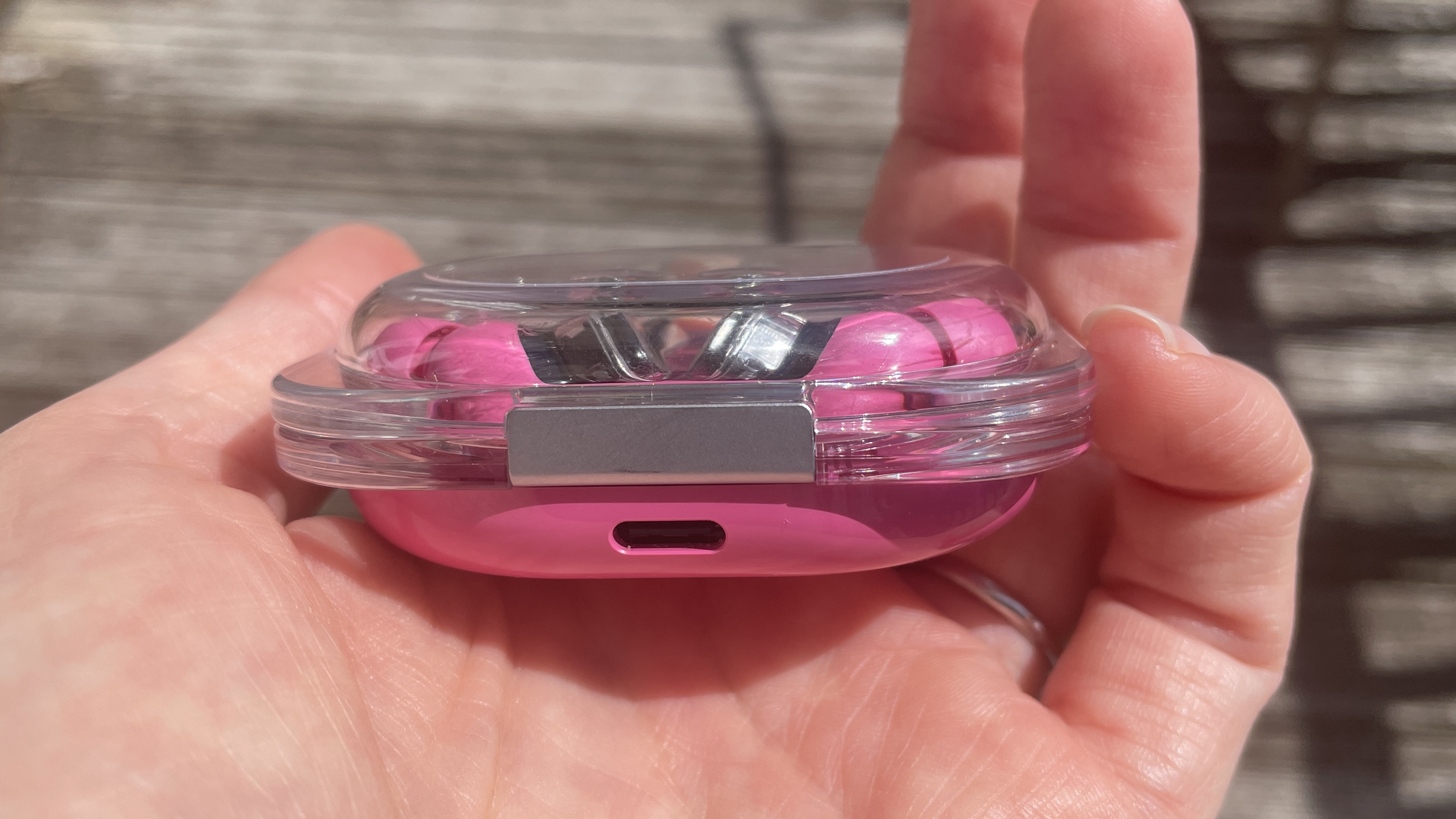
USB-C for juicing up, but there's no wireless charging (Image credit: Future)
Tested for two weeks, listened against the Ear (a), Bose QuietComfort Ultra Earbuds (Gen 2), Technics EAH-AZ100 and AirPods 4
Listened in the office, walking along a beach, on a train into London, into Central London and at home
Listened to Tidal Masters, Apple Music Lossless tracks and Spotify on an iPhone 15 Pro, MacBook Pro and Sony Xperia smartphone
The Nothing Ear (3a) became my primary musical companions for well over two weeks — after a 48-hour run-in period.
They accompanied me to work (walking brusquely to our Paddington office and on the London Underground to various press events) and even walking on a beach at sunset.
To assess comfort levels, ANC and battery life claims, I followed TechRadar's meticulous methodology testing and found much of note — including slightly disappointing stamina.
To check the audio quality across the frequencies, I listened for several hours to my own reference playlists on Apple Music and Tidal, alongside TechRadar's reference tracks, plus podcasts and movies. Additionally, I wore them to watch YouTube tutorials from my MacBook Pro.
I’ve been testing audio products for well over seven years, full-time. As a dancer, aerialist and musical theater performer in another life, sound quality, fit, and user experience have always been a priority for me, but having heard how wonderful ANC can be when done well, I know what I'm listening to here, too.
Surfshark One+ réunit VPN, antivirus et outils de protection des données dans une seule offre.Une solution pensée pour renforcer la confidentialité en ligne sans multiplier les abonnements.
Associer la puissance d'un processeur Intel Core 7 de dernière génération à un confortable écran de 16 pouces pour moins de 1 100 € constitue une opportunité rare. C'est pourtant exactement ce que propose le fabricant avec cette configuration personnalisée au meilleur prix.
Dénicher un smartphone doté d'une autonomie redoutable, d'un écran OLED lumineux et d'une conception renforcée est difficile sans y mettre le prix. C'est pourtant ce qu'il est possible de trouver en se rendant sur AliExpress. Sur le site marchand, le polyvalent HONOR Magic8 Lite s'affiche sous...
Tous les quatre ans depuis 1950, le Congrès international des mathématiciens décerne des médaille Fields à quatre lauréats qui doivent être âgés de moins de 40 ans. Cette année 2026, l'une revient à la Chinoise Hong Wang et c'est un événement car elle est la 3e femme lauréate de ce « prix Nobel...
In U.S. states such as California, driver’s licenses and state IDs can be added to Apple Wallet, enabling residents to seamlessly and securely add and present their IDs using iPhone or Apple Watch.
Utah residents may soon be able to store their driver’s licenses and IDs in Apple Wallet on iPhone and Apple Watch. MacRumors has uncovered references to a Utah ID in Apple’s backend systems, indicating the company is actively working on support. While the state already offers a mobile driver’s license through a standalone app, that solution currently lacks Apple Wallet integration.
Utah’s mobile driver’s license FAQ page still says that it is still in the initial planning process of adding Utah IDs to Apple Wallet, but it may not be up to date.
The site also says that when Apple Wallet integration launches, iPhone users who already use the mobile app for their Utah ID will be able to download it to Apple Wallet.
Apple announced plans to add Utah driver’s licenses and IDs to the Apple Wallet app way back in 2021, but no integration has materialized. Utah was one of the first states Apple mentioned when rolling out the feature.
Other states planning to add support for driver’s licenses in Apple Wallet include Connecticut, Kentucky, Mississippi, Oklahoma, and Virginia.
MacDailyNews Note: Multiple states and Puerto Rico have already implemented support for users to store their driver’s licenses and IDs in Apple Wallet on iPhone and Apple Watch, including:
Arkansas*
Arizona
California
Colorado
Georgia
Hawaii
Illinois
Iowa
Maryland
Montana
New Mexico
North Dakota
Ohio
West Virginia
*some users in specific jurisdictions in Arkansas may still see staggered access depending on whether their state agency has finalized all local database integrations.
Please help support MacDailyNews — and enjoy subscriber-only articles, comments, chat, and more — by subscribing to our Substack: macdailynews.substack.com. Thank you!
Dr. Tsimerman won one of four Fields Medals, an award for top mathematicians under 40, for his work on the André-Oort conjecture, but is now changing his focus to artificial intelligence.
When NASA’s OSIRIS-REx spacecraft delivered pristine samples from theasteroid Bennu back to Earth in 2023, scientists knew they were receiving one of the most chemically untouched collections of material ever recovered from the Solar System.
Since then, the returned grains have steadily transformed researchers’ understanding of how asteroids formed, howwater altered primitive worlds, and even how the ingredients for life may have spread through the early Solar System.
Now, a new study, published in Nature Communications, has uncovered another surprise hidden inside those microscopic particles. Embedded within Bennu are tiny mineral fragments that formed during the Solar System’s earliest moments—less than 100,000 years after its birth—and they may reveal that the asteroid’s ancient parent body formed much farther from the Sun than scientists once suspected.
The research suggests that Bennu inherited some of the oldest surviving solids ever created, while simultaneously preserving evidence that Jupiter’s formation may have acted as an enormous cosmic filter, separating different populations of dust before planets had even fully formed.
“Our observations of phyllosilicates replacing olivine and interstitial phyllosilicates between olivine grains within AOAs… collectively indicate that these refractory inclusions experienced aqueous alteration on Bennu’s parent planetesimal,” researchers write. “Therefore, they were incorporated into the parent planetesimal before the onset of aqueous alteration, during which phyllosilicates and magnetite formed.”
“These mineralogical, isotopic, and chronological similarities among refractory inclusions in Bennu samples, Ryugu samples, and CI chondrites provide evidence that their parent planetesimal(s) accreted a common suite, and likely similar relative abundances, of high-temperature refractory inclusions and their fragments,” researchers write.
The research concentrates on “refractory inclusions”—tiny mineral-rich objects known as calcium-aluminum-rich inclusions (CAIs) and amoeboid olivine aggregates (AOAs). These objects are widely considered the oldest solid materials to condense from the hot gas surrounding the newborn Sun.
Long before planets existed, the infant Solar System consisted of a rotating disk of gas coupled with dust known as the protoplanetary disk. Temperatures near the young Sun exceeded 2,000 degrees Fahrenheit (roughly 1,100 degrees Celsius), allowing only the most heat-resistant minerals to crystallize.
These refractory inclusions were among the very first solids to emerge from that environment before eventually being transported throughout the growing Solar System.
Although scientists have found such inclusions in meteorites for decades, Bennu offered an unprecedented opportunity to examine them in material collected directly from an asteroid rather than from meteorites that survived passage through Earth’s atmosphere.
To investigate, researchers analyzed polished sections prepared from 12 Bennu particles using scanning electron microscopy, transmission electron microscopy, oxygen isotope measurements, and radioactive aluminum-magnesium dating techniques.
The team identified six amoeboid olivine aggregates and three calcium-aluminum-rich inclusions, all remarkably small—none exceeding roughly 100 micrometers across, or about the thickness of a human hair. This turned out to be one of the study’s most important discoveries.
The mineral chemistry and oxygen isotopes showed these inclusions formed in an extremely hot, oxygen-16-rich environment during the Solar System’s earliest stages. Radioactive dating using aluminum-26 indicated at least one inclusion formed essentially at the very beginning of Solar System history, within roughly the first 100,000 years after the earliest known solids condensed.
In other words, Bennu contains fragments that have survived for approximately 4.567 billion years with surprisingly little alteration. Yet, those ancient relics also preserve evidence that they later encountered liquid water.
Several inclusions show minerals partially replaced by phyllosilicates—water-bearing clay minerals—while magnetite and other alteration products reveal that water once circulated through Bennu’s ancient parent body after these primordial objects had already become incorporated into it.
For scientists, that sequence helps establish a timeline. First, the earliest high-temperature solids formed close to the newborn Sun. Later, they were transported outward through the protoplanetary disk. Only after they became part of Bennu’s larger parent asteroiddid liquid water alter portions of the rock.
Researchers found distinct similarities between Bennu’s inclusions and those previously identified in samples returned from Japan’s Hayabusa2 mission to asteroid Ryugu, as well as in rare CI carbonaceous chondrite meteorites found on Earth.
The oxygen isotopes, crystal chemistry, and formation ages all closely match, suggesting these seemingly distant objects inherited material from the same population of ancient Solar System building blocks.
That mutual heritage points toward a surprisingly interconnected early Solar System, where material formed close to the Sun was efficiently transported across enormous distances before eventually becoming incorporated into multiple asteroid populations.
However, the absence of something proved just as revealing as what scientists found.
Unlike many carbonaceous meteorites, Bennu contains no large refractory inclusions larger than about one-tenth of a millimeter. Other meteorites frequently preserve inclusions ranging from submillimeter sizes up to several centimeters across.
According to the researchers, the missing population may reflect the increasing influence of the Solar System’s first giant planet.
As proto-Jupiter accumulated mass, its gravity likely created a pressure bump within the gas disk encircling the young Sun. Such pressure bumps act as natural traffic jams for dust, trapping larger particles while allowing much smaller grains to continue drifting through the disk.
Under this scenario, larger refractory inclusions became concentrated closer to Jupiter’s orbit. At the same time, only the smallest particles were able to migrate farther outward into the distant regions where Bennu’s parent body eventually formed.
If correct, Bennu’s microscopic inclusions effectively record the influence of Jupiter before the giant planet had even fully matured.
The hypothesis also helps explain why Bennu, Ryugu, and CI meteorites all possess nearly identical populations of tiny refractory inclusions while lacking the larger varieties commonly found elsewhere.
Rather than showing different source materials, the distinction may instead reflect where—and perhaps when—their parent bodies assembled within the developing protoplanetary disk.
The findings similarly reinforce earlier studies suggesting Bennu is among the Solar System’s most chemically primitive objects. Because large refractory inclusions contain unusually high concentrations of certain elements, their absence helps preserve Bennu’s overall composition close to that of the earliest solar nebula from which the planets formed.
That makes the asteroid an unusually valuable time capsule. Every new microscopic grain examined inside the OSIRIS-REx collection provides another insight into processes that occurred billions of years before Earth existed as a habitable world.
Rather than simply representing rubble from a small asteroid, Bennu appears to preserve a remarkably faithful record of how the Solar System sorted, mixed, transported, and assembled its earliest building materials.
The study also demonstrates why sample-return missions have grown increasingly important to planetary science. Laboratory instruments on Earth can perform measurements impossible for spacecraft operating millions of miles away, letting researchers reconstruct events that occurred within the Solar System’s first fractions of a million years.
“We conclude that Bennu’s parent planetesimal, like those of Ryugu and CI chondrites, accreted small refractory inclusions that persisted in the outer Solar System beyond the influence of the proto-Jupiter-induced pressure bump,” researchers write. “Taken together, these findings highlight the need to integrate Bennu samples into comparative studies of early Solar System solids to better constrain the diversity and possible genetic links among planetesimal formation pathways,” researchers write.
Tim McMillan is a retired law enforcement executive, investigative reporter and co-founder of The Debrief. His writing typically focuses on defense, national security, the Intelligence Community and topics related to psychology. You can follow Tim on Twitter:@LtTimMcMillan. Tim can be reached by email: tim@thedebrief.org or through encrypted email:LtTimMcMillan@protonmail.com
Les promotions sur les tondeuses sans fil en pleine saison ne courent pas les rues. Avec son prix ramené de 199,99 € à 179,99 € chez Amazon, la Litheli offre une belle occasion de s'équiper d'un modèle léger, pratique et sans câble avant que cette offre ne disparaisse.
ChatGPT Health is returning with substantially wider access, giving more iPhone users the option to connect information from Apple Health directly to the AI assistant.
The expansion follows a limited test introduced in January. OpenAI is now gradually making the dedicated Health experience available to eligible ChatGPT Free, Go, Plus and Pro users in the United States who are at least 18 years old.
Despite the close Apple connection, this is not a feature created by Apple or built directly into the Health app. OpenAI operates the service through ChatGPT, while Apple Health serves as one of the sources users can voluntarily connect.
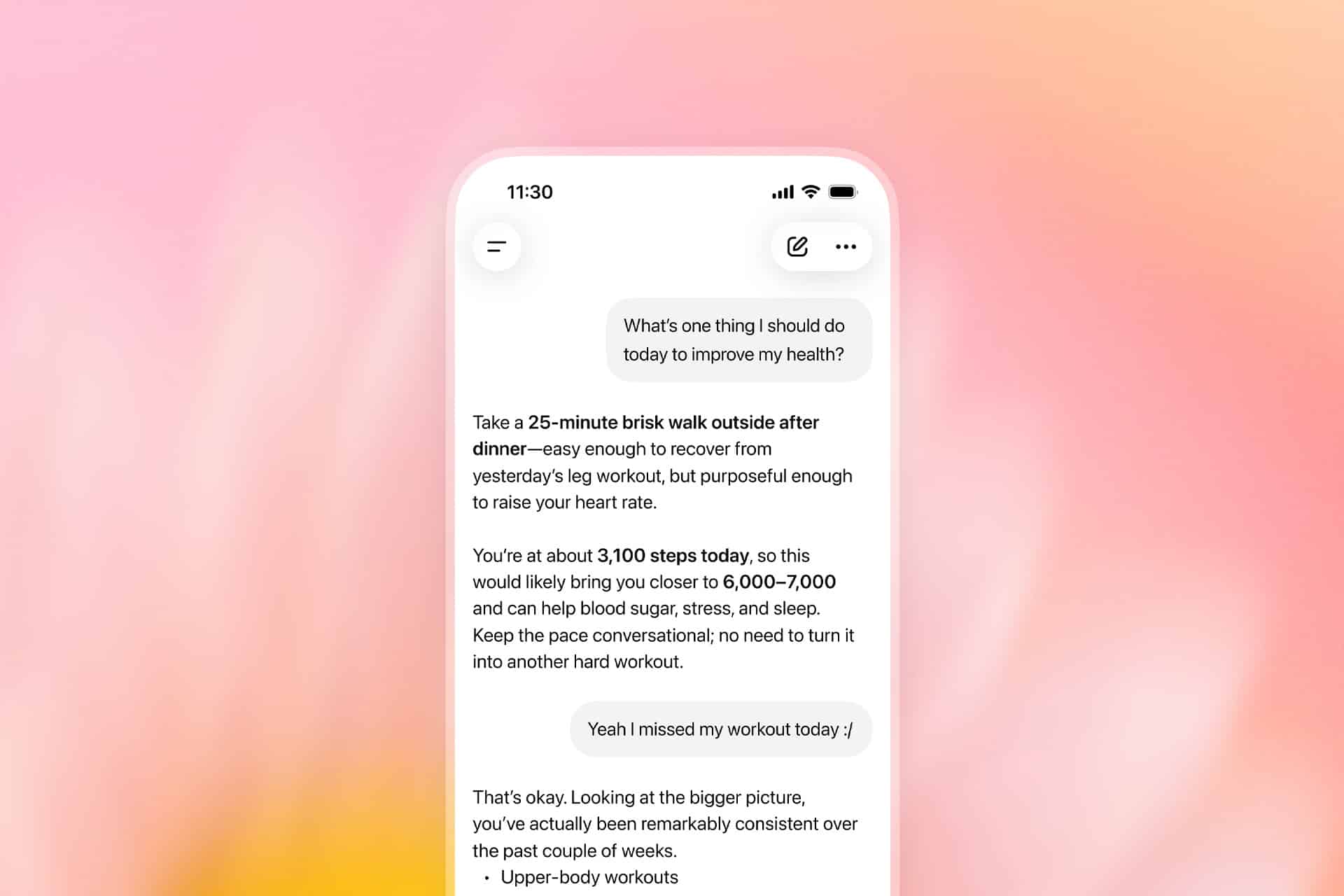
Once permission is granted, ChatGPT can examine selected health and fitness information stored on iPhone, including activity, sleep, workouts and other measurements collected by compatible apps and devices. Users can then ask questions about changes over time without manually exporting records or uploading screenshots during every conversation.
Image Credit: OpenAI
ChatGPT Health Reaches More iPhone Users
ChatGPT Health originally appeared as a limited early-access experience for a small group of testers. The expanded rollout replaces that narrow availability with support for eligible adult users across the United States, although OpenAI says access may take several weeks to reach every account.
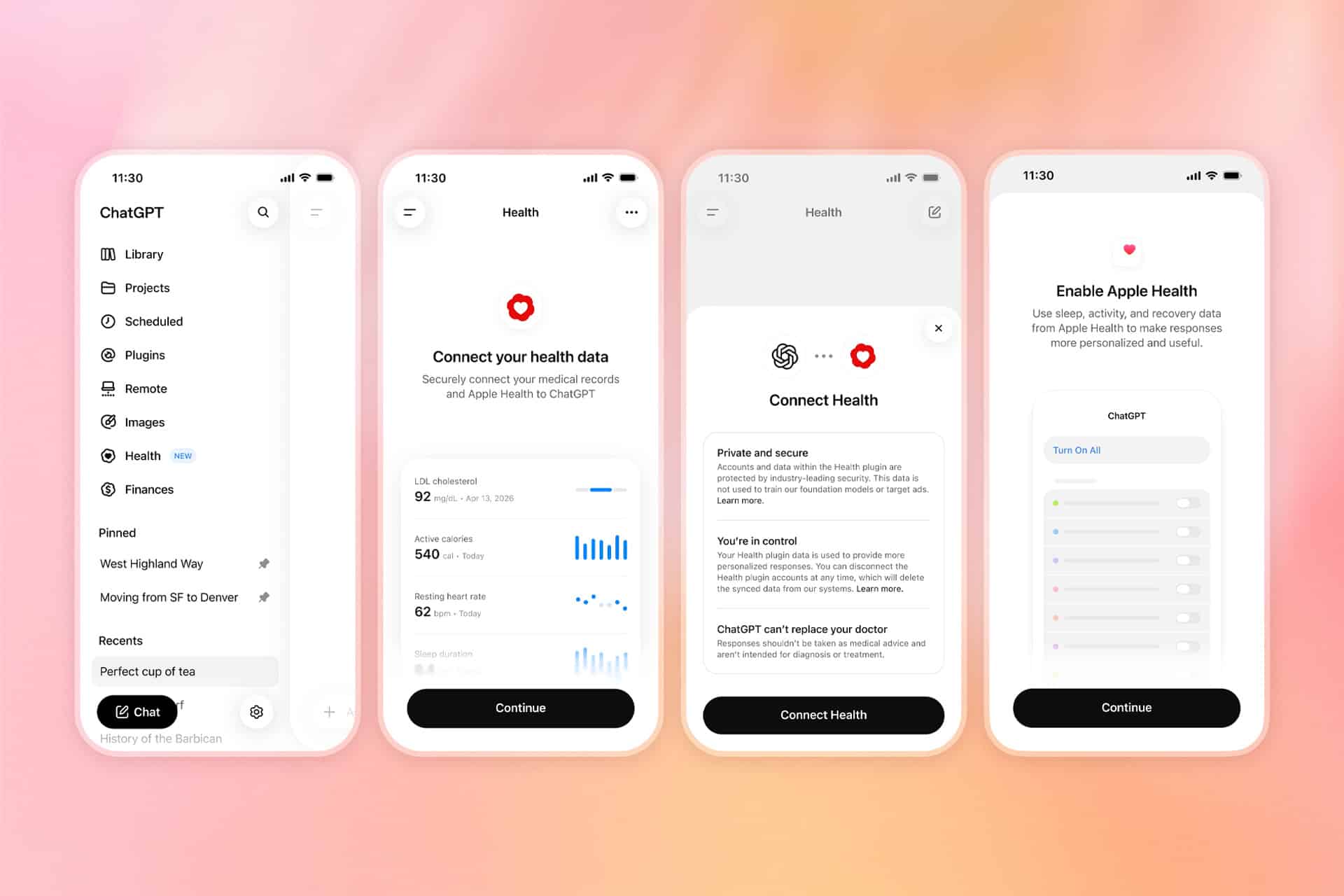
The feature works on the ChatGPT website and iOS app, but connecting Apple Health requires an iPhone. Users also need a recent version of the ChatGPT app before the Health option appears in the sidebar or More menu.
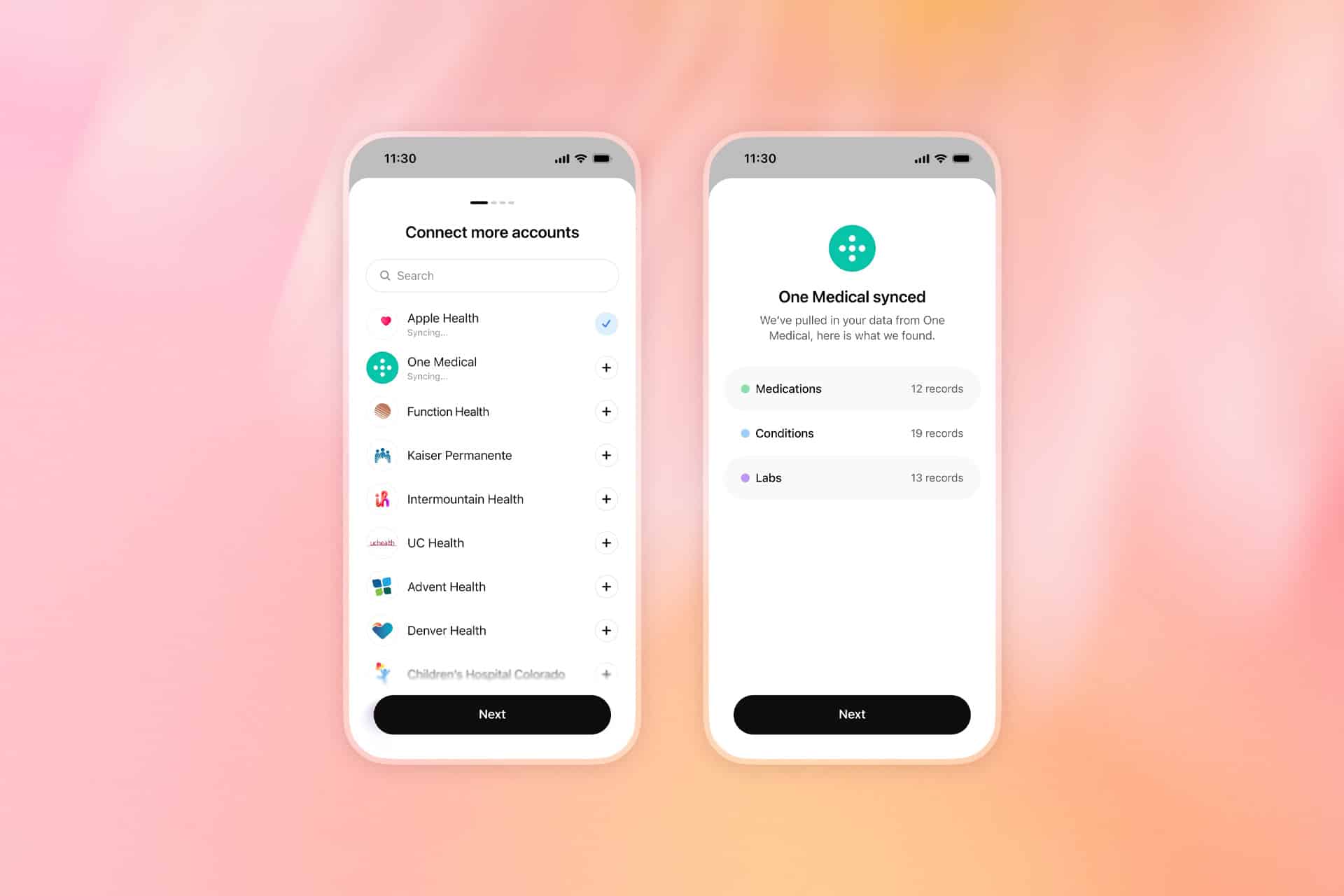
Apple Health is only one part of the system. ChatGPT can also connect to supported medical-record portals, One Medical and Function Health. Bringing those sources together allows the assistant to answer questions using a broader personal context than activity data alone.
A user could ask how sleep duration has changed across several weeks, whether workout frequency declined after a schedule change or how recent laboratory results compare with earlier tests. ChatGPT can also help organize questions before a medical appointment or summarize changes found across connected records.
Information from third-party fitness services can reach ChatGPT through Apple Health when those apps already share their data with the iPhone database. That may include measurements from platforms such as Garmin, Oura, Whoop, Strava and MyFitnessPal, depending on which categories each service makes available.
Not every proprietary score transfers. An app may calculate its own readiness, recovery or sleep score without writing that exact result into Apple Health. ChatGPT can only use the information made available through the connected source and approved by the user.
After synchronization, health information can inform responses throughout ChatGPT rather than remaining limited to conversations opened from the Health tab. The assistant normally asks for permission before using connected information, and users can also add “@Health” to a prompt when they specifically want a response based on their records.
Image Credit: OpenAI
Apple Health Data Gains a Conversational Layer
The appeal of the integration comes from turning a large collection of measurements into questions expressed in ordinary language.
Apple Health can already organize trends, highlights, medications, laboratory results and activity records. ChatGPT adds a conversational layer capable of comparing those categories or explaining them in a more personalized format.
Someone preparing for an annual physical could ask for a summary of meaningful changes since the previous appointment. A runner might request a comparison between training volume, sleep and resting heart rate. Another user could ask which information deserves discussion with a clinician after receiving new laboratory results.
That does not make ChatGPT a doctor. OpenAI says the feature is intended to support medical care rather than diagnose conditions or recommend treatment. Urgent symptoms and emergencies still require professional assistance.
The distinction is especially important because health data can appear more conclusive than it is. A change in heart rate, sleep or activity may have several explanations that cannot be determined from an iPhone record alone. Wearables can identify patterns, but they do not automatically reveal the medical cause behind them.
ChatGPT may help users notice relationships and prepare better questions. It should not be treated as the final authority on whether a symptom is harmless, whether medication should change or whether professional care is unnecessary.
The service is also read-only. ChatGPT can examine approved Apple Health information but cannot alter the original records stored on iPhone. It cannot add a diagnosis, change a medication list or write new measurements back into the Health app.
Users retain control over which Apple Health categories are shared. Someone may allow access to steps, workouts and sleep while withholding reproductive health, medications or other sensitive information.
That selective approach may be more appropriate than approving every category simply because the option is available. A useful response does not always require a complete health history.
Image Credit: OpenAI
Privacy Becomes the Central Decision
Connecting Apple Health to ChatGPT creates a different privacy relationship from using health features entirely within the Apple ecosystem.
Apple designs the Health app around on-device protections and user-controlled permissions. ChatGPT Health requires selected information to synchronize with OpenAI systems so the company can analyze it and generate personalized responses.
OpenAI says connected Apple Health data, medical records and conversations using that information are not used to train its foundation models or target advertising. The company also applies additional encryption and isolation protections to health information.
Users can disconnect Apple Health at any time. OpenAI says synchronized data from the disconnected source will be deleted from its systems within 30 days.
Previous conversations are handled separately. Information already included in ChatGPT conversation history remains until those chats are deleted, even after the Apple Health connection is removed.
Memory introduces another consideration. Conversations using Health can create memories when ChatGPT memory is enabled, although OpenAI says memories are not generated directly from synchronized health data. Temporary Chat or separate project memory can reduce how much personal context continues across future conversations.
The new Health experience should also not be confused with the existing ChatGPT integration inside Apple Intelligence. Siri and Writing Tools can use ChatGPT for certain requests without requiring the dedicated ChatGPT app or a connected account.
ChatGPT Health is a separate OpenAI service with its own account, permissions, privacy controls and health-data connections. Using ChatGPT through Siri does not automatically give OpenAI access to Apple Health.
That separation gives users a meaningful choice. They can continue keeping health information inside Apple apps, share only selected categories with ChatGPT or connect medical records for a more comprehensive view.
The expanded rollout makes one of the most personal databases on iPhone available to conversational AI. Its usefulness will depend not only on the quality of the answers, but also on whether users understand exactly which information they are sharing and where it goes after leaving the device.
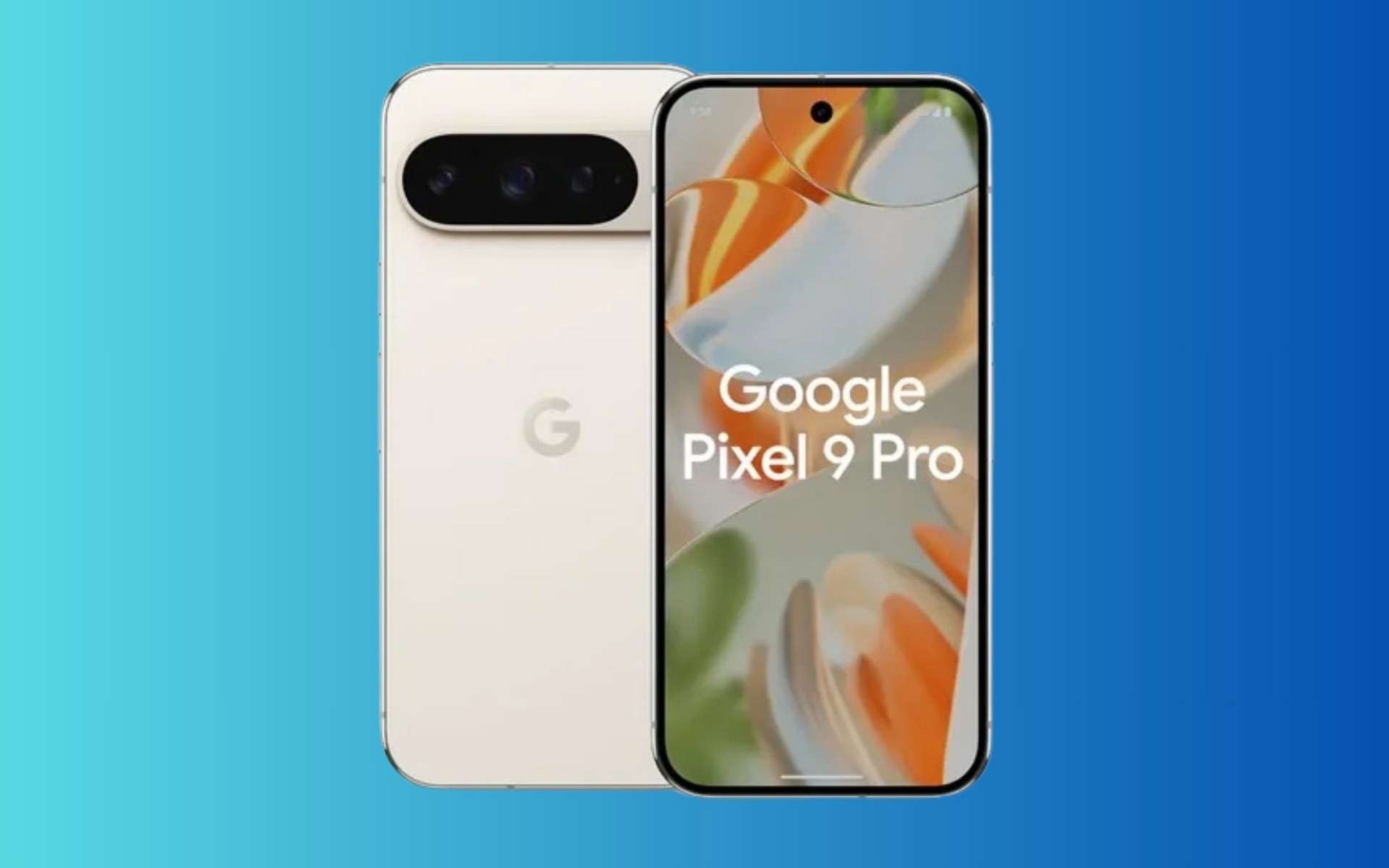
Voir un Google Pixel 9 Pro perdre 50 % de son prix n'arrive pas tous les jours. En promo chez Rakuten, ce smartphone haut de gamme combine un excellent appareil photo, l'intelligence artificielle de Google et un écran OLED 120 Hz dans une offre aussi spectaculaire que rarement observée.
Longtemps associés à l’émerveillement, les aquariums s’imposent désormais comme des lieux de conservation, de recherche et de transmission scientifique. À Boulogne-sur-Mer, Nausicaá a réuni les acteurs du secteur pour dessiner les contours de l’aquarium du futur.

 Login