Specially engineered materials known as metamaterials can boost heat transfer over nanoscale distances compared with conventional materials, thanks to the coupling of quasiparticles known as surface phonon polaritons. This new result, from researchers at Carnegie Mellon University, Stanford University and Purdue University, all in the US, could help improve technologies such as on-chip cooling and thermophotovoltaic systems.
The maximum radiative heat transfer between two macroscopic-sized objects at different temperatures can be estimated by assuming that the objects are “black bodies”. These are ideal entities that absorb all the radiation falling on them and emit thermal radiation according to Planck’s law. This approximation breaks down, however, when the objects are placed within a few hundred nanometres of each other. In this case, they begin to exchange heat much more strongly thanks to a phenomenon known as near-field enhancement, which can exceed the far-field black body limit by several orders of magnitude. This effect is already put to good use in technologies such as heat extraction and thermophotovoltaic systems.
Until now, near-field enhancement had only been observed and studied in naturally occurring materials, such as polar dielectrics, doped semiconductors and metals, explain the study leaders, mechanical engineer Sheng Shen at Carnegie Mellon and electrical engineer Shanhui Fan from Stanford. Although theoretical studies have predicted that metamaterials could surpass the performance limits of naturally occurring materials, there had not previously been any experimental demonstration of metamaterial-enhanced near-field radiative heat transfer. Identifying such metamaterials would be of great use as it would allow the effect to be exploited more widely.
Heat transfer increased by up to four times
Shen, Fan and colleagues observed enhanced near-field radiative heat transfer in a nanodevice platform comprising metamaterials based on arrays of gold split-ring resonators patterned on silicon nitride membranes. The researchers positioned the metamaterials so that they faced each other across a nanoscale gap, observing that heat transfer between them increased by as much as four times compared with similar setups using ordinary materials.
As well as confirming that radiative heat transfer is enhanced over short distances for these metamaterials, the results suggest that the interaction between metamaterials and surface phonon polaritons is responsible for the increase. These quasiparticles are produced by phonons, which are vibrations of the crystalline lattice, as they interact with oscillating electromagnetic fields at the material surface – in this case, those at the surface of the gold metamaterial structures. This coupling allows heat to tunnel across the gap between them and the silicon nitride membranes more efficiently – something that increases the energy flow between the two, explains Shen.
Heat management applications
According to the researchers, the effect could help enhance and manipulate heat exchange at the nanoscale and could find applications in next-generation cooling for high-performance microelectronics, thermophotovoltaic systems for waste-heat harvesting and high-sensitivity infrared detection.
There are still a number of challenges to overcome before such applications see the light of day, however. On the theoretical side, notes Fan, the complex interactions between the metamaterial units and their supporting substrate make numerical calculations and analyses exceptionally difficult. “To address this difficulty, we have developed a numerical tool based on fluctuational electrodynamics to design the structures, alongside a coupled-mode theory model to fully elucidate the underlying physics,” he says.
Experimentally, measuring nanowatt-level radiative heat exchange across a sub-micron gap also demands extreme precision. The researchers tackled this challenge by designing an on-chip device using a “suspended thermal bridge” method that transforms the minute heat exchange into a measurable temperature rise. Indeed, they succeeded in detecting heat flow of less than 1 nW in these nanodevices.
Frost can spread not only along surfaces but also via suspended “ice bridges” that form above them. The discovery of this previously unknown frost-propagation pathway could lead to new ways of making surfaces that resist frost growth, thereby improving the performance of devices that operate in cold, humid environments.
Frost accumulation is a major problem in refrigerators, aeroplanes and heat pumps, to name just a few. On the microscale, it primarily spreads from one individual freezing water droplet to the next via two-dimensional bridges, or causeways, that temporarily form on the surface of an object. Although the wettability of the surface is known to affect the spreading process, the mechanism behind this effect was poorly understood.
Ice bridges can grow in two distinct spatial modes
To learn more, a team led by physicist Nenad Miljkovic at the University of Illinois Urbana-Champaign, US imaged the channel-forming process using high-speed high-resolution optical microscopy combined with a profilometry technique called focal plane shift imaging (FPSI). They found that frost can spread in two distinct ways. On hydrophilic surfaces, causeways form along the substrate, in line with current theoretical models. On superhydrophobic surfaces, however, the situation is quite different. Here, frost spreads via ice bridges that are suspended above the surface in three-dimensional space.
This suspended or “out-of-plane” growth mode represents a fundamentally different pathway for frost propagation, says team member Siyan Yang, the first author of a Nature Physics paper about the work. Previous studies likely overlooked this mechanism, Yang adds, because of limitations in experimental observations.
Superhydrophobic coatings nearly double the frost propagation time
The researchers also studied the growth rate of the different bridge types. They found that suspended bridges grew slower than bridges on the surface due to the reduced thermal coupling between the bridges and the cold substrate. This reduced coupling correspondingly reduces the vapour pressure difference between ice and water droplets (which depends on surface droplet geometry, itself controlled by wettability) and drives down ice growth. Indeed, the team found that the speed at which frost spreads fell more than 80% in this mode.
To test the practical relevance of their findings, the researchers applied superhydrophobic coatings to metre-sized structures such as the finned-tube aluminium heat exchangers commonly found in air conditioners, refrigerators and automotive systems. Condensation frosting on such systems poses a major efficiency challenge because frost has an inherently low thermal conductivity. When it accumulates on heat exchangers, it therefore severely impedes heat being exchanged with the surrounding air.
On uncoated commercial heat exchangers that are inherently hydrophilic, the team found that frost rapidly forms and spreads across the fins. “In the superhydrophobic counterparts, however, the onset of frost formation is delayed, and it propagates much more slowly,” Yang says. In the two kinds of commercial systems they tested, she adds, applying superhydrophobic coatings nearly doubled the frost propagation time.
The results suggest that designers of anti-frost surfaces could benefit from trying this new strategy, Yang says. “Rather than focusing solely on delaying initial ice nucleation, surfaces could be engineered to control the geometry of ice-bridge growth and interrupt frost spreading, thereby improving the performance and energy efficiency of a host of equipment operating in cold and humid environments,” she tells Physics World.
The team is now investigating how surface chemistry and surface structures influence suspended ice-bridge formation and frost propagation. “We are also exploring ways to translate the fundamental mechanism into scalable anti-frost coatings and heat-exchanger technologies,” Yang reveals. “Ultimately, our goal is to establish predictive design rules that connect microscale ice-bridge dynamics with real-world frost management performance.”
A new glass screen containing nanoclusters of copper iodide could create higher-resolution X-ray images using a much lower dose of radiation. The scintillating screen, which also works underwater, can be moulded into curved shapes, overcoming key limitations of the conventional rigid, flat-panel detectors used for many medical imaging applications. These include mammography, say the researchers at King Abdullah University of Science and Technology (KAUST), Saudi Arabia, and the University of Hamburg, Germany, who developed it.
X-ray scintillators capture X-rays passing through an object and convert them into flashes of visible light to form a digital image, explains physicist Mehmet Bayindir of KAUST and the University of Hamburg. The more efficient the scintillator is at this conversion, the clearer the final image and the lower dose of radiation required to generate it.
He and his colleagues’ detailed analyses of a scintillator containing nanoclusters of copper, iodine and an organic ligand revealed a fascinating phenomenon: its photoluminescence and radioluminescence pathways appear to have distinct physical origins. This implies that the scintillating light yield – that is, how much visible light a material emits when struck by high-energy X-rays – can be separated from its standard photoluminescence quantum yield (how efficiently the material converts absorbed ultraviolet or visible light into a different wavelength of light).
Until now, Bayindir explains, it was assumed that a material must have high photoluminescence efficiency to perform well when excited by X-rays. “Breaking this assumption directly challenges conventional wisdom and opens up a promising new design space for making high-performance scintillators – provided that materials highly responsive to radiation can be engineered of course.”
Enter amorphous quantum systems
In recent years, researchers have been looking into cubane-type [Cu4I4L4, L: organic ligand] nanocluster glasses (NCGs) for use in this context. These belong to a family of hybrid transparent luminescent amorphous materials that show much promise for X-ray scintillation applications.
In their latest work, detailed in ACS Energy Letters, Bayindir and colleagues studied several stable alkyl-phosphine ligand-based NCGs. In these amorphous zero-dimensional quantum systems, ionizing radiation is mostly absorbed by the heavy iodine and copper elements at the cluster cores. The researchers used these NCGs to make large-area, free-standing scintillating screens – both planar and conformal – with ultrasmooth surfaces, using a fabrication methodology that they developed in their lab.
The screens are robust and can image samples – both electronic and biological – with sub-3 µm spatial resolution. They also work underwater, something that is difficult for conventional screens. The researchers demonstrated this by capturing a very clear scan of a fish’s tail in water that was indistinguishable from an image taken in air.
Such a glass scintillator represents a significant milestone, says team leader Osman Bakr. “Indeed, the level of precision we obtained allows us to capture highly detailed, high-contrast X-ray images of complex internal microstructures, such as the delicate anatomy of a microscopic insect and an electronic memory card, to cite but two examples,” he says.
X-ray imaging systems that curve to fit a person’s body
“Combined with the fact that this new nanocluster glass becomes almost rubbery when heated to 42 °C, we can mould it into any three-dimensional shape at low temperatures,” study lead author Bashir Hasanov adds. “This could allow for X-ray imaging systems that curve to fit a person’s body and overcomes the limitations of conventional rigid, flat-panel detectors.”
One possible application is in mammography, he notes. Today, a major drawback of current mammography machines is that breast tissue must be firmly compressed between flat panels so that it can be imaged. This is very uncomfortable – and even painful – and deters many women from going for a scan.
“One in 20 women around the world will be diagnosed with breast cancer in their lifetime, with annual cases projected to reach 3.2 million and related deaths climbing to 1.1 million by 2050,” says Bayindir. “Many of these fatalities stem from late-stage diagnosis.
Nearly one-third of women miss their initial mammogram appointments, something that significantly increases their risk of succumbing to the disease. “While the reasons for this vary, the medical literature frequently cites the physical discomfort of tissue compression,” says Bakr. “What is more, because current guidelines recommend starting routine mammography screenings at age 40, cumulative lifetime exposure to X-ray radiation remains a clinical concern for many. Our long-term objective is to completely redefine this clinical experience.”
Indeed, the researchers say they would now like to bring this quantum glass out of the lab and into real-world applications. Bakr tells Physics World that his team’s immediate next step is to scale up the geometric dimensions of its mouldable screens while maintaining perfect thickness and clarity. “This would move us closer to full-scale clinical prototyping for 3D conformal medical imaging.”
“We are also designing a novel detector architecture capable of high-resolution imaging on curved surfaces using an array of specialized optical sensors,” he reveals.
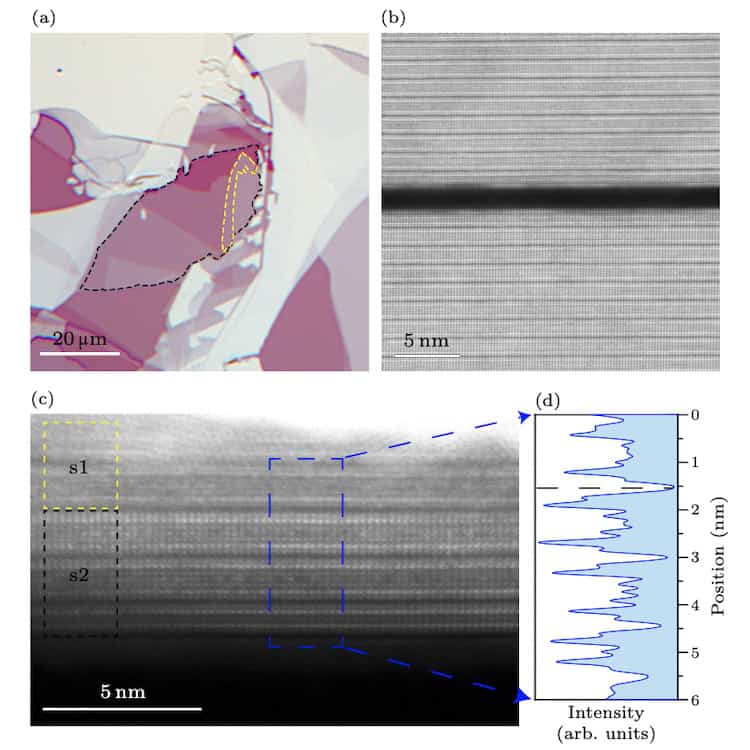
Surface preservation (a) Optical image of MBT-on-MBT sample, with the capping flake s1 and target flake s2 outlined in yellow and black, respectively. (b) TEM image of a homojunction interface with a thick capping layer, showing a substantial interface gap. (c) TEM image of an optimized interface using a thin capping flake s1 on the target s2. (d) The intensity profile extracted from the blue dashed box confirms that both the bottom surface of s1 and the top surface of s2 maintain a distinct seven-atom septuple-layer structure, demonstrating effective surface preservation. (Courtesy: Luo et al., Chin. Phys. Lett.43 050713)
Thanks to a novel encapsulation technique, researchers at Fudan University in Shanghai, China, have succeeded in imaging the surface structure of the atomically thin topological quantum material MnBi2Te4 (MBT) for the first time. The work could help advance our understanding of the intrinsic properties of this technologically important class of materials and enable their use in novel devices.
The electronic, magnetic and topological properties of materials thinned down to atomic-scale thicknesses are very different to those of their bulk counterparts. They can, for example, be employed to study exotic quantum states that could prove useful for a host of advanced applications, such as next-generation spintronics and dissipationless electronics.
Before such devices see the light of day, however, we need to understand these emergent properties, which means accurately determining the surface atomic structure of these materials. This is no easy task because these surface structures are extremely sensitive to their environment. What is more, the most common technique used to study them, transmission electron microscopy (TEM), requires samples to be prepared as lamellae, which degrades them, changing their structure. The high-energy electron irradiation beam in the microscope does them no good either.
In the new work, a team led by Yuanbo Zhang of the State Key Laboratory of Surface Physics and department of physics at Fudan University, studied the topological quantum material MBT. This is the only intrinsic magnetic topological insulator made in the laboratory so far and can be used to study novel topological states – such as the quantum anomalous Hall effect and axion-insulator physics – many of which are fundamentally governed by surface states.
MBT’s surface is exceptionally vulnerable
Like other sensitive 2D materials, explains study co-author Jingjing Gao, MBT’s surface is exceptionally vulnerable to external perturbations, such as ambient air exposure, heat or standard electron microscopy preparation. These degrade the surface layer and irreversibly alter its structure. Indeed, a previous TEM study also revealed that the septuple-layer structure of an MBT flake transforms into a Bi2Te3-like quintuple layer configuration under ambient conditions.
To overcome this problem, Gao and colleagues developed a protective encapsulation technique that successfully shields the delicate surface structure of MBT from its environment and protects it during TEM sample preparation.
The researchers examined two types of encapsulating materials. The first was hexagonal boron nitride (hBN), which is chemically inert and already routinely employed to protect 2D materials. The second was a thin flake of MBT itself, which provides a “homomaterial” capping layer. They encapsulated the MBT in one of these two materials immediately after they had exfoliated (or shaved off) flakes of MBT from a bulk sample. They did this inside an inert argon-filled glovebox.
An atomic-scale barrier
The protective layer acts like an atomic-scale barrier that isolates the MBT surface from oxygen, moisture, ion-beam damage and other environmental disturbances produced during the focused-ion beam processing used to prepare the samples for TEM. It also protects the MBT from the high-energy electron irradiation in the imaging microscope.
The researchers found that the homomaterial encapsulation is especially protective because the atomically similar layers can intimately contact with a minimal interfacial gap.
The technique strongly reduces defect formation, so the original lattice structure remains stable throughout the entire TEM workflow, explains Gao. “We therefore succeeded in safeguarding the ‘true’ surface throughout, allowing us to visualize the intrinsic septuple-layer structure at atomic resolution for the first time.”
The work will be important for both understanding intrinsic magnetic topological insulators and for developing quantum devices from these materials in the future, she tells Physics World. “Making such devices will demand exceptionally stringent requirements for sample surface and interface quality. This is because the MBT’s unique topological and magnetic properties are hosted by its surface states and even minor atomic reconstruction can distort its intrinsic quantum behaviour.”
Looking ahead, the researchers, who detail their work in Chinese Physics Letters, say they will now be looking to construct heterostructure devices with high-quality intrinsic surfaces and interfaces based on MBT. They will also make use of their encapsulation strategy to fabricate and study magnetic topological heterostructures.
“We will also explore topological superconductivity by interfacing MBT with superconductors, thereby advancing the development of topological quantum computing platforms,” reveals Gao.
Altermagnets can transfer their unusual magnetic properties to nonmagnetic materials placed next to them, say theorists in China and the US. This so-called “proximity effect” had already been observed in ferromagnets and superconductors, but it is new for altermagnets, which were only recognized as a distinct class of magnetic materials in 2024. If confirmed experimentally, the team says the effect could aid the development of advanced quantum materials with applications in fields such as spintronics, valleytronics and fault-tolerant quantum computing.
In ferromagnets, proximity effects make it possible to tune properties such as magnetic anisotropy, coercivity and exchange bias in nonmagnetic materials that have acquired magnetic polarization from a neighbouring ferromagnet. Similarly, ordinary materials that have picked up superconducting correlations from a nearby superconductor are a mainstay of experiments on topological superconductivity and topological quantum computing.
In the latest research, physicists led by Tong Zhou of the Eastern Institute of Technology in Ningbo sought to understand whether altermagnets could likewise transfer their behaviour to a neighbouring material. To do this, they created a model of a van der Waals bilayer heterostructure in which the bottom layer is a two-dimensional (2D) altermagnet, V2Se2O, while the top layer is a non-magnetic semiconductor, PbO.
Zhou explains that the vanadium atoms in V2Se2O form two opposite-spin sublattices that are connected by rotational symmetry rather than by simple translation or inversion. This complex structure is what gives V2Se2O its characteristic altermagnetic spin splitting, with a band structure in which spin-up and spin-down electrons have different energies that vary in periodic patterns. V2Se2O also has a so-called spin texture, which is a pattern of spin polarization that produces a net zero magnetization in the material.
First-principles calculations
Using first-principles calculations, the researchers found that the distinctive symmetry-patterned magnetism of V₂Se₂O can indeed transfer into the PbO layer across the interface between them. As a result, Zhou says the originally spin-degenerate bands of PbO develop a clear momentum-dependent spin splitting.
Importantly, this pattern is not arbitrary. Instead, it follows the symmetry expected from the altermagnetic order of V2Se2O. What is more, the real-space spin density of the PbO mirrors the symmetry of the V2Se2O, showing that it has inherited altermagnetism rather than simply becoming generically spin polarized.
When the researchers rearranged the V2Se2O into a conventional antiferromagnetic configuration with no alternating spin splitting, they found that the induced splitting in PbO disappeared. They also observed that the degree of induced splitting decreases when the PbO is placed further away from the V2Se2O, confirming the proximity effect.
As a final piece of evidence, the researchers searched for similar proximity effects in other altermagnetic systems, ranging from insulators to metals and covering material platforms with 3D architectures as well as 2D ones. “Even graphene, one of the most common 2D materials, can acquire altermagnetic characteristics when interfaced with CrSb, which is an experimentally well-established altermagnet,” Zhou notes.
Altermagnets as interfacial “spin-pattern generators”
One of the work’s main implications is that altermagnets could be used to generate spin patterns in many otherwise non-magnetic materials, Zhou tells Physics World. “This means that instead of searching only for intrinsic altermagnets, we can now design ‘proximitized’ altermagnetic systems by combining an altermagnet with a semiconductor, metal or superconductor,” he says.
In semiconductors, Zhou notes, the altermagnetic proximity effect can induce controllable spin and valley splitting, which are promising for spintronics and valleytronics devices, respectively. In superconductors, meanwhile, the effect can generate momentum-dependent spin splitting without the need to apply an external magnetic field or introduce net magnetization – something that Zhou says offers a new route toward topological superconductivity and the Majorana modes that could revolutionize fault-tolerant quantum computing. “More generally, this effect provides a versatile platform for designing field-free spin devices, topological quantum devices and multifunctional van der Waals heterostructures,” he says.
Looking ahead, Zhou and colleagues say they would now like to observe the altermagnetic proximity effect in heterostructures fabricated in the laboratory. They also want to find out how to control the strength of the effect – for example, by changing interlayer spacing, stacking, strain, gating and possibly even layer twisting.
“More fundamentally, an important question is how fast and how reversibly altermagnetic order, and therefore the altermagnetic proximity effect, can be reconfigured dynamically,” Zhou says. “That would be especially interesting for controlling spin-dependent transport and topological phases in real time.”
Confine a liquid to a region a millimetre or less in size, and you’re in the weird world of “microfluidics” – where surface tension and capillary action dominate in ways we easily overlook from our macro-scale vantage point. Despite being a term that was coined only in 1992, the underlying phenomena have been with us for millennia, as Albert Folch argues in How the World Flows: Microfluidics From Raindrops to COVID Tests.
Folch, who is a professor of bioengineering at the University of Washington in the US, has spent his career developing microfluidic devices that exploit the peculiar properties of flows at this scale. In this book, he now steps back to admire the full scope and impact of microfluidics, revelling in droplets that form rainbows, deliver inhalable asthma medications, make up salad dressings and cosmetics, and print scaffolds of living tissue to aid patients’ healing.
I particularly enjoyed Folch’s ode to the Olmec – Indigenous people who lived in Central America from about 1200 BCE to 400 BCE. They would harvest latex from Panama rubber trees by tapping the bark and collecting the liquid drop by drop before the day’s heat caused the latex to coagulate and seal the cut. The Olmec even had their own version of vulcanization – the process that makes rubber elastic – using the juice of morning glory vines to process the sap into bouncy elastic balls, stretchy bands, shoe soles and raingear.
The Olmec spread their knowledge to neighbours as well. In fact, the name “Olmec” comes from the Aztec language and literally means “the rubber people”. Like the maple sugar industry – which gets its own historical treatment from Folch – the Olmec latex harvest relied on a tree’s vascular system, made up of narrow 25 µm capillaries that carry liquids like water, sap, resin and latex to nourish and defend the tree. Although the Olmec civilization eventually declined, their technology and ingenuity lived on, impacting the entire world.
Folch walks readers not just through the physics and biology of these systems – capillary rise, photosynthesis, transpiration – but through their human impact, too. He includes wonders, such as natural rubber powering a Victorian-era craze that brought us tyres, inflatable boats, children’s dummies (pacifiers) and other objects. Folch also covers darker stuff, such as the British businessman Henry Wickham (1846–1928) who smuggled thousands of rubber tree seeds out of the Brazilian Amazon to establish plantations in Africa and Asia, where he could exploit cheaper labourers.
Another chapter begins in the mountains near Granada, Spain, where villagers are rebuilding acequias – open-air waterways originally built by the Moors in medieval times. For nearly 1000 years, acequias turned the arid slopes into terraced fruit gardens by diverting snowmelt toward agriculture and recharging the groundwater. Water seeps downward through the acequia’s dirt bottom, protecting it from evaporating in the hot Sun and feeding aquifers.
As Folch notes, aquifers contain nearly 30% of Earth’s freshwater – far more than is found in rivers and lakes, which make up less than 1% of the total. But in the US alone, industrial agriculture has been draining aquifers at rates as high as 60 cm per year, far exceeding the slow percolation of rainfall into these underground reservoirs.
In fact, aquifers take hundreds or thousands of years to recharge, which, Folch notes, means a depleted aquifer effectively ceases to exist for those of us living now. Without acequias and other dedicated efforts to replenish aquifer levels through microfluidic flow, today’s corn fields will soon turn to dust.
Candles to kidneys
How the World Flows charts the history of other unexpectedly microfluidic technologies too. Candles, for example, carry their fuel to the flame by capillary action along the wick. Then there’s paper, which soaks up ink through capillary action. Among more recent microfluidic inventions, Folch offers special laurels to the ballpoint pen, of which BIC alone has sold over 100 billion units since 1950.
Folch also takes care to introduce readers to many microfluidic medical devices, which might not be as widespread as ballpoint pens, but are perhaps more important. They range from dialysis machines that clean blood for failing kidneys, to COVID tests and continuous glucose monitors that let diabetics manage their blood glucose levels – a microfluidic technology that’s critical in my own home.
Folch describes the microfluidic devices that enable the Human Genome Project, as well as prototype instruments that could one day catch cancer cells through a simple blood screening. He also covers devices that could pick the perfect personalized drug cocktail for treating a patient’s tumour by studying their biopsied cells.
The most stunning microfluidic device Folch describes may be us
But the most stunning microfluidic device Folch describes may be us. As he argues, we ourselves are microfluidic. From our lungs to our cardiovascular system, from our lymphatic system to our sweat glands, our bodies rely on flow through tiny vessels.
Our bodies make up for diffusion’s slow pace by operating in parallel. Like the many co-operating central-processing units in a supercomputer, our bodies absorb oxygen through 500 million micro-sized alveoli in our lungs. We hear through ears equipped by microfluidics to act as both microphones and accelerometers. Our kidneys clean some 200 litres of blood a day – sending two litres of urine to our bladders as they do – through massively parallelized filtration.
Throughout How the World Flows, Folch’s enthusiasm for his subject shines. His approach is that of a storyteller, rather than a scientist, and the book is all the better for it. Whether readers are microfluidics experts or not, they will walk away with new stories to tell. (Don’t skip the footnotes…)
Although Folch’s stories are wide-ranging and entertaining, he stumbles at times with the overarching narrative. Some transitions are rough, and it’s not always clear why he’s chosen to order the stories in the way they’re presented. Nevertheless, his book is a fun and highly readable introduction to microfluidics that’s sure to entertain lay readers and excite a new generation of microfluidic engineers.
2025 Oxford University Press 306pp £22.31hb £19.16ebook
Photonic glasses containing gold-cored, silica-shelled nanoparticles can produce high-purity colours across the visible spectrum. Crucially, the colours are independent of viewing angle. Developed by researchers in Korea, their design avoids the short-wavelength scattering that has prevented the attainment of a true red – and blurred other colours – in previous photonic glasses.
Synthetic materials are usually coloured using pigments, such as those found in dyes or paints. A pigment has a chemical composition that causes it to reflect light at certain wavelengths and absorb light at other wavelengths. Nature, however, makes widespread use of structural colour, whereby the physical structure of a material dictates which wavelengths are reflected and which are absorbed. A familiar example is iridescence, which is responsible for rainbow-like colours on some plants and animals.
Creating colour using structure rather than chemistry has several advantages. One is that there are no chemical chromophores to be bleached by sunlight, so the colour tends to be more durable. Another benefit is that there is no dye to leach if the material comes into contact with water or another solvent.
While structural colour can be created using traditional photonic crystals, these can be tricky to produce controllably. Moreover, a surface that relies on interference effects is inevitably iridescent – which means that its colour changes with the viewing angle.
Short-range order
One solution is colloidal photonic glasses, which are not physically textured but have particles such as silica or polymers dispersed throughout them with short-range order. These can be produced simply by solution processing, and their colour does not vary with viewing angle. The principal problem with these glasses is the attainment of colour purity – especially in the red. The challenge is that the glasses scatter light more effectively at shorter (bluer) wavelengths owing to Rayleigh scattering. This effect makes the sky appear blue and adds unwanted blue light to structural colour.
In the new work, nanophotonics expert Seungwoo Lee of Korea University in Seoul and colleagues synthesized 230 nm core–shell nanoparticles in which silica surrounds a 20 nm gold cluster. This has a plasmonic resonance that absorbs shorter wavelengths. The researchers then dispersed the nanoparticles in ethoxylated trimethylolpropane triacrylate. This is a photocurable resin that has a very similar refractive index as the nanoparticles. The resin was applied to surfaces by painting or solution deposition and then cured under ultraviolet light.
The resulting photonic glass scatters red light randomly, while absorbing shorter wavelengths. Lee stresses that this is different from a traditional paint. “The reflected colour is determined by particle size, spacing, refractive-index contrast, and the degree of structural order, rather than by a molecular chromophore alone,” he says. When the researchers reduced the size of the nanoparticle shells, first to 180 nm and then to 160 nm, they found that they packed more closely together, producing first green and then deep blue colours.
The explanation for the blue scattering is more subtle than for the red: “The gold core is not needed to ‘make’ blue in the same way that a blue dye would,” explains Lee. “However, the gold core can still improve perceived colour purity by reducing broadband diffuse scattering and nonresonant background light.” explains Lee “Without this suppression, silica-only photonic glasses tend to look milky or whitish because many wavelengths are scattered together.”
Durable coatings
The researchers are now exploring several possible extensions of their research. They believe that the work could provide easily applied coatings that are durable as the light scattering comes from within the material structure rather from than a surface pigment.
They also believe it could have anti-counterfeiting properties: “In a normal ink or paint, its colour mainly originates from chemical pigments or dyes,” says Lee; “Our material produces a nanoscale structural signature: a specific reflectance spectrum, bandwidth, angular response, and microstructural arrangement determined by the particle diameter, core–shell geometry, refractive-index matching, volume fraction, and assembly pathway. This gives several possible authentication handles.”
Lee believes that it should be possible to reduce the cost of the material using a metal that is cheaper than gold. However, the precious metal is only 0.022% of the film by weight, so the technology may already be economically viable.
“I think it’s really neat,” says materials scientist Aaswath Raman of the University of California, Los Angeles. “The concept of structural colour has been around for a really long time but to me it’s, like, the last steps before we see it out it the real world.”
He says the largest problems he foresees are the simple economics of competing with industrially-optimized paint industry – even if the technology is, in principle, superior. Nevertheless, he says, “of the technologies we see in research this is likely quite a good candidate for commercialization”. The next step, he says, is to actually find a “first use” application – he suspects the aerospace industry, which values ultralight, durable coatings, could be a candidate.
In today’s technologies, mechanical mechanisms generally provide the brawn while electronics supplies the brains. This is partly because it is challenging to write information into mechanical memories without resetting each bit individually. However, that could change as researchers led by Pedro Reis at École Polytechnique Fédérale de Lausanne in Switzerland and Martin van Hecke at AMOLF in the Netherlands have now found a practical means of writing mechanical bits. Their technique, which they describe in Science Advances, uses structures that resemble children’s slap bracelets placed on a rotating turntable. While they acknowledge it is unlikely to replace electronic memories, they argue that it could have specialist applications and might produce insights that translate into electronic innovations.
“The framework we propose could be very useful, for example, in the domain of physical intelligence, where you provide hardware with capabilities that don’t require essentially a brain or an electronic control system to do individual tasks,” Reis says.
Mechanics for memory
Reis and van Hecke’s interest in mechanical memory stems from their research on metamaterials, which are materials that are defined not just by their composition, but also by the structures within them. Mechanical systems offer a tangible means of getting to grips with the complex behaviour of these metamaterials. “Often, all sorts of things that we do rely on nonlinear responses,” van Hecke notes, adding that such responses are much easier to study in mechanical systems than in optical devices.
A metamaterial made up of an array of switchable mechanical elements could function as a form of mechanical memory. However, to be practical, it needs to be possible to flip the states of individual mechanical bits using global controls, as opposed to addressing them individually. Otherwise, writing data will be very fiddly.
A solution emerged from Reis’ interest in rotating platforms, which he describes as “a very versatile way of loading mechanical systems”. While the pair had been friends for more than two decades, they had been working independently until, during a visit, the penny dropped and they realized that placing the metamaterial array on a rotating platform could provide the control they needed.
Because the angular velocity of the platform sends its momentum outwards, each mechanical object experiences a force in the radial direction, known as the centrifugal force. If this angular velocity is not constant, the object will experience an additional force in the orthogonal azimuthal direction, known as the Euler force. “So you have a complex force and bi-directional field that is highly tuneable,” says Reis. “And this tuneability is what we realized is very powerful.”
A rotating array
To construct their array, the researchers used clamped beams with two stable mechanical states – a little like a slap bracelet can be coiled up or flat, except these beams could either curve to the right or to the left. To individually address different beams, they ensured that each beam was unique in its width, the angle it was clamped at, and so on, all of which affect how much force is needed for a beam to ping into the opposite state. By tuning the parameters of each clamped beam and the angular acceleration of the rotating platform, they could engineer the applied force to switch (or not switch) specific beams, thereby writing data into the array purely by rotating the platform.
Doing this accurately requires a level of precision in acceleration control that surpasses what standard lab motors can achieve. However, the researchers say they were able to team up with a local company that had designed high-spec rotating platforms for its high throughput silicon chip production process. By programming platforms with five tailored clamped beams and the right rotation functions, they showed they could write the letters of the alphabet in ASCII script.
“This is a significant advance because it points toward future smart devices and robots that can be reprogrammed remotely without complex wiring or electronics, using only carefully designed motion‑based signals driven by a sole dynamic driving strategy,” explains Damiano Pasini of McGill University, Canada, who studies systems for mechanical computing but was not involved with this work directly.
Reis says he is excited about the scalability of the approach and its potential in high throughput experiments. Meanwhile, van Hecke is looking into how the idea might transfer to other systems, such as applying engineered force functions to crumpling sheets of complex glasses. “It just opens up possibilities for both studies, really fundamental studies of complex systems, but also real applications where you use this dynamic idea,” he tells Physics World.
Teenage Engineering’s OP-XY has a huge number of functions. | Photo by Terrence O’Brien / The Verge
With elements from synthesizers, loopers, and effects pedals, Teenage Engineering’s devices lie somewhere between musical instrument and modern art. These grooveboxes, as they’re often called, are capable of helping you producesongs in real time from a single unit, with an eye-catching design language. A wide swath of the brand’s offerings are 30 percent off at Guitar Center when you use code TE30, atAmazon when you click the on-page coupon for whichever product you’re interested in, and B&H Photo (discount applied automatically at checkout). The terms for the Amazon coupon claim it will run through August 8th, 2026, while Guitar Center deal is listed as “limited time.”
The OP-XY is one of the flagship units, which my colleague Terrence O’Brien described as a “greatest hits tour for Teenage Engineering.” Normally $2,299, the discount code brings the price down to a more palatable $1,609.30, which is a lot cheaper, but still pretty pricey for an aspiring musician. That said, it’s loaded with features for both production and live performance, and has a premium, durable build quality that reflects its price point. It’s currently sold out at Amazon, but in stock and discounted at Guitar Center and B&H Photo. Read our Teenage Engineering OP-XY review.
The model I’m most tempted by is the EP-40 Riddim, a compact sampler with a library of over 400 built-in synth settings and effects particularly well-suited for producing dub and reggae music, plus 128MB of storage for your own loops and recorded sounds. It’s a bit less intimidating for a beginner than the OP-XY, both in terms of price point and features, and itstighter genre focus may help concentrate your efforts and onboarding. Normally $329, the EP-40 is $230.30 at Amazon, Guitar Center, and B&H Photo during the promotion.
We tracked a few solid deals on Apple devices this week, including savings across the entire AirPods lineup, a record low price on AirTag 2, and the best prices on Apple's A16 iPad since June. All of these deals are still available to purchase today, plus ongoing low prices on Apple Watch Series 11.
Note: MacRumors is an affiliate partner with some of these vendors. When you click a link and make a purchase, we may receive a small payment, which helps us keep the site running.
AirPods
What's the deal? Save on AirPods 4, Pro 3, and Max 2
Amazon this week introduced solid deals across the full AirPods lineup, with up to $100 off these models. You can find discounts on the AirPods Pro 3, AirPods 4, and AirPods Max 2 still available today.
Apple's AirTag 2 is available for the all-time low price of $89.00 this week, down from $99.00. This sale is on the 4-Pack of the AirTag 2, and it's a match of the record low price we last tracked during Prime Day.
Amazon this week is taking $50 off Wi-Fi models of Apple's 11th generation iPad. Prices start at $399.00 for the 128GB Wi-Fi iPad, down from $449.00. This is now the best price we've seen on the iPad since Apple's price hikes in June.
Apple Watch Series 11
What's the deal? Take $100 off Apple Watch Series 11
Amazon this week has low prices on the Apple Watch Series 11, with $100 discounts across numerous models of the smartwatch. This sale includes a handful of 42mm and 46mm GPS aluminum models, but cellular devices are a bit more rare this time around.
If you're on the hunt for more discounts, be sure to visit our Apple Deals roundup where we recap the best Apple-related bargains of the past week.
Deals Newsletter
Interested in hearing more about the best deals you can find in 2026? Sign up for our Deals Newsletter and we'll keep you updated so you don't miss the biggest deals of the season!
YH Toys YH18001 PRO is a compact yet powerful 1/18-scale brushless RC monster truck designed for enthusiasts who want high-speed performance without stepping up to a larger and more expensive platform. Featuring a 4300KV brushless motor, 4WD drivetrain, metal drivetrain components, and a claimed top speed of 70km/h, the YH18001 PRO promises an exciting driving experience on a wide variety of terrains.
Whether you’re new to the RC hobby or looking for a portable off-road basher, the YH18001 PRO packs impressive specifications into a rugged pickup-style body.
Compact Size, Serious Performance
Despite its 1/18 scale, the YH18001 PRO is engineered for performance rather than being a simple toy.
The truck measures 277 × 202 × 120mm and weighs approximately 758g, making it easy to transport while remaining stable at higher speeds. Its aggressive pickup truck body is complemented by LED headlights, realistic wheel arches, and a durable PVC shell that gives it an authentic off-road appearance.
4300KV Brushless Power System
The biggest highlight is its 2435 4300KV brushless motor, paired with a 35A integrated brushless ESC and receiver.
This setup enables the truck to reach speeds of up to 70km/h under ideal conditions, providing rapid acceleration and smooth throttle response. Compared to brushed RC vehicles, the brushless system delivers:
Higher efficiency
Greater reliability
Lower maintenance
Stronger acceleration
Longer motor lifespan
The truck supports proportional throttle and steering control, allowing drivers to precisely manage speed instead of operating at only full throttle or full brake.
Full-Time 4WD for All Terrains
The YH18001 PRO uses a shaft-driven four-wheel-drive system designed to maintain traction across challenging surfaces.
It performs well on:
Dirt trails
Gravel roads
Sand
Grass
Hard-packed surfaces
The drivetrain also includes numerous upgraded metal components such as:
Metal differentials
Metal center driveshaft
Metal CVD front driveshafts
Metal steering knuckles
Metal suspension mounts
Metal wheel cups
These upgrades improve durability during aggressive driving and repeated jumps.
Independent Suspension
Handling is enhanced by a double wishbone independent suspension system with front and rear spring shock absorbers.
This setup helps the truck absorb bumps while maintaining tire contact over uneven terrain, improving both stability and cornering performance.
Large off-road tires with deep tread patterns provide strong grip on loose surfaces, making the truck suitable for recreational bashing as well as casual racing.
Ready-to-Run Convenience
The YH18001 PRO arrives in RTR (Ready-to-Run) configuration.
Inside the box you’ll find:
YH18001 PRO RC truck
2.4GHz transmitter
7.4V Li-ion battery
USB charging cable
Wheelie bar
Screwdriver
Metal body clips
User manual
Only three AA batteries for the transmitter need to be purchased separately.
Battery Life
Power comes from a 7.4V 1600mAh 20C Li-ion battery.
Expected performance includes:
Approximately 18 minutes of driving time
Charging time of around 3–3.5 hours
While runtime is typical for a high-speed brushless RC vehicle, enthusiasts planning extended sessions may wish to purchase an additional battery pack.
2.4GHz Radio System
The included 4-channel 2.4GHz transmitter provides:
Full proportional steering
Proportional throttle
Stable signal
Approximately 80 meters of operating range
The 2.4GHz system also minimizes interference when multiple RC vehicles are operated nearby.
YH Toys YH18001 PRO delivers an impressive balance of speed, durability, and value in the increasingly competitive 1/18-scale RC market. Its 70km/h brushless powertrain, metal drivetrain upgrades, independent suspension, and full-time 4WD make it a capable off-road performer that is equally enjoyable for beginners looking to step into the hobby and experienced drivers wanting a compact high-speed basher.
For RC enthusiasts seeking a portable monster truck with genuine hobby-grade performance, the YH18001 PRO stands out as an exciting option that offers far more capability than its compact dimensions might suggest.
The mega-disposable vaping sector has officially entered the 50,000-puff arena, introducing complex multi-battery architectures and hyper-advanced displays. In this ultimate high-capacity clash, theUpends UP9 50K Vape Kit goes head-to-head with theNEXA Ultra II(also recognized as the Ultra 50k II). Both devices seek to eliminate the anxiety of running out of juice on a long trip, yet they treat the 50k puff milestone with distinct approach pathways. The UP9 relies heavily on a specialized dual-battery setup, whereas the Ultra II leans into its innovative locked flavor preservation design.
Design
When it comes to aesthetic footprints, both devices break away from generic box shapes, opting instead for structural elements that immediately command attention. The Upends UP9 features a striking, clear visual layout dominated by a transparent e-liquid tank and an expansive, wrap-around 270-degree 3D screen. This sweeping panoramic screen offers constant, high-definition tracking of your real-time settings and power levels from almost any viewing angle. The combination of a crystalline tank and a smooth outer framework creates a look that feels highly technical and deeply satisfying to handle.
The NEXA Ultra II responds with a refined, ultra-modern polycarbonate chassis designed specifically to minimize annoying smudges and fingerprints.It is noticeably more compact than its direct predecessor, giving it a much softer, more pocketable feel.Like the UP9, the Ultra II boasts a clear, transparent tank window that lets you confidently evaluate your remaining e-juice by eye rather than guessing blindly.Its standout visual asset is a massive, smartwatch-inspired front display panel flashing crisp animated circuitry graphics.For those who prefer a stealthier approach, it introduces a convenient Dark Mode toggle that allows users to switch off the flashing lights while keeping basic stats active.
Features
Looking closely at the underlying mechanics reveals two distinctly engineered beasts designed to squeeze out maximum longevity.
The Upends UP9 is powered by a creative dual-battery system, distributing power across a built-in 850mAh base battery combined with a separate 230mAh battery tucked into the pod itself to achieve a total output pool of 1080mAh.
Capacity & Puff Count: Packs a massive 20ml e-liquid reservoir delivering a full 50,000-puff ceiling.
Adjustability: Utilizes a highly flexible Triple Power Mode scaling from a cool 15W draw (yielding 50,000 puffs) up to a punchy 25W cloud mode (dropping total yields to 30,000 puffs).
Convenience: Integrates a Smart Click Match System, Type-C fast charging, and dedicated airflow adjustments to tailor the restriction.
The NEXA Ultra II utilizes a single, robust 900mAh quick-charge battery paired with an equally impressive 20ml e-liquid capacity.
Juicy Lock System: NEXA implements a two-part assembly system featuring their proprietary Juicy Lock click-in framework.The tank and battery ship as separate components in the box, locking out leaking or stale e-juice prior to activation.
Output Modes: The Ultra II is driven by a 1.0Ω dual mesh coil system supporting two distinct operation presets.Normal Mode delivers a steady, cool vape for the full 50,000-puff threshold, while Turbo Mode instantly cranks up flavor intensity, throat hit, and vapor density (reducing life to 30,000 puffs).
Verdict
Specification
Upends UP9
NEXA Ultra II
Battery Configuration
1080mAh Total (850mAh + 230mAh Dual System)
900mAh Integrated Battery
Output Adjustability
Triple Modes: 15W / 20W / 25W
Dual Modes: Normal / Turbo
Display Style
270-degree Panoramic 3D Screen
Animated Circuit Screen with Dark Mode
Freshness Protection
Smart Click Match System
Click-in Juicy Lock Mechanical Seal
Choosing between these two 50k juggernauts hinges on your preference for fine-tuning power versus total flavor structural defense. The Upends UP9is a spectacular choice if you love deep wattage personalization, giving you three distinct power modes and a massive dual-battery reserve to play with. On the other hand, if your priority is consistent, zero-fade flavor performance protected by a physical leak-proof seal and an option to black out your display lights completely, the NEXA Ultra II stands tall as the absolute gold standard for long-haul durability.
Aspire Pixo Aura 2 is a stylish and easy-to-use pod vape designed for adult users who value portability, performance, and simplicity. As the latest addition to Aspire’s Pixo Series, the Pixo Aura 2 combines a sleek ergonomic design, long-lasting battery, refillable pods, and smooth airflow to deliver an enjoyable vaping experience for both beginners and experienced users.
Whether you’re switching from disposable vapes or looking for a reliable everyday pod system, the Aspire Pixo Aura 2 offers a balance of flavor, convenience, and modern design.
Modern and Ergonomic Design
The Aspire Pixo Aura 2 features a slim, lightweight body that fits comfortably in your hand or pocket. Constructed from durable materials with a premium finish, the device is designed for everyday portability while maintaining a stylish appearance.
Its minimalist design includes intuitive controls, making it easy to operate without a complicated learning curve.
Long-Lasting Built-In Battery
Powered by a high-capacity rechargeable battery, the Pixo Aura 2 is designed to provide all-day vaping for most users. USB Type-C fast charging helps reduce downtime, allowing you to recharge quickly and get back to vaping with minimal interruption.
Smooth and Consistent Flavor
The Pixo Aura 2 is engineered to maximize flavor delivery through Aspire’s advanced pod technology. The integrated mesh coil heats e-liquid evenly, producing rich flavor, smooth vapor, and excellent coil longevity.
Whether you enjoy nicotine salts or standard freebase e-liquids, the device is optimized to provide a satisfying vape with consistent performance.
Refillable Pod System
The refillable pod design allows users to easily fill their favorite e-liquid while reducing waste compared to disposable devices.
Benefits of the refillable system include:
Easy top or side filling (depending on pod version)
Leak-resistant construction
Transparent pod for monitoring e-liquid levels
Convenient magnetic pod connection
The pod system is designed for quick installation and effortless daily maintenance.
Adjustable Airflow
The Aspire Pixo Aura 2 features adjustable airflow, allowing users to customize their vaping experience.
With a simple airflow adjustment, you can switch between:
Tight Mouth-to-Lung (MTL) draws for a cigarette-like inhale
Restricted Direct-to-Lung (RDL) vaping for increased vapor production
This flexibility makes the device suitable for a wide range of vaping preferences.
Intelligent Performance
The device automatically detects the installed pod and delivers an appropriate power level for consistent vapor production. This smart output system eliminates complicated wattage adjustments, making the Pixo Aura 2 especially beginner-friendly.
Built-in safety protections typically include:
Overcharge protection
Short-circuit protection
Low-voltage protection
Overheat protection
Overtime vaping protection
These features help ensure reliable and safe operation during everyday use.
Easy Everyday Operation
Designed with convenience in mind, the Aspire Pixo Aura 2 offers a simple vaping experience.
Key user-friendly features include:
Draw-activated firing
Quick pod replacement
Fast USB Type-C charging
Lightweight construction
Compact pocket-friendly size
Minimal maintenance
Its intuitive operation makes it an excellent choice for users transitioning from disposable vapes to refillable pod systems.
Key Features
Compact and ergonomic design
Rechargeable built-in battery
USB Type-C fast charging
Refillable pod system
Advanced mesh coil technology
Rich flavor production
Adjustable airflow
Leak-resistant pod design
Automatic power adjustment
Suitable for MTL and RDL vaping
Multiple built-in safety protections
Who Is the Aspire Pixo Aura 2 For?
The Aspire Pixo Aura 2 is ideal for:
Adult smokers switching to refillable vape devices
Users replacing disposable vapes
Beginners seeking a simple pod system
Flavor-focused MTL vapers
Users looking for a compact everyday vape
Travelers who need a lightweight and portable device
Final Thoughts
Aspire Pixo Aura 2 combines elegant design, dependable battery life, refillable convenience, and excellent flavor performance in a compact pod system. With adjustable airflow, intelligent power delivery, and easy operation, it offers a satisfying vaping experience for both new and experienced adult users.
If you’re looking for a stylish refillable pod vape that delivers consistent performance without unnecessary complexity, the Aspire Pixo Aura 2 is a strong option for everyday use.
Shark Week 2026 is here! This year's highlights include experiments testing great white intelligence, Molly Carlson's death-defying freefall dive into a reef shark feeding frenzy, and a deep-dive on the thresher’s tail strike. The 20-strong lineup of shows airs across seven nights, and Live Science is here with all the TV and streaming details.
Shark Week still packages its science with ominous music and blockbuster titles, but its strongest moments challenge the familiar "mindless killer" myth, presenting sharks instead as intelligent, highly specialized predators whose decline could destabilize the world’s oceans.
Look out for a great study of the highly aggressive and erratic sharks in the waters off Marshall Islands, where the United States military detonated 67 nuclear bombs between 1946 and 1958.
And if you're a tech fan, there's plenty of new camera systems and tagging technology to discover.
Read on as we explain how to watch "Shark Week" 2026 from anywhere.
How to watch "Shark Week" 2026 in the U.S.
"Shark Week" 2026 comprises 20 brand-new TV specials that will air on Discovery from 8 p.m. ET/PT every evening from Sunday, July 26 to Saturday, Aug. 1.
If you don't have the Discovery channel on cable, it's available on a streaming basis from several cable alternatives. Best of all, many offer a free trial to new customers.
YouTube TV usually costs $82.99 per month but comes with a free trial and $15 off each of your first five months.
The DirecTV MyEntertainment genre pack costs $42.99 per month after a 5-day free trial, and Hulu + Live TV costs $89.99 per month after a 3-day free trial.
Alternatively, you can watch Shark Week 2026 on HBO Max (from $10.99 per month).
Can you watch "Shark Week" 2026 in the U.K.?
"Shark Week" programming typically airs on Discovery Plus in the U.K. at a later date.
At the time of publication, plans for the 2026 slate of specials are still firmly under wraps.
If you're currently in the U.K. for work or on vacation from the U.S., you can still catch "Shark Week" 2026 by using a VPN, such as Surfshark.
Watch "Shark Week" 2026 from anywhere
If you're traveling abroad you can access your usual streaming services from anywhere with a good VPN.
A VPN, or virtual private network, is a piece of internet security software that can alter your device's digital location, unlocking the geo-restrictions on most streaming platforms.
Our expert colleagues at TechRadar rate Surfshark as one of the best VPNs. Not only is it great for unblocking streaming services, it has top-level security features, a reasonable price tag and, right now, a big discount.
Live Science x Surfshark Exclusive "Shark Week" Deal
Whether you're tuning into Discovery's Shark Week or diving deep into the web, privacy matters. Surfshark keeps your connection encrypted and your data out of sight – no matter what waters you're navigating.
Protect unlimited devices for just $2.39/mo + 4 Extra Months. Save 85%! Shark Week Special runs from July 26 to August 1, 2026.
🥇 From $2.39 per month ✅ Block ads, trackers, scams, and malware 🤝 30-day money-back guarantee 🏆 4 Extra monthsView Deal
"Shark Week" 2026 trailer
When is "Shark Week" 2026?
"Shark Week" 2026 runs from Sunday, July 26 to Saturday, Aug. 1 in the United States.
"Shark Week" 2026 episodes
Sunday, July 26
► 8 p.m. ET/PT – "K-Pop Shark Heroes"
After a recent series of shark encounters off the Korean Peninsula, actor and comedian Ken Jeong joins forces with Grammy-nominated singer and lifetime shark lover Rei Ami on a mission to reshape the perception of sharks across East Asia and around the globe, fueled by the power of K-pop.
► 9 p.m. ET/PT – "Air Jaws: Red, White and Breach"
A new phenomenon is emerging as great white sharks are captured on film breaching in California like never before. Filmmaker Jeff Kurr, marine biologist Alison Towner, and cinematographer Andy Casagrande set out to capture this unprecedented behavior and uncover the secrets behind the Great American Breach.
► 10 p.m. ET/PT – "Invasion of the Mega Sharks"
Shark researcher Neil Hammerschlag, joined by Shark Week expert Paul de Gelder, leads a team to track down Big Rose, a record-breaking great white believed to be one of largest predators in the North Atlantic. Using innovative tagging technology and daring field operations, they venture to a newly discovered shark hotspot off Nova Scotia aiming to transform our understanding of these ocean giants.
Monday, July 27
► 8 p.m. ET/PT – "Bull Shark Dinner Bell"
Shark attack survivor and advocate Paul De Gelder teams up with apex predator specialist Rosie Moore in Jupiter, Florida to investigate what triggers giant bull sharks to confront humans. The team tests how human behavior in the ocean, extreme weather events and prey preferences influence shark attacks.
► 9 p.m. ET/PT – "House of Sharks"
Off the coast of New Zealand lies a hidden shark battleground, where three distinct groups of great whites organize into competing "houses" and may be competing with one another to gain control of a major seal feeding ground. Marine biologist Tristan Guttridge and underwater cinematographer Kina Scollay venture into the middle of the action on an epic expedition. As they investigate, they uncover the possibility that these clans of great whites recognize their kin and return season after season to their ancestral territories, raising the theory that these predators aren't solitary hunters but rival dynasties at war.
► 10 p.m. ET/PT – "Biggest Mako on Earth"
For decades, rumors have swirled about massive, 15- to 20-foot-long (4 to 6 meters) mako sharks patrolling the deep waters off Southern California. Long dismissed as fishers' tales, new footage, along with a recently published photo capturing a mako that appears to stretch 15 feet, is now forcing scientists to rethink everything they know about these oceanic apex predators. Marine biologist Tristan Guttridge, alongside conservationist Kendyl Berna and shark tagger Keith Poe, go on an investigation to determine whether the world's biggest mako is real — and hunting in the coastal waters of Santa Catalina.
Tuesday, July 28
► 8 p.m. ET/PT – "Jurassic Sharks"
In a Shark Week first, revolutionary CGI resurrects the ocean's most bizarre Jurassic (201 million to 143 million years ago) sharks, bringing them to life like never before. Guided by the rare living sharks that once shared their seas, real-world expeditions seamlessly merge with cutting-edge visual effects to uncover stories from the deep and prehistoric seas in ways never before possible.
► 9 p.m. ET/PT – "Jaws vs Orca"
For millennia, the great white shark has reigned as the ocean's ultimate apex predator. But now, a new challenger is emerging: the orca. Around the world, sharks are washing ashore with their livers removed with chilling precision while in the Strait of Gibraltar, orcas are targeting sailboats — ramming hulls, crippling rudders and sinking vessels. To investigate this shift in behavior, Tristan Guttridge explores orcas' attacks on boats to reveal how these predators hunt and how they may be taking down great white sharks.
► 10 p.m. ET/PT – "Chum Island: Catching a Killer"
In this Shark Week whodunnit, a rare surge of highly aggressive shark attacks hit a tight-knit community off Australia’s southern coast, prompting marine biologist Riley Elliott to find and tag the oceanic suspects. But when he discovers this could be a new, elusive population of sharks, he builds the world's first "chum island" to lure them in and uncover if they are the ones responsible for the attacks.
Wednesday, July 29
► 8 p.m. ET/PT – "Expedition X: Atomic Sharks"
Phil Torres and Heather Amaro travel 5,000 miles (8,000 kilometers) west of the U.S. to the remote Marshall Islands, home to the world's largest shark sanctuary, where apex predators are exhibiting highly aggressive behaviors and erratic swimming patterns. Between 1946 and 1958, the United States military detonated 67 nuclear bombs around the island, raising questions about their lasting impact on marine life. Now, the team dives into these dangerous waters to investigate reports of "mutant" sharks and uncover whether atomic blasts could be to blame.
Global explorer Josh Gates travels back in time and dives into the history behind some of the world’s most infamous shark encounters, from the earliest known shark attack to the mystery surrounding the shark feeding frenzy faced by sailors following the sinking of the USS Indianapolis. He also investigates the legendary "Stronsay Beast," a mysterious creature that washed ashore in Scotland in 1808.
► 10 p.m. ET/PT – "Alien Sharks: Untamed America"
In celebration of America’s 250th anniversary, wildlife biologist Forrest Galante embarks on a nationwide quest to find the nation’s most bizarre and dangerous "alien" sharks – from glowing swell sharks to elusive sawfish.
(Image credit: Discovery)
Thursday, July 30
► 8 p.m. ET/PT – "What Shark Attacked?"
Shark attacks are extremely rare, but when they happen, the first question is always the same: What kind of shark was it? Leading shark scientists Tom Hird and Rosie Moore, alongside conservationist Kinga Philipps, investigate mysterious attacks from around the world using cutting-edge forensic analysis – including bite pattern comparison, geographic profiling, video evidence, and eyewitness testimony – to identify the species responsible and uncover why these life-threatening encounters occur.
► 9 p.m. ET/PT – "How to Train a Great White"
Tristan Guttridge ventures into shark-infested waters off New Zealand to answer a provocative question: Can sharks be trained? Using techniques pioneered by the U.S. Navy to train dolphins in complex cognitive tasks, the team tests whether these apex predators can learn, solve problems and respond to cues. If successful, the experiment can potentially redefine shark intelligence and transform our understanding of one of the ocean's most misunderstood predators.
► 10 p.m. ET/PT – "Ultimate Shark Dive"
World-class Red Bull high diver Molly Carlson leaps from a helicopter hovering above the open ocean, targeting a narrow plexiglass cage surrounded by circling reef sharks, or risking a direct plunge into a chum-filled feeding frenzy. From concept to execution, Carlson pushes herself to the limit with a record-setting stunt that no high diver has ever attempted.
Friday, July 31
► 8 p.m. ET/PT – "Secrets of the Great White Kill"
For centuries, great whites were believed to simply stalk their prey. Now, groundbreaking science suggests that these alpha sharks are highly intelligent predators that adapt their hunting techniques in real time. In this program, the full range of great white hunting tactics is revealed, reinforcing the species' status as one of the ocean's top predators.
► 9 p.m. ET/PT – "Sharkzilla Takes New York"
After a wave of mauled marine life washes ashore in New York, conservation biologist Craig O'Connell launches an investigation to find the culprit. When it leads to an old nuclear dumping ground teaming with great whites and makos, he is left with the theory that the predator may be radioactive. A deeper dive reveals an unexpected hotspot for massive makos off the coast of the Hamptons, suggesting that these waters may be hiding something even bigger beneath the surface.
► 10 p.m. ET/PT – "My Strange Shark Addiction"
How far will people go to fuel their fascination with sharks? For four devoted shark "fin-atics," their obsession shapes every aspect of their lives. From a dentist who spends every spare moment searching for life-size shark replicas to a woman who insists she has a special connection with her shark "boyfriend," and a world-record holder covered in shark tattoos, this special explores how their daily routines, relationships and finances revolve entirely around sharks.
Saturday, August 1
► 8 p.m. ET/PT – "Great White Highway"
Great white sharks are pushing farther up the East coast than ever before and in far greater numbers, leading to close encounters and forcing beach closures. Now, a team of shark scientists races to install high-tech receivers and tag as many great whites as possible.
► 9 p.m. ET/PT – "Thresher Shark: Stun to Kill"
The physics behind the thresher shark’s devastating tail strike has long remained a mystery — until now. For the first time ever, the discovery of a shallow-water feeding ground has made observing this behavior possible. Now, shark scientist Craig O’Connell and marine biologist Aliah Banchik dive into the direct line of fire as they attempt to reveal exactly how these predators use their tails to stun and kill.
Is there a "Shark Week" 2026 host?
John Cena and Jason Momoa have hosted recent editions of "Shark Week", but the 2026 incarnation won't have a single overarching presenter stitching its constituent parts together.
We test and review VPN services in the context of legal recreational uses. For example: 1. Accessing a service from another country (subject to the terms and conditions of that service). 2. Protecting your online security and strengthening your online privacy when abroad. We do not support or condone the illegal or malicious use of VPN services. Consuming pirated content that is paid-for is neither endorsed nor approved by Future Publishing.
LONGER LK10 Plus is a next-generation FDM 3D printer designed for makers, engineers, hobbyists, and small businesses seeking fast printing without sacrificing quality. Featuring a generous 320 × 320 × 400 mm build volume, a maximum print speed of 500 mm/s, and an upgraded direct-drive extrusion system, the LK10 Plus delivers the performance needed for everything from large prototypes to detailed functional parts.
Large Build Volume for Bigger Ideas
One of the standout features of the LONGER LK10 Plus is its spacious 320 × 320 × 400 mm printing area. The oversized build volume allows users to create large models in a single print or produce multiple parts simultaneously, improving productivity for workshops and production environments.
Whether you’re printing cosplay helmets, architectural models, mechanical components, or educational projects, the generous build space provides greater creative freedom.
High-Speed Printing Up to 500 mm/s
Built with a Klipper-powered control board, the LK10 Plus supports print speeds of up to 500 mm/s, significantly reducing print times compared to traditional desktop 3D printers.
Advanced motion control technologies, including vibration compensation and input shaping, help maintain print quality even at high speeds by reducing ringing and ghosting effects. This combination enables users to complete projects faster while preserving precision.
High-Flow Direct Drive Extruder
The printer features an upgraded high-flow direct-drive extruder capable of delivering up to 25 mm³/s volumetric flow. This design provides consistent filament feeding, improved extrusion accuracy, and excellent compatibility with flexible materials.
Combined with a redesigned hotend and enhanced cooling system, the extruder minimizes clogging while supporting reliable, long-duration printing.
Wide Material Compatibility
With a nozzle temperature reaching 300°C and a heated PEI print bed capable of 110°C, the LONGER LK10 Plus supports a wide range of popular filaments, including:
PLA
PETG
ABS
ASA
TPU
Other 1.75 mm materials
This versatility makes the printer suitable for decorative models, engineering prototypes, and durable functional parts.
Automatic Leveling for Easy Setup
The LK10 Plus simplifies the printing process through automatic bed leveling and Auto Z-Offset calibration. These features automatically establish the correct nozzle-to-bed distance, reducing manual adjustments and improving first-layer consistency.
For beginners, this means a faster setup process and fewer failed prints. Experienced users also benefit from improved workflow efficiency.
Stable Metal Frame with Dual Z-Axis
A rigid all-metal frame provides excellent structural stability during high-speed operation. The printer also incorporates a dual Z-axis system with independent motors and lead screws, ensuring smoother vertical movement and better layer alignment.
The sturdy construction minimizes vibrations, helping maintain dimensional accuracy across large prints.
Smart Features for Reliable Printing
The LONGER LK10 Plus includes several intelligent features designed to improve reliability and user convenience:
Automatic bed leveling
Auto Z-Offset calibration
Filament runout detection
Power-loss recovery
Object exclusion during multi-part printing
Sensorless X/Y homing
4.3-inch full-color touchscreen
Together, these features reduce interruptions and make long printing sessions more dependable.
Flexible Connectivity
Users can manage print jobs through multiple connection options, including:
Wi-Fi
LAN
USB flash drive
The printer is compatible with Windows and macOS and supports common 3D model formats such as STL, OBJ, and STEP. OrcaSlicer is recommended for slicing and print preparation.
Technical Specifications
Specification
Details
Printing Technology
FDM
Build Volume
320 × 320 × 400 mm
Maximum Print Speed
500 mm/s
Extruder
High-Flow Direct Drive
Maximum Nozzle Temperature
300°C
Heated Bed Temperature
110°C
Layer Height
0.1–0.4 mm
Nozzle Diameter
0.4 mm
Supported Filaments
PLA, PETG, ABS, ASA, TPU
Connectivity
Wi-Fi, LAN, USB
Display
4.3-inch Color Touchscreen
Frame
Full Metal
Bed Surface
PEI Spring Steel Platform
Who Should Buy the LONGER LK10 Plus?
The LONGER LK10 Plus is an excellent choice for:
Hobbyists looking to upgrade to a larger, faster printer.
Designers and engineers producing functional prototypes.
Schools and makerspaces requiring reliable classroom equipment.
Small businesses creating production parts or custom products.
Cosplay enthusiasts printing oversized props and helmets.
Its combination of speed, large build volume, and intelligent automation makes it suitable for both beginners and experienced makers.
Final Verdict
LONGER LK10 Plus offers an impressive blend of speed, size, and ease of use. With a large 320 × 320 × 400 mm build volume, a high-flow direct-drive extruder, automatic leveling, Klipper-powered high-speed printing, and support for a broad range of materials, it provides excellent value for users who need a capable and dependable desktop 3D printer.
If you’re searching for a machine that can efficiently handle large-format prints while maintaining quality and reliability, the LONGER LK10 Plus is a strong contender in today’s FDM 3D printer market.
Quantum materials could transform technologies ranging from powerful computers and highly secure communications to advanced energy systems, but one major obstacle has long stood in the way. Most quantum materials reveal their unusual properties only when chilled to temperatures near absolute zero. At room temperature, continual atomic vibrations caused by heat can overpower the fragile [...]

 Login



 Note: MacRumors is an affiliate partner with some of these vendors. When you click a link and make a purchase, we may receive a small payment, which helps us keep the site running.