❌

Reading view

An ‘Asteroid’ Tracked Since 1998 Made an Unexplained Orbital Shift—Now Astronomers Say It’s Something Far More Mysterious  

Last summer, astronomers were observing the near approach of a space object believed to be an asteroid that had been tracked since its discovery in 1998. However, in a surprising development, the object failed to appear where it was predicted to be after decades of observations.

Now, a team of researchers reports in a new study that this mysterious orbital body is no asteroid at all, but instead may be an elusive class of space objects that scientists are still working to fully understand.

The research, published in the journal Nature Astronomy, identifies the newly suspected reasons for this unexpected “dark” twist in the developing story of 1998 SH2, a celestial body once thought to be a common space rock that is now upending past thinking on how to protect Earth from potential impact risks.

1998 SH2’s August Surprise

Since its discovery in 1998, the object designated 1998 SH2 has been monitored by astronomers continuously, providing close to three decades of observations that inform us about its orbit, leaving what researchers thought would be little room for surprises.

That all changed last August as the anticipated return of 1998 SH2 approached. Based on radar observations, the object appeared to be absent from its expected orbital path—a mystery that initially baffled astronomers.

Eventually, once the near-Earth object was spotted again by Brazil’s Southern Observatory for Near Earth Asteroids Research, it had moved significantly beyond its expected path. But what could account for such an unusual display?

When AN Asteroid Goes “Dark”

Now, according to Jet Propulsion Lab and CalTech researcher Davide Farnocchia and colleagues, 1998 SH2 was likely steered off course as a result of jets of gas escaping from beneath the object’s surface—a phenomenon known as weak cometary outgassing—meaning that the suspected asteroid is actually probably a type of comet.

However, unlike most comets, this one showed none of the typical characteristics astronomers associate with them, including a glowing tail or coma. This helped to explain the confusion over its initial classification, and additional observations of layered composite imagery did finally reveal these features, albeit faintly.

This confirmation that the object was indeed releasing material meant that 1998 SH2 was a rare variety of space objects known as dark comets, enigmatic bodies whose subtle behavior falls somewhere between comets and asteroids.

Planetary Defense Implications

One of the more concerning aspects of the discovery involves 1998 SH2’s unexpected orbital shift, which presents the question of whether other suspected asteroids might turn out to be dark comets. If so, could any of these shifty space objects pose a risk to Earth?

Fortunately, Farnocchia and his colleagues say there is currently no indication that 1998 SH2 poses an impact threat to Earth in the foreseeable future. Still, the team’s findings do have important implications for planetary defense, since their findings underscore the possibility that additional near-Earth objects currently classified as asteroids may turn out to be hidden comets.

Given the unpredictable orbital shifts and changes in acceleration these objects display, challenges associated with identifying and tracking them could complicate long-term impact forecasts, and influence how future deflection missions are designed.

Fortunately, the team’s study also highlights beneficial findings, which include the possibility that a hidden population of dark comets could potentially resolve questions about how water was delivered throughout the early solar system, eventually making its way to a young planet Earth billions of years ago.

Additionally, such possibilities could help to explain past observations of enigmatic objects like ‘Oumuamua, the first confirmed interstellar object, whose detection in 2017 and unexplained acceleration during subsequent observations have fueled scientific debate over its origins for many years.

Farnocchia and his colleagues’ new paper, “Non-gravitational acceleration indicative of cometary activity of near-Earth object,” appeared in Nature Astronomy.

Micah Hanks is the Editor-in-Chief and Co-Founder of The Debrief. A longtime reporter on science, defense, and technology with a focus on space and astronomy, he can be reached at micah@thedebrief.org. Follow him on X @MicahHanks, and at micahhanks.com.

  •  
  •  

Breakthrough in Optical Computing: Introducing the Digital Twin System

In the rapidly evolving realm of artificial intelligence and deep learning, conventional electronic computing architectures are increasingly strained by the demands of large-scale data processing and intricate computational tasks. Optical computing has risen as a compelling alternative, leveraging the inherent physical phenomena of light—such as interference and diffraction—to execute computations fundamentally differently from traditional electronics. By harnessing these optical effects, optical computing systems (OCS) promise unparalleled advantages: notably superior processing speeds, heightened energy efficiency, and a natural aptitude for massive parallelism. These attributes make optical computing especially attractive for intensive applications like image processing, machine learning, and big data analytics, holding transformative potential across these domains.

Yet, despite these promising characteristics, contemporary optical computing platforms grapple with a significant bottleneck rooted in their hardware-centric development workflows. Conventionally, researchers must directly engage with physical OCS hardware to develop, tune, and validate computational tasks. This process entails sequential access to a limited number of costly and often heavily utilized devices. Users must physically occupy the system to load parameters, fine-tune configurations, and iteratively calibrate the hardware—an intrinsically tedious and time-consuming cycle. Each new user or task demands resetting the system state, leading to protracted queues, repetitive adjustments, and redundant calibrations. The resulting workflows impose long hours of equipment occupation and elevated trial-and-error expenses, stifling the possibility for concurrent task development and drastically curtailing research throughput and system agility.

To surmount these entrenched challenges, cutting-edge research has introduced the concept of the Digital Twin Optical Computing System (DT-OCS). This innovative approach establishes a high-fidelity digital replica—a “digital twin”—of the physical OCS that accurately models its input-output behavior under varying configuration parameters. Crucially, the digital twin allows researchers to perform extensive offline simulations, training, and optimization without the constraints of physical hardware availability. Analogous to a digital simulator software that mirrors a complex “real machine,” DT-OCS enables extensive task development and parameter tuning within a virtual environment, dramatically decoupling software development from hardware dependency. Consequently, optimized parameters validated digitally can be seamlessly transferred back to the physical system for deployment, bypassing numerous iterative hardware trials.

The implications of DT-OCS extend well beyond mere time savings. By effectively creating a “digital development toolkit” for optical computing, this framework revolutionizes the research ecosystem—transforming optical computing platforms from isolated, hardware-bound experiments to versatile, shareable research infrastructures. Researchers can now conduct task training, performance benchmarking, and method comparisons entirely within a unified digital realm, fostering collaborative innovation. Distinguished from legacy OCS paradigms, DT-OCS supports parallel task development workflows, allowing multiple computational problems to be advanced simultaneously without hardware conflicts. This capability markedly enhances flexibility, reduces development bottlenecks, and accelerates the maturation and practical adoption of optical computing technologies.

Envisioning the trajectory of optical computing, the integration of digital twin models with physical hardware appears indispensable. Contemporary transportation systems, for instance, benefit from the synergy between tangible road networks and dynamic digital mapping platforms. Similarly, next-generation optical computing platforms should embody dual representations: a robust physical computing infrastructure supplemented by perpetually updated digital twins. This paradigm champions accessibility, reproducibility, and scalability—cornerstones for fostering broad-scale collaboration. It paves the way for unified validation standards and equitable performance comparisons, catalyzing optical computing’s evolution into a general-purpose, widely deployable resource rather than a niche experimental setup.

The DT-OCS framework’s hallmark is its strategic decoupling of task development from hardware constraints. In traditional optical computing, task training and parameter fine-tuning necessitate iterative hardware engagements involving adjustments, diagnostics, and recalibrations. This approach encumbers the process with inefficiencies and precludes simultaneous multi-task development. DT-OCS obviates these impediments by faithfully modeling the physical system’s responses across parameter spectra, enabling exhaustive offline optimization. This digital-first workflow increases research agility, minimizes hardware occupancy, and substantially compresses the development timeline. Consequently, DT-OCS amplifies the throughput and adaptability of optical computing research endeavors.

The real-world efficacy of the DT-OCS framework has been experimentally validated using a cutting-edge high-speed optical computing system incorporating silicon photonic feature-computing chips. These empirical studies demonstrated DT-OCS applications in diverse computational domains, including image classification and sequential decision-making. Notably, configurations optimized within the digital twin translated flawlessly to the physical hardware, with observed task performance closely mirroring digital forecasts. This underscores not only the high fidelity of the DT-OCS model but also its robust transferability across practical scenarios. Moreover, by enabling parallel task development within the digital domain, DT-OCS expedites the overall research workflow, markedly elevating efficiency.

An illustrative application of the DT-OCS system involved offline training and deployment for the Fashion-MNIST image classification task—a benchmark dataset widely used in machine learning. This practical demonstration affirms DT-OCS’s capacity to bridge digital model development with real-world optical computing implementations. Beyond efficiency gains, DT-OCS signifies a conceptual shift toward disentangling computational task design from the idiosyncrasies of physical system constraints. Historically, optical computing research has been hamstrung by its dependence on specific hardware platforms and accessibility limitations, hindering reproducibility and cross-task comparisons. The introduction of an open-source digital twin framework surmounts these barriers by democratizing access and standardizing evaluation protocols.

By openly releasing the DT-OCS framework alongside associated task datasets, the research fosters a community-driven ecosystem where software-based task design, training, and validation can proceed independently of physical system constraints. This openness engenders scalability, reproducibility, and collaborative potential that traditional optical computing architectures cannot easily achieve. Researchers worldwide gain the freedom to explore broader task horizons, perform comprehensive benchmarking, and validate innovative approaches within a consistent computational substrate. Such a paradigm shift propels optical computing from isolated experimental configurations into accessible and extensible platforms, expediting technological advancements and practical deployments.

This pioneering work advocates a transformative application paradigm for optical computing platforms: the symbiotic coexistence of physical hardware and computationally equivalent open-source digital twin models. Only by embracing such dual-system architectures can the field transcend limitations imposed by experimental variability and hardware scarcity. The resultant platforms will be shareable, replicable, and adaptable to a diverse array of research challenges. As optical computing moves towards becoming a mainstream computational resource, the principles embodied by DT-OCS may well establish the foundational infrastructure that underpins scalable, collaborative innovation in photonic information processing.


Subject of Research: Not applicable

Article Title: Digital twin optical computing system

News Publication Date: 21-Apr-2026

Web References:

References:
DOI: 10.29026/oea.2026.250254

Image Credits: Dr. Tingzhao Fu from the National University of Defense Technology, China, and Dr. Hongwei Chen from Tsinghua University, China


Keywords

Artificial intelligence, Computer science, Photonics, Engineering, Machine learning, Computer modeling, Computer processing, Semiconductors, Optics, Applied optics

  •  

Jupiter Accelerates Electrons to Near-Light Speed, Offering Clues to Cosmic Ray Origins

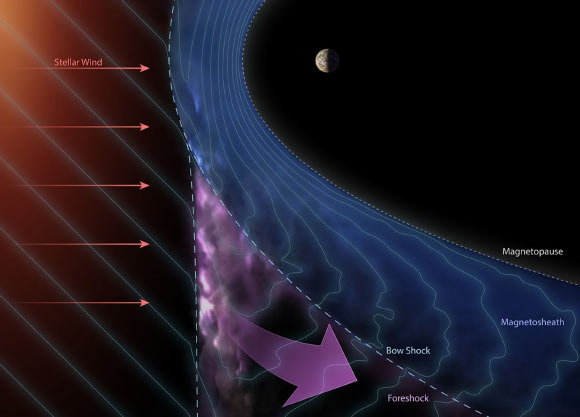
As planets and stars travel through the streams of charged particles flowing across space, their magnetic fields act like obstacles; incoming particles are slowed and deflected, forming a boundary called the bow shock; just ahead of this boundary lies the foreshock, a variable region where magnetic conditions can accelerate some particles to nearly the speed of light. Image credit: Ben C. Smith, Johns Hopkins Applied Physics Laboratory.

The giant planet’s bow shock isn’t just deflecting the solar wind, it’s acting as a powerful particle accelerator, firing electrons to relativistic energies of at least 1 MeV, according to a new analysis of data from NASA’s Juno spacecraft.

The post Jupiter Accelerates Electrons to Near-Light Speed, Offering Clues to Cosmic Ray Origins appeared first on Sci.News: Breaking Science News.

  •  

Revisiting the Velocity-Time Function

Kinematics: The Velocity-Time Function Author’s Preface: A Collaborative Approach to Lesson Development The intention behind what I hope will be a series of articles on Kinematics (this one being the first) is to begin an open, collaborative process of lesson development on Physics Forums. In order to expedite this workflow, I am making deliberate use...
  •  
❌