Firstly, VideoCardz spotted that the Economic Daily News in Taiwan published a report in which the general manager of Asus, Liao Yi-hsiang, noted that as of May 2026, the price hikes on some Asus products in that country amounted to nearly 30% (compared to Q4 of 2025).
The executive then confirmed that Asus would be raising prices further in the second half of 2026 due to the component crisis, but that the increase should only be a single-digit affair. Under 10% is quite a drop compared to knocking on the door of 30%, of course.
Liao said that price rises would be milder because the cost of memory and storage had recently decreased, and also that consumers are increasingly unlikely to buy if more large hikes are heaped onto Asus products. Especially given that there was quite a lot of buying activity early in 2026, as consumers in Taiwan acted earlier than they would have otherwise, with a view to securing purchases before heftier price increases made themselves felt.
The other nugget of positivity is that, as Trading View informs us, there have been some interesting rumblings about SK Hynix, one of the big three memory chip makers (alongside Micron and Samsung).
There are reports that "SK Hynix may slow the expansion of AI memory-chip production and increase its focus on conventional DRAM products."
This apparent shift away from making HBM (the mentioned AI memory) to conventional RAM modules (the ones in consumer electronics) unsettled investors, and led to shares in SK Hynix tumbling over 12%. (Samsung followed suit with a 12% drop, and a wider tech share slide was witnessed, particularly for companies linked to the world of AI.)
What's bad news for investors is good news for consumers though; if this report is on the money, SK Hynix reallocating assembly lines to produce more DDR5 RAM could be the beginning of the end of the memory crisis.
Analysis: is the AI bubble ready to pop? I doubt it…
(Image credit: Getty Images)
You could leap to some big conclusions here, and the rumor around SK Hynix is a potential move that could have a significant impact for consumers. With some folks talking about the end of the 'AI bubble' in recent times — which feels like hopeful chatter indeed — it could be read as another indicator in that respect, too. However, it's way too early to make that kind of call (and I don't personally think we're seeing that by any means).
What we don't know is the extent of the apparent shift away from HBM, and anyway, the move could partly be about DRAM being so pricey now that it represents a tempting enough diversification in terms of SK Hynix's overall memory strategy (a theory raised in some quarters).
We should also remember that the chairman of SK Group (the parent company of SK Hynix), Chey Tae-won, has previously predicted that the RAM shortage may not be over until 2030 (a forecast more recently echoed by Nvidia's CEO). So, as noted, temper any optimism, but this is at least a positive sign from the big chip maker, as is the price prediction from Asus.
Regarding Asus, again there's a caveat — namely that it's an analysis for the Taiwanese market only. But if price rises in H2 2026 are only (roughly) a third of what they effectively were in the first half of the year, that'll surely be reflected to some extent globally. Also, it's very true that consumers everywhere will refuse to buy if pricing goes higher too quickly, which is something I've pointed out a few times before. This isn't something unique to Taiwan.
Finally, it's also worth noting that earlier this month, we heard some more positive news on the RAM crisis from David McAfee, AMD's VP and general manager of Ryzen CPU and Radeon GPUs.
As PC Gamer reported, McAfee said: "There is an enormous amount of capacity that is being built by the memory manufacturers to bring more production online, and that more production online is going to focus on DDR, LPDDR, HBM, like the newer memory technologies."
He added: "I don't expect a lot of DDR4 production to come back into the world, but those newer memory technologies, a significant amount of capacity is coming online. I think we'll start to see by the end of next year and into 2028 that that ramp really starts to take hold, and then it's just a factor of the forces of supply and demand, and how that affects memory prices."
OK, so this is really just a reminder of what we've already been told, but it's still worth bearing in mind that the expectation for some remains a considerable easing of the crisis by 2028.
In a groundbreaking study soon to redefine neuroscientific understanding of memory mechanisms, researchers have uncovered the pivotal role played by Neurensin-2 (NRSN2) in regulating hippocampal synaptic plasticity and memory functionality. This newly published research reveals how deficiency in NRSN2 leads to profound impairments in memory, traced back to disrupted excitatory synaptic transmission and weakened long-term potentiation (LTP) within the hippocampus, a brain region critically involved in memory formation and cognitive processing.
The hippocampus serves as the brain’s memory hub, integrating myriad neuronal signals to encode and retrieve information efficiently. Central to this integration is the function of excitatory synapses that employ glutamate receptors, especially the N-methyl-D-aspartate (NMDA) receptor, which plays an essential role in synaptic plasticity—the ability of synapses to strengthen or weaken over time. This plasticity underlies learning and memory. The study elucidates how NRSN2 exerts a regulatory influence on the expression of NMDA receptor subunits, with deficiency in NRSN2 tipping the balance unfavorably and compromising synaptic efficacy.
Utilizing advanced genetic models, the investigators engineered mice lacking NRSN2 to dissect its functional contributions. Behavioral assays showcased a marked decline in memory performance, particularly in spatial and recognition tasks reliant on hippocampal circuits. These deficits were not attributed to developmental anomalies but to disrupted synaptic physiology, signaling a direct role for NRSN2 in maintaining synaptic integrity and plasticity during adult cognition.
At the molecular scale, the absence of NRSN2 triggered a significant downregulation of key NMDA receptor subunits, notably NR1, NR2A, and NR2B. These subunits orchestrate receptor assembly and gating properties critical for calcium influx, a signal cascade necessary for potentiation of synaptic strength. The reduction in their expression correlated tightly with the inhibition of LTP induction, a process considered the cellular analog of memory encoding, confirming the hypothesis that NRSN2 deficiency impairs memory by hampering core synaptic mechanisms.
Electrophysiological recordings from hippocampal slices further substantiated the disrupted synaptic function. In control animals, robust LTP was readily induced by theta burst stimulation—a protocol mimicking physiological neuronal firing during learning. Conversely, hippocampi from NRSN2-deficient mice exhibited significantly weakened potentiation, underscoring the protein’s critical role in modulating synaptic responsiveness. This impairment was not a general defect of synaptic transmission but selectively impacted excitatory plasticity mediated through NMDA receptors.
Delving deeper, the team explored the intracellular cascades influenced by NRSN2, discovering that its absence perturbed the trafficking and surface expression of NMDA receptor complexes. NRSN2 appears to act as a chaperone or scaffold protein, ensuring proper receptor assembly and synaptic localization. Without it, receptor subunits fail to achieve adequate membrane insertion, resulting in diminished postsynaptic sensitivity to glutamate and compromised signal transduction.
This mechanistic insight offers a fresh perspective on how synaptic architecture and molecular composition govern cognition. The study’s integration of molecular biology, electrophysiology, and behavioral neuroscience draws a comprehensive picture of how a single protein’s deficit can destabilize the neural substrates of memory. Such findings not only enrich fundamental neuroscience but also hint at novel targets for cognitive-enhancing therapies.
Intriguingly, alterations in NRSN2 expression and NMDA receptor dysfunction have been implicated in various neuropsychiatric disorders, including schizophrenia and major depressive disorder. By illuminating this molecular nexus within the hippocampus, the research opens doors to understanding disease pathophysiology at a finer scale and may spur development of precision interventions aimed at restoring synaptic balance in affected individuals.
The investigators also examined compensatory mechanisms that might mitigate NRSN2 absence. While some plasticity-related proteins showed upregulation, these changes failed to rescue the deficits in NMDA receptor expression and synaptic potentiation. This highlights the non-redundant and indispensable nature of NRSN2 in maintaining synaptic homeostasis and cognitive function.
Beyond the laboratory findings, the study raises fascinating questions about how synaptic proteins coordinate to sustain the dynamic range of neural connectivity required for adaptive learning. The delicate equilibrium modulated by NRSN2 and NMDA receptors underscores the complexity of neuronal networks and their vulnerability when key molecular elements are compromised—insights that are pivotal as the field seeks to decode the neural basis of memory disorders.
Future research directions spawned by this work include investigating how NRSN2 interacts with other synaptic scaffold proteins and cytoskeletal elements, potentially shaping the three-dimensional organization of the postsynaptic density. Additionally, exploring the developmental timeline of NRSN2 expression could reveal critical periods during which intervention might prevent or reverse memory impairments.
From a translational perspective, the study’s revelations beckon the clinical neuroscience community to consider NRSN2 and its pathways as therapeutic candidates. Pharmacological strategies aimed at upregulating NRSN2 or mimicking its stabilizing effects on NMDA receptors could hold promise for enhancing cognition or slowing neurodegenerative progression in disorders marked by synaptic decline.
In sum, this landmark research defines NRSN2 as a vital regulator of excitatory synaptic plasticity and memory formation. Its deficiency causes a cascade of molecular disturbances culminating in impaired NMDA receptor expression and disrupted LTP, ultimately compromising hippocampal-dependent memory functions. This work not only advances our understanding of the molecular machinery underlying memory but also charts new territory in the quest to ameliorate cognitive dysfunction.
As neuroscience inches closer to mapping the intricate cellular and molecular landscape of cognition, findings such as these underscore the profound impact a single synaptic protein can have on brain function. The compelling evidence presented lays a robust foundation for future explorations into synaptic plasticity and memory, promising strides in both basic science and clinical applications that may soon transform lives burdened by memory loss.
Subject of Research: Impact of Neurensin-2 (NRSN2) deficiency on hippocampal memory functions and synaptic plasticity
Article Title: Impact of NRSN2 deficiency on memory: Altered excitatory synaptic plasticity associated with reduced expression of NMDA receptor subunits and impaired LTP in the hippocampus.
Article References:
Wei, J., Wu, Y., Yi, Y. et al. Impact of NRSN2 deficiency on memory: Altered excitatory synaptic plasticity associated with reduced expression of NMDA receptor subunits and impaired LTP in the hippocampus. Transl Psychiatry (2026). https://doi.org/10.1038/s41398-026-04163-7
Artificial intelligence is increasingly being used to see and understand the world around us. From facial recognition on smartphones to self-driving cars and humanoid robots, computer vision has become one of the most important technologies in modern AI. Now, researchers from the Korea Advanced Institute of Science and Technology (KAIST), working with scientists from the […]
In a groundbreaking stride toward enhancing robotic cognition, scientists at MIT have unveiled an innovative memory framework that equips robots with the capacity to create, retain, and retrieve extensive, richly annotated spatial memories over extended periods. This advancement marks a significant leap beyond traditional robotic mapping techniques, enabling robots to comprehend and interact with complex environments in ways that closely mirror human spatiotemporal reasoning. The development promises transformative impacts on robotic collaboration with humans, particularly in dynamic and large-scale settings such as industrial facilities and urban landscapes.
Traditional robots, while adept at constructing geometric maps and executing predefined tasks, lack the nuanced memory capabilities that humans effortlessly employ. Consider a factory worker recalling the exact location of a partially assembled component from the previous day—a routine yet intricate cognitive task. Robots confronted with this scenario traditionally falter because their mapping systems fail to integrate detailed object descriptions and temporal context seamlessly. MIT’s new framework addresses this critical deficiency by embedding rich semantic information directly into the spatial maps robots generate as they navigate, thus producing a coherent, language-accessible mental model of their environment.
At the core of this system is a method termed Describe Anything, Anywhere, Anytime, at Any Moment (DAAAM), which synergizes advanced computer vision with robust spatial mapping. DAAAM endows robots with the ability to tag objects with descriptive annotations as they explore. For instance, a robot might label a building as the “Stata Center,” noting its architectural style, or observe a collection of bicycles and recall specifics such as a red bike sporting a flat tire. Crucially, these annotations are spatially organized within a three-dimensional map, allowing the robot to group objects logically by their locations and create a persistent, queryable memory that supports efficient retrieval.
One of the distinguishing challenges in realizing such a system lies in balancing the richness of data with the constraints of real-time operation. Existing approaches to detailed environmental annotation are computationally intensive, often taking precious seconds to process a handful of objects, thereby rendering them impractical for dynamic robotic applications. To solve this bottleneck, the MIT team engineered an optimization technique for keyframe selection, enabling the robot to identify and annotate images that offer the clearest and most comprehensive view of multiple objects simultaneously. This selective strategy accelerates the annotation process by an order of magnitude, permitting the robot to construct and update its semantic map as it moves without latency.
Beyond data acquisition, the ability to efficiently query and extract relevant information from the amassed database of spatial and semantic knowledge is vital. The researchers integrated a sophisticated large language model (LLM) enhanced with tailored toolsets designed to mitigate common issues such as hallucinations and to refine the relevance of retrieved data. This framework allows for rapid, accurate responses to complex spatial-language queries like, “Where did I leave my wallet?” or inquiries about specific landmarks within an indoor or outdoor environment. By leveraging semantic search capabilities that consider both linguistic cues and geographical context, the robot can pinpoint targets with remarkable precision and speed.
The practical implications of this technology are profound. In manufacturing settings, a robotic assistant could be dispatched to retrieve components based on natural language queries referencing past events and locations, thus augmenting human productivity and safety. Similarly, augmented reality systems could harness this structured long-term memory to guide maintenance personnel through complex infrastructure, flag anomalies based on historical data, or assist commuters in navigating public transportation hubs with personalized, context-aware directions.
MIT’s approach signifies a departure from conventional 3D mapping systems that either sacrifice descriptive depth for computational efficiency or rely on rich annotations that are prohibitively slow to generate at scale. By fusing high-level semantic perception with spatial cognition underpinned by real-time processing capabilities, DAAAM lays the foundation for a new class of robots that can engage in sophisticated spatial-temporal reasoning analogous to human common sense.
Ongoing research aims to extend this framework’s scope to encompass temporally dynamic events, enabling robots not only to remember object locations but also to encode significant occurrences within their environment. Integrating confidence metrics into the system’s responses is also a priority, enhancing the reliability and interpretability of information supplied to human users in collaborative scenarios. The vision is to cultivate a versatile, generalist robotic agent capable of executing diverse tasks on demand through naturalistic human-robot interaction grounded in shared language and understanding.
The robustness of the DAAAM system was empirically validated through comparative experiments, demonstrating superior accuracy over leading existing methodologies by margins ranging from 21 to 53 percent, contingent on the nature of the queries. The project’s intersection of computer vision, robotics, and natural language processing underscores a multidisciplinary approach vital for advancing intelligent autonomous systems that are primed for real-world deployment.
With the proliferation of autonomous machines across myriad domains, the advent of this long-term spatiotemporal memory framework addresses a pivotal gap in robotic intelligence. Robots equipped with such memory capabilities can transcend static, pre-programmed functions, adapting fluidly to evolving tasks and environments while fostering seamless collaboration with humans through shared understanding. As such, MIT’s contribution is poised to accelerate the integration of robots as capable and context-aware partners in everyday human endeavors.
This research, funded partly by the U.S. Army Research Laboratory and the Office of Naval Research, was publicly disclosed in a paper authored by Nicolas Gorlo, Lukas Schmid, and Luca Carlone and presented at the Conference on Computer Vision and Pattern Recognition (CVPR). Luca Carlone, the principal investigator and a professor at MIT’s Department of Aeronautics and Astronautics, emphasizes that the technology was developed with the goal of endowing robots with human-like language-based spatial reasoning, a foundational step toward more intelligent and helpful machines.
Subject of Research: Robotics, Artificial Intelligence, Long-Term Spatial Memory for Robots
Article Title: MIT Develops Real-Time Long-Term Memory Framework for Robots Combining Semantic Understanding with 3D Mapping
News Publication Date: Not explicitly stated; presented at CVPR 2024
In a groundbreaking development that could revolutionize the field of artificial intelligence and neuromorphic computing, researchers have unveiled a novel algorithm–hardware co-design approach featuring neuromorphic networks supported by dual memory pathways. This innovative framework, recently published in Nature Machine Intelligence, promises to overcome longstanding challenges in efficiently mimicking brain-like processing in silicon hardware. The fusion of algorithmic design and hardware architecture epitomizes a synergistic leap forward for neuromorphic systems, which strive to emulate the efficiency and adaptability of biological neural networks.
Neuromorphic computing, inspired by the structure and function of the human brain, seeks to replicate neural dynamics through specialized hardware that inherently supports parallel and event-driven processing. Unlike traditional von Neumann architectures, which segregate memory and processing units, neuromorphic systems integrate these functions, drastically reducing latency and energy consumption. However, a persistent limitation in current neuromorphic implementations lies in their constrained memory capacity and difficulties in sustaining stable learning over time. The new co-design method directly confronts these issues by introducing a dual memory pathway mechanism akin to the human brain’s approach to memory storage and retrieval.
The dual memory pathways conceptualized by the research team separate short-term and long-term memory processing within the neuromorphic network. Short-term memory pathways facilitate rapid, flexible adaptation to incoming data, echoing the brain’s working memory functions. Concurrently, long-term memory pathways enable the consolidation and retention of learned information over extended periods. This bifurcation fosters an architectural efficiency that mitigates memory interference and catastrophic forgetting—two notorious hurdles in neuromorphic learning systems and artificial intelligence at large.
Fundamentally, the innovative algorithm tailors synaptic plasticity dynamics to the hardware substrate, leading to more stable, biologically plausible learning rules. The researchers employ spike-timing-dependent plasticity (STDP) paradigms adjusted dynamically by the dual pathways, allowing the system to adapt continuously yet retain core learned information without overwriting. This hybrid plasticity approach is supported by circuits that facilitate separate yet interactive memory stores, closely emulating the hippocampus-neocortex complementarity observed in mammalian brains.
Critically, the design is optimized to leverage emerging non-volatile memory technologies such as resistive RAM (ReRAM), which afford dense, low-power synaptic implementation. The team’s hardware prototype integrates these resistive elements into the dual memory architecture, striking a delicate balance between speed, retention, and energy efficiency. By co-optimizing the algorithmic parameters with hardware constraints, the design attains a level of performance and scalability previously unattainable in neuromorphic networks.
Extensive benchmarking on machine learning tasks highlights the superiority of this co-design approach. Tasks demanding continual learning and domain adaptation—traditionally challenging due to interference effects—exhibit enhanced stability and precision. Notably, the dual pathways enable the neuromorphic system to segregate novel information from prior knowledge efficiently, supporting lifelong learning scenarios critical for real-world AI applications such as robotics, autonomous systems, and adaptive sensory processing.
The implications of this breakthrough extend beyond traditional AI. By more faithfully replicating the brain’s memory consolidation processes, these neuromorphic networks could yield insights into neurological disorders characterized by memory dysfunction. Additionally, the modularity of the dual memory pathways invites future customization and specialization for domain-specific tasks, envisioning a new class of adaptive hardware that evolves alongside its operational environment.
Moreover, the research addresses the formidable challenge of hardware variability and noise—a persistent bottleneck in neuromorphic device deployment. The co-designed algorithm inherently compensates for device-level imperfections through adaptive learning thresholds and redundancy in memory representations. This robustness not only ensures reliable operation over extended periods but also enhances manufacturability and cost-effectiveness for large-scale silicium implementations.
This co-design paradigm exemplifies a pivotal shift in neuromorphic engineering, moving away from generic algorithm deployment on fixed hardware towards integrated development of systems where both hardware and software are mutually optimized. This approach reflects an emerging philosophy in AI hardware: embracing the interdependence of physical substrate and algorithmic function to unlock previously constrained capabilities.
Such a sophisticated neuromorphic platform provokes exciting questions regarding the future landscape of artificial intelligence. Could dual memory pathways represent a standard architectural motif underpinning all next-generation AI chips? Might this design accelerate the creation of truly autonomous systems capable of continuous, context-aware learning within dynamic environments? The potential scale and impact of these mechanisms suggest transformative ripples across industry sectors reliant on AI, from healthcare and finance to autonomous vehicles and beyond.
While promising, challenges remain. Scaling the dual memory network to extremely large, brain-scale systems presents engineering complexities necessitating further innovations in materials, circuit design, and integration techniques. Additionally, fine-tuning the balance between memory consolidation and plasticity, ensuring both adaptability and stability, demands deeper theoretical understanding informed by neuroscience. Continued collaboration between multidisciplinary teams of neuroscientists, material scientists, electrical engineers, and computer scientists will be pivotal to this endeavor.
Looking ahead, this work may catalyze the proliferation of neuromorphic devices poised to operate at unprecedented energy efficiencies while offering continuous learning capability. By taking inspiration from the brain’s memory architecture and rigorously co-designing compatible hardware, the research ushers in an era where artificial intelligence systems can remember, adapt, and grow with a natural fluidity previously attainable only in biological organisms.
The dual memory pathway design stands as a milestone demonstrating that bridging the algorithm–hardware gap is an indispensable strategy for advancing neuromorphic computing. Its capacity to resolve persistent issues such as catastrophic forgetting and memory interference attests to an elegant merging of biological principles with cutting-edge technology. As AI advances toward greater autonomy and contextual sophistication, innovations like these could form the foundational building blocks of truly intelligent machines.
In sum, the synergy achieved by this algorithm–hardware co-design exemplifies the future of neuromorphic architectures — dynamic, adaptive, and deeply integrated with the physical medium of computation. It heralds a pivotal moment where the dream of brain-inspired computing inches closer to reality, promising devices that do not merely process information, but learn and remember in a resilient and energy-efficient manner akin to the human mind.
Subject of Research: Algorithm–hardware co-design in neuromorphic networks incorporating dual memory pathways to enhance learning stability and efficiency.
Article Title: Algorithm–hardware co-design of neuromorphic networks with dual memory pathways.
Article References:
Sun, P., Su, Z., Achterberg, J. et al. Algorithm–hardware co-design of neuromorphic networks with dual memory pathways. Nat Mach Intell (2026). https://doi.org/10.1038/s42256-026-01255-3
Alzheimer’s disease is the most common cause of dementia and one of the biggest health challenges facing the world today. It gradually damages memory, thinking abilities, and the capacity to perform everyday tasks. In the early stages, people may forget recent conversations or misplace objects more often. As the disease progresses, many struggle to recognize […]
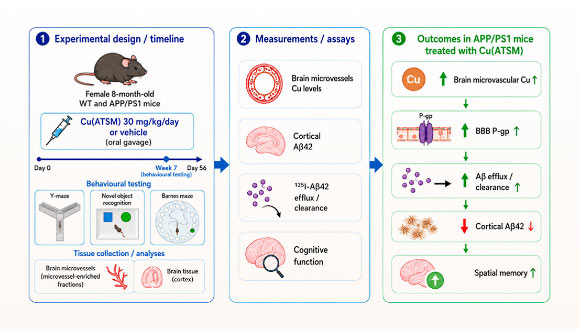
Copper diacetyl bis(4-methyl-3-thiosemicarbazone), or Cu(ATSM), restored a key waste-removal system in the brain, reducing toxic amyloid-beta buildup and improving spatial memory in lab models of Alzheimer’s disease, according to a team of researchers at Monash University.
A new study suggests that reproducing a crucial sleep-like brain pattern in awake animals may help preserve memory and learning abilities. What if part of the brain could get some of the benefits of sleep without the rest of the brain ever going offline? A new NIH-funded study suggests that may be possible. Researchers found [...]
As artificial intelligence, cloud computing, and online services continue to grow, the demand for faster and more energy-efficient computer hardware is rising rapidly. Now, researchers in Japan have developed a new type of magnetic memory that can be rewritten using a single pulse of laser light instead of electric current, potentially paving the way for […]
Researchers at NYU Langone Health recorded the activity of hundreds of neurons simultaneously across several brain regions in mice. By tracking how signals move from the hippocampus to the neocortex, where long-term memories are kept, they found that a subset of hippocampal neurons appears to participate in routing information between regions in distinct patterns. These cells participate in both incoming and outgoing signaling, but do so using distinct patterns of activity.
Separate Channels Through the Same Cells
The study focused on a series of interconnected brain regions: CA3, which processes rapidly changing information; CA1, which serves as a central hub; and the retrosplenial cortex, which is important for navigation and spatial memory. About one in four CA1 neurons receives most of the signals from CA3. When these same neurons send signals to the retrosplenial cortex, they fire in a different pattern, creating a separate outgoing channel using the same cells.
Rather than using new neurons, the brain separates these channels by changing how the same neurons fire together. The researchers suggest this arrangement may help reduce interference between new learning and more stable cortical memories.
“Our findings help explain how memory can be both moldable and enduring,” said co-lead author Joaquín Gonzalez, PhD, a postdoctoral fellow in the Department of Psychiatry at NYU Grossman School of Medicine. “By changing how the same cells fire together instead of turning on new cells, the brain can keep information organized and protect older memories.”
What Happens During Sleep
The CA1 neurons involved in learning during the day also stay active at night. The researchers found that these cells remain busy during sleep events called sharp-wave ripples, which are bursts of activity the hippocampus uses to replay and strengthen memories from the day.
Since overlapping neurons are recruited during both waking activity and sleep replay, the same circuit elements appear to participate in both learning and consolidation. This theoretically allows the brain to use a single system for both learning and storing memories, without the two processes interfering with each other.
“Our study shows how learning and memory consolidation can coexist in the same network,” said co-lead author Mihály Vöröslakos, MD, PhD. “Our discovery was made possible because for the first time, we were able to record hundreds of individual neurons across all the key regions simultaneously in animals that were moving around naturally.”
Implications for Disease and AI
The system identified in this research may help explain how memory disorders begin. In Alzheimer’s disease, for example, the hippocampal circuits examined here are some of the earliest to deteriorate. These networks are essential for sorting and organizing new experiences.
“Our discovery of a ‘memory switchboard’ deep in the hippocampus may provide clues as to how memory circuits fail in Alzheimer’s disease,” said co-senior author Zhe S. Chen, PhD, a professor in the Departments of Psychiatry and Neuroscience at NYU Grossman School of Medicine.
Artificial intelligence systems have a hard time holding onto what they’ve already learned when faced with new tasks, a problem researchers call catastrophic forgetting. The human brain appears able to update memories without catastrophic forgetting by altering the use of existing neural circuits. By studying how our brains pull this off, scientists hope to design AI that can keep learning new things without forgetting the old.
“By showing how the mammalian brain can safeguard memories during learning, our research may offer a biological blueprint for designing next-generation AI technology that can update itself continuously without overwriting what it has already acquired,” said co-senior author György Buzsáki, MD, PhD, the Biggs Professor of Neuroscience at NYU Grossman School of Medicine.
The researchers plan to investigate whether similar switchboard-like channels exist in other memory circuits. The authors caution that their findings in mice under controlled conditions do not yet allow conclusions about the human brain.
Austin Burgess is a writer and researcher with a background in sales, marketing, and data analytics. He holds an MBA, a Bachelor of Science in Business Administration, and a data analytics certification. His work focuses on breaking scientific developments, with an emphasis on emerging biology, cognitive neuroscience, and archaeological discoveries.
A new study shows that tau helps organize and preserve long-term memories, while abnormal tau may contribute to memory problems in Alzheimer’s disease by disrupting memory formation and recall. New research has revealed that tau, a protein closely linked to Alzheimer’s disease, is also essential for creating long-lasting memories. The findings could point to new [...]
 Login





 Older adults with higher vitamin C levels showed stronger brain-network markers.
 A new study suggests that reproducing a crucial sleep-like brain pattern in awake animals may help preserve memory and learning abilities. What if part of the brain could get some of the benefits of sleep without the rest of the brain ever going offline? A new NIH-funded study suggests that may be possible. Researchers found [...]

 Single cells used past nutrient shocks to change how they grew.
 A new study shows that tau helps organize and preserve long-term memories, while abnormal tau may contribute to memory problems in Alzheimer’s disease by disrupting memory formation and recall. New research has revealed that tau, a protein closely linked to Alzheimer’s disease, is also essential for creating long-lasting memories. The findings could point to new [...]