❌

Reading view

US domino team sets Guinness World Record by toppling 29,193 tiles in a 3D pyramid
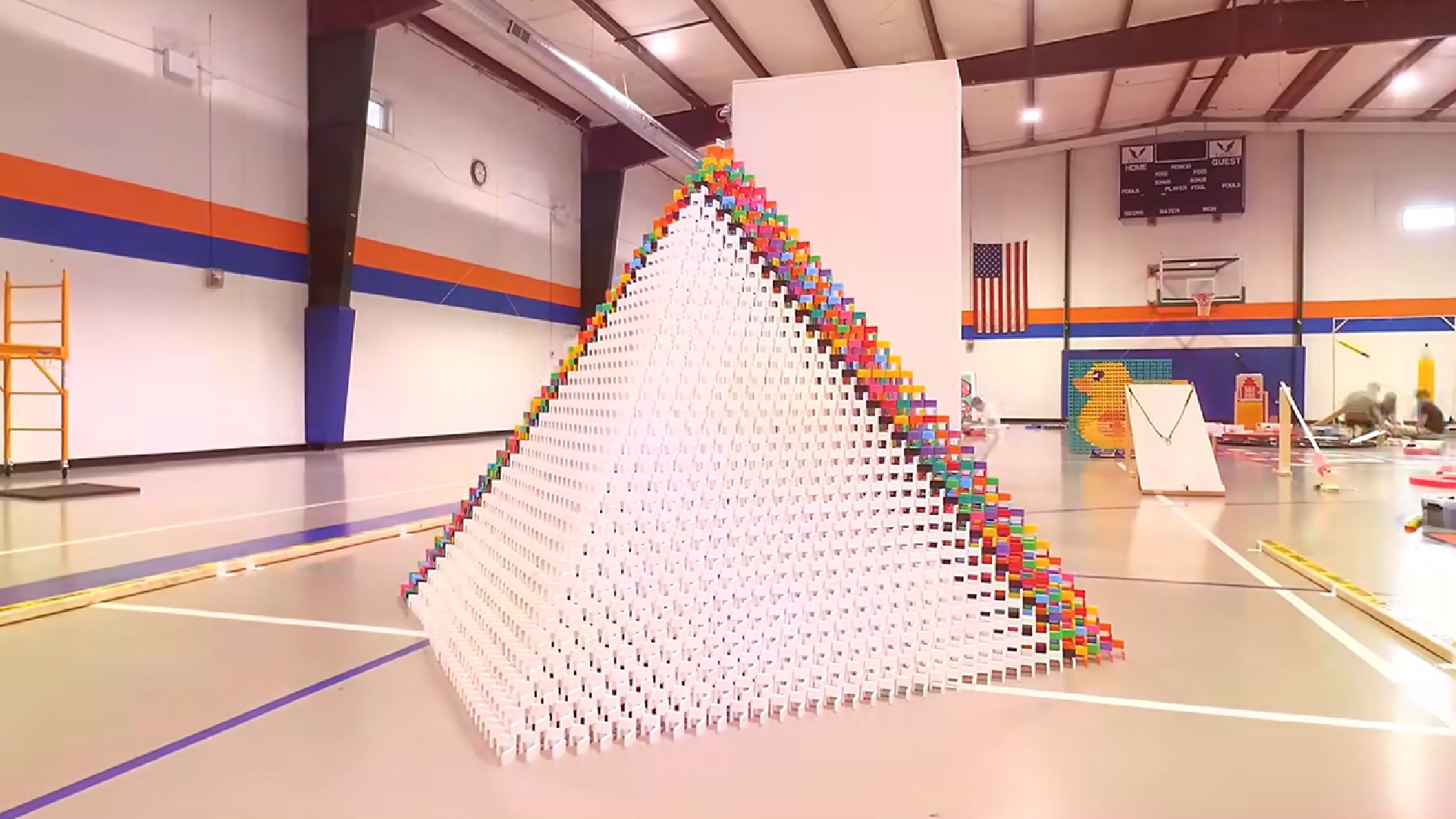
A team of ten domino artists has set a new Guinness World Record for the most dominoes toppled in a three-dimensional pyramid, bringing down 29,193 tiles in a single chain reaction at a gym in Garden City, Michigan, on June 20.

Guinness World Records has officially certified the achievement, which was set by the FALLDOWN Domino Team led by Steven Price of Sprice Machines as part of a larger installation that incorporated no fewer than 123,456 dominoes in total.

The feat, documented in a YouTube video titled “123,456 Dominoes SUPERSIZED — FALLDOWN 2026,” has attracted widespread attention online for the scale and precision of its construction

Price has held four domino-related Guinness World Records previously and has served as a judge on Fox’s competition show Domino Masters. He holds a mechanical engineering degree, a background that is evident in the structural ambition of this project.

Building a 35×35 pyramid without triggering it

The three-dimensional pyramid that forms the centerpiece of the record sits on a base of 35 by 35 dominoes and rises in layers to a pointed apex. Constructing a 3D pyramid of this scale requires a level of precision that flat domino runs do not — every tile must be positioned accurately while the structure beneath it remains stable, and a single mistimed touch anywhere in the grid can bring the entire build crashing down prematurely.

Watch the video here.

The FALLDOWN team, which includes Michael Fantauzzo, Matt VanVleck, Gabe Dean, Alex Koops, Derek Koops, Stephan Burton, Brady Dolan, Evan Voeltner, and Aaron Bimrah alongside Price, spent multiple days installing the complete setup.

A world built from supersized everyday objects

The pyramid was not the only engineering feat in the room. The team built a themed installation around 123,456 dominoes arranged into giant versions of ordinary objects — enormous paperclips, oversized friendship bracelets, massive bonsai trees, school supplies and a rubber duck that appears mid-sequence.

These elements fed into a series of Rube Goldberg-style chain reactions that snaked through the entire installation before converging on the pyramid, making the final topple a product of everything that came before it.

Guinness required a traditional domino-to-domino start

The team had originally planned to use a special mechanical trigger to bring the pyramid down. Guinness World Records rejected the approach: to qualify for an official record, the entire chain must begin with a conventional domino touching the next in sequence, with no external mechanism initiating the fall. The team revised their plans accordingly, and the record-setting run began exactly as the rules required.

Price’s fifth Guinness record in domino art

The FALLDOWN record is Steven Price’s fifth Guinness certification in domino-related categories. His prior titles include the largest domino circle field, the longest domino wall, and the largest two-dimensional pyramid. Price first gained wider recognition as a 22-year-old when his Incredible Science Machine project, which involved 250,000 domino tiles, set records and went viral.

His YouTube channel, Sprice Machines, includes videos with over 30 million views, with the Lemonade Machine — a chain reaction that travels through an entire house to serve lemonade — among the most-watched.
  •  

New metal alloys that beat 1,832°F heat could help jet engines and nuclear reactors

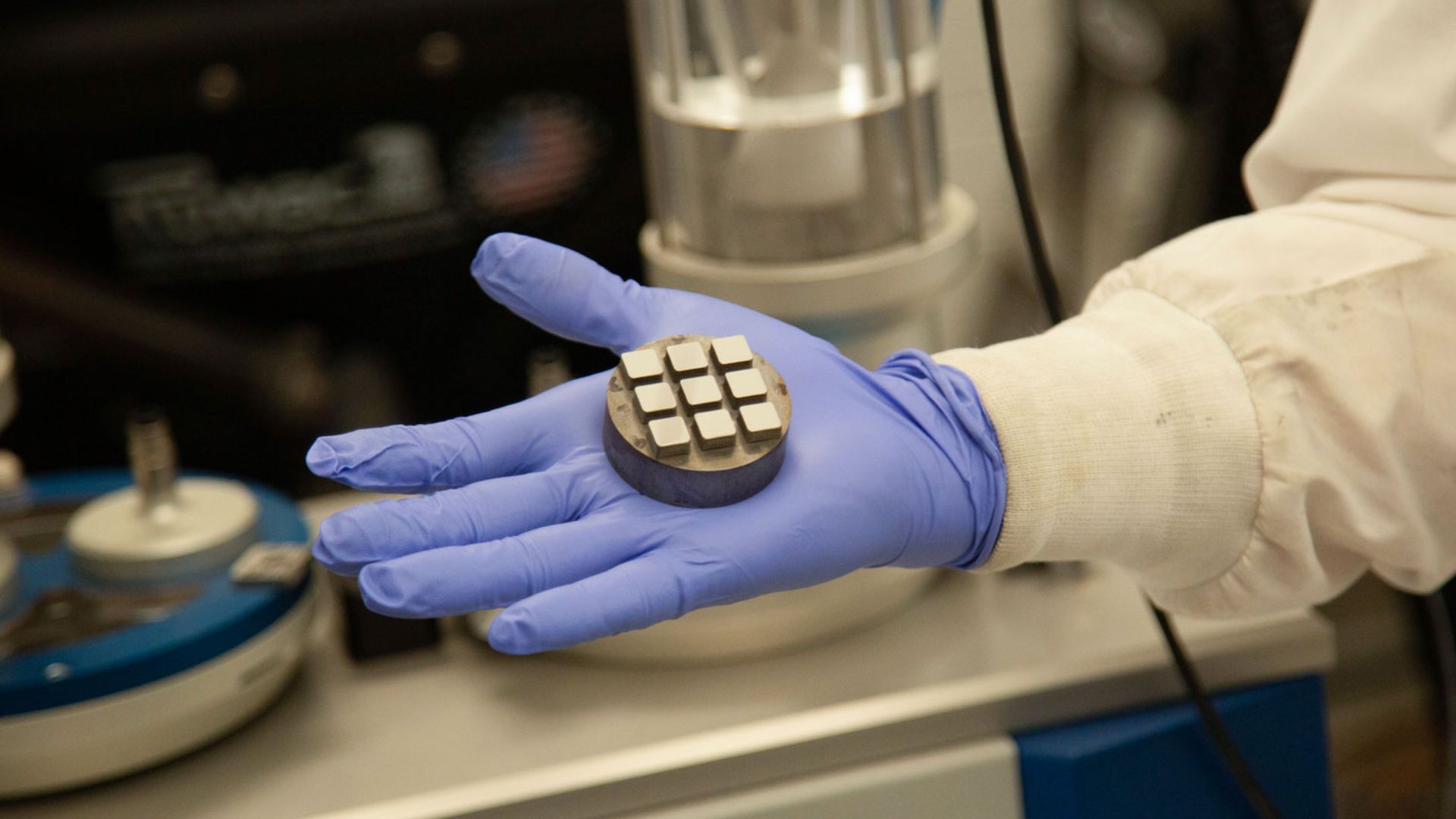
Researchers at the University of Toronto Engineering have developed six new metal alloys using an artificial intelligence-driven discovery platform that could improve the durability of parts used in jet engines, nuclear power plants, and other extreme environments. The findings show that the AI-assisted system identified promising alloys within just a few weeks, significantly speeding up the search for high-performance materials.

These new alloys also work well with 3D metal printing, enabling the production be complex parts that are hard or impossible to produce with traditional methods.

AI speeds up alloy discovery

Led by Yu Zou, Canada Research Chair in Materials and Manufacturing for Extreme Environments, the team worked with Jason Hattrick-Simpers to build a system that uses computer modeling, machine learning, and robots to help with manufacturing.

Their method, called active learning, acts like a self-driving laboratory. Rather than testing thousands of metal combinations by hand, the system picks the best options, makes them, tests how they perform, and uses those results to guide the next experiments.

“There’s enormous demand for materials that can stand up to huge swings of temperature and pressure, such as what you would find inside a jet engine or in the steam generators inside nuclear power plants, anywhere conventional steel just can’t survive,” said Yu Zou, who led the project.

“We also need materials that can be printed layer by layer, enabling us to make components that can’t be created by traditional manufacturing processes. For example, to make a material that is both lightweight and strong, you can vary the composition: a hard, tough alloy on the outside to something softer and lighter on the inside.”

The project was partly supported by the University of Toronto’s Acceleration Consortium, a group that uses AI and automation to accelerate the discovery of new materials.

Active learning cuts the need for massive datasets

Most AI systems need a large amount of experimental data to make accurate predictions. This becomes a problem when researchers look at materials that have not been tested yet.

“One problem you often run into when trying to use AI to design materials is that most machine learning models require lots of data about material properties to learn from,” revealed Ajay Talbot, a Ph.D. student in Zou’s lab and lead author of the study.

“But if you’re working in part of the design space that hasn’t been explored yet, that data doesn’t exist, so you’re kind of flying blind.”

“The way we get around that challenge is to use data-lean models that essentially feel their own way along. Our active learning model strategically selects a few samples to manufacture and test, and the data from those experiments is fed back into the model to inform where we go next. It really speeds things up.”

<a href=”https://www.youtube.com/watch?v=RFYJV7WvtOM“>https://www.youtube.com/watch?v=RFYJV7WvtOM</a>

New alloys outperform industry benchmark

To demonstrate the system, the researchers focused on compositionally complex alloys made from nickel, cobalt, and chromium. Within weeks, the automated platform identified six new alloy formulations with strong performance.

“One of the properties we were targeting was puncture resistance at temperatures of up to 1,112°F (600°C), which is what you’d find in the front section of a jet engine,” Talbot said.

“The industry standard in this space is nickel-based alloys such as Inconel 625. But we found one made of 12 percent nickel, 62 percent cobalt, and 26 percent chrome that was great for retaining hardness at extremely high temperatures. Even with just three components, our alloy outperformed Inconel 625, an alloy of more than 10 different elements, by 4.5 percent in our lab tests.”

The team also developed another alloy designed for hotter sections of jet engines, where temperatures can reach 1,832°F (1,000°C).

“One of the things that happens in an environment like that is the formation of oxide scale, which essentially means that your material is just getting burned away,” Talbot explained.

“We found a material made of 36 percent nickel, 14 percent cobalt, and 50 percent chrome that was extremely good for oxidation resistance at these high temperatures: It even outperforms Inconel 625 by 85 percent. We’re eventually aiming to ramp up to even higher temperatures, up to 2,192°F (1,200°C).”

Researchers plan to expand to more complex materials

The researchers say the current alloys represent an early demonstration of what the AI-driven discovery platform can achieve.

“This nickel-cobalt-chrome system has just three elements in it. In the grand scheme of things, it’s a relatively simple system,” he added.

“But it’s great for showing that this whole closed-loop discovery platform really works. What we want to do next is ramp up the complexity a bit more to make even crazier stuff, with maybe up to 10 or 12 different elements.”

“As you add more components, you can get different strengthening mechanisms, different kinds of useful properties. There’s a lot more out there just waiting to be discovered.”

The study was published in the journal npj Advanced Manufacturing.

  •  

China deploys ‘Transformer’ rescue barge to save over 6,000 stranded flood victims

A foldable, self-propelled pontoon barge has played a key role in rescuing more than 6,000 stranded students and staff from a flood-hit region in southern China.

The rapid-deployment vessel was used during evacuation efforts in the Guangxi Zhuang Autonomous Region after flooding due to Typhoon Maysak inundated communities, according to Chinese media reports. The modular barge can be assembled in just over 10 minutes, carry more than 500 people per trip, and transport loads exceeding 66.1 US tons. 

According to its manufacturer, the platform is engineered to operate reliably in harsh environments, including high-altitude regions up to 10,800 feet (3,300 meters) above sea level and areas with extreme cold.

Pontoon powers rescue

The self-propelled pontoon barge helped to evacuate more students and staff trapped after floodwaters nearly five meters deep cut off the campus.

The modular vessel, described by Chinese Foreign Ministry spokeswoman Mao Ning as “China’s real-life transformer,” played a central role in a large-scale evacuation at Guangxi Logistics Vocational and Technical College in Guigang, Guangxi Zhuang Autonomous Region, reported the South China Morning Post (SCMP). 

The rescue operation took place after torrential rains left the college campus submerged under nearly five meters (16.4 feet) of floodwater, cutting off thousands of people from surrounding areas. According to China’s state news agency Xinhua, conventional rescue methods initially struggled to cope with the scale of the emergency.

Emergency teams first relied on inflatable rescue boats and assault boats to reach those stranded. While effective for small-scale operations, these vessels could transport only a limited number of passengers at a time, making the evacuation process slow and difficult.

To accelerate the rescue effort, the state-owned China Anneng Construction Group, China’s emergency rescue force, deployed three heavy-duty self-propelled pontoon barges to the flooded area between Wednesday night and Thursday. The arrival of the modular barges dramatically increased evacuation capacity, allowing rescuers to move hundreds of people during each trip. By midday Thursday, every student and staff member had been safely evacuated, according to Guangxi Television.

Heavy-duty lifeline

The pontoon barge used in the operation measures approximately 60 meters in length and eight meters in width. It is capable of carrying more than 500 passengers in a single journey while supporting a total payload exceeding 66.1 US tons. Unlike conventional floating bridges or barges that require external towing, the vessel is equipped with its own propulsion system, enabling it to travel at speeds of up to 6.7 mph (10.8 km/h) even when fully loaded.

One of its biggest advantages is its rapid deployment capability. China Anneng said the modular system can be transported to a disaster site, assembled, and placed into operation in just over 10 minutes. Its foldable design allows emergency responders to quickly establish a large-capacity transport platform without relying on permanent infrastructure.

The rescue barge is regarded as one of China’s most advanced modular heavy-duty water rescue systems. It was specifically developed to address one of the biggest challenges during major floods—transporting large groups of people, emergency responders, vehicles, and heavy equipment across inundated areas or rivers made impassable by rising water, according to the SCMP.

The vessel is manufactured by China Harzone Industry Corporation, a subsidiary of the state-owned China State Shipbuilding Corporation (CSSC). The company says the platform is designed to operate reliably in demanding environments, including high-altitude regions up to 10,800 feet (3,300 meters) above sea level and areas experiencing extremely cold temperatures.

CSSC noted that the high-tech rescue platform has been widely deployed in domestic emergency response operations since 2020. Its successful use during the Guangxi floods demonstrates how rapidly deployable modular engineering systems are becoming an increasingly important tool for large-scale disaster response, enabling emergency teams to evacuate thousands of people far more quickly than traditional rescue boats alone. thousands of people far more quickly than traditional rescue boats alone.

💾

China deployed a rapid-deployment pontoon barge to evacuate 6,000 flood victims, carrying 500 people per trip.
  •  

Electra hybrid-electric aircraft adds 250 turbogenerators for ultra-short flights

Electra has selected Safran Helicopter Engines to supply the turbogenerator for its EL9 Ultra Short aircraft under a production agreement that will run for the life of the program. The deal gives the Virginia-based aircraft developer a key propulsion partner as it works toward Federal Aviation Administration (FAA) certification and commercial service by 2030.

The agreement includes an initial order for 250 TG600 turbogenerators. Electra expects production to increase as demand grows for the EL9, a hybrid-electric aircraft designed to operate from landing areas as short as 150 feet. The capability could allow flights from locations that cannot support conventional commercial aircraft.

Hybrid system selected

Safran’s TG600 will generate 600 kilowatts of electrical power for the EL9’s hybrid-electric propulsion system. Engineers based the unit on the company’s Arrano helicopter engine, which delivers an 18% improvement in fuel efficiency over the previous generation of engines.

The system also integrates two GENeUS electric generators developed by Safran Electrical & Power. Earlier this month, Safran completed the first bench test of the flight-ready turbogenerator at its facility in Bordes, France. The company plans to use that hardware during the EL9’s initial flight-test campaign.

Electra CEO Marc Allen called the agreement an important milestone for the aircraft program. He said Safran’s expertise in hybrid-electric propulsion and long-term commitment would help bring the EL9 into commercial service.

Safran Helicopter Engines CEO Cédric Goubet said the contract formally launches the company’s turbogenerator business. He added that combining Safran’s engine technology with its electrical systems expertise creates a propulsion package tailored for the EL9’s performance goals.

Designed for short fields

Unlike conventional regional aircraft, the EL9 relies on hybrid-electric propulsion and blown-lift technology to achieve extremely short takeoffs and landings. Electra says the aircraft needs only about 150 feet of runway, opening access to small airfields and other locations closer to population centers.

The company believes that capability could reshape regional transportation by reducing dependence on major airports for shorter trips. Electra describes the concept as “Direct Aviation,” allowing travelers to fly closer to their origin and destination instead of connecting through large airport hubs.

FAA certification work is already underway under Part 23 regulations. Electra expects the aircraft’s first flight in late 2027 or early 2028 before targeting entry into service in 2030.

Growing production plans

The Safran agreement follows other commercial milestones for the EL9 program. Earlier this year, Bristow Group signed a pre-delivery payment agreement that secured the first production delivery slot through binding commercial terms, subject to aircraft certification. Electra also released market projections suggesting demand for between 12,000 and 16,000 aircraft during the first decade of Direct Aviation operations across the United States.

If those forecasts materialize, the EL9 would represent a new category of regional aircraft that combines electric propulsion with conventional turbine power. Electra and Safran aim to deliver an aircraft capable of connecting communities that currently lack practical commercial air service while reducing fuel consumption compared with traditional regional aircraft.

  •  

Intel ships first commercial processors made with next-generation lithography tools

Intel Foundry has become the first chipmaker to manufacture and ship a high-volume logic product using ASML’s High NA extreme ultraviolet (EUV) lithography, marking a major step toward commercial adoption of the next generation of chipmaking technology.

The milestone applies to a subset of Intel Core Ultra Series 3 processors, code-named Panther Lake, built on the company’s Intel 18A process node. Intel said specific Intel 18A layers are now dual-qualified on ASML’s High NA EUV platform at its Oregon facility, with products shipping to customers at yields matched to the existing NXE platform.

The announcement signals a shift for High NA EUV from research and early testing into production manufacturing. Intel and ASML said the technology is being used on selected chip layers to collect manufacturing data and further optimize system setup, uptime, and production implementation before wider deployment in future process nodes.

High NA EUV is the next evolution of EUV lithography, offering higher resolution and improved process control for patterning increasingly smaller chip features. The technology is expected to help semiconductor manufacturers build denser and more complex chips while supporting future advances in computing and artificial intelligence.

Production milestone reached

ASML said the deployment builds on decades of collaboration with Intel to advance semiconductor manufacturing. The latest production milestone follows Intel’s installation of the industry’s first commercial High NA EUV system at its Hillsboro, Oregon, research and development site in 2024. The company later became the first to install and qualify ASML’s second-generation TWINSCAN EXE:5200B system, which delivers higher throughput, improved overlay accuracy, and an upgraded light source.

The Panther Lake processors are manufactured on Intel 18A, with High NA EUV used to pattern selected layers of the chips. Intel said the approach provides manufacturing experience while maintaining production performance on existing platforms.

“With increased resolution and better process control, the introduction of High NA EUV marks a substantial development in semiconductor lithography,” said Christophe Fouquet, ASML President and CEO. “We are proud to play a role in enabling the smaller, denser patterning that will accelerate advancements in AI and other emerging technologies.”

The companies said insights gained from production will help refine system setup, uptime and manufacturing processes, paving the way for broader adoption of the technology in future generations of semiconductor manufacturing.

Scaling future nodes

Intel described the milestone as an important step in integrating High NA EUV into commercial chip production at scale while maintaining manufacturing flexibility for future process technologies.

“This milestone reflects the close technical collaboration between Intel and ASML and shows how High NA EUV can be integrated into advanced semiconductor manufacturing at scale,” said Naga Chandrasekaran, Executive Vice President and General Manager of Intel Foundry.

According to Intel, qualifying High NA EUV on selected Intel 18A product layers allows the company to continue delivering production output while evaluating how the technology can support future process nodes with higher performance, greater transistor density, and improved manufacturing flexibility.

With Panther Lake now entering high-volume manufacturing using High NA EUV, Intel becomes the first company to ship commercial high-volume logic products built with the technology, providing an early demonstration of how next-generation lithography can move from development into large-scale chip production.

  •  

NASA Uses Subscale Aircraft to Accelerate Flight Innovation

4 Min Read

NASA Uses Subscale Aircraft to Accelerate Flight Innovation

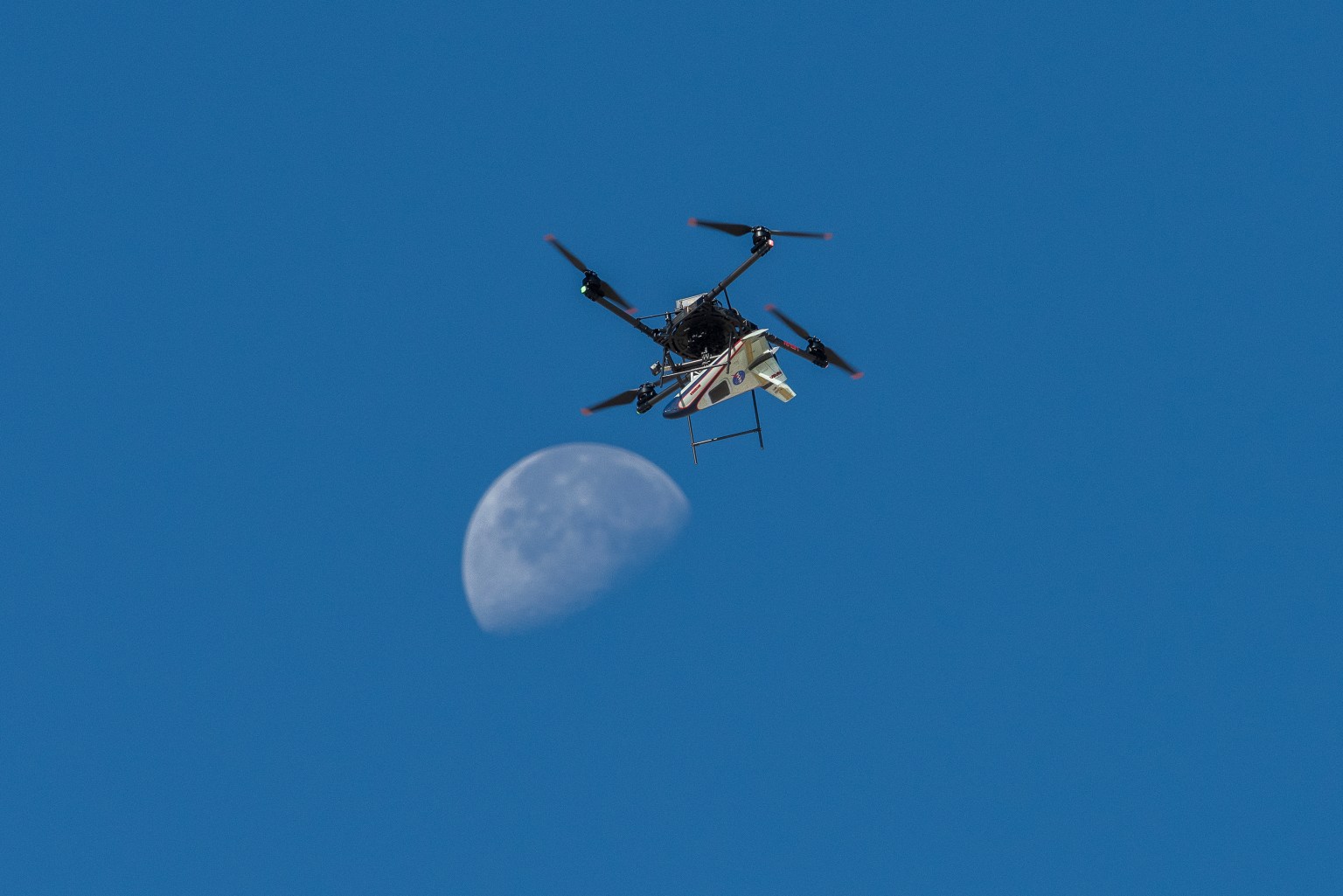
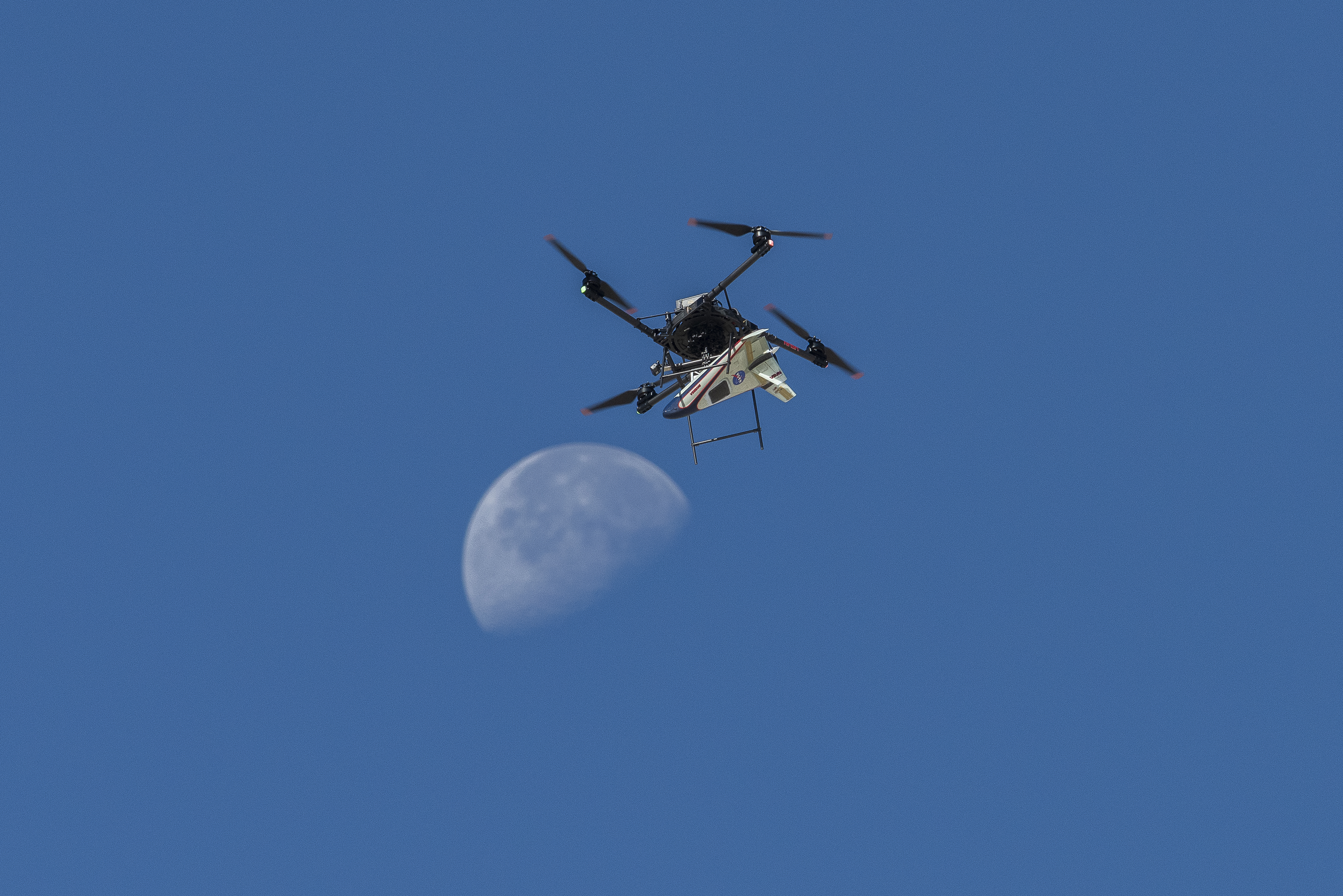
A white, blue, and red probe attached to a rotor with four blades flies in the blue sky, just above the Moon.
An atmospheric probe model attached upside down to a quad rotor remotely piloted aircraft ascends with the Moon visible on Oct. 22, 2024. The quad rotor aircraft released the probe above Rogers Dry Lake, a flight area adjacent NASA’s Armstrong Flight Research Center in Edwards, California. The probe was designed and built at the center.
Credits: NASA/Steve Freeman

Testing new aerospace concepts in flight remains one of NASA’s most effective ways to advance knowledge and reduce risk.

The Dale Reed Subscale Flight Research Laboratory at NASA’s Armstrong Flight Research Center in Edwards, California, supports this mission by using small, remotely piloted and autonomous aircraft as cost‑effective platforms to mature innovative ideas, accelerate learning, and enable smoother transitions to full‑scale flight.

When experiments require a flight platform, several NASA remotely piloted aircraft are available: the Alta‑X quadrotor; the Dryden Remotely Operated Integrated Drone (DROID) with its 10‑foot wingspan; and the Multi‑Use Cub, a 14‑foot‑span fixed‑wing aircraft with an expandable payload capacity for flight experiments. For electric vertical takeoff and landing testing, the HQ‑90 quadrotor provides an additional option.

Once aircraft and experiments are cleared for operations, laboratory pilots support the mission, including ground operations and flight activities.

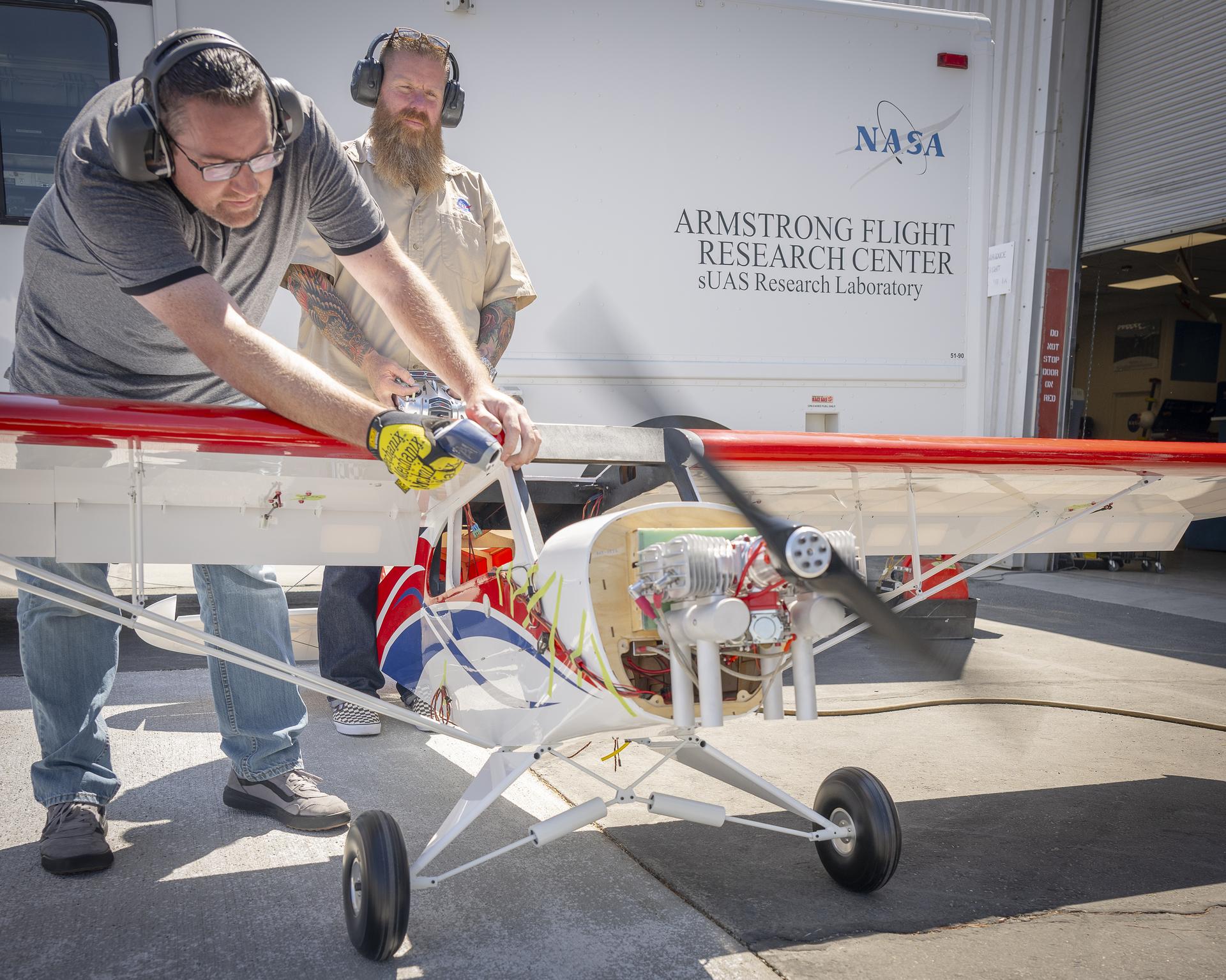
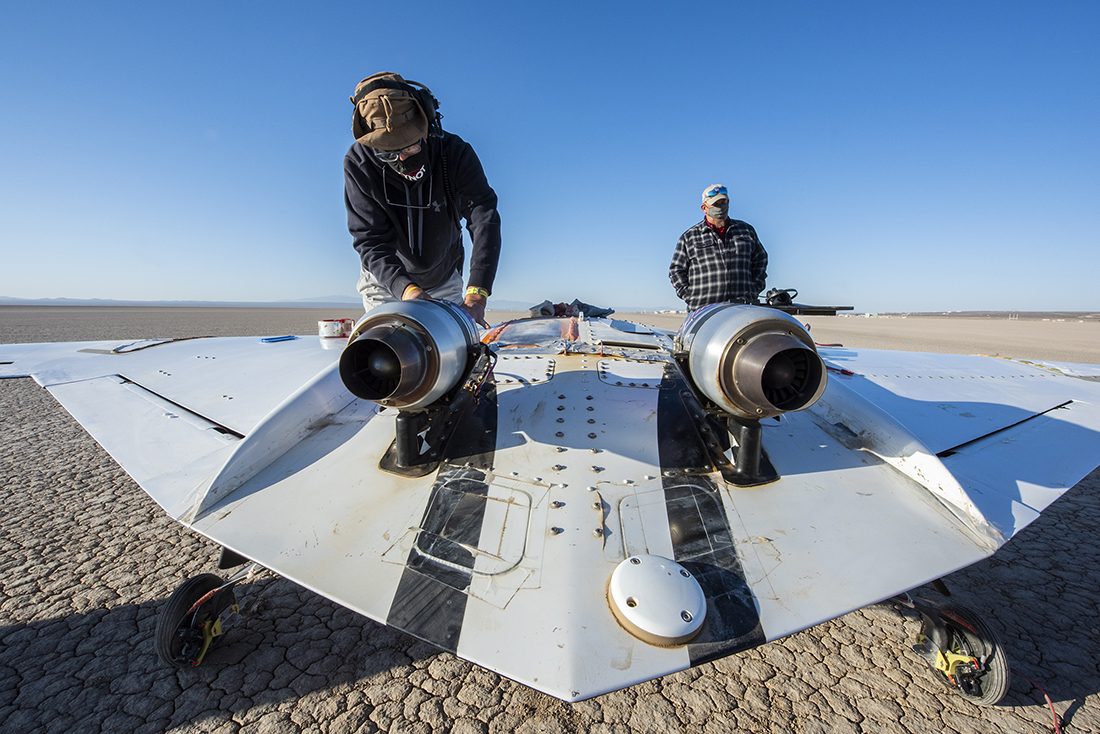
One man manages engine speed with a hand-held controller, while another firmly holds the subscale aircraft in place.
Justin Link, left, holds the subscale aircraft in place, while Justin Hall manages engine speed during preliminary engine tests on Friday, Sept. 12, 2025, at NASA’s Armstong Flight Research Center in Edwards, California. Link is a pilot for small uncrewed aircraft systems at the center’s Dale Reed Subscale Flight Research Laboratory and Hall is the chief pilot.
NASA/Christopher LC Clark

Flight expertise

Each staff member serves as an experienced and certified subscale aircraft pilot and is prepared to fly unique one-of-a-kind or modified commercial aircraft wherever the mission requires.

NASA’s FireSense project conducted flights in the Geneva State Forest, located about 100 miles south of Montgomery, Alabama. NASA Armstrong flight research staff integrated the instrument onto an Alta-X drone and tested the system before deployment. Two team members then transported the drone and sensor to the forest, prepared the vehicle for flight, and operated it during the mission. The NASA sensor was flown on the drone to demonstrate how remotely piloted aircraft can gather localized weather data that influences smoke movement and fire behavior. This information may help operational agencies improve wildfire decision-making and better allocate firefighters and resources.

Other missions occur closer to NASA Armstrong, such as the Enhancing Parachutes by Instrumenting the Canopy (EPIC) project. EPIC involved air‑launching a capsule containing a parachute and flexible sensor from the Alta‑X. Laboratory staff piloted the flights, supported flight operations, and worked with the EPIC team to design and integrate the parachute‑drop mechanism and safety system into the aircraft.

These tests demonstrated that a flexible sensor could help researchers study supersonic parachutes. Continuation of this work can help fill gaps in computer models, making supersonic parachutes safer and more reliable for delivering science instruments and payloads to Mars.

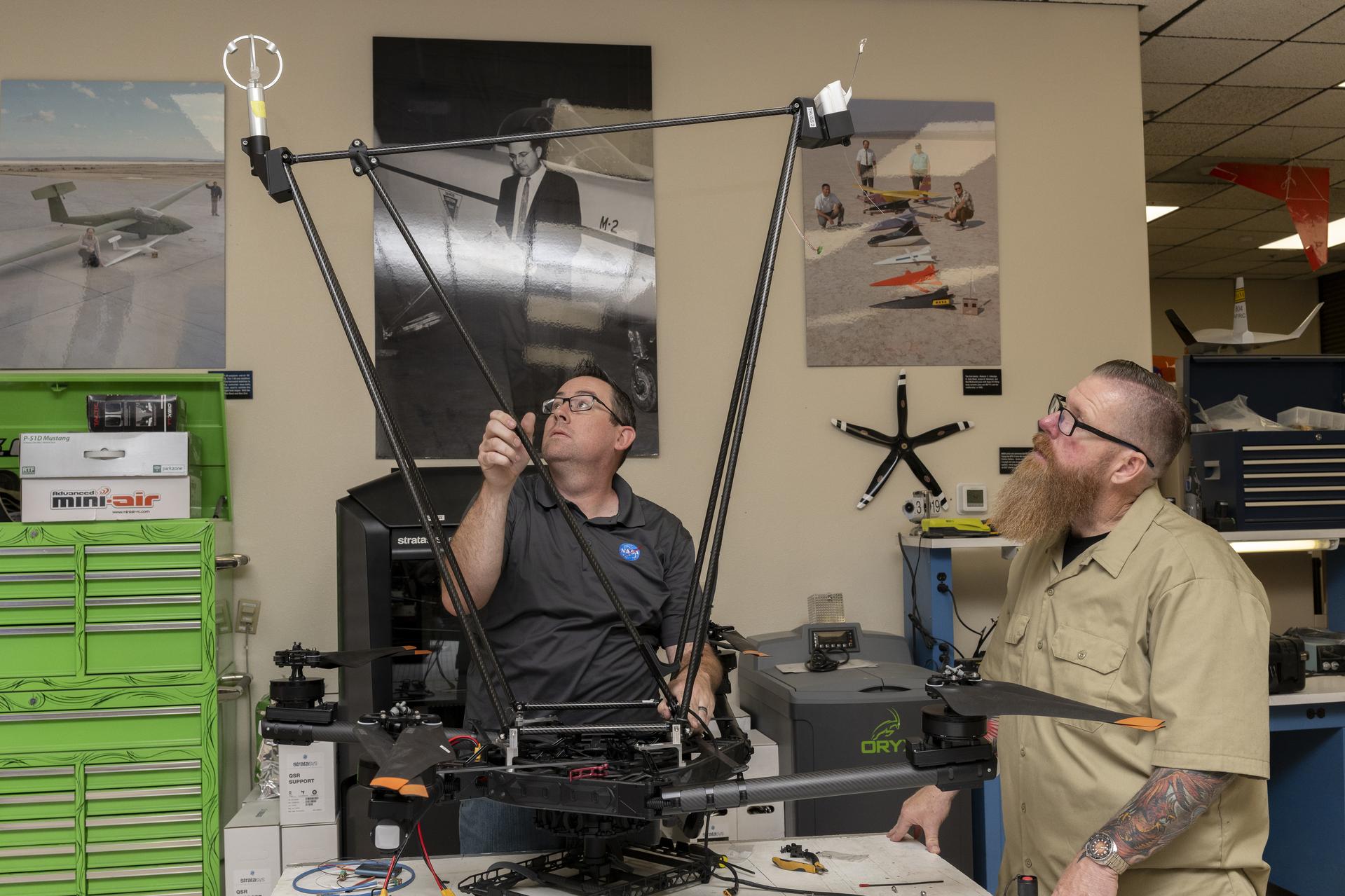
Two men integrate instruments onto a drone.
Justin Link, left, pilot for small uncrewed aircraft systems, and Justin Hall, chief pilot for small uncrewed aircraft systems, install weather instruments on NASA’s Alta X drone at the agency’s Armstrong Flight Research Center in Edwards, California. Members of the center’s Dale Reed Subscale Flight Research Laboratory used the Alta X to support the agency’s FireSense project in March 2025 for a prescribed burn in Geneva State Forest, which is about 100 miles south of Montgomery, Alabama.
NASA/Steve Freeman

Advancing challenging research

The Dale Reed Subscale Flight Research Laboratory uses rapid design and testing capabilities to help small aircraft fly big ideas. These concepts could lead to future breakthroughs that support NASA’s missions across aeronautics, science, and exploration.

For decades, NASA and its partners have advanced Automatic Collision Avoidance Technology. The research demonstrated an autopilot could detect and recover from an imminent ground collision – a capability now helping save lives in high‑performance U.S. military jets. NASA Armstrong had key roles in that work and developed a simplified version, the Automatic Ground Collision Avoidance System, which was installed on the DROID for testing.

The system demonstrated on the DROID — developed to assist general aviation pilots as well as remotely piloted and autonomous aircraft — performed well and led to further research toward a version that provides alerts and steering cues. The NASA Armstrong Technology Transfer Office is working to license the technology for U.S. businesses to develop the system as a commercial product.

The Prandtl‑D (Preliminary Research Aerodynamic Design to Lower Drag) flying‑wing glider was also designed, fabricated, and flown at NASA Armstrong. Researchers found that its twisted wing design could reduce drag and generate thrust at the wingtips, advancing concepts that may support greater fuel economy for future aircraft. The original Prandtl‑D is now part of the Smithsonian National Air and Space Museum collection in Washington, and the Prandtl-D3 is at the California Science Center in Los Angeles. Researchers continue developing the next generation of the design in the laboratory.

A wide range of capabilities in the laboratory help transform promising concepts into flight-ready test structures. These include rapid prototyping using traditional and advanced 3D manufacturing techniques, as well as composite and conventional fabrication processes. The team of engineers and technicians also provides custom component design and specialized fabrication to meet unique research needs.

The laboratory supports electrical and mechanical design, hardware and software integration, and the safety and flight-readiness processes required for successful missions. Additional technical facilities, such as the Experimental Fabrication Branch and the Environmental Laboratory at NASA Armstrong, further enhance these capabilities. Together, they support development, testing, and validation activities that advance NASA’s aeronautics and exploration goals.

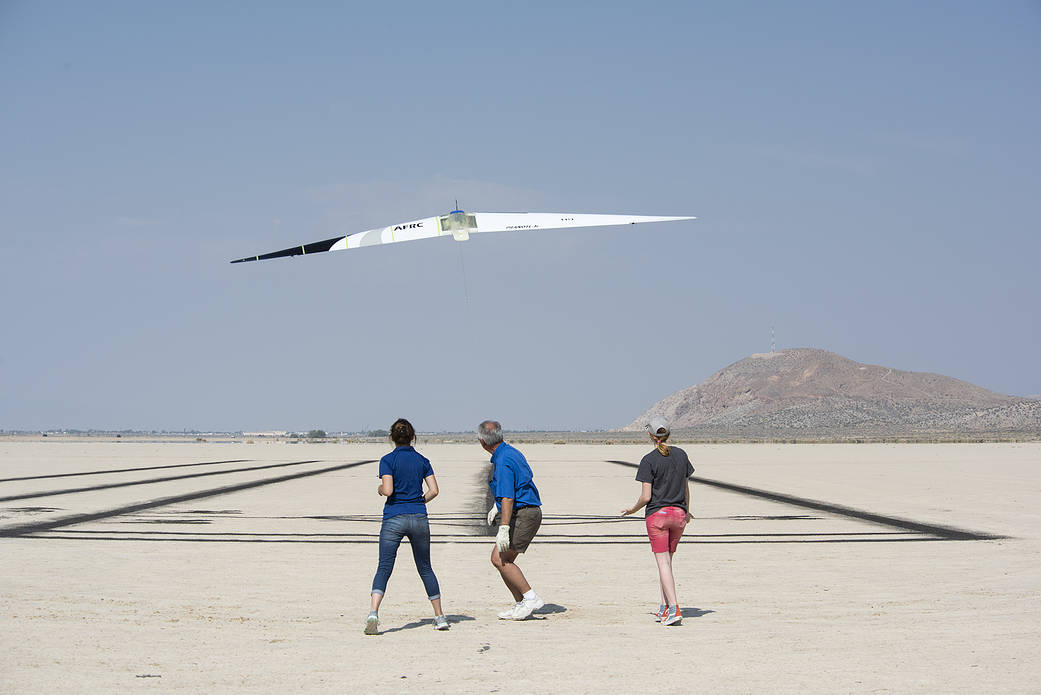
Deborah Jackson, Al Bowers and Abbigail Waddell successfully launch the subscale Prandtl-D 3C glider.
NASA

Share

Details

Last Updated
Jul 15, 2026
Editor
Dede Dinius
Contact

The post NASA Uses Subscale Aircraft to Accelerate Flight Innovation appeared first on NASA Science.

  •  

NASA Uses Subscale Aircraft to Accelerate Flight Innovation

4 Min Read

NASA Uses Subscale Aircraft to Accelerate Flight Innovation

A white, blue, and red probe attached to a rotor with four blades flies in the blue sky, just above the Moon.
An atmospheric probe model attached upside down to a quad rotor remotely piloted aircraft ascends with the Moon visible on Oct. 22, 2024. The quad rotor aircraft released the probe above Rogers Dry Lake, a flight area adjacent NASA’s Armstrong Flight Research Center in Edwards, California. The probe was designed and built at the center.
Credits: NASA/Steve Freeman

Testing new aerospace concepts in flight remains one of NASA’s most effective ways to advance knowledge and reduce risk.

The Dale Reed Subscale Flight Research Laboratory at NASA’s Armstrong Flight Research Center in Edwards, California, supports this mission by using small, remotely piloted and autonomous aircraft as cost‑effective platforms to mature innovative ideas, accelerate learning, and enable smoother transitions to full‑scale flight.

When experiments require a flight platform, several NASA remotely piloted aircraft are available: the Alta‑X quadrotor; the Dryden Remotely Operated Integrated Drone (DROID) with its 10‑foot wingspan; and the Multi‑Use Cub, a 14‑foot‑span fixed‑wing aircraft with an expandable payload capacity for flight experiments. For electric vertical takeoff and landing testing, the HQ‑90 quadrotor provides an additional option.

Once aircraft and experiments are cleared for operations, laboratory pilots support the mission, including ground operations and flight activities.

One man manages engine speed with a hand-held controller, while another firmly holds the subscale aircraft in place.
Justin Link, left, holds the subscale aircraft in place, while Justin Hall manages engine speed during preliminary engine tests on Friday, Sept. 12, 2025, at NASA’s Armstong Flight Research Center in Edwards, California. Link is a pilot for small uncrewed aircraft systems at the center’s Dale Reed Subscale Flight Research Laboratory and Hall is the chief pilot.
NASA/Christopher LC Clark

Flight expertise

Each staff member serves as an experienced and certified subscale aircraft pilot and is prepared to fly unique one-of-a-kind or modified commercial aircraft wherever the mission requires.

NASA’s FireSense project conducted flights in the Geneva State Forest, located about 100 miles south of Montgomery, Alabama. NASA Armstrong flight research staff integrated the instrument onto an Alta-X drone and tested the system before deployment. Two team members then transported the drone and sensor to the forest, prepared the vehicle for flight, and operated it during the mission. The NASA sensor was flown on the drone to demonstrate how remotely piloted aircraft can gather localized weather data that influences smoke movement and fire behavior. This information may help operational agencies improve wildfire decision-making and better allocate firefighters and resources.

Other missions occur closer to NASA Armstrong, such as the Enhancing Parachutes by Instrumenting the Canopy (EPIC) project. EPIC involved air‑launching a capsule containing a parachute and flexible sensor from the Alta‑X. Laboratory staff piloted the flights, supported flight operations, and worked with the EPIC team to design and integrate the parachute‑drop mechanism and safety system into the aircraft.

These tests demonstrated that a flexible sensor could help researchers study supersonic parachutes. Continuation of this work can help fill gaps in computer models, making supersonic parachutes safer and more reliable for delivering science instruments and payloads to Mars.

Two men integrate instruments onto a drone.
Justin Link, left, pilot for small uncrewed aircraft systems, and Justin Hall, chief pilot for small uncrewed aircraft systems, install weather instruments on NASA’s Alta X drone at the agency’s Armstrong Flight Research Center in Edwards, California. Members of the center’s Dale Reed Subscale Flight Research Laboratory used the Alta X to support the agency’s FireSense project in March 2025 for a prescribed burn in Geneva State Forest, which is about 100 miles south of Montgomery, Alabama.
NASA/Steve Freeman

Advancing challenging research

The Dale Reed Subscale Flight Research Laboratory uses rapid design and testing capabilities to help small aircraft fly big ideas. These concepts could lead to future breakthroughs that support NASA’s missions across aeronautics, science, and exploration.

For decades, NASA and its partners have advanced Automatic Collision Avoidance Technology. The research demonstrated an autopilot could detect and recover from an imminent ground collision – a capability now helping save lives in high‑performance U.S. military jets. NASA Armstrong had key roles in that work and developed a simplified version, the Automatic Ground Collision Avoidance System, which was installed on the DROID for testing.

The system demonstrated on the DROID — developed to assist general aviation pilots as well as remotely piloted and autonomous aircraft — performed well and led to further research toward a version that provides alerts and steering cues. The NASA Armstrong Technology Transfer Office is working to license the technology for U.S. businesses to develop the system as a commercial product.

The Prandtl‑D (Preliminary Research Aerodynamic Design to Lower Drag) flying‑wing glider was also designed, fabricated, and flown at NASA Armstrong. Researchers found that its twisted wing design could reduce drag and generate thrust at the wingtips, advancing concepts that may support greater fuel economy for future aircraft. The original Prandtl‑D is now part of the Smithsonian National Air and Space Museum collection in Washington, and the Prandtl-D3 is at the California Science Center in Los Angeles. Researchers continue developing the next generation of the design in the laboratory.

A wide range of capabilities in the laboratory help transform promising concepts into flight-ready test structures. These include rapid prototyping using traditional and advanced 3D manufacturing techniques, as well as composite and conventional fabrication processes. The team of engineers and technicians also provides custom component design and specialized fabrication to meet unique research needs.

The laboratory supports electrical and mechanical design, hardware and software integration, and the safety and flight-readiness processes required for successful missions. Additional technical facilities, such as the Experimental Fabrication Branch and the Environmental Laboratory at NASA Armstrong, further enhance these capabilities. Together, they support development, testing, and validation activities that advance NASA’s aeronautics and exploration goals.

Deborah Jackson, Al Bowers and Abbigail Waddell successfully launch the subscale Prandtl-D 3C glider.
NASA

Share

Details

Last Updated
Jul 15, 2026
Editor
Dede Dinius
Contact

💾

NASA researchers are developing technology to close knowledge gaps and make supersonic parachutes safer and more reliable for delivering science instruments ...
  •  

DARPA’s X-plane designed to maneuver with bursts of air gets new wings attached

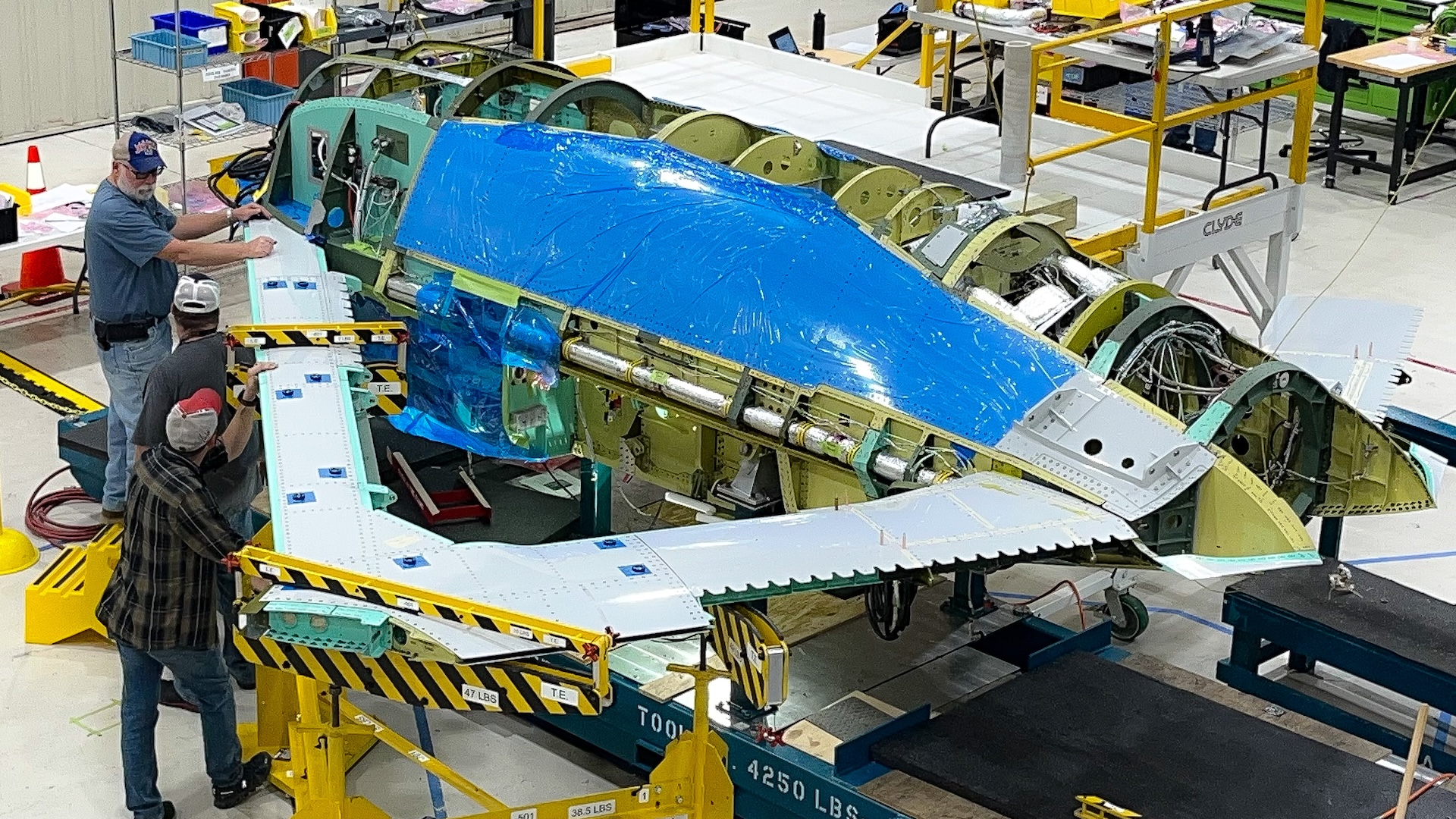
Boeing subsidiary Aurora Flight Sciences has begun installing the wings on the X-65, an experimental drone developed under DARPA’s Control of Revolutionary Aircraft with Novel Effectors (CRANE) program.

The installation brings DARPA and Aurora a step closer to flying the unconventional uncrewed aircraft, which was designed to test flight control using only bursts of pressurized air instead of conventional moving surfaces.

The X-65’s active flow control

The X-65’s key innovation lies in its active flow control (AFC) system. Fourteen AFC effectors embedded across the aircraft’s lifting surfaces use jets of high-pressure air to manage roll, pitch, and yaw.

This will either replace or supplement traditional flaps and rudders. The X-65 incorporates both systems to establish performance baselines before transitioning to AFC-only operation. Essentially, it will allow researchers to flight test the technology while minimizing risk.

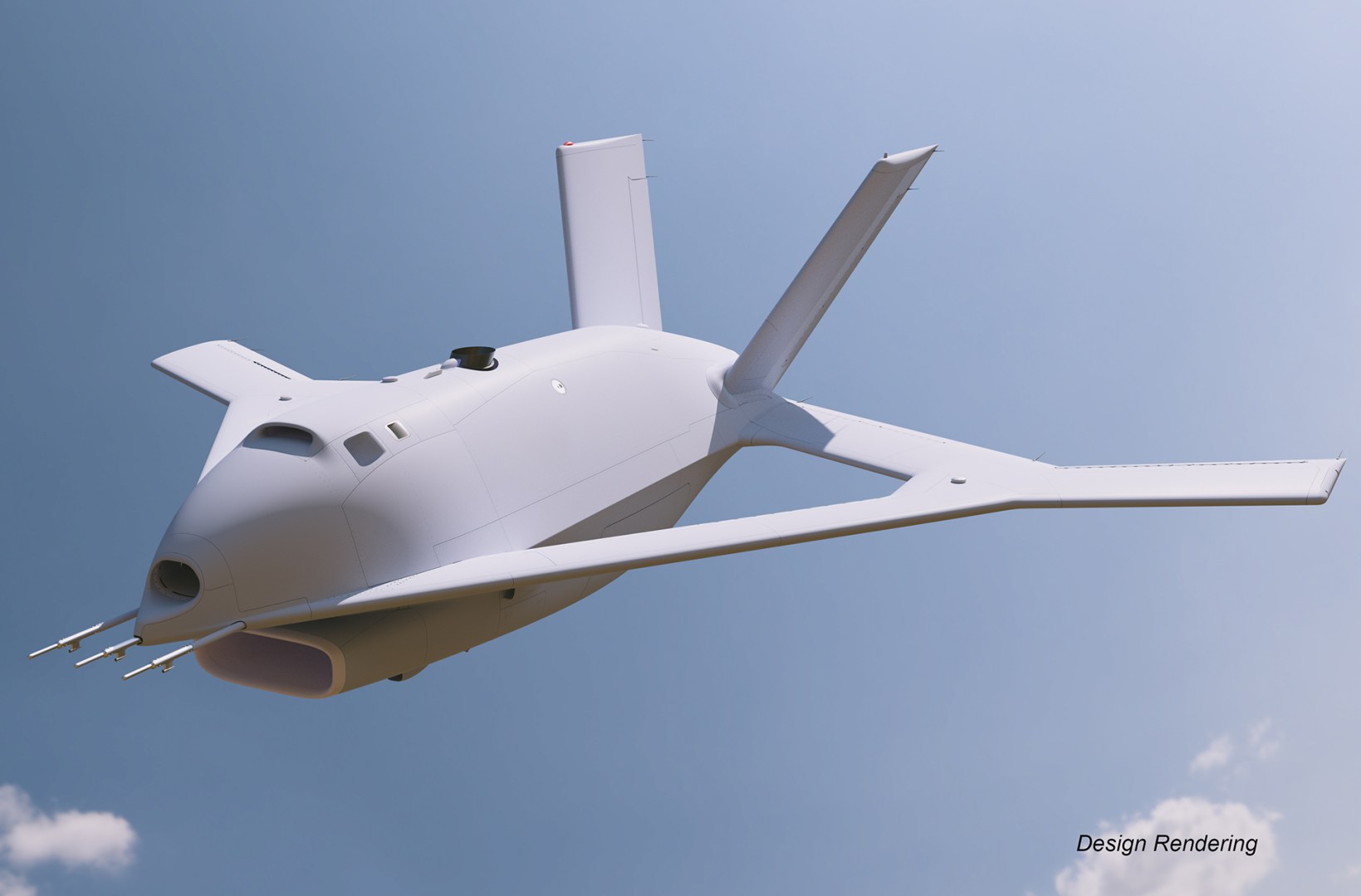
An artist’s render of the X-65 drone. Source: Aurora Flight Sciences / X

“The X-65 conventional surfaces are like training wheels to help us understand how AFC can be used in place of traditional flaps and rudders,” Dr. Richard Wlezien, former CRANE program manager at DARPA, said in a 2024 press statement. Sensors will compare the two approaches to evaluate potential benefits.

Aurora Flight Sciences announced the wing’s arrival on social media, noting that the components were built at its West Virginia facility. Integration is underway in Virginia, with the first flight now targeted for 2027.

Novel effectors to enhance survivability

The X-65 features a co-planar joined wing configuration with triangular wing sections on each side that merge at the tips, plus small extensions for a total wingspan of 30 feet.

The triangular wings support testing across multiple sweep angles and feature modular, swappable sections for future AFC configurations.

The aircraft also includes a twin vertical tail, a chin air intake, and a single exhaust. The uncrewed aircraft has a gross weight of approximately 7,000 lbs.

DARPA kick-started the CRANE program in 2020. Though Aurora has advanced to the detailed design and fabrication phases, the program has encountered delays and cost overruns, as reported by The War Zone.

Original flight plans for 2025 slipped after higher-than-expected prototype costs and supply chain issues. Pentagon funding for the effort since fiscal year 2024 has reached nearly $63 million.

Eliminating moving control surfaces could yield multiple advantages. Removing moving parts could result in improved aerodynamics and efficiency, particularly at high altitudes. Reduced mechanical complexity also offers potential weight savings, lower maintenance demands, and greater reliability. For military applications, such systems could have enhanced survivability against battle damage.

The technology holds particular promise for stealth aircraft. Traditional control surfaces create gaps and protrusions that increase radar cross-section and require constant adjustments in fly-by-wire systems. AFC effectors embedded flush with the airframe could help maintain smoother external contours and lower observability.

As Aurora vice president Larry Wirsing stated last year: “The X-65 platform will be an enduring flight test asset, and we’re confident that future aircraft designs and research missions will be able to leverage the underlying technologies and flight test data.”

  •  

Your Home Could Help Solve AI’s Growing Power Demand

Tesla, Sunrun and Renew Home plan to tap solar panels, batteries, thermostats and other devices installed in millions of homes to meet the energy demands of artificial intelligence.

© Collin Chappelle for The New York Times

Installation of a Sunrun solar panel on a roof in California. Sunrun is working with Tesla and Renew Home to use home energy devices to help data centers get online faster.
  •  
  •  

Self-healing contact lenses repair scratches with just one hour of UV light exposure

Scratched contact lenses often mean an expensive replacement, even if the damage is minor. Researchers in South Korea have now developed a self-healing material that can repair those tiny imperfections using just one hour of ultraviolet light, opening the door to more durable soft contact lenses.

The new hydrogel-based material restores itself at room temperature and could eventually help wearers extend the life of their lenses instead of discarding them after everyday wear. The technology also combines a protective coating that resists scratches and bacteria, adding another layer of durability for future designs.

UV repairs damage

Researchers Jung-Hyun Choi and Byoung-Ki Cho created the material using a hydrogel, a water-rich polymer network already widely used in soft contact lenses. They redesigned the structure so that ultraviolet light, instead of heat, activates the repair process.

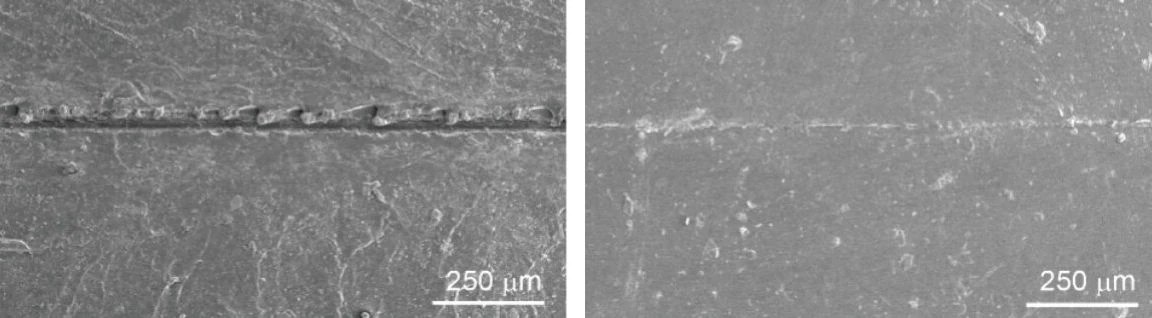
One hour of UV light nearly erases scratches in this self-healing contact lens material. Credit – ACS

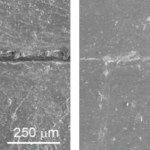
Exposure to UV light with a wavelength of 365 nanometers for one hour triggers a chemical reaction known as disulfide exchange. During that process, sulfur bonds temporarily break apart and reconnect with neighboring atoms, allowing the damaged polymer network to gradually rebuild itself.

The team had previously demonstrated a heat-driven self-healing hydrogel, but that approach required several hours of warming. Extended heating dries out contact lenses and makes them unsuitable for everyday use, making room-temperature repair a more practical alternative. Laboratory tests showed the healing process restored scratched samples with high efficiency, leaving behind a nearly seamless surface instead of visible damage.

Protective coating adds strength

The researchers also coated the hydrogel with another polymer designed to reduce bacterial growth and shield the surface from abrasion. That extra layer proved effective during durability testing. Even after repeated contact with fine-grit sandpaper, the coated material maintained its clarity. Transparency declined by only about 2%, suggesting that routine scratches would have little effect on vision quality.

The hydrogel also retained water and displayed mechanical characteristics comparable to those expected from commercial soft contact lenses. Those properties are critical because comfort depends on a lens remaining hydrated throughout the day.

According to the researchers, users could eventually repair minor damage with UV lamps already found in many homes, including devices used for cleaning or curing gel nail polish. The repair process can also be repeated, allowing the material to recover from multiple instances of wear.

More testing ahead

Several steps remain before self-healing contact lenses reach consumers. The material must undergo additional stability evaluations and regulatory review to confirm it can withstand long-term use and repeated repair cycles.

If those hurdles are cleared, the technology could reduce waste and lower replacement costs for millions of contact lens users. Instead of treating every scratch as the end of a lens’s life, future designs may be able to recover from everyday damage and stay in service much longer. The project received funding from the National Research Foundation of Korea.

The study titled “Room-Temperature UV-Induced Self-Healing Hydrogels with Antifouling and Antiscratch Surfaces for Soft Contact Lenses” is published in the journal ACS Applied Polymer Materials.

  •  

MIT’s 6 mW chip lets tiny drones see and map their surroundings in real time

MIT researchers have developed a low-power chip that enables tiny drones and robots to build detailed 3D maps of their surroundings in real time while consuming only about 6 milliwatts of power. The system-on-a-chip, called Gleanmer, could help battery-powered autonomous machines navigate cluttered environments such as industrial ventilation systems, warehouses, tunnels, and other confined spaces where obstacle avoidance is critical.

The technology may also find applications in lightweight augmented reality headsets, allowing them to map indoor environments without draining batteries. The chip combines specialized hardware with a compact mapping algorithm that dramatically reduces the memory and energy needed to create 3D representations of the world around a robot.

Mapping without burden

Building detailed 3D maps typically requires robots to process large volumes of image data and store complex representations of their surroundings. These tasks often demand significant memory and power, making them difficult to deploy on small battery-powered devices.

Instead of relying on conventional voxel-based maps, which represent environments using millions of tiny cubes, the MIT team uses flexible ellipsoid shapes known as Gaussians. These shapes can more efficiently represent curved objects and open spaces while requiring far less memory.

The researchers paired the chip with a mapping algorithm called GMMap, which creates 3D maps from depth images in a single pass. This allows the system to discard image data almost immediately instead of repeatedly storing and processing it.

“At any point in time, we only need to store a few pixels in memory, which significantly reduces the memory footprint our algorithm requires,” said Peter Zhi Xuan Li, one of the study’s co-lead authors.

The system also avoids another common challenge in mapping. As a robot moves, it often observes the same object from multiple angles, creating overlapping representations that increase map size. The MIT team developed a method to merge overlapping Gaussians directly without returning to the original image data.

Tiny chip, big reach

This approach allowed the researchers to keep much of the active data in fast on-chip memory rather than relying on power-hungry external storage. “By having a dedicated memory that just stores the objects you’ve seen in the previous few frames, you can access the data much more efficiently,” said co-lead author Zih-Sing Fu.

In tests involving a variety of previously recorded environments, Gleanmer generated detailed 3D maps in real time while consuming about 6 milliwatts of power. According to the researchers, this is roughly 2.5% of the energy required by the best existing chip designed for map construction.

The chip can also reconstruct obstacles and free space directly from live data streamed from an iPhone camera. By reusing compact Gaussian representations during path planning, the system enables robots to calculate collision-free routes using about 20% of the energy typically required.

“This paper showcases a key example of how you can leverage co-design of the algorithm and hardware to really push energy efficiency,” said Vivienne Sze, professor of electrical engineering and computer science at MIT and senior author of the study.

The researchers believe future versions could become even more efficient by placing computing resources closer to onboard sensors. Beyond robotics, the team is also exploring whether Gaussian-based representations could help computing systems process technical drawings and complex schematics more efficiently.

The research was presented at the IEEE Very Large-Scale Integrated Circuits Symposium.

  •  
❌