❌

Reading view

NASA looks for the origins of interstellar comet 3I/ATLAS | Space photo of the day for June 24, 2026

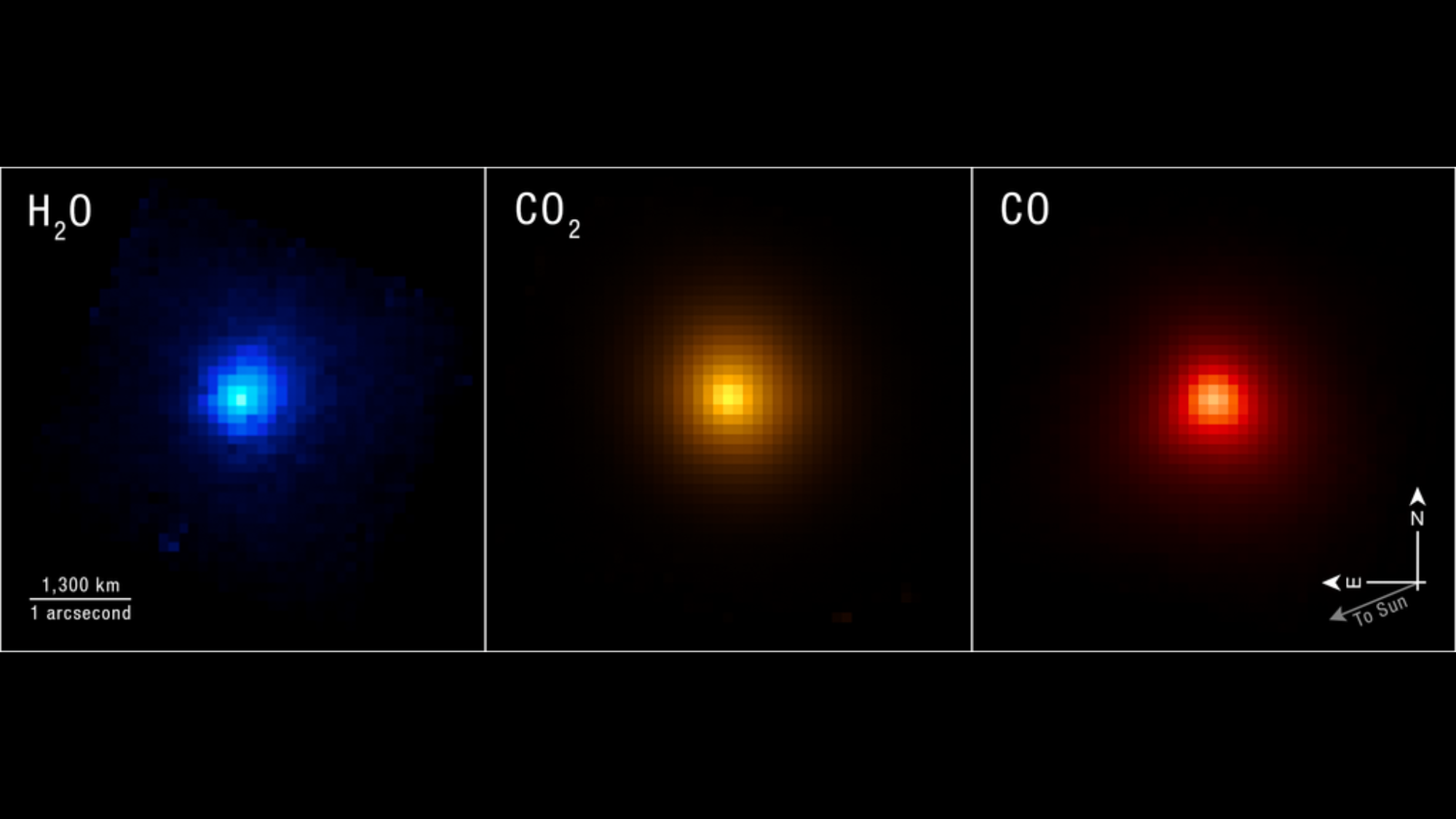
Three boxes contain a glowing center that in the left box is blue, the middle box is yellow, and the right box is red.

Researchers using JWST are finding clues about comet 3I/ATLAS' origins. (Image credit: NASA, ESA, CSA, STScI, Martin Cordiner (CUA, NASA-GSFC); Image Processing: Alyssa Pagan (STScI))

NASA's James Webb Space Telescope is finding clues that are leading scientists closer to understanding the origins of the interstellar comet 3I/ATLAS.

What is it?

Comet 3I/ATLAS captured the world's attention when it was discovered nearly a year ago on July 1, 2025. The comet was first spotted by the Asteroid Terrestrial-impact Last Alert System (ATLAS), and is only the third interstellar object every discovered.

The comet swooped through our solar system, passing by Earth at a far (and safe) distance on its tour of our cosmic neighborhood. It is on a long trajectory that will take it out of our solar system, never to return.

In observations from the James Webb Space Telescope, scientists were able to look in the direction the comet as it began moving away from the sun in December of last year. While in close proximity to our star, the sun's heat warmed the comet, making it extra bright and easy to observe.

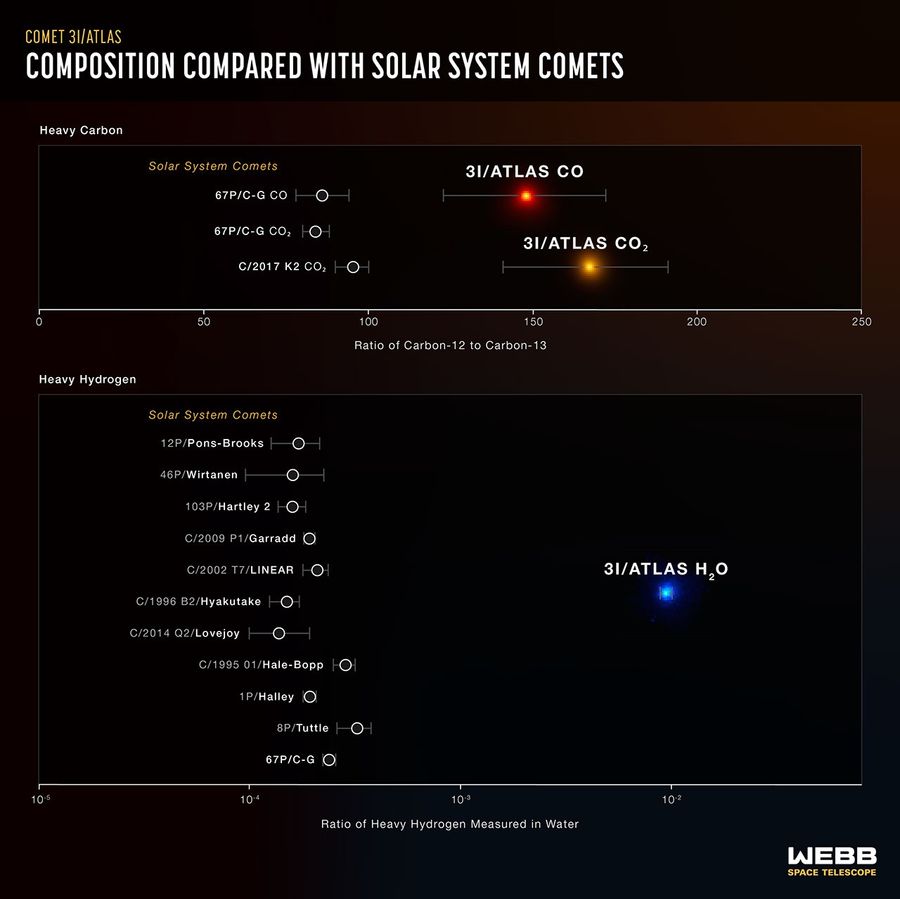
With this view, astronomers were able to calculate some of the ratios of the chemicals present in the comet. This further highlighted that the object is from out of our solar system, as they found ratios of carbon and heavy hydrogen not found in comets in our solar system.

Researchers described their results in a new paper published June 22 in the journal Nature.

A chart exploring the new findings about 3I/ATLAS.

This graph shows some of the differences between 3I/ATLAS and comets found in our own solar system. (Image credit: NASA, ESA, CSA, Martin Cordiner (CUA, NASA-GSFC), Leah Hustak (STScI))

Why is it incredible?

Being only the third interstellar object ever found, people were excited about 3I/ATLAS. They were so excited, in fact, that conspiracies about the object sprouted up quickly. Due to it being from outside of our solar system, some claimed that the comet could be some sort of alien spaceship, similar to the initial suspicions about the interstellar object 'Oumuamua found years earlier.

But with new information coming in from space telescopes, and astronomers eager to understand this object better, these clues are leading us closer and closer to the true origins of this strange comet.

  •  

SpaceX Dragon says goodbye to the ISS | Space photo of the day for June 23, 2026

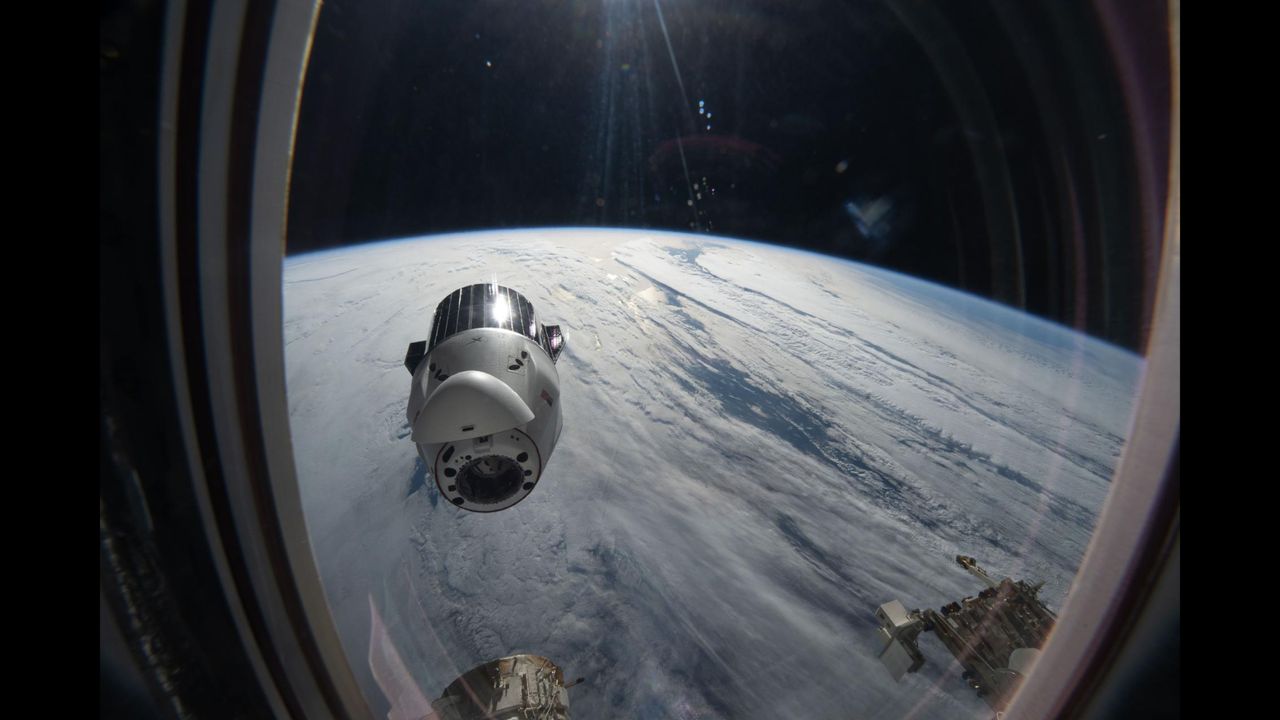
A view out of the window of the ISS sees the SpaceX Dragon capsule with Earth in the background.

SpaceX's Dragon capsule leaves after dropping off some supplies and science at the ISS. (Image credit: NASA/Jessica Meir)

SpaceX's Cargo Dragon capsule shines in the sunlight over Earth as it departs from the International Space Station in a new image snapped from onboard the station.

What is it?

Peering through the window of the International Space Station (ISS), NASA astronaut Jessica Meir snapped a striking photo as she watched a SpaceX Cargo Dragon capsule depart from the station.

With sunbeams gleaming downward, reflecting off of the spacecraft's hull, the Dragon can be seen backing away from the station mere moments after undocking from the port on the station's Harmony module. The undocking is so recent that you can clearly see both the docking port and the hatch of the Dragon where the two connected.

The Dragon disconnected from the space station on June 16, and just one day later, parachuted into the Pacific Ocean off the coast of Southern California where it was retrieved, chock-full of cargo and finished science experiments.

Why is it incredible?

The space station has been in orbit since 1998 and continuously occupied since November, 2000. With decades of work in orbit, it can be easy to take for granted the incredible transport system that supports cutting-edge research hundreds of miles above Earth's surface.

The work done on the station is impressive, but this system is just as mind-boggling. In addition to launching and returning astronauts who perform critical maintenance and repair work on the station on top of their research duties, cargo missions keep the station stocked.

From food and clothing to medical equipment and intricate science experiments, these missions are essential for both keeping astronauts safe and healthy on station as well as continuing the progression of science in-orbit. This back-and-forth between Earth and the space station is an impressive feat, and this photo shows the system fully in-motion.

  •  

Late, great singer-songwriter Elliott Smith finds immortality as an asteroid

An asteroid now bears the name of beloved musician Elliott Smith, thanks to one ambitious filmmaker.

Elliott Smith passed away at the age of 34 in 2003, but his impact and his music continue to connect with people around the world. And his influence has now extended to space, thanks to independent filmmaker Orlando Campopiano, who worked to get an asteroid named "Elliottsmith."

"I hope this introduces at least one new person to Elliott's brilliant discography, and I'm happy to see a permanent legacy in the stars! To have this tribute to him blessed by the estate and discoverers is also a great honor," Campopiano told Stereogum.

While listening to the song "Shooting Star," from Smith's album "From a Basement on the Hill," which was released in 2004 following his death, Campopiano had the idea to try and get an asteroid named after Smith, he told Stereogum.

He took this inspiration and ran with it, connecting with Smith's estate and working together to submit a proposal to the International Astronomical Union (IAU), which gives official names to cosmic objects, including asteroids. Maybe there are some Elliott Smith fans at the IAU, because the organization actually said yes.

With this positive response, Asteroid (861969) 2014 OS439 is now officially "Elliottsmith."

An illustrated visual of where asteroid Elliottsmith is in our solar system.

The asteroid Elliotsmith (861969) visualized in our solar system. (Image credit: NASA)

The asteroid was discovered back in 2014 by the Pan-STARRS 1 (Panoramic Survey Telescope and Rapid Response System) project in Hawai'i.

The IAU's announcement of the renaming reads: "Steven Paul 'Elliott' Smith (1969–2003) was an influential, Oscar-nominated American songwriter. His intricate music left a lasting impact on many musicians. Asteroid 861969 honors his birth date, August 6, 1969. Smith often used celestial motifs in his work, notably in the song 'Shooting Star,' which, in hindsight, symbolizes his brief but brilliant light."

As this classification states, this asteroid is more than just a random rock in the sky. Its previous, numerical name 861969 happens to perfectly mirror Smith's birthday. This cosmic alignment makes it feel like this naming was truly meant to be.

You can get a look at the asteroid's place in our solar system on the small-body website of NASA's Jet Propulsion Laboratory, which you can find here.

  •  

Menstruation in space will be studied for 1st time with 'Operation Period'

One new mission is setting out to study menstruation in microgravity for the first time ever.

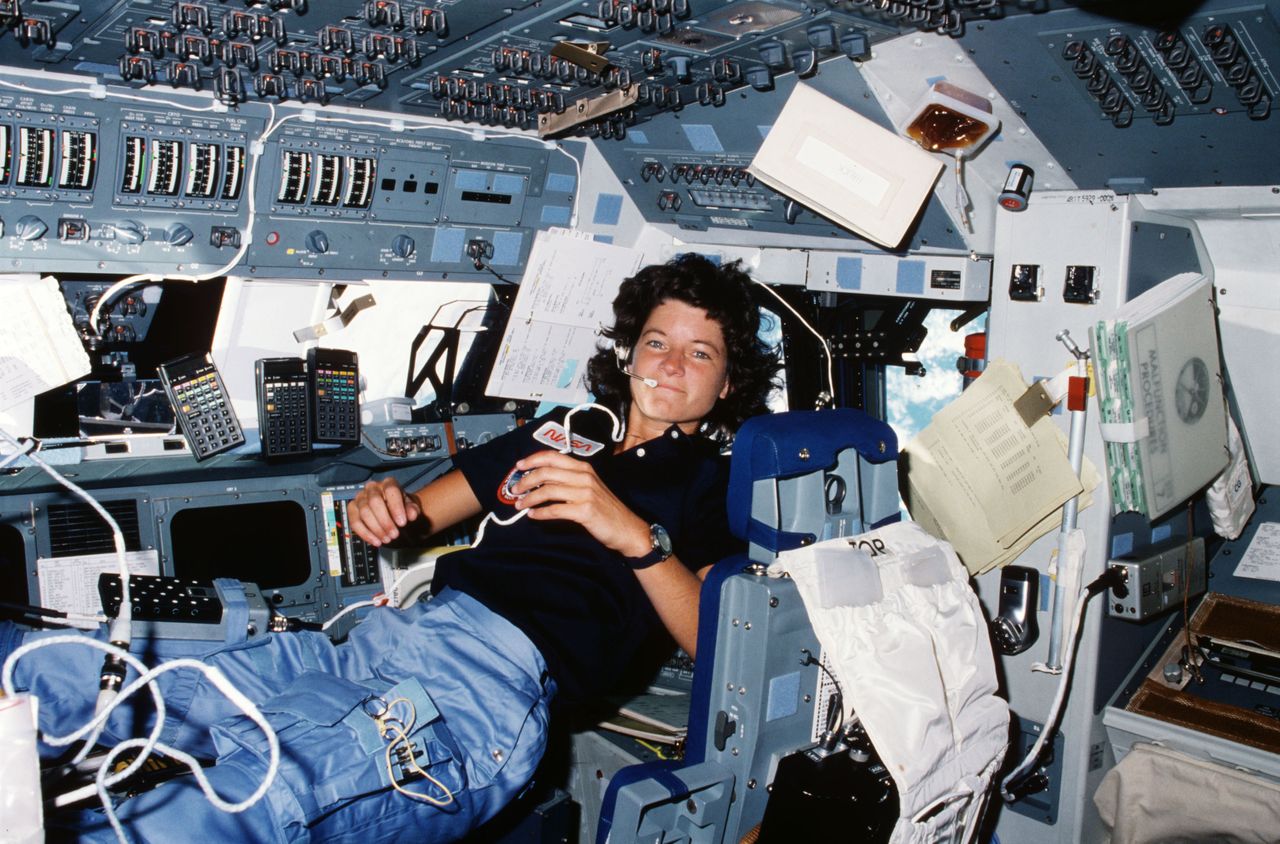
Forty-six years ago, NASA engineers asked Sally Ride if 100 tampons was the right amount to send with her for a six-day spaceflight. Though people laugh at that fact today, there has still never been any scientific study dedicated to studying menstruation in space. But a non-profit called Operation Period aims to change that. Led by Gen-Z researchers, this non-profit works to provide what its founder Manju Bangalore calls "menstrual freedom," which she says would mean everyone can have easy access to menstrual products. Meanwhile, the organization also aims to tackle the wider issues that leave people without such access in the first place. With its upcoming suborbital mission Operation Period-01 (OP-01), this ambitious team is taking their cause into microgravity. On OP-01, the mission's founder will launch to space to conduct the research themselves on a Virgin Galactic suborbital flight in 2027.

In conducting their work here on Earth, Operation Period found that "there were still some of those same gaps in spaceflight medicine," Manju Bangalore, the founder and executive director of Operation Period and research astronaut in training for OP-01, told Space.com. " I want all menstruators to be able to live life with their full dignity and reach their fullest potential, and that includes astronauts."

With a background in physics and astronomical engineering as well as with training in bioastronautics and having spent time working at NASA, Bangalore brings her love of space to this cause. She and Priya Abiram, the Director of Research at Operation Period's Redshift Lab, feel so strongly about their message, even 9 years since the pair founded their non-profit; in fact, with this mission, the two will become some of the youngest South Asian women to travel to space.

"On a personal level, I've always been fascinated by space and human space exploration. It's what's always excited me as a child, and I've kept that curiosity going," Bangalore said. "I didn't think those two missions would ever combine into this. It wasn't something I ever planned, but I'm very grateful to lead this historic mission to advance menstrual health in this way."

And just as this team is excited to bring their research into a suborbital environment, Virgin Galactic is excited to be expanding the range of microgravity science the non-profit supports. "This mission with Operation Period is a powerful example of how Virgin Galactic can continue to support real-time, in-flight scientific investigation into long-overlooked areas of human health, helping advance more inclusive and innovative exploration that delivers insight for both space and life on Earth," Virgin Galactic director of system analysis & research Amber Favaregh said in an emailed statement.

Recently, Operation Period expanded to include a research wing, and this mission will be conducted under that umbrella. The team was not yet able to share specific details on the exact protocol that will be conducted during the mission, information they said will be shared at a date closer to launch, but they did share the current issues that this research aims to begin to address.

Currently, astronauts typically choose to fully suppress their periods during their spaceflights, through hormonal IUDs or oral contraceptive pills. While that is a choice astronauts might continue to make in the future, without data to show the reality of dealing with a period in space, astronauts are left with fewer choices with their own bodies. Comprehensive data on menstruation in space will also be important if astronauts are to complete longer spaceflights or even extended stays on the moon. While the mission has not yet revealed its priorities and exactly what data it will collect, with such limited data on menstruation in space, there is a lot of knowledge to be gained.

While "the data that we have, although limited, says that it is generally safe to menstruate, in terms of long duration missions, we don't have quantitative data," Bangalore said. "We don't have enough data to continue to assist with patient resource allocation for mission planners."

Historic missteps like the "100 questions" moment with Sally Ride highlight an issue that could have big effects on future, longer-term missions. Sure, having a ridiculous number of backup products would ensure that there is no need unaddressed, mass considerations for spaceflight are extremely serious and future missions will need to have better data to know what will be needed in a microgravity environment.

And just like with other science in space, the research conducted in microgravity will also be used on Earth. The pair aim to collect menstruation data that will benefit astronauts as well as people back on our home planet. .

"I think on Earth, there's a lot of gaps right now in menstrual health research," Bangalore said. As just one example, she cited recent findings that menstrual product companies were reporting incorrect absorbency of their products because they were testing products with saline, which is very different from menstrual blood. "This was potentially leading to doctors to underdiagnosed heavy menstrual bleeding, which right now the stats say affects 20% of American menstruators," Bangalore said.

With this being the first mission of its kind, OP-01 will not answer every question that remains about menstruation and space, but it will bring data to a conversation decades in the making. "Our hope is to continue to iterate this research so that we can do future suborbital flights, as well as orbital flights, to continue to create larger data sets," Bangalore said. "I think the point of preliminary studies is to be able to know what questions to ask in the future, so we don't expect that this suborbital flight will solve everything or create all the data that we need, right, but we hope that this will be a good stepping stone."

Momentum for this research was actually sparked by many millions of views on a viral social media video in which Bangalore conducted an early version of a menstrual fluid dynamic experiment in a low-gravity environment aboard a parabolic flight.

This viral moment "ended up being a really cool kind of 'in' to continue talking about destigmatizing periods," she said. "Through that, I got to talk more about the gaps in spaceflight medicine, in terms of menstrual health."

  •  
❌