When 3-year-old Cameron arrived at the UC Davis MIND Institute for a recent medical appointment, she was in for a surprise: cuddly, social AI robots visiting from Japan were in the waiting room. "We both melted when we saw them," said Cameron's mom, Caroline Nguyen. "They're so adorable, and the little sounds they make—I mean, she took to them right away."
As the World Cup fever grows around stars like Messi and Ronaldo, Shanghai hosts a unique penalty shootout featuring humanoid robots.
At MWC Shanghai 2026, humanoid robots are stepping up to the spot in the Humanoid Robot Football Penalties Challenge, testing the limits of robotics, AI, machine vision, and real-time motion control.
According to Chinese media outlets, the event showcases how embodied AI performs under pressure, highlighting next-generation autonomous technology through football-inspired challenges.
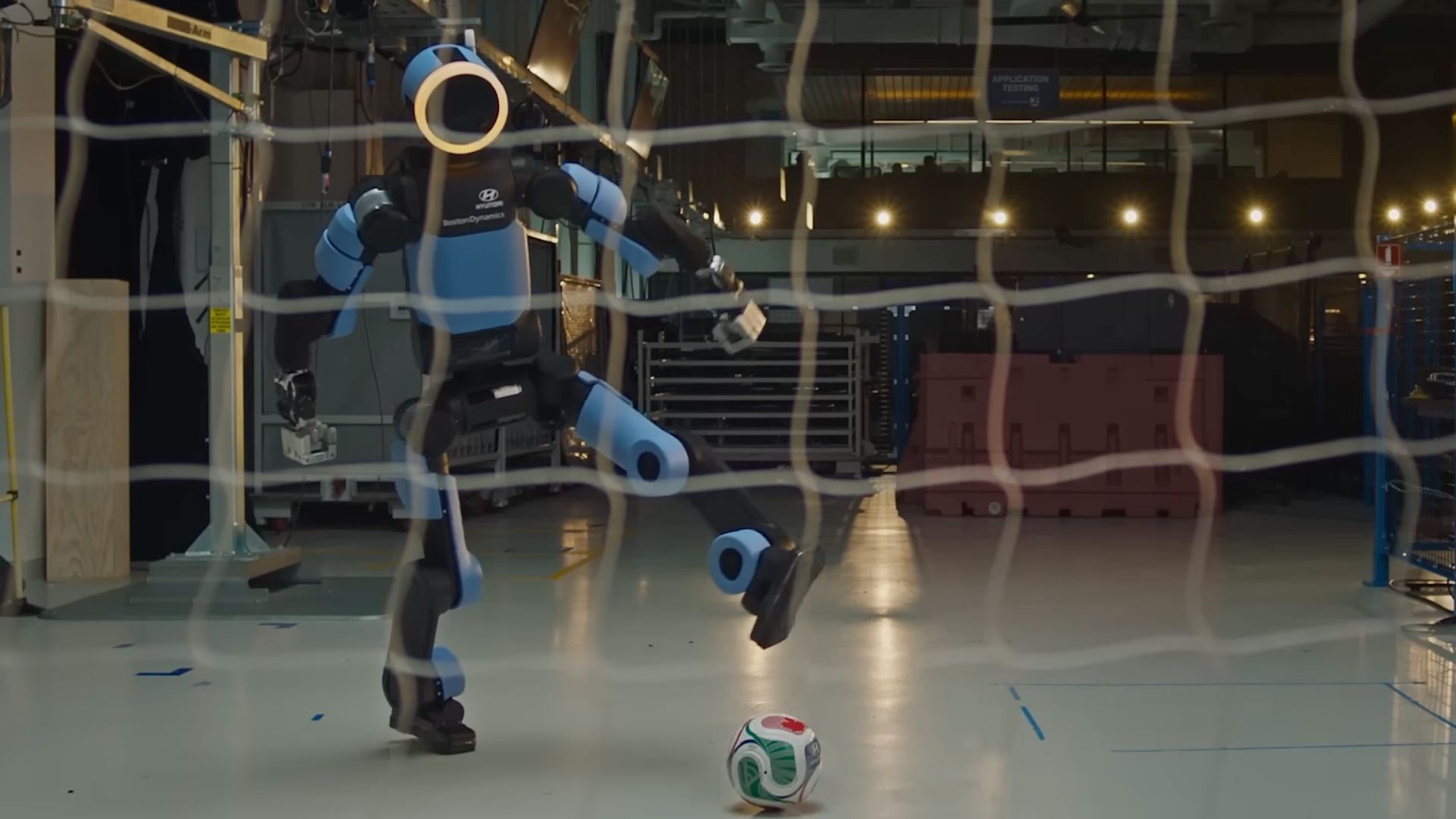
Ahead of the 2026 FIFA World Cup, Hyundai Motor recently launched a football-themed campaign featuring Boston Dynamics’ Atlas humanoid robot.
Humanoid football test
On its opening day at MWC Shanghai 2026 on June 24, the spotlight quickly shifted from keynote speeches to a live demonstration of embodied AI in action: the Humanoid Robot Football Penalties Challenge.
Held within the Mobile AI Innovation Frontiers Zone at the Shanghai New International Expo Centre, the event is designed as a controlled stress test for real-time autonomous decision-making, where humanoid robots must read the goal, judge angles, and execute penalty kicks without pre-programmed sequences, external control, or resets, reported CGTN.
While official details of the participating humanoid robots remain limited, videos circulating online suggest models from Booster Robotics and Unitree Robotics taking part in the challenge.
In the penalties challenge itself, participating humanoids are evaluated on perception accuracy, balance control, motion planning, and adaptive response under game-like pressure. Each robot must independently interpret ball position and goalkeeper movement before committing to a strike, making split-second corrections based on sensor feedback.
The format escalates through semi-finals and a final scheduled for June 25, intensifying constraints to simulate high-pressure competitive conditions. By turning a universally understood sports moment—the penalty kick—into a robotics benchmark, the showcase highlights how far embodied AI has progressed toward coordinated, human-like physical intelligence in unpredictable environments.
Atlas soccer showcase
In a recent football demonstration by Boston Dynamics, an Atlas robot is shown standing before a large display screen, closely tracking player movements, body positioning, and in-game reactions across football footage. After each clip ends, Atlas moves into a practice zone where it immediately attempts to reproduce the actions it has just observed, effectively linking visual perception with physical execution in real time.
The footage highlights a series of football-inspired motions. In one sequence, the robot shifts its weight, swings a leg forward, and smoothly guides a ball across the floor with controlled contact. It then progresses through rapid training drills focused on balance, coordination, and timing. As the session continues, Atlas’s movements appear increasingly fluid, suggesting the system is being evaluated not only for strength but also for agility, reflex response, and adaptive motor control.
Some of the most notable moments show Atlas imitating human emotional reactions. After completing a drill, it raises its arms in celebration, mirroring a footballer’s goal celebration. In another instance, it drops to one knee and pauses, recreating an injury response seen in match footage it had just observed.
Hyundai Motor Company, parent of Boston Dynamics, described the demonstration as Atlas’s first exposure to football under its “School of Football” initiative. The company has also indicated potential plans to showcase Atlas and the quadruped robot Spot at the FIFA World Cup, though their exact roles remain undisclosed.
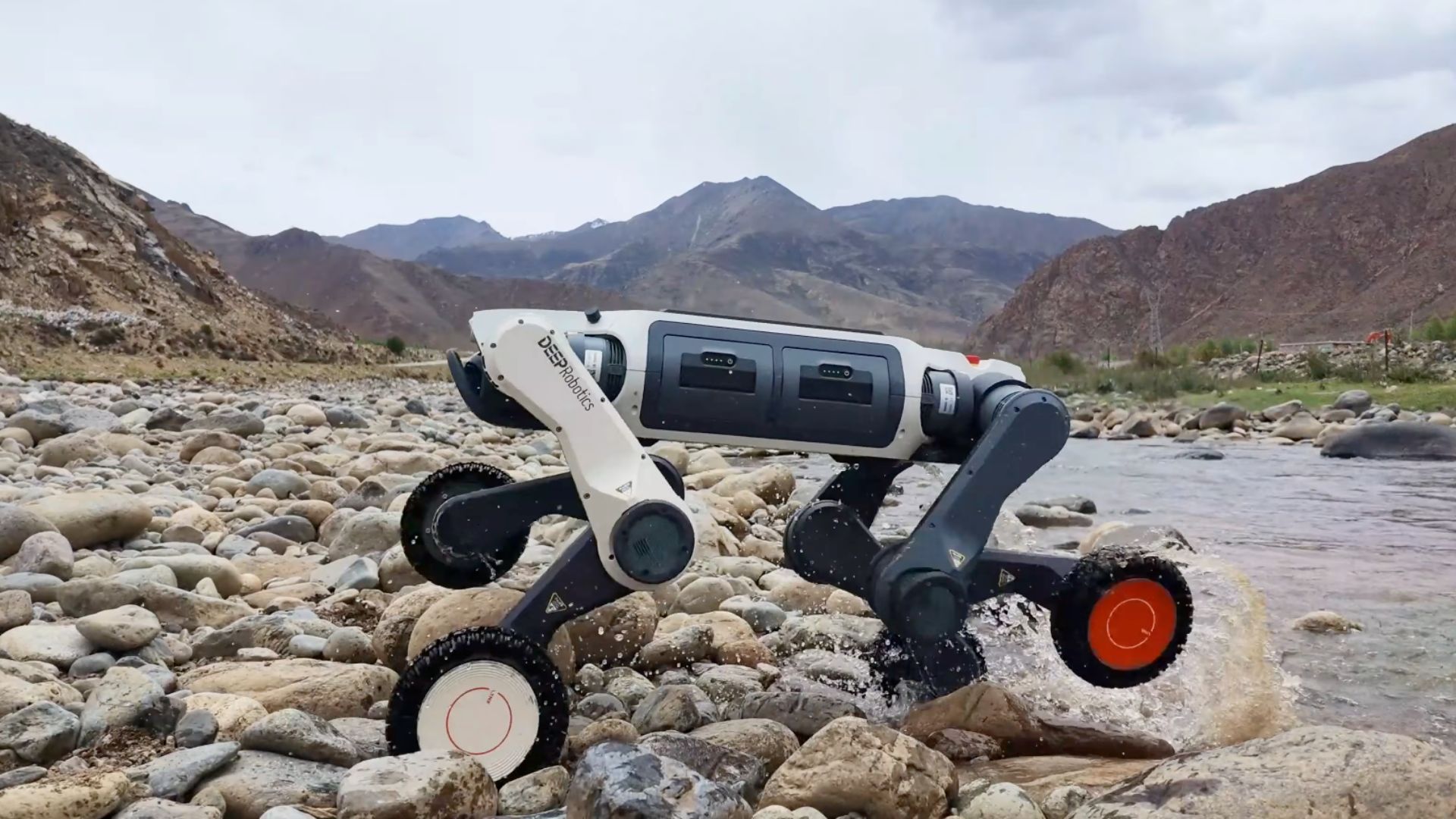
DEEP Robotics has demonstrated its new wheeled-legged robot in action, designed to handle challenging industrial operations across complex terrain.
M20S introduces significant improvements over M20 in payload capacity, mobility, durability, and endurance, positioning it as a new benchmark for industry-grade wheeled-legged robots.
Built for all-terrain performance, the Lynx M20S is designed to support a wide range of inspection, logistics, and field operations where reliability and adaptability are critical.
Recently, Deep Robotics unveiled new footage of its DR02 humanoid traversing rough terrain, climbing stairs, and carrying equipment, which is built for industrial and hazardous-environment operations.
Mastering rough terrain
LYNX M20 is a wheeled-legged robot designed for industrial operations in challenging terrain and hazardous environments. The company describes it as the world’s first wheeled-legged robot built specifically for demanding field applications, including power inspection, emergency response, logistics, and scientific exploration.
In this newly released demonstration video, DEEP showcases the capabilities of its Lynx M20S wheeled-legged robot in some of the world’s most demanding environments. The footage follows the robot traversing rugged mountain terrain, crossing icy rivers up to 31.5 inches (80 centimeters) deep, and operating in temperatures as low as -22°F (-30°C).
The Lynx M20S is also shown climbing steep 45-degree slopes and navigating rocky, uneven landscapes that would challenge conventional mobile robots. At elevations reaching nearly 17,000 feet (5,177 meters), the robot maintains stability and mobility while carrying out its mission in harsh outdoor conditions. The video highlights the platform’s combination of wheeled speed and legged agility, enabling it to tackle obstacles, extreme weather, and difficult terrain.
According to DEEP, the Lynx M20S, designed for industrial inspections, emergency response, and field operations, demonstrates how advanced robotic mobility can extend autonomous operations into environments that are often inaccessible or hazardous for human workers.
Next-gen field robot
M20S, weighing 77 pounds (35 kilograms), combines the speed of wheeled mobility with the adaptability of legged locomotion. It can navigate narrow spaces with as little as 50 cm of clearance, climb stairs up to 25 cm high, overcome obstacles up to 80 cm high, and handle slopes up to 45 degrees. The platform is designed to operate across rugged mountain trails, muddy wetlands, tunnels, pipelines, and disaster-stricken areas.
The M20 can carry a payload of 33 pounds (15 kilograms) and support a maximum load of 110 pounds (50 kilograms). It offers up to three hours of operation or 9 miles (15 kilometers) of travel on a single charge when unloaded, while carrying a 33-pound (15-kilogram) payload reduces endurance to 2.5 hours and 7.4 miles (12 kilometers). The robot can reach a laboratory-tested top speed of 5 m/s and an operating speed of 2 m/s.
For perception and navigation, the robot is equipped with dual 96-line LiDAR sensors providing a 360-degree by 90-degree field of view, along with wide-angle cameras and omnidirectional obstacle avoidance capabilities. Built for harsh environments, the platform carries an IP66 protection rating and can operate in temperatures ranging from -4°F (-20°C) to 131°F (55°C). Additional features include hot-swappable batteries, bidirectional lighting, OTA updates, and modular expansion options.
To improve operational endurance, DEEP increased the Lynx M20S’s single-charge runtime by 17 percent to 67 percent and added dual hot-swappable batteries. The upgrades help offset the high power demands of wheeled-legged locomotion and support longer, uninterrupted missions.
Autonomous drones could deliver packages, inspect bridges and skyscrapers, monitor emergencies like wildfires and, eventually, ferry people. But the airspace still lacks the testing and coordination infrastructure needed to prove drones can operate safely around people, buildings, aircraft and each other.
Electrostatic forces enable low-voltage actuation without relying on rare earth materials. Nearly every electric motor in modern life, from the fan on your desk to the motor in an electric vehicle, relies on magnetism. For more than a century, magnetic fields have dominated motor design because electrostatic forces were considered too weak for practical machines. [...]
China’s e-commerce giant JD.com is preparing for a future where packages are delivered by robots instead of people. The company’s founder and chairman, Richard Liu, expects robots will “sooner or later” take over deliveries from the company’s roughly 700,000 couriers.
“It will definitely be robots delivering packages. But I really don’t want our 700,000 brothers to go without food and without jobs,” Liu said at the Asia-Pacific Economic Cooperation CEO Forum, according to the Financial Times.
He did not provide a more specific timeframe for the change. As part of the transition, Liu said JD.com has entered into agreements with about 120 schools to retrain couriers for new professions, including the repair and maintenance of robots.
The number of gig workers in China — including delivery drivers, chauffeurs, and factory workers on temporary contracts — is expected to reach about 320 million this year, according to Chinese researchers. At the same time, the youth unemployment rate stands at over 16%.
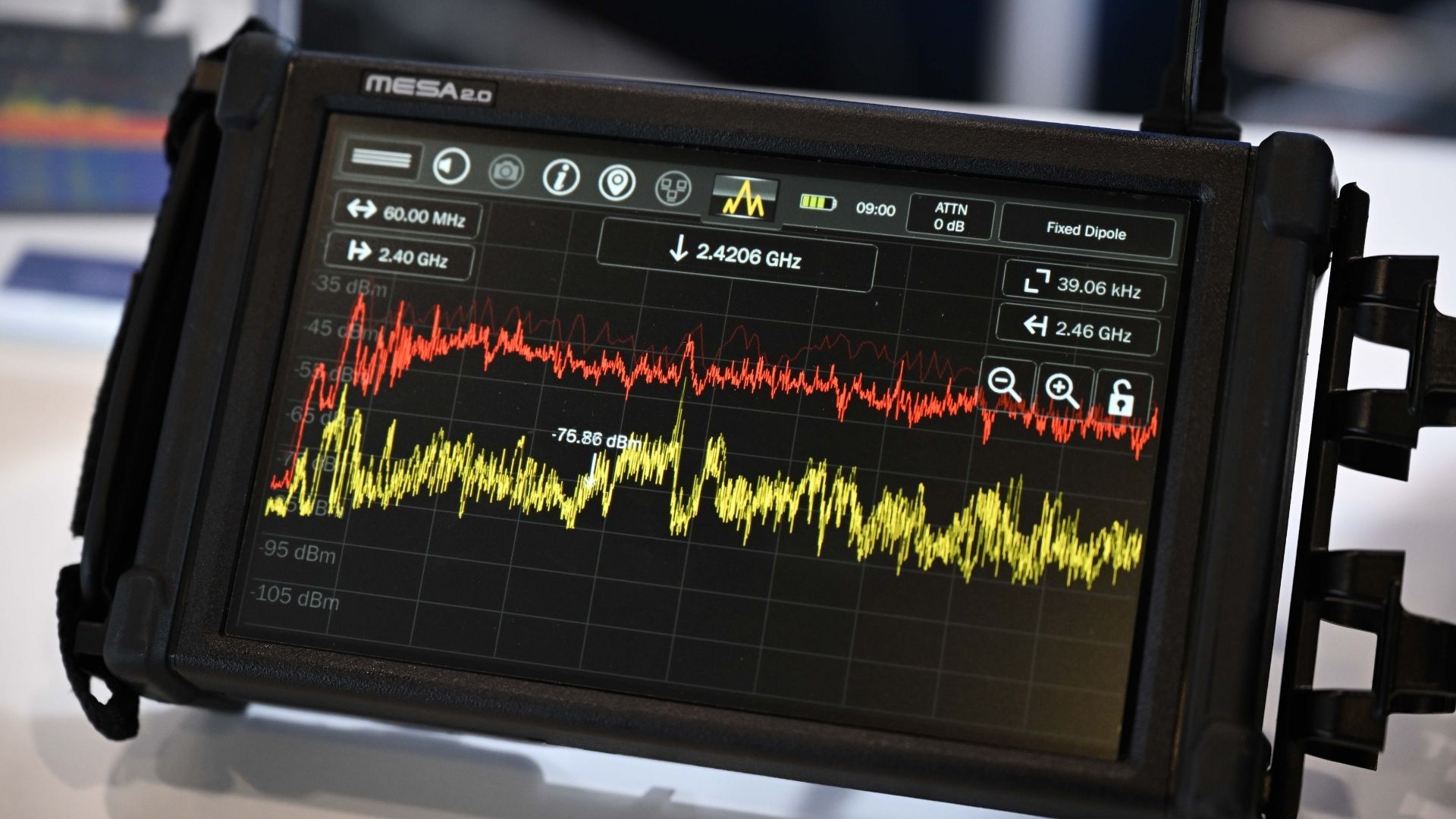
Australia-based technology company BrainChip has launched a new hardware platform designed to classify radio frequency (RF) signals in real time while operating on less than a watt of power, targeting defense and intelligence applications that require processing at the edge.
Called the Akida Communication Reference Platform, the system is built around the company’s Akida AKD1500 neuromorphic processor and is intended for defense contractors, government agencies, software-defined radio vendors and edge AI developers.
The platform performs RF signal classification directly on-device, eliminating the need for cloud connectivity or large computing hardware. BrainChip said the system is designed for environments where power availability, thermal constraints and size limitations make conventional GPU- or FPGA-based solutions difficult to deploy.
Potential applications include handheld signal intelligence systems, unmanned aerial vehicles, satellite communications terminals and other portable defense technologies.
AI tackles RF threats
According to BrainChip, the platform can identify more than 20 signal modulation types in real time while maintaining greater than 85% accuracy at a signal-to-noise ratio of 30 decibels.
Traditional digital signal processing systems typically rely on rule-based approaches that can struggle to identify new or intentionally modified signals. BrainChip says its neuromorphic AI approach allows the system to capture unknown waveforms and use them for future model retraining, enabling adaptation to emerging wireless threats.
The company argues that this flexibility addresses a key limitation of existing RF classification systems, which often require significant computational resources and can be difficult to update for changing operational conditions.
The platform is also designed to support battery-powered deployments where continuous operation is required without access to external infrastructure.
“BrainChip’s Akida Communication Reference Platform proves that real-time signal intelligence can be condensed into a portable battery powered solution to extend the range of deployment options,” said Sean Hehir, BrainChip’s CEO.
Built for edge deployment
The platform is available for evaluation and partner integration as a reference design kit. It supports integration with software-defined radio front ends such as the USRP B205mini and EPIQ Sidekiq.
A host system, including devices like the Raspberry Pi 5, can be used to manage data flow and application development. BrainChip said engineering teams can use the platform to prototype intelligence, surveillance and reconnaissance capabilities, as well as broader signal intelligence applications.
The launch expands the company’s portfolio of edge AI reference platforms beyond radar and sensor-fusion systems. BrainChip says the new offering demonstrates how neuromorphic computing can be applied to RF processing workloads that traditionally require larger and more power-hungry hardware.
The release comes as defense agencies and communications providers increasingly explore AI-powered spectrum monitoring tools capable of operating in remote and contested environments. By reducing power consumption and hardware requirements, such systems could enable RF awareness capabilities in smaller platforms that previously lacked sufficient computing resources.
As military and commercial users continue pushing AI capabilities closer to sensors and data sources, low-power processors capable of running advanced inference at the edge are becoming increasingly important for real-time decision-making in disconnected environments.
NASA is developing the next generation of surface exploration technology with its Exploration Rover for Navigating Extreme Sloped Terrain (ERNEST), designed with advanced mobility and autonomy capabilities to enable access to previously off-limits regions on the Moon and Mars.
In Southern California’s Colorado Desert, NASA’s ERNEST prototype is traversing rough patches of terrain as the design team at the Jet Propulsion Laboratory (JPL) continues to dial in the rover’s advanced mobility technology.
The four-wheeled, four-foot-long rover can readily handle landscapes that would be impassable for its six-wheeled predecessors, such as Curiosity and Perseverance.
NASA Lunar Navigation
ERNEST features mesh wheels for physically traversing difficult ground, as well as an intelligent decision-making system that determines the best route to its destination. As plans for humanity’s return to the lunar surface grow more ambitious, a rover capable of traveling longer distances at higher speeds will become a necessity. This is what ERNEST is accomplishing for NASA, already showing improvement over the performance of earlier rovers by an order of magnitude, as demonstrated in one test by traveling 16 miles in 37 hours.
The ERNEST prototype is less than half the size that the JPL team expects the final build to be. Since the project began in 2022, this is the third ERNEST prototype, with the other two being only two feet long and built primarily to test various suspension iterations over simulated lunar regolith packed at various slopes. They completed fabrication of the current prototype in September 2024 and operated it remotely via joystick control.
“You could do a science road trip across the Moon — or Mars — with this vehicle,” said James Keane, a JPL planetary scientist working on lunar missions.
ERNEST Project
ERNEST was a project that grew from relatively humble beginnings: initially, it sought only to replace current rovers with a simple, low-cost alternative by tweaking the rocker-boogie suspension already in use. The new active suspension developed for ERNEST allows it to balance weight among the four wheels rather than distributing it equally across all six wheels, as in the rocker-boogie system.
“We started by postulating that we could do better in designing a planetary surface robotic mobility system,” said Hari Nayar, a JPL principal technologist leading the ERNEST team. “While the rocker-bogie system has been very successful over the past 30 years, there’s been a lot of research in that time on mobility and understanding terrain interaction.”
NASA JPL conducted ERNEST times at all times of day to determine if darkness or shadow would confuse the autonomous system. Credit: NASA/JPL-Caltech
Powered joints in front of the rover allow it to switch between squirming, wheel-walking, and obstacle-climbing gaits to adapt to changing surface conditions. For less challenging terrain, a clutch allows the system to switch to a more energy-efficient passive suspension, conserving power for longer journeys. Each wheel is articulated to allow movement in any direction, allowing the vehicle to move completely sideways.
These major mobility advances will be a boon to mission planners, who have struggled to reach hard-to-access areas on Mars and the Moon that were previously inaccessible with previous technology.
NASA’s Autonomous Rover
“This testing is helping us refine the mobility hardware and autonomy software to navigate extreme distances across a wide range of terrain and lighting conditions anticipated on the Moon,” said Issa Nesnas, a principal technologist at JPL.
To move beyond operator control to autonomous decision-making, the team used an artificial intelligence technique called reinforcement learning, in which a model learns through interactions with the environment.
A virtual testing environment, running multiple simultaneous instances for months, allowed the researchers to have the rover ready to meet its environmental challenges from its first real-world test. Conducted at JPL’s Mars Yard, the initial tests featured an obstacle course of steps, slopes, ripples, and rubble. From this, and in many subsequent tests, ERNEST proved successful in navigating a range of very difficult environments.
Further improvements to the rover’s autonomy are being pursued with an eye on intelligent long-distance travel, with the rover independently switching between suspension settings.
Ryan Whalen covers science and technology for The Debrief. He holds an MA in History and a Master of Library and Information Science with a certificate in Data Science. He can be contacted at ryan@thedebrief.org, and follow him on Twitter @mdntwvlf.
The elephant’s trunk is one of the animal world’s most formidable facial appendages; it is capable of tearing a tree limb from its base and, moments later, carefully lifting a single blade of grass.
A boneless appendage that can both move heavy logs and peel fruit like a banana, the elephant’s trunk has long been studied by engineers seeking to understand how it can perform both powerful and delicate tasks effectively. Now, in a new study published in PNAS Nexus, researchers have identified the skin, rather than the underlying muscle, as a key factor in the versatility of this pachyderm appendage.
Lucia Beccai and colleagues at the Istituto Italiano di Tecnologia studied the trunk of an adult Asian elephant that died of natural causes at Zurich Zoo in 2020. They collected 35 samples from different regions of the trunk and analyzed them using biomechanical testing, histology, various imaging techniques, and computational modeling. The team’s analysis revealed a trunk that combines two very different mechanical strategies within a single structure.
One Trunk, Two Skins
The elephant trunk acts as a muscular hydrostat, similar to an octopus tentacle or the human tongue. With no bones and over 100,000 muscles, the trunk can stretch, compress, twist, and bend in any direction. The trunk achieves this flexibility through a combination of muscle power and specialized skin architecture. The study found that the trunk’s outer surface varies in structure depending on location and the types of forces it encounters.
The researchers identified clear differences between the upper and lower surfaces of the trunk, reflecting what scientists call functional anisotropy. The trunk’s upper surface serves as a tough, protective layer, which is over three times stiffer than the underside. In contrast, the trunk’s lower surface remains soft and flexible, allowing the elephant to grip objects with delicacy and precision.
The way elephants use their trunks reflects this structural difference. The upper surface faces the environment and absorbs impacts and abrasions. The underside is used for gripping objects. Its lower stiffness allows it to adapt to the shape of objects and hold them securely. The design of the elephant trunk may offer a solution to a persistent challenge that has stumped soft-robotics engineers in balancing protection and precision by assigning each function to a different layer of skin.
A Lens Made of Tissue
Another significant finding was made beneath the gripping surface. The researchers identified dome-shaped structures known as dermal papillae. Finite element modeling suggested that these structures act as subsurface mechanical lenses, concentrating mechanical stress in regions where sensory nerves are located.
This design could solve an additional problem in robotics: touch sensors are often fragile and require protective coatings that can reduce their sensitivity. The tissue in the elephant trunk appears to protect sensory structures while still allowing mechanical signals to reach them.
The Biomimetic Blueprint
For Beccai’s group, which specializes in soft robotics, the possible design template represents a huge opportunity for their field. A robotic gripping device built on this idea would feature a stiff outer shell over a flexible inner layer, with structures underneath to direct pressure to protected sensors. This setup would keep sensitive electronics shielded while still allowing for mechanical feedback from touch.
This research adds to the growing scientific interest in the elephant trunk as a model for engineering. Another 2024 study in Communications Biology found that the trunk’s dermis is reinforced by tangled collagen fibers, creating skin armor thicker than an armadillo’s shell. Together, these studies show a structure optimized at every level, from the protein fibers in the dermis to the clear split between the upper and lower surfaces.
Today’s robotic hands still struggle to balance durability with sensitivity. The elephant trunk offers biological inspiration for this challenge, providing a model for future engineering designs.
Austin Burgess is a writer and researcher with a background in sales, marketing, and data analytics. He holds an MBA, a Bachelor of Science in Business Administration, and a data analytics certification. His work focuses on breaking scientific developments, with an emphasis on emerging biology, cognitive neuroscience, and archaeological discoveries.
Industrial robots have mastered many repetitive tasks, but preparing sashimi remains a surprisingly difficult challenge. A piece of raw salmon rarely stays where it is placed. The fish deforms during handling, making it difficult for machines to deliver consistent cuts.
Researchers in Norway have developed a robotic system that can prepare sashimi with minimal human involvement. The machine tackles a task that has long challenged robots because raw fish constantly changes shape during handling.
The project highlights a broader goal in robotics. Engineers want machines to work with soft materials that do not behave predictably. Success in that area could benefit industries ranging from food processing to healthcare.
Built for delicate tasks
The research team at the Norwegian University of Science and Technology designed Sashimi-Bot around three robotic arms. Each arm performs a specific role. One arm stabilizes and positions the salmon before cutting begins. Another handles a chef’s knife. A third arm uses chopsticks to transfer finished slices onto a tray.
Getting the fish into the correct position proved critical. A salmon loin can shift during handling, which affects cut quality. To address that issue, the researchers trained the robot in a virtual environment. The system relied on deep reinforcement learning, an AI technique that improves performance through repeated practice. During the simulation, the robot tested countless movements and gradually learned how to arrange the fish for slicing. The researchers then transferred that knowledge to the physical robot without additional training on real salmon.
Giving the knife touch
Cutting introduced another obstacle. The robot needed to know exactly when the blade reached the cutting board. That task becomes more difficult because the knife sits inside a soft robotic gripper. Small variations in the grip can affect the blade’s position during a cut.
To solve the problem, the team equipped the system with a GelSight tactile sensor. The device uses a soft gel surface and an internal camera to detect pressure changes. Those measurements provide information similar to a sense of touch.
Researchers trained the sensing system using more than 12,000 data samples collected during 157 cutting motions. The resulting model detected contact with the cutting board with 95% accuracy. It also achieved 99% precision during testing. That feedback allowed the robot to adjust its cutting motion before driving the blade too deeply into the board.
Performance on salmon
The team evaluated Sashimi-Bot using real salmon loins. During testing, the robot produced 34 slices ranging from 6 to 16 millimeters thick. Some pieces adhered to the knife after cutting, a common issue when working with raw fish. The robot successfully recovered all six of those slices directly from the blade.
Most of the remaining pieces reached the serving tray without issue. The system successfully transferred 26 of 28 slices left on the cutting board. Only two failed transfers occurred, both involving extremely thin pieces that slipped from the chopsticks.
The study was published in the journal npj Robotics.
Sensory Robotics has received safety certification for a system designed to let industrial robots operate alongside people without the protective cages commonly used on factory floors. The certification clears the way for deployment of the company’s SR-1 technology in regulated manufacturing environments across the United States and Canada.
The SR-1 system combines 3D vision technology, sensors, and real-time safety software that continuously monitors the area around robotic arms. Instead of relying on physical barriers, the system creates virtual safety zones that adjust based on human movement and machine activity.
The company says the technology can be installed on existing industrial robotic production cells, potentially allowing manufacturers to retrofit current equipment rather than replace it. The goal is to enable human workers and high-speed industrial robots to share the same workspace safely.
The certification includes cULus 1740 and ISO 13849 Performance Level d validation, standards widely recognized in industrial automation and machine safety. The approvals mark the transition of the technology from development and testing into commercial deployment.
Invisible safety zones emerge
“Without this safety certification, our technology doesn’t leave the lab, and it doesn’t reach the factory floor,” Sensory Robotics CEO Chris Edwards says. “Now, it can.”
Industrial robots have long been separated from workers by fences and cages because of the speed and force at which they operate. While collaborative robots have been designed to work closer to humans, many traditional robotic systems still require physical barriers to meet safety requirements.
Sensory Robotics says SR-1 addresses that challenge by continuously tracking people near robotic cells and adjusting robot behavior in real time.
“We designed SR-1 to continuously see people and adjust robot movements in real time,” Edwards says. “This UL certification now allows our technology to be purchased and installed on industrial robots, enabling them to safely operate alongside humans without physical barriers.”
According to the company, the certification process evaluated how the system responds to equipment failures, safety-function disruptions, and potential risks to workers. Such certifications are often required before technologies can be introduced into regulated manufacturing facilities.
Factory robots lose fences
The company argues that eliminating physical cages could free up factory floor space, improve workflow flexibility, and reduce production interruptions. Traditional robotic work cells often require complete shutdowns when workers enter restricted areas, creating downtime that can accumulate across large manufacturing operations.
“The goal is simple,” says chief operating officer Mark Gagas. “Keep people safe without stopping production every time someone enters a workspace. In traditional environments, a safety interruption can require a full robot shutdown and restart, sometimes taking up to 10 minutes per incident. Add that up across a production line, and those delays compound into high operational costs.”
The company says its system is already attracting interest from sectors including automotive, aerospace, logistics, manufacturing, and defense. Sensory Robotics also received a $1.25 million Department of Defense SBIR Phase II grant and additional support through the University of Cincinnati’s innovation ecosystem.
“These combined certifications are the key that unlocks real-world industrial adoption and approval for companies to purchase fenceless human-robot collaboration systems like SR-1,” Gagas says. “It means regulated manufacturing environments can now trust and deploy this technology into their robots with confidence.”
Unmanned aerial vehicles (UAVs), commonly known as drones, are now widely used for various purposes, ranging from filmmaking and aerial photography to industrial inspection, precision farming and reaching obstructed areas during emergency response missions. While many existing drones can move swiftly in their surroundings and circumvent large obstacles, most still struggle in cluttered environments. In addition, they are often unable to execute maneuvers that would allow them to safely pass through small gaps or reach secluded areas.
Harvard researchers found that adding a little randomness to robot movements can prevent gridlock and dramatically boost efficiency in crowded swarms. Imagine a swarm of robots sent into a tight space to handle an urgent job, such as cleaning up an oil spill or assembling complex equipment. At first, adding more robots speeds things up. [...]
Northrop Grumman’s Stargazer took off Thursday, June 18, 2026, from NASA’s Wallops Flight Facility in Virginia. The modified L-1011 aircraft carried the company’s Pegasus XL rocket hosting LINK, a robotic servicing spacecraft from Katalyst Space. LINK will launch from the air-deployed Pegasus XL later this month on a mission to boost the orbit of NASA’s Neil Gehrels Swift Observatory.
NASA/Jeanette Kazmierczak
An airplane carrying a rocket loaded with a robotic spacecraft designed to raise NASA’s Neil Gehrels Swift Observatory departed the agency’s Wallops Flight Facility in Virginia on Thursday, June 18.
Stargazer, a modified L-1011 operated by Northrop Grumman, took off for Kwajalein Atoll, part of the Republic of the Marshall Islands in the South Pacific Ocean. Attached to the belly of the aircraft was one of the company’s Pegasus XL rockets with LINK inside.
NASA contracted Katalyst Space to design and build LINK to rendezvous and dock with Swift and lift it back to a higher altitude.
Spacecraft in low Earth orbit experience drag caused by our planet’s atmosphere, which gradually reduces their altitude if they do not have propulsion systems to counteract the effect.
Recent solar activity magnified this effect on Swift, which began to sink faster than anticipated.
Katalyst selected Northrop Grumman’s Pegasus XL launch vehicle as the best means of reaching Swift on a short timeline based on orbital and programmatic needs.
Stargazer will carry Pegasus and LINK to Kwajalein Atoll, part of the Republic of the Marshall Islands in the South Pacific Ocean with stopovers in California and Hawai’i.
NASA/Jamie Adkins
Later this month, Stargazer will carry the rocket to an altitude of around 40,000 feet before releasing it.
After several seconds in free-fall, Pegasus XL will fire the first of its three-stage rocket motors, delivering LINK into orbit in about 10 minutes.

 Login