Riding a hot train in London on June 24. Average temperatures across Western Europe last month were 3.05 degrees Celsius, or 5.5 degrees Fahrenheit, above the mean from recent decades.
Morning commuters on the London Bridge on Wednesday, where temperatures reached 96 degrees Fahrenheit, the hottest recorded June day in the United Kingdom.
A bright, dense cluster of hot, massive stars in a galaxy that existed 1.4 billion years after the big bang has been found helping to end the early universe's foggy days during which neutral hydrogen gas was draped across the cosmos, obscuring ultraviolet light from luminous objects.
The cluster was found emitting ultraviolet light in a small but quickly growing galaxy by the Hubble Space Telescope. The presence of this ultraviolet light, and the star-forming history of the cluster producing it, suggests that bursts of star formation contributed to waves of ionizing radiation that gradually cleared out the opaque neutral hydrogen.
In the aftermath of the big bang, the universe was filled with neutral hydrogen gas that is opaque at short wavelengths of light, such as ultraviolet. However, this ultraviolet light was the neutral hydrogen's worst enemy, gradually ionizing the gas across the universe. Once ionized, hydrogen gas cannot absorb ultraviolet light — and so, the cosmos became transparent at those wavelengths.
Because of this, the first billion or so years are called the Epoch of Reionization. It is referred to as "reionization" rather than ionization because, technically, the gas had already been ionized once before during the first 379,000 years after the Big Bang.
While investigating what brought about this epoch, astronomers had identified two chief suspects that could have produced sufficient amounts of ultraviolet light to ionize the neutral hydrogen. One is active supermassive black holes and the other is the first generations of hot, massive stars. The problem is, given that neutral hydrogen is adept at absorbing the ultraviolet light, astronomers have had difficulty tracing that ultraviolet back to its source and identifying which of the two suspects are the main culprit.
In 2023 the James Webb Space Telescope (JWST) made a major breakthrough, finding a galaxy that existed just 900 million years after the Big Bang that was producing enough energy to ionize the neutral gas surrounding it.
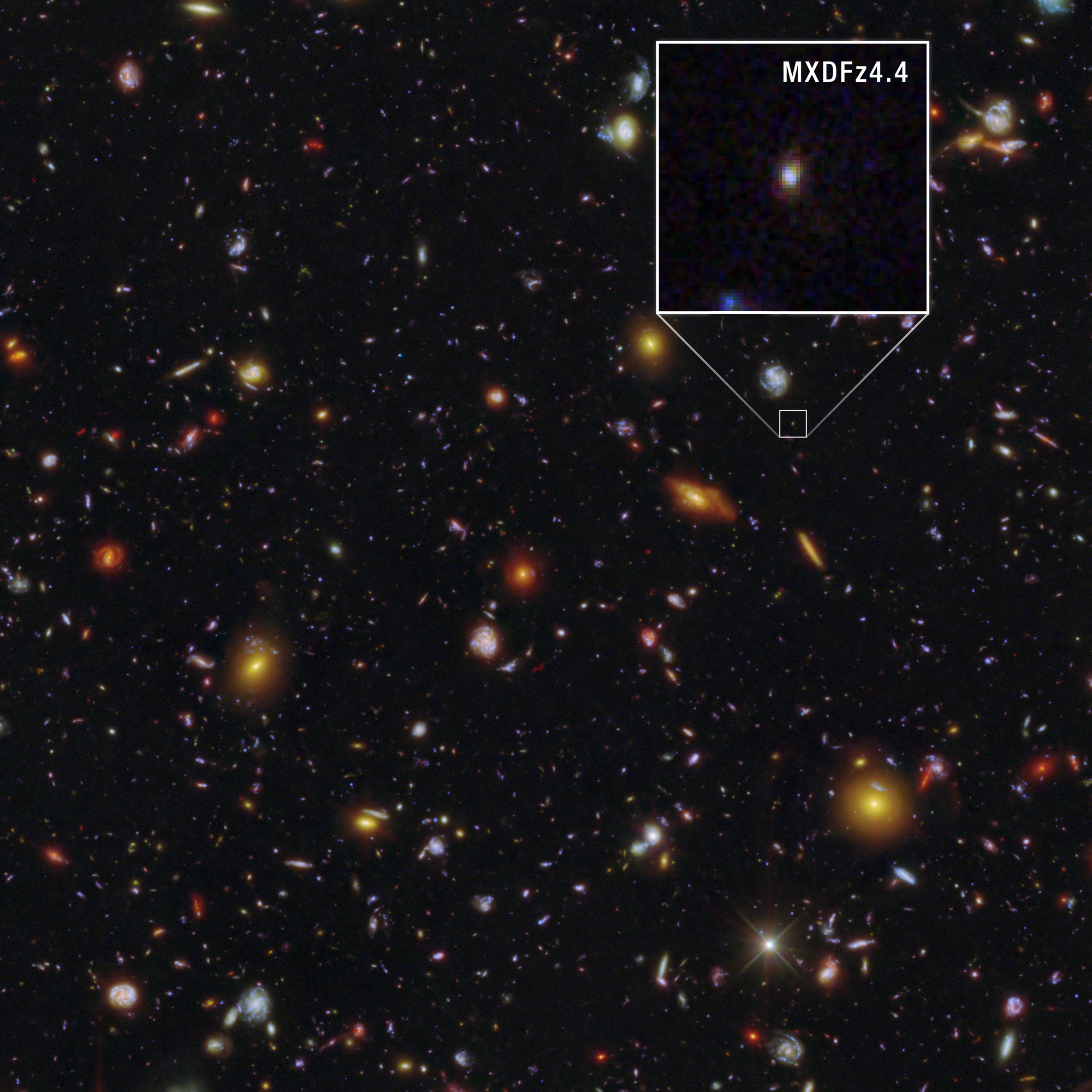
Now the Hubble Space Telescope has gone further, detecting ultraviolet light from a galaxy called MXDFz4.4. This ultraviolet light should only be visible if the surrounding gas had already been ionized.
"Observing a galaxy like this was thought to be impossible," said Ilias Goovaerts of the Space Telescope Science Institute (STScI) in Baltimore, who led the discovery, in a statement. "Researchers expected the 'fog' of neutral hydrogen that filled the early universe would be too thick and obscure our view of its ionizing light. Hubble not only spotted that light, but it also helped reveal incredible details about the galaxy's characteristics."
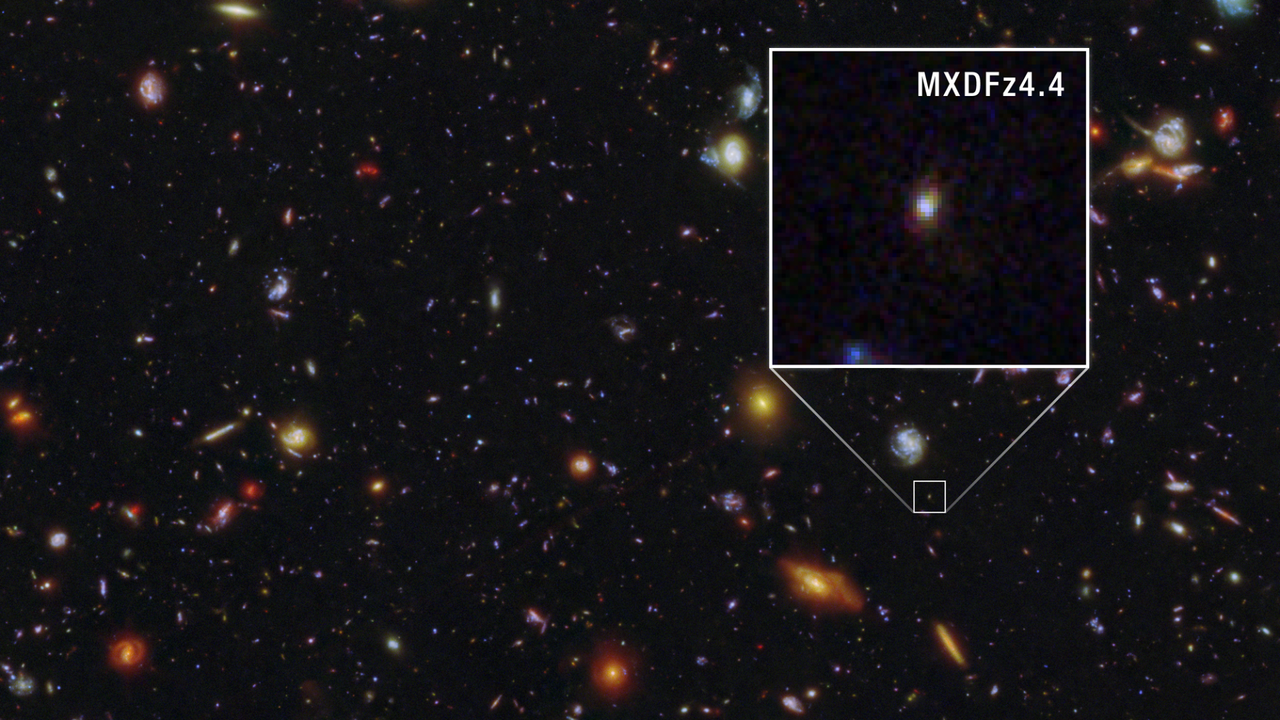
The full Hubble Space Telescope's view of MXDFz4.4 and its surroundings from our vantage point. (Image credit: NASA/ESA/CSA/STScI/Ilias Goovaerts and Anton Koekemoer (STScI)/Marc Rafelski (STScI, JHU)/ Image Processing: Alyssa Pagan (STScI))
MXDFz4.4 was first identified in the MUSE eXtremely Deep Field (MXDF), with MUSE being the Multi Unit Spectroscopic Explorer on the European Southern Observatory's Very Large Telescope in Chile. The "z4.4" part of its name tells us that the galaxy exists at a redshift of 4.4, meaning that it existed 12.37 billion years ago. As the universe has expanded in the time since then, the ultraviolet light has been redshifted into visible wavelengths that were detected by Hubble.
"Astronomers have found many galaxies that existed at this point in the history of the universe, but we haven't detected ionizing photons from any of them, making MXDFz4.4 one of a kind," said Marc Rafelski, who is the Hubble Deputy Mission Head at STScI.
MXDFz4.4 is 100 times smaller than our Milky Way galaxy but is forming stars ten times faster than our galaxy is. Many of those stars are being born in the tight, luminous cluster producing the ionizing ultraviolet.
An artist's impression of the young, distant galaxy MXDFz4.4 and its dense cluster of luminous stars. (Image credit: NASA/ESA/Leah Hustak (STScI))
The cluster contains "A lot of young, hot, massive stars in a small space [that] do a better job of blasting through opaque gas," said Goovaerts.
Furthermore, by comparing Hubble's observations of MXDFz.4.4 with those of the JWST, which probed for cooler, older stars in the galaxy, Goovaerts and Rafelski's team discovered that the stars in the cluster had formed in bursts, each burst producing fresh quantities of ionizing ultraviolet radiation that helped to clear out more and more of the neutral gas over time. We now see the galaxy about 250 million years after it finished reionizing the surrounding gas. These hot, massive stars in the cluster end their lives after a few million years as supernova explosions, the blast waves and radiation from which can create bubbles in the gas light years across, creating further pathways for ultraviolet light to escape and be detected by Hubble.
The observations seem to nail down the theory that clusters of hot, massive, luminous stars in young galaxies in the early universe played a dominant role in ionizing the universe's neutral gas.
"Hubble's observations of MXDFz4.4 let us test our hypotheses much closer to the Era of Reionization than ever before," said Rafelski. "Finding more galaxies, especially at slightly later cosmic times where larger samples are within reach, would let us refine these measurements and figure out what cleared our view as that era was ending."
Photographer Shane Hynan explores the tension between the central role peat bogs play in Irish life and their wider environmental impact
“You can read Ireland’s history in the boglands. They hold millennia in their layers,” says photographer Shane Hynan of his project, Beofhód (meaningBeneath in English).
The boglands, known as portachs in Irish, cover roughly 1.2m to 1.5m hectares or about 14% to 17% of the country’s total land area. The raised bogs of the Irish Midlands are made of peat that forms at a rate of 1mm a year (0.04in) in low-lying, poorly drained basins or former lakes. As the historical geographer Kevin Whelan observes in the Atlas of the Irish Rural Landscape, “the bog has been etched as deeply into the human as into the physical record in Ireland – to an extent unrivalled elsewhere.”
Eddie and Con footing turf for domestic use, Knockirr Bog, County Kildare, 2022.
Ferrari has replaced its long-serving chief marketing and commercial officer, Enrico Galliera, just weeks after the rocky debut of the Luce, the automaker’s first electric car.
The company named former BMW Italy boss Massimiliano Di Silvestre as Galliera’s successor, effective July 1, after a launch that wiped roughly 8% off Ferrari’s stock in a single day.
SAN FRANCISCO – Ubotica Technologies, an Irish company focused on artificial intelligence for spacecraft, has raised $11 million to expand commercial sales of its maritime-intelligence platform. The platform, Live Maritime […]
The UK’s Competition Appeal Tribunal approved a £3 billion class action lawsuit against Apple over its iCloud service, allowing consumer group Which? to proceed with a claim on behalf of nearly 40 million users across the country.
The lawsuit alleges Apple abused its dominant position and breached UK competition law by “trapping” users into using iCloud. Which? argued Apple steered iOS users towards its own cloud storage service and limited visibility of alternative providers, leading to “rip-off” prices and lower levels of free storage.
The case is expected to go to trial in 2028 after the UK court granted Which? a Collective Proceedings Order (CPO), clearing the path for what could become one of the UK’s largest consumer tech claims.
At the centre of the dispute is Apple’s cloud storage model, where users receive 5GB of free storage before being directed towards paid tiers. Pricing then rises across multiple levels, from 99p per month for 50GB to £54.99 for 12TB in the UK. The consumer group argued this structure reflects a lack of competition, with users “locked-in” once their devices become reliant on iCloud for photos, messages and device data backups.
Strong message The claim, first filed in November 2024, will cover consumers living in the UK who used iCloud services between 8 November 2018 and 8 June 2026. Potential compensation is estimated at around £77 per user if it succeeds.
Which? also called on the tech giant to resolve the dispute without litigation, urging the company to offer consumers refunds and open up iOS “to allow users a real choice for cloud services”.
However, Reuters reported Apple previously rejected the allegations, arguing users are not required to use iCloud and that third-party alternatives remain available.
Which? CEO Anabel Hoult said the group “wants to make clear that no company, no matter how powerful, can get away with abusing its position”. “The granting of the CPO means we’re one step closer to getting consumers the redress we believe they are owed from Apple,” she noted, adding, “this should send a strong message to any other companies using anti-competitive tactics”.
UK operator Virgin Media O2 announced plans to begin its 2G network switch-off in Summer 2029, joining rivals BT and VodafoneThree in setting a date to wind down the legacy technology.
Its timeline is similar to that of the country’s other operators, with BT expecting to begin deactivating 2G in May 2029 and VodafoneThree set to turn off its last sites in Spring 2030.
All three operators have signed a voluntary government charter for retirement of the technology. Commitments in that document include undertaking a gradual process starting in trial areas, thorough testing, and work to aid migration of IoT devices supporting “life critical services” which are currently tied to 2G.
VMO2 noted decommissioning 2G would mean it could switch resources to 4G and 5G, having turned off 3G in 2025.
Advantages cited include redeployment of spectrum resources, cutting energy consumption and generally upping service levels for customers.
The operator reports its 2G network currently carries less than 0.5% of all data used by its customers.
VMO2 CTO Jeanie York said “having recently switched off our 3G network and signed up to the government 2G switch-off charter, we know exactly how to do this responsibly and without disrupting customers. While most customers won’t need to take any action at all, some businesses might need to start planning for this now”.
“We will communicate with customers directly and ensure we support everyone as this essential upgrade takes place.”
The interstellar comet 3I/ATLAS carries a chemical fingerprint unlike anything in our Solar System, and it may have formed 10 to 12 billion years ago, before our Sun even existed, according to two papers published in the journal Nature.
Researchers have identified the most distant dormant black hole known, dating back to the universe’s early history. Astronomers have long relied on brilliant quasars, supermassive black holes actively feeding on surrounding matter, to study the early universe. Yet these luminous objects reveal only part of the story. Now, researchers have detected the most distant dormant [...]
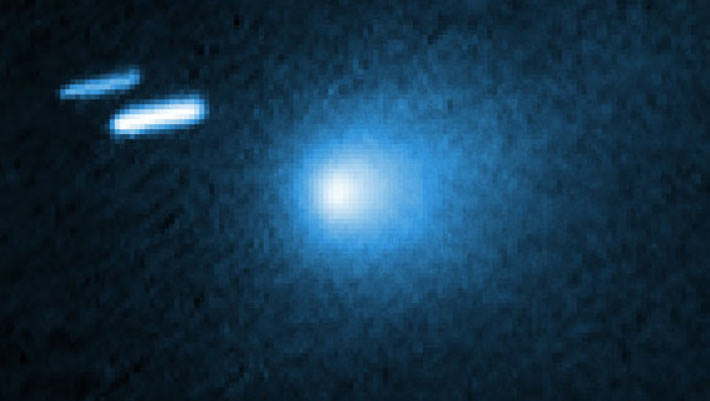
Following its trip around the Sun late last year, 3I/ATLAS had been significantly warmed, causing a large amount of its icy exterior to be converted into a cloudy coma. This not only made the comet more visible but also provided Webb an ideal opportunity to collect spectrographic data that could offer important information about its chemical composition.
The Webb data, which was detailed in a recent study, indicates chemical ratios of carbon and deuterium emanating from the object that are very unlike those of comets found within our solar system.
The compelling new findings, according to NASA officials, “surprised researchers.” Here’s why.
A Rare Look at an Ancient Space Object
Fundamentally, the recent Webb observations provided astronomers with one of their best opportunities to observe information about the comet’s possible origins throughout the duration of its visit to our Solar System last year.
Martin Cordiner, an astro-chemist at NASA’s Goddard Space Flight Center in Greenbelt, Maryland, called the observations “a unique opportunity to study an ancient object from the distant galaxy, probably pre-dating our Sun and solar system.”
Above: Researchers used Webb’s NIRSpec instrument to map specific chemical contents of comet 3I/ATLAS as it exited our Solar System (Image Credit: NASA, ESA, CSA, STScI, Martin Cordiner (CUA, NASA-GSFC); Image Processing: Alyssa Pagan (STScI).
Cordiner, who was also the lead author of the recent Nature study, said that the data he and his co-authors were able to obtain helped to provide “direct insight into that distant time and place” from which 3I/ATLAS originates, while also providing new insights into “how unusual our own solar system may be.”
Understandably, the Webb telescope is in high demand, and Cordiner and his team had to interrupt the space observatory’s planned schedule to turn its powerful eye toward 3I/ATLAS as it made its exit.
A Deuterium-Rich Space Object
Cordiner and the research team joined astronomers from many sub-disciplines in taking the opportunity to get a look at 3I/ATLAS on its journey through the solar system, which relied primarily on Webb’s NIRSpec (Near-Infrared Spectrograph) instrument.
As previously reported by The Debrief, the telescope’s NIRSpec instrument revealed “exceptionally high” levels of deuterium—also known as “heavy hydrogen”—amounting to nearly 30 times the amount normally seen in comets within our solar system.
One thing this probably indicates is that early in its lifetime, 3I/ATLAS was likely exposed to large amounts of radiation, which gave rise to the deuterium-rich ice in its composition. However, after drifting through space for eons without coming into proximity to a star like our Sun, there were no opportunities for this “heavy water” to be converted back into the typical kind of H20 water common on our planet.
Clues from Carbon Traces
Another primary finding Cordiner and the team made is that NIRSpec data revealed only small amounts of carbon-13, as opposed to its lighter counterpart, carbon-12. Since carbon-13 enrichment is known to occur within stellar systems over time, the team interprets this as evidence for the extreme age of 3I/ATLAS, which could have origins going as far back as an astonishing 12 billion years ago.
This would place the interstellar object’s birth within the period astronomers identify as “cosmic noon,” during which our universe was undergoing its peak period in star formation. Additionally, separate observations involving the European Southern Observatory’s Very Large Telescope help to affirm the recent Webb findings, along with complementary insights into the ancient comet’s carbon content, as well as nitrogen present in the form of cyanide, revealed from recent spectrographic analysis.
“For us as scientists, finding these rare isotopes is fascinating, but the bigger picture here is looking at the possibilities of prebiotic chemistry elsewhere in the galaxy,” said Stefanie Milam, one of the recent study’s co-authors, and also a researcher at NASA Goddard, in a recent statement.
Fundamentally, what the latest data on 3I/ATLAS conveys is more than just a rare look at a cosmic voyager who briefly entered our Solar System—it is a potential glimpse at how the very building blocks of life could have made their way into our planetary neighborhood long ago, eventually arriving here on Earth.
“So far, we know of only one place in the vast cosmos where chemical ingredients led to life – our solar system, our Earth,” Milam recently said.
“Analysis of these interstellar objects is a major step towards learning how common, or uncommon, the conditions for the evolution of life are in the universe,” Milam added.
The team’s recent study, “Isotopic evidence for a cold and distant origin of 3I/ATLAS,” appeared in the journal Nature on June 22, 2026.
Micah Hanks is the Editor-in-Chief and Co-Founder of The Debrief. A longtime reporter on science, defense, and technology with a focus on space and astronomy, he can be reached atmicah@thedebrief.org. Follow him on X @MicahHanks, and at micahhanks.com.
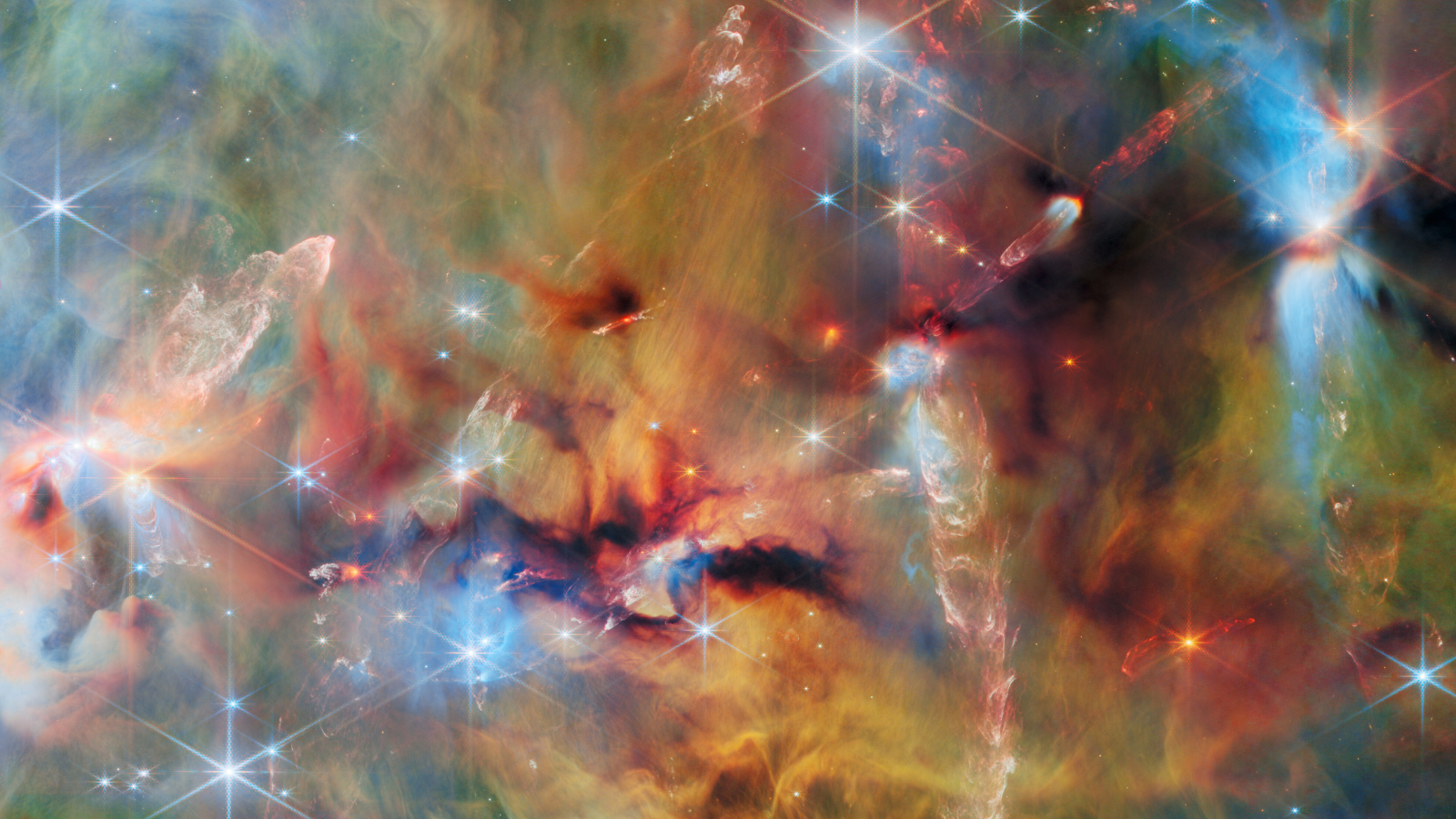
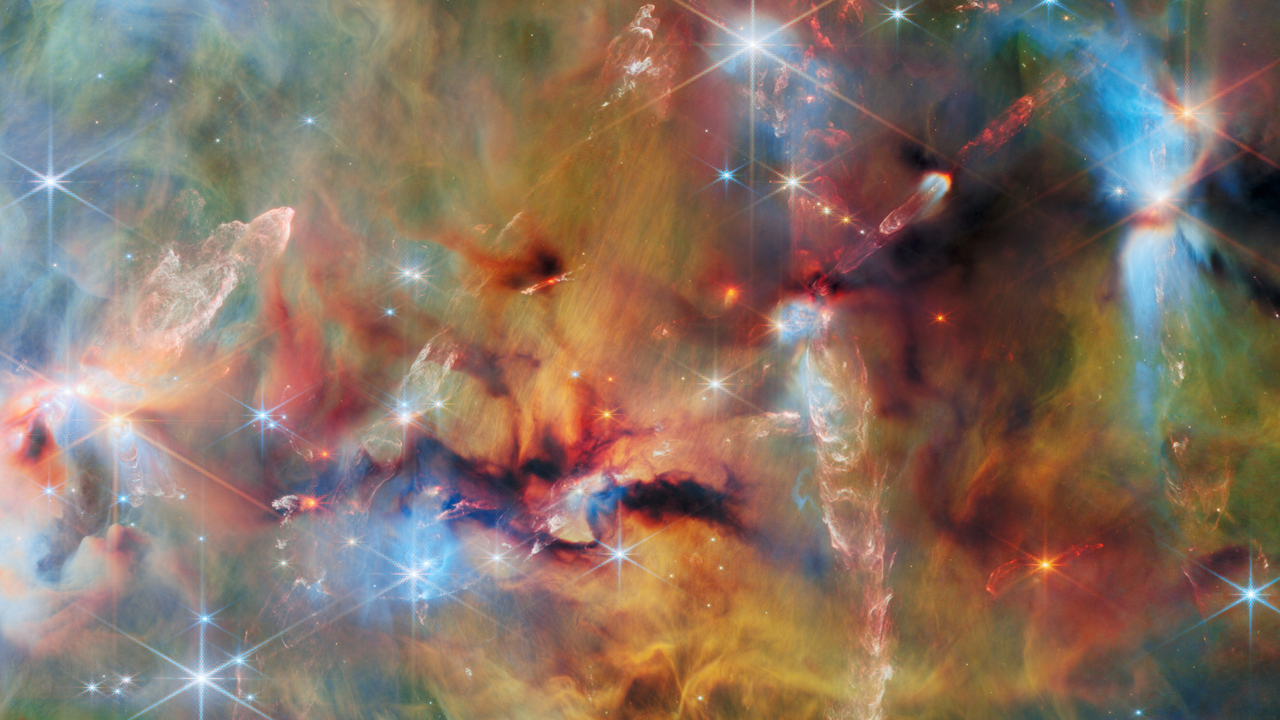
The James Webb Space Telescope Picture of the Month shows the giant molecular cloud Orion A, an area of the sky replete with star-forming clouds. (Image credit: ESA/Webb, NASA & CSA, T. Megeath, M. Zamani (ESA/Webb) Acknowledgement: M. H. Özsaraç)
The image of the day for Monday (June 22) shows the star-forming clouds of Orion A in stunning detail.
Released as the James Webb Space Telescope (JWST) Picture of the Month, the image further demonstrates the impact the $10 billion space telescope has had on our view of the cosmos since it began operations in July 2022.
What is Orion A?
Located around 1,300 light-years from Earth and situated to the south of Orion's Beltin the night sky,Orion A is one of the largest and closest molecular clouds to our planet. Shaped like a filament, this structure of gas and dust is around 290 light-years long.
Part of the Orion molecular cloud complex, Orion A is a packed stellar nursery. Over the last few million years alone, it is estimated that Orion A has given birth to around 3,000 stellar objects.
The molecular cloud is also host to many young protostars surrounded by platters of gas and dust called protoplanetary disks, which, as the name suggests, will form planets. Thus, studying regions like Orion A could be key to understanding how the solar system came to be around 4.6 billion years ago.

 Login