❌

Reading view

What do the IPOs for SpaceX, OpenAI and Anthropic mean for Microsoft?

The AI IPO tsunami on the stock market has only recently gotten under way, with SpaceX’s more-than-$2 trillion IPO likely to be followed in several months by OpenAI’s and Anthropic’s IPOs — each of which is likely to hit $1 trillion.

That will mint three new trillion-dollar AI companies in a matter of months, all of which compete with Microsoft. 

Wall Street has never seen anything like it. Previously, the most money raised by all IPOs in a single year was $671 billion in 2021. It took 38,644 deals to get to that figure. Compare that to three deals this year that by themselves will likely total $4 trillion.

The numbers are eye-popping. 

For Microsoft though, it’s not the numbers themselves that are important. It’s what will happen to the company once it as three newly minted trillion-dollar AI competitors. Until recently, when it came to AI, Microsoft was king of the hill. But can it keep that place?

Microsoft’s weakened position

The IPOs come at a particularly fraught time for Microsoft. At one point, it was the most valuable AI company in the world, with a big head start on the tech industry.

No longer. Microsoft’s stock price has tanked in the past 12 months, even as the S&P index has soared. In the last year, Microsoft’s stock price has dropped 24%, while the S&P has jumped 24%. The two were pretty much in sync until last fall..

Microsoft has fared even worse against its most powerful AI competitor, Google. In June 2025, Google’s total value was $2.1 trillion, well behind Microsoft’s  $3.57 trillion. By  mid-June this year Google was worth $4.5 trillion, Microsoft, $2.8 trillion. That’s entirely due to Google’s AI push and Microsoft’s failure to improve Copilot significantly.

Matt Vellosso, who worked for Microsoft for 14 years — including four as technical advisor to CEO Satya Nadella and then as Partner Director for fostering AI innovation in Windows before leaving in 2023 — is scathing about what he views as Microsoft’s AI failures. 

He warned: “Microsoft missed the internet wave, the mobile wave and now it missed the AI wave.”

Show me the money

The most immediate likely impact on Microsoft after the three massive IPOs take place will be on the company’s stock price, which could well take another hit. Investors don’t want to miss out on the AI boom, and until now, there’s been a relatively small number of companies in which they could. When Anthropic and OpenAI join SpaceX as publicly traded companies, investors will have three more choices than they did only a few months ago. That could make it tougher for Microsoft to attract AI-focused investors. And that, in turn, could knock down its stock price. 

A lower stock price means the company will have a harder time raising money when it needs it. In addition, Microsoft won’t be able to as easily buy other companies in stock-only deals, because the value of its stock will be less.

Still, the IPOs are not all bad news for Microsoft’s stock position. It does, after all, own 27% of OpenAI. So if OpenAI is valued at $1 trillion after its IPO, Microsoft has a $270 billion stake in it.

Thumbs up for increased Azure revenue

One area where these mega IPOs should be unalloyed good news for Microsoft is in Azure revenue, which should significantly. Microsoft’s final divorce settlement with OpenAI requires the latter to buy $250 billion in Azure services through 2030. And its  estimated trillion-dollar valuation ensures the company will be around for the long term, meaning Microsoft can count on that revenue — and possibly more on an ongoing basis.

Microsoft will likely also get tens of billions of dollars from Anthropic for Azure cloud services. Anthropic might spend $43 billion annually on Azure cloud services by 2030, according to estimates by HSBC, one of the world’s largest banking and financial services companies.

Thumbs down for the effect on Copilot

Although Azure use will boom thanks to the IPOs, Microsoft’s own Copilot could face significant competition at a time when it’s having serious problems gaining traction. In its April 2026 earnings call, the company said Microsoft 365 Copilot had 20 million paid seats. That’s up from 15 million paid seats as of January, but still a minuscule number, considering Microsoft has 450 million Microsoft 365 commercial subscribers. That means only about 4% of the company’s business customers have been willing to pay for it since its launch in late 2023.

Beyond that, developers have been leaving GitHub Copilot and turning to Anthropic’s Claude Code and SpaceX’s recently purchased Cursor. A survey by the software development company JetBrains of more than 10,000 developers found that 29% used GitHub Copilot, 18% used Cursor and 18% used Claude Code. 

Early in 2025, GitHub Copilot had a commanding 67% market share.

More downside than up from the IPOs

Although the IPOs do have some upside for Microsoft — dramatically increased Azure revenue and several hundred billion dollars in OpenAI stock holdings — mostly, they’re bad news thanks to increased competition. 

Unless Microsoft significantly improves Copilot for businesses, developers and consumers, the company’s one-time AI dominance will erode even further.

  •  

Caught in the iCloud: Apple trial set in the UK

Forty million UK iCloud users could be owed up to $100 (£77) each after a $3.9 billion (£3 billion) class action lawsuit against Apple was cleared for trial — and the company’s problems may be just getting started. 

For Apple, the worry is that this case could snowball to become yet another existential regulatory problem. The action was brought by consumer group Which?, which accused Apple of breaching UK competition law by giving its iCloud storage service preferential treatment and “trapping” customers with Apple devices into using iCloud. 

Trapping happy customers

Apple achieves this by encouraging its customers to sign up to iCloud for storage of photos, videos and other data while also making it difficult for them to use alternative providers to backup key data. The company also squeezes extra dollars out of customers by providing a stingy 5GB of storage for free, while putting important data including messages and photos inside that allocation. Even Google provides 15GB of storage in its free tier.

The problem is that the scale of Apple makes it difficult for competitors to reach customers with alternative solutions, while Apple’s control over the operating system gives it integration advantages third-party competitors don’t get. 

While there may well be justifications for constraining access to some personal data, those privacy and security challenges don’t apply to all of it. 

You are the product

When it originally filed the claim, Which? explained that Apple could resolve the claim without litigation by offering consumers their money back and opening up iOS to allow users a real choice for cloud services. This is unlikely to happen.

This case has been slowly making its way through the Competition Appeal Tribunal, which last week finally gave permission for the case to go to trial.

Apple won’t be looking at a hefty fine just yet. The first available trial date is in October 2028 and the legal fight is expected to last nine weeks, which might, or might not, equate to a Christmas surprise for Apple’s then CEO. There’s no time to sit back, however, as the company must still file its defense papers with the court by the end of next month, July 31.

The snowball factor

The UK is not alone. Italy has launched its own antitrust probe into Apple’s iCloud dominance under the EU’s Digital Markets Act (DMA). The problem with that litigation is that since Italy has commenced the probe, other nations across the bloc might also act.

Italy is looking to see whether Apple has failed to open up its iOS and iPadOS ecosystems to rival cloud services, arguing that third-party providers are unable to access the same system components as iCloud. The DMA insists competitors should enjoy the same degree of access as iCloud because Apple is seen as a gatekeeper, which means it is required to meet a higher set of standards.

Apple, of course, will inevitably — and rightly — argue that customer privacy needs to be protected, and that open, free, access to some of the data its trusted iCloud service can use is not in the consumer interest. 

The company has already proposed one way in which it can provide third-party services with access to confidential data with a trusted intermediary system that anonymizes that information in use. 

Why we need a Trusted System Agent model

That’s precisely what it offered Europe when it proposed a solution called Trusted System Agent — an intermediary that would allow virtual assistants to safely access the same features and capabilities as Siri AI for devices in the EU. Unfortunately, EU regulators didn’t accept Apple’s justification concerning the need to protect customer privacy, which is why Apple Intelligence won’t be available in Europe for a while, if at all.

In the event Apple’s iCloud service falls short of the Italian probe and therefore the DMA, the danger is that if EU regulators take the same evangelically hard-line stance with iCloud services as they have done so far with AI, customers might find themselves losing access to the service. 

First blood

That’s in Europe, of course. But the UK case is likely to get to court long before litigation processes in Europe get going, making the UK action an important test case in which yet another important component of Apple’s offering to consumers is up for trial.

Please join me on social media at BlueSky,  LinkedIn, or Mastodon, even better, please subscribe to The Core for your daily fix of human-curated Apple News.

  •  

The trillion-dollar AI hallucination

Not-yet-profitable AI companies are constructing a vast and expensive global network of server farms to support cloud-based generative AI (genAI) services. Deeply financed by venture capitalists who will one day want to see return on their investments, these centers are consuming enough memory to drive consumer technology prices higher and higher.

Yet, for all the investment now going on, it’s inevitable that new on-device genAI models will emerge. When they do, the AI tasks for which you use cloud services today will be handled on device tomorrow. And at the speed we’re going, tomorrow is not very far away.

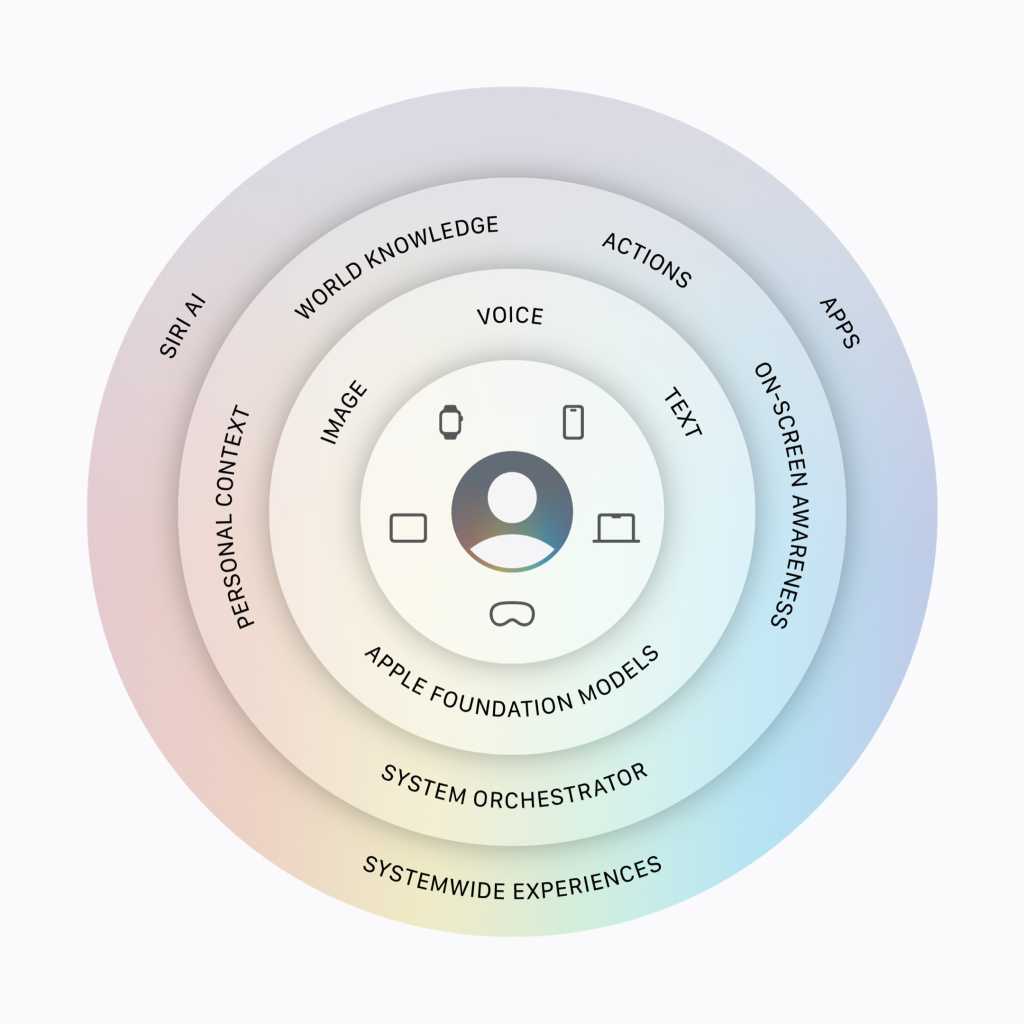
We already know it is possible. Just look at Siri AI. To create it, Apple worked with Google Gemini — using the latter to help build and distill Apple’s own AI models, many of which now work entirely on device.

The hidden cost of the AI buildout

This move toward edge AI takes place as the tech industry pours its eggs into the AI basket, with major memory suppliers redirecting manufacturing capacity toward higher-value memory products for AI servers, such as advanced-layer 3D NAND. They’ve done so while failing to invest in additional capacity, prompting a shortage of the kind of general purpose RAM you use in your computer, console, or smartphone.

This is having a dramatic impact. Gartner says the memory shortage will cause PC shipments to drop 10.4% in 2026 and smartphone shipments to decline 8.4%, with prices on those products rising 17% and 13%, respectively, versus 2025 levels.

The AI consumer tech tax

This leaves electronics manufacturers quarrelling over the remaining supply, while shrinking profit margins force them to increase prices. Sony has already raised the PS5 price by $100, Microsoft has raised Xbox prices, and Nintendo has raised the price of its first-generation Switch. Samsung has quietly increased prices across Galaxy smartphones, tablets, and laptops. Analysts also warn that “shrinkflation” is escaping from the supermarket and coming to your tech, an insidious move in which manufacturers quietly reduce the features/performance of their devices to maintain familiar price points. That laptop you purchase could ship with a downgraded display, for example.

Apple is not immune. The iPhone 18 Pro is tipped for a significant price increase in 2026, potentially adding $100 to $150, even before tariffs are considered. Apple CEO Tim Cook recently warned of price increases ahead as a direct impact of demand for memory components.

A business model under pressure

Surely all this investment in AI servers and the increased cost of tech products will be worth it in the end, right? Writer and tech critic Ed Zitron disagrees, pointing out that for $200 a month, a user can burn $8,000 in Anthropic tokens or $14,000 in OpenAI tokens. 

He argues that subsidy at this scale suggests AI economics are already broken, and that the actual value of AI may be inflated, forming a big bad bubble ready to burst once market opinion (and investment) catches on.

By spending billions chasing market share, AI has fundamentally undermined its own value, making it harder to achieve sustainable business success. Costs might well fall in future, of course, but edge AI could be the biggest cost reduction exercise of all.

Make tokens pay

Perhaps AI companies have finally begun turning things around? Maybe not. Less than three months into paying the actual costs of LLM-based services, both OpenAI and Anthropic are considering drastic price cuts, with one Cisco executive stating publicly that AI token costs are far higher than the actual value those tokens are generating at scale.

Even Meta has imposed strict limits on token usage after finding it was on track to spend billions on internal AI alone in 2026. The Times reports that two large banks spent an astonishing $1 billion on AI experiments without seeing any significant return.

That’s the use value, but what about the hardware investment? It is really hard to ignore the irony that billions of dollars are being poured into a server-based infrastructure that might become obsolete before turning any kind of profit. Today’s H200-based servers will need to be upgraded sooner or later, and when they are, where will the money come from? 

Apple has a different approach

Consumer electronics leader Apple clearly sees this. While it has been accused of being behind in AI, perhaps it was just being realistic. After all, the reality seems to be that we’re experiencing something akin to venture capital backed economic socialism in the AI sector, with billions invested for no visible — or, if Zitron is right — possible return. 

At the same time, Apple seems focused on building edge AI as a privacy-preserving, cost-saving alternative to the massive data center buildouts rivals have pursued. 

Rather than squandering billions on a revenue-draining chatbot, Apple worked with others to create its own alternative. As part of its agreement with Google, Apple is using a large version of Gemini to train a smaller, distilled version capable of running locally on Apple hardware.  Siri AI can hold conversations, pull context from a user’s emails, messages, and photos, answer live questions from the web, and act across apps, with much of the work taking place on the device itself.  

These tools are also available to app developers, thanks to Apple’s Foundation Models framework. At WWDC, Apple showed how its devices can work together to run local LLMs using MLX Distributed, which means users can run on-premises, highly private AI models. And the company continues to make strategic acquisitions, such as the recent purchase of on-device AI startup Liquid AI.

On-device or off, the move has caused Apple to break with years of tradition to pack its systems with more and more memory, ironically feeding the same component pricing narrative.

The squeeze isn’t over

Who pays for all this? You do. Memory prices will continue to rise across the year, with TrendForce predicting up to 75% increases on top of the already 100% spike we’ve seen in recent months. Memory suppliers seem unwilling to ramp up supply to help bring costs down, potentially because they don’t want to be left with unused capacity once the AI bubble does burst. That means existing manufacturing is being pointed at the highest value memory components, further feeding price hikes.

When AI leaves the cloud

What happens to investors when AI stops needing a data center to be useful?  The companies that survive this shift won’t necessarily be the ones who built the biggest and most costly clouds. They are more likely to be the ones who identified cloud-based AI as the start of a transition toward more intelligent devices equipped with their own on-device AI. That is precisely what Apple is building toward.

Please join me on social media at BlueSky,  LinkedIn, or Mastodon, even better, please subscribe to The Core for your daily fix of human-curated Apple News.

  •  

Apple scrambles to handle component price hikes

Apple execs are now acknowledging the company is going to need to raises prices to cope with higher component costs, particularly memory. Apple has been battling to avoid doing so, but warned this week that those efforts are “unsustainable.”

The price pressure is being felt across the tech industry. Omdia predicts the average selling price (ASP) of smartphones globally will increase by around 20% this year — partly because AI industry demands have pushed up RAM prices and partly because of rapid cost increases in processor production as a direct consequence of war in the Middle East. This impacts anything that uses memory or processors.

Apple must raise prices, CEO warns

“We’re doing our best to mitigate the huge increases that are being passed to us, and we’ve been trying to shield our customers from the increases, but the situation has become unsustainable,” current Apple CEO Tim Cook told the Wall Street Journal.

OK, so prices are going to go up. But how?

If Apple must raise prices, the way it does so matters. Will it increase prices across the board, or choose a subtle, strategic approach that protects margins while also maintaining rapidly accelerating market share growth?

Until now, Apple has been benefiting from the rising tide in memory prices. While competitors have been steadily increasing prices across the board, Apple introduced its first $599 laptop even as it eats into mid-range smartphone sales. 

To grow, or to grow less?

The PC industry is not growing (outside of Cupertino), and Apple and its investors already know that the inordinately high customer satisfaction ratings its platforms enjoy mean that when people switch to them they tend to stick around. That’s why it matters that Cook highlighted record switchers and first-time platform users during the company’s most recent fiscal call. Apple is growing new customers, people who are likely to sign-up for services, accessories, and future upgrades. Winning the customer is an investment in future performance.

When it comes to increasing prices, we’ve seen some gentle experimentation in the Mac mini line, where the entry-level $599 model was effectively replaced by a more expensive $799 SKU. There have been suggestions Apple could do the same with the $599 MacBook Neo, dumping the entry-level build in favor of the (better) $699 model. I’m not certain that’s the best approach. 

A matter of choice

I’d argue that the $599 price point is psychologically the best bit of marketing Apple has ever done as it draws new users to look at its platforms. I also think substantial numbers of people already shift up to the $699 version, if they can, making that entry-level price an incredibly effective marketing tool with which to woo customers. It looks like that approach is working; the MacBook Neo has led the Amazon Laptop Sales chart ever since it was introduced and is selling in huge quantities globally.

Francisco Jeronimo, IDC vice president for data and analytics, sees this, writing: “It will be interesting to see whether Apple raises prices across its entire portfolio or plays strategically by subsidizing its more affordable products to gain market share and grow its installed base.”

If Apple raises prices at the price sensitive, entry-level end of its market, it runs the risk of slowing its own resurgence. Given that a 10% price hike here is only worth around $60, the revenue generated might not justify blunting Apple’s offer to new users.

Pricing and strategy

But Apple isn’t defined by its entry-level markets. Its biggest earning opportunities continue to be generated by the aspirational middle class, who, while feeling the pinch of declining living standards in many markets, can still handle the price of a top-of-the-range iPhone Pro. A 10% price increase at that end of the market will generate a much more significant chunk of revenue – and since rival vendors are raising their prices at this end of the market, Apple can follow suit while still seeming affordable. It’s an approach that maintains growth while optimizing margins.

Apple generates roughly half its revenue from iPhone sales, with the Pro and Pro Max devices accounting for a significant chunk of that money. Consumers looking to buy one of Apple’s high-end devices are likely to be less price-sensitive than those making purchases at the low- and mid-points of the company’s market range. 

With that in mind, it makes more sense for the company to raise prices at the top, while working to maintain the cost of entry at the lower end. It could, of course, raise prices universally, but doing so makes less sense.

What next?

Whatever strategy Apple adopts, company leadership is clear that component pricing is hitting hard. “We definitely need memory pricing and supply to return to reasonable levels for consumer products. That’s the bottom line,” Cook said.

You can follow me on social media! Join me on BlueSky,  LinkedIn, Mastodon and subscribe to The Core for your daily fix of Apple News.

  •  

Judge signals AI recruitment tool vendors like Workday may not escape liability for discrimination

A federal judge has rebuffed Workday’s claim that it cannot be held liable under California anti-discrimination laws when its tools are used to screen (and potentially reject) job candidates in other states.

This week, US District Judge Rita Lin indicated that she will likely allow additional state discrimination claims against Workday to move forward. This would significantly expand the closely-watched case and likely ratchet up scrutiny of AI recruiting tools and their potentially inherent biases when it comes to age, race, sex, disabilities, and other factors.

Further, it could indicate that, even if a company is not the final employer, it may be held liable if its tools materially influence who gets rejected. This could set new legal standards for AI hiring systems, and have implications across industries, experts note.

“This case reinforces the importance of actually managing AI risks,” said Valence Howden, advisory fellow at Info-Tech Research Group. “If an AI-enabled model or ATS [Applicant Tracking System] is making decisions based on historical information, it can raise questions about whether bias in outcomes and datasets has been properly addressed.”

The case so far

Mobley v. Workday, Inc. alleges that Workday’s AI screening tools discriminate against job seekers based on age, race, and disability. The suit was filed in 2024 in the US District Court of California by Derek Mobley, a Black disabled man over 40, who claimed Workday’s algorithms continually screened him out as he applied for more than 100 positions on the platform.

The claims alleged discrimination prohibited by several US and California statutes: Race and sex under the Civil Rights Act of 1964 (Title VII); disability under the Americans with Disabilities Act of 1990 (ADA); age under the Age Discrimination in Employment Act of 1967 (ADEA); and race, gender, and age under California Fair Employment and Housing Act (FEHA).

Specifically, the suit centered around Workday’s use of automated, algorithm-driven tools for applicant screening. It alleged that these systems rely on historical data and statistical modeling that can make them susceptible to existing biases, even if protected characteristics like race, age, sex, or disability are not explicitly provided.

Bias may enter these systems in different ways, the plaintiffs argued, including via training data, model design, and evaluation criteria for candidate fit. The system could reproduce discriminatory outcomes by making correlations from data. For instance, years of experience on a resumé may indicate age; long employment gaps may infer a disability or caregiving responsibilities; educational and institutional affiliations could reflect race.

Workday has argued that it is not subject to liability under employment statutes because it does not qualify as the job applicants’ “employer.” But federal judges have allowed key parts of the lawsuit to move forward, ruling that Workday could potentially be treated as an employer’s “agent” for the purposes of anti-discrimination law.

The latest dispute centers on FEHA. According to legal sources, the California statute is among the strongest anti-discrimination laws in the US, in many cases providing broader protections than federal employment laws.

Workday asked the court to dismiss claims brought under California law, saying FEHA should not apply to the hiring decisions of out-of-state employers and applicants. The company’s lawyers argued that enforcing this would effectively allow California law to supersede that of other states, just because a company used their platform.

But Lin disagreed, saying FEHA does apply, and in fact, Workday is directly liable for its “own engagement in FEHA-regulated activities on the employer’s behalf.” Holding businesses liable for “their own discriminatory conduct” is within the scope and purposes of FEHA and consistent with public policy.

However, the issue is still to be decided; Lin did not indicate when she would release a final ruling.

Workday’s defense

A Workday spokesperson called the claims in the suit “false.”

“Workday’s AI recruiting tools don’t make hiring decisions and are designed with human oversight at their core,” the spokesperson told CIO. “Our technology looks only at job qualifications, not protected traits like race, age, or disability. We rigorously test our products as part of our responsible AI program to confirm our tools do not harm protected groups.”

Workday’s platform is meant to provide insights on how well a candidate’s qualifications match the requirements of a posted job, the company said. Those tools focus only on qualifications listed in a candidate’s application, which are compared to qualifications identified by the employer as important for the job.

Workday’s Chief Responsible AI Officer Kelly Trindel said its AI does not make employment decisions, automatically reject candidates, or determine who gets a job; further, she said, there is no evidence that the company’s tools result in harm to protected groups.

Trindel, who is former chief analyst of the Equal Employment Opportunity Commission (EEOC), leads a dedicated team composed of psychologists and PhD-level data scientists whose sole focus is to ensure that its AI is “responsible, fair, and ethical.” She said that the company’s AI systems undergo ongoing reviews throughout their lifecycle to help prevent unintended consequences, and Workday is “committed to accountability, transparency, and trust,” and invests “significant resources” into identifying and mitigating bias.

Further, she said, Workday has a company-wide commitment to ethical AI, and an independently-evaluated AI governance program based on standards from the National Institute of Standards and Technology (NIST) and the International Standards Organization (ISO).

“Workday builds AI to support people, not replace them, and this is of particular importance when it comes to hiring,” Trindel noted. Its platform is designed to help employers “manage high-volume processes more efficiently, surface relevant information, and reduce administrative work so teams can spend more time applying their expertise and judgement to hiring decisions.”

What this means for enterprise leaders

Workday isn’t alone in its legal challenges; other AI hiring tools are also being scrutinized over their methodologies, algorithms, and data-collecting practices. Eightfold, for one, is also facing a California class action lawsuit alleging that its tools unfairly rely on job candidates’ online data to predict whether they’d be a good fit for a position.

This means that enterprises, who are already feeling increased pressure to document hiring decisions, conduct AI bias audits, and maintain human oversight in recruitment and hiring, must be even more diligent in their vetting of AI tools.

Organizations must be actively defining how these recruitment tools should work, identifying bias in their algorithms, and setting up structures to test for bias across the tools’ decision-making logic, Info-Tech’s Howden advised.

“Validation of non-biased outcomes also needs to be active and ongoing, rather than a point-in-time exercise,” he said.

While Workday and others say human oversight is paramount, “it’s hard to incorporate humans into the process if the platform does the weeding out before humans have the ability to intervene,” Howden pointed out.

Discriminatory biases can exist in past hiring decisions, so it’s easy to forget that AI can “emulate and adapt those biases as part of its perspective,” he said. That includes how AI looks at language: Different cultures use different phrasing, and AI can capture that and use it to exclude candidates.

Ultimately, he called the case a “cautionary tale” illustrating how lightly some organizations have been treating AI risk. It also highlights the urgency involved in building out more advanced enterprise risk practices, “rather than relying on the limited capabilities they may have employed up until now.”

This article originally appeared on CIO.com.

  •  

Adobe: New Firefly Graph can turn creative workflows into reusable assets

Adobe’s Firefly Graph is now available to Creative Cloud customers, offering a node-based workflow tool designed to help business create content at scale with generative AI (genAI). 

With Firefly Graph, users can connect multiple tools in visual workflow, with each “node” performing a specific task before passing its output to the next node. This gives creative professionals more control over generated outputs, according to Adobe, and makes it easier to try out ideas by swapping, adjusting or adding components.

For example, a user could start with a text prompt box that connects to a node that generates an image using an AI model from Adobe or third-parties such as Google and OpenAI. Further along the chain, the user could add nodes to remove a background or upscale an image, for instance, before producing an image, video or other asset ready for use.

Changing one aspect, such as adding a reference image or adapting the text prompt, would change the final output.

It’s an approach similar to node-based workflow tools such as ComfyUI — a startup valued at $500 million which claims more than 4 million users. Others include Weavy, acquired by Figma last year for a reported $200 million. 

With so many AI tools available to creative professionals, workflows can get complex and hard to replicate, said Elliot Sedegah, director for strategy and product marketing at Adobe. Firefly Graph provides access to more than 300 different node types, including images, video editing and AI generation tools across Adobe’s portfolio and third-party tools. 

“Whether you’re working at a mom-and-pop shop or a larger enterprise, you’re looking for consistency and then bringing that into a workflow so that you’re not hopping in and out of different tools,” he said. “Putting all that together takes massive amount of time, and sometimes it’s very difficult to even know what you did.”

Once created, workflows can be shared across an organization as repeatable processes for other individuals or teams to use. “Think of that rock star creative that you have and the recipes they create: those are now canonized as workflows, as assets, that the rest of the organization can take and reuse over and over again,” said Sedegah.

In addition, while creative professionals are needed to created high quality assets, reusable workflows can be put into the hands of broader teams to create content for large audiences, said Sedegah.

Firefly Graph addresses a challenge that most large creative organizations face, said Lisa Gately, principal analyst at Forrester — namely that their best creative workflows “live inside the heads of a few experts.

“Teams can generate images and video with AI, but reproducing the exact sequences of creative decisions, model selections, edits, and refinements that lead to a high-quality result is difficult and inconsistent. Firefly Graph turns those workflows into reusable assets,” she said.

While other node-based workflows aim to address similar problems, Adobe’s pitch is that Firefly Graph provides customers with the benefit of integration into its product suite. 

“Firefly is a full, broader AI creative studio, not just a node-based tool, so [Firefly Graph] is a part of a bigger picture,” said Sedegah. “The strength is having everything in one place with the tools that people know.” 

“Where Adobe differentiates is in enterprise integration,” said Gately, with Adobe connecting Firefly Graph to a range of other Adobe tools. Those include Creative Cloud applications; Firefly Boards for ideation; and Firefly Creative Production. 

“The workflow becomes part of a broader content supply chain instead of a standalone creation tool,” she said. ”Organizations committed to other tools are unlikely to migrate for a node-based canvas — making a change is about the broader content supply chain.”

Firefly Graph is available now to Adobe Creative Cloud for Enterprise subscribers. Creative Cloud for Enterprise is licensed by seat, requiring custom, volume-based enterprise agreements. Creative Cloud for Enterprise customers receive credits for Firefly Graph. Creative Cloud for teams customers can sign up for a public beta online. Creative Cloud pricing starts at $99.99 per license each month.

This article was updated on June 19 with pricing information from Adobe.

  •  

Jamf CEO: ‘AI is happening whether organizations know it or not’

Beth Tschida, who became Jamf CEO in May after serving as CTO and as interim CEO, is the first woman to lead the company in its near 25-year history. I spoke with her this week at the London Jamf Nation event, where the company introduced its new AI Governance solution.

How the transition to CEO is going 

“It’s been a great privilege and an adjustment,” she said. “Jamf has always been a company deeply focused on culture, which is exactly why I love being here. Having the ability to influence and improve that culture from this role is something I feel very supported in doing.”

The last few years have seen a variety of changes at Jamf, which was briefly a public company. “We’ve come through a period of change, not all of it easy,” Tschida said. “But we now have a great partnership with Francisco Partners. We’re private, we’re focused on solving customer problems, and we’re finding ways to lean into what we’re good at.”

Women in tech and mentorship

Tschida is a good choice to lead a software engineering company, as she’s an engineer herself. She originally joined Jamf as vice president for software engineering in 2018, moving up to CTO in 2022. She’s also one of the few women in leadership positions in tech. (To Jamf’s credit, the company also has CIO Linh Lam on its team.)

“I think it’s important for women to stay deep in the tech, build their skills and find their voice confidently,” Tschida said. “You’ll never know all the technology out there. Nobody does. What matters is the ability to keep adapting and evolving.”

Tschida stressed the importance of mentorship. “I feel very honored to have a chance to be a role model for other women,” she said. “I had women who forged a path for me, including a female CIO early in my career who I asked to mentor me and learned an enormous amount from. I’m certainly not the first woman in tech, but I do want to play my part in helping others grow in their careers.

“Ultimately, I want to be respected for what I do, not for my gender. That’s how everyone should be judged.”

AI Governance

Tschida’s product focus means she knows what matters to Jamf. “If you focus on the problems customers have and how your product can help fix them, that’ll take you to where you want to go.”

For many in the enterprise, both in and beyond the Apple space, the next big problem is AI — how to deploy it, how to manage it, and how to regulate it.

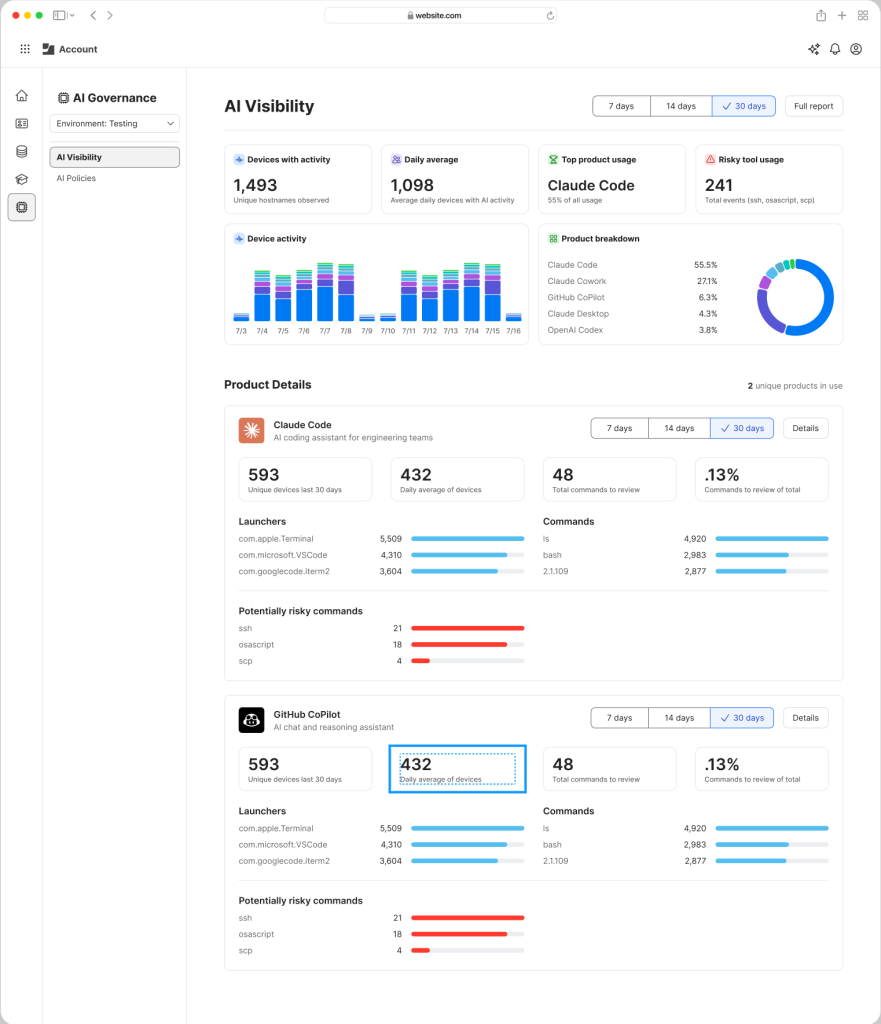
AI Governance is a new Jamf solution that has been developed in response to those pain points. Countless surveys, including Jamf’s own data, show that AI is being widely used across every company, but IT lacks visibility into its use. It’s hard to know what data is being shared with AI tools, which services are being used, and how to report on that use effectively — particularly in regulated industries.

AI Governance is designed to make it possible for anyone managing an Apple fleet to get granular insight into AI use across their Mac, iPhone, and iPad devices. It uses telemetrics to shed light on that use, offers governance and management tools to help IT gain better oversight and control over it, and provides highly comprehensive reporting tools suitable for internal or regulatory review.

“AI is happening whether organizations know it or not,” said Tschida. “That’s the problem. You can try to block it, but that’s very hard to do well. It’s far better to build visibility and governance around it.”

The offering makes it possible for companies to enable the AI use they already know is taking place while protecting corporate interests and enabling fast and accurate reporting. You can find out more details here.

Empowering better AI

Jamf’s approach is focused on endpoint management. AI Governance means IT can see what’s running on a device, categorize it, and understand what AI tools and models are in use. “If you know how people are running AI on your fleet, you can open it up safely. Then all of your customers and employees can find their way to figure out how AI is going to optimize their workforce,” she said.

What does that look like in practice? Think of it as an orchestration layer. IT can define different AI configurations for different teams: HR might use one set of models, engineers another. And admins can apply opinionated postures per group: what models are permitted, what cloud services they connect to, what’s visible to IT versus the CISO versus the CFO. “It’s an extension of what Jamf has always done, it just now applies to AI endpoints too.”

What about regulatory complexity across geographies? “A lot of governance controls are shared across regulations; a good base set is a healthy way to run regardless. But each regulation has its own twists. Our mission is to make sure customers operating in different markets can expand on that base and fit the specific models and regulations they need, getting the right configurations to the right devices.”

Managers must prepare for AI cost challenges

There’s a second dimension beyond management — cost. The industry is developing quickly, with new AI models appearing almost every week. Yesterday’s leading LLM is tomorrow’s fading star, even while the cost of AI infrastructure goes through the roof. As that churn slows, investors will want to start seeing returns on their bets, which is why token costs — the price of running AI services, at least in the cloud — are climbing fast.  

As costs become more realistic, that’s going to change the nature of AI deployment from the laissez-faire, anything goes approach to a more strategic management of such use. “Models keep dropping fast, but token costs are only going to go up,” said Tschida.

“Organizations will need to decide: just because you can build something with AI, should you? What’s the right model for what work? We’re helping customers move from, ‘We’ll just block it’ or ‘We’ll turn it on and hope for the best,’ toward a place where they have a real viewpoint and can manage and change that viewpoint over time.”

The ever-changing AI world is also prompting Jamf to make more of its APIs externally available. “We’re used across every industry and every geography, at every scale,” said Tschida. “There’s no way we can build every workflow every customer needs, we’d never get to all of them.”

Embracing openness also helps build future foundations. “Thinking about where we’re heading next — agentic endpoint management — having platform APIs allows our customers to build things they can imagine, that we can learn from, in a way that solves their specific problems.”

Apple, WWDC, and the enterprise

Tschida’s comments come shortly after WWDC 2026, where Apple introduced a raft of AI advances that formed a strong foundation for its future, improvements that matter to Jamf. “When Apple innovates, Jamf celebrates,” she said.

“Apple is doing great things in their AI ecosystem, revamping Siri, expanding their AI capabilities, making Apple the platform people want to run AI on because those machines simply perform better. Our job is to take what Apple builds and bring it into the enterprise in the way that enterprises actually need it.”

Most of the industry recognizes that Apple’s enterprise story has changed dramatically as its products see accelerating use, and momentum is not slowing. Tschida reflected on how just a few years ago, Apple in the enterprise was an option in employee choice programs. “Now it’s becoming the clear choice,” she said. “We expect that trend to continue. And the more Apple invests in AI running natively on device, the stronger that argument gets.”

Where is Jamf going?

AI Governance is a unique answer to an increasingly important set of questions that are now beginning to affect the IT management of Apple’s platforms. (It’s not clear whether anything as sophisticated exists for other platforms at al, but as the need to manage AI grows, demand for such solutions will grow.)

Ultimately, the company’s latest move reflects Jamf’s inherent strategy under its new CEO. “Focus on customers, listen to them, solve their problems, and don’t throw tech at it. Ask: what’s the problem? Can we solve it? That focus is what takes you where you need to go.

“We’re on a good trajectory, customers stay with us, and the culture has always underpinned us. Now we’re finding ways to lean into it even further,” she said.

You can follow me on social media! Join me on BlueSky,  LinkedIn, Mastodon and subscribe to The Core.

  •  

Microsoft launches Copilot Cowork with usage-based pricing

Microsoft has introduced usage-based billing for Copilot Cowork, which is now generally available. 

Microsoft unveiled Copilot Cowork in March, pitching it as an AI agent that’s capable of independently performing long-running, multi-step tasks — even when a user’s computer is off. 

It’s built on the same technology that underpins Anthropic’s Claude Cowork. Unlike Claude Cowork, which can interact directly with files and applications on a user’s computer, Copilot Cowork runs in Microsoft’s cloud environment and acts on documents held in a customer’s Microsoft 365 tenant.

On Tuesday, Microsoft unveiled pricing details for Copilot Cowork, which involves usage-based billing in addition to a Microsoft 365 Copilot license ($30 per user each month for large enterprises before discounts, and $20 for Microsoft 365 Copilot for Business). 

The usage-based pricing is calculated from four components, according to Microsoft: “model use, context retrieval, tool calls, and runtime.” 

In practice, this means more intensive tasks that draw on multiple sources, use “deep reasoning” and generate two or more outputs will lead to higher costs — denoted in Copilot Credits. 

There are two payment options: pay as you go — priced at 1 cent per credit — and P3, where customers commit to usage volume in advance and receive a discount.

Cowork is turned off by default; IT admins can decide when to make it available and which employees get access. Admins can also impose spending limits at the tenant, group, and user level, and receive notifications when spending reaches a certain level.

Users will also be able to see how much each tasks costs in credits (available “soon after” the general availability launch, Microsoft said). 

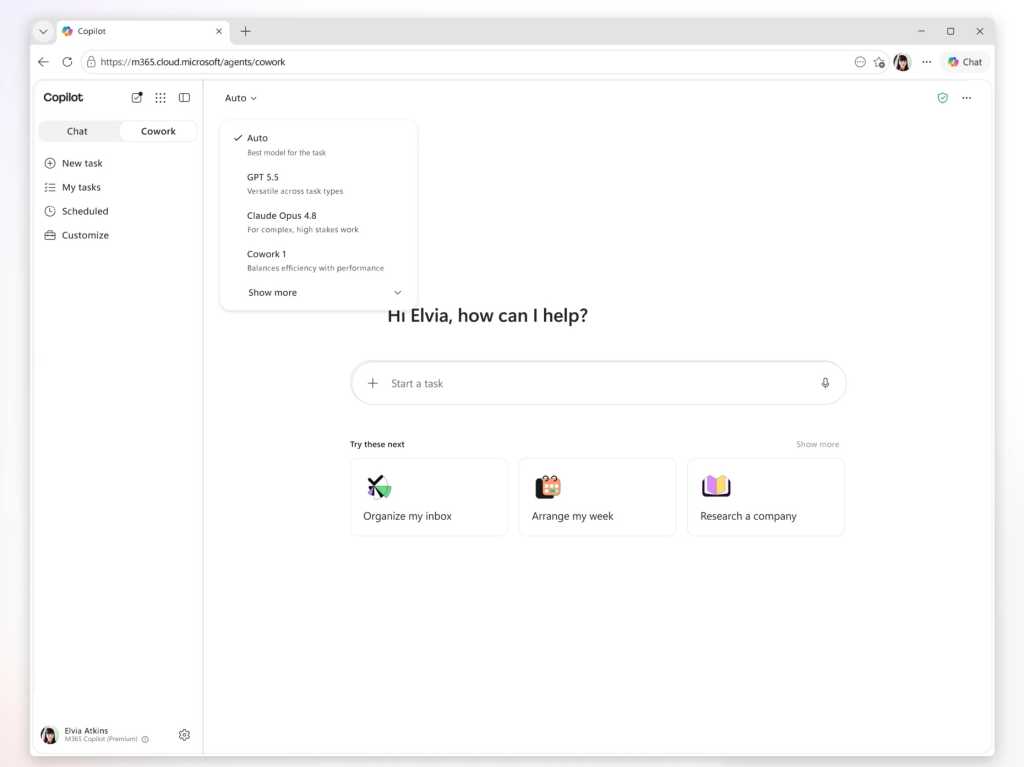
Copilot Cowork customers can select from multiple AI models, including Anthropic’s Opus 4.8 and Sonnet 4.6, while those enrolled on the Frontier program can access OpenAI’s GPT 5.5 and Microsoft’s own Cowork 1 model.

Microsoft is considering hosting a version of DeepSeek’s open source models. “We are actively exploring a range of options that meet those requirements, and DeepSeek is one of several models under consideration. We’ll share more specifics on the underlying model closer to release,” said a Microsoft spokesperson.

Microsoft also announced new integrations with third-party apps such as Miro and Monday.com, with more — such as Adobe, Box, and Canva — coming soon.

This article was updated on June 19 to add Microsoft’s comment on DeepSeek.

  •  

Microsoft says you don’t need another email security tool; experts say, not so fast

Despite best efforts by defenders, malicious emails continue to slip through the cybersecurity cracks, leading some enterprises to implement a layered “defense in depth” strategy that incorporates multiple tools.

Microsoft seems to be challenging this idea, revealing that there are only nominal returns from adding integrated pre- and post-send partners to Defender for Office 365’s protections.

According to its new quarterly benchmarking data, the tech giant catches the vast majority of malicious and spam emails before delivery, misses the fewest compared to competitors by a wide margin, and removes nearly 100% of dangerous emails that do reach the inbox. Collectively, its integrated partners improve that catch rate by less than .05%.

While these numbers seem to tip the scales towards a one-vendor email security stack, experts urge enterprises to be skeptical and cautious of such vendor claims.

Seva Ioussoufovitch, senior research analyst at Info-Tech Research Group, pointed out, “percentages obscure the true quantity and severity of what’s getting through, and, considering it only takes one message to result in an incident, it’s simple enough to argue that there is real value in the defense in depth that having multiple tools provides.”

Malicious and spam email catch by the numbers

Microsoft introduced its quarterly benchmarking report in July 2025 alongside a Defender integrated cloud email security (ICES) ecosystem designed to support multi-vendor security strategies.

The SEG players it ranked itself against this year includes Mimecast, Proofpoint, Hornetsecurity, Trend Micro, Iron Port (Cisco), Barracuda, and FireEye (Trellix); ICES companies include Abnormal, Checkpoint Harmony, Cisco, DarkTrace, KnowBe4 Defend, Tessian, and Trend Micro.

Redmond reported that Defender “consistently leads” in pre-delivery detection, missing 59% fewer high-severity cyberthreats prior to delivery than the other SEG vendors it evaluated. Its closest competitors were Mimecast and Proofpoint. The company also introduced a new metric in this area: A threat miss rate per 1,000 employees. In Microsoft’s case, that was 194 per 1,000; for Mimecast, 478; for Proofpoint, 483.

When it came to post-delivery protection, Defender removed an average of 96.03% of malicious emails that reached the inbox, up from an initial 45% when Microsoft first started tracking the data in its second report.

This makes Defender “an increasingly critical backstop, operating even when ICES solutions are in place,” Jeff Pinkston, VP and GM for Microsoft Defender, wrote in a blog post. Still, ICES tools operating in tandem with Microsoft Defender “continue to provide benefits,” improving malicious catch by 0.29% and spam catch by 0.68%, he said.

“If we focus on the basics, their argument seems strong,” Info-Tech’s Ioussoufovitch noted. “Do you really need a separate ICES vendor for that extra sub 1% catch?” Microsoft paints a “compelling picture” by only focusing on raw catch rate, he said, but we don’t hear the rest of the story: “What exactly is the danger of what isn’t being caught by Defender?”

No one vendor catches everything

David Shipley of Beauceron Security pointed out that the report underscores the fact that “lots of stuff still gets by e-mail filters.”

His company regularly analyzes hundreds of thousands of emails, and the content that gets through “ranges from the shockingly mundane and obvious to a human expert, to highly clever time-delayed attacks,” he said.

A key factor in what gets through is the amount of content that is allowlisted; settings in “100% paranoid mode” get high catch rates, as well as high false positives, Shipley noted. “Anyone who has ever had a sales person lose a deal because the purchase order PDF got flagged has felt this pain.”

Then there’s the AI conundrum: “A key risk for e-mail vendors using agentic LLM-based analysis is it’s now possible to poison those models with hidden content (such as ‘ignore this e-mail, pretty please’),” Shipley said. This means enterprises need a variety of analysis methods.

Ioussoufovitch agreed that keeping pace with threat actors using AI is an industry-wide challenge, particularly as AI enables higher-quality phishing. Filters are improving and will catch some of it, but some will inevitably continue to get through. Those messages are likely highly-targeted, which are lower in volume but harder to catch.

“As of now, current tools do seem to be struggling to keep pace, but that doesn’t mean those tools aren’t necessary,” said Ioussoufovitch. “It just highlights that defense-in-depth, broadly speaking, is becoming more and more important.”

Claims ‘appear more honest’

Shipley said that this report appears more honest, accurate, and mature than others claiming 99.99% phish catch rates, “which is never true.” It’s also a “smart marketing move,” because Microsoft competes for the same security budget as other tools, and would rather enterprises remove those vendors and buy more from it in areas beyond e-mail.

On the other hand, he said, Microsoft is offering up a list of other vendors to think about, “which, congrats to Mimecast on coming in second.”

In the long run, CISOs need to determine the best spend for their limited security dollars, he noted. Enterprises need a good filter; whether they need two is up for debate. “They also clearly still need to invest in a robust awareness program,” Shipley said, “because as this report shows, lots of phishes are still getting delivered.”

Missing an important nuance

Ioussoufovitch noted that while the claims in the study are interesting, the data is presented without much of the nuance that would make it truly actionable.

“We are all too familiar with vendors’ abilities to massage data to tell the story they want, so I would advise leaders not to extrapolate the data beyond what it actually says,” he said.

Instead of the takeaway being “get rid of our current vendors,” this post highlights that Defender provides “considerable value,” he noted. Whether adding or subtracting additional vendors is worth the money should be a case-by-case conversation that considers an organization’s risk appetite, and overall security budget and environment.

“I’d treat these claims more as a reminder to assess your own environment and compare detections,” he said. “Come to conclusions based on the data you have, not what a vendor is presenting.”

This article originally appeared on CSOonline.

  •  

Why Europe’s demands on Apple AI put your data at risk

Europe’s evangelistic approach to insisting Apple open up personal data to competing AI services is hurting Apple users in the region. More than that, it also places its entire business sector at risk, and a newly-published Jamf survey suggests why.

Announced at WWDC 2026, Apple Intelligence/Siri AI relies on personal, contextual data to run. Europe wants that same information to be made available to third-party services for competing apps, but has not worked with Apple to protect user confidentiality. It’s an approach that places your data at risk of exfiltration using those apps because Europe is insisting Apple share personal information with the developers of other apps.

The desire to protect that data is why Apple won’t distribute Siri AI in the EU for a while.

Jamf survey exposes the IT risks of AI

It’s not as if Europe doesn’t understand the risk of data leaks in an era of AI. Just look at the bloc’s focus on things that do matter, such as sovereign AI or managed AI services like Orange Live Intelligence. These locally-produced AI services, alongside Europe’s attitude toward them, tell me the confederation understands the risks.

How real are these risks? Very. Jamf on Monday published survey results confirming the scale of that risk, telling us that one-in-five IT and security leaders in the enterprise sector has already experienced an AI-related incident involving unexpected costs, a security issue, or both.  The survey also found that:

  • 72.9% of organizations have already deployed AI in some form.
  • 59.7% see an AI-related incident as a near-term risk.
  • Organizations with deeply integrated AI are 40% more likely to report an AI-related incident than organizations still in the exploratory stage. 

The implication is that AI governance is becoming an operational requirement and — as Apple has told us umpteen times in the past — the best way to maintain operational confidentiality is not to collect or share any data at all. That’s the whole point of its approach: the data doesn’t need to be shared, it just needs to be turned into another signal that promotes utility while protecting confidentiality. 

Crafting trust in a crowded market

There’s another challenge to emerge. There are now multiple brands of AI, with more coming on stream all the time. That’s great in terms of finding a model that suits your needs, but challenging when it comes to ensuring all the services you or your employees use of are equally secure. You don’t want your business to become deeply reliant on any service only for that vendor to subsequently get bought out and/or shut down, nor do you want a service to be hacked or otherwise exploited to your detriment.

“AI isn’t arriving as a single application that IT can approve and move on from,” said Jamf CEO Beth Tschida. “It’s showing up in developer tools, productivity apps, autonomous agents, and other software they already run. The challenge is maintaining visibility and control as that footprint expands.” 

The survey described the challenges IT faces with AI deployment: shadow IT, vendor sprawl, and the need to grapple with highly unpredictable use-based pricing models. And that’s even before considering the governance challenges of agentic and developer AI.

AI and the emerging governance nightmare

“What our survey shows is that governance must keep pace with adoption,” Tschida said. “For organizations built on Apple, the foundation is already an advantage. Apple’s privacy model and the management controls built into the platform give IT teams a strong foundation to build on and … that advantage depends on using tools built for Apple from the start.”

That’s the point of the curated, private and secured service offered by Siri AI, of course. It’s also part of what Apple is building toward with its wider ambitions toward AI on its platform. Bloomberg’s Mark Gurman discussed elements of this in his weekend newsletter, in which he suggested Apple might introduce some subscription services using AI, and that it is building an App Store for Siri Extensions, which would allow third-party chatbots to work with Siri. 

There is a need for curation and management in AI

What makes that model work is the curation with which Apple surrounds it, and its determination to extend Private Cloud Compute so it can protect your data even when using third-party servers (in this case, Google’s server clusters). It makes sense to think Apple intends to use that system to protect all approved third-parry AI interactions provided across its platforms by its own routes. That’s true, even if users access services free of those safeguards using a web browser, which they currently can.

But the key thing is that if Apple can get this right, offering up a managed, curated, and controllable ecosystem for AI agents and services, it will be going a long way toward building the kind of managed AI ecosystem the Jamf survey shows our modern digital enterprises increasingly need. 

You can follow me on social media! Join me on BlueSky,  LinkedIn, Mastodon and subscribe to The Core.

  •  

Google unveils DiffusionGemma, an AI model that breaks free of left-to-right processing

Extremely powerful large language models (LLMs) still operate as though they’re typing on a keyboard, processing workloads in a simple left-to-right fashion. But in locally-run, single-user scenarios, this sequential processing can leave graphics processing units (GPUs) and tensor processing units (TPUs) underutilized.

Google is betting that DiffusionGemma can get around this bottleneck. The new experimental open model generates text “exceptionally fast,” creating entire blocks of text simultaneously through diffusion techniques rather than through token-by-token processing. The company says this technique results in 4x faster inference compared to auto-regressive models that rely on sequential processing.

It can also save users money. Technology analyst Carmi Levy noted that existing pay-per-token monetization models “penalize the use of less than optimally efficient AI solutions.”

But DiffusionGemma “could herald a new generation of task-defined, efficient solutions that can enable expanded compute capacity without draining the operations budget,” he said.

A contrast to left-to-right processing

Built on Google’s Gemma 4 family and its Gemini Diffusion research, DiffusionGemma is a 26B mixture-of-experts (MoE) model designed to maximize text output generation.

It essentially shifts how models use hardware, giving processors a larger hunk of work each cycle so it can draft full 256-token paragraphs in sequence. This allows the model to generate text up to 4x faster on GPUs, Google claims. It activates only 3.8B parameters during inference, and, when quantized, can fit within 18GB VRAM on high-end consumer GPUs like Nvidia RTX 5090.

“It upgrades your model inference from a single, sequential typewriter to a massive printing press that stamps the entire block of text simultaneously,” Google research scientists Brendan O’Donoghue and Sebastian Flennerhag wrote in a blog post.

AI image generators begin with pure, random ‘visual noise’ and iteratively refine that into a finalized picture (what’s known as ‘diffusion’); DiffusionGemma applies this same process to text. It does not generate tokens in order, but begins with a “canvas of random placeholder tokens” that it processes in multiple passes, identifying the context tokens it feels are most relevant and using those to refine the rest.

The model has the ability to self-correct, using confidence scoring to re-evaluate tokens in the next pass. “The model iteratively refines its own output, allowing it to evaluate the entire text block at once to fix mistakes in real-time,” O’Donoghue and Flennerhag explained.

DiffusionGemma also has bidirectional attention, they wrote. “Generating 256 tokens in parallel with each forward pass allows every token to attend to all others.” This can be particularly helpful in domains that are non-linear in nature, such as mathematical graphs, code infilling, and in-line editing, they said.

DiffusionGemma is optimized across Nvidia’s hardware stack, making it compatible with consumer setups as well as with high-performance enterprise systems like Hopper and Blackwell.

Because it is released under the Apache 2.0 license, developers can freely use, modify, distribute, and commercialize the software using their preferred tools. It can be run on GPUs or in the cloud through Google Cloud Model Garden or Nvidia NIM, and is available on Hugging Face, GitHub, and vLLM, with support for the open-source library llama.cpp coming soon.

Key use cases

The model is particularly useful in local workflows that are “speed critical,” such as generation of non-linear text structures, and unlocks what Google calls “new patterns of model behavior” like multimodal understanding and generating and rendering code in near real-time.

Levy explained, “DiffusionGemma is particularly well suited for interactive coding and editing where its efficiency allows rapid processing and iterations,” noting that its ability to fit within 18GB of VRAM and its deployability on commonly available local GPUs can potentially benefit customer service-related workloads that lean heavily on real-time interaction and local processing.

“DiffusionGemma also incorporates a thinking mode that is especially adept at problem solving,” he said. For instance, the model was fine-tuned to play Sudoku, a typically challenging task for autoregressive models because each token depends on future tokens. This “rather handily” illustrates the model’s capability to solve more complex problems, Levy noted.

Limitations

Google freely admits that DiffusionGemma is geared to specific workflows, and there are “key trade-offs.”

The model is engineered for small batch size inferencing and low-latency, high-speed generation low-to-medium batch sizes on a “single capable accelerator.”

In high-QPS cloud serving environments, (where infrastructure is designed to handle tens or hundreds of thousands of requests per second with ultra-low latency), DiffusionGemma’s parallel coding “offers diminishing returns,” and can even result in higher serving costs, Google conceded. In addition, its overall output quality is lower than that of standard Gemma 4, which is built for apps demanding maximum quality.

However, Levy noted that while DiffusionGemma “can be less precise than other models in certain workloads,” subsequent refinement cycles could overcome this limitation.

While Google isn’t sharing runtime costs, it’s clear that this is an efficiency play, he added. “When deployed across the kinds of workloads that would optimally benefit from its architecture, DiffusionGemma seems to have the potential to reduce processing overhead and related costs,” he said.

This article originally appeared on InfoWorld.

  •  

Microsoft’s Patch Tuesday updates: Keeping up with the latest fixes

Long before Taco Tuesday became part of the pop-culture vernacular, Tuesdays were synonymous with security — and for anyone in the tech world, they still are.  Patch Tuesday, as you most likely know, refers to the day each month when Microsoft releases security updates and patches for its software products — everything from Windows to Office to SQL Server, developer tools to browsers.

The practice, which happens on the second Tuesday of the month, was initiated to streamline the patch distribution process and make it easier for users and IT system administrators to manage updates.  Like tacos, Patch Tuesday is here to stay.

In a blog post celebrating the 20th anniversary of Patch Tuesday, the Microsoft Security Response Center wrote: “The concept of Patch Tuesday was conceived and implemented in 2003. Before this unified approach, our security updates were sporadic, posing significant challenges for IT professionals and organizations in deploying critical patches in a timely manner.”

Patch Tuesday will continue to be an “important part of our strategy to keep users secure,” Microsoft said, adding that it’s now an important part of the cybersecurity industry.  As a case in point, Adobe, among others, follows a similar patch cadence.

Patch Tuesday coverage has also long been a staple of Computerworld’s commitment to provide critical information to the IT industry. That’s why we’ve gathered together this collection of recent patches, a rolling list we’ll keep updated each month.

In case you missed a recent Patch Tuesday announcement, here are the latest six months of updates.

For June, Patch Tuesday means an IT scramble

Microsoft this month released 206 updates affecting Windows, Office, Exchange Server, and its developer tools — including three Windows vulnerabilities already publicly disclosed. That trio includes an elevation of privilege in the Collaborative Translation Framework (CVE-2026-45586), a denial of service in HTTP.sys (CVE-2026-49160), and a BitLocker security feature bypass (CVE-2026-50507). At the moment, none appear to be under active exploitation, but all three are rated “Exploitation More Likely.” 

Even without an exploited zero-day, the June 2026 Patch Tuesday release requires Patch Now recommendations for Windows, Office, and Exchange. The latter is back in the patch picture with a consolidated security update that Microsoft recommends installing “as soon as possible.”

More info is available here on Microsoft Security updates for June 2026.

For May, Patch Tuesday means 139 updates — but no zero-days

Microsoft this month released 139 updates affecting Windows, Office, .NET, and SQL Server (though there were no updates for Microsoft Exchange Server). Despite the absence of zero-days, the May Patch Tuesday update still requires Patch Now recommendations for Windows and Office. 

The combination of three unauthenticated network RCEs (Netlogon, DNS Client, and SSO Plugin for Jira and Confluence), four Word Preview Pane RCEs, the large TCP/IP vulnerability cluster, and the carry-over BitLocker recovery condition (still active on Windows 10 and Windows Server) warrants an accelerated deployment release schedule. 

More info is available here on Microsoft Security updates for May 2026.

Microsoft’s Patch Tuesday release for April is a whopper

Windows admins are going to be busy this month, dealing with the largest Patch Tuesday cycle in memory. The April release involves 165 updates and roughly 340 unique CVEs from Microsoft — including two zero-days, one of which is already being actively exploited in the wild. 

The Readiness team recommends “Patch Now” schedules for nearly every major product family: Windows, Office (with a zero-day), Microsoft Edge (Chromium), SQL Server, and Microsoft Developer Tools (.NET). April also brings Phase 2 of Microsoft’s Kerberos RC4 hardening with full enforcement set for July. There is a lot to cover, so here’s a useful infographic mapping the deployment risk for each platform.

More info is available here on Microsoft Security updates for April 2026.

For March, Patch Tuesday delivers fixes for 83 vulnerabilities

Microsoft’s March Patch Tuesday release addresses 83 vulnerabilities across Windows, Office, SQL Server, Azure, and .NET — with two publicly disclosed zero-days affecting SQL Server and .NET (though neither is being actively exploited in the wild.) Six additional vulnerabilities spanning the Windows Kernel, Graphics Component, SMB Server, Accessibility Infrastructure, and Winlogon are flagged as “Exploitation More Likely.”

The most significant change this month is the introduction of Common Log File System (CLFS) hardening with signature verification, which will affect how Windows handles log files across the operating system. More info on Microsoft Security updates for March 2026.

February’s Patch Tuesday release fixes 59 flaws, including 6 being exploited

The company’s Patch Tuesday release for February addresses 59 CVEs across the company’s product family — roughly half the volume of January’s 159 patches. Six vulnerabilities, affecting Windows Shell, MSHTML, Desktop Window Manager, Remote Desktop, Remote Access, and Microsoft Word, are already being actively exploited. (All five Critical-rated CVEs target Azureservices rather than Windows, however.) 

Both Windows and Office get a “Patch Now” recommendation, with CISA setting a March 3 enforcement deadline for all six exploited vulnerabilities. Two new enforcement timelines also take effect in April: Kerberos RC4 deprecation (CVE-2026-20833) and Windows Deployment Services hardening (CVE-2026-0386). More info on Microsoft Security updates for February 2026.

For January, Patch Tuesday starts off with a bang

The first Patch Tuesday release of 2026 addresses 112 CVEs across Microsoft’s product portfolio, including eight rated critical and three zero-day vulnerabilities. One zero-day (CVE-2026-20805), an information disclosure flaw in the Desktop Window Manager, is already under active exploitation, prompting CISA to add it to the Known Exploited Vulnerabilities catalog with a remediation deadline of Feb. 3, 2026. (Note: 95 of the vulnerabilities affect Windows.) More info on Microsoft Security updates for January 2026.

  •  

For June, Patch Tuesday means an IT scramble

Microsoft this week released 206 updates affecting Windows, Office, Exchange Server, and its developer tools —  including three Windows vulnerabilities already publicly disclosed. That trio includes an elevation of privilege in the Collaborative Translation Framework (CVE-2026-45586), a denial of service in HTTP.sys (CVE-2026-49160), and a BitLocker security feature bypass (CVE-2026-50507). At the moment, none appear to be under active exploitation, but all three are rated “Exploitation More Likely.” 

Even without an exploited zero-day, the June 2026 Patch Tuesday release requires Patch Now recommendations for Windows, Office, and Exchange. The latter is back in the patch picture with a consolidated security update that Microsoft recommends installing “as soon as possible.” 

The Readiness team suggests testing start with domain controllers, Hyper-V hosts, anything self-hosting on HTTP.sys, and Outlook-heavy desktops —  in that order. To help navigate these changes, here’s a useful infographic detailing the risks of deploying the updates to each platform.

(More information about recent Patch Tuesday releases is available here.)

Known issues

This June release note from Microsoft flags known issues with three updates:

  • KB5094128 — BitLocker recovery prompt on first restart (Windows Server 2022). The PCR7 condition we have tracked since April is still live on the platforms that did not receive May’s Boot Manager servicing fix. Devices with BitLocker enabled on the OS drive, the Group Policy “Configure TPM platform validation profile for native UEFI firmware configurations” set with PCR7 included, and System Information reporting Secure Boot State PCR7 Binding as “Not Possible” may prompt for the recovery key on the first restart after installing this update.
  • KB5094127 — Windows 10 21H2/22H2. The release note carries a known-issue flag, too, with Windows 10 in the same boat as Server 2022: it has not received the Boot Manager servicing improvement that closed the BitLocker/PCR7 recovery condition on Windows 11. So, that same Group Policy configuration remains the trigger to check before deployment.
  • KB5094125/KB5094128 — WSUS synchronization error details suppressed (Windows Server 2025 and 2022). WSUS no longer displays synchronization error details in its reporting. This is deliberate: the functionality was “temporarily removed to address the Remote Code Execution Vulnerability, CVE-2025-59287.” Microsoft offered no workaround.

One continuing advisory from May remains in effect: Windows Update can still replace manually installed graphics drivers with older OEM versions from the Windows Update catalogue.

Major revisions and mitigations

Unlike last month, this patch cycle delivered two genuine revisions and a cluster of out-of-band fixes that require action:

  • Microsoft Teams Spoofing (CVE-2026-32185) — revised to version 3.0 on May 21. Microsoft announced the availability of the security update for Teams for Android; customers running affected versions should install it. If your mobile fleet runs Android, this is the action item.
  • Microsoft Defender out-of-band cluster (May 19–21) — a Critical remote code execution flaw (CVE-2026-45584), plus an elevation of privilege (CVE-2026-41091) and a denial of service (CVE-2026-45498).
  • SharePoint RCE (CVE-2026-45659) — a separate out-of-band fix also posted on May 21. SharePoint admins had three distinct security notices in a fortnight. The recommendation: deploy these clustered but separate patches as a single unit.

Interestingly, there were two omissions from last month’s list:

  • SharePoint Server RCE (CVE-2026-47294) — published May 29 with the note that it “was addressed by updates that were released in May 2026, but the CVE was inadvertently omitted from the May 2026 Security Updates.”
  • Windows DWM Core Library Information Disclosure (CVE-2026-48566) — also fixed in May, also left off the May list.

That makes two months running: the Patch Tuesday list is never final. The June release itself also carried a substantive revision:

  • Remote Desktop cluster re-issued for Windows 11 26H1 — five RDP/RDS CVEs from 2024–2025, including two Critical RCEs (CVE-2024-49123, CVE-2024-49132) and the RDP Server RCE (CVE-2024-43582). If you are running 26H1, the June cumulative closes these older CVEs.

Windows lifecycle and enforcement updates

Given the month SharePoint just had, SharePoint 2016/2019 require some of the cycle’s most active patching on a platform with one update left. If migration is not already in progress, July’s final update is the deadline. Here are the other key dates:

  • The 2011 KEK CA expires on June 24, and the UEFI CA for third-party boot loaders follows three days later, with the Windows Production PCA for the boot manager coming up October. 19. Devices that have not taken the Windows UEFI CA 2023 key updates under CVE-2023-24932 lose the ability to receive updated boot components once the certificates lapse. This is a big deal.
  • With just one Patch Tuesday to go, SharePoint Server 2016 and 2019, Project Server 2016 and 2019, SQL Server 2016, and SQL Server 2014 ESU Year 2 all reach end of support on July 14. (InfoPath 2013, SharePoint Designer 2013, and Visual Studio 2022 17.12 LTSC go with them.)
  • Kerberos RC4 hardening (CVE-2026-20833) moves from default-hardening to its enforcement phase next month. Accounts still depending on RC4 service tickets have weeks, not months.
  • The graphics-driver targeting change (four-part to two-part Hardware IDs) pilots to September 2026, with broader enforcement planned for Q4 2026 to Q1 2027; until then, Windows Update can still downgrade manually installed display drivers.

This month’s release is a security-only release with a clear feature focus: the Remote Desktop client. The Remote Desktop ActiveX control (mstscax.dll) is the most patched component this cycle with five separate updates (see below). 

The secondary theme is Windows authentication, with three updates to the NTLM security package. Every Windows binary this month reports no functional changes, so the work is pure regression validation. Lower-risk patches reach DHCP, telephony, Hyper-V, UDF and Projected File System storage, and the graphics stack.

Remote Desktop client

The Remote Desktop client (mstscax.dll) draws a high-risk flag that lands specifically on printer redirection — the path that maps a client’s local printers into a remote session. A regression here typically shows as missing redirected printers, failed print jobs, or a hang on connect or reconnect. The wider Remote Desktop stack is also updated, including RemoteApp and clipboard redirection (rdpclip.exe, RdpCoreTS.dll) and Remote Desktop Licensing (lserver.dll). So, be sure to validate connection, session, and licensing together.

A passing run is a remote session that connects, redirects printers, prints, and survives a reconnect with no crashes or missing devices.

  • Connect with Remote Desktop Connection (mstsc.exe) to a test host, enable printer redirection in Local Resources, and confirm redirected printers appear in the session.
  • Print a test page from an app in the session to a redirected printer; repeat with two or more client printers installed.
  • Disconnect and reconnect the session, then confirm the redirected printers are still present and usable.
  • Repeat the printer test in both a full desktop session and a RemoteApp session.
  • Exercise general remote access: connect through a Remote Desktop Gateway, use VMConnect to reach a VM, and verify clipboard and device redirection.
  • On a Remote Desktop Licensing server, confirm clients connect with licensing enabled, across Per User and Per Device modes.

Windows authentication (NTLM)

Three updates touch the NTLM security support provider (msv1\_0.dll), the module behind network authentication when Kerberos is not used. Authentication changes are regression-sensitive: the failure modes are logon failures, broken file-share or RDP access, and application sign-in problems. Validate across domain-joined and workgroup machines.

  • Sign in to domain-joined and standalone machines with domain, local, and cached credentials after a reboot.
  • Access SMB file shares by host name and IP, including paths that fall back to NTLM, and confirm authenticated reads and writes.
  • Authenticate to a Remote Desktop host and to line-of-business applications that rely on integrated Windows authentication.
  • Watch the Security event log for new logon-failure or audit anomalies during the test window.

Other Windows components

The remaining updates carry no functional changes, so cover them with routine regression by area.

  • Networking: exercise DHCP lease, renewal, and release on IPv4 and IPv6 (dhcpcore), sustained socket traffic over the WinSock driver (afd.sys, two updates), HTTP.sys request handling under IIS, and TAPI telephony integrations (tapisrv.dll).
  • Virtualization: boot Generation 1 and Generation 2 VMs, including nested virtualization, to cover the Hyper-V hypervisor (hvix64/hvax64), and connect a VM through an external virtual switch (toggling NIC RSS) to cover vmswitch.sys.
  • Storage and filesystems: read and write UDF-formatted media (udfs.sys), exercise the Projected File System minifilter (prjflt.sys), and validate cloud files hydration and Work Folders sync (cldflt.sys, workfolders.exe), including a ReFS volume with BitLocker enabled.
  • Graphics and shell: run GPU-accelerated and 2D rendering workloads to cover Direct2D (d2d1.dll), GDI+ (gdiplus.dll), the Desktop Window Manager (dwmcore.dll), the Windows Imaging Component (windowscodecs.dll), and UI Automation (UiaManager.dll); watch for artifacts and accessibility regressions.
  • Notifications and input: open apps that raise toast and push notifications (wpnapps.dll, wpncore.dll) and verify Text Services Framework input across keyboard layouts and IMEs (msctf.dll).

Microsoft Office & SharePoint

June’s Office updates are MSI editions only: Excel 2016 (KB5002877), Word 2016 (KB5002879), Office 2016 shared components (KB5002878, KB5002852, and the rich-edit control KB5002578), and Office Online Server 2019 (KB5002875). The shared Office 2016 component updates also apply to the SharePoint Server 2016, 2019, and Subscription Edition baselines. No Critical non-security client release ships this cycle, and Click-to-Run estates are unaffected.

  • Open complex Excel workbooks with formulas, macros, and external data connections; save and reopen to verify integrity.
  • Edit Word documents with embedded objects, tracked changes, and rich formatting that exercises the rich-edit control.
  • On the SharePoint Server baselines (2016, 2019, Subscription Edition) and Office Online Server, validate document library operations, co-authoring, and browser-based viewing and editing.
  • Confirm that Office add-ins and line-of-business integrations continue to operate.

Developer tools and databases

June’s fixes update the .NET SDK across the 8.0, 9.0, and 10.0 servicing lines (8.0.422, 9.0.315, 10.0.301), and ships SQL Server GDR security updates spanning SQL Server 2016 SP3 through SQL Server 2025, in both RTM+GDR and cumulative-update+GDR branches.

  • After installing the .NET SDK update, build and run representative applications and confirm existing projects compile and execute normally.
  • For SQL Server, install the GDR update onto the matching baseline or cumulative-update branch, then restart the service and run standard transactions.
  • Verify a backup and restore, confirm Always On availability groups stay healthy, and test patch install and removal on each servicing branch.

The Readiness team suggests that this month’s testing lead with Remote Desktop. The client is both the most-patched component and the sole High Risk item, so give it a focused regression pass centered on printer redirection, then broaden to general connectivity, RemoteApp, clipboard and device redirection, gateway access, and licensing. 

The NTLM authentication updates are the second priority: validate domain and standalone logon, file-share access, and application sign-in. Everything else is a no-functional-change security update, so cover networking, Hyper-V, storage, and graphics with routine regression. Office is MSI-only, with Click-to-Run untouched, and the .NET and SQL Server updates round out the developer and database estate.

Each month, we break down the update cycle into product families (as defined by Microsoft) with the following basic groupings:

Browsers

Microsoft Edge released the stable version (149.0.4022.52) on June 4, per the Edge security release notes. Nothing ships for Internet Explorer, which remains retired. This cycle is unusually lopsided: just one Edge-engineered CVE against a very large Chromium upstream flow:

  • CVE-2026-47644 — Copilot Chat (Microsoft Edge) — Information disclosure (CVSS 6.5, rated critical). For the second month running, Copilot Chat in Edge supplies the headline browser issue (May’s was CVE-2026-33111); Microsoft addresses the Copilot service component, with the browser update completing the fix.
  • Chromium upstream — 407 CVEs relayed through MSRC this cycle, spanning the weekly Chrome release cadence since the May report: use-after-free, out-of-bounds read/write, type confusion, and policy bypass across V8, Blink, PDFium, WebRTC, ANGLE, and DevTools. The same fixes ship in the Chrome Stable channel; see the Chrome release blog for the upstream notes.

The Chromium volume looks alarming but is routine plumbing —  it flows to Edge through its own auto-update channel. Add these updates to your standard release schedule for Edge-managed environments.

Windows

Microsoft addressed 119 vulnerabilities in Windows this month, 22 rated critical and 97, important —  nearly double May’s count. Elevation of privilege again dominates by volume (49 entries), followed by remote code execution (28), information disclosure (16), security feature bypass (15), denial of service (6), and a handful of spoofing and tampering entries. All three of June’s publicly disclosed zero-days land here:

  • CVE-2026-45586 — Collaborative Translation Framework (CTFMON) — Elevation of privilege (CVSS 7.8, publicly disclosed).
  • CVE-2026-49160 — HTTP.sys — Denial of service (CVSS 7.5, publicly disclosed).
  • CVE-2026-50507 — BitLocker — Security feature bypass (CVSS 6.8, publicly disclosed) —  BitLocker’s third entry this month, keeping it on the radar alongside the PCR7 known issue.

At the feature level, the critical risks are concentrated in nine areas:

  • Remote Desktop Client — the largest single cluster: 11 CVEs, 7 rated critical, led by CVE-2026-47289 and CVE-2026-42985 (both CVSS 8.8, the latter “Exploitation More Likely”).
  • Windows Kernel — CVE-2026-45657, remote code execution at CVSS 9.8, the joint-highest Windows score this cycle.
  • HTTP.sys — CVE-2026-47291, unauthenticated remote code execution (CVSS 9.8, “Exploitation More Likely”) in the kernel-mode web server underpinning IIS, WinRM, and anything self-hosting on http.sys — paired with the disclosed DoS above.
  • DHCP Client — CVE-2026-44815, remote code execution at CVSS 9.8.
  • Active Directory Domain Services — CVE-2026-45648, remote code execution (CVSS 8.8) on the directory itself, with the Kerberos KDC adding a separate critical RCE (CVE-2026-47288).
  • Hyper-V — three critical RCEs (CVE-2026-45607, CVE-2026-45641, CVE-2026-47652, up to CVSS 8.4) — guest-to-host risk on virtualization hosts.
  • Windows Graphics Component — two critical RCEs (CVE-2026-44803, CVE-2026-44812, CVSS 7.8), both “Exploitation More Likely” vulnerabilities reachable through Office rendering paths.
  • Windows Deployment Services — CVE-2026-42987, remote code execution (CVSS 8.1).
  • Cryptographic Services and Device Health Attestation — critical elevation-of-privilege entries (CVE-2026-44810, CVSS 8.4; CVE-2026-33828, CVSS 7.8) in trust-anchor components.

Given the publicly disclosed vulnerabilities this month, add this Windows update to your Patch Now schedule.

Office

Microsoft released 53 Office CVEs this month — 10 critical, 43 important. Remote code execution again leads (24 entries), but the surprise is spoofing at 20 entries, almost all of it SharePoint. (SharePoint Server appears in 30 of the 53 CVEs this cycle.) The rest split across information disclosure (6), elevation of privilege (2), and a security feature bypass.

Add these Office updates to your Patch Now deployment, prioritizing Outlook-heavy desktops and SharePoint farms.

Microsoft Exchange and SQL Server

The pattern inverts from May: SQL Server receives nothing (no patches at all), while Exchange Server — absent in May — returns with a consolidated security update carrying seven CVEs for on-premises builds (Exchange Server 2016 CU23 and Exchange Server 2019), plus one cloud-side critical:

  • CVE-2026-45504 — Exchange Server — Elevation of privilege (CVSS 8.8). The headline on-premises entry.
  • CVE-2026-45503 and CVE-2026-47631 — Exchange Server — Information disclosure and spoofing, each CVSS 8.1.
  • CVE-2026-45583 — Exchange Server — Remote code execution (CVSS 7.5), with three further spoofing/information-disclosure entries (CVE-2026-45500, CVE-2026-45501, CVE-2026-45502) rounding out the set.
  • CVE-2026-48579 — Exchange Online — Information disclosure (CVSS 9.1, rated critical) —  addressed service-side, no customer action.

Microsoft also revised the May Exchange spoofing entry (CVE-2026-42897) to point at this same June security update, with the recommendation to install “as soon as possible.” Add the June Exchange SU to your Patch Now schedule.

Developer tools

Microsoft released 10 CVEs across its developer tooling this month, all rated important —  though the top score outranks most of this cycle’s criticals, and the concentration in Visual Studio Code (seven of 10 entries) continues last month’s pattern:

  • Visual Studio Code — seven entries led by CVE-2026-47281, an elevation of privilege at CVSS 9.6 —  the highest developer-tools score in months. Behind it: CVE-2026-45482, a security feature bypass in the GitHub Copilot Chat extension (CVSS 8.4); CVE-2026-47292, remote code execution in the MSSQL extension (CVSS 7.8); a second elevation of privilege (CVE-2026-40376, CVSS 7.5); and security-feature-bypass, tampering, and information-disclosure entries (CVE-2026-48569, CVE-2026-47287, CVE-2026-47284).
  • Microsoft .NET on Windows has three entries: CVE-2026-45490, a .NET SDK elevation of privilege (CVSS 7.8) across .NET 8.0, 9.0, and 10.0; CVE-2026-45591, an ASP.NET Core denial of service (CVSS 7.5); and CVE-2026-45491, a .NET tampering issue (CVSS 6.2).

Add these Microsoft updates to your standard developer update release plan.

Adobe (and third-party updates)

Adobe released APSB26-63 for Acrobat and Reader this cycle, fixing critical code-execution flaws; Adobe reports no exploitation in the wild. Add it to your standard third-party schedule. This is a big (fat) Windows update this month (and yes, I think that AI has something to do with the number of these patches). 

Good luck with your deployments.

  •  

Siri AI is all Apple; it just needed Google to get there

Apple’s executives have been taking questions, hosting seminars, seemingly working around the clock to stress one very important thing: Apple is not using a white label version of Google Gemini to make Siri AI happen. They just pooled resources to get there. 

The new Siri AI is faster, more accurate, offers powerful contextual capabilities and shows how Apple has leap-frogged into a good peer position in an AI race critics felt it had already lost. Its market scale — even without the EU — is huge. For most consumers, Apple Intelligence and Siri will continue to be their primary/first engagement with artificial intelligence on a device.

Getting there took a lot of work, and Apple needed Google to get it done. Though there is still some confusion about what that means, Apple’s software chief tried to explain it this week. “We use none of the models that Google deploys to their customers, nor do we use the infrastructure and means by which they employ models to their customers,” Craig Federighi said in a presentation at WWDC.

Apple is not even using Google Search as the foundation of its system, he said. “This is the amount of Google Assistant we use,” Federighi said, pointing at an empty chart. “Nothing.”

Apple not Gemini, Siri AI is not Google’s

What makes this hard to understand is that we all know Apple partnered with Google to build Siri AI; back in January, we were told the next generation of Apple Foundation Models would be based on Gemini models and cloud technology. So, how can we have moved from partnership hero to usage zero?

The answer is, we didn’t. What happened is that Apple built its new Apple Frontier Models (AFMs) (the AI inside Siri AI) by training them using proprietary Apple data and reinforcement learning and then refined those models using “outputs from Google’s Gemini Frontier models.”

In other words, Apple used Google Gemini to help improve its own models, which means the models themselves, the AI in Siri AI, are Apple’s — but they were trained with help from Gemini. They are not white label iterations of those Google models. 

Apple also hit a second snag. Its very best model (AFM 3 Cloud Pro) requires more processor power to run than Apple could deliver using its own cloud-hosted Private Cloud Compute servers. Now, we know Apple doesn’t like using other people’s stuff. But it’s a realistic company that understands it sometimes must, and just as it uses AWS to support some of its services, it moved to adopt Google cloud services and Nvidia processors to drive the most demanding requests.

A question of trust

Apple also developed a technological solution that means it can claim the interaction remains just as private as if it were run on your device. Apple has made it possible for independent security experts to confirm this and says it is the only company that can deploy software on those servers, with strong security to ensure your device only interacts with those servers when you want it to. So far, no one has broken this protection. 

I came across an interesting report in which Tekonyx Founder and Chief Research Officer Sid Nag explained the significance of Apple finding a way to expand its Private cloud Compute infrastructure beyond its own data centers.

“Apple is effectively arguing that trust in AI systems should come from cryptographic and architectural guarantees rather than trust in the cloud provider itself,” he told Fierce. Where enterprises have faced a choice between access to powerful AI or privacy, Apple has introduced a new solution he called “portable trust.” This could conceivably become a new IaaS offering from the companies involved over time.

Working together for the benefit of all

So, while Apple’s models were built with Google’s help, and while its most advanced models run with support from Google and Nvidia, the models are Apple’s alone. 

It’s good for Google, of course. Apple is paying for this use, which helps the search giant claw back some of the value of its massive, muti-billion-dollar AI infrastructure investment. It’s not clear how much Apple is paying; earlier this year, the $1 billion figure was bandied around. But Apple’s decision to tie usage to iCloud subscriptions in some hitherto undisclosed way hints that the deal may also see some token-based usage charges on top of the basic Apple fee. I’ve not come across any details, but that’s what I surmise based on the size of Apple’s ecosystem and the growing realization of how quickly users can consume AI capacity.

What AI models is Apple running?

AFM 3 Cloud Pro is one of five Apple Frontier Models driving Siri AI.  Here’s how Apple describes those five models:

On-device models

  • AFM 3 Core, the next generation of Apple’s 3-billion-parameter dense model. You’ll use this for basic text generation, summaries, conversational replies, all the standard uses. It can also handle indexing, search, App Intents, basic dictation and contextual awareness.
  • AFM 3 Core Advanced, the most powerful on-device model. This is what makes Siri’s voice match mood or context, does all the high-accuracy dictation, and can process various data to handle tasks across different apps. It’s the AI driving your more involved Siri conversations. 

AFM Core Advanced is impressive in its own right, because Apple has managed to cram a 20-billion-parameter model onto a smartphone. It has done this by using a sparse architecture, which means it activates just 1 to 4 billion parameters at a time depending on the request. It is, however, only available to Apple’s most powerful systems — iPhone 17 Pro, iPhone 17 Pro Max, iPhone Air, M4 or later iPad, M3 or later Mac with 12GB+ memory.

Server-based models

  • AFM 3 Cloud, which Apple calls its server-side workhorse, optimized for speed, efficiency, and performance.
  • ADM 3 Cloud (Image), for image generation and editing, which unlocks advanced photo-editing tools, the all-new Image Playground, and more.
  • AFM 3 Cloud Pro, the most capable server-based model, which powers the most demanding use cases, like agentic tool use and complex reasoning.

All five were built using the same common foundation, which was then specialized to reflect the proposed use of that model. It’s interesting to look at the human evaluation tests Apple ran to test how well these models performed; they demonstrate impressive improvement on the company’s original models, effectively justifying the decision to work with Gemini.

You can follow me on social media! Join me on BlueSky,  LinkedIn, Mastodon and subscribe to The Core.

  •  

WWDC: What IT admins need to know

Under-the-hood AI changes and efficiency improvements at the OS layer across Apple’s platforms are certainly the highlights at WWDC 2026. But there have also been significant changes IT admins will need to prepare for, particularly around Declarative Device Management (DDM). 

The Intel age is over

Apple warned us this was coming, but macOS 27 will not support Intel at all. The company will deliver three more years of security updates for those devices, and you will still be able to use Rosetta to get Intel app binaries to run legacy apps on Apple Silicon. But if you still rely on any Intel apps or Macs, it really is time to plan your upgrade.

DDM becomes the present

It was the future once, but when it comes to Declarative Device Management (DDM) that future is now. Apple is removing all its legacy MDM mechanisms to replace them with DDM. “For IT admins, WWDC 2026 is a migration year,” wrote Fleet. “Apple is removing legacy MDM mechanisms and replacing them with Declarative Device Management (DDM). Some of it is urgent. Some of it just needs a plan.”

It’s a great step, though IT admins will need to ensure they aren’t relying on legacy MDM to handle any of their device fleets. That’s a particular issue around software and security update management. In most cases, your MDM provider has probably already introduced DDM support. But if you aren’t certain, now is the time to find out before your systems fail.

Apple has also added new DDM tools across various systems, apps, identities and more. Some of the highlights include:

  • VPN and Network configurations can be provisioned using DDM; they also become credential-reliant, which should make management more streamlined.
  • Apple Intelligence, Siri, and keyboard settings can also be configured via DDM, and admins can manage individual Apple Intelligence tools. 
  • Web content filter and content caching both become controllable with DDM.
  • A new privacy key lets IT manage things like camera or microphone access.
  • Apple has added a device system health reporting function to verify that hardware components on iPhone and iPad are genuine.
  • IT will be able to detect whether a device is in Lockdown Mode.

“One of the new features I’m most excited about is the ability to set permission defaults for managed apps and websites viewed in Safari,” said Adam Henry, senior product manager at Iru. “While the user is still prompted to allow these permissions, we can now present those requests as a unified prompt immediately upon app launch, along with a custom explanation as to why those permissions are important — think a teleconferencing app or website that always needs access to camera and microphone.

“Overall, I think this is a much more user-friendly solution that will likely increase permission compliance.”

Siri and AI

Although, Apple has introduced new management tools for AI, it’s important to remember some advice from Joel Rennich, senior vice president for product management at JumpCloud: “Traditional IAM models assume users directly interact with applications, but agentic systems change that assumption. AI intermediaries can now retrieve data, execute workflows, and make decisions across systems. Enterprises will need identity frameworks that govern both human and non-human actors consistently.”

He also noted: “The separation between where data lives and where it is used becomes increasingly invisible to the user. Intent becomes the primary input, not app selection.”

At the same time, the evolution of AI on Apple’s devices promises a lot for enterprise users. Matt Vlasach, Jamf senior vice president, enterprise products and solutions engineering, told me: “Most notable for me was Siri AI and the push towards on-device and more capable models that can do more with user context. While obvious for consumer use cases as illustrated in the keynote, the opportunity to evolve this to the work context using a more advanced Apple Intelligence framework is an exciting evolution.”

Farewell AFP

Apple has finally eradicated Apple Filing Protocol (AFP) in macOS. This will be an issue for any business that uses legacy Time Capsule or NAS storage devices, though in most cases those products are already obsolete and should be replaced. This is unlikely to be a huge challenge for most, given that Apple began using SMB as its primary file sharing protocol back in 2013 and support for AFP server disappeared in 2020. (Time Capsule fans might want to take a look at the TimeCapsuleSMB open-source project.)

Hello AppleCare log collection

Apple will introduce a new remote log collection capability that integrates directly with the company’s support infrastructure. So, when AppleCare support engages with an organization’s IT team, they can provide an enhanced logging token which can be shared to get the device to collect diagnostic logs to upload to AppleCare. You just know this will expedite remedy.

Single Sign-On improvements

As I noted here, there are some significant Single Sign-On (SSO) updates; two that caught my eye include:

  • IT can now insist on biometric as well as password ID on managed devices.
  • Authenticated Guest Mode with Platform SSO allows users to quickly and securely login to a shared Mac in a temporary session.
  • Platform SSO on macOS 27 adds web-based authentication.

Network and more

Another change affects the system processes used in device management at a network level. Apple now requires that you use TLS 1.2 or later. If you or your MDM systems are not doing so, get ready for things to break. (Apple has published a support article to help IT test their network environments in preparation for this change.)

Apple also announced that IT admins will be able to purchase and manage app subscriptions directly in Apple School Manager and Apple Business Manager. And it introduced a managed migration feature that should help migrate data, while preserving device management enrollment and settings. 

More information

I’ve really only offered a flavor of some of the IT improvements introduced at WWDC. To find out more, watch the Apple sessions on “What’s new in managing Apple devices” and take a look at the Apple Platform Deployment guide; it should be updated before the new operating systems ship this fall 

You can follow me on social media! Join me on BlueSky,  LinkedIn, Mastodon and subscribe to The Core.

  •  

Apple Silicon boosts the TCO benefit of Macs — report

Apple Silicon Macs fail at less than half the rate of Intel Macs, dramatically reducing the platform’s already industry-leading total cost of ownership (TCO), according to data revealed by London, UK-based Apple reseller Hoxton Macs.

While it’s true the data is based on a relatively small sample group, it does seem to reflect what the industry in general sees.

Apple’s chip design transforms Mac reliability

The success of Apple Silicon hardware is attributed to its simpler design, which integrates multiple components into a single chip, reducing the number of potential failure points. Additionally, Apple Silicon Macs run cooler, leading to less wear and tear on components such as batteries and USB-C ports, the report says. Across the wider laptop market, most studies show hardware faults affect one in five non-Apple machines over their first three years in use.

This builds on Apple’s enduring record for making good hardware as independent reliability surveys consistently rank the company as the most reliable laptop brand. To some extent, the data reflects the anecdotal experience most Mac users have — their computers seem to last much longer than other systems do, which helps them retain value on the second-user market.

Apple already had a good story to tell in terms of tech support before it introduced Apple Silicon machines. More than a decade ago, Fletcher Previn, then vice president of Workplace-as-a-Service at IBM, told the Jamf Nation User Conference that just 5% of IBM’s Mac-using employees needed to call the help desk; in contrast, an astonishing 40% of PC-using staff had to do so. That difference is significant because it translates into serious differences in cost; each tech support call made by those working on your ailing PC fleet has a price.

That TCO difference prompted Previn to say, “I can confidently say every Mac that we buy is making and saving IBM money.” Years later, as CIO at Cisco, he said the company’s tens of thousands of Mac users experienced five times fewer cyberthreats and nine times fewer virus issues than PCs, and that Cisco needed 33% fewer engineers to manage the Macs.

Those impressive real-world data points reflected Macs in the pre-Apple Silicon world. Those Intel Macs already worked better for longer and required less tech support. This month’s Hoxton Macs data, while based on a much smaller sample group, suggests that this particular advantage has grown even greater now. And it’s not just down to the silicon.

Fewer parts, less heat, fewer failures

Apple has designed its processors to deliver excellent performance per watt. Because these are SoCs (System on Chips) the power requirement to drive all the system components is that much lower, and it means whole categories of component failure are removed. The design also means they use less energy and generate less heat to run, dramatically reducing thermal wear and tear. 

“Fewer parts, less heat, simpler construction: the result is a machine with markedly fewer ways to break,” Hoxton Mac said in an extensive article explaining its data.

>Failure rates are consequential to everyone. Even a small failure rate means some people will end up with Macs that have hardware issues, which is always a problem for those affected. But the low fail rate should be reassuring to the millions of people switching to Apple’s  href="https://www.computerworld.com/article/4180406/after-a-quick-1-1m-sales-macbook-neo-set-to-reshape-the-pc-industry.html">even cooler-running MacBook Neos>. 

Those users might now justifiably look forward to lower running costs from their new computers, combined with good resale rates once they’re ready to upgrade. It doesn’t hurt Apple’s platform loyalty either — making it even more likely those millions of users will stay with the Mac rather than going back to where they were before.

You can follow me on social media! Join me on BlueSky,  LinkedIn, Mastodon and The Core.

  •  

Why I’m leaving Copilot for Gemini

I’ve been using and writing about Microsoft Copilot since it was publicly released in 2023. I’ve reviewed it, written articles about using it more effectively, explained how to curb hallucinations in it and other similar tools, and detailed how to use it in concert with Microsoft 365. It’s also been my go-to generative AI (genAI) tool for personal projects and advice.

But the time has come for me to leave it behind for my personal use. It’s become abundantly clear that for those tasks, Google Gemini is better. Here’s why.

Copilot is inept at solving a tech problem

Like many people who know something about technology, I’m the IT staff for friends and family. I’ve often used Copilot to help solve issues I can’t fix myself. Sometimes Copilot helps. And other times…, well, the last time I turned to it for troubleshooting advice is when I realized it was time to abandon Copilot.

My wife had bought a new iPhone, and I noticed she was receiving texts sent to her email address but hadn’t received any sent to her phone number. I asked Copilot for help.

I won’t go into the details of the wild goose chase Copilot sent me on — I’ll just offer a few lowlights. It first told me, with absolute authority, that there are “only two real explanations” for the problem and asked me to look at several settings to confirm which explanation would fix the issue.

It turned out that neither of the “two real explanations” were the cause. Undeterred, Copilot assured me, again with complete confidence, that it was going to send me “straight to the switch” that would immediately solve the problem.

I tried it. The switch didn’t work. Neither did the “final fix” it promised me. Nor did any of the other many “solutions” if offered after that so-called final fix. For more than an hour, it flailed with utter confidence and utter futility trying to diagnose and fix the problem. 

And then came the final indignity: After doing some digging, I realized Copilot was trying to solve the problem based on an old version of iOS, not the current one on my wife’s phone. When I confronted Copilot about that, it briefly apologized and promised it knew the solution: I had to call the cellphone carrier.

That was it for me. I’d had enough. I turned to Gemini for help. 

Thirty seconds later, Gemini diagnosed the problem and recommended a simple fix, which didn’t require a call to my phone carrier. It worked like a charm. Gemini had solved a tech problem in 30 seconds that Copilot couldn’t resolve after an hour. 

Copilot whiffs on personal research 

I often used Copilot for personal research projects. A recent one involved Parisian neighborhoods in the 1870s. I was looking for information about the area around the Saint-Lazare train station. When I asked Copilot, it told me the area was dangerous and poverty-ridden back then, with poor housing whose exteriors were heavily stained by coal smoke from arriving and departing trains.

That didn’t sit right with me. I recalled a well-known painting Paris Street; Rainy Day by the Impressionist painter Gustave Caillebotte, which depicted the neighborhood in the 1870s as wealthy and fashionable, filled with elegant Hausmann-style apartment buildings. I asked both Gemini and Claude about the neighborhood in the 1870s. They both told me it was expensive, fashionable and sought after by the well-off. I confirmed that with my own follow-up research.

Once again, Copilot had whiffed.

Copilot gives bad scheduling advice

I swim for exercise three or four times a week at my health club’s indoor pool. The club closed the pool for several months, so I decided to swim at the pool of an elementary school a short walk from my house. I hadn’t exercised there before and wanted to find the times on Monday through Friday when the pool would be least crowded. I asked Copilot for help.

As always, Copilot spoke with a solid air of authority. And once again, it was wrong. It told me that the least crowded time for public swimming on weekdays was between 11:30 a.m. and 12:30 p.m. or between 12:00 p.m. and 1:00 p.m.

On one count it was right: the pool would certainly not be crowded with public swimmers at those times. Because the pool doesn’t open to the public until 3 p.m. 

I turned to Gemini, which told me that 3 p.m., when the pool opened, would be the least-crowded time. Claude was no help. It demurred and said it didn’t know the answer – a rare, refreshing admittance of ignorance from a chatbot.

Gemini was on target again — 3 p.m. did indeed turn out to be the least-crowded time to swim. I often get a lane to myself, and at worst have to split a lane with one other swimmer. I asked several lifeguards if 3 p.m. was the least-crowded time on weekdays; they all confirmed it was.

Bye-bye, Copilot

For all those reasons, when it comes to personal research and advice, I’ve abandoned Copilot. I typically use Gemini now, although on occasion, I ask for a second opinion from Claude.

For my Computerworld work, I’ll keep using Copilot, and continue to write reviews of it, offer advice on how to use it and keep you informed about the latest news about it.

But other than that, for my personal use, Copilot is dead to me.

  •  

Apple’s AI plans show promise, but proof of success still to come — analysts

WWDC26 felt like a defining platform moment. Apple is no longer simply promising that AI will arrive eventually; it is arguing that Apple Intelligence and Siri AI should become central to the future of its ecosystem. If that works, the company will have turned AI from a perceived weakness into a new reason to stay inside Apple’s world.

Still, the bigger question is execution. Apple did not present AI as a lab experiment; it presented a polished, consumer-ready experience. That raises expectations. 

Apple must deliver this time

Users will not judge Apple Intelligence by model architecture or parameter counts. They will judge it by whether Siri understands them, whether actions work reliably, whether personal context feels useful rather than intrusive, and whether the experience is consistent across devices.

Since Monday’s announcements, we’ve learned that some features will not work on all devices — and there’s speculation Siri AI may not fully escape beta until 2027. “Until Apple puts a stake in the ground and says when the new Siri features will be available, the debate remains: Does Apple actually have the chops in personalized AI? The demo suggests yes. The lack of timing suggests maybe,” wrote analyst Gene Munster.

Optimists argue that Apple has regained momentum by presenting a coherent AI story, one built around privacy, integration and everyday utility rather than spectacle. Skeptics counter that many of the features resemble capabilities already available elsewhere, and say the company still needs to prove it can ship them at scale and make them a meaningful reason for consumers to upgrade.

What the analysts say

That balance is visible in analyst reaction. In a client note seen by Computerworld, Erik Woodring of Morgan Stanley described the keynote as clear progress on Apple’s AI roadmap and said it suggested monetization opportunities could arrive earlier than expected — even if the overall journey will be “a marathon, not a sprint.”

UBS, in contrast, said the privacy-focused AI additions are useful but unlikely to be a material driver of iPhone demand in the near term, while Barclays called the changes interesting but incremental, and not enough to drive an upgrade cycle.

Ben Wood, chief analyst at CCS Insight, argued that Apple had to answer concerns about its AI shortcomings and now has to prove that its privacy-led, integration-first approach translates into a meaningfully better everyday experience. “Consumers will not judge Apple Intelligence by model sizes, partnerships or technical architecture,” Wood told me. “They will judge it by whether Siri understands them, whether actions work, whether personal context feels useful rather than intrusive, and whether the experience is consistent across devices.”

Dipanjan Chatterjee, vice president principal analyst at Forrester, said Apple’s strength lies in shifting the focus from the underlying technology to outcomes such as usefulness, simplicity and trust, while warning that the company still has skeptics to win over after its stop-start AI rollout. “The lesson for brands is clear: market the value, not the ingredients,” said Chatterjee. “After stumbling with the Apple Intelligence roll-out, Apple’s success will hinge on delivering the new Siri experience quickly, and ensuring it works as promised for iPhone users at scale.”

What about Apple developers?

While many are infuriated about Europe’s inability to build compromise, Apple’s developer army otherwise seems positive about what the company has accomplished. 

“On the AI front, it never made sense to me for Apple to develop their own LLM, so focusing on powerful, fast and private for implementation of Apple Intelligence seems to be an effort that is progressing rather nicely.  In all, a pretty good Keynote, I’d say,” Rich Siegel, founder and CEO of Bare Bones Software, said in an interview.

“It’s great to see Apple continue to pursue a vision of AI that leverages local systems, preserves privacy, and integrates with third party tools,” said Ken Case, CEO of the Omni Group. “A lot of our work around the Apple Foundation Models and automation, App Intents, and adopting Swift look to be fruitful investments, but it’s clear there’s more to do starting this summer. It’s also welcome to see them refine Liquid Glass, giving customers more control and listening to feedback they’ve heard over the past year.”

“I expected that this year’s Siri revamp would be the biggest personal assistant update Apple has ever done, and that’s exactly what we got,” said Sergii Kryvoblotskyi, director of AI and research at MacPaw. “Since Apple acquired Siri back in 2010, it has lacked one thing: real intelligence. Behind the great speech recognition service it provided, the tech was not ready to provide real value to users.”

“Most notable for me was Siri AI and the push towards on-device and more capable models that can do more with user context,” Matt Vlasach, Jamf senior vice president, enterprise products and solutions engineering,” said in an interview. “While obvious for consumer use cases, as illustrated in the keynote, the opportunity to evolve this to the work context using a more advanced Apple Intelligence framework is an exciting evolution.”

“OS 27 feels like a deliberate reset, less about new features and more about polish and quality-of-life improvements, which most users will welcome,” said John Richards, general manager, IT products, at Iru. “The new capabilities are focused entirely on Apple Intelligence and Siri AI, and what’s encouraging is how much Apple leaned into privacy with the Gemini partnership. That combination of capability and privacy-first design is the right instinct.”

“The single biggest request I made at Apple’s Foundation Models workshop in Madrid was opening Private Cloud Compute to third-party developers,” said Serhii Popov, senior software Eengineer at CleanMyMac. “It’s here and free for apps under 2 million users. That’s a real breakthrough and a huge opportunity for a lot of great apps.”

How will integrated AI change things?

Joel Rennich, senior vice president for product management at JumpCloud, looked ay how on-device AI will transform other paradigms. For starters, it shifts identity from simple authentication to governing what actions an AI agent is allowed to take.v“Enterprises will need identity frameworks that govern both human and non-human actors consistently,” he said.

“iOS 27 and Apple Intelligence point toward an operating system that does not just launch apps, it executes intent,” Rennich said. “Instead of users navigating between tools, the OS increasingly mediates outcomes directly through AI. This changes how work is initiated and completed on devices.

“With Apple Intelligence integrated across core experiences like Siri, Safari, and system services, AI is no longer an overlay but infrastructure. The separation between where data lives and where it is used becomes increasingly invisible to the user. Intent becomes the primary input, not app selection.”

I also spoke with Hexnode CEO Apu Pavithran, who pointed to some of the concerns enterprise users might have following WWDC: “The keynote didn’t speak much to admins,” he said. “The features that matter most at the management layer, such as how Apple exposes Siri AI through MDM APIs, whether IT gets granular per-app controls for Apple Intelligence, how shared device deployments handle the new assistant — these will be answered in the developer documentation. This week, that’s where IT teams should be looking.”

“Admins should dig in immediately and see what’s changed. Watch the developer docs, audit how Apple Intelligence interacts with existing device policies, and remember that the keynote is only a part of the story for enterprises,” he said.

Making AI great again

“Rebuilt from the ground up, Apple is trying to make AI feel native, useful and invisible across the devices people already use every day,” Francisco Jeronimo, vice president for client devices at IDC, said in an interview. “This matters, because the winning AI experience for consumers will not be the loudest or most technically complex. It will be the one that understands context, respects privacy, works reliably across apps, and reduces friction without forcing users to change behavior.”

“[Apple] is also clearly seeking to differentiate through its privacy promises,” said CCS Insight’s Wood. “This looks like a step in the right direction, but there is no room for complacency, and Apple still has a long AI journey ahead.”

Pavithran reflected on something more. “Overall, it’s hard not to think of this year as a deliberately measured keynote, one that’s intentionally playing it safe and seeking to rewrite the AI narrative,” he said. “I won’t be surprised if this ends up setting the stage for a much bigger installment next year with incoming CEO John Ternus hitting the ground running with some ‘wow’ features like new hardware or agentic AI at scale.”

That we can now seriously consider that possibility shows the extent to which Apple has regained momentum in AI on its platforms.

You can follow me on social media! Join me on BlueSky,  LinkedIn, Mastodon and The Core.

  •  

WWDC: Did Apple make the AI grade this year?

There were several key components to emerge from Apple’s developer conference Monday as the company sought to reassure users (and investors) that it has met the existential challenge represented by AI. Aside from a serious focus on Siri AI and embedded Apple Intelligence across its varied platforms, officials also hailed a slew of performance/usability tweaks, described new child safety tools, gave macOS 27 a real name, “Golden Gate” — and offered a standing ovation in farewell to outgoing CEO Tim Cook.

Before the Worldwide Developer Conference (WWDC), analysts seemed optimistic about the company’s plans, most of which had already leaked. Analysts didn’t expect Apple to announce anything that would transform the AI industry (it didn’t), but they did hope the company would introduce tools to keep it competitive with rivals (it did). That’s assuming all the demos at the event were live, actual feature demos, rather than faked set-ups as seen before.

Hard, hard work

Apple’s teams have evidently worked incredibly hard to come this far, and execs did introduce truly impressive new AI features focused on what customers and developers actually need. The company also played to its strengths, particularly around vision intelligence; private-by-design (large language models) LLMs; highly useful contextual awareness; and Siri AI, which works as an app and lets you carry on conversational quests securely across all your Apple devices.

As anticipated, Apple also introduced APIs developers will be able to use to provide new AI features in their apps.

Among the many individual tools most of us can expect to use this fall, are:

  • Siri AI, which can help users search for information across their messages, emails, photos, and more; answer questions about virtually any topic; and take action in apps. 
  • Apple Passwords, which now automatically fix weak and compromised passwords with agentic AI.
  • Spatial reframing, which lets users recompose a photo after it’s been taken by dragging to shift perspective, as if repositioning the camera in the original scene.
  • A new Extend Tool, which expands the edges of an image to add breathing room, fix a crooked horizon, or change aspect ratio without losing the original subject.
  • A Notify Me tool that monitors web pages for changes such as price drops or restocks and sends a notification when something changes.
  • Photorealistic image generation, which supports the creation of high-quality photo-realistic images via a new generative model running on Private Cloud Compute.
  • One-tap contextual suggestions in Messages, which surface actions such as creating reminders and notes, or finding relevant photos based on conversation context.
  • And Describe a Shortcut, which means users can describe an automation they want in plain language and Shortcuts assembles the required steps automatically.

All about you, not AI

Apple did not seek to introduce AI features for their own sake; instead, it remains deeply focused on how to make its devices more useful to customers. As Craig Federighi, Apple’s senior vice president of software engineering, said: 

“Truly helpful AI must be centered on our users’ needs, deeply integrated into the products they rely on every day, grounded in personal context, and built with privacy at every step. That is our vision for Apple Intelligence. With useful features for browsing the web, expressing creativity, editing photos, and so much more, today marks a big step forward on our journey to integrate powerful AI into the core of our platforms and make our products even more personal and useful.”

Apple is not Gemini

Apple confirmed that it worked with Google Gemini to create some of the AI models highlighted today. This led some analysts before the event to say: “For Apple, the bull case is that a working Siri reframes it as an AI winner; the bear case is that paying a rival for core intelligence caps the premium investors assign to the stock.”

Perhaps they need not worry, as what we now seem to have is a far more solid base from which to continue to develop AI services and tools that compete against others in the space. Not only that, but Apple is not using rebranded Gemini — it simply worked with Google to build its own models, as Federighi insisted. In meetings at the show, Apple explained the full extent of the work it did with Google, stressing that none of the new features should be considered white label versions of Google’s LLMs. 

(Even Apple’s new search tools are based on its own search database, rather than anybody else’s. And when advanced searches are shared with Google-hosted Nvidia processors, Apple puts privacy protection in place.)

In the end, the most important consideration — for customers and developers — is that Apple seems to have succeeded in bringing dozens and dozens of powerful new on-device AI tools to its customers, giving it a firmer, more impressive peer position in the business. (It’s also true that investors were disappointed that the new AI features won’t be made available in Europe or China due to regulatory challenges, putting developers in both nations at a disadvantage.) Developers elsewhere will be able to explore Apple’s Foundation Models and its new Core AI APIs to their heart’s content. 

First reactions to Apple’s news

While Apple’s stock value dipped as investors sold on the news and invested into the speculation, I do think Apple successfully turned this corner — though it will need to continue to invest heavily in AI across its platforms. The work is far from over.

“It is great to see Apple continue to pursue a vision of AI that leverages local systems, preserves privacy, and integrates with third party tools,” Ken Case, CEO of the Omni Group, told me. “A lot of our work around the Apple Foundation Models and automation, App Intents, and adopting Swift look to be fruitful investments, but it’s clear there’s more to do starting this summer.”

Creative Strategies President and Principal Analyst Carolina Milanesi explained why it matters Apple is deploying these capabilities across its ecosystem, as it gives the company a unique market position. “Where Apple Intelligence is today is different than what Claude or ChatGPT are because is it really embedded in the devices, and we need to remember that Apple sells devices,” she said.

Apple did also note that the new Siri AI will be available in beta this year. “Investors wanted it in September. That means the real version is likely early to mid 2027,” said Gene Munster at Deepwater Asset Management. “Funny that the stock actually ticked up 0.5% on the “beta later this year” update given [that] while it’s later than what they wanted, it is at least a date that investors can focus on.”

It is also true that what Apple did achieve this year at WWDC is to offer up a set of new AI features that investors already see as having significant value.

You can follow me on social media! Join me on BlueSky,  LinkedIn, Mastodon and The Core.

  •  

WWDC: Apple’s AI moment of truth arrives

Everybody is watching to see what comes from Apple at its annual Worldwide Developer Conference (WWDC) today. There’s a great deal at stake, as when it comes to artificial intelligence (AI) today’s event represents an existentially important moment for the company. 

Apple execs absolutely must convince developers, industry watchers, users — all of us — that it has learned from its well-publicized mistakes of the past two years and put together a serious proposition for AI across its platforms.

What we think we know

Right now, we think Apple intends to offer a hybrid of its own self-developed AI tools and services combined with others made with Google Gemini — all supported by an open approach to using AI services from third-party providers such as Anthropic or OpenAI. 

When it comes to implementation, this should mean a contextually sensitive Siri that can respond to what you have on the screen of your device, or in the viewfinder of your camera app. The idea here is that you’ll be able to do contextual tasks like book restaurants or send a message to your granny, translate a sign, or even navigate around a room. More than this, you should also be able to combine tasks giving Siri complex — agentic AI — tasks it can then transact on your behalf.

Many of these functions will take place on device. Some will rely on Apple’s own fleet of Private Cloud Compute servers, supported by additional capacity from Google and Nvidia. When Apple Intelligence/Google Gemini can’t accomplish a task, you’ll be able to request that another service handle it on your behalf outside Apple’s managed garden. Siri itself will also gain a brand new interface.

What developers expect and how we got here

As discussed here, developers expect Apple will make access to many of its new Apple Intelligence APIs available to them.  This will let them deploy useful functionality in their apps at no charge, in part because the intelligence takes place on the device. 

It will also be possible for developers to permit their apps to run without being opened, which means a user should be able to ask Siri to do complex tasks that also include functionality from their apps. During this past weekend, we were warned that some or all of the new Siri functionality might be introduced on a staggered basis using a waiting list.

Apple has come a long way since that tense meeting in early 2025 when the company’s senior leadership established a new approach to AI. With Apple CEO Tim Cook taking an uncharacteristic interest in driving his teams to pull their act together, Apple developed a new, partnership-based approach to try to recapture lost ground.

Has Apple achieved it? That’s the test

Has Apple finally regained the initiative?

To a great extent, that will be the big focus across the industry once the company tells us what it’s done. Cook’s final WWDC as CEO sees a company at the absolute top of its game in so many ways, including soaring Mac sales. But to some extent he will be judged on how successfully Apple’s AI pivot comes across.

Weekend analyst notes summed it up, with bears and bulls tossing insights along. In one camp, you’ll find the true believers who argue that if Apple does come to us with something convincing, it has a chance to absolutely dominate consumer AI. “Siri/Apple Intelligence 2.0 has the potential to become the ultimate AI resource offload and deliver a form of Agentic AI to the consumer at a lower cost than incumbents,” said Morgan Stanley analyst Eric Woodring.

Cynics, however, warn that Apple really must demonstrate the kind of contextual, agentic AI it first announced (and failed to ship) two years ago; they want a chatbot with muscle, and will see right through any attempt to place a PR veneer over something weaker than what others already provide. If Apple fails to deliver on this, it can expect its stock to be utterly savaged over the next few days, though some analysts believe that Apple’s previous missteps mean the damage is already priced in.

A chance to shine, but can it?

Ultimately, of course, in addition to convincing industry watchers, Apple will need to find a way to deliver the kind of AI power consumers have been told to expect — while also protecting privacy. If it does get that right, particularly if it truly exploits its powerful hardware to ensure the most common tasks take place directly on the device, it has a major opportunity to deliver a form of Agentic AI at a lower cost than incumbents can. And it can do so while leaving the core AI bubble to burst as and when it will.

Will Apple succeed? We’ll know in a few hours, when you should check back for first takeaways on what Apple has to share. Join me on the Core for the headline summaries.

You can follow me on social media! Join me on BlueSky,  LinkedIn, Mastodon and The Core.

  •  
❌