 Login

James Webb Space Telescope Finds a Hot Jupiter Roasting on a 111-Day Skewer
 An extreme exoplanet gives astronomers a rare look at weather changing in real time.
 An extreme exoplanet gives astronomers a rare look at weather changing in real time.
For the first time, astronomers have distinguished between the morning and evening atmospheres of a single planet, revealing two remarkably different environments at its edges. WASP-121 b is a gas giant that orbits extremely close to its star, resulting in one hemisphere exposed to temperatures approaching 2,500 degrees Celsius while the opposite side remains in constant darkness.
A research team from the Max Planck Institute for Astronomy used the James Webb Space Telescope to provide observational evidence for a phenomenon that models had previously predicted. The boundary regions between day and night on tidally locked planets can exhibit distinct temperatures and chemical compositions.
The recent findings appeared in a study published in Nature Astronomy.
WASP-121 b is part of a group of gas giants known as hot Jupiters. These massive planets orbit their stars in just a few days and eventually become locked in place by gravity. Tidal forces keep one side facing the star at all times, while the other side never sees daylight.
“WASP-121 b is particularly extreme,” said co-author Tom Evans-Soma of the University of Newcastle, Australia. “Average temperatures on the dayside hemisphere are around 2,770 Kelvin, while those on the nightside are closer to about 1,000 Kelvin.”
The difference in temperature between the two hemispheres, which is about 1,775 degrees Celsius, makes WASP-121 b one of the most thermally extreme exoplanets known. The regions at the boundary between day and night, called terminators, are where the planet experiences constant morning or evening conditions. Scientists expected these areas to have different atmospheric properties, but only with the precision of JWST could these differences be directly observed.
The researchers used a method based on the planet’s transit across its star to study these differences. As WASP-121 b passes in front of its star, it rotates by about 30 degrees, which means that different parts of its atmosphere can be observed during each transit. By tracking how infrared starlight filters through the atmosphere over time, the team reconstructed how temperature and chemical composition change across different longitudes.
“By measuring how starlight absorption changes as WASP-121 b rotates, we probe its atmosphere longitude by longitude,” said lead author Cyril Gapp of MPIA. The observations not only confirmed what models had predicted, but also showed that the differences between the two terminators are even greater than expected.
The evening side of the planet’s terminator absorbs more starlight than the morning side. Powerful eastward winds sweep heat from the scorching dayside toward the nightside, with the evening region getting the first blast of this warmth. This extra heat causes the atmosphere there to puff up, allowing it to absorb even more starlight, as the observations showed.
Chemical measurements backed up these findings. Carbon monoxide absorption increased as the hotter regions of the evening came into view near the end of the transit. Water showed a different pattern. Rather than simply decreasing with higher temperatures, the researchers interpret the result as evidence that water molecules in the upper atmosphere are breaking apart, likely due to the intense heat at the evening terminator. This points to a real chemical change, not just a shift in molecular location.
The morning side shows a different environment. Although models predicted a difference between the two terminators, they did not fully explain why the morning side appears cooler and more opaque. The most likely explanation involves clouds that are unlike those on Earth.
At the morning terminator, air comes in from the cold nightside. Temperatures may be low enough for silicate and mineral compounds to turn into tiny particles, forming clouds that block infrared radiation from below. This makes the atmosphere appear cooler than it really is underneath.
When the team adjusted their models to account for these clouds, the results more closely aligned with their observations. Still, confirming exactly how these clouds form and behave will require more advanced modeling, as cloud formation and evaporation in such extreme environments remain a major puzzle in exoplanet science.
WASP-121 b has been the subject of previous studies, but JWST now enables astronomers to examine its atmosphere in detail, section by section. This approach is now also available for use with other exoplanets.
The team has already found other ultra-hot gas giants with the right temperatures and orbits for similar analysis. Using this method on other planets will help astronomers compare atmospheric conditions and deepen our understanding of extreme planetary environments.
Austin Burgess is a writer and researcher with a background in sales, marketing, and data analytics. He holds an MBA, a Bachelor of Science in Business Administration, and a data analytics certification. His work focuses on breaking scientific developments, with an emphasis on emerging biology, cognitive neuroscience, and archaeological discoveries.
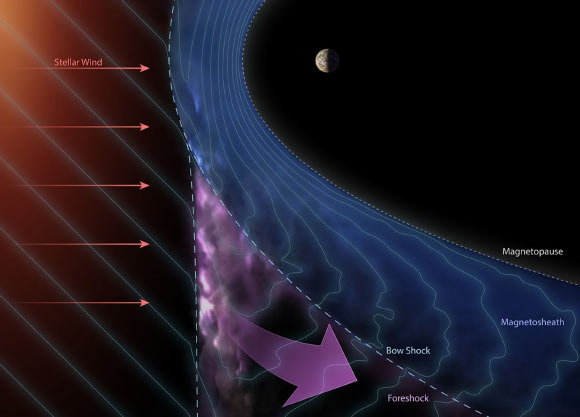
The giant planet’s bow shock isn’t just deflecting the solar wind, it’s acting as a powerful particle accelerator, firing electrons to relativistic energies of at least 1 MeV, according to a new analysis of data from NASA’s Juno spacecraft.
The post Jupiter Accelerates Electrons to Near-Light Speed, Offering Clues to Cosmic Ray Origins appeared first on Sci.News: Breaking Science News.
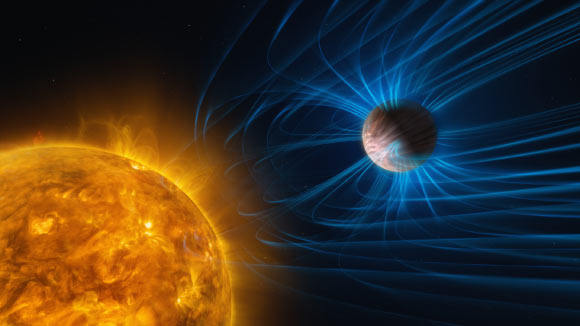
By tracking fierce winds racing through the atmospheres of seven ultra-hot Jupiters, astronomers have uncovered the strongest evidence yet that magnetic fields shape weather on worlds beyond our Solar System.
The post Astronomers Detect Clearest Signs Yet of Magnetic Fields on Extrasolar Planets appeared first on Sci.News: Breaking Science News.

Using spectral data from the Near-Infrared Spectrograph (NIRSpec) onboard the NASA/ESA/CSA James Webb Space Telescope, astronomers analyzed the atmosphere of TOI-199b, a distant Saturn-mass world that is neither frozen nor scorching hot.
The post Webb Detects Methane in Atmosphere of Exo-Saturn TOI-199b appeared first on Sci.News: Breaking Science News.
WASP-94A b is a hot, tidally locked gas giant orbiting close to one of the stars in a binary system roughly 690 light-years away from Earth. In a new Science study, scientists led by Sagnick Mukherjee, an astrophysicist at Johns Hopkins University, used the James Webb Space Telescope to learn what the weather looks like out there.
Tidal locking means that you no longer have day- and night-side temperature differences sweeping across the planet. “We wanted to understand the atmospheres of such planets,” Mukherjee says. “Are they static or dynamic? Do they have winds? Do they have clouds?” His team found that, on WASP-94A b, it’s cloudy in the morning, but the skies are clear in the evening. The fact that we didn’t know this already means we might have gotten the chemistry of this and many other exoplanets surprisingly wrong.
WASP-94A b has a mass slightly below half of Jupiter but has a diameter that’s over 70 percent wider. “This means the planet has low density, and its atmosphere extends further out into space, which makes it easier to observe,” Mukherjee explains. When astronomers study atmospheres like this, they usually rely on transmission spectroscopy. By analyzing the spectrum of light filtering through the planet’s atmosphere as it crosses in front of its star, they can figure out its chemical composition.
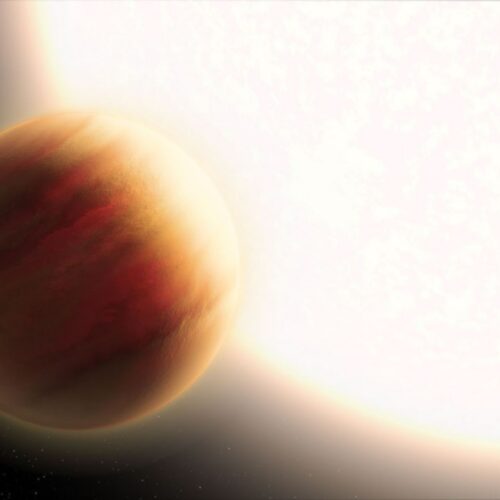

© NASA, ESA, and L. Hustak (STScI)
