 Login

Buildings May Soon Have ‘Immune Systems’ That Fight Airborne Disease
Following the pandemic, the federal government is spending $150 million on new technology to ensure clean indoor air. Here’s what scientists are pursuing.


The US Department of Justice has asked a federal court to throw out a Clean Air Act lawsuit against Elon Musk’s xAI, arguing that the company’s unpermitted gas turbines near Memphis are a matter of “national, economic, and energy security.”
The move puts the Trump administration in court alongside Musk to defend dozens of methane-burning turbines that have been running without air permits in one of the most polluted regions of the country.
In an ambitious new study published in the Journal of Exposure Science and Environmental Epidemiology, researchers report compelling evidence linking long-term exposure to outdoor air pollution with an increased risk of ovarian and endometrial cancers. This groundbreaking investigation harnesses a large prospective cohort to unravel the intricate relationship between environmental pollutants and gynecologic malignancies, offering a critical perspective on public health implications that extend far beyond respiratory diseases.
Air pollution has long been recognized as a major contributor to cardiovascular and respiratory conditions, but its potential carcinogenic effects on reproductive organs have remained underexplored. The study conducted by Ammons, Fisher, Madrigal, and colleagues seeks to fill this gap by focusing on two of the most common gynecologic cancers – ovarian and endometrial cancer – and evaluating the impact of chronic exposure to ambient air pollutants. By analyzing data from thousands of participants over an extended period, the researchers embarked on an epidemiologic journey to quantify risks associated with particulate matter and other airborne toxins.
The cohort employed in this study includes a diverse population sampled across multiple geographic regions, allowing researchers to capture variations in pollution levels and their corresponding cancer incidences. Utilizing cutting-edge exposure assessment techniques, the team mapped pollutant concentrations at individual residences with unprecedented accuracy. These methods integrated satellite data, ground-level monitors, and atmospheric modeling to deliver robust, spatially resolved exposure metrics. Such advances surpass prior limitations inherent in ecological and self-reported exposure assessments, lending unprecedented credibility to the findings.
Delving into the biological plausibility of how air pollution could influence the pathogenesis of ovarian and endometrial cancers, the researchers propose several mechanistic pathways. Persistent exposure to fine particulate matter (PM2.5) and polycyclic aromatic hydrocarbons (PAHs) may induce systemic inflammation, oxidative stress, and hormonal dysregulation. These factors could disrupt the delicate microenvironment of reproductive tissues, promoting DNA damage, aberrant cell signaling, and ultimately malignant transformation. The findings echo mounting laboratory evidence that airborne pollutants can act as endocrine disruptors, complicating hormonal balance crucial for gynecologic health.
Statistical analyses revealed that the risk for endometrial and ovarian cancers escalates in tandem with pollutant concentration levels. Notably, women residing in urban areas with higher vehicular emissions and industrial activities exhibited significantly greater cancer risks compared to those in less polluted settings. After adjusting for known confounders such as age, BMI, smoking status, and reproductive history, the association remained robust, underscoring the independent contribution of chronic air pollution exposure to cancer pathogenesis.
Importantly, this research highlights a disproportionately higher vulnerability among subgroups, including postmenopausal women and those with pre-existing metabolic disorders. These populations may experience exacerbated inflammatory responses or impaired detoxification pathways, amplifying carcinogenic potential. Such differential susceptibility underscores the urgency for targeted interventions and personalized public health strategies to mitigate the undue burden of pollution-induced cancers.
Beyond its epidemiological insights, the study calls attention to the glaring disparities in environmental exposures driven by socioeconomic and racial factors. Marginalized communities situated near highways, factories, and waste sites confront a compounded risk landscape for gynecologic cancers due to cumulative environmental and social stressors. Addressing these inequities demands integrated policy responses encompassing urban planning, emission regulation, and healthcare accessibility.
From a preventive medicine standpoint, these findings compel a re-evaluation of current cancer risk models and screening guidelines to incorporate environmental exposure metrics. Recognizing air pollution as a modifiable risk factor opens avenues for novel primary prevention strategies including community-level emission reductions, green space expansion, and personal behavior modifications. Public awareness campaigns and healthcare provider education must integrate these environmental determinants to holistically address cancer prevention.
Moreover, the study’s prospective cohort design strengthens the causal inference between pollution and cancer development, circumventing biases typical of retrospective analyses. Continuous monitoring and follow-up of the cohort will enable future research to delineate critical exposure windows, dose-response relationships, and potential synergistic effects with other carcinogens. Such longitudinal data is vital for refining risk assessments and tailoring interventions.
The multidisciplinary collaboration driving this research showcases the essential convergence of epidemiology, environmental science, oncology, and biostatistics in addressing complex health challenges. It underscores the power of leveraging big data and sophisticated modeling to uncover subtle yet impactful health hazards lurking within everyday environments. The authors advocate for sustained funding and cross-sector partnerships to expand these investigations globally, given the universal prevalence of air pollution.
As air quality deteriorates worldwide amidst urbanization and industrial growth, this study serves as a timely warning of the hidden costs borne by women’s health. It challenges policymakers, scientists, and clinicians alike to rethink environmental determinants as integral components of cancer etiology and control. The evidence presented marks a significant stride toward recognizing air pollution not only as a respiratory threat but also as a stealthy contributor to oncologic morbidity.
Crucially, these findings could galvanize international efforts to adhere to stricter air quality standards and accelerate transitions to clean energy sources. Reducing exposure to harmful pollutants would yield multifaceted benefits including diminishing cancer risks, improving cardiovascular health, and enhancing overall quality of life. The research invites a paradigm shift wherein environmental stewardship aligns squarely with cancer prevention goals.
In conclusion, the pioneering work by Ammons and colleagues elucidates how invisible toxins permeating the air we breathe insidiously influence the development of ovarian and endometrial cancers. Their rigorous approach and comprehensive analyses illuminate a previously underrecognized dimension of cancer risk, compelling a broad re-examination of environmental health policies and clinical practices. As the global burden of cancer continues to rise, addressing modifiable environmental exposures emerges as an indispensable frontier in safeguarding women’s health for generations to come.
Subject of Research: Long-term outdoor air pollution exposure and its association with ovarian and endometrial cancer risk.
Article Title: Long-term outdoor air pollution and risk of ovarian and endometrial cancers in a large prospective cohort.
Article References:
Ammons, S., Fisher, J.A., Madrigal, J.M. et al. Long-term outdoor air pollution and risk of ovarian and endometrial cancers in a large prospective cohort. J Expo Sci Environ Epidemiol (2026). https://doi.org/10.1038/s41370-026-00901-7
Image Credits: AI Generated
DOI: 10.1038/s41370-026-00901-7 (15 June 2026)

© Brad J. Vest for The New York Times
As the world continues to witness unprecedented growth in air travel, a groundbreaking study published in Communications Earth & Environment reveals alarming insights into the global repercussions of accelerating aircraft emissions on air quality and human health. This landmark research meticulously quantifies how expanding aviation activities contribute to deteriorating atmospheric conditions and exacerbate public health crises worldwide, underscoring an urgent need for global policy interventions and technological innovation.
The aviation sector, responsible for a substantial portion of anthropogenic greenhouse gas and pollutant outputs, has long been scrutinized for its environmental footprint. Yet, the intricate dynamics linking aircraft emissions to widespread air quality degradation and subsequent health implications have remained largely underexplored until now. Quadros, Nelen, Snellen, and colleagues harnessed sophisticated atmospheric modeling techniques combined with epidemiological data to elucidate these complex pathways with unprecedented precision.
Aircraft engines emit a cocktail of pollutants, including nitrogen oxides (NOx), particulate matter (PM), volatile organic compounds (VOCs), and carbon dioxide (CO2). These emissions initiate a cascade of atmospheric chemical reactions, creating secondary pollutants such as ozone and fine particulate matter, which profoundly impair air quality. The study’s simulation results reveal that aircraft emissions alone contribute significantly to elevated ground-level ozone concentrations, particularly in densely populated and heavily trafficked air corridors.
One of the study’s pivotal findings focuses on the spatial distribution of pollution burdens. Regions adjacent to major airports and common flight routes exhibit air quality dips notably beyond local vehicular and industrial contributions. The researchers found that the transboundary nature of aircraft emissions facilitates the transport of chemically reactive species across continents, linking aviation activities not only to local but also to regional and global air pollution episodes.
In terms of human health, the implications are disturbing. The researchers applied integrated exposure-response functions to estimate the morbidity and mortality attributable to aviation-induced pollution. Their assessments suggest a substantial increase in respiratory ailments, cardiovascular diseases, and premature deaths attributable to aircraft emissions. Particularly vulnerable populations, such as urban dwellers, children, elderly individuals, and those with preexisting conditions, face disproportionate risks.
Moreover, the study highlights the synergistic effects of aircraft emissions with other urban pollutants, exacerbating harmful synergistic interactions that amplify health risks. For instance, the NOx and VOCs emitted interact under sunlight to generate ozone, a potent respiratory irritant, and exacerbate asthma symptoms. The authors stress the importance of recognizing these nonlinear effects for robust public health policy formulation.
Climate feedback mechanisms linked to aviation emissions emerge as a critical concern in the report. The authors delineate how nitrogen oxides released at high altitudes not only affect surface-level ozone but also perturb the radiative balance of the atmosphere. This creates complex feedback loops that potentially accelerate climate warming, indicating that the environmental cost of aviation extends beyond conventional pollutants to include broader climatic impacts.
Technology advances and mitigation strategies receive thorough evaluation in the study. The authors discuss current emission reduction technologies such as lean-burn engines, sustainable aviation fuels (SAFs), and operational measures like optimized flight paths and altitude adjustments. Despite their promise, the research cautions that without comprehensive adoption and scaling, these technologies alone may fall short of offsetting the forecasted growth in emissions.
The aviation sector is projected to expand considerably over the coming decades, driven by economic growth and increasing globalization. The study’s projections indicate that without stringent regulatory frameworks and aggressive emission reduction commitments, the global burden of aviation-induced air pollution and related health impacts will escalate dramatically, particularly in emerging economies with rapidly growing air traffic.
Policy recommendations form a cornerstone of the researchers’ conclusions. They advocate for coordinated international efforts to tighten emission standards, mandate SAF usage, and invest in next-generation propulsion technologies such as electric and hydrogen-powered aircraft. Furthermore, integrating aviation sector goals into broader air quality management and climate policies is deemed essential to maximize health and environmental benefits.
In addition to technological and regulatory measures, the report emphasizes the role of real-time monitoring networks and data-sharing frameworks. Enhanced surveillance of aircraft emissions and their atmospheric transformations can enable dynamic policy responses, better inform public health advisories, and foster transparency and accountability among stakeholders ranging from airlines to regulators.
The health economics dimension discussed in the study reveals enormous societal costs tied to aviation-related air pollution. Hospitalizations, lost productivity, and long-term healthcare expenditures attributed to pollution-induced diseases impose substantial financial burdens on governments and communities alike, reinforcing the public health imperative for aggressive mitigation.
Further research priorities identified in the report call for improved characterization of ultrafine particles emitted by aircraft engines, nuanced understanding of population exposure patterns near airports, and exploration of co-benefits arising from simultaneous air quality and climate interventions. Interdisciplinary collaboration combining atmospheric science, epidemiology, engineering, and policy studies is championed as the pathway to innovative solutions.
In light of this new research, the aviation industry stands at a crossroads. Balancing the undeniable economic and social advantages of air travel with its adverse environmental and health externalities necessitates transformative thinking and collaborative global action. The study’s revelations provide an indispensable scientific foundation for stakeholders to forge a sustainable aviation future.
This comprehensive investigation serves as a clarion call for urgent recognition of the aviation sector’s hidden consequences, urging policymakers, industry players, and the public to engage in proactive, science-informed strategies that safeguard air quality and human health on a planetary scale.
Subject of Research:
The study focuses on evaluating the global impact of increasing aircraft emissions on air quality and related human health outcomes, analyzing both direct and indirect effects through sophisticated atmospheric and epidemiological modeling.
Article Title:
Global air quality and human health impacts of growing aircraft emissions
Article References:
Quadros, F.D.A., Nelen, R., Snellen, M. et al. Global air quality and human health impacts of growing aircraft emissions. Commun Earth Environ (2026). https://doi.org/10.1038/s43247-026-03732-4
Image Credits: AI Generated
DOI: 10.1038/s43247-026-03732-4
Keywords:
Aircraft emissions, air quality, human health, nitrogen oxides, particulate matter, ozone formation, aviation pollution, atmospheric modeling, public health impact, sustainable aviation fuels

Across the stories today, a common thread emerges: the gap between what we know and what we’re able to protect is narrowing, but not fast enough. From hidden pollutants driving 15 percent of global warming to fungal networks stretching nearly a billion times the distance to the sun, science continues revealing the intricate systems that sustain life on Earth—even as political and economic forces test our commitment to preserving them.
The day’s coverage points to growing momentum around conservation breakthroughs. In the Marshall Islands, researchers hunt for “super reefs” that could survive rising ocean temperatures, while Brazil celebrates Amazon deforestation dropping to nearly decade-low levels. Young Stanley the giraffe joins breeding programs in Wiltshire, osprey chicks hatch successfully in North Wales, and Australia’s PlantBank emerges as a global leader in seed conservation. These aren’t just feel-good stories—they represent systematic efforts to build resilience into ecosystems under unprecedented pressure.
Yet the challenges are accelerating too. A century of Antarctic research data now helps scientists track El Niño patterns, but current observations show Antarctica missing a France-sized area of sea ice while winter temperatures soar 20 degrees above normal. The Hoover Dam faces massive power cuts as Lake Mead approaches critical lows, and millions of climate-displaced people find virtually no legal pathway to safety in the United States. It’s a reminder that progress and pressure often arrive together.
Perhaps most striking is how these environmental shifts intersect with human communities. Behind the numbers are real communities adapting in real time—from families near the massive illegal waste dump behind a UK primary school that’s become an election flashpoint, to Florida volunteers mounting dramatic rescue operations for endangered sea turtles. When botanist Beronda Montgomery explores connections between trees and Black American history in her new memoir, she’s mapping how environmental and social justice have always been intertwined.
The global wildlife trade, operating like “pandemic roulette” as it moves billions of animals across continents, exemplifies how our interconnected world amplifies both risks and opportunities. Commercial satellite launches threaten the night sky that has guided humanity for millennia, while SpaceX prepares for a massive public offering. Each technological leap forward carries environmental trade-offs that ripple across systems we’re still learning to understand.
China’s story encapsulates these tensions perfectly: achieving a historic drop in power sector emissions for the first time in a decade, yet simultaneously surging coal power that threatens to reverse those gains. Australia faces a similar paradox, preparing to lead international climate negotiations even as climate denial gains political ground domestically.
What emerges from today’s reporting is a picture of accelerating change on multiple fronts. Scientists are racing to identify heat-resistant corals and document rare butterfly discoveries in Surrey, while bird enthusiasts fly across Australia for a single gull sighting—small acts of attention that collectively map our changing world.
As the week unfolds, all eyes will be on how these parallel tracks—scientific discovery, conservation innovation, political resistance, and community adaptation—continue to intersect. The federal judge ruling against the Trump administration’s cancellation of environmental justice grants signals that legal frameworks remain crucial battlegrounds. But the deeper story may be in the fungal networks beneath our feet: vast, interconnected systems working largely unseen to sustain life, reminding us that resilience often operates at scales both smaller and larger than we imagine.
The post Hidden Pollutants Drive 15 Percent of Global Warming, Wildlife Trade Creates ‘Pandemic Roulette’ With Billions of Animals — Today’s Environmental Briefing for Sun, Jun 14 2026 first appeared on EnviroLink Network.

**
Across the stories today, a common thread emerges: the tension between revelation and rescue—moments when new understanding drives urgent action, even as time runs short.
Beneath our feet, scientists have mapped fungal networks stretching nearly a billion times the distance to the sun, revealing an underground web of connection that dwarfs anything visible above ground. It’s a reminder that the natural world operates on scales both microscopic and cosmic, with systems we’re only beginning to understand. This same spirit of discovery appears in unexpected places—from the ghostly earthshine illuminating the moon’s dark side to the arrival of a tropical western reef heron in Wales, likely pushed northward by changing climate patterns.
The day’s coverage points to growing momentum around what happens when scientific insight meets conservation urgency. In Mozambique, nine female white rhinos completed their journey to establish the country’s first viable breeding population in generations—a decade-long effort finally bearing fruit. Meanwhile, Australian researchers at PlantBank work like modern-day ark builders, preserving seeds before species disappear forever. On Palau’s Ulong Island, the simple act of removing invasive rats triggered rapid ecological recovery across both land and marine environments, challenging assumptions about how long nature needs to heal.
Yet revelations don’t always bring good news. China’s power sector emissions fell for the first time in a decade, a historic milestone, but a coal surge threatens to reverse that progress. Trees may store less carbon than scientists hoped, according to new research examining growth patterns across 137 forest sites. And Antarctica is missing sea ice equivalent to France’s size, with winter temperatures soaring 20°C above normal—numbers that feel abstract until you consider their global implications.
It’s a reminder that progress and pressure often arrive together. Lake Mead approaches the critical threshold that will slash Hoover Dam’s electricity production, while thousands of marine animals die in fishing nets annually through bycatch. For the 58-year-old Kenyan fisherman Mohamed Mwazigona, returning to shore with just 2 kilograms of fish, these aren’t statistics—they’re the reality of dwindling catches that threaten coastal livelihoods.
Behind the numbers are real communities adapting in real time. Eight volunteers used ropes and pulleys to rescue a 172-pound loggerhead turtle named Bowser from a Florida pier—the kind of hands-on conservation that makes the difference between survival and loss. In Albania, protesters dubbed the “Flamingo Revolution” emerged after bulldozers illegally destroyed protected wetlands for a luxury resort, showing how environmental destruction can galvanize public resistance.
The stories also reveal how legal frameworks struggle to keep pace with environmental challenges. A federal judge ruled the Trump administration’s cancellation of environmental justice grants illegal, while Australia’s climate chief outlined plans to transform the country from fossil fuel exporter to renewable energy leader. Meanwhile, environmental laws were waived to enable border wall construction through Big Bend National Park, illustrating how political priorities can override conservation concerns.
What emerges is a picture of a planet under pressure, but also of human ingenuity rising to meet unprecedented challenges. As commercial satellites threaten the night sky that has guided humanity for millennia, conservationists celebrate osprey chicks hatching in Wales and sengi pups born in captivity. Progress isn’t linear, and solutions often come from unexpected directions—underground fungal networks, community rescue efforts, and the patient work of seed preservation.
As the week unfolds, all eyes will be on how these parallel stories of discovery and rescue continue to intersect, shaping our understanding of what’s possible when knowledge meets action.
The post China’s Coal Surge Threatens Historic Emissions Drop, Hoover Dam Faces Massive Power Cut as Lake Mead Hits Critical Low — Today’s Environmental Briefing for Sat, Jun 13 2026 first appeared on EnviroLink Network.

For millennia, the starry night sky has served as humanity’s compass, calendar, and source of wonder. From ancient navigation to agricultural timing, the celestial sphere has been our shared inheritance—a cosmic commons connecting all cultures to the vast universe around us.
But this fundamental relationship is now under threat. A dramatic surge in commercial satellite launches is rapidly filling Earth’s upper atmosphere with thousands of new objects, fundamentally altering our view of the night sky. What was once a pristine canvas of stars is becoming increasingly crowded with artificial lights streaking across the darkness, disrupting both scientific observation and cultural traditions that have depended on clear skies for generations.
The environmental implications extend far beyond aesthetics. Scientists warn that this unprecedented space traffic is introducing new forms of atmospheric pollution, with potential consequences we’re only beginning to understand. The rapid commercialization of space raises urgent questions about who has the right to alter our shared sky and whether current regulations are adequate to protect this global commons.
Perhaps most troubling, experts caution that the current approach to space development risks repeating the destructive patterns of historical colonialism—where powerful interests claim and exploit shared resources without considering the broader impacts on communities worldwide. As private companies race to deploy massive satellite constellations, the question becomes whether we can balance technological progress with our collective right to an unpolluted night sky.
The post Commercial Satellite Boom Threatens Night Sky and Atmospheric Health first appeared on EnviroLink Network.

**
Across the stories today, a common thread emerges: the planet is sending signals, and communities are finally learning to listen—sometimes by choice, sometimes by necessity.
The day’s most prominent signal comes from the Pacific, where scientists have confirmed the arrival of a powerful El Niño that could rank among the century’s strongest climate events. This naturally occurring phenomenon, which emerges every few years to reshape weather patterns globally, arrives at a moment when human communities are already stretching to adapt to climate disruption. For families from Florida to California already spending an extra $400 to $900 annually on climate-related costs—rising to over $1,300 in the hardest-hit areas—the prospect of intensified extreme weather represents more than meteorological curiosity. It’s a reminder that progress and pressure often arrive together.
Yet the day’s coverage also points to growing momentum around solutions that seemed impossible just years ago. Solar power has quietly crossed a historic threshold, generating more electricity than coal in the United States for the first time ever—12.8% versus coal’s 12.2% in May alone. Meanwhile, engineers in Barcelona have finally realized Antoni Gaudí’s sustainable architecture vision at the Sagrada Familia, using modern technology to complete designs that were ahead of their time by more than a century. These breakthroughs suggest that patient innovation can eventually bridge the gap between ambitious vision and practical reality.
The tension between environmental protection and human needs surfaces repeatedly across today’s stories, revealing communities grappling with complex tradeoffs. In Queens, residents debate whether an abandoned railway should become green space or renewed transit infrastructure. Nebraska towns that fiercely rejected wind and solar projects are welcoming nuclear power plants. Even Britain found time to celebrate, with the peacock butterfly claiming the crown in the nation’s first-ever favorite species poll—a small but significant reminder that public engagement with nature remains strong.
Behind the numbers are real communities adapting in real time. In London, new research shows that clean air zones have measurably reduced emergency hospital visits, translating policy into tangible health benefits. But the challenges run deep: in Alabama, a community that lacks basic sanitation infrastructure now faces a proposed data center that would strain resources further, while in Ecuador’s Amazon, an Indigenous community surrounded by two rivers cannot access clean drinking water due to mining pollution.
The natural world continues revealing both its resilience and vulnerability. Scientists captured the first-ever footage of goblin sharks in their deep-sea habitat, while researchers documented how elephant loss triggers immediate dung beetle extinctions in Kenya—the first direct evidence of coextinction in action. Perhaps most remarkably, new research has mapped the underground fungal networks that span 110 quadrillion kilometers worldwide, moving billions of tons of carbon in an invisible web beneath our feet.
These discoveries underscore how much we’re still learning about the systems that sustain life on Earth, even as we’re rapidly changing them. From pharmaceutical pollution in East African waters to the transformation of Miami’s Biscayne Bay into saltier, more acidic habitat threatening endangered sharks, the impacts of human activity continue cascading through ecosystems in ways we’re only beginning to understand.
As these stories unfold, they reveal a world where environmental challenges and solutions are increasingly inseparable from questions of justice, economics, and community resilience. The coming months will test whether the momentum behind renewable energy and conservation can match the scale of changes already underway.
The post El Niño Officially Begins as Solar Power Surpasses Coal, SpaceX Eyes Historic IPO — Today’s Environmental Briefing for Fri, Jun 12 2026 first appeared on EnviroLink Network.

London’s efforts to tackle air pollution are showing measurable health benefits, with new research revealing that emergency hospital admissions declined after the city introduced its T-charge and Ultra Low Emission Zone (ULEZ) in central areas. Scientists from Imperial College analyzed extensive health records from before and after these pollution-reduction measures took effect, providing concrete evidence of improved public health outcomes.
The findings add to a growing body of evidence supporting the effectiveness of clean air initiatives across the UK. Similar zones have demonstrated remarkable results elsewhere—Bradford’s clean air zone led to a 25% reduction in doctor visits for heart and breathing problems, while central London’s emission restrictions correlated with fewer people taking sick leave from work.
These low-emission zones, while often controversial during the planning stages, are proving their worth through tangible health improvements. The zones work by restricting or charging the most polluting vehicles from entering designated areas, encouraging drivers to switch to cleaner alternatives and reducing harmful emissions in densely populated urban centers.
The research represents a significant milestone in understanding how environmental policy directly impacts community health. As cities worldwide grapple with air quality challenges, London’s experience offers compelling evidence that targeted emission controls can deliver rapid, measurable benefits to public health systems and reduce the burden on emergency medical services.
The post London’s Clean Air Zones Linked to Fewer Emergency Hospital Visits, New Study Shows first appeared on EnviroLink Network.

In Hayneville, Alabama, a stark environmental justice issue is unfolding along the historic route where civil rights marchers once walked toward Montgomery. This rural community, where some residents still cannot flush their toilets due to inadequate sewage infrastructure, now faces the prospect of a massive data center being built in their backyard.
The proposed facility represents a troubling pattern of environmental inequality, where communities already struggling with basic utilities become targets for industrial development that could strain their limited resources further. Data centers are notorious for their enormous energy consumption and water usage requirements for cooling systems, potentially exacerbating existing infrastructure challenges in areas that can least afford additional environmental burdens.
The juxtaposition is particularly striking along Highway 80, a road that symbolizes the fight for equal rights and justice. Today, residents of this same corridor face a different kind of struggle—one for environmental equity and access to basic services that many Americans take for granted. The situation highlights how communities with limited political and economic power often bear disproportionate environmental costs while receiving few benefits from industrial development.
This case exemplifies the growing tension between the digital economy’s infrastructure needs and environmental justice concerns, particularly in rural areas where oversight may be limited and community voices often go unheard in development decisions.
The post Rural Alabama Community Lacking Basic Sanitation Faces New Environmental Challenge from Proposed Data Center first appeared on EnviroLink Network.
 Scientists find fog droplets host growing bacteria that may help clean polluted air.

Across the stories today, a common thread emerges: the growing gap between urgent environmental realities and the systems—political, economic, and social—struggling to keep pace with change.
This tension plays out most starkly in the realm of climate health impacts. New research warns that heat-related hospitalizations could double by 2040, while a super El Niño threatens to deepen global economic inequality through cascading climate disruptions. Behind the numbers are real communities adapting in real time. In Pacoima, a working-class Los Angeles neighborhood sandwiched between highways and heavy industry, residents like Jose Luis Salas are mounting their own defense against air pollution, installing shoebox-sized monitoring devices that track what they breathe daily.
Yet the day’s coverage also points to growing momentum around practical solutions gaining real traction. Solar energy quietly surpassed coal in U.S. electricity generation for the first time this May—a milestone that arrived not through grand announcements but through the steady accumulation of rooftop panels and utility-scale installations. Britain cleared a major bottleneck by offering grid connections to over 700 clean energy projects, while new data reveals the country’s green economy now employs over one million workers across a £100 billion sector.
The stories reveal how environmental challenges are increasingly driving innovation at the community level. In Guatemala’s Western Highlands, approximately 60 communities are reviving ancient Maya agricultural wisdom, creating homemade biopesticides from aromatic plants to replace expensive chemical alternatives. Similarly, 120 women farmers in Malawi’s Chiradzulu district have transformed traditional maize cultivation by adding organic fruits and vegetables now in high demand from urban buyers—though their success is shadowed by a troubling reality: their bees, crucial pollinators for food security, are mysteriously disappearing.
It’s a reminder that progress and pressure often arrive together. Colombia enacted groundbreaking legislation requiring detailed cattle tracking to prevent deforestation-linked beef from reaching markets, while Indonesia’s magnificent hornbills face accelerating threats from both habitat loss and an illegal online pet trade. The contrast illustrates how conservation gains in one area can be undermined by emerging threats in another.
Perhaps most telling is how wealth continues to complicate climate action. New research from Greenpeace reveals that the ultra-rich drive a quarter of global emissions not through private jets—their visible symbols of excess—but through their investment portfolios and asset ownership. Meanwhile, chemical companies are quietly pushing “immunity laws” across 15 states to shield themselves from health-related lawsuits, even as communities bear the costs of environmental damage.
The space program offers its own metaphor for these broader tensions. NASA’s latest astronaut selections for Artemis missions reflect both ambition and limitation—crews training for missions that won’t reach the Moon, while hundreds of women gathered at the AeroWomen conference to prepare for space careers in an industry still taking shape.
As the week unfolds, all eyes will be on whether these parallel tracks—accelerating environmental pressures and emerging solutions—can converge into the systemic changes scientists say are necessary. Today’s stories suggest we’re living through a period when local innovation and global challenges are both intensifying, creating opportunities for breakthrough and breakdown in equal measure.
The post Rare African Bird Makes Historic UK Debut While Communities Transform Lawns Into Wildlife Havens — Today’s Environmental Briefing for Wed, Jun 10 2026 first appeared on EnviroLink Network.

In Pacoima, a working-class neighborhood trapped between Los Angeles highways and heavy industry, residents are taking air quality monitoring into their own hands. Jose Luis Salas recently watched as environmental project manager Shance Taylor climbed a ladder to install a shoebox-sized white container on the side of his home—an Aeroqual sensor that’s part of an ambitious community-led air monitoring program.
The sensor network, operated by local environmental group Pacoima Beautiful, represents a growing trend of hyperlocal air quality monitoring that gives communities real-time data about the pollution they’re breathing. Unlike traditional government monitoring stations that may be miles away, these sensors provide block-by-block information about air quality conditions.
Pacoima’s geography makes it particularly vulnerable to poor air quality. Nestled in Los Angeles’s northeast San Fernando Valley, the neighborhood sits at the intersection of major freeways and industrial facilities, creating a perfect storm for air pollution accumulation. Residents often report higher rates of asthma and respiratory issues compared to other parts of the city.
The grassroots monitoring program empowers residents with data they can use to make informed decisions about outdoor activities, advocate for policy changes, and hold polluting industries accountable. By installing sensors on homes, offices, and even portable units carried in bags, the community is creating an unprecedented picture of how air pollution varies throughout their neighborhood—data that could prove crucial for protecting public health and environmental justice.
The post Los Angeles Community Fights Air Pollution with Grassroots Sensor Network first appeared on EnviroLink Network.

Across the stories today, a common thread emerges: the growing tension between our rapidly expanding digital world and the natural systems struggling to sustain it. From AI data centers planned for drought-stricken regions to coal plants getting emergency extensions, we’re witnessing the collision between technological acceleration and environmental limits.
The numbers tell a stark story. Two-thirds of new AI data centers are slated for areas already grappling with water scarcity, while these facilities demand massive amounts of both electricity and cooling water. Meanwhile, Florida’s coal plant—scheduled for retirement as part of a clean energy transition—gets an emergency lifeline to keep the lights on. It’s a reminder that progress and pressure often arrive together, forcing difficult choices between immediate needs and long-term sustainability.
The day’s coverage points to growing momentum around accountability, particularly in how we fund and regulate resource-intensive industries. Australian lawmakers are pushing for fair taxation of AI infrastructure, determined not to repeat what they see as mistakes with gas exports. North Carolina legislators face their own paradox, crafting bills that simultaneously curb data center expansion while boosting fossil fuel development. These policy tensions reflect a broader reckoning: how do we harness technological progress without overwhelming the ecosystems that support us?
Yet signs of genuine environmental recovery punctuate today’s more challenging headlines. Water voles have returned to an English nature reserve after four decades, while marine protected areas now cover 10% of the world’s oceans—a significant milestone toward the 30% goal by 2030. In Sumatra’s hills, coffee farmers like Sri Atmiatun are proving that conservation and community prosperity can grow together, restoring forests while securing livelihoods through innovative social forestry programs.
Behind the numbers are real communities adapting in real time. Alaska’s fishing industry faces uncertainty as critical ocean monitoring systems face budget cuts, while Arizona’s San Carlos Lake sits closed indefinitely after drought and dam releases killed all fish life. These aren’t abstract environmental statistics—they’re disruptions to ways of life, forcing entire communities to reimagine their relationships with changing landscapes.
The financial flows reveal where power and priorities truly lie. The world’s largest banks poured a record $906 billion into fossil fuels despite climate commitments, an 8% increase that environmental researchers call “unfathomable.” Meanwhile, China launched the world’s first wind-powered underwater data center, signaling that sustainable technology infrastructure is possible when political will aligns with innovation.
Perhaps most troubling is what we’re losing while focused on these larger battles. Wildfire smoke has erased four years of air quality progress across the United States, while sea levels are now rising at twice the rate recorded just a decade ago. Scientists are racing to record forest sounds before wild spaces fall silent—a poignant reminder that some losses can’t be reversed.
The day’s stories also illuminate the gap between good intentions and effective action. Louisiana legislators unanimously approved expanding their wood pellet industry despite the bill’s sponsor admitting he knows little about the sector. FIFA appears unprepared for wildfire smoke threats at upcoming World Cup venues. These moments reveal how quickly environmental challenges can outpace institutional readiness.
As the week unfolds, all eyes will be on whether emerging solutions—from underwater data centers to marine protection expansions—can scale fast enough to match the magnitude of the challenges. The central question remains: can we innovate our way toward sustainability, or will the pace of environmental change force more fundamental reckonings with how we live and build in a resource-constrained world?
The post Florida Coal Plant Keeps Running Past 2025 Closure, Decade of Wildfires Erases US Air Quality Gains — Today’s Environmental Briefing for Tue, Jun 9 2026 first appeared on EnviroLink Network.

A troubling new study reveals that wildfires have dramatically reversed years of hard-won progress in cleaning up America’s air. Over the past decade, increasingly severe wildfire seasons have pushed ozone pollution levels so high that they’ve effectively erased approximately four years of air quality improvements across the United States.
The research shows that surface ozone levels—commonly known as smog—have steadily climbed from 2015 to 2024, with the most severe impacts hitting the Midwest and Western regions. This represents a significant setback for public health, as ground-level ozone is a major component of smog that can trigger respiratory problems, worsen asthma, and cause other serious health complications.
The irony is particularly stark given that stricter vehicle emissions standards implemented in the early 2000s had successfully reduced smog concentrations for years. These tailpipe regulations represented a major environmental victory, steadily cleaning the air that millions of Americans breathe daily. However, the longer, more intense fire seasons that have become the new normal are now overwhelming those gains.
The findings highlight a concerning climate feedback loop: as global temperatures rise, wildfire seasons become more severe and prolonged, releasing massive amounts of pollutants that degrade air quality. This creates a double burden for communities already grappling with the direct threats of fire while also facing the lingering health impacts of degraded air quality that can persist long after the flames are extinguished.
The post Decade of Wildfires Erases Four Years of US Air Quality Progress, New Study Reveals first appeared on EnviroLink Network.
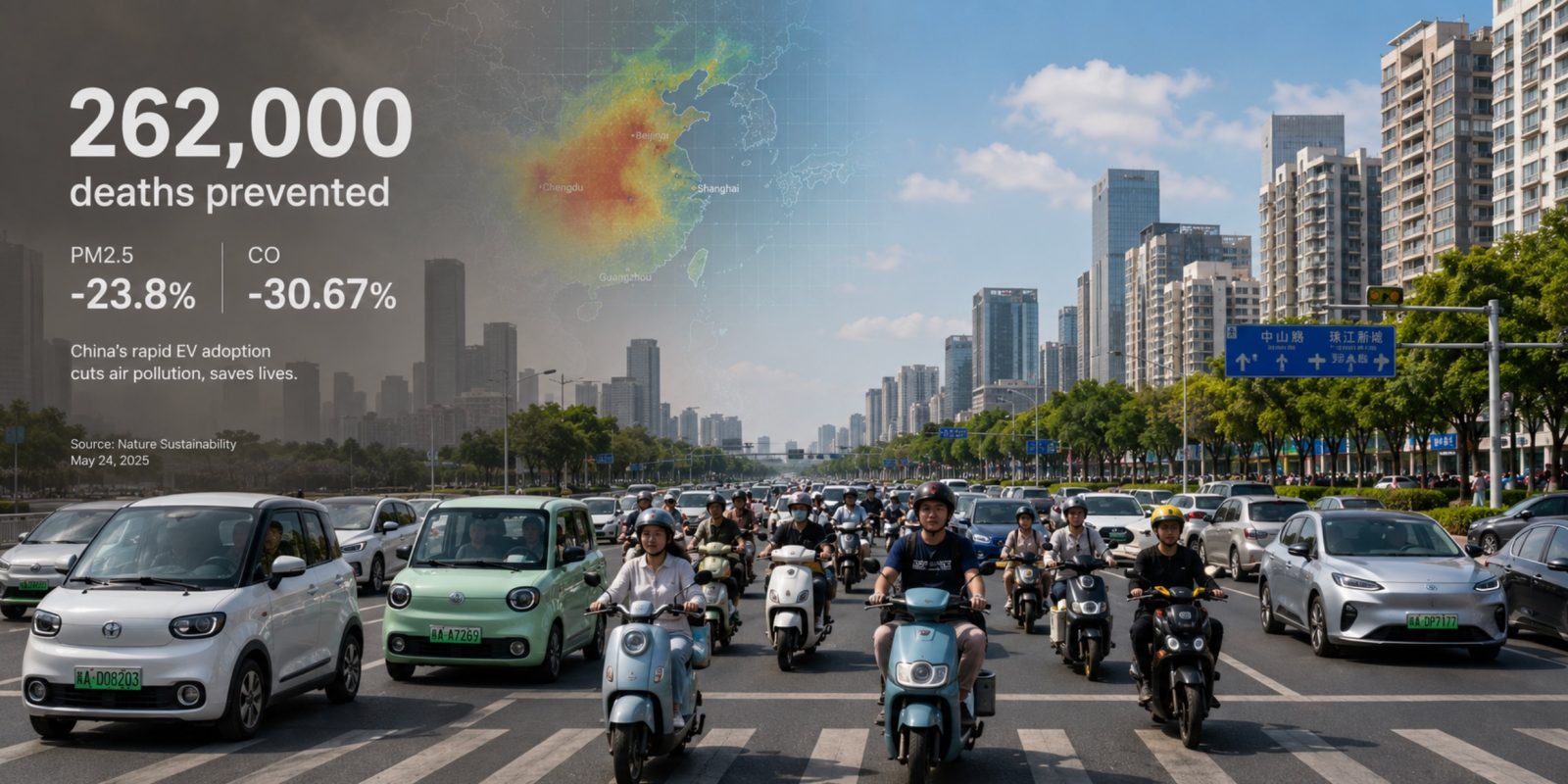
China’s rapid switch to electric and other new energy vehicles cut urban air pollution enough to prevent an estimated 262,000 premature deaths, according to a new peer-reviewed study published in Nature Health.
It’s some of the strongest real-world evidence yet that electrifying transportation delivers measurable public-health benefits, not just lower tailpipe emissions on paper.
