Au salon Eurosatory 2026, Renault et Thales dévoilent un prototype de véhicule tactique 4x4 hybride, capable de coordonner drones et robots en temps réel. Le véhicule en question est un SUV Rafale et il répond aux nouvelles exigences imposées par la guerre moderne.
Il y a quelques années, la température a dépassé les 41 °C en Bretagne, du jamais-vu ! Plus étonnant encore, ce record a été battu dans un village, loin des grandes zones urbanisés.
Été 1925. Un professeur convaincu que dormir est une perte de temps lance un défi radical à sept étudiants : les tenir éveillés pendant 60 heures d'affilée. Une expérience folle, menée à Washington dans un contexte d'euphorie industrielle. Et si cette nuit blanche prolongée avait finalement...
Ce jeudi, les premiers 40 °C de l’année ont été atteint à Montmorillon dans la Vienne, alors que cette nouvelle canicule débutait à peine. Après une légère baisse des températures à l’ouest ce vendredi, puis au nord samedi, un niveau de chaleur extrême va se produire pendant trois jours.
Canicules, nuits tropicales, événements extrêmes… Les conséquences du changement climatique sur la santé sont déjà visibles. Un rapport d'Oxfam met en lumière leur impact disproportionné sur certains groupes de la population.
À l’occasion de VivaTech 2026, OVHcloud lève le voile sur sa Quantum Platform, une offre de quantum-as-a-service pour appréhender le quantique avant sa montée en puissance. À travers un écosystème de start-up européennes, le groupe entend structurer une filière souveraine. Fanny Bouton,...
Nombreux sont ceux qui pensent qu'Elon Musk et Peter Thiel sont devenus complètement hors sol et dangereux, malgré des succès entrepreneuriaux incontestables. Faut-il aussi s'inquiéter de la déclaration récente d'un autre milliardaire, Jeff Bezos, lorsqu'il a dit à VivaTech : « Si le voyage...
Film alimentaire, barquette, réfrigérateur, congélateur... Des chercheurs se sont penchés sur les interactions entre les emballages en plastique et la conservation du poisson. Leurs résultats soulèvent des inquiétudes.
Un chien ou un chat partage-t-il davantage votre ADN ? La réponse de la science est contre-intuitive. Entre organisation chromosomique et maladies communes, les similitudes génétiques entre l'humain et ses animaux de compagnie réservent de vraies surprises. Et les enjeux dépassent largement la...
Un complément alimentaire économique pourrait améliorer significativement les capacités cognitives des personnes de plus de 60 ans. Cette découverte, issue d'une étude sur des jumeaux, ouvre de nouvelles perspectives sur le lien entre l'intestin et le cerveau. Et si prendre soin de notre...
Alors que l'été va bientôt commencer sur le calendrier, le fléau des coups de soleil, indissociable des fortes chaleurs, est lui aussi de retour. Cependant, cette année, une innovation pourrait bien changer la donne.
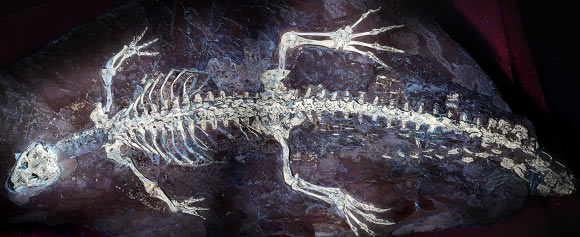
Exceptionally preserved skin of Montsecosuchus depereti, an extinct crocodylomorph no larger than a house cat that prowled the tropical wetlands of Early Cretaceous Spain, has allowed paleontologists to reconstruct details of its scales, sensory organs and even possible banded markings along its tail.
Résister à une attaque terroriste dans son garage, survivre à un tsunami depuis son salon : c'est la promesse de Momentum Technologies. Sur le salon Eurosatory 2026, Futura a pu s’installer dans ces bunkers du futur conçus dans les Pyrénées-Orientales.
Plague swept through groups of hunter-gatherers in southeastern Siberia 5,500 years ago, leaving dozens dead in its wake—with DNA from Yersinia pestis bacteria still trapped inside their teeth.
University of Oxford ancient DNA researcher Ruairidh Macleod and his colleagues recently sequenced the telltale bacterial DNA in teeth from plague victims at four ancient cemeteries in the area around Russia’s Lake Baikal. The tragedy that befell these communities is now the earliest known plague outbreak, courtesy of the oldest strain of Y. pestis ever sequenced.
Unearthing a new backstory for the plague
Until recently, scientists who study the evolution of diseases have held two fairly solid ideas about the origins of plague, the disease caused by Yersinia pestis bacteria. It's a scourge so awful that it has gone down in history as not just a plague but the plague. The first idea is that the earliest strains didn't have the right genetic traits to be really lethal. And the second is that the plague first began menacing humans when the first farmers settled in densely packed towns alongside rats and domestic animals.
Intelligence artificielle, informatique quantique, semi-conducteurs : l’Europe doit mobiliser des financements massifs pour réduire sa dépendance technologique aux États-Unis et à la Chine. À VivaTech, investisseurs, banques et industriels ont plaidé pour de nouveaux leviers de financement afin de faire émerger des champions européens.
Un reflux gastro-œsophagien mal contrôlé peut, à long terme, favoriser l’apparition d’un cancer de l’œsophage. Mais des chercheurs américains viennent de mettre en lumière une approche aussi surprenante que prometteuse : l’utilisation de probiotiques pour limiter l’inflammation, réparer les...
Stonehenge est indéniablement le monument néolithique le plus célèbre du monde. Et une découverte inattendue à quelques kilomètres de là pourrait révolutionner notre compréhension de ses origines.
À Pékin et à Shenzhen, des robots humanoïdes dopés à l’intelligence artificielle sont testés dans des logements privés. Encore lents, maladroits et accompagnés par des humains, ces assistants mécaniques servent autant à nettoyer qu’à collecter les données indispensables à la prochaine génération...
Pour sa dixième édition, VivaTech 2026 révèle une France de l’innovation moins parisienne que d’habitude. De la santé numérique à l’hydrogène, du quantique à la mobilité décarbonée, les pavillons régionaux veulent prouver que les prochains champions de la tech se trouvent aussi à Rouen,...

 Login