
❌

Reading view

NASA to Preview Katalyst Mission to Boost Swift Spacecraft’s Orbit
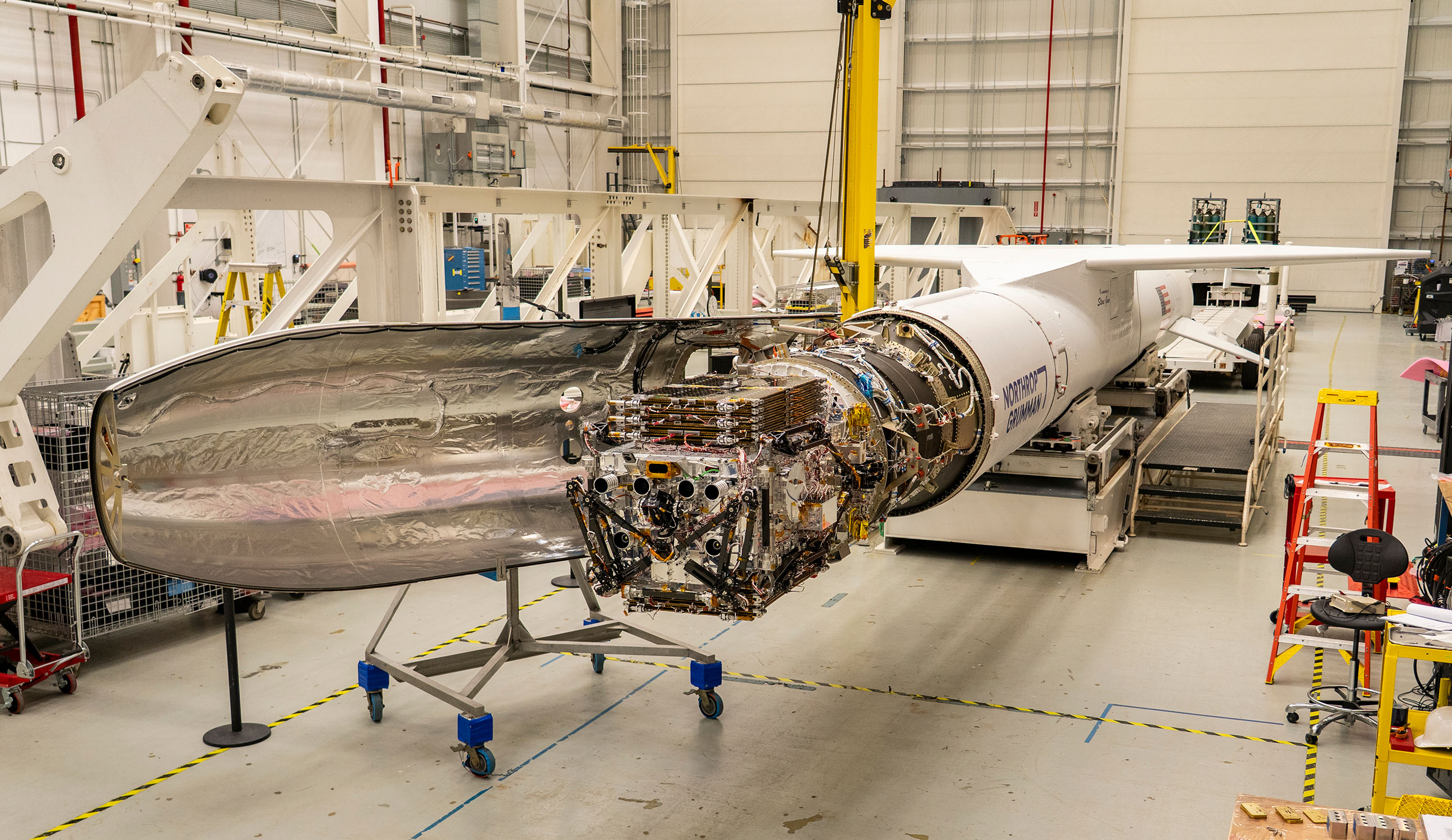
LINK attached to the front of the Pegasus XL
Katalyst Space’s LINK robotic servicing satellite awaits encapsulation inside a Northrop Grumman Pegasus XL on June 8, 2026, at NASA’s Wallops Flight Facility in Virginia. The rocket will carry LINK to space for an attempted orbital boost of NASA’s Neil Gehrels Swift Observatory.
Credit: NASA/Ron Beard

NASA will host an audio-only media teleconference at 11 a.m. EDT, Wednesday, June 17, to preview the Katalyst Space mission to boost the orbit of NASA’s Neil Gehrels Swift Observatory.

Katalyst’s robotic servicing spacecraft, called LINK, will attempt to rendezvous with Swift and raise its altitude, extending its science mission lifespan and advancing a key capability for the future of space exploration. The LINK spacecraft will launch on Northrop Grumman’s Pegasus XL rocket later this month from Kwajalein Atoll in the Marshall Islands.

Media interested in participating by phone must RSVP no later than two hours before the start of the call to Amy Barra at: amy.l.barra@nasa.gov. NASA’s media accreditation policy is available online.

Audio of the media teleconference will stream on the agency’s website at:

https://www.nasa.gov/live

Participants in the media teleconference include:

  • Shawn Domagal-Goldman, division director, Astrophysics, NASA Headquarters in Washington
  • Brad Cenko, principal investigator, Swift, NASA’s Goddard Space Flight Center in Greenbelt, Maryland
  • Kieran Wilson, principal investigator, LINK, Katalyst Space
  • Robert Lamontagne, vice president, strategic partnerships, Katalyst Space
  • Wes Collier, vice president, launch systems, Northrop Grumman

The Swift mission, which launched in 2004, leads NASA’s fleet of telescopes in studying changes in the high-energy universe, like gamma-ray bursts, which are the most powerful explosions in the cosmos. When a rapid, sudden event takes place in the sky, Swift serves as a “dispatcher,” providing critical information that allows other “first responder” missions to follow up to learn more about how the universe works.

After 21 years, Swift’s low Earth orbit has begun to rapidly decay because of increased solar activity. Rather than allowing the observatory to re-enter Earth’s atmosphere, as many missions do at the end of their lifetimes, NASA is using this opportunity to advance U.S. spacecraft servicing technology. In September 2025, NASA awarded a contract to Katalyst to mount a robotic servicing mission for Swift in less than a year. The mission will use LINK to rendezvous with Swift and boost it to a higher altitude, demonstrating a key capability for the future of space exploration. The mission is targeted for launch in June from Kwajalein Atoll, Marshall Islands.

Learn more about the mission to boost Swift’s orbit at:

https://science.nasa.gov/mission/swift/swift-boost-mission/

-end-

Karen Fox / Alise Fisher
Headquarters, Washington
202-385-1287 / 202-358-2546
karen.c.fox@nasa.gov / alise.m.fisher@nasa.gov

Amy Barra
Wallops Flight Facility, Wallops Island, Va.
757-824-1579
amy.l.barra@nasa.gov
  •  

NASA Awards Contract for Construction Services in California

NASA insignia.
Credit: NASA

NASA has selected multiple small businesses for the Western Regional Multiple Award Construction Contract, which supports a broad range of facility enhancement, modernization, and sustainment work at NASA’s Armstrong Flight Research Center in Edwards, California, NASA’s Ames Research Center in California’s Silicon Valley, and other federal agencies in the region.

The contract provides general construction, modification, maintenance and repair, and demolition services, as well as new construction of buildings and facilities that incorporate Leadership in Energy and Environmental Design practices and building information modeling to support efficient and sustainable project execution.

The indefinite-delivery/indefinite-quantity, firm-fixed-price contract is a follow-on to the agency’s previous regional construction contract and has a potential value of $450 million over a five‑year period.

Contract awardees are:

  • Abide International Inc.
  • Able Heating and Air Conditioning
  • Anderson Burton Construction Inc.
  • Anna Lisa Luna Construction
  • Barkley Andross Corporation
  • Bibro Construction Company Inc.
  • CM Construction Services
  • CMS Construction Inc.
  • FASONE
  • G‑1 Lead Builders JV LLC
  • Gideon USA
  • Good‑men Roofing & Construction Inc.
  • Groundlevel Construction Inc.
  • IPI Construction Inc.
  • Innovative Project Solutions Inc.
  • Ironwood Commercial Builders Inc.
  • J.I. Garcia Construction Inc.
  • JG Contracting
  • Lead Builders Inc.
  • Martinez Construction Services
  • MX Construction Inc.
  • OCS Construction Services Inc.
  • Patricia I. Romero Inc., doing business as Pacific West Builders
  • Gustav Keoni, doing business as Precision Construction
  • Prime MIK JV LLC
  • Spectrum Builders and Renovations Inc.
  • Sea Pac Engineering Inc.
  • Sergent Construction
  • Souza Construction Inc.
  • TLI Construction Inc.

For more information about NASA and agency programs, visit:

https://www.nasa.gov

-end-

Jennifer Dooren / Jessica Taveau
Headquarters, Washington
202-358-1600
jennifer.m.dooren@nasa.gov / jessica.c.taveau@nasa.gov

Dede Dinius
Armstrong Flight Research Center, Edwards, Calif.
661-276-5701
darin.l.dinius@nasa.gov

Share

Details

Last Updated
Jun 10, 2026
Editor
Jessica Taveau
  •  
❌