The Echo Dot Max comes in a variety of fun colors, including purple. | Photo by Jennifer Pattison Tuohy / The Verge
We’re seeing good early Prime Day deals ahead of the event next week, and unsurprisingly, some of the best deals are on Amazon’s own devices. Several Echo speakers have dropped to new low prices, including the Echo Dot Max, which is on sale for $64.99 ($35 off) at Amazon.
Our smart home reviewer Jennifer Pattison Tuohy named the Echo Max her top pick among Alexa speakers, calling it “Amazon’s best all-around smart speaker.” The elegant, fabric-wrapped speaker delivers plenty of bass, and comes with its own dedicated tweeter and woofer that provide crisper sound than its predecessor. It’s also faster and more responsive, with Amazon’s AZ3 Neural Edge processor helping it hear voice commands more accurately, even if you’re speaking from across the room or over background noise.
The Echo Max also doubles as a capable smart home hub with support for Zigbee, Matter, and Thread, allowing you to connect and control a wide range of compatible smart home devices from brands beyond Amazon. It also supports Alexa Plus, Amazon’s more context-aware AI-powered voice assistant, which can handle multiple requests at once. That means you can do things like dim the lights and lock the doors without having to issue separate commands. In our reviewer’s testing, Alexa was even able to turn off the hallway lights, adjust the upstairs thermostat, and start a robot vacuum in the kitchen all at once.
Amazon’s Prime Day is one of the biggest shopping events of the year, and the four-day sale for 2026 begins June 23rd at 3:01AM ET and ends at the same time on June 27th. It will grant Prime members access to some of the best prices of the year on Amazon devices, as well as those from Sony, Sonos, Bose, Anker, Apple, and other well-known (and lesser-known) brands we cover at The Verge.
As always, you can count on us to publish only the best deals from Amazon — as well as any worthwhile ones featured at Walmart, Best Buy, Target, and other competing retailers. That said, if you want to be sure you catch any and all deals that are most important to you, we’ve compiled some helpful tools and advice.
Below, we’ve spilled a few of our best deal-hunting tips, from how to use automated price trackers to the different ways you can set up your own personalized deal alerts. All of these methods and tools are free to use, and once you put in just a little bit of work, you can rest easy knowing that you don’t need to take much action until it comes time to make a purchase.
CamelCamelCamel tracks the price of every product sold on Amazon and can send you alerts only when they reach the price that’s right for you. Once a product reaches the desired price you’ve set (or goes below it), you’ll get an email about it. CamelCamelCamel only works for products on Amazon, so you’ll need to use one of the other methods below if you want to track price movement at Walmart, Best Buy, Target, and other retailers.
To track prices and get alerts via email, you’ll first need to create a free account. We also suggest installing the site’s browser extension, called The Camelizer, which lets you see pricing trends on a product-by-product basis, and allows you to set your desired price without navigating away from Amazon. It’s fantastic and easy to use.
And, if you already have a wishlist saved on Amazon, you can import it into CamelCamelCamel.
The developers also make Camelmart, which is its price tracker for Walmart. It’s just as good as its Amazon-exclusive tracker, which is nice if you prefer shopping at Walmart, or just want to track prices. You can find and save items you want to keep tabs on, view its pricing history, and set a price alert that’ll ping your email so you can quickly make a purchase. There currently isn’t a browser extension you can use alongside shopping at Walmart, but our fingers are crossed that one gets made.
Slickdealsaggregates some of the best deals around the internet, as discovered by its team and community of users. It’s a great place to find a curated set of deals on things you might be interested in. The site also allows you to create deal alerts based on keywords, but they work a little differently on Slickdealsthan they do on the above sites.
You can type in a product name, like “Sonos Era 100” or a retailer’s name, and once it’s added to your list, you’ll be notified of a deal alert if it meets your criteria. You can set it to alert you to any deal related to your keyword, or you can filter out deals so that you’ll be notified if, for example, the deal is popular enough to make it to Slickdeals’ front page or has earned a high rating from the community. Setting these keywords a little too broadly may result in frequent notification pings and emails, though, so you’ll need to use some discretion and find the right balance of how aggressively you want Slickdeals to notify you.
Keepa is another handy tool you can use to track and compare Amazon prices over time. Like CamelCamelCamel, Keepa provides charts that track pricing trends and will alert you when it finds a deal. You can also import any wishlists you’ve previously saved on Amazon.
Unlike CamelCamelCamel, however, you don’t necessarily need to create an account in order to track prices with Keepa. You just need to install the extension, and Keepa will automatically add a price history graph to supported product listings. The embedded extension features different tabs as well, one of which showcases pricing history and another that allows you to specify various pricing details. Once you’ve set your desired price, you’ll then receive price alerts via email, push notification, or RSS.
Alexa for Shopping
Amazon’s “Alexa for shopping” tool will show you pricing history for most products, and let you set a price alert. If you’re using a desktop or laptop computer, you can access the feature by clicking “Price history” next to the price listed in the middle of the product page. You may also be able to find a button for it in the main nav bar of Amazon’s homepage.
However you access it, Alexa for Shopping will summon a widget that can show you price history for product, which can be toggled up to a year ago. There is also an option in the widget to let you set a price alert. It will likely offer some price suggestions based on data, but you can type in your desired price. You’ll receive a deal alert to the email address associated with Amazon if the price drops accordingly. You can also set the tool to automatically buy the product if it drops to a certain price.
Set up deal alert notifications through Alexa or the Amazon app
If you’re a Prime member who owns a fourth-gen Echo speaker or a newer model, you can also request that Amazon send you deal notifications up to 24 hours ahead of time on products you’re interested in. Amazon can alert you to price drops on eligible products in your shopping cart or wishlist, as well as anything you’ve marked as “saved for later.” To enable the feature, tap More > Settings > Notifications in the Alexa app, and then tap Amazon Shopping. Then, scroll down to Shopping Recommendations and enable Deal Recommendations. Once done, you’ll receive a notification on both your device and your Echo speaker (the latter in the form of a yellow ring) notifying you of the deal.
Alternatively, you can sign up to receive deal alerts regarding products you’ve recently viewed in the Amazon Shopping app, as well as those related to your recent search history. If you’re a Prime member, you just need to navigate to the Prime Day event page in the mobile app between now and Wednesday, October 8th, to create an alert. Once done, you’ll receive push notifications for any deal(s) you’ve subscribed to when the event begins. You can also just open the Amazon Shopping app and tap Settings > Notifications > Deals and Recommendations before toggling “Savings” and / or “Recommendations.”
Look for deals outside of Amazon
Prime Day is meant to show off Amazon’s huge retail presence, so, naturally, other retail chains take notice. Because of this, you can sometimes find better deals at retailers like Target, Walmart, and Best Buy. At the very least, they may be able to match Amazon’s pricing if you ask.
If Amazon’s upcoming sale doesn’t have everything you want, or if you just want to make sure you’re getting the best deal, shop around a bit. For example, Walmart will soon host a Walmart Deals event from June 22nd through June 28th. Target is getting in on the deals, too, with Target Circle Deal Days happening the same span of time as Prime Day. Lastly, Best Buy is hosting its Tech Fest sale from June 22nd through June 29th. And as usual, you’ll be able to find all of our deals coverage in and outside of Amazon here.
Trust the experts
We’re a discerning bunch here at The Verge, so don’t fret if you’re going into this without any prep. We’ll be corralling the best tech deals and keeping our coverage up to date in the run-up to the main event this week. So mark June 23rd on your calendar, sign up for Amazon Prime and our Verge Shopping newsletters, and maybe start putting aside a little spending cash.
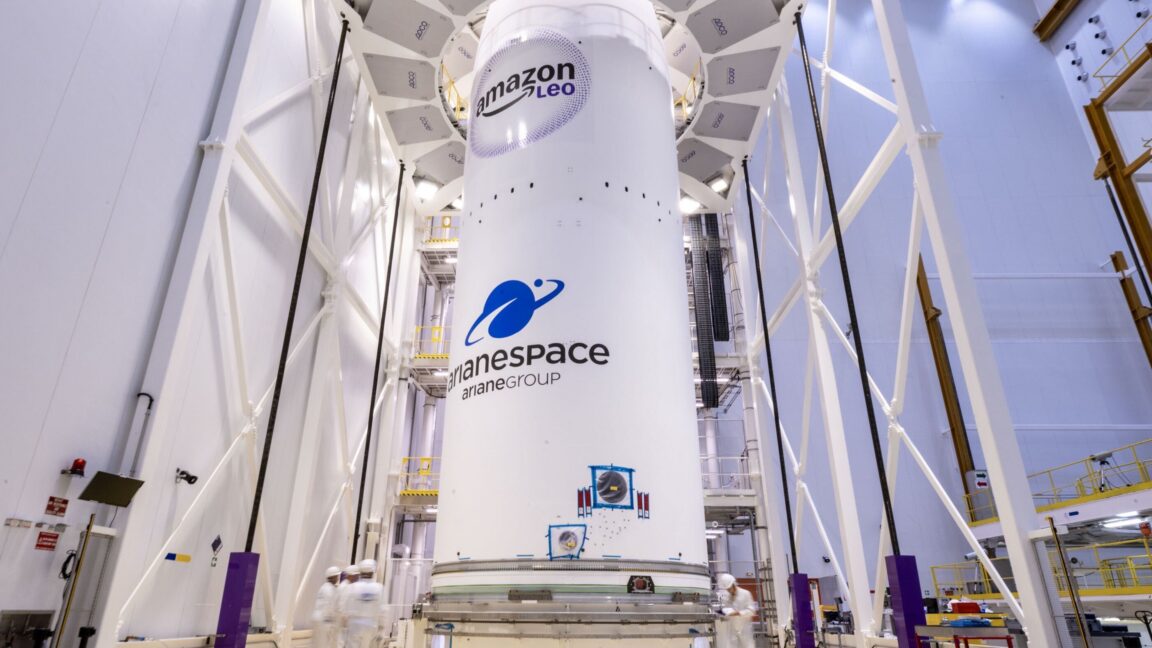
Amazon now has hundreds of flight-ready satellites standing idle in Florida, waiting to join the company's low-Earth orbit Internet constellation, an Amazon official said Tuesday.
"They're built, and sitting in a payload processing facility waiting for trips to orbit," said Steve Metayer, vice president of Amazon Leo Production Operations, during a teleconference with reporters. "And we're currently manufacturing several satellites a day."
Metayer spoke on the eve of the company's next mission, during which an Ariane 64 rocket will launch three dozen Amazon Leo satellites into orbit from a spaceport in French Guiana. Liftoff is targeted for 7:53 am ET (11:53 UTC) on Wednesday.
Amazon’s Smart Thermostat looks surprisingly nice for such a cheap gadget. | Photo by Jennifer Pattison Tuohy / The Verge
If your electricity bill climbs every summer, a smart thermostat could help keep cooling costs in check. The Amazon Smart Thermostat is an excellent option for its price, especially today. It’s down to just $57.99 at Amazon as a part of Amazon’s early Prime Day sale, which is the best price we’ve seen since Black Friday.
For a smart thermostat that costs under $100, the Amazon thermostat offers a lot of helpful features. One of its most useful is its ability to learn and adapt to your routines, reducing the need to constantly tweak the temperature yourself. It’s also compatible with most 24-volt HVAC systems, and adjusts itself accordingly depending upon whether or not you’re asleep or at home. The app lets you create schedules and monitor energy usage as well, giving you a sense of how much AC you’re using so you can make adjustments before your next utility bill arrives.
Plus, it’s a particularly good buy if you’re embedded in Amazon’s ecosystem. It’s compatible with Amazon’s Alexa, allowing you to adjust the temperature using voice commands or the mobile app. You can also create Alexa Routines so it can work alongside other compatible smart home devices like Amazon’s $44.99 ($25 off) Smart Air Quality Monitor, setting up automations that adjust your home’s temperature when certain indoor air quality conditions are detected. So long as you’re fine going without native temperature sensors, this smart thermostat is an excellent value for the price.
La Smart TV 4K Xiaomi TV F2 55 pouces est en forte baisse de prix sur Amazon : passez de 419 € à seulement 349 € pour un téléviseur connecté avec Fire TV, HDR10, 120 Hz, Dolby Audio et compatibilité Alexa et AirPlay. Design moderne, image fluide et son immersif au rendez-vous.
Apenas dias após o lançamento, o governo norte-americano emitiu uma diretiva de controlo de exportações que obrigou a Anthropic a desligar globalmente os seus dois modelos mais avançados. A Comissão Europeia reagiu com preocupação e invocou soberania tecnológica.
According to theThe Wall Street Journal, the export control directive that led to Anthropic cutting off access to Fable 5 and Mythos 5 was triggered in part by cybersecurity research from Amazon and conversations between CEO Andy Jassy and the White House. According to the report, the paper from Amazon claims that, through a series of prompts, it was able to get Fable 5 to serve up information that could be used in cyberattacks. Amazon has yet to respond to a request for comment.
Shortly after Jassy shared the company's findings with the government, it made the call to block its use by foreign nationals. Complicating this issue is that man …
Amazon's rolling out a free software update for Echo Hub devices that gives the homescreen a much-needed update to the interface it launched with in 2024. It had already added Alex Plus AI support, but the new interface has a cleaner, fully customizable layout that fits more smart home info and controls on the screen than the previous version.
The Echo Hub is also getting access to Ring AI's Video Search feature that lets you use natural language to search through your smart home camera footage, as well as Alexa Plus summaries of detected camera events.
These are the five new features Amazon highlighted for the Echo Hub:
Hundreds of camera-trap records from Bolivia and Peru suggest the short-eared dog (Atelocynus microtis), one of the world’s least-known canids and one of Latin America’s least-known carnivores, may be thriving in intact upland forests.
Just after Seattle enacted a one-year data center moratorium that some of Amazon's own employees pushed for, Amazon shared how much water its data centers use, reportedly for the first time. With concerns about water consumption and energy use a focus of new AI data center construction debates, Amazon says its global data center operations consumed 2.5 billion gallons of water in 2025 at a rate of 0.12 liters per kilowatt-hour of electricity, dropping by 2 percent from its 2024 total even as it expanded operations.
Amazon also claims it's using water more efficiently than some Big Tech rivals - this graphic in Amazon's report points to Mic …
With Sleep Studio the Echo Glow can light up to let kids know when they should be sleeping or can get out of bed. | Image: Amazon
Amazon has launched a new feature for its Echo and Echo Kids smart speakers called Sleep Studio that's designed to make the daily transition to bedtime more enticing for kids and less stressful for parents and caregivers. The feature uses a combination of bedtime stories, relaxing sounds, and guided meditations along with scheduling and customization options accessible only to adults.
Sleep Studio is now available to those with a $5.99 per month Amazon Kids Plus subscription at no extra cost. Amazon offers a free one month trial of the service, but purchasing an Echo Kids device will also get you a complementary six or 12-month subscription …
Pinterest is adding support for Amazon Storefronts, allowing creators to earn affiliate commissions more easily while showcasing their product recommendations in one place.
In 1925, while exploring the remote jungles of the Amazon on a quest to uncover a fabled lost city, British explorer Percy Fawcett and his small expedition party vanished without a trace.
Fawcett, a noted geographer, artillery officer, cartographer, surveyor, and archaeologist, set off into the rainforest accompanied only by his son, Jack Fawcett, and Jack’s best friend, Raleigh Rimell. Their goal was to locate an ancient lost city rumored to exist in the heart of the Amazon that Fawcett and others called “The Lost City of Z.”
While Fawcett and his expedition crew’s fate remains unknown, new advancements in modern archaeological science, propelled by technologies that include unmanned aerial vehicles and LiDAR, are now revealing what could be the archaeological reality behind part of what the ill-fated British explorer sought.
“The reward is that we’re finally finding the ‘lost civilisation’ that explorers like Percy Fawcett were searching for a century ago,” says José Iriarte, a professor of archaeology at the University of Exeter, writing in a piece featured at The Conversation, though adding that such discoveries are now being made “by cajoling a drone rather than battering through jungle.”
LiDAR: Unearthing Lost Worlds Hidden from Time
For a time, archaeologists presumed that the Amazon rainforest was a vast wilderness that, while abundant in resources, would have been capable of supporting only small, scattered communities.
With the aid of modern technologies, those past ideas have gradually changed as new archaeological evidence continues to push researchers toward rethinking past assumptions. Among these technologies is advanced laser-mapping technology known as LiDAR (light detection and ranging), which archaeologists have put to great use in the last several decades to aid in uncovering evidence of surface features that were once either inaccessible or otherwise invisible during ground-based surveys.
Something else that LiDAR excels at is penetrating the dense forest of areas like the Amazon, enabling researchers to get unprecedented aerial views of the surface below the canopy, along with any structures that may have been left there by humans from long ago. The result has been evidence of sprawling ancient societies hidden beneath the cover of thick jungle, revealing the Amazon as a region that once supported large populations that existed in sophisticated, interconnected landscapes.
The Cotoca site in Bolivia, revealed through LiDAR imagery (Image Credit: Prümers, Iriarte, et al./Nature/https://doi.org/10.1038/s41586-022-04780-4)
Rediscovering a ‘Lost Civilization’ in the Amazon
A particularly striking example of such discoveries involves the Llanos de Moxos region of northern Bolivia, where recent LiDAR surveys have revealed the presence of a sprawling archaeological site long hidden by dense jungle. Archaeologists believe the ancient settlement is linked to what is called the Casarabe culture, which would have thrived in the area sometime between A.D. 500 and 1400.
“The Casarabe organized into a hierarchy of four different sizes of settlements,” writes Professor Iriarte in his recent piece at The Conversation. “The biggest ones—the primary settlements—were as large as 3km² or 300 hectares.”
“That’s enough space for over 400 football pitches,” Iriarte notes, “suggesting that they could have accommodated substantial numbers of people.”
Unseen Evidence of an Ancient Amazonian Culture
Viewed from the ground, an observer who braved this dense region of Bolivian jungle might only see thick patches of forest separated by grassland savannahs.
That all changes when viewing LiDAR imagery obtained during aerial surveys, however. Through the sensitive detection capabilities afforded by laser pulses that can easily penetrate the dense vegetation, a lost world emerges—one the likes of which Percy Fawcett and other early explorers once only dreamed of rediscovering.
Researchers have now successfully identified a vast network of settlements at Llanos de Moxos, connected by raised causeways, canals, reservoirs, and engineered agricultural systems that cover an area of close to 20,000 square kilometers.
These complexes upend past thinking about the presence of isolated settlements in the region, and instead appear to show sites covering areas as large as three square kilometers, featuring monumental civic and ceremonial architecture, towering conical pyramids that ascend to heights of 20 meters, and the presence of massive U-shaped structures, which archaeologists believe had likely served as ceremonial structures that once hosted gatherings.
Unprecedented Scale of a Hidden World
Another surprising feature is the scale of the structures archaeologists have uncovered, which they say rivals some of the most well-known monuments like those of the ancient Tiwanaku civilization in the Andes.
Yet, unlike many densely packed ancient cities, the Casarabe landscape also differs in several ways: the unique variety of urbanism it reflects is suggestive of dispersed populations whose connected infrastructure also brought them together through ancient shared water management systems.
“It was clearly all planned and coordinated,” Iriarte explains, adding that the ancient builders at Llanos de Moxos engaged in precocious designs that were intended “not only as living spaces but for integrating the population across the region.” Similar architectural planning has been observed at other ancient sites around the world, which include those assembled by the ancient Maya of Central America, as well as the builders of Angkor across the world in Cambodia.
The “Dark Earth” Enigma
Beyond just architecture and clues to the way of life of these ancient societies, researchers are also gaining new insights into the agricultural practices of the early Amazonian world.
For many decades, scientists presumed that a major limiting factor on the region’s ability to sustain larger populations hinged on the presence of factors that included poor soils, seasonal flooding, droughts, and tropical diseases. However, mounting evidence suggests that the indigenous societies of the region were far from hindered by the landscape, and instead managed to transform and manage farmland at scales previously unimagined.
Along with sophisticated agricultural systems, ancient Amazonians were also capable of engineering remarkably fertile soils, known as Amazonian Dark Earths, which Iriarte says “combined charcoal, bone and waste materials with the existing poor-quality soil to make it fertile enough for widespread farming.”
“Amazonia had reclaimed vast expanses of seasonally flooded savannahs over several thousand years to create raised and drained field systems,” he adds, also noting the construction of extensive drainage networks and the cultivation of diverse crops such as maize. Rather than merely adapting to the rainforest, the ancient inhabitants of the Amazon actively reshaped it.
An Amazonian Archaeological Revolution
Thanks to similar LiDAR surveys that have recently been undertaken in nearby countries, including Ecuador’s Upano Valley, where thousands of structures linked by roads and organized according to highly structured settlement plans have been detected, the recent findings at Llanos de Moxos are one of the latest additions to a broader revolution in archaeology made possible through such exciting Amazonian discoveries.
In addition to Bolivia and Ecuador, researchers have also documented ceremonial earthworks, geometric enclosures, and sprawling ancient settlements in Colombia, Peru, and Brazil in recent years, all of which are challenging decades of past assumptions about ancient life in the Amazon.
Despite the recent advancements in our understanding, many questions remain unanswered. Among the questions archaeologists have are those related to how these ancient societies were governed, as well as what factors led to their decline, a fall which was precipitated by unknown factors that occurred before European arrival.
Possible contributing factors may include shifts in ancient climates, as well as environmental pressures. It is also possible that political changes or conflicts that emerged between neighboring societies may have played a role, which could have contributed to disruptions in trade networks that may have further weakened these once thriving societies.
Despite the remaining mysteries about these enigmatic cultures, one thing is becoming increasingly clear: the Amazon was far from being the unclaimed tropical wilderness many long believed it to be. In many ways, the fascination with lost cities and ancient civilizations that drove explorers like Percy Fawcett—and which led to his untimely fate—had more basis in reality than many historians, archaeologists, and explorers probably guessed.
As ongoing LiDAR surveys continue to expand across previously unexplored regions, archaeologists believe thousands more structures may still await discovery, suggesting that some of the Amazon’s greatest archaeological secrets remain hidden, but no longer kept entirely from view.
“What lies beneath the Amazon is not just a hidden past,” Iriarte says. “It is a reminder that even the most seemingly untouched landscapes can carry deep histories, waiting—sometimes just beneath our feet—to be revealed.”
Professor José Iriarte’s complete article appeared at The Conversation on June 8, 2026.
Micah Hanks is the Editor-in-Chief and Co-Founder of The Debrief. A longtime reporter on science, defense, and technology with a focus on space and astronomy, he can be reached atmicah@thedebrief.org. Follow him on X @MicahHanks, and at micahhanks.com.
The Federal Communications Commission has waived a requirement for Amazon to launch half of its satellite broadband constellation by the end of July, a key regulatory reprieve that buys the tech giant time to get more of its spacecraft into orbit.
Amazon won regulatory approval for the Amazon Leo network in July 2020. The FCC's authorization came with two deadlines. First, Amazon had to launch half of its 3,232 satellites by July 30, 2026, in order to maintain authorization to launch the rest of the network. The regulator gave Amazon a deadline of July 30, 2029, to have all of its first-generation satellites in orbit.
It has been apparent for some time that Amazon would not meet the FCC's requirement to launch half of its satellites—1,616 spacecraft—by the end of next month. Amazon filed an application in January requesting the FCC extend the deadline to July 2028 or waive it altogether. The commission decided on the latter option, removing any time limit for the 50 percent deployment milestone, but keeping the July 2029 deadline in place for the entire constellation.

 Login